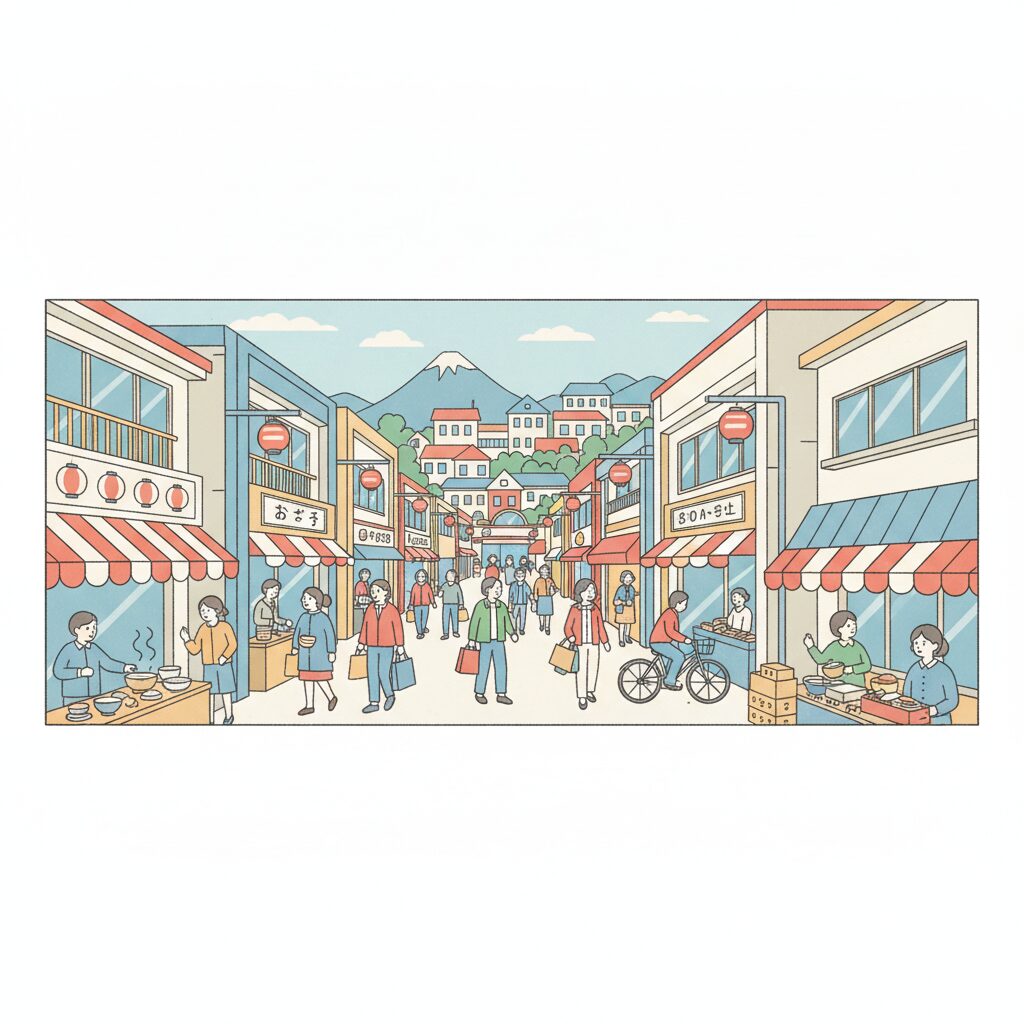
Coming from Tokyo, my world was built on efficiency. Train stations are designed for flow, not friction. Convenience stores are temples of silent, swift transactions. You get in, you get what you need, you get out. We navigate the city with a shared, unspoken agreement to minimize our impact on each other’s space and time. So, when I first moved to Osaka and stepped into a proper, old-school shotengai, or shopping arcade, my Tokyo-tuned brain short-circuited. It was loud. It was crowded. It was a glorious, chaotic mess. Bicycles weaved precariously through chatting neighbors. Shopkeepers weren’t standing politely behind counters; they were practically on the street, shouting about the day’s specials. Nothing was streamlined. And that, I soon realized, was entirely the point. These covered streets aren’t just commercial corridors. They are the sprawling, beating, impossibly human hearts of Osaka’s neighborhoods. They function less like markets and more like the city’s collective living rooms, places where life happens out in the open, unfiltered and unashamed.
For those captivated by the vibrant energy of Osaka’s shotengai, exploring Sakai’s ancient tombs and artisanal traditions offers a compelling glimpse into another facet of Japan’s rich cultural tapestry.
The Unspoken Contract: It’s Not About Buying, It’s About Belonging
In Tokyo, commerce is straightforward and efficient. You choose your item, pay the listed price, and receive a polite but distant “arigatou gozaimasu.” The interaction serves purely as a means to an end. In an Osaka shotengai, however, the transaction often serves as an invitation to start a conversation. My first experience buying vegetables there was a lesson in this approach. I picked up some daikon radish, and the elderly woman at the stall, the obachan, didn’t just weigh it. She sized me up—not judgmentally, but in a way that implied curiosity. She asked where I was from, what I was cooking, and then told me I was cutting it wrong for oden stew. Before I knew it, we were chatting about the weather, her grandson, and the price of fish next door. The actual sale felt like an afterthought.
This is the unspoken rule of the shotengai. You’re not just a customer; you’re part of a daily story. The common greeting is not the sterile “irasshaimase” (welcome), but the warm “maido!” (literally “every time,” meaning “thanks for your continued business”). That single word transforms the experience. “Irasshaimase” is for strangers. “Maido” is for regulars, for neighbors, for those woven into the community’s fabric. It implies a relationship, recognizing a shared history even if you only started shopping there last week. This marks a fundamental difference in outlook. Tokyo values smooth, anonymous service for a transient crowd. Osaka’s shotengai focuses on building relationships, weaving a network of familiarity that makes a vast city feel like a small town. You’re not just buying groceries; you’re connecting with your community.
The Architecture of Community: Noise, Clutter, and Human Friction
If you judge a shotengai by Tokyo standards, you might consider it a failure. The signs present a chaotic mix of colors and fonts. The pathways are often crowded with merchandise spilling out from the storefronts. The air is thick with the combined aromas of grilled eel, fried croquettes, and fresh fish. It’s a full sensory overload. But this ‘mess’ is actually the architecture of community. Whether by design or not, it slows you down and compels you to engage with your surroundings.
In Tokyo’s sleek shopping districts, the design aims to minimize what I call ‘human friction.’ Wide, clear paths allow people to move efficiently from point A to point B without interruption. In an Osaka shotengai, friction is the whole point. You must navigate around stacks of oranges, sidestep groups of gossiping grandmas, and listen to multiple shopkeepers shouting prices simultaneously. This environment discourages retreating into your own world, staring at your phone. It demands your presence. You make eye contact. You say ‘sumimasen’ as you squeeze past. You overhear snippets of neighborhood news. This ongoing, low-level interaction is what weaves the social fabric of the area. The noise isn’t a nuisance; it’s the soundtrack of a vibrant community. The clutter isn’t poor planning; it signals lively, active commerce that resists neat, orderly confines.
The Language of the Arcade: Beyond Keigo
One of the biggest changes for anyone coming from outside Osaka, especially Tokyo, is the language. The formal, polite Japanese, or keigo, that greases most service exchanges elsewhere is mostly absent here. Instead, you get the full, undiluted energy of Osaka-ben, the local dialect. It’s direct, fast, and carries a playful rhythm that can easily be mistaken for aggression if you’re unaccustomed.
A shopkeeper might not ask, “How may I help you?” but instead yell, “Anchan, nani shitenno?” (“Hey you, what’re you up to?”). A question about price might be met with a theatrical sigh and a story about how the cost of mackerel is driving him broke. This isn’t rudeness; it’s intimacy. It’s a performance. The classic Osaka comedy duo dynamic of the ‘boke’ (the funny fool) and ‘tsukkomi’ (the straight man) plays out dozens of times daily between vendors and shoppers. Haggling is part of this show. It’s rarely about seriously cutting the price; it’s banter, a test of wit, and a way to connect. Asking for a small ‘omake’ (extra) is a cherished tradition. Receiving that extra spring onion or bonus potato feels like a win—not just for your wallet, but for the relationship you’ve just enacted with the shopkeeper. It’s all rooted in Osaka’s core value of neuchi—getting good value for your money. It’s not just about being cheap; it’s a savvy, street-smart approach to life where buyer and seller arrive at a price and product that feels fair and human.
A Safety Net Woven from Gossip and Groceries
Beyond commerce and conversation, the shotengai serves a vital, almost invisible function: it acts as a neighborhood-wide safety net. The shopkeepers are the community’s unofficial guardians. They are the eyes and ears of the street. They know who lives where, who’s married to whom, and whose children are in which grade.
From their vantage point, they see everything. They notice when elderly Suzuki-san hasn’t come to buy her daily newspaper and tofu. The fishmonger will casually ask the fruit seller, “Have you seen Suzuki-san today?” If no one has, someone might go knock on her door to check. They watch over elementary school kids who use the arcade as a shortcut on their way home, ensuring they’re not getting into trouble. This type of passive surveillance arises not from suspicion, but from genuine care. In the relative anonymity of a Tokyo high-rise, you might not speak to your next-door neighbor for years. Your isolation is your own problem. In an Osaka neighborhood centered around a shotengai, your well-being becomes, to some extent, the community’s concern. For some, this may feel intrusive; for most, it provides a deep sense of security. It’s the feeling of being known, of your absence being noticed. This is the ‘living room’ in its truest sense—a place where you are cared for by an extended, informal family.
The Shotengai vs. The Shopping Mall: A Battle for Osaka’s Soul
Certainly, Osaka is home to its fair share of gleaming, modern shopping malls and ubiquitous chain stores. These provide air conditioning, reliable inventory, and the same seamless experience found anywhere in the world. A common misconception among outsiders is to view the shotengai as outdated relics, destined to be replaced by these newer, more efficient commercial models. Indeed, some smaller arcades are struggling as both their owners and customers grow older. However, many are not merely surviving; they are flourishing. Why is that?
Because a shotengai offers something a mall never can: a true sense of place and identity. The Aeon Mall in Osaka is no different than the one in Chiba. But the Kuromon Market is distinctly Osaka. The Tenjinbashisuji Shopping Street tells a story about its neighborhood that spans generations. Many shops are family businesses, passed down from grandfather to father to son. The tofu recipe has been perfected over 80 years. The pickle seller’s craft comes from lessons learned from his mother. This fosters deep trust and continuity. You aren’t buying a product from a faceless corporation; you’re purchasing a piece of the neighborhood’s history from a family that helped build it. The shotengai stands as a strong symbol of localism in an increasingly globalized world. It’s a declaration that community, personality, and human connection are not merely nostalgic ideals but vital parts of a vibrant urban life.
Your Role in the Ecosystem: How to Participate, Not Just Observe
For a foreigner living in Osaka, the shotengai can initially feel intimidating. The language is rapid, the norms unwritten, and it might seem like you’re an outsider in a private club. But gaining entry is easier than expected, and it’s the quickest way to genuinely feel at home in the city. The key is to shift your perspective from observer to participant. Don’t just use the arcade as a scenic shortcut. Pause. Engage.
Make a conscious effort to become a jouren, a regular. Purchase your produce from the same stall every week. The first time, you’re a stranger. The second time, a familiar face. By the fourth or fifth visit, the obachan will have your usual order ready and ask how that new recipe turned out. Learn a few simple Osaka-ben phrases. A warm ‘ookini’ (thank you) instead of ‘arigatou’ will bring a surprised smile. Saying ‘maido’ when entering a shop shows your understanding. Don’t hesitate. The directness of Osaka’s people is an invitation. When they ask where you’re from or what you’re doing, they are genuinely curious. They’re opening a door to conversation. Walk through it. Ask about their products. Compliment their displays. Once you become part of the daily rhythm of the shotengai, you stop being a foreigner and become something far more meaningful: a neighbor.
The Future of the Living Room

Are the shotengai an endangered species? I don’t believe so. They are adapting. While some traditional shops shut down, a new generation is moving in, attracted by the low rent and genuine atmosphere. Nowadays, you see trendy, third-wave coffee shops alongside fishmongers who have been there for decades. A craft beer bar might be nestled between a kimono store and a vendor of senbei rice crackers. This blend of old and new is revitalizing the arcades, ensuring they stay relevant for future generations.
Living in Osaka has shown me that a city’s value isn’t just in its towering skyscrapers or efficient subway system. It lies in the quality of its public spaces and the strength of its human connections. The shotengai embodies Osaka’s civic philosophy perfectly. It is practical, unassuming, and deeply communal. It values the small, the local, and the personal over the large, the corporate, and the impersonal. It reminds us that a city can be more than just a collection of individuals living side-by-side; it can be a place where our lives overlap, intersect, and weave together in the noisy, messy, and beautiful chaos of a shared living room.