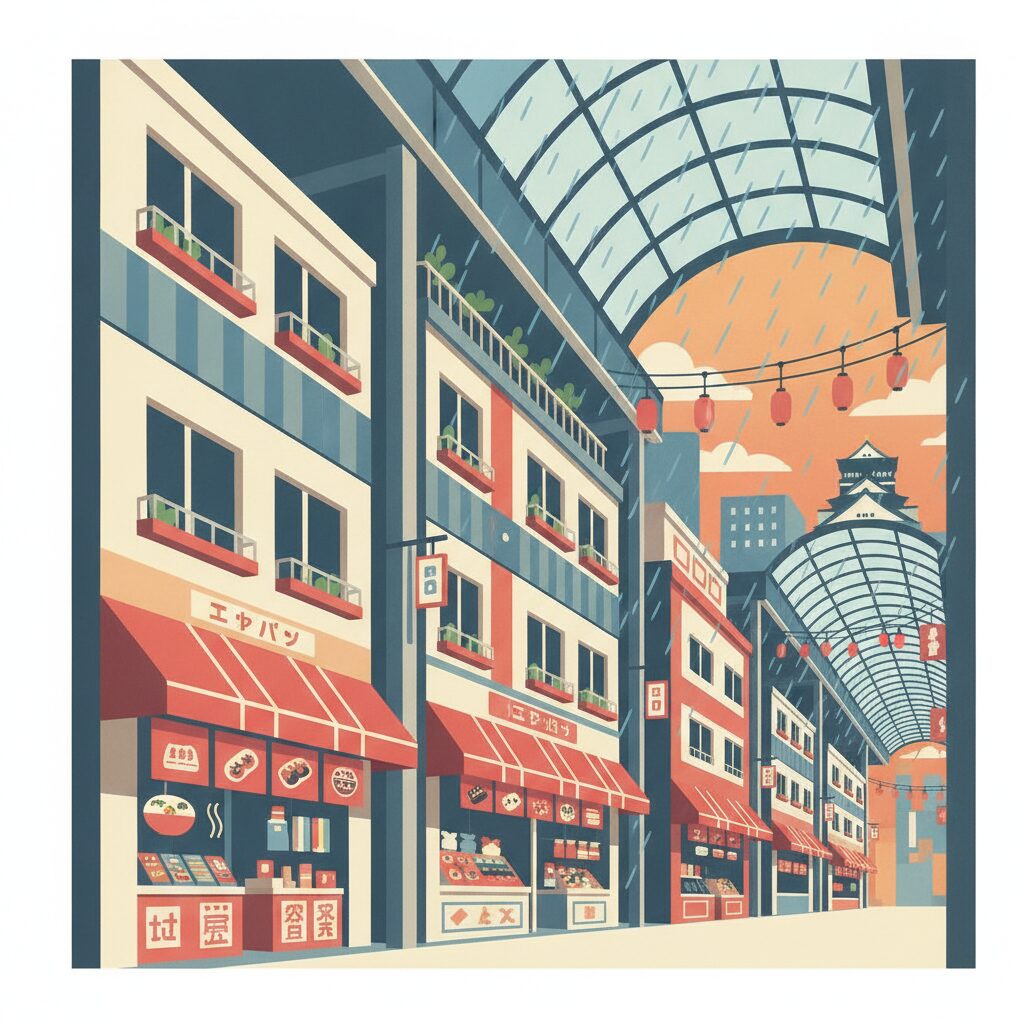
There’s a certain sound that defines mornings in much of Japan. It might be the gentle chime of a train crossing, the polite announcement from a passing recycling truck, or simply the quiet hum of a city waking up. But if you live in an apartment nestled above an Osaka shotengai, your alarm clock is a symphony of raw commerce. It’s the metallic groan of a shop’s rolling shutter, a sound that echoes down the covered arcade like a steel beast yawning awake. It’s the sharp, percussive clatter of vegetable crates hitting the pavement. It’s the faint, savory scent of dashi broth already simmering for lunch, mingling with the sweet perfume of yeast from the corner bakery. This isn’t just background noise; it’s the very heartbeat of your home. The idea of renting an apartment here, in the thick of it all, is something that fascinates and terrifies newcomers in equal measure. Forget the serene, minimalist image of Japanese living often portrayed abroad. Life in a shotengai is a full-contact sport for the senses, a vibrant, chaotic, and deeply human experience that cuts to the very core of what makes Osaka tick. These covered shopping arcades are more than just commercial thoroughfares; they are the communal kitchens, living rooms, and backyards of their neighborhoods, and choosing to live within one is to choose a life of total immersion. It’s a world away from the detached, vertical living of a Tokyo high-rise, offering a horizontal, interconnected existence that is both wonderfully convenient and utterly relentless. To understand this lifestyle is to understand the soul of Osaka itself.
The everyday clamor of Osaka’s shotengai mirrors the conversational cadence found in Osaka-style aizuchi, a subtle yet lively dialogue that adds an extra layer to the neighborhood’s dynamic pulse.
The Rhythm of the Arcade: Your New Soundtrack
Living in a shotengai means your life follows the unyielding rhythm of commerce. It’s a 24/7 soundtrack you cannot switch off, a constant presence that shapes both your days and nights. This is perhaps the biggest adjustment, and whether you find it energizing or frustrating will shape your entire experience.
The Upside: A Living, Breathing Building
There’s an undeniable energy to waking up amid the action. Before your feet even hit the floor, you already sense what’s happening in the world below. The rhythmic pon-pon-pon of a fishmonger tenderizing octopus signals that dawn has just passed. The sizzle and pop from the tempura shop hint that lunchtime is near. You grow intimately familiar with the daily choreography of the arcade. This constant hum of activity can be deeply comforting. In a city where loneliness can easily settle into the sterile silence of a modern apartment, the shotengai offers a built-in sense of connection. You are never truly alone. The daytime buzz—a rich tapestry woven from vendors’ calls, children’s laughter on their way home, and the tinny background music piped through the arcade’s speakers—becomes a familiar soundscape. It’s the opposite of the anonymous quiet that dominates so many residential areas in Tokyo. Here, life is loud, and that loudness signals vitality.
The Downside: The Relentless Sensory Onslaught
Naturally, the flip side of this vibrant soundtrack is that there’s no off switch. Forget about sleeping in on a Saturday. Delivery trucks for the produce stand will be rumbling outside your window at 5 AM, their backup beepers sounding like piercing digital birdcalls. Light sleepers will struggle. Privacy takes on a whole new meaning. You might assume your thin walls only let in sound, but they also let in smells. The croquette shop’s deep-fryer below means your laundry will carry a faint, greasy scent no matter how many windows you open. The sharp aroma of pickled vegetables from the tsukemono stand can become an inescapable part of your apartment’s character. Then there are the lights. If you’re unlucky enough to live near a pachinko parlor, the flashing, strobing facade can become a constant, unwelcome aurora borealis in your living room. The sensory overload is real, demanding a certain tolerance and an acceptance that your personal space is porous and permeable to the outside world.
The Human Element: Neighbors as Your New Family
The most profound difference in living in a shotengai isn’t the noise or the smells, but the people. You are not just an anonymous resident of apartment 302; you become “the young person from above the bookstore.” This lack of anonymity is both the shotengai’s greatest strength and its biggest challenge.
The Upside: An Instant, Inescapable Community
From the very first day, you become part of an ecosystem. The butcher will learn your name. The woman at the fruit stand will start setting aside the best strawberries for you. The elderly man who runs the tea shop will nod to you every morning without fail. This embodies the heart of Osaka‘s famous friendliness—it’s not just a cliché but a practical reality shaped by daily, repeated interactions in close proximity. This closeness creates a strong, unspoken safety net. If you’re ill and haven’t been seen for a couple of days, someone will notice. It’s common for a concerned shopkeeper to knock on your door, offering a bag of oranges and a quick check-in. This level of communal care is nearly impossible to find in a modern, auto-locked apartment complex in Tokyo, where it might take years to even learn your neighbors’ names. Plus, the convenience is remarkable; running out of soy sauce mid-recipe isn’t an emergency, just a 30-second trip downstairs in your slippers.
The Bonds of Shared Space
These connections extend beyond simple transactions. You’ll witness the community’s entire life cycle. You’ll watch the shopkeepers’ children grow up, celebrate their success in exams, and take part in local festivals together. You become woven into the neighborhood’s fabric. This nurtures a profound sense of belonging, which can be especially grounding for a foreigner adjusting to a new culture. You’re not simply living in Osaka; you are living with Osakans, quite literally.
The Downside: The Loss of Anonymity
Such a close-knit community comes at a cost: your privacy. Everyone knows your routine. They know when you leave for work, when you come home, and they definitely notice if you return at 3 AM with a new companion. The idea of personal space is different. The boundary between caring and meddling is very thin and often crossed. The obachan at the dry cleaner will offer unsolicited advice about your love life. The fishmonger may critique your cooking based on the ingredients you buy. This is not intended to be hostile; it’s simply how the community functions. It reflects the Osaka mindset that everyone’s business is, to some extent, everyone else’s business. For someone from a more individualistic background, this can feel invasive and overwhelming.
The Unspoken Social Contract
Along with this lifestyle comes a social responsibility. You’re expected to participate. A quick trip to the convenience store turns into a series of greetings (aisatsu). You pause to chat, ask about someone’s grandson, or comment on the weather. Simply walking by with headphones on, absorbed in your own world, can be perceived as rude or distant. It demands a constant outflow of social energy, which can be exhausting if you’re naturally introverted. You can’t just be a resident; you must be a neighbor.
Bricks and Mortar: The Quirks of Arcade Architecture
The buildings themselves often possess as much character—and present as many challenges—as the people who live in them. These are not sleek, modern structures. They are frequently remnants of the Showa era, designed with practicality rather than luxury in mind.
The Upside: Character, Space, and a Permanent Umbrella
If you enjoy retro charm, a shotengai apartment can feel like a dream. You may discover beautiful old wooden beams, quirky layouts, and original tiled bathrooms that radiate a warmth and history missing from sterile new constructions. Due to their age, these apartments can sometimes provide surprisingly spacious floor plans for the price. You could find a sprawling two-room apartment for the same rent as a tiny, modern studio. Yet the biggest architectural advantage is the arcade roof itself. It acts as your giant, permanent umbrella. Being able to walk to the supermarket, post office, train station, and numerous restaurants without ever being caught in the torrential rains of the rainy season or the blazing sun of August is a quality-of-life benefit that cannot be overstated. It completely transforms how you engage with your neighborhood.
The Downside: Drafts, Pests, and the Stairway of Doom
That Showa-era charm comes paired with Showa-era drawbacks. Soundproofing is practically nonexistent. You’ll hear your neighbor’s television, phone calls, and late-night arguments as if they were right beside you. Drafty window frames and inadequate insulation mean your heating and cooling bills can be quite high. Elevators? A rare convenience. Most shotengai apartments are walk-ups, often with dangerously steep and narrow staircases. Carrying a week’s worth of groceries up three flights is an exhausting challenge. Moving furniture becomes a logistical headache. Moreover, living close to many food establishments means you will almost certainly share your home with some unwelcome guests. Battling cockroaches (gokiburi) is not a possibility you might face; it is guaranteed. You need to be ready for a more hands-on, less sanitized living environment.
The Osaka Mindset: Why This Lifestyle Thrives

Ultimately, the shotengai apartment perfectly embodies the Osaka psyche. Understanding why this living arrangement continues to exist and flourish here reveals much about the city’s fundamental values.
Practicality Above All Else
Osaka is a city founded by merchants (akindo). Its culture is deeply grounded in pragmatism, efficiency, and a concept known as kosupa (cost performance). An apartment doesn’t need to be attractive or prestigious; it must be practical. If it’s affordable, convenient, and places you at the center of everything you need, then its shortcomings—the noise, the lack of privacy, the age—are seen as acceptable compromises. This stands in stark contrast to Tokyo, where image, brand, and maintaining a certain aesthetic are often far more important. In Osaka, life and business are not separated; they are fully intertwined, and living above the marketplace is the most natural expression of this.
A Love for the ‘Gaya Gaya’
The Japanese onomatopoeia gaya gaya describes a noisy, bustling, lively atmosphere. While in many parts of Japan this might be viewed negatively, in Osaka, it is often a source of comfort. Osakans draw energy from the crowd. They enjoy the human interaction and constant activity. The quiet, orderly calm prized elsewhere can feel sterile or lonely here. The gaya gaya of the shotengai isn’t a flaw; it’s a feature. It signals that the community is vibrant, business is thriving, and life is unfolding. Choosing to live there means embracing this affection for lively chaos.
Living above a shotengai is not suited for those faint of heart. It is not for those who seek silence, privacy, and immaculate modernity. It is a trade-off. You give up personal space for communal connection. You exchange tranquility for unmatched convenience. It demands a fundamental shift in your expectations of a home—from a private sanctuary to an open-air observation deck. It is, undeniably, the most unfiltered, high-definition Osaka experience you can find. To live in a shotengai is to feel the city’s pulse beneath your feet, hear its voice as the soundtrack of your life, and truly understand that in Osaka, you are never merely an individual; you are part of the noisy, messy, warm, and wonderful whole.