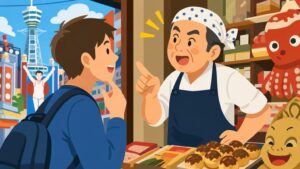
You never forget your first time. Not your first time trying takoyaki, or your first ride on the Midosuji Line during rush hour. I’m talking about your first real, high-speed, no-holds-barred Osaka conversation. For me, it was at a playground in Tennoji, chatting with another mother. I was telling a simple story about my toddler’s recent obsession with the garbage truck. In Tokyo, where I’d lived previously, a story like this would earn me a series of gentle nods, some quiet “sou desu ne” interjections, and maybe a polite chuckle at the end. It’s predictable. It’s orderly. It’s a conversational slow dance.
But this was Osaka. Before I could even get to the punchline, I was met with a verbal barrage. “Honma ni?!” she exclaimed, leaning in. “Uso ya ro, every single day?!” followed by a rapid-fire “Soya nen, uchi no ko mo sou yatta wa!” which translates to something like, “That’s it! My kid was exactly the same!” The conversation didn’t flow; it bounced. It ricocheted. It felt less like a slow dance and more like a verbal pinball machine, and my story was the shiny silver ball. I left that playground feeling both exhilarated and utterly exhausted, as if I’d just run a conversational marathon. I hadn’t just been listened to; I had been participated with. This, I quickly learned, was the art of Osaka-style `aizuchi`.
`Aizuchi`, for the uninitiated, are the little interjections Japanese speakers use to show they’re listening. They’re the “uh-huhs,” “yeps,” and “I sees” of Japanese. They are the essential grease that keeps the wheels of communication turning smoothly. But in Osaka, `aizuchi` are transformed. They are no longer just passive acknowledgements. They are active, emotional, and often hilarious contributions to the narrative. They are the very soul of the city’s communication style, a rhythmic and expressive language all their own that says far more than just “I’m listening.” Understanding this unique conversational beat is fundamental to understanding the heart of Osaka itself.
The vibrant interplay of Osaka-style aizuchi resonates through every facet of city life, as seen in the warm gatherings at local neighborhood sento sanctuaries, where residents share a similar passion for authentic connection.
The Standard Japanese Baseline: The Polite Nod
Before we plunge into the lively world of Osaka dialect, let’s first establish the foundation with standard Japanese, or `Hyojungo`. In a typical conversation in, for example, Tokyo, `aizuchi` serve a distinct and culturally significant purpose: to foster harmony and demonstrate respect. They are subtle, well-timed, and meant not to interrupt the speaker’s flow but to gently support it. They resemble a slow, continuous nod in auditory form.
You’ll encounter a familiar set of phrases. `Hai` is the formal, clear “yes” or “I understand.” `Ee` is its softer, slightly more casual counterpart. `Un` is the informal “yeah” used among friends. Then there are the slightly more nuanced ones. `Sou desu ne` (“That’s right, isn’t it”) is a social lubricant, a non-committal agreement that confirms the speaker’s point without necessarily asking you to share their opinion. `Naruhodo` (“I see” or “Indeed”) signals that a point has landed, an intellectual recognition that you’ve learned something new.
All of these are essential tools. They make sure the speaker feels acknowledged and prevent awkward silences, which can be quite uncomfortable in Japanese culture. The overall effect is one of smoothness and control. The conversation is like a river, and these `aizuchi` are the riverbanks, quietly guiding the flow without causing disturbance. The listener’s role is supportive, akin to a bassist in a band who maintains a steady, unobtrusive rhythm so the lead vocalist can shine. It is polite, effective, and for someone from a Western background, already a step forward in active listening. But this is merely the opening act for the main event in Osaka.
Welcome to the Main Stage: Osaka’s Performative Aizuchi
If a Tokyo conversation flows like a river, an Osaka conversation bubbles and boils like a hot pot. The `aizuchi` are the ingredients thrown in with abandon—not just to guide the flavor but to transform it completely. Here, the listener isn’t simply a bassist; they are the co-vocalist, the drummer, and sometimes the hype man, all rolled into one. The aim isn’t merely to show you’re listening, but to demonstrate that you are feeling the story alongside the speaker. It’s an emotional duet, a shared performance.
Forget the gentle hum of `sou desu ne`. The Osaka soundscape is loud, frequent, and deeply emotional. The volume is cranked up, the pace quickened, and the vocabulary entirely distinct. It’s a move from passive listening to active engagement. A speaker in Osaka doesn’t just want you to hear their story—they want you to react, to be surprised by its twists, to laugh at its jokes, and to empathize with its sorrows. Your `aizuchi` prove you’re on this journey with them. Silence isn’t polite listening; it’s boredom—the greatest conversational sin in this city. This demand for emotional feedback drives communication, powered by a unique and powerful set of phrases.
The Osaka Aizuchi Toolkit: More Than Just Words
To navigate conversation here, understanding the core tools is essential. These phrases aren’t just words; they are emotional signals, prompts, and punchlines loaded with meaning and nuance.
`Honma ni?` / `Honma ka?` (Really? / Seriously?)
In standard Japanese, you might hear `hontou desu ka?`, a polite question. Osaka’s `honma ni?` is something else entirely. It’s not a question rooted in doubt, but an exclamation of engagement. When someone says `Honma ni?`, they’re saying, “Wow, that’s amazing information—tell me more right now.” It’s a prompt to expand and enliven the story. If you share news of a promotion, the fitting Osaka reply isn’t a quiet “omedetou” (congratulations), but a loud `Honma ni?! Yokatta na!` (“Really?! That’s great!”). It amplifies joy and validates the importance of the news, turning a simple statement into the start of an exciting tale.
`Uso ya!` / `Uso ya ro!` (No way! / You’re kidding!)
This phrase is often misunderstood by outsiders. `Uso` literally means “lie.” So when a foreigner tells a dramatic story and their Osaka friend shouts `Uso ya!`, panic might set in: “They think I’m lying!” But this couldn’t be more wrong. `Uso ya!` is the highest compliment to your storytelling skill. It means, “What you just said is so shocking, amazing, and unbelievable, it sounds like a lie.” It expresses the ultimate surprise and praise. If you say you waited three hours in line for a famous cheesecake, `Uso ya ro!` doesn’t doubt your wait—it confirms the cheesecake must be legendary. It’s a shared expression of astonishment, a way to say, “We’re both blown away by this.” Being met with `Uso ya!` means your story has made a powerful impact.
`Soya nen` / `Sore na` (That’s it / Exactly)
While Tokyo relies on `sou desu ne`, Osaka says `soya nen`. The difference is striking. `Sou desu ne` is a gentle, polite agreement; `soya nen` is a passionate cry of total solidarity. It’s the sound of two minds perfectly aligned. It means, “You’ve expressed exactly what I was thinking, and I’m so glad you said it.” It’s a powerful way to build immediate rapport. You complain about August humidity, and your neighbor responds with `Soya nen, mou akan wa` (“That’s it, I can’t take it anymore”). In that moment, you’re not two individuals but a united front against the oppressive heat. Its younger, hipper counterpart, `sore na`, works similarly and is widely used across generations to punctuate absolute agreement. It’s the verbal equivalent of a high-five for a shared opinion.
`Akan wa` (That’s no good / Oh man)
This phrase channels shared sympathy and frustration. `Akan` means “no good,” “useless,” or “futile.” As `aizuchi`, it’s a deep, empathetic groan acknowledging, “I hear your struggle, and I agree it’s awful.” When a friend tells you they missed the last train home, you reply, `Uwa, akan wa…` shaking your head. “Oh man, that’s no good.” You’re not offering solutions, just validating their misfortune. You’re sitting with them in their frustration. It’s a simple yet powerful way to show you care, acknowledging that the situation is, quite frankly, rubbish—and you understand that.
`Nande ya nen!` (Why the heck? / What the hell?)
This quintessential Osaka phrase lies at the heart of `manzai` comedy and daily conversation. It’s the sound of the `tsukkomi` (the straight man) responding to the `boke` (the funny man). While it can express genuine frustration, it’s overwhelmingly a playful, rhythmic jab. It’s a conversational punchline calling out absurdity. When someone says something silly or nonsensical, `Nande ya nen!` resets the conversation with humor. If a friend says, “I’m so tired I could sleep for a week,” you might lovingly reply, `Nande ya nen! Ashita shigoto ya ro!` (“What the heck! You’ve got work tomorrow!”). It’s not an attack—it’s a beat in the comedic rhythm of Osaka life. It’s a sign of affection, saying, “You’re ridiculous, and that’s why we get along.”
The Rhythm and Tempo: Why It Feels So Different
Grasping the words is only part of the challenge. The real charm of Osaka `aizuchi` comes from its rhythm and pace. Conversations here move quickly, a nonstop exchange of ideas and responses. There’s no empty space. The notion of `ma`, or pause, takes on a different meaning. Across much of Japan, `ma` is a respectful moment for reflection. In Osaka, `ma` is a wide void that demands filling with a joke, comment, or loud interjection. Hesitating means losing your turn.
At first, this can feel overwhelming. It seems like you are constantly interrupted. You begin a sentence, and before finishing, someone has already jumped in with a `Honma ni?` or a `Soya nen!`. Yet this isn’t interruption in the Western sense. It’s not a rude attempt to take over the conversation. Quite the opposite—it’s a sign of deep engagement. They are so absorbed in what you’re saying that they can’t hold back their reaction. They literally meet you halfway through your sentence to show their support.
Imagine the difference between classical music and improvisational jazz. A Tokyo conversation resembles a well-orchestrated classical piece where everyone knows their part, comes in at the right moment, and pauses are scripted. An Osaka conversation is like a jazz club. The main speaker sets a melody, and listeners jump in with riffs, solos, and percussion. It’s a collaborative, spontaneous creation. The aim isn’t a flawless, polished performance but a lively, energetic session where everyone adds to the final sound. Mastering Osaka speech means learning how to improvise.
The Emotional Temperature: From Warm to Hot
This style of conversation reflects the stereotype of Osaka people as warm, passionate, and straightforward. The `aizuchi` serve as verbal proof. In a culture that often values `tatemae`—the public facade or polite, socially acceptable opinion—Osaka conversation feels refreshingly candid. The `honne`, or true feelings, bubble closer to the surface, bursting through these emotional interjections.
Because the reactions come swiftly and transparently, you instantly know where you stand with someone. There’s very little ambiguity. If they love your story, you’ll hear a chorus of `Meccha ee yan!` (“That’s awesome!”). If your idea seems ridiculous, you’ll get a playful `Nande ya nen!`. This constant, real-time emotional feedback builds a sense of rapid intimacy. You may feel closer to someone after a single ten-minute conversation in a Namba izakaya than after months of polite exchanges elsewhere.
This emotional frankness can be mistaken for a lack of subtlety, but it’s more about a preference for efficient connection. Why waste time with polite vagueness when you can jump straight to the heart of the matter and share a good laugh? This directness stems from Osaka’s history as a merchant city, where quickly establishing trust and rapport was essential for business. Knowing who you were dealing with was crucial, and this expressive, honest communication style was the quickest way to find out.
Common Misunderstandings and How to Adapt
For any foreigner settling into life in Osaka, this flood of feedback can cause some typical misunderstandings. However, once you figure out the rhythm, you can begin to enjoy the experience.
Misunderstanding 1: “They’re always interrupting me!” As mentioned earlier, this isn’t interruption; it’s engagement. The biggest fear for an Osaka speaker is silence, as it signals boredom. Their rapid-fire `aizuchi` are an urgent plea: “Please, keep going! This is great!” The best way to adjust is to view it as a green light. When they jump in, don’t stop. Let their energy drive your story forward.
Misunderstanding 2: “They think I’m lying!” (`Uso ya!`) Remember, this is actually a compliment. `Uso ya!` is a badge of honor for a well-told, surprising story. The day a local shopkeeper listens to your weekend tale and responds with a heartfelt `Uso ya ro!` is the day you know you’re beginning to fit in. Embrace it. Exaggerate your story even more. They’ll appreciate it.
Misunderstanding 3: “They’re being aggressive!” (`Nande ya nen!`) Unless someone is truly red-faced and shouting, `Nande ya nen!` is almost always playful. It’s an essential part of the conversational game of `boke` (the fool) and `tsukkomi` (the straight man). Sometimes you’ll be the `boke`, saying something a bit silly. Their `tsukkomi` isn’t criticism; it’s their way of joining in the comedic routine. The proper reaction is to laugh, not get defensive.
So how do you participate? Start small. The next time a friend tells you something even slightly surprising, try saying `Honma ni?`. When you agree with someone’s complaint about the train, offer a sympathetic `Soya nen`. People won’t just understand—they’ll be delighted. You’re speaking their language—not just the words, but the emotional rhythm. Match their energy. Be a bit louder and more expressive. It might feel unnatural at first, but it’s the key to unlocking genuine communication here.
Aizuchi in Daily Life: Where You’ll Hear the Real Osaka
This isn’t mere theory. It’s the ever-present, audible soundtrack of everyday life in the city. You hear it everywhere, even in the most ordinary moments.
Visit any `shotengai`, the covered shopping arcades that serve as the heart of Osaka neighborhoods. Listen to the exchange between a fishmonger and a regular customer. The customer points out she’s making sashimi tonight. The fishmonger exclaims, `Ooh, ee na! Kyou no tai, pintchiri shiteru de!` (“Oh, nice! This sea bream today is incredibly fresh!”). The customer replies, `Honma ka? Ja, sore morao ka na!` (“Really? Well then, I’ll take that!”). It’s a performance, a negotiation, a relationship built through lively back-and-forth.
Sit on a bench near a playground and eavesdrop on the mothers. Their conversation quickly shifts from vegetable prices to a child’s latest scraped knee to a funny TV show from last night. Each comment is met with chorus-like responses of `Soya nen!`, `Uso ya!`, and empathetic `Akan wa`. They aren’t merely talking; they’re weaving a shared emotional tapestry of their everyday lives.
Even a brief interaction with a cashier can become a mini-performance. If you buy just a block of curry roux and an onion, they might glance at you and say, `Are, kyuryo mae ka?` (“Oh, is it before payday?”), accompanied by a wink. The fitting reply is a laugh and a `Nande ya nen! Chotto dake tabetai nen!` (“What the heck! I just want to eat a little!”). It’s this steady, playful hum of engaged banter that makes the city feel vibrant and closely connected.
Beyond Words: The Physicality of Osaka Aizuchi
It’s important to emphasize that this is not merely a verbal phenomenon. Osaka communication is a full-body experience. The `aizuchi` almost always come with a rich array of physical gestures that enhance their meaning.
A `Honma ni?` is expressed while leaning forward, eyes wide with anticipation. An `Uso ya ro!` might involve a hand covering an open mouth in mock surprise. A genuinely heartfelt `Soya nen` features a deep, vigorous nod that seems to come from the lower back. And the classic `Nande ya nen!` is often accompanied by a light, open-palmed tap on the other person’s shoulder or arm—a physical punctuation of the comedic timing.
Watching two Osaka natives engaged in conversation is like witnessing a theatrical performance. There are dramatic hand movements, exaggerated facial expressions, and a level of physical animation that can feel striking compared to the more restrained body language seen elsewhere in Japan. This physical expressiveness reflects the same desire for clear, unmistakable emotional connection. It leaves no doubt about how the listener feels, making the whole interaction more engaging and, ultimately, more enjoyable.
The Soul of the Conversation
Ultimately, the distinctive style of Osaka `aizuchi` is more than merely a regional dialect trait. It directly reflects the spirit of the city. It embodies a culture that prioritizes directness over ambiguity, active participation over polite detachment, and humor over solemnity. It represents the linguistic heritage of a merchant city founded on the art of negotiation, where forging quick, strong human connections was the key to success.
This is what people genuinely mean when they say Osaka is “friendly.” It’s not about a hollow smile. It’s about a readiness to engage with you, to emotionally invest in your story, and to draw you into a shared conversational flow. The lively, interruptive, and emotionally charged `aizuchi` are the very means of that friendliness. It’s an invitation to set aside the `tatemae` and connect on a more sincere, human level.
So the next time you find yourself amid a conversational whirlwind in Osaka, don’t withdraw. Don’t be overwhelmed by the volume or the pace. Listen for the rhythm. Feel the flow. And when the time is right, take a deep breath and jump in with a `Honma ni?` of your own. You’re not just uttering a word. You’re joining the ensemble. You’re taking part in the vibrant, chaotic, and wonderfully human music of Osaka.