Step off the train in Osaka, and the first thing you feel isn’t the humidity or the scent of takoyaki—it’s the motion. Not the rumbling of subways beneath your feet, but a silent, swishing, ever-present current of humanity on two wheels. Bicycles are everywhere. They flow down sidewalks, weave through shopping arcades, and cluster around station entrances like metallic barnacles. At first glance, it’s pure chaos. A sidewalk ballet with no choreographer, where pedestrians, cyclists, and the occasional scooter perform a frantic, near-miss dance. You wonder, are there any rules? Is anyone in charge? And how does this city not collapse into a heap of tangled spokes and sprained ankles every single day?
This isn’t just about getting from A to B. In Osaka, the bicycle, specifically the humble mamachari, is the key that unlocks the city’s true rhythm. It’s a cultural artifact, a statement of intent, and your ticket to understanding the Osakan mindset. Forget the sleek, lightning-fast road bikes you might see in other global cities. Here, practicality is king, and the bicycle is its throne. This guide isn’t about the best cycling routes for sightseeing. It’s about the unwritten laws of the sidewalk, the social contract of a shared parking spot, and what the way an Osaka local rides their bike tells you about who they are. It’s a deep dive into the freedom, the frustrations, and the undeniable soul of a city that lives life in the bike lane. Before we pedal on, let’s get our bearings on the sprawling urban stage where this daily drama unfolds.
Amid the urban commotion evoked by its diverse cycling scene, visitors can also immerse themselves in the local tachinomi culture that captures Osaka’s distinctive spirit.
The Mamachari Reigns Supreme
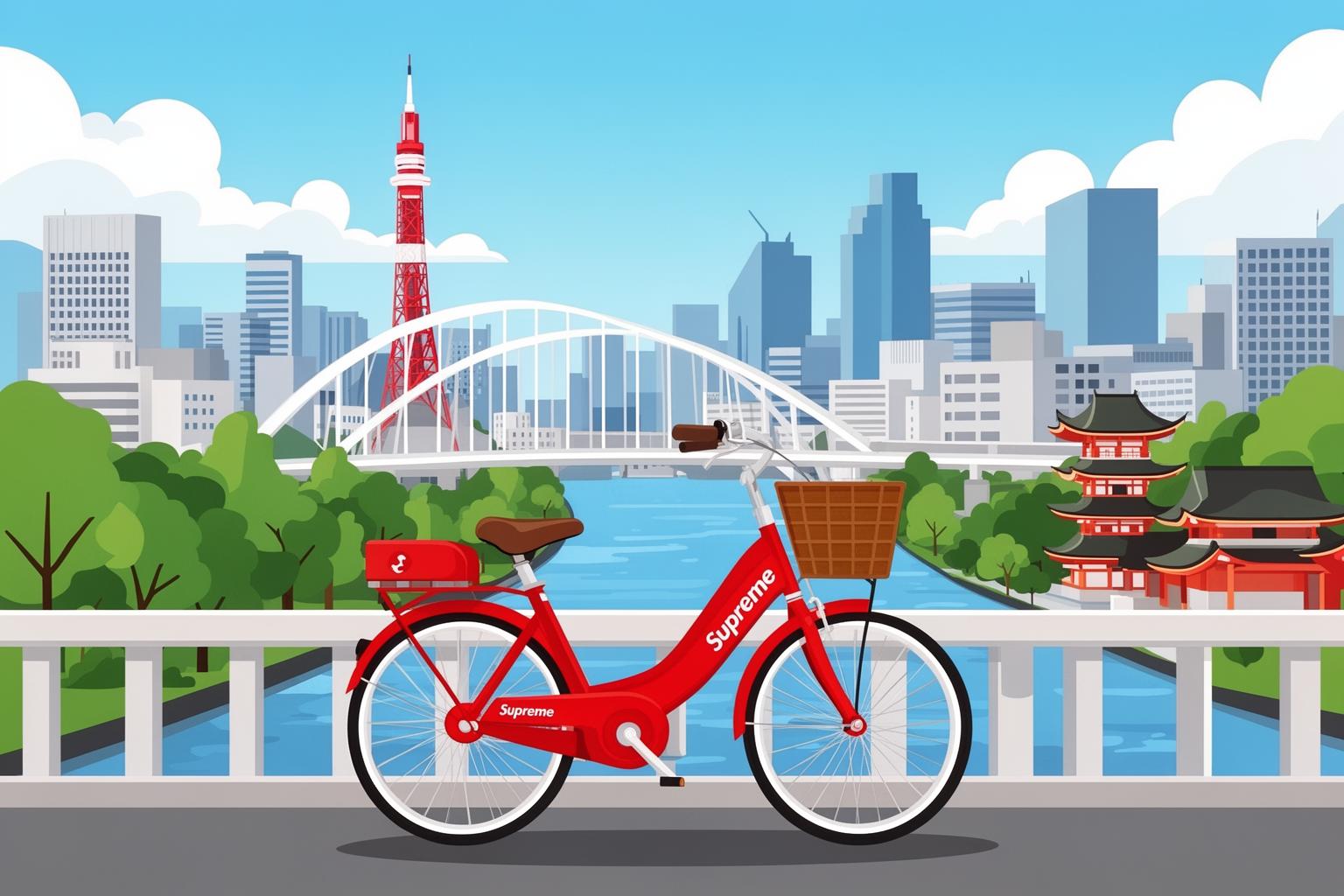
In the realm of Japanese bicycles, one model reigns supreme as an unmistakable emblem of suburban and urban life—so ubiquitous it often fades into the background. This is the mamachari (ママチャリ), a blend of mama (mom) and chari (a slang term for bicycle). To truly grasp Osaka, you must first understand this bicycle. It serves as the city’s urban workhorse, family station wagon, grocery carrier, and mobile command center all in one.
What is a Mamachari?
Forget about aerodynamics and lightweight carbon frames. The mamachari is designed solely for utility. Imagine a heavy, steel-framed bike with a low, step-through frame that makes mounting and dismounting easy, even while wearing a skirt or carrying a child. Its features prioritize practicality over performance. At the front, there’s a large, sturdy basket, perfect for holding daikon radishes, bags of rice, or a week’s worth of groceries. The handlebars are tall and swept back, encouraging an upright, comfortable posture that focuses more on observing your surroundings than minimizing wind resistance.
A strong kickstand, often double-legged, keeps the bike stable when parked, preventing it from tipping over under heavy loads. A built-in lock on the rear wheel provides quick, convenient security. Mudguards and a chain guard are standard, protecting your clothes from dirt and grease. Most mamacharis are single-speed, ideal for flat city terrain, with three-speed internal hubs frequently available as an upgrade. Iconically, many feature a built-in child seat—either on the back or between the handlebars—transforming the bicycle into a true family vehicle. Some modern models include electric assist, or denki-jitensha, with a battery and motor that provide extra power to tackle mild hills or heavy cargo effortlessly.
Why the Mamachari?
The mamachari’s widespread use directly reflects Osaka’s urban layout and the practicality of its people. Osaka is predominantly flat. Unlike the hilly port cities of Kobe or Nagasaki, most of Osaka rests on a plain, making cycling an energy-efficient transportation choice. The city is also densely packed, with narrow streets, winding alleys, and covered shopping arcades (shotengai) where cars are impractical or restricted. A bicycle is the perfect means to navigate this complex urban environment, enabling direct door-to-door travel that trains and buses cannot easily match.
Life in Osaka revolves around local amenities. The nearest supermarket, post office, ward office, or your child’s daycare is often just a ten- to fifteen-minute bike ride away. Using a car for such short errands would be expensive and time-consuming due to parking and traffic. While trains are great for longer distances, they are excessive for a quick run to the bakery. The mamachari fills this vital gap. It’s quicker than walking, cheaper than public transportation, and far more flexible than driving. It forms the backbone of neighborhood life.
A Symbol of Osaka Practicality
Here lies a striking contrast between Osaka and Tokyo. While Tokyo has its cyclists, the scene there feels more diverse and, at times, more style-oriented. Stylish city cruisers, sleek road bikes, and foldable Bromptons are common sights on Tokyo’s streets. Cycling there can be a lifestyle or fashion statement. In Osaka, it’s pure, straightforward functionality. The mamachari isn’t fashionable or trendy. It may be a little rusty or squeak occasionally, but it performs reliably, day after day. This perfectly reflects the spirit of Osaka. This city of merchants values cost performance (kosupa) deeply. An Osakan doesn’t ask, “Does it look good?” but rather, “Does it work? Is it a good value?” The mamachari—affordable, durable, and endlessly practical—is the definitive answer. It’s a tool, not a toy; a means to an end, not a status symbol. In its humble, utilitarian form, it is the quintessential Osakan ride.
Navigating the Grey Zone: Sidewalks, Streets, and Shared Spaces
So, you’ve got your mamachari and you’re ready to join the flow. You pedal onto the street and are immediately faced with a fundamental question that shapes the entire experience of cycling in Osaka: where are you actually supposed to ride? The law is clear and unambiguous—bicycles are vehicles and must be ridden on the road, specifically on the left side, following the traffic flow. However, the reality, in all its chaotic splendor, is that nearly everyone rides on the sidewalk.
The Sidewalk Dilemma
This isn’t simply widespread law-breaking; it’s a tacit social agreement born from necessity and a shared awareness of risk. Osaka’s streets are often narrow, traffic is fast, and dedicated bike lanes are scarce and prized. For the average mamachari rider, loaded with groceries or a child, competing with cars, taxis, and large trucks is intimidating and genuinely dangerous. Thus, the sidewalk becomes the de facto bike lane. This creates an environment that can be intimidating for newcomers. You become a vehicle moving quickly through space designed for pedestrians. Success depends less on strict rules and more on mastering a fluid, intuitive negotiation.
Here, you witness the Osakan spirit in action. There is constant, subtle communication: a slight turn of the handlebars, a gentle shift in body weight, a brief eye contact—these signals govern the sidewalk. You learn to anticipate the unpredictable movements of a toddler, the sudden stop of someone checking their phone, or the slow pace of an elderly person. You don’t rush through; you adjust. It’s a dance of yielding and proceeding, a shared responsibility to avoid collisions without saying a word. This preference for flexible, situational problem-solving over rigid rules is deeply embedded in local culture. Officially, you should ride on the street, but practically, the sidewalk is safer, and everyone figures it out together. It’s organized chaos—and it works.
The Unspoken Language of the Bell
Every mamachari has a bell, but its use is often misunderstood by Westerners. A Westerner might ring a bell as a harsh warning: “Move out of my way!” In Osaka, the bell is a tool of politeness. A sharp, frantic ring is considered rude and startling. Instead, the bell is used as a gentle sound tap on the shoulder. A soft chirin from afar means, “Excuse me, I’m approaching from behind and will pass on your right.” It’s an announcement, not a demand—akin to a slight bow. You ring it well in advance, giving pedestrians enough time to notice and slightly adjust their path. They might shift an inch or two, signaling they’ve heard you. No one jumps aside in panic. The goal is harmony, not forcefulness. Understanding this nuance is key to integrating smoothly into the sidewalk ecosystem. Use your bell sparingly and softly to be seen as a courteous community member; ring it sharply, and you’ll be marked as an aggressive outsider.
The “Osaka Weave”
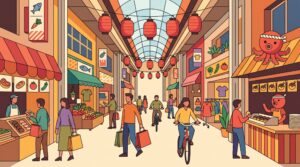
Nowhere is this sidewalk ballet clearer than in the covered shotengai. These lively shopping arcades form the heart of Osaka’s neighborhoods, buzzing with pedestrians, shoppers, and cyclists alike. Here, the “Osaka Weave” is on full display. Cyclists move just above walking pace, skillfully weaving through groups chatting, shop displays, and children running free. There is no defined lane; the entire arcade is a shared space. It demands heightened awareness and a 360-degree sense of what’s around you. It seems like a recipe for disaster, yet collisions remain remarkably rare. This is because everyone operates on the same unspoken protocol—a program of mutual awareness and tiny adjustments. The ability to coexist comfortably in crowded, seemingly chaotic spaces is a hallmark of Osaka life. Visitors from more orderly cities may feel overwhelmed, but locals find a peculiar comfort in this controlled bustle. It’s a living system, and your bicycle is the ticket to move within it.
Perils and Pitfalls: What to Watch Out For
Cycling in Osaka offers unmatched freedom, but the experience comes with its challenges. The city’s deep connection to bicycles hides a harsher reality—one involving petty crime, bureaucratic hassles, and harsh weather conditions. Maneuvering through these obstacles is an essential part of life for locals, imparting lessons in vigilance, responsibility, and the resilient spirit unique to Osaka.
Bicycle Graveyards and the Abandonment Problem
Near any major train station, you’ll notice vast areas filled with parked bicycles. Among the orderly rows, some bikes lie abandoned—flat tires, rusted chains, and bent frames slowly deteriorate in the open air. Bicycle abandonment is a significant issue. Since a basic mamachari can be purchased new for about 15,000 yen (or much less secondhand), they are often treated as disposable. Students may buy one for a semester and simply abandon it upon leaving. This results in sprawling bicycle graveyards that clog public spaces.
The city continually battles this growing problem. Workers patrol well-known spots, attaching warning tags—usually bright yellow or red paper—to bikes that appear abandoned or are illegally parked for long periods. These tags specify a deadline by which the bike must be moved; otherwise, it will be removed to a large, remote impound lot. This serves as a vital reminder: if you leave town for a week, ensure your bike is parked legally or risk losing it. The sheer number of abandoned bicycles reflects not only the popularity of cycling in Osaka but also the city’s pragmatic, unsentimental attitude toward possessions.
Theft and Registration (Jitensha Touroku)
When buying a bicycle in Japan—from a new or reputable secondhand shop—you must complete the jitensha bohan toroku, the bicycle crime prevention registration. For a small fee (usually around 600 yen), your name, address, and phone number are linked to a unique serial number on your bike, displayed on a small orange sticker on the frame. This registration is mandatory and serves as a rite of passage for every bike owner.
The registration has two main purposes: first, it deters theft; second, it helps police identify the owner. Police often stop cyclists, especially foreigners, for routine checks. They request your residence card and verify the bike’s registration number. Riding an unregistered bike or one registered to someone else can lead to lengthy, uncomfortable questioning at the local police box (koban) as authorities investigate ownership. Always buy from a legitimate shop that handles registration transfers. Purchasing a bike from a departing friend or an online stranger without proper registration transfer invites trouble.
While violent crime rates are low, bike theft is a genuine risk. A brand-new, expensive road bike left unlocked will disappear within minutes. Even cheap mamacharis can be targeted—often experiencing “rental theft,” where someone borrows an unlocked bike for a quick ride to the station before abandoning it. The takeaway is clear: always lock your bike, even when stepping into a convenience store for half a minute. The built-in wheel lock is the bare minimum; a sturdy cable or U-lock is strongly recommended.
The Rain, the Wind, and the Osaka Mom
Osaka’s weather can be harsh. Summers are oppressively hot and humid, winters can be sharply cold, and the rainy and typhoon seasons bring heavy rain and strong winds. In these conditions, the true champions emerge: the Osaka moms on their electric-assist mamacharis. They are a formidable sight. Imagine a woman riding through a gusty, rainy street, steering with one hand while holding an umbrella with the other. One child sits behind her, another in front, both protected by rain gear. The basket is loaded with groceries. Yet, she pedals on with unwavering determination.
This striking image also reveals a significant hazard. Riding while holding an umbrella is extremely dangerous and is, in fact, illegal, though enforcement is inconsistent. Many locals get around this by using umbrella holders attached to handlebars. These contraptions have questionable legality and are often unstable in the wind. For newcomers, the best advice is to invest in high-quality waterproof gear—jacket, pants, and shoe covers. Attempting to imitate the umbrella-wielding skill of a seasoned Osaka cyclist is likely to end in a painful, thoroughly soaked accident.
The Quest for a Parking Spot
Your journey doesn’t truly end upon arriving at your destination. In Osaka, it simply marks the start of the next challenge: finding a spot to park your bike. In a city teeming with millions of bicycles, securing parking is a continuous, unspoken struggle. It’s a game of strategy, social awareness, and luck, guided by a complex mix of official regulations and informal community guidelines.
Official “Churinjo” vs. Guerilla Parking
Most train stations, large supermarkets, and public venues offer official bicycle parking lots called churinjo (駐輪場). These range from basic open-air racks to advanced, multi-level automated garages where bikes are stored in underground vaults. Many of these facilities charge a fee, some providing the first few hours free—ideal for quick errands—while others require daily or monthly payments, which are vital for commuters who leave their bikes all day. These paid lots provide security and peace of mind, keeping bikes relatively safe from theft and crucially, from city towing.
Still, the availability of official parking rarely satisfies the massive demand, leading to the more prevalent form of parking: guerilla parking. This involves finding any small slice of public space to park your bike. Sidewalks outside convenience stores, railings along canals, building walls—any spot not explicitly marked with “No Bicycle Parking” is fair game. This creates the chaotic clusters of bicycles visible throughout the city. From afar, it appears to be a complete free-for-all, a sign of civic disorder.
The Social Contract of Parking
Look closer, however, and an unwritten order emerges amidst the chaos. A social contract is in effect. Yes, bikes are parked everywhere, but certain boundaries remain respected. The top rule is not to block access. You don’t park in front of store entrances, emergency exits, or residential doors. Particularly, you avoid parking on the textured yellow blocks in the sidewalk—tactile paving for the visually impaired—and obstructing them is a serious social taboo. Bicycles are lined up neatly, handlebars turned to minimize space. If someone’s bike blocks yours, it’s generally acceptable to gently move it aside to retrieve yours, as long as you return it to its original position.
This system works thanks to a shared understanding of mutual convenience and respect for public space. It’s a pragmatic compromise: the city cannot provide enough official parking, so residents create their own informal arrangement. It bends official rules but follows a stricter, community-enforced code of conduct—a reflection of Osaka’s flexible, results-driven approach to civic life. The aim is to make things work for everyone, even if it appears somewhat chaotic.
The Dreaded “Removal” Notice
Violating this social contract, or parking in strictly enforced zones, brings consequences. The first warning comes as a tag placed on your bike by city officials. Ignoring this means returning to find your bike gone, replaced by a notice chalked on the pavement or taped to a nearby pole stating that all illegally parked bicycles have been removed. This is when your day takes a negative turn. The notice details the location of the municipal impound lot, which is almost always in inconvenient, hard-to-reach areas—under distant expressways, on industrial riverbanks, far from train stations. Retrieving your bike requires a lengthy trip, a bureaucratic process, and a fine of several thousand yen. Every longtime resident has a story of reclaiming their bike from the pound—an exasperating, time-consuming, and costly lesson in the importance of considerate parking.
More Than a Commute: The Bike as Your Key to the City
After you’ve mastered weaving through sidewalks, understood the bell’s language, and navigated the delicate politics of parking, the bicycle becomes more than just a means of transportation. It transforms into your key to the city, a tool for discovery that reveals sides of Osaka unseen from the window of a train. It acts as a great equalizer, offering a shared experience that connects you to the daily rhythm of this remarkable place.
Discovering the Backstreets
Osaka’s true spirit isn’t found on the grand avenues of Midosuji or in the neon lights of Dotonbori. It resides within the labyrinth of backstreets, the narrow roji winding behind the main roads. These are places inaccessible by subway and too tight for cars. On a bicycle, this hidden world unfolds. You can pedal at your leisure, driven by curiosity. You might encounter a tiny, concealed Shinto shrine nestled between two apartment blocks, its entrance guarded by stone foxes. You’ll catch the aroma of sweet soy sauce from a neighborhood senbei (rice cracker) shop operated by the same family for three generations. You’ll discover a local takoyaki stand with a line of regulars, where the owner knows everyone’s favorite order. A bicycle grants you the freedom to get lost, follow whims, and pause to explore. It lets you piece together the city’s intricate geography block by block, forming a personal, deeply felt mental map. You are no longer just traveling between stations; you are moving through communities.
A Great Equalizer
In a society that can often feel hierarchical, the bicycle stands as a powerful force of democratization. Stand on an Osaka street corner and watch the cyclists pass. You’ll see a high school student in uniform, a salaryman in a sharp suit, a young mother with her child, and a grandmother well into her eighties. They all ride the same kind of bike, negotiate the same crowded sidewalks, and face the same risk of sudden rain. The mamachari transcends age, occupation, and social class. It creates a shared public space where everyone participates. This common experience nurtures a quiet sense of community. You’re all in it together, moving through the city under your own power. This feeling of a level playing field, of shared effort and shared space, embodies the essence of Osaka. It’s a city proud to be down-to-earth, unpretentious, and slightly scrappy. The omnipresent mamachari perfectly embodies that identity.
Osaka vs. Tokyo on Two Wheels
Ultimately, a city’s cycling culture reveals its character. In Tokyo, cycling often feels more deliberate and orderly, with a stronger emphasis on following rules and riding on the street where possible. The infrastructure, in some areas, is more developed with clearly marked bike lanes. This reflects the city’s overall nature: polished, efficient, and focused on maintaining public order. Osaka, however, on two wheels, is a different story. It’s more improvisational, chaotic, and reliant on social intuition rather than formal rules. The sidewalk is the main stage, and the mamachari is the star performer. It’s a system born from pragmatism, mirroring the merchant city’s historical emphasis on what works in practice, not what looks good on paper. If Tokyo’s cycling culture is a carefully orchestrated symphony, Osaka’s is a free-form jazz session—somewhat unpredictable, occasionally dissonant, but always vibrant and full of life.
Living in Osaka without owning a bicycle is to miss out on a fundamental urban experience. It’s like seeing the city in black and white when it’s meant to be lived in full, vibrant color. The freedom it offers is immense, but the lessons it imparts are even more valuable. It teaches you awareness, flexibility, silent communication, and how to find order within apparent chaos. Getting a mamachari, registering it, and mastering the nuanced dance of the sidewalk is more than a practical step—it’s an act of integration. It’s your way of declaring that you’re not just a visitor passing through, but a resident ready to join the flow and embrace the genuine, unvarnished, and utterly wonderful rhythm of life in Osaka.