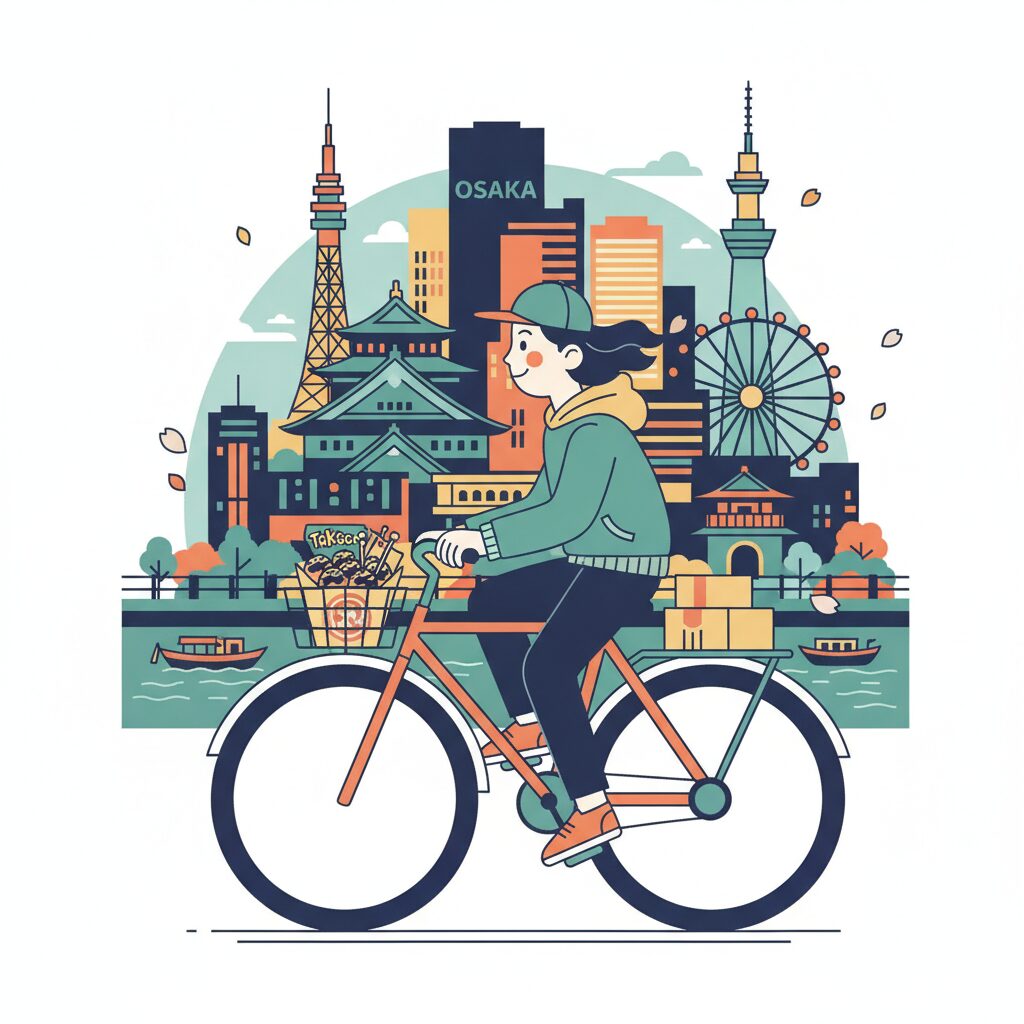
The first thing you notice isn’t the neon glow of Dotonbori or the sheer scale of Umeda Station. It’s the bikes. They flow like a silent, metallic river through every street, alley, and shopping arcade. They are a constant, weaving presence, a swarm of steel and rubber that seems to operate on a logic entirely its own. You see a grandmother with a perm, her basket full of daikon radishes, gliding serenely through a crowd of pedestrians. You see a salaryman in a full suit, one hand on the handlebars, the other holding a briefcase, somehow making a phone call. You see a mother on a tricked-out electric mamachari, a toddler secured in the back, an infant in the front, and a week’s worth of groceries balanced precariously, all while navigating a narrow lane with the grace of a seasoned acrobat. To the newcomer, it looks like pure, unadulterated chaos. A lawless free-for-all where traffic signals are mere suggestions and sidewalks are personal expressways. And in a way, you’re not wrong. But it’s not chaos without a system. It’s a complex, unspoken dance, a rhythm you have to learn if you want to survive, let alone thrive, in the vibrant, kinetic energy of Osaka. This isn’t just about transportation; it’s a window into the city’s soul—pragmatic, impatient, hyper-efficient, and built on a foundation of shared, unspoken understanding. Forget what you learned about cycling back home. You’re in Osaka now. The rules are different here because the people are different.
Navigating Osaka’s intricate biking choreography is only the beginning of feeling at home, as learning local sento etiquette can further unlock the city’s unique neighborhood charm.
The Sidewalk Is the Main Street
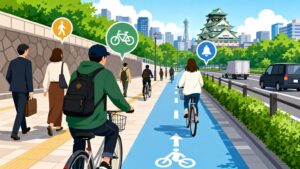
In most Western countries, riding your bicycle on the sidewalk is considered a cardinal sin, a violation that draws furious glares and angry shouts. In Osaka, however, it’s often the norm. The city’s roads are frequently narrow, crowded, and intimidating, with trucks and taxis competing for every inch of asphalt. As a result, people have turned to the sidewalks and never looked back. This simple practice fundamentally reshapes the urban environment. The sidewalk is no longer a peaceful refuge for pedestrians; it becomes a shared, multi-use space where a continuous, low-key negotiation for room takes place.
The Pedestrian Pecking Order
Legally, pedestrians have the right of way. That’s the rule. But in reality, the hierarchy is much more fluid. A cyclist in Osaka rides with the expectation that pedestrians are aware and will make small adjustments. You’re expected to ride defensively yet with purpose. A slow, wandering pedestrian might find a bicycle gently but confidently sliding past them with mere millimeters to spare. A group blocking the entire path will be met with a subtle but persistent bell ring, a clear prompt to move closer together. The unspoken understanding is that everyone is trying to get somewhere, and efficiency is key. You yield to the elderly and steer wide around children, but everyone else is part of the flow. It’s a delicate balance. As the cyclist, you are the faster, more agile participant, so it’s your responsibility not to cause a collision. Meanwhile, pedestrians have the unspoken obligation not to be clueless obstacles. This sharply contrasts with Tokyo, where a clearer and more respectful boundary exists between pedestrian and cyclist spaces. In Osaka, those boundaries blur into one continuous, pulsing stream of people.
Mastering the Bell: The “Chirin-Chirin” Code
The bicycle bell here is not a tool of aggression. Instead, it serves as a sophisticated means of communication. A quick, light chirin from afar is a polite alert, essentially saying, “Excuse me, I’m approaching on your left.” It’s the audible equivalent of a friendly nod. Then there’s the more urgent chirin-chirin, used when someone is drifting into your path or completely absorbed in their phone. This bell signals, “Hey, pay attention, we’re sharing this space.” The truly aggressive, rapid-fire ringing is rare, reserved for moments of real danger or extreme frustration. Understanding the bell’s nuances is vital. Using it too forcefully will brand you as a rude outsider, while ignoring it altogether will result in slow, frustrating trips stuck behind inattentive walkers. Mastering the gentle, informative ring is essential for blending into the local cycling culture. It’s your way of saying, “I’m part of this flow, not a threat to it.”
Meet the Mamachari: The Unsung Hero of Osaka Roads
Forget sleek, lightweight road bikes or rugged mountain bikes. The undisputed ruler of Osaka’s streets is the mamachari, or “mom’s chariot.” These bicycles are the tanks of the cycling world. With heavy steel frames, upright handlebars, a step-through design for easy mounting, built-in locks, dynamo-powered headlights, and, most importantly, baskets—a front basket is standard and often large enough to hold both a bag of groceries and a handbag. Many also feature a sturdy rear rack, frequently equipped with a child seat. They embody practicality, designed for utility rather than speed. The mamachari sets the rhythm of the city’s cycling—steady, relentless, and workhorse-like. This isn’t about fitness or weekend recreation; it’s about the everyday, essential activities of life. It’s about taking your child to daycare, picking up vegetables for dinner, and heading to your part-time job at the local clinic. Riding a mamachari signals your active involvement in the city’s daily life. It declares that you are here to accomplish things, to be productive, and to be part of the community’s fabric. The prevalence of the mamachari is a key reason why Osaka feels so unique. In other cities, cycling can seem like a subculture. In Osaka, it is the culture.
The Great Parking Gamble
With millions of bicycles, the monumental challenge of storing them arises. Bicycle parking—or the lack thereof—is a constant, low-level source of stress for every cyclist in Osaka. The city is a battleground of legal and quasi-legal parking tactics, a daily game of risk and reward where losing means your bike disappearing into the back of a silver municipal truck.
The Churinjo Sanctuary
The official solution is the churinjo, or paid bicycle parking lot. These massive, multi-level facilities are found near nearly every train station. For a modest fee, usually around 150-200 yen per day, you secure a safe, legal spot. Often automated marvels of Japanese engineering, they feature intricate lifts and conveyor belts that whisk your bike away into a dense, metallic hive. Using a churinjo is the responsible, stress-free choice. It’s simply the right thing to do. However, they can fill up quickly during peak times, and sometimes they’re just a bit too far from your actual destination when an Osakan is in a hurry.
Guerrilla Parking and Its Consequences
This leads to the far more common practice of what can only be called guerrilla parking. Bikes line railings, hide in alleyways, cluster around utility poles, and form long, orderly rows outside supermarkets and apartment buildings. There’s an unwritten etiquette—don’t block doorways, don’t obstruct wheelchair paths—but for the most part, any available sliver of public space is considered a potential parking spot. This is where the gamble begins. Certain areas, especially near major train stations, are designated no-parking zones. City workers regularly patrol these spots, tagging illegally parked bikes with warning notices. If the bike isn’t moved, the dreaded silver trucks arrive. They are swift and relentless. Workers descend, snip cheap locks with bolt cutters, and load dozens of bikes into the back. All that remains is a chalk mark on the pavement and a notice pasted on a nearby pole with a map to the impound lot. Retrieving your bike is a bureaucratic ordeal. You must travel to a remote, desolate lot, usually beneath a highway overpass, present your ID and bike key, pay a fine of several thousand yen, and endure a stern lecture. Every long-term resident has an impound story—it’s a rite of passage, a harsh lesson in the city’s ongoing battle between convenience and order.
Red Lights and Calculated Risks
Now we come to the most controversial and, for many foreigners, the most surprising aspect of cycling in Osaka: the approach to traffic signals. To be clear—at major, multi-lane intersections with heavy cross-traffic, cyclists stop and wait for the green light just like everyone else. However, at smaller, neighborhood intersections, especially those without pedestrian crossings, the red light is often treated like a yield sign. This is known as the “Osaka Stop.” Cyclists slow down as they approach, carefully look for oncoming cars or other bikes, and if the way is clear, they proceed through the red light. While this behavior can appear reckless and unsettling, it stems from Osaka’s core philosophy of pragmatism. The logic goes, “If there are no cars, there is no danger. If there is no danger, why stop? Stopping wastes time and momentum.” It’s a straightforward calculation of risk versus efficiency. This is one of the biggest behavioral contrasts compared to Tokyo. In Tokyo, rules are rules—a red light means stop, no exceptions, even on empty streets at 3 AM. The societal pressure to obey is intense. In Osaka, the rule is viewed more as a guideline, overridden by the immediate, observable circumstances. People place trust in their own judgment rather than blindly following the traffic signal. This mindset—this readiness to bend formal rules in favor of practical efficiency—is distinctly Osaka.
The Unwritten Laws of Motion
Beyond the primary rules of sidewalks and signals, there exists a whole universe of smaller, subtle behaviors that regulate the flow of bike traffic. These instincts are honed over a lifetime of navigating crowded spaces and are crucial for a smooth ride.
The Art of the No-Look Exit
One of the first skills you must acquire is anticipating the unexpected. People will suddenly appear from shops, step out of alleyways, or pull their bikes from parking spots without glancing over their shoulder. They operate within their own bubble of intention, assuming that others on the path will see them and adjust accordingly. This isn’t considered rude; it’s just how things are. You learn to interpret subtle signals—a shop door opening, a flicker of movement in a side street—and you preemptively give extra space or ring your bell. Riding demands constant, 360-degree awareness. You are the captain of your ship, fully responsible for navigating the unpredictable currents surrounding you.
The All-Weather Rider
The dedication of the Osaka cyclist is unwavering. Rain doesn’t stop them. In fact, it creates one of the city’s most incredible and daunting sights: the one-handed, umbrella-wielding cyclist. They hold a full-sized umbrella in their left hand, steer with their right, and somehow maintain perfect balance while riding on wet, slippery streets. Some have even mastered holding their phone to their ear with their shoulder while doing this. It’s a breathtaking display of skill you should never, ever attempt to imitate. It powerfully illustrates how deeply the bicycle is woven into the rhythm of life here. It isn’t a recreational toy; it’s an essential tool, as fundamental as a pair of shoes, used to get the job done regardless of the conditions.
Decoding the Chaos: What It All Means
So, is it a lawless chaos? From an outsider’s perspective, it might certainly seem that way. However, from within, it is a highly effective, albeit unconventional, system. It functions due to a dense concentration of participants who share a common, unspoken understanding. There’s a mutual awareness and a continuous reading of subtle signals. Cyclists watch pedestrians, pedestrians listen for bells, and everyone subconsciously negotiates their way through the city together. This system values flow over formality, personal judgment over strict rules, and efficiency above all else. It truly reflects the character of the Osakan people, who are often described as more direct, impatient, and pragmatic compared to those in Tokyo. They want to move forward quickly, and they’ve developed a movement system that enables them to do just that. The apparent chaos of the bicycle culture isn’t a sign of social disorder; it’s an indication of a society that has naturally formed its own highly effective, hyper-local set of rules for coexisting in a busy, vibrant environment.
Your Survival Kit: How to Ride Like a Local
Adapting to Osaka’s bicycle culture requires time and a bit of courage. However, by following a few essential principles, you can transform from a nervous newcomer into a confident participant in the city’s daily dance.
Go with the Flow
Your first and most crucial lesson is to avoid resisting the current. Match the speed of the cyclists around you. Don’t be overly cautious, as hesitation can cause confusion. But don’t be too aggressive either. Find the street’s rhythm and blend in. Move with intention, signal your intentions through body language, and become a predictable part of the ecosystem.
Assume Nothing
Adopt a defensive cycling mindset. Assume that the car at the intersection doesn’t see you. Assume the pedestrian about to cross is listening to music and can’t hear you. Assume the bike ahead could stop abruptly at any moment. Maintaining this heightened awareness is not stressful; it’s freeing. It puts you in control and shields you from others’ unpredictable behavior.
Use Your Bell (Wisely)
Don’t hesitate to use your bell, but learn its subtle language. A gentle, early chirin is your best ally. It prevents issues before they arise and signals that you are a considerate, aware cyclist. It’s a small sound, but it’s key to navigating smoothly through crowded pedestrian areas.
Get Registered
When purchasing a bike in Japan, new or used, you must complete the bōhan tōroku, or crime prevention registration. This simple process costs a few hundred yen, and your local bike shop will take care of it for you. It links your name to the bike’s serial number, invaluable if your bike is stolen and later recovered. It’s also important if the police stop you for a random check, confirming you’re the legitimate owner. A small but essential piece of bureaucracy.
Embrace the Mamachari
Finally, the best way to truly grasp Osaka’s cycling culture is to fully embrace it. Resist the urge to buy a fancy road bike. Instead, visit a local shop and pick up a simple, sturdy mamachari. Feel its weight and stability. Load groceries into the basket. Take it for a ride down a covered shotengai shopping arcade. When you ride a mamachari, you’re not just a foreigner on a bike—you’re part of the city’s living, breathing machinery. You’re part of the flow.