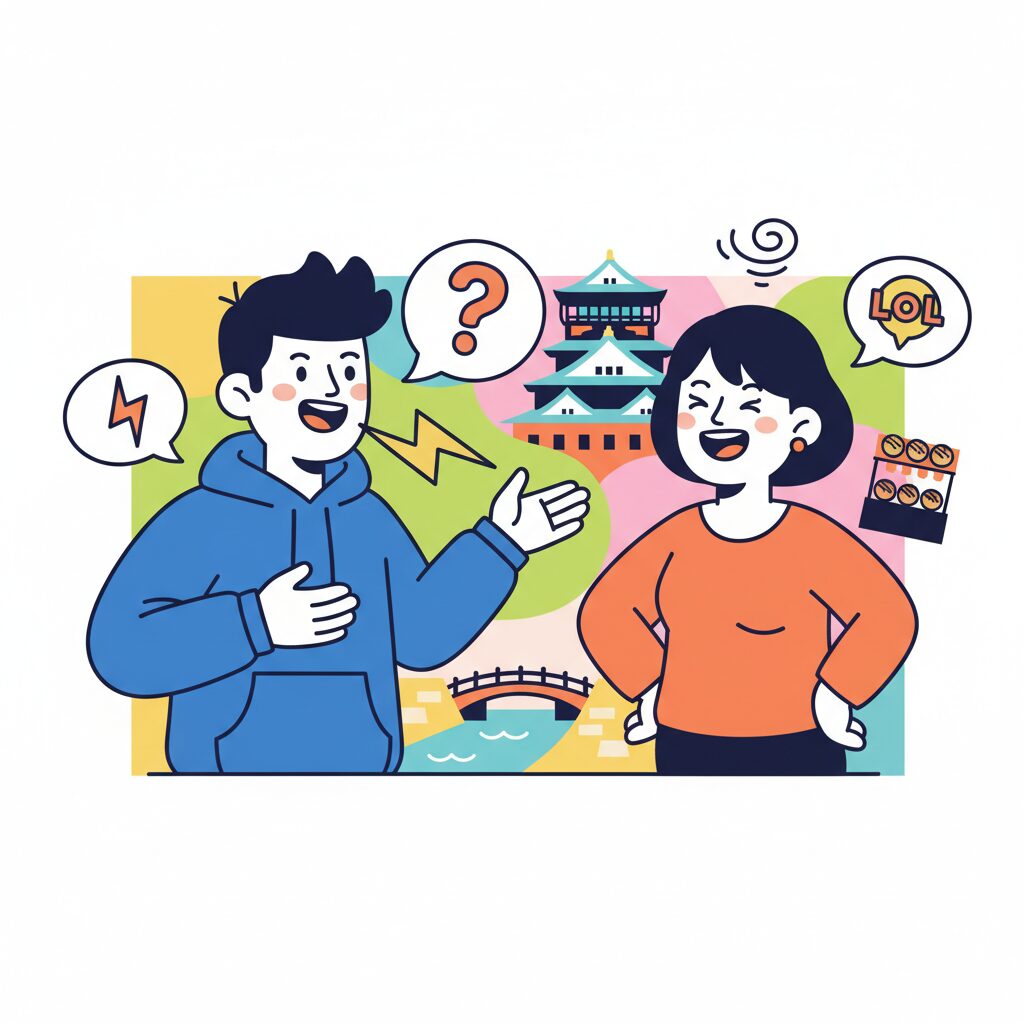
Step off the Shinkansen at Shin-Osaka Station, and the first thing you’ll notice isn’t the skyline or the smell of takoyaki—it’s the sound. The language shifts, the cadence quickens, and the volume knobs seem to twist a few notches to the right. You’ve entered the heartland of Osaka-ben, a dialect that can sound, to the uninitiated ear, like a friendly argument that never quite ends. It’s a rapid-fire volley of words that seem too direct, too playful, and sometimes, too blunt for the Japan you thought you knew. For many foreigners fresh from the polite, measured tones of Tokyo, the initial reaction is often confusion. Is that shopkeeper mad at me? Are those two friends about to fight? Why does everyone sound so… loud?
Welcome to Osaka, where conversation is a contact sport, and the dialect is the jersey everyone wears. Understanding Osaka-ben isn’t about memorizing a new set of vocabulary; it’s about learning a new philosophy of communication. It’s a language built on rhythm, humor, and a deep-seated desire to shrink the distance between two people as quickly as possible. Where standard Japanese, or hyojungo, often prioritizes harmony through indirectness and careful phrasing, Osaka-ben builds relationships through playful jabs, heartfelt exaggeration, and a level of directness that can feel jarring at first. This article is your guide to reading between the lines of that banter. We’re going to decode the emotional punctuation, unravel the comedic timing, and explore why an insult might just be the warmest welcome you’ll receive in this city. Forget the phrasebooks for a moment. To truly live in Osaka, you have to learn to listen to the music, not just the words.
Embracing the rhythm of Osaka conversation also invites you to explore the intricacies of business communication as an essential facet of the city’s unique cultural interplay.
The Sound of Osaka: More Than Just Words
Before you can grasp the content of Osaka-ben, you first need to become familiar with its form. The dialect is marked by a distinctive intonation, a kind of musical rise and fall that gives it a lively, energetic vibe. This melody is essential. The same word can serve as gentle teasing or a stern warning, and the only difference lies in the pitch and rhythm. Osakans convey vast amounts of information through tone, elongating vowels to soften a critique or shortening words for comedic effect. It’s a performance where every conversation becomes a small stage. Ignoring the delivery and focusing solely on the literal translation is the quickest way to completely misunderstand the city and its people.
“Akan!” – The All-Purpose Negative with a Thousand Meanings
One of the first words you’ll come across is “akan.” The dictionary will tell you it means “no good,” “useless,” or “you mustn’t.” And sometimes, that’s exactly what it means. A mother chasing her toddler away from an electrical outlet will shout a sharp, definitive “Akan!”—leaving no room for ambiguity. But in most everyday interactions, “akan” is a wonderfully flexible tool, a conversational Swiss Army knife whose meaning is shaped entirely by context and delivery.
Imagine yourself in a shotengai, one of Osaka’s bustling covered shopping arcades. You’re eyeing a vintage jacket and, feeling bold, you ask the shopkeeper for a small discount. He might suck air through his teeth, throw his hands up in mock despair, and exclaim, “Sonna nedan ja akaaaan wa~” (“I can’t possibly sell it at that price!”). He’s not angry. He’s not shutting you down. The elongated vowel, the dramatic tone—it’s an invitation. He’s signaling that the game is on. This “akan” means, “That’s a good starting offer, but you’ll have to do better. Now, let’s negotiate.” It’s the opening bell for a friendly bargain, a form of communication that is itself a valued social exchange.
Later, you’re out with a friend, and you tell an embarrassingly cheesy joke. They might slap their knee, laugh, and say, “Sore wa akan de!” (“Oh, that’s just terrible!”). This isn’t a criticism of your humor. It’s the highest form of praise. It means, “That joke was so bad, it’s brilliant. You got me.” This “akan” is a mark of affection, a conversational glue that strengthens your connection. By calling your joke “no good,” they’re really saying, “I get you, and I appreciate your effort at humor.” It’s a paradox at the core of Osaka communication: negativity often expresses the purest form of positivity.
The Rhythmic Insults: “Aho” vs. “Baka”
Nowhere is this paradox more apparent than in the classic linguistic divide between Osaka and Tokyo: the use of “aho” and “baka.” Both words roughly translate as “idiot” or “stupid.” Throughout much of Japan, especially in Tokyo and the Kanto region, being called “baka” is common. It can be playful but also carry a real sting. Being called “aho,” however, is often felt as a harsh, genuine insult—a sign of real contempt.
In Osaka, the roles are completely reversed. Here, “aho” is the currency of affection. It’s a verbal pat on the back, a punctuation mark in a friendly tale, a rhythmic beat in the drum of everyday banter. When your friend stumbles on the pavement and you shout, “Nani yatten nen, aho!” (“What are you doing, you goofball!”), you’re not questioning their intelligence. You’re expressing surprise, concern, and camaraderie all rolled into one efficient word. It’s a way of saying, “I see you, I’m paying attention, and your little mishap is now a shared moment of amusement between us.” A well-timed “aho ya naa” delivered with a smile is one of the clearest signs that an Osakan feels at ease with you. It’s a verbal tic, a term of endearment that smooths social interactions.
By contrast, using “baka” in Osaka can abruptly end a conversation. It sounds cold, clinical, and genuinely insulting. It lacks the warm, bouncy rhythm of “aho.” While “aho” playfully comments on a person’s actions, “baka” feels like a judgment on their character. It implies a true lack of intelligence, not just a temporary slip or silly decision. Foreigners who learn Japanese in Tokyo often bring “baka” with them to Osaka, only to be confused when its use is met with awkward silence. It’s a classic case of cultural mistranslation. In Osaka, you can call your closest friend “aho” ten times a day. But call them “baka” once, and you may find yourself needing to apologize.
The Comedy of Communication: Why Banter is a Social Glue
At the heart of Osaka’s conversational style lies an unspoken understanding that life acts as a performance, with each interaction serving as a scene. This doesn’t mean being insincere; rather, it’s a mutual dedication to making everyday life more entertaining. This performance is grounded in the structure of manzai, the traditional Japanese stand-up comedy form perfected and popularized in Osaka. Grasping its fundamental principles is like receiving the keys to the city’s social dynamics.
Tsukkomi and Boke: The DNA of Osaka Conversation
Manzai features two performers: the boke (the funny one, the fool) who says or does something absurd, and the tsukkomi (the straight one, the reactor) who quickly corrects them, often with a sharp retort or a light smack. This dynamic isn’t limited to comedians on the Namba Grand Kagetsu stage; it forms the essential, unspoken framework for nearly every conversation in Osaka. People frequently, and often unconsciously, slip into these roles. One person offers a boke—an exaggeration, a playful observation, or a clumsy moment—creating an opening for another to deliver the tsukkomi punchline.
For instance, if you remark on the gray, rainy weather by saying, “Wow, it’s a beautiful day for a picnic,” a typical Tokyo response might be a puzzled look or a polite correction like, “But it’s raining.” In Osaka, you’ve just presented an ideal boke. The usual tsukkomi reply would be an incredulous, “Nande ya nen!” (“Why would you say that!” or “What the hell!”), accompanied by laughter. The purpose of the tsukkomi is not to factually correct you but to complete the comedic exchange. It’s a collaborative act, a brief two-person play.
This dynamic influences everything. If you show up in a brightly colored new sweater, your friend’s tsukkomi might be, “Meccha hade ya na! Me ga chika chika suru wa!” (“That’s so loud! It’s like my eyes are hurting!”). Far from an insult, it’s a compliment, acknowledging your fashion choice through humor. The proper response isn’t to take offense but to play along, perhaps with a boke of your own like, “I’m trying to be a traffic light.” Taking the tsukkomi literally disrupts the game’s premise—it’s seen as being nori ga warui (having bad rhythm or being a poor sport). Engaging in this exchange signals that you belong; it’s the quickest way to build rapport and show a deeper understanding of local culture.
“Shiran kedo” – The Ultimate Conversational Get-Out Clause
Another distinct conversational tool in Osaka is the phrase “shiran kedo,” which literally means “I don’t know, though.” What makes it unique is its placement—almost always appended to the end of a statement made with absolute, unwavering confidence. It functions like a verbal sleight of hand, allowing the speaker to have it both ways.
An Osakan might declare with the certainty of a seasoned food critic, “That takoyaki stand over there is the best in the entire city. The owner’s grandfather learned the secret recipe from a sea god. Shiran kedo.” The claim is bold, the evidence mythical, and the disclaimer seems to undercut the whole assertion. But this isn’t about doubt. “Shiran kedo” is a nuanced device serving several purposes.
First, it acts as a punchline, deliberately deflating the speaker’s bravado and adding a moment of self-deprecating humor. Second, it demonstrates social humility, letting the speaker share a strong, passionate opinion without sounding arrogant or dismissing other viewpoints. It conveys, “This is what I wholeheartedly believe, but I’m not the ultimate authority, so feel free to disagree.” It also gives the listener an easy way out. If you’ve tried that takoyaki and didn’t like it, you don’t have to directly challenge your friend’s enthusiastic praise—the “shiran kedo” has already opened space for differing opinions.
This verbal tic reveals much about the Osaka mindset. Communication is valued not only for its entertainment but also for its role in preserving smooth social relationships, sometimes even more than for factual accuracy. It’s a way of being assertive yet easygoing simultaneously, a balance that defines much of the city’s character.
Navigating the Nuances: Practical Tips for Daily Life
Grasping the theory is one thing, but putting it into practice in your everyday life is another. Living in Osaka means fully engaging with its distinctive communication style. It calls for listening not only to what is said but how it’s said, and being prepared to join in the performance yourself. From shopping for groceries to complimenting a friend, the unspoken rules of Osaka-ben are always at play.
The Sound of Money: Haggling and “Honma ni?”
Osaka’s history as Japan’s merchant capital is deeply ingrained in its culture. Commerce here has never been just a cold transaction; it’s a human interaction, a dialogue. Although haggling isn’t as common as it once was, its spirit remains alive, especially in the city’s numerous shotengai and markets like Kuromon Ichiba. The key phrase is “Chotto makete,” a gentle way to ask for a small discount. In a Tokyo department store, this request would usually be met with a polite, firm refusal. In many small shops in Osaka, however, it’s the opening line of a beloved routine.
The shopkeeper will likely respond with feigned shock, as we saw with “akan.” Your next move is to use another essential Osaka phrase: “Honma ni?” (“Really? For real?”). When the vendor quotes a price, you can look at the item, then back at them, and say with a playful sigh, “Honma ni? Chotto takai na~” (“Really? That’s a bit expensive~”). This isn’t a challenge. It’s your next line in the play. It signals that you’re an engaged and savvy customer, ready to participate in the tradition. The aim isn’t to save a large amount of money. The five-minute, laughter-filled negotiation that ends with a 100-yen discount is the true prize. The discount is just a token, a memento of a successful social exchange. You’ve made a connection. That, in Osaka, is the ultimate bargain.
Reading Tone Over Text: The Challenge of “Meccha” and “Chau Chau”
Much of Osaka-ben’s meaning comes from its lively delivery, which makes it especially easy to misunderstand in written form or when heard without visual cues. Two examples stand out: “meccha” and “chau chau.”
“Meccha” is Osaka’s version of “totemo” or “sugoku”—it simply means “very” or “super.” But it’s used so frequently and with such enthusiasm that it becomes an emotional indicator of the speaker’s mood. Everything is “meccha oishii” (super delicious), “meccha atsui” (super hot), or “meccha omoroi” (super funny). The word itself is simple, but it’s almost always spoken with a burst of energy. It injects conversations with a baseline level of excitement that can seem exaggerated to outsiders. It’s a reminder that understatement is rarely the norm in Osaka.
Then there’s the famous tongue-twister, “chau chau.” On paper, it’s just a repeated denial: “chau” means “wrong” or “different.” So “chau chau” means “no, no” or “that’s not it.” Its fame comes from a classic joke involving the Chow Chow dog breed (pronounced “chau chau” in Japanese). Someone might ask, pointing at a dog, “Is that a Chow Chow?” (“Are, chau chauちゃうん?”). The owner might reply, “No, no, it’s not a Chow Chow!” (“Chau chau! Chau chau chau chau!”).
The string of identical sounds is funny, but it also demonstrates an important point. Without context, a rapid “chau chau chau chau!” could sound harsh and dismissive. But in person, it’s delivered with a sing-song rhythm, often accompanied by a smile and a head shake. The repetition is for comedic and rhythmic effect, not anger. It’s a playful, firm denial. It underscores the crucial need to listen for the melody in Osaka-ben. The tone reveals whether you’re being corrected, teased, or scolded. More often than not, it’s the first two.
Conclusion: Embracing the Osaka Rhythm
Living in Osaka is a deeply immersive lesson in communication. It reveals that a dialect is much more than just a collection of regional words and grammatical quirks; it embodies the spirit of a city. Osaka-ben, with its straightforwardness, theatrical flair, and deep-rooted love of humor, drives a culture that values human connection over formal etiquette. It serves as a means to break down barriers rather than create them. The banter, teasing, and playful insults all invite you to let your guard down and connect on a more personal, genuine level.
For those arriving from the more reserved environment of Tokyo or the polite distance typical of many other cultures, the initial adjustment can be difficult. The first impression of roughness or aggression is often a misunderstanding. But if you look beyond the loudness and bluntness, you’ll discover a strong current of warmth, wit, and acceptance. You’ll find a city where people aren’t afraid to be loud, to be playful, and to treat strangers like old friends who just haven’t exchanged jokes yet.
Don’t hesitate to join in. Laugh at a tsukkomi directed your way. Playfully haggle at the market. Share a confident opinion, then soften it with a “shiran kedo.” The moment you stop merely translating words and start sensing the rhythm of the conversation is when you cease being a visitor and truly become part of the city’s lively, ongoing performance. One day, an elderly woman at the supermarket might see you drop an apple, shake her head with a smile, and call you “aho.” In that moment, you won’t feel offended. You’ll just feel at home.