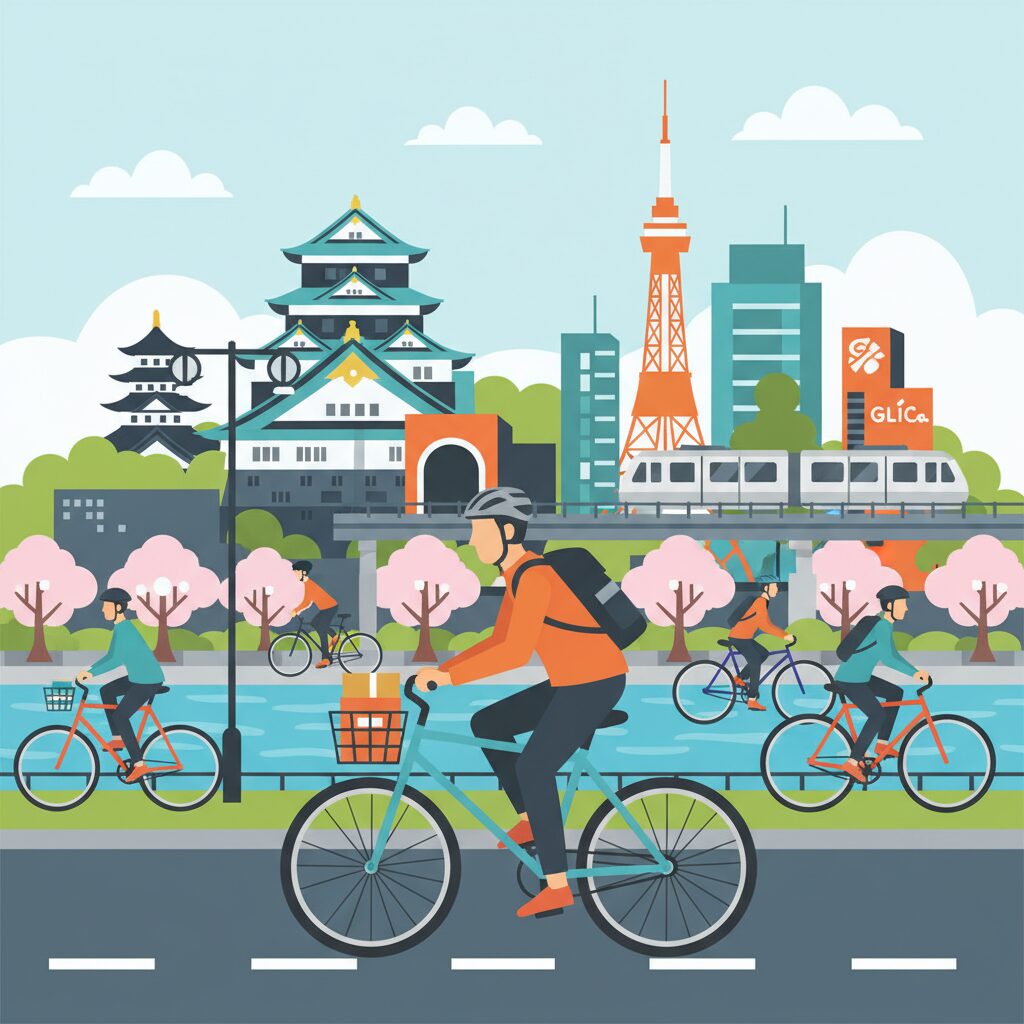
Step off the train in Tokyo, and you’ll see cyclists. They move with a certain predictable grace, often in designated lanes, stopping obediently at lights. They are part of the city’s meticulously choreographed ballet. Now, step off the train in Osaka. The first thing you might see is a mother on an electric-assist bicycle—a fortress on two wheels—with a kid in a seat upfront, another on the back, and a week’s worth of groceries overflowing from the basket. She’s not in a bike lane. She’s gliding down a crowded sidewalk, weaving between pedestrians with the instinct of a river navigating rocks, all while talking on her phone tucked into her shoulder. This isn’t chaos; it’s the overture to Osaka’s symphony of motion. For anyone coming from the orderly world of Tokyo, or anywhere else for that matter, it’s a culture shock on two wheels. You see, in Osaka, a bicycle isn’t just transportation. It’s an extension of the self, a tool for maximum efficiency in a city that values getting things done over doing them by the book. The unwritten rules of the road here aren’t found in any traffic manual; they’re absorbed through daily observation, a shared understanding that prioritizes flow over formality. This is the real rhythm of the city, and to live here, you have to learn the beat.
Embracing the spontaneity of Osaka means discovering every facet of its daily rhythm, from unconventional bike maneuvers to how locals transform mundane errands into an art form during a vegan and allergy-friendly supermarket shuffle.
The Mamachari: Osaka’s Urban Assault Vehicle
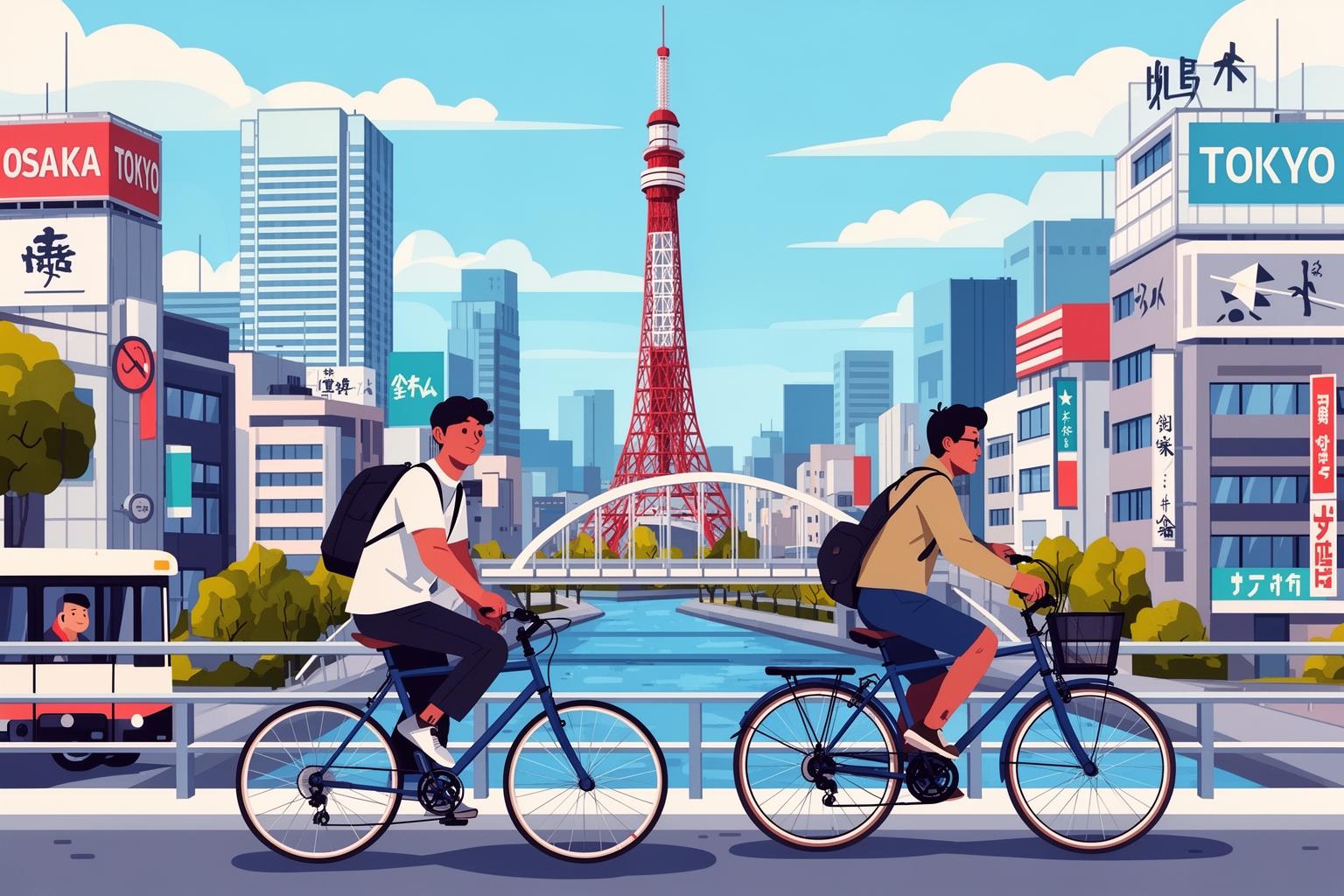
To truly grasp cycling in Osaka, you first need to understand the mamachari. The name literally translates to “mom’s chariot,” but that hardly captures its essence. This isn’t a quaint cruiser for a casual park ride. The mamachari serves as Osaka families’ SUV, minivan, and shopping cart all in one. It’s a marvel of practical engineering. These bikes are heavy, designed low to the ground for stability, and feature a robust double kickstand so you can load them up without tipping over. The front basket is spacious enough to hold a daikon radish, a bag of rice, and a six-pack of beer. The rear rack almost always carries a child seat resembling a pilot’s cockpit. Ambitious parents often add a child seat to the front as well. Recently, the electric-assist version has become the norm, offering a quiet yet powerful torque that allows them to accelerate swiftly from a stoplight, fully loaded, with surprising speed.
In Tokyo, a short store trip might mean walking or taking the subway one stop. In Osaka, for any journey under five kilometers, the mamachari is the default choice. It embodies a core Osaka value: katsudouryoku, meaning mobility and the power to act. Why waste time walking to the station, waiting for a train, and walking again when you can cut straight to your destination? The mamachari physically represents the city’s obsession with efficiency and practicality. It’s not about enjoying the ride; it’s about knocking out errands with ruthless speed. You’ll spot them everywhere, day or night, ridden by mothers, fathers, students, and seniors alike. They are the heartbeat of the city’s neighborhoods, the unsung heroes of daily life.
Sidewalk or Street? The Great Osaka Non-Debate
Here is the biggest source of confusion for newcomers: in Osaka, sidewalks are meant for bikes. While this isn’t strictly legal, laws here are often more like suggestions than strict rules. The reality is that many of Osaka’s streets are narrow and congested with delivery vans, buses, and taxis driven with a distinctively assertive style. For cyclists, especially those on a mamachari loaded with children and groceries, the street feels hazardous. As a result, the sidewalk becomes the unofficial bike lane.
This is where the unspoken social contract takes effect. It’s a complex, fluid interaction based on mutual awareness. Cyclists don’t just speed through; they anticipate pedestrians’ movements. Pedestrians, on the other hand, are familiar with the faint approach of a bike and often instinctively shift to one side without looking. This system relies on anmoku no ryōkai, a tacit understanding. The rule isn’t “don’t ride on the sidewalk.” It’s “don’t be a nuisance (meiwaku).” In Osaka, the definition of nuisance is flexible. Making a pedestrian step aside quickly isn’t a nuisance; it’s just an ordinary Tuesday afternoon on Tenjinbashisuji. However, colliding with someone is a serious violation of this unwritten code.
This sharply contrasts with Tokyo, where there is greater social pressure to obey the law precisely. There, you’ll see more cyclists riding on the road, and those on sidewalks tend to move at a pedestrian pace. In Osaka, the cyclist sets the pace. The expectation is that everyone stays alert and adapts accordingly. It’s a system that demands a high level of ambient awareness—a skill Osakans possess in abundance.
The Sound of Silence: The Bell is a Declaration of War
In most places, a bicycle bell is a polite auditory cue. “Excuse me, I’m passing through.” In Osaka, it’s a sonic blast of indignation. Ringing your bell at a pedestrian is considered extremely rude. It’s like honking your car horn at someone crossing the street. The message isn’t “pardon me,” but “move out of my way, you’re an obstacle.” It’s a direct and unnecessary confrontation in a system designed for smooth flow.
So, what’s the alternative? Silence and skill. A seasoned Osaka cyclist will weave through a crowded shopping arcade like Shinsaibashi-suji by reading gaps in the crowd. They adjust their speed, anticipate movements, and slip through openings that appear and vanish in seconds. If they absolutely must signal their presence, they might use a subtle click of the brake levers or a quiet cough. The aim is to pass through the human flow with minimal disruption. This preference for non-verbal communication is closely tied to local interaction styles. While Osakans are famously straightforward and blunt in conversation, in these small daily interactions, they prefer to avoid petty conflicts and just get on with things.
Parking Pandemonium: The Art of the Guerrilla Park
Finding a spot to park your bike is another area where Osaka’s practicality clashes with official regulations. Yes, there are designated bicycle parking lots (churinjo), especially near train stations. However, they are often full, charge a fee, and may be a block or two away from your actual destination. For an Osakan on a mission, that’s two blocks too far.
As a result, the city serves as a living museum of inventive bicycle parking. You’ll find bikes chained to guardrails, leaning against shop windows, tucked away in forgotten corners of public squares, and lined up with military precision under highway overpasses. This is guerrilla parking. The guiding principle combines optimism with situational ethics. “I’ll only be ten minutes,” the mindset goes. “As long as I’m not blocking a store entrance or an emergency exit, what’s the harm?”
Naturally, this approach carries risks. The city deploys teams to periodically collect illegally parked bicycles. They leave a dreaded warning sticker, and if the bike isn’t moved, it’s taken to a distant impound lot, reclaimable only after paying a fine. Every Osaka cyclist has either lost a bike this way or knows someone who has. It’s a calculated risk, a continual gamble against the system. This readiness to bend the rules for convenience and efficiency embodies Osaka. In Tokyo, the fear of causing inconvenience and stricter enforcement result in a much more orderly, though less convenient, parking environment.
Riding in the Rain: The Umbrella Ninja
Rain doesn’t stop Osaka, and it certainly doesn’t stop its cyclists. One of the city’s most iconic and puzzling sights is a person riding a bicycle with one hand on the handlebar and the other holding a full-sized umbrella against a downpour. It’s an astonishing display of balance, coordination, and sheer determination. To outsiders, it seems dangerously risky. To locals, it’s simply how you get to work when it’s raining.
This habit has become so ingrained in local culture that it inspired its own invention: the Sasube. This is a sturdy clamp that attaches to your handlebars, designed to hold your umbrella for you, creating a personal, mobile rain shelter. It’s a clever, slightly quirky innovation that could only have flourished in Osaka. It perfectly captures the local spirit: when faced with inconvenience, you don’t give in; instead, you devise a smart, practical, and slightly defiant solution so you can keep moving at full speed.
The Two-Wheeled Hierarchy: Who Yields to Whom?
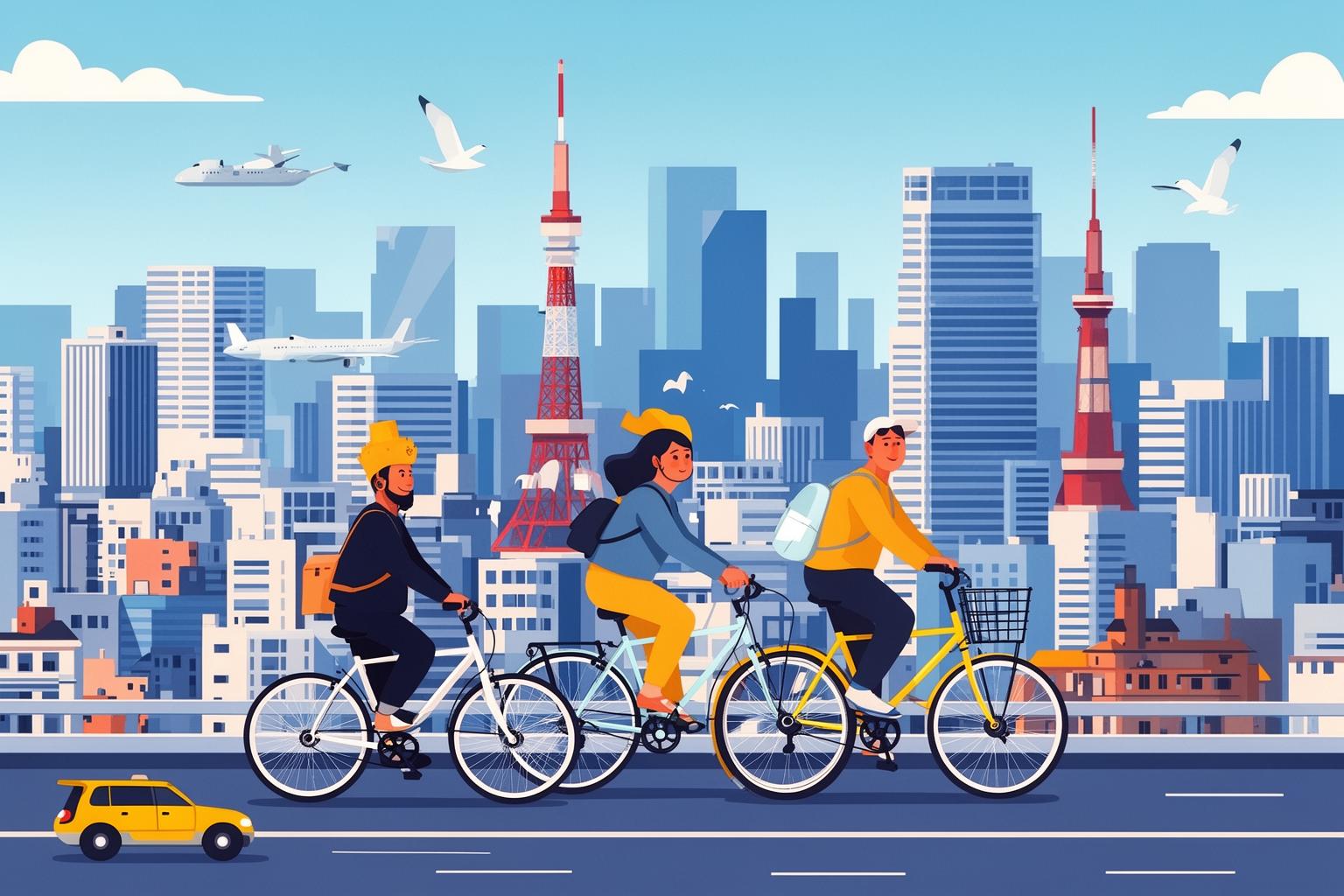
To navigate Osaka’s sidewalks effectively, you need to grasp the unspoken pecking order. This isn’t about laws; it’s about social physics—a complex interplay of momentum, age, and perceived importance.
At the very top of the hierarchy is the oba-chan (a colloquial term for an older woman) on an electric-assist mamachari. She has experienced it all and yields to no one. Her speed is deceptive, her path is non-negotiable. She is the apex predator of the sidewalk. When you see her coming, you step aside. It’s both a sign of respect and self-preservation.
Just beneath her is the parent on a mamachari carrying children. This precious and often surprisingly quick cargo requires a wide berth. Their mission—transporting a child to or from daycare—is regarded as sacred.
Next in line are the commuters and delivery people. Cycling with purpose, they know their route and are focused on their destination. They expect you to maintain your line.
Following them are students and casual cyclists, who tend to be more flexible and aware of their surroundings. And at the very bottom of this hierarchy? The pedestrian, especially one distracted by their smartphone. In the fluid, high-awareness environment of Osaka’s sidewalks, the oblivious pedestrian is a static obstacle everyone else must navigate around.
This system contrasts sharply with Tokyo’s more egalitarian, rule-based traffic culture, where the pedestrian in a crosswalk reigns supreme. In Osaka, right-of-way is asserted through a mix of speed, confidence, and one’s place in the informal hierarchy.
Beyond the Chaos: What It All Means
At first glance, Osaka’s bicycle culture may seem chaotic, as if the city is filled with rule-breakers. However, this is only a superficial impression. What you’re truly witnessing is a distinct kind of order—an organic, self-regulating system founded on shared assumptions and heightened awareness. It functions not despite the people, but because of them, depending on everyone constantly reading their surroundings and making subtle adjustments.
This behavior offers a clear insight into the Osaka mindset, revealing a pragmatic approach that prioritizes results over strict adherence to rules. The focus isn’t “Am I following the rule?” but rather, “Am I achieving my goal efficiently and without causing a major issue?” It embodies an individualism that operates within an unwritten communal framework. People concentrate on their own tasks while maintaining a mutual understanding of how to move together without collisions.
Moreover, it demonstrates a greater tolerance for the messy, unpredictable nature of urban life. Tokyo aims for a seamless society where every interaction is smooth and foreseeable. In contrast, Osaka embraces a certain degree of friction as an inevitable—and sometimes even effective—part of living in a dense, vibrant city. A near-miss on a bicycle isn’t a crisis but a non-event: a brief, silent negotiation that ends with everyone continuing on their way.
So, if you decide to live in Osaka, my advice is this: get a bike. But don’t ride it the way you would in Tokyo. Spend a week observing. Feel the rhythm. Watch the flow. Then hop on and find your place within it. Don’t be hesitant, but stay aware. Learn to anticipate, to yield, and to claim your space. Mastering the Osaka style of cycling is one of the quickest ways to stop feeling like a visitor and start grasping the powerful, practical, and endlessly captivating pulse of this city.