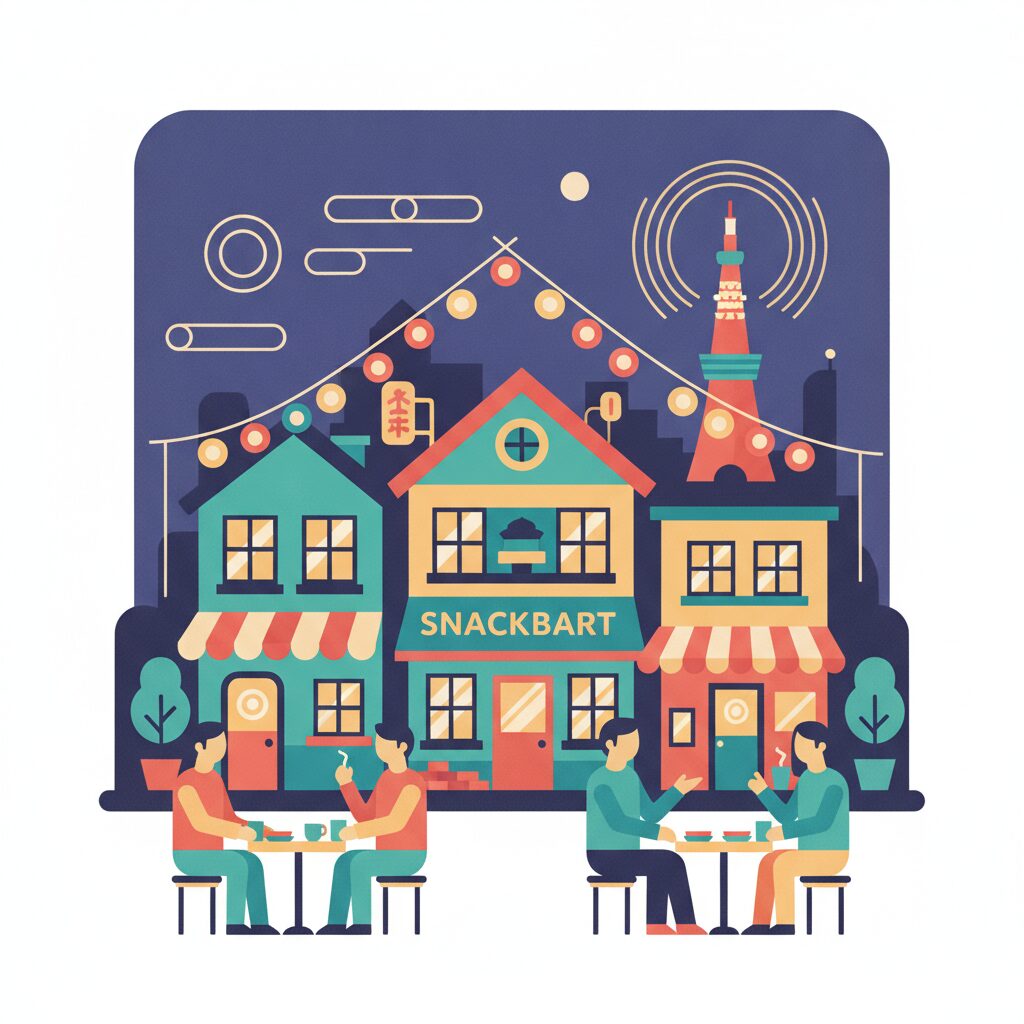
You’ve seen them. Tucked away on the second floor of a weathered building, down a narrow shotengai alley, or glowing softly on a quiet residential street. A simple sign, maybe with a kitschy name like “Snack Ami” or “Bar Seventeen,” a heavy door that betrays nothing, and the faint, muffled sound of a karaoke ballad trickling out into the night. Your first thought might be, “What even is that place?” It’s not a club, it’s too small. It’s not a restaurant, there’s no menu posted. It’s a sunakku, a snack bar. And if you really want to get under the skin of Osaka, to understand the city’s true rhythm and the bonds that hold its neighborhoods together, you need to understand what happens behind that mysterious door. This isn’t just a place to drink; it’s a vital organ of the community, a living room for the soul of the city. Forget the flashy lights of Dotonbori for a moment. The real story of Osaka is told over glasses of watered-down whiskey in these tiny, timeless establishments.
For a deeper look into the social intricacies that bind these neighborhoods, consider exploring our guide on Osaka’s osekkai culture to further illuminate the area’s charming community dynamics.
What Exactly is a “Snack Bar”? Unpacking the Mystery
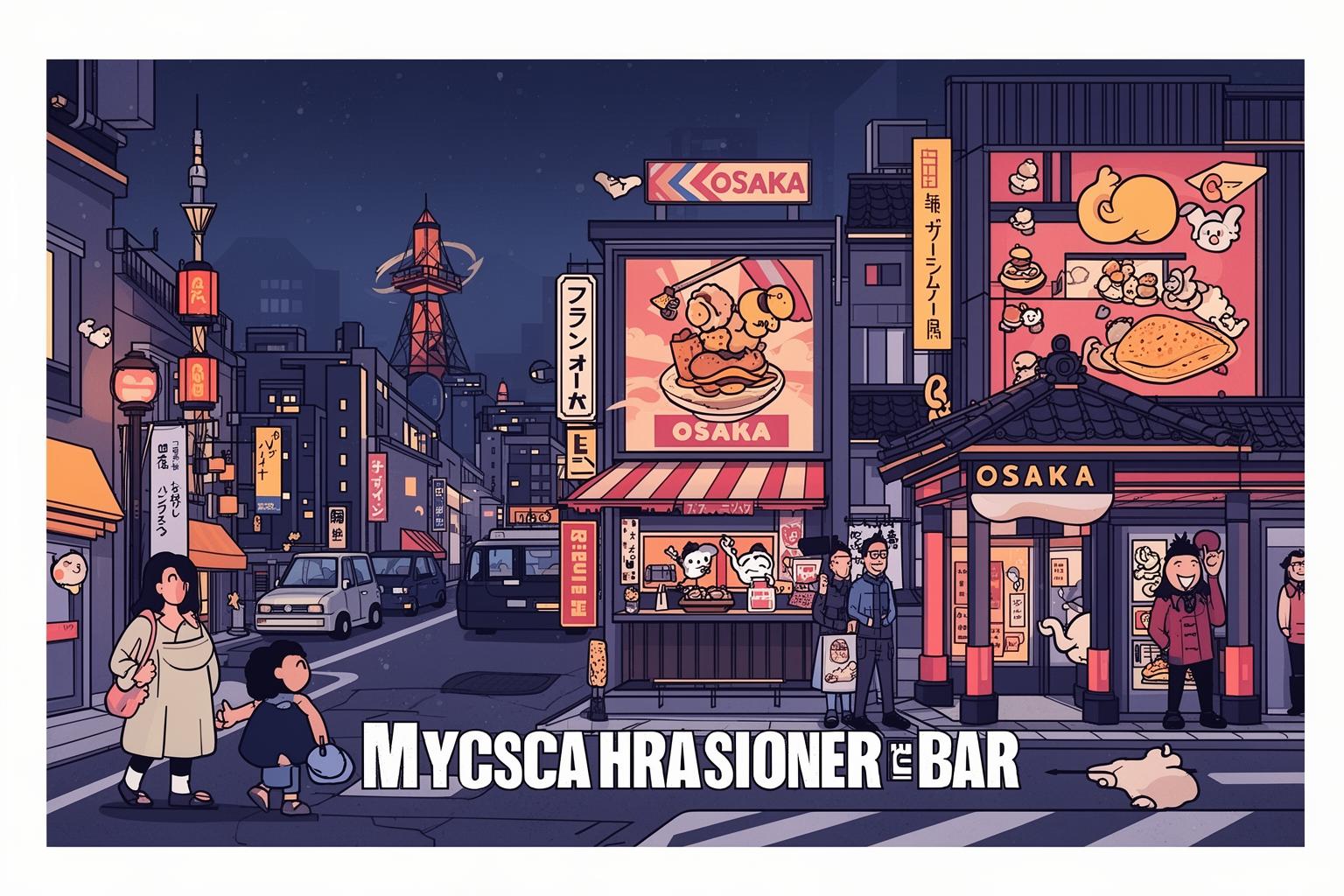
First things first, let’s clarify the name. A “snack bar” is one of Japan’s greatest misnomers. You don’t go there primarily for the food. While you might receive a small bowl of peanuts or rice crackers, the term is a holdover from a bygone era. A snack bar, or sunakku, is a distinctively Japanese institution: a small, cozy bar run by a proprietress affectionately called the “Mama-san.”
The layout is almost always consistent. A long counter dominates the space, with perhaps a few small booth tables towards the back. The lighting is dim, the decor often serves as a time capsule from the Showa Era (1926-1989), and somewhere in the corner sits the undisputed king of the snack bar: the karaoke machine.
However, the real key to understanding the snack bar is its business model, which can be confusing for newcomers. Unlike Western bars where you pay for each drink individually, most snack bars operate on a “set charge” system (setto ryōkin). This is a cover charge you pay simply to have a seat. It generally includes ice, water for mixing drinks, and those small bowls of snacks. You then order your drinks on top of that. For regulars, the system develops further. They often engage in “bottle keep” (botoru kīpu), where they purchase an entire bottle of whiskey or shochu, have their name written on it, and the Mama-san stores it behind the counter for their future visits. This system isn’t a tourist trap; it’s the whole point. It’s designed to foster a base of regulars, turning a simple bar into a sort of membership club—a place where you don’t just visit, you belong.
It’s important to distinguish a snack bar from a “girls bar” or a hostess club (kyabakura). While the Mama-san is a woman, this isn’t a place where you pay for flirtatious female companionship. The relationship with the Mama-san isn’t transactional; it’s familial, respectful, and built over years of shared conversations and off-key karaoke duets.
The “Mama-san”: More Than Just a Bartender
At the heart of every snack bar, the sun around which the neighborhood planets revolve, is the Mama-san. She’s more than just a bartender; she’s the community’s curator, a skilled listener, a trusted confidante, and the guardian of local secrets. Her duties go far beyond mixing highballs. She’s the one who recalls that Tanaka-san’s daughter just passed her university exams, that Sato-san’s company is facing challenges, and that Suzuki-san needs a gentle push to finally sing his favorite song.
Watching a Mama-san at work is like observing a master conductor. She effortlessly refills a drink, queues up a karaoke tune, listens carefully to a customer’s work woes, and playfully teases another about his golf game, all while ensuring the ice buckets are full. She cultivates an environment where people feel secure enough to be themselves, to vent their office frustrations, or to share a small personal triumph. She’s part therapist, part social coordinator, and part den mother for a circle of adults.
In a city like Osaka, known for its direct, human-to-human connections, the Mama-san’s role is essential. She is the center of the local network. She might connect a small business owner with a potential client sitting just three seats away. She might offer quiet life advice, delivered with that typical Osaka bluntness that’s both incisive and deeply caring. This personal touch contrasts sharply with the cool, professional anonymity of a trendy Tokyo cocktail bar. At a snack bar, you’re not just a customer; you’re one of Mama-san’s regulars, and that status comes with a genuine sense of belonging.
A Third Place for Osaka’s Working Class
Sociologists refer to the “third place”—a location that is neither home (the first place) nor work (the second place)—as vital for civil society and community building. In Osaka, the neighborhood snack bar epitomizes the third place. It serves as neutral ground where people from various backgrounds within the same neighborhood can meet and relax.
This concept is especially meaningful in Osaka, a city shaped by merchants and artisans. In contrast to Tokyo’s corporate culture, where after-work drinking often takes place in large, impersonal izakayas with strict hierarchical seating, Osaka’s social life feels more local and rooted. A salaryman might sit alongside the owner of a local tofu shop, a retired couple, and a young office worker living nearby in a small apartment. The snack bar breaks down social and professional barriers. Inside, everyone is simply part of the same small community.
Here, conversation isn’t about corporate strategy; it revolves around the Hanshin Tigers’ latest game, neighborhood news, or complaints about the weather. It acts as a pressure-release valve for the daily stresses of life. For many older men, single workers, or people living alone, the snack bar offers an essential source of social interaction and a strong antidote to loneliness. It is a place where they are recognized, where their presence is anticipated, and where they can speak openly without pretense. It functions as an extension of their living room, but with better company and a fully stocked bar.
Karaoke as a Social Lubricant, Not a Performance
And then there’s karaoke. To a foreigner, the ever-present karaoke machine might appear to be the main attraction, a chance for amateur singers to shine. But that’s a fundamental misunderstanding of its purpose in a snack bar. Here, karaoke is not about performance; it’s a form of communication. It’s a ritual of participation.
The aim isn’t to be a perfect vocalist. In fact, being too polished or professional might even be seen as missing the point. The real magic happens when a shy customer is finally encouraged by the Mama-san to sing, and their shaky rendition of a classic ballad is met with enthusiastic applause and cheers. It happens when everyone in the bar joins in on the chorus of a well-known song, creating a brief but powerful moment of unity.
This reflects a core aspect of the Osaka character called nori. It’s a tricky word to translate, but it means something like getting into the groove, feeling the vibe, and participating with enthusiasm. People from Osaka generally have less of the self-conscious reserve you might find in Tokyo. They value joining in over staying coolly detached. The snack bar karaoke is nori in its purest form. Singing a song—any song, no matter how off-key—is a way of saying, “I’m here with you. I’m part of this.” It’s a social lubricant that breaks down barriers and turns a room full of strangers into temporary friends.
Navigating Your First Snack Bar: An Insider’s Guide
The thought of pushing open that heavy door can feel daunting. Many snack bars are known for being regulars-only, and though the infamous “ichi-gen-san okotowari” (no first-time customers) sign is rare, it does exist. However, this is less about exclusivity and more about preserving the intimate, family-like atmosphere inside. Still, many, especially in less remote areas, are quite welcoming to newcomers who show respect and genuine interest.
If you want to take the plunge, here’s a practical tip. Going with a Japanese friend or colleague is the simplest way to get in. If you’re on your own, look for a bar that has a price list displayed outside—it’s a good indication they welcome new customers. When you enter, a simple, friendly “Konbanwa” (Good evening) goes a long way. The Mama-san will likely seat you at the counter.
Don’t hesitate to admit you’re a first-timer. You can say, “Hajimete desu” (It’s my first time). Feel free to ask her to explain the pricing system. This honesty is usually appreciated. Order a simple drink like a whiskey highball (haibōru). The set fee will be added to your bill at the end.
The most important rule is to engage. Don’t just sit in the corner on your phone. If someone nearby speaks a bit of English, strike up a conversation. If someone sings a song, applaud. If the Mama-san invites you to sing, give it a shot! No one expects a Grammy-worthy performance. Singing a well-known English song like something by The Beatles or Queen is often a crowd-pleaser. Your participation shows respect for the space and its culture. In Osaka, making an effort to connect is always more appreciated than being perfect.
Why Snack Bars Thrive in Osaka (And Feel Different from Tokyo)
Snack bars can be found throughout Japan, but they feel especially at home in Osaka. They embody the city’s core values in a tangible way. Osaka culture is often characterized as kote-kote (rich, heavy, almost over-the-top) and prioritizing honnē (one’s true feelings) over tatemae (the public facade). The snack bar provides a setting where this straightforward, unpretentious, and deeply human way of life can thrive.
Tokyo’s social scene frequently centers on what’s new, trendy, or featured in magazines. It can seem more curated and, at times, more impersonal. Osaka, in contrast, fiercely preserves its traditions. The snack bar is not fashionable; it hasn’t changed in decades, which is exactly why it appeals. It offers stability and a sense of continuity in a fast-changing world.
This reflects the city’s merchant roots. For centuries, Osaka’s business has been based on personal relationships and trust, often developed over food and drink. The snack bar is the contemporary version of this, a place where local information is shared and community ties are deepened. It’s a “wet” social space, full of emotional connection, unlike the “dry,” more transactional interactions found in other major cities.
To truly live in Osaka is to recognize that the city’s strength lies not in its gleaming skyscrapers, but in the complex network of human connections weaving through its neighborhoods. The snack bar is where that network is created, night after night. It’s a microcosm of the city itself: a little loud, unapologetically old-fashioned, and brimming with a warmth as intoxicating as the whiskey poured by the Mama-san. The next time you pass by one of those glowing signs, don’t just see a mysterious bar. See a sanctuary of community, the true heart of Osaka, beating steadily behind a closed door.