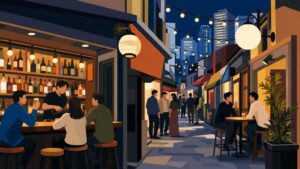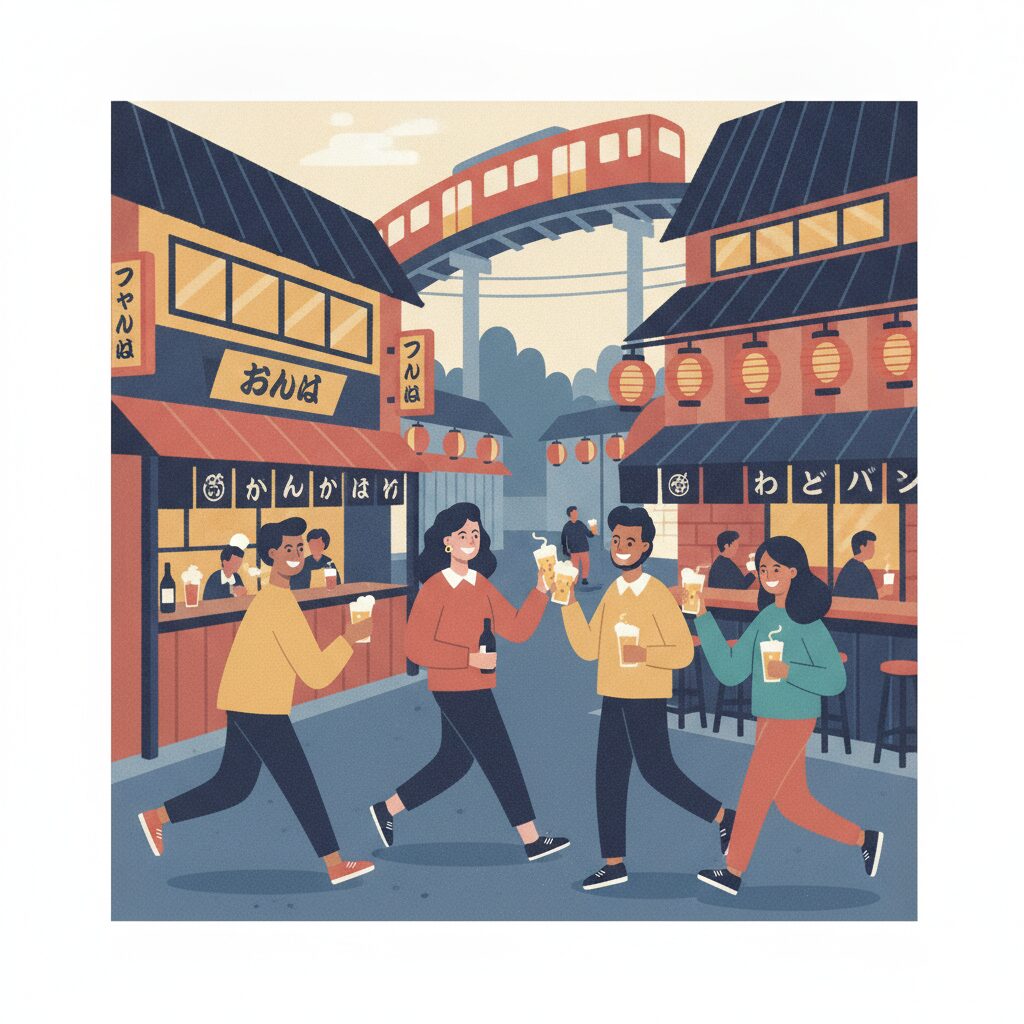
Walk out of JR Tenma Station on a Tuesday night. Not a Friday, not a holiday. Just a regular Tuesday. The air hits you first. It’s thick with the scent of grilled meat, dashi broth, and cheap, cold beer. The sound comes next, a rising tide of laughter, shouting, and the percussive clatter of plates and glasses. This isn’t a special event. This is just Tenma, breathing. For a newcomer, especially one accustomed to the more measured social cadences of, say, Tokyo, the scene can feel like stepping into a human beehive. Hundreds of tiny, open-fronted bars, restaurants, and standing-only tachinomi joints are crammed into a labyrinth of narrow streets and covered arcades. People spill out onto the pavement, drinks in hand, their conversations bleeding into one another, creating a single, pulsing roar of humanity. It’s easy to see this as chaos, a frantic rush to drink. But you’d be missing the point entirely. This isn’t chaos; it’s a highly refined, deeply cultural ritual. This is the Osakan art of hashigo-zake—the bar crawl—and understanding it is one of the fastest ways to understand the soul of this city. It’s a world away from the reserved, meticulously planned nights out you might find elsewhere in Japan. In Tenma, the plan is to have no plan. The goal isn’t just to drink; it’s to connect, to move, to taste, and to immerse yourself in a river of shared experience, one small bar at a time. This is where Osaka sheds its formalities and reveals its true, unpretentious, and relentlessly social heart.
For those eager to explore even more about Tenma’s unique drinking ritual, our guide on hashigo-zake culture reveals the insider secrets behind each bar crawl.
The Philosophy of Perpetual Motion: ‘Saku-nomi’ and the Rejection of the Reservation

In Tokyo, a night out usually starts with a reservation. You book a table at an izakaya for a set time, gather your group, and settle in for a few hours. The evening has a defined structure, a beginning and an end, all contained within four walls. Osaka, and Tenma in particular, follows a completely different principle: continuous movement. The key concept here is saku-nomi, which roughly means “a quick drink.” But it’s more than that; it’s a philosophy. It’s the idea that you stop by a place for one beer and one plate of something tasty, and then you move on. The whole ecosystem of Tenma is designed to support this fluid, nomadic way of socializing.
Consider the architecture of the bars themselves. They are mostly small, many of them tachinomi, or standing bars, with space for maybe ten people packed tightly together. The fronts are often wide open to the street, with plastic curtains as the only flimsy shield from the elements. There are no cozy booths, no private rooms, no comfortable chairs to lounge in for hours. This is deliberate. The design of a Tenma bar says, “Come in, have fun, but don’t get too comfortable.” It’s an environment built for high turnover and constant movement. This might seem fleeting or impersonal, but it’s quite the opposite. It’s a system that maximizes the chance for social encounters. By spending only twenty or thirty minutes in one spot, you’re not dedicating your entire evening to one group or one setting. You’re free to drift, to follow a scent, to be drawn by a lively crowd.
This reflects a core Osakan trait: a practical mindset combined with an almost allergic dislike of pretense. Why settle on one place when there are a hundred other potentially great experiences just a few steps away? This attitude stems from Osaka’s history as a merchant city. Merchants valued efficiency, good value (kosupa, or cost performance), and quick, decisive action. You see this in the Tenma bar crawl. There’s no time wasted on elaborate ceremonies or formalities. You enter, order, eat, drink, pay, and leave. It’s a beautifully efficient social exchange that removes everything but the essentials: good food, good drink, and the possibility of lively conversation. Making a reservation a week in advance for a two-hour slot feels absurdly restrictive and inefficient to a Tenma regular. The joy is in the spontaneity, the freedom to create your own adventure on the spot.
A Cacophony of Connection: The Sound and Flavor of a Tenma Night
Step into the Tenma maze and close your eyes. The sound is overwhelming. It’s not merely the murmur of conversation you’d expect in a European pub or a quiet Tokyo bar. It’s a vibrant symphony of human interaction. There are the bellowed greetings of “Irasshai!” from the staff, the sharp calls of “Chuumon onegaishimasu!” (Order please!), the clatter of chopsticks on ceramic, and a constant, high-energy hum of conversation that borders on a roar. In many cultures, and certainly in much of Japan, this level of noise would be seen as disruptive or rude. In Tenma, it’s the soundtrack of a good time—an indication that the place is thriving, people are connecting, and the energy is just right.
For many Osakans, a quiet bar feels suspicious. Silence suggests something is amiss. The noise serves as social proof, reassuring you that you’ve arrived at the right spot. This comfort with public loudness distinguishes Osaka from Tokyo. Whereas Tokyoites often cultivate an aura of public anonymity, even in crowds, Osakans draw energy from being part of the collective. They are less focused on maintaining a personal bubble of quiet and more interested in contributing to the overall communal vibe. This is why conversations between complete strangers are not only possible but likely. The high volume acts as a social lubricant; you almost have to raise your voice to be heard, and this act of projecting outward helps break down initial inhibitions.
Then there’s the food. A Tenma bar crawl is as much a culinary tour as it is a drinking one. Yet, it’s done with that signature Osakan efficiency. You won’t find complex, multi-course meals here. Instead, you’ll encounter laser-focused menus of specialties, executed perfectly and served quickly. One tiny stall might offer nothing but grilled scallops topped with uni for 500 yen. The place next door could be a shrine to horumon (grilled offal), serving rare cuts on skewers. Around the corner, a standing sushi bar sells single pieces of fresh tuna for 150 yen. The idea is to have one or two signature items—the bar’s “killer content”—that are affordable, delicious, and quick to eat. This lets you sample a dozen different culinary experiences in one night without breaking the bank or feeling too full. It’s the culinary equivalent of the saku-nomi philosophy: maximum variety, minimum commitment. It embodies the kuidaore (“eat ’til you drop”) culture Osaka is famous for, but done in a fast-paced, modern, and incredibly social way.
The Shrinking Personal Bubble: How Strangers Become Neighbors for a Night
Perhaps the most striking culture shock for a foreigner in Tenma isn’t the food or the noise, but the close physical proximity to others. The idea of personal space, so carefully preserved in many Western cultures and even elsewhere in Japan, becomes flexible, almost nonexistent here. In a typical tachinomi, you’ll be standing elbow-to-elbow, back-to-back with strangers. You’ll have to excuse yourself to reach the counter, and someone’s backpack will likely brush against you. To an outsider, this can feel intrusive. But for the regulars, this enforced closeness is the whole point. It acts as a social catalyst.
When you’re standing less than a foot from someone, ignoring them feels more awkward than acknowledging them. This physical closeness systematically breaks down the barriers that usually exist between strangers. A simple “Sore, nandesuka?” (“What’s that you’re eating?”) can easily turn into a half-hour conversation. People will offer you a bite of their food. They’ll ask where you’re from, what you do, and—most importantly—what you’re drinking next. This is the renowned Osakan friendliness in its natural setting. It’s not a myth, nor is it a vague, abstract warmth. It’s a friendliness born of circumstance, a practicality. In a city built by merchants, making connections was a survival skill. You had to size someone up, quickly build rapport, and find common ground. That legacy persists in the cramped bars of Tenma.
This sharply contrasts with Tokyo’s social dynamics. On a crowded Tokyo train, for example, the unwritten rule is to act as if no one else exists. You avoid eye contact, retreat into your phone, create a psychological barrier of personal space. In a crowded Tenma bar, the rule is quite the opposite: acknowledge the crowd, engage with it, become part of it. This can be unsettling for foreigners who misread it. They might see direct questions like “How old are you? Are you married?” as intrusive. But in the Osakan context, these questions often serve as the quickest way to forge a connection. It’s not an interrogation; it’s a shortcut to familiarity. It expresses what Osakans call ningen-kusai, or “human-smelling”—an affection for the raw, messy, unpolished aspects of human interaction.
The Tenma Code: Unwritten Rules of the Crawl
Navigating Tenma successfully isn’t about following a map; it’s about grasping the unspoken social contract. A few key principles, once understood, unlock the entire experience.
Don’t Get Comfortable
This is the golden rule. The soul of the hashigo-zake is movement. Find a spot, have a drink and a snack, enjoy the atmosphere, then move on. Lingering more than an hour in a small, crowded standing bar is considered poor manners. It disrupts the flow, the nagare, of the evening. You’re occupying valuable space that another wanderer is eager to experience. The beauty lies in the churn. Paying your bill and stepping back out into the night isn’t an ending; it’s a transition to the next chapter. A successful night in Tenma may involve four, five, or even six different venues.
Bring Your Coins
While the world shifts towards digital payments, much of Tenma remains steadfastly analog. Many of the smallest, most charming stalls are cash-only. This isn’t due to technophobia; it’s about speed. A cash transaction is instantaneous. You slap your coins on the counter, receive your change, and the exchange is done. It’s another small element that keeps the night’s rhythm flowing smoothly. Fumbling with a credit card you know won’t be accepted marks you as someone who doesn’t quite get it.
Read the Air, Osaka-Style
The Japanese concept of kuuki wo yomu, or “reading the air,” is famous for its subtlety. In Tenma, you still need to read the air, but the signals are much less subtle. People are more direct. If someone starts a conversation with you, it’s almost certainly a genuine invitation to chat. Conversely, if a group is deep in a private conversation, you’ll know it. There isn’t the same ambiguity you might find in Kyoto or Tokyo. People’s intentions are generally clear on their faces. Don’t hesitate to initiate a conversation, but also don’t take it personally if it doesn’t catch on. The Osakan approach is often to try, and if it fails, just laugh it off and move on. There’s little room for social awkwardness when the next bar is only ten seconds away.
More Than a Night Out: Tenma as a Microcosm of Osaka

Ultimately, a bar crawl through Tenma is much more than a mere act of consumption. It’s a dynamic, living expression of Osakan identity. It serves as a weekly vote against the polish, pretense, and predictability often found in other major cities. It’s messy, loud, unapologetically human, and fiercely proud of these traits. The entire experience mirrors Osaka’s historical DNA as a city rooted in commerce. The focus is on value, efficiency, and—most importantly—the human connections that keep life running smoothly.
While a Tokyoite might seek a carefully curated, aesthetic experience, the Osakan in Tenma looks for something genuine and unscripted. They aren’t after the perfect Instagram shot; they want a real conversation. They don’t care about a famous chef’s signature dish; they want a tasty plate of grilled intestines served by someone they’ve known for years. This is often misunderstood by foreigners. They see the low prices and chaotic vibe and might dismiss it as low-brow. But that misses the deeper cultural meaning. In Tenma, the lack of polish is the point. It’s a statement that what truly matters isn’t fancy decor or an exclusive location, but the quality of the food, the cold beer, and the warmth of the person beside you.
So, if you really want to grasp what daily life in Osaka is like, set aside the guidebook. Forget the famous landmarks for an evening. Head to Tenma with an open mind and some cash in your pocket. Let yourself be swept up in the flow of people. Squeeze into a tiny bar, order a highball, and simply listen. Watch. And if someone next to you asks what you’re drinking, don’t be surprised. Just answer them. You’re not just having a drink; you’re joining the real, vibrant, and enduring culture of Osaka.