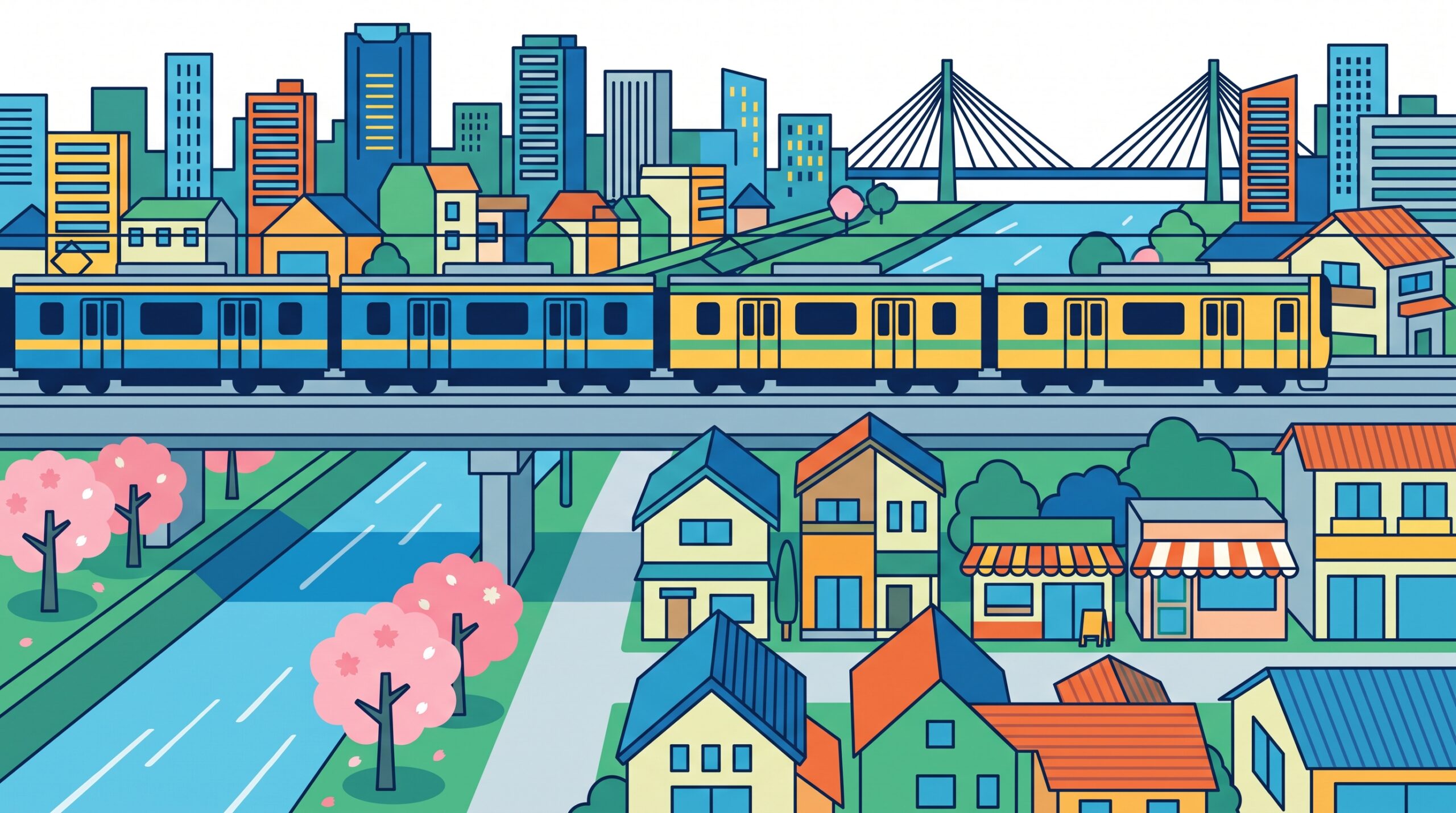
You step off the bullet train at Shin-Osaka station and the air immediately feels different. The sterile, hushed whispers of Tokyo fade into the rearview mirror of your mind. Here, the voices are louder. The walking pace is a fraction faster, yet somehow infinitely less rigid. You have arrived in Osaka. But arriving is not the same as understanding. Many foreign residents move to this sprawling metropolis and make their first critical mistake before they even unpack their bags. They choose an apartment based purely on its distance to a central hub like Umeda or Namba. They look at a map, draw a neat little circle, and assume that geography alone dictates the quality of their daily life. This is a profound misunderstanding of how Osaka works. In Osaka, your geography is secondary. Your train line is your destiny.
Tokyo is a city defined by its wards. Shinjuku, Shibuya, Minato, Setagaya. Those names carry heavy, immovable stereotypes. Osaka is different. Osaka is a city defined by its steel arteries. The private railway companies that carved their way into the city center over a century ago did not just build train tracks. They built entire suburban cultures. They built department stores, amusement parks, baseball stadiums, and residential tracts. They engineered the very social fabric of the neighborhoods they serve. When you meet a local and tell them where you live, they do not just hear the name of a ward. They hear the name of the train line you ride. They immediately know whether you prefer polished elegance, working-class grit, quiet isolation, or chaotic vibrancy. They know how you spend your weekends. They might even guess what newspaper you read.
To live in Osaka is to align yourself with a specific rhythm of transit. The difference between riding the maroon-colored Hankyu trains into the north and riding the stainless-steel Nankai trains into the deep south is not just a matter of compass directions. It is a shift in cultural tectonic plates. The language changes. The fashion changes. The unspoken rules of eye contact and personal space shift subtly but unmistakably. Foreigners often come to Osaka armed with the exhausting cliché that the city is simply friendly. They expect a monolithic landscape of gregarious street food vendors and slapstick comedians. That surface-level warmth exists, heavily rooted in centuries of transactional merchant culture where making a stranger feel welcome was the fastest way to make a sale. But beneath that pragmatic friendliness lies a complex, deeply layered society highly stratified by its railway lines. Understanding this network is the key to decoding daily life in Japan’s most fiercely independent city.
Navigating Osaka: An Overview of the Train and Subway System
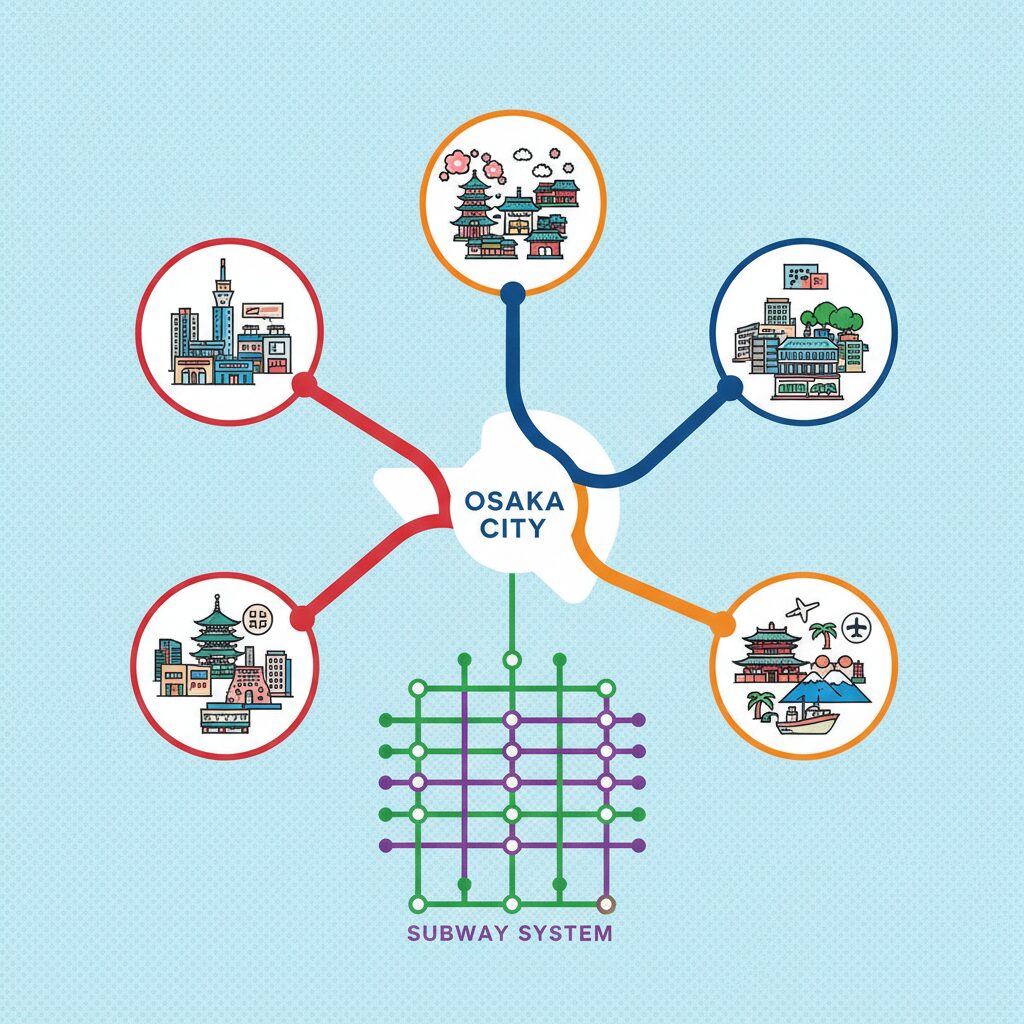
Before grasping the cultural nuances of the private suburban lines, you must first understand the fundamental structure of the city. Osaka’s transit network is a vast, intertwining web of municipal subways, national railways, and private commuter lines. For someone new, staring at the transit map resembles a bowl of spilled spaghetti. Lines intersect, merge, change names, and end in seemingly random spots. Yet, there is a method to this madness.
At the heart of the city lies the Osaka Metro, the subway system that serves as the backbone of the urban center. It runs beneath the main avenues, mostly following a strict grid pattern that mirrors the city’s ancient layout. Running alongside and intersecting this grid is the JR, or Japan Railways, network. Originally state-owned, JR operates regional and national lines, linking Osaka to the rest of Japan while maintaining a crucial loop encircling the inner city. Extending outward from the primary terminal stations like spokes on a giant wheel are the private railways: the Hankyu, Kintetsu, Nankai, Keihan, and Hanshin lines. These lines ferry millions of commuters from surrounding prefectures and suburban areas into the city center each morning and carry them back every evening.
Deciding where to base yourself means understanding the difference among these three systems. The Osaka Metro efficiently navigates the downtown core. The JR Lines connect you to adjacent prefectures and offer a chaotic yet practical circular route. But the private lines shape your daily living environment—they are the architects of your neighborhood.
Essential Osaka Train Lines for Tourists and New Residents
To truly understand the city’s rhythm, you must first become well-acquainted with its main arteries. These are the routes new residents travel almost daily, linking the commercial centers with the historic districts. The Osaka Metro has thoughtfully color-coded its network, creating a visual language that locals rely on constantly. You don’t just memorize the names of the lines; you recognize their colors. You watch for the signs and follow the colored stripes painted on the floors of the sprawling underground transfer stations.
The Midosuji Line (Red): Osaka’s Central Artery
No line is more essential, renowned, or packed than the Midosuji Line. Marked in striking Red, it forms the very backbone of Osaka. Running straight north to south, it cuts through the city’s most vital economic and cultural zones. If Osaka has a heartbeat, it pulses along the Midosuji Line, connecting Shin-Osaka in the north, passing through the corporate towers of Umeda, the historic pharmaceutical and financial neighborhoods of Yodoyabashi and Hommachi, rushing into the lively entertainment hubs of Shinsaibashi and Namba, and ending in the bustling southern district of Tennoji.
Living near the Midosuji Line means you are always in the center of things. It is the ultimate route for tourists and commuters alike. But this unrivaled convenience comes with a cost. The morning rush hour on the Midosuji Line is a masterclass in crowding. You find yourself shoulder to shoulder with countless salarymen, students, and shop workers. The air feels heavy, the silence dense, broken only by the rhythmic clatter of the tracks and the automated announcements. Nevertheless, the architecture of the older Midosuji stations is breathtaking. Umeda and Shinsaibashi boast vast vaulted ceilings adorned with grand chandeliers, a legacy from the 1930s when the city aimed for its subway to rival Europe’s grand public projects. Living near a Midosuji station means higher rent, but it also guarantees you’ll never have to worry about missing the last train home after a night out in Minami.
The JR Osaka Loop Line: The City Circle
If the Midosuji Line is the city’s straight spine, the JR Osaka Loop Line is its ribcage. It encircles the central wards, much like Tokyo’s famous Yamanote Line. However, comparing the two overlooks the raw character that defines Osaka. The Yamanote Line is polished, predictable, and remarkably uniform in style, whereas the JR Osaka Loop Line is chaotic, rusted in places, and fiercely diverse.
Riding the full loop offers a fast-paced tour of Osaka’s many faces. You pass the gleaming skyscrapers near Osaka Station, travel through the Korean neighborhoods of Tsuruhashi, where the scent of grilled meat fills the train cars, skirt Tennoji’s blend of ancient temples and modern glass towers, and cross the gritty, working-class industrial districts along the western bay. Living near a Loop Line station provides excellent access, especially if you frequently travel to Kyoto or Kobe on the connecting JR lines. The neighborhoods along the eastern and southern sides of the loop, like Tamatsukuri or Teradacho, offer an authentic, unpolished glimpse of everyday life. Here, narrow streets are lined with old wooden houses, tiny standing bars where locals sip warm sake from glass tumblers, and a strong neighborhood spirit that downtown high-rises rarely offer.
The Chuo Line (Green): Bay Area to Osaka Castle
Stretching horizontally from west to east is the Chuo Line, marked by its Green color. This line represents commerce, history, and futuristic vision. Beginning in the expansive western Bay Area, the line runs above ground, offering views of massive port facilities, the giant Tempozan Ferris wheel, and the sprawling event venues slated to host the World Expo. It then descends underground, crossing the Midosuji Line at Hommachi, before resurfacing near the impressive stone walls and moats of Osaka Castle.
The Chuo Line acts as a crucial link between the city’s historical core and its industrial maritime frontier. Living along its western stretch, in neighborhoods like Osakako or Bentencho, means adopting a quieter, more spacious lifestyle. Ocean breezes sweep through wide streets, and you exchange the central city’s density for large supermarkets and expansive parks. This side of Osaka, largely unseen by most short-term visitors, reveals a landscape of shipping and logistics, a reminder that this city was built on trade.
The Sakaisuji Line (Brown): Access to Retro Osaka
Parallel but slightly to the east of the Midosuji Line runs the Sakaisuji Line, identified by its Brown color. This fitting hue represents a line that connects you to the deep-rooted history of merchant Osaka. The Sakaisuji Line bypasses the ultra-modern Umeda district, instead serving traditional commercial areas. It passes through Kitahama, home to the old stock exchange framed by retro brick buildings with stylish riverfront cafes, continues through Nippombashi, the electric town and pop-culture center, and ends near the retro-futuristic Shinsekai neighborhood.
Riders of the Sakaisuji Line often differ from the corporate crowd on the Midosuji Line. Here you’ll find older merchants, antique dealers, wholesale fabric buyers, and chefs heading to the bustling Kuromon Market. Choosing to live near the Sakaisuji Line, perhaps around Minamimorimachi or Ebisucho, places you firmly in Osaka’s historical core. You’re surrounded by traditional shopping arcades where local grandmothers haggle over the price of daikon radishes and where the rhythmic buzz of daily trade feels more personal and less corporate.
The Private Railways: Architects of Osaka’s Suburban Soul
While the Metro and JR lines transport people around the city center, the private railways shape the residential outskirts. Over a century ago, visionary railway entrepreneurs recognized that merely laying tracks between cities was insufficient to ensure profit. They needed to generate ridership by giving people a reason to travel. Their solution was groundbreaking. They constructed massive terminal department stores at city stations, providing unmatched luxury and entertainment. Then, they acquired inexpensive farmland along their new tracks and developed pristine, planned suburban neighborhoods.
They sold a dream: work in the busy, smoky city center, shop at our magnificent department store, and then take our comfortable trains back to your quiet, modern suburban home. This business model fundamentally transformed the culture of the Kansai region. It forged highly distinct neighborhood identities based entirely on which company built the tracks. Today, choosing between the Hankyu, Kintetsu, or Nankai lines as your base is not merely a logistical choice. It is a cultural statement.
Hankyu Railway: The Maroon Fleet of Northern Elegance
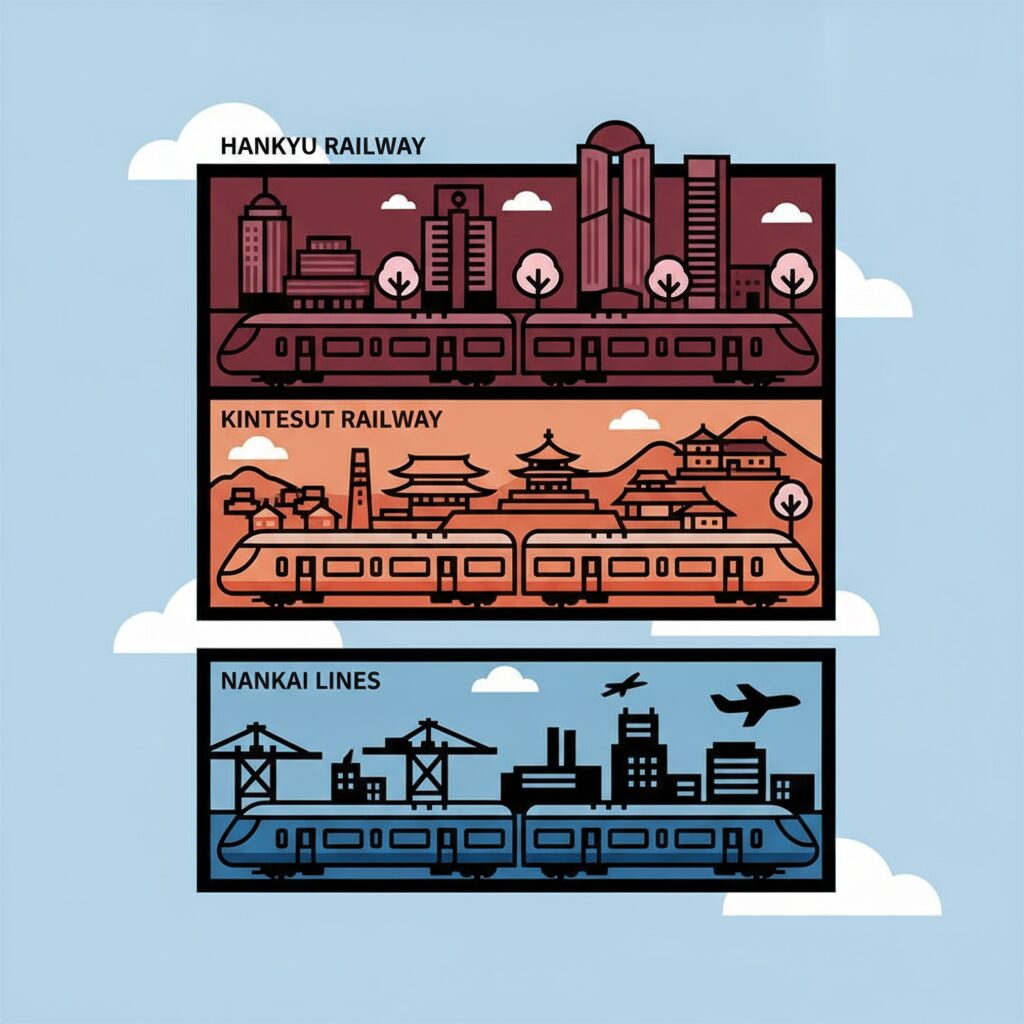
Speaking of the Hankyu Railway is to evoke thoughts of ambition, refinement, and a fierce yet quiet pride. Hankyu trains are instantly identifiable by their rich, glossy maroon color—a hue the company has steadfastly and proudly preserved for decades. Their interiors are equally distinctive, adorned with faux wood paneling and plush, olive-green velvet seats that resemble antique theater furniture more than typical transit seating.
Hankyu dominates the northern sector of the city, linking the bustling hub of Umeda to the upscale cities of Kyoto, Kobe, and Takarazuka. Ichizo Kobayashi, Hankyu’s founder, pioneered the private railway business model. He didn’t merely build a train line; he created the renowned Takarazuka Revue, an all-female musical theater troupe designed to attract crowds to the line’s terminus. He introduced the concept of the station department store and nurtured an image of upper-middle-class sophistication that remains fully intact today.
The Hankyu Kobe Line: Aspirational Living
The Hankyu Kobe Line epitomizes residential aspiration in the Kansai region. Running alongside the mountains, it connects Umeda with the cosmopolitan port city of Kobe. The neighborhoods along this route, such as Shukugawa and Okamoto, are famous for their elegant bakeries, refined cafes, and breathtaking cherry blossom promenades. Locals often describe the residents and passengers of this line as possessing a uniquely cultivated aura.
Boarding a train on the Hankyu Kobe Line reveals a subtle shift in atmosphere. Conversations are noticeably quieter, and fashion leans toward conservative, polished styles. You’ll see private school uniforms, designer handbags, and an overall air of quiet confidence. Many foreign residents choose to live near Hankyu lines because they seek a peaceful, orderly, and aesthetically pleasing daily environment. It contrasts starkly with the neon-lit stereotypes of downtown Osaka—a life marked by weekend hikes in the Rokko mountains followed by afternoon tea in exquisitely restored Western-style homes.
The Hankyu Takarazuka and Kyoto Lines: Tradition Meets Suburbia
Other Hankyu branches share a similar prestige, each with its own distinct character. The Takarazuka Line winds through historic, affluent residential areas, heading toward the hot spring resort and theater grandstand that launched the company’s cultural empire. The Kyoto Line provides a fast, comfortable connection to the ancient capital, favored by university professors, traditional artisans, and commuters balancing the historic weight of Kyoto with Osaka’s commercial vitality.
Living north of the Yodo River, primarily served by Hankyu, places you in a historically wealthier and culturally more conservative environment than the south. It’s an ideal base for families, academics, and professionals who want easy access to the lively Umeda center yet demand tranquility at home. The trade-off is a slight distance from the gritty, raw energy that defines Osaka’s reputation—you reside in Osaka but experience its most polished, restrained form.
Kintetsu Railway: The Sprawling Eastern Giant
If Hankyu symbolizes the refined, affluent north, Kintetsu embodies the vast, hardworking, and historically rich east. Kinki Nippon Railway, commonly known as Kintetsu, is a vast conglomerate. It operates Japan’s largest private railway network, extending well beyond Osaka’s borders into Nara, Kyoto, Mie, and even as far as Nagoya.
The Kintetsu lines that branch out from hubs like Namba, Uehommachi, and Tsuruhashi dive straight into the working-class core of eastern Osaka. This area serves as the industrial powerhouse of the region. Higashiosaka, a sprawling city heavily served by Kintetsu, is nationally renowned for its dense cluster of small and medium-sized manufacturing plants. It’s said that the factories in Higashiosaka can produce anything from a simple screw to satellite components.
Connecting Osaka to Nara and Beyond
Kintetsu serves as the main link for travelers moving between Osaka and the ancient, deer-populated parks of Nara. The Kintetsu Nara Line cuts directly through the rugged Ikoma mountain range. Riding this line offers a striking experience: the train departs the dense, flat urban expanse of Osaka, climbs steep slopes, plunges into long, dark tunnels, and emerges into the peaceful, temple-rich basin of Nara Prefecture.
Choosing to live along the Kintetsu lines heading east is a practical decision. Rent drops considerably once you cross the city limits. You gain more space and easier access to the mountains. Yet, thanks to Kintetsu’s rapid express trains, you can still reach Namba in under twenty minutes.
The Working-Class Heartbeat of East Osaka
The cultural character of Kintetsu riders is noticeably distinct from that of Hankyu passengers. Here, the atmosphere feels earthier, louder, and more straightforward. You’ll see factory workers in rugged jackets, high school rugby players lugging large duffel bags, and older men returning from a day at the races. Conversations are lively. The Osaka dialect in this area is thick, rhythmic, and filled with humor and practical observations.
Living along this eastern corridor immerses you in the everyday life of working-class Japan. You shop at local butcher shops run by families for three generations. You dine at humble okonomiyaki restaurants where the owner recognizes your face by the second visit. Foreigners settling along the Kintetsu lines often experience a strong and rewarding sense of community. The people here are famously direct; they’ll ask where you’re from, what you do for a living, and how much your shoes cost within minutes of meeting you. This isn’t rude—it’s the purest form of Osaka friendliness, an honest and open engagement with the world around them.
Nankai Electric Railway: The Southern Gateway
Traveling south from Namba on the Nankai Electric Railway leads you into the deep south of Osaka, a region with a distinctly strong local identity, a fiercely independent history, and a culture that feels worlds apart from the polished skyscrapers of the north. Nankai operates two main lines. The Main Line follows the coast, passing through the historic port city of Sakai, the castle town of Kishiwada, and ultimately connecting to Kansai International Airport and Wakayama. The Koya Line heads inland, traversing suburban residential areas before ascending into the remote, sacred mountains of Koyasan.
The Nankai trains themselves embody a practical, no-frills aesthetic. While limited express trains like the futuristic, blue Rapi:t provide fast, comfortable service to the airport, the local commuter trains are simple, stainless-steel workhorses.
Deep South Vibe: Sakai and Kishiwada
The neighborhoods along the Nankai Main Line are rich in ancient history. Sakai, just south of Osaka City, was once a self-governing merchant city during the feudal period, fiercely independent and extremely wealthy through foreign trade. That independent spirit remains strong. The people of southern Osaka take great pride in their heritage.
This region is famous for the Danjiri Matsuri, an aggressively thrilling, dangerously fast float-pulling festival held in Kishiwada. The festival’s energy permeates the daily culture of the south. The dialect is more robust. The humor is sharper. The unspoken social etiquette is somewhat more relaxed. For outsiders, the experience on the Nankai line might initially feel a bit daunting. The quiet reserve seen in Tokyo or on the Hankyu line is completely absent here. If someone bumps into you, expect a loud, boisterous apology. If you appear lost, a grandmother might firmly grab your arm and guide you to the correct platform.
Living along the Nankai Main Line offers numerous advantages. You have immediate access to the ocean. You are the first to reach the airport. The cost of living is surprisingly low, and the food culture—especially the seafood from the southern ports—is outstanding.
The Nankai Koya Line: From City Hustle to Mountain Serenity
The Nankai Koya Line presents a striking contrast. It starts amid the chaotic, neon-lit heart of Namba and travels through densely populated middle-class suburbs. As it pushes further south, the scenery changes dramatically. Concrete gives way to dense forests. The track narrows to a single line winding through steep mountain passes.
Living along the suburban stretches of the Koya Line is a popular choice for families. Here, you get the straightforward, unpretentious culture of southern Osaka paired with quiet, spacious residential neighborhoods. It’s a grounded, deeply authentic place to live, surrounded by the real Osaka—a community where neighborly ties are strong, local shopping streets remain central to daily life, and pretension is quickly recognized and openly ridiculed.
Major Osaka Neighborhoods and Their Train Connections
Understanding the extensive railway networks is essential, but eventually, you must connect those steel lines to the physical geography. Foreign tourists and new residents naturally gravitate toward the major hubs. Deciding which hub to build your life around requires a clear understanding of which trains converge there and the type of culture that convergence fosters.
Kita (Umeda): The Northern Transit Hub
Kita, meaning simply North, is the area surrounding the enormous Umeda station complex. This is the undisputed corporate and commercial center of modern Osaka. It is a dizzying, hyper-modern environment filled with glass skyscrapers, extensive underground shopping mazes, and luxury department stores.
Umeda is not just one station; it is a vast, interconnected entity that includes JR Osaka Station, the Hankyu and Hanshin terminal stations, and three different Osaka Metro lines, including the crucial Red Midosuji Line. Living in or near Kita means prioritizing maximum connectivity and absolute modernity. You are surrounded by international businesses, upscale dining, and a continuous flow of polished commuters. The atmosphere is fast-paced, professional, and somewhat sterile compared to other parts of the city. You are perfectly positioned to catch a Hankyu train to Kyoto or a JR train to Kobe. However, living here distances you from the city’s historical grit. You pay a significant premium for the convenience of rarely needing to transfer to reach a major hub.
Minami (Namba & Shinsaibashi): The Entertainment Heart
Minami, or South, is the neon-lit, chaotic, and intoxicating core of Osaka’s entertainment and youth culture. Centered around Namba and Shinsaibashi, this is the Osaka seen on postcards. The giant illuminated Glico running man, the mechanized crabs, the endless arcades teeming with tourists, touts, and late-night revelers.
Transit here is dominated by the Midosuji Line running straight through the center and the sprawling Nankai terminal at Namba, bringing people in from the deep south. Kintetsu also operates beneath the streets, connecting this lively hub to the eastern suburbs. Living in Minami means embracing full sensory overload. You step outside and are instantly greeted by the aroma of takoyaki, the flashing lights of pachinko parlors, and the roar of countless conversations. It’s incredibly convenient for dining and nightlife. However, daily living here can be exhausting. Supermarkets are small and crowded, green spaces are absent, and the streets are permanently congested. It’s a fantastic place to visit, but as a long-term home, it demands a particular high-energy tolerance.
Tennoji & Shinsekai: Deep Osaka Charm
Further south along the Midosuji Line lies Tennoji. Historically, this area was viewed warily. It marked the gritty, unpolished edge of the city, bordering day-laborer districts and the retro, slightly seedy entertainment zone of Shinsekai. Today, Tennoji is undergoing extensive redevelopment. The towering Abeno Harukas skyscraper dominates its skyline, bringing luxury shopping and upscale hotels to the neighborhood.
Despite gentrification, Tennoji retains deep historical charm. It is served by the JR Osaka Loop Line, the Midosuji Line, and the Tanimachi subway line. It acts as a gateway to the deep south without leaving the city center. Living in Tennoji offers access to Tennoji Park, the city zoo, and the ancient Shitennoji Temple. The culture here is distinctly older and more grounded than Minami. You’ll find incredible, affordable street food, standing bars filled with local characters, and a vibe untouched by the polished corporate ambitions of the north. It’s an excellent base for those wanting to experience Osaka’s raw, authentic soul while maintaining excellent transit access.
Shin-Osaka: The Bullet Train Gateway
Located entirely north of the Yodo River, Shin-Osaka exists for one main purpose: the Shinkansen. It is the bullet train gateway to the city. The neighborhood around the station is a grid of business hotels, corporate branch offices, and practical apartment buildings.
Transit here revolves around the indispensable Midosuji Line, which acts as a lifeline pulling travelers from the bullet train into the city centers of Umeda and Namba. Living in Shin-Osaka is a study in extreme practicality. It’s quiet on weekends, with restaurants mainly catering to traveling businessmen on expense accounts. The residential buildings are functional and uninspiring. However, if your job requires frequent travel to Tokyo, Nagoya, or Fukuoka, there’s no better base. You trade the cultural vibrancy of the inner city for the unmatched convenience of rolling out of bed and onto a bullet train.
The Bay Area: Ports and Parks
The Bay Area, stretching along the city’s western edge, feels completely separate from the dense urban core. Primarily served by the Green Chuo Line and the JR Sakurajima Line, this area is characterized by vast water expanses, enormous cargo ships, and sprawling entertainment complexes like Universal Studios Japan.
Living in the Bay Area, in neighborhoods such as Minato Ward or Suminoe, offers a lifestyle that feels surprisingly un-Japanese. The roads are incredibly wide, the skies expansive, and the apartments significantly larger and more affordable than those in the central wards. It’s a haven for families seeking space, ocean views, and peaceful weekend parks. The isolation, however, is genuine. Traveling to Umeda or Namba takes time, and residents contend with fierce winter winds from the ocean. But for those overwhelmed by inner-city claustrophobia, the sweeping industrial beauty of the Bay Area provides a much-needed breath of fresh air.
Practical Tips for Riding Trains in Osaka
Grasping the culture of the train lines and the layout of the neighborhoods is crucial, but surviving the daily commute demands mastering a particular set of practical skills. The Japanese transit system is famed for its efficiency, yet it operates within a complex network of unspoken rules, technological needs, and behavioral expectations.
First and foremost, you need to obtain an IC card. Paper tickets are now a thing of the past, used only by the most confused tourists. In Kansai, the predominant card is the ICOCA, issued by JR West. However, if you already possess a Suica or Pasmo from Tokyo, they work perfectly on all trains, subways, and buses in Osaka. You tap your card on the glowing blue sensor at the ticket gates and walk through—it’s a seamless and essential technology. It’s important to note that if you hold a national Japan Rail Pass, it only grants access to JR lines, such as the Loop Line, and is entirely useless on the Osaka Metro, Hankyu, Kintetsu, or Nankai lines. Relying solely on a JR Pass in Osaka is an unwise strategy that will severely limit your ability to navigate the city efficiently.
Moving through the stations also requires following local customs. The most well-known difference between Osaka and Tokyo is the escalator rule. In Tokyo, you stand on the left and walk on the right; in Osaka, you stand on the right and walk on the left. This rule is absolute. Standing on the left side of a crowded escalator in Umeda during the morning rush hour will immediately create a dangerous bottleneck. You won’t just receive the silent, passive-aggressive stares common in Tokyo—you’ll encounter loud sighs, clicking tongues, and probably a sharp request to move aside. People in Osaka have places to be and little patience for spatial ignorance.
Although trains in Osaka tend to be louder than those in Tokyo, there remains a strict etiquette about noise. Talking on mobile phones while on the train is strictly forbidden and highly frowned upon. Your phone must be set to silent mode, known in Japan as manner mode. Conversations between passengers are common, especially on private suburban lines and in the southern districts, but the volume should always be respectful of the shared space. Eating is generally unacceptable on local commuter trains, though perfectly fine on long-distance limited express trains featuring forward-facing seats.
Ultimately, learning to ride Osaka’s trains is learning to read the city itself. You begin to notice subtle shifts in fashion as the train crosses municipal borders. You come to appreciate the utilitarian beauty of the color-coded Metro lines. You realize a city is defined not just by its geographical boundaries, but by the relentless, pulsing rhythm of the steel tracks that connect it. You choose your line. You learn its rules. You become part of the rhythm.