The true rhythm of a city is rarely found in its tourist attractions. You will not find the beating heart of Osaka under the neon glare of the entertainment districts, nor will you feel its authentic pulse while wandering through the historic castle grounds. If you truly want to understand how this city breathes, how its people think, and what drives its relentless daily energy, you must stand on the corner of Midosuji Avenue in Yodoyabashi or Honmachi at exactly five minutes to noon on a weekday. This is the corporate spine of Western Japan. It is a landscape of towering glass facades, immaculate banking headquarters, and bustling trading companies. It is a place of serious business, where the historic merchant spirit of Osaka has evolved into modern boardrooms and endless rows of cubicles. But when the clock strikes twelve, the polished corporate veneer cracks just a little, revealing the beautiful, chaotic, and fiercely pragmatic soul of the local workforce.
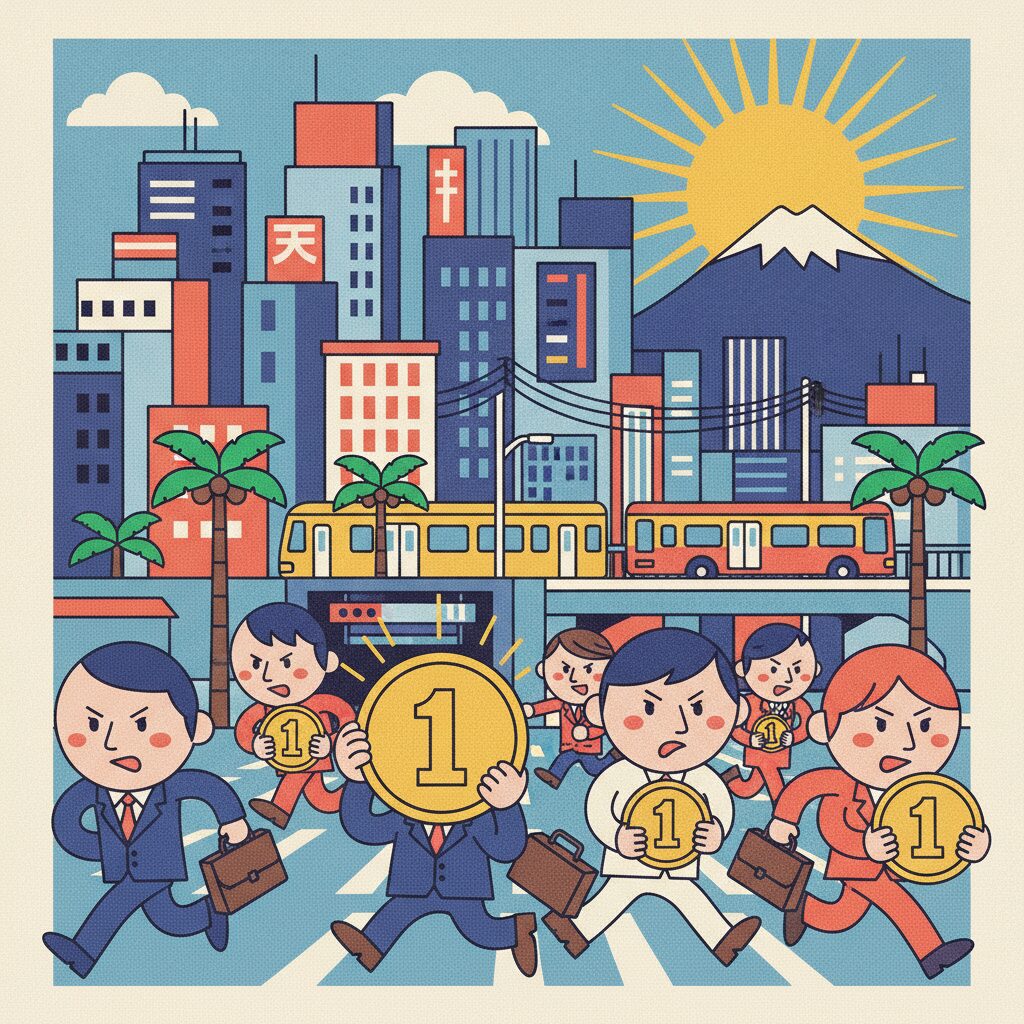
The doors slide open. The elevators empty. The sidewalks flood. A tidal wave of charcoal suits, navy blazers, and crisp white shirts spills onto the pavement. They are hungry. They are in a massive hurry. And they have exactly sixty minutes before they must be back at their desks. This is the great Osaka lunch rush, a daily phenomenon that operates with breathtaking speed and unspoken rules. For foreigners living in the city, this hour can be incredibly intimidating. The restaurants fill up in seconds. The lines stretch around corners. The noise level rises as thousands of people try to secure their midday fuel.
Yet, at the center of this daily storm lies one of the most fascinating cultural touchstones of Japanese corporate life. It is the relentless, celebrated pursuit of the ‘one-coin’ lunch. The concept is beautifully simple. You hand over a single five-hundred-yen coin, requiring no change, no complicated math, and no waiting, and in return, you receive a hot, filling, and surprisingly delicious meal. It is the ultimate expression of value, efficiency, and speed. While inflation has threatened the pure existence of the one-coin meal in recent years, the culture surrounding it remains firmly intact. Understanding this lunch culture is not just about finding cheap eats. It is about understanding the very fabric of Osaka’s society, a city built on merchant values where getting a good deal is not just a preference, but a profound point of personal pride.
The Hunt for a One Coin Lunch in Yodoyabashi and Honmachi
To truly understand why the five-hundred-yen lunch holds such a significant place in daily life here, you need to grasp the economic reality of the average Japanese salaryman. Beneath the sharp suits and expensive leather briefcases lies a widespread domestic financial system called ‘okozukai.’ In many Japanese households, the wife manages the entire family budget. The husband’s salary goes directly into a shared bank account, and he receives a fixed monthly allowance for his personal expenses. This allowance must cover everything from daily lunches to after-work drinks with colleagues, morning coffees, and reading material for the train. The budget is often tight. Spending a thousand or fifteen hundred yen on a fancy lunch every day would quickly deplete his funds, leaving nothing for the essential evening socializing that lubricates corporate life.
This is where the charm of the five-hundred-yen coin shines. It is the ideal currency unit for a working professional on a tight budget. It leaves just enough in the pocket for an afternoon canned coffee from a vending machine and a few cold drafts at a local tavern after work. But the fixation on the one-coin lunch goes far beyond household budgeting. It strikes at the heart of the Osaka mindset. Osaka is historically a city of merchants, where commerce, trade, and value are ingrained in the local culture. Here, overpaying for something is almost considered a moral failure.
If you visit a high-end business district in Tokyo, such as Marunouchi or Otemachi, you’ll often see office workers quietly lining up for overpriced organic deli plates, artisanal sandwiches, or beautifully curated salad bowls costing upwards of twelve hundred yen. There is a desire to appear sophisticated, a need to match one’s lunch choice with the upscale environment of the area. In Tokyo, admitting you opted for the cheapest meal available might be met with polite, somewhat awkward silence.
Osaka, by contrast, operates on a completely different wavelength. In Yodoyabashi and Honmachi, people want hearty calories served quickly and want to save their money. Here, finding a huge, delicious meal for very little is a badge of honor. An Osaka worker will proudly boast to colleagues about the incredible value discovered at a hidden basement eatery. They’ll eagerly ask, “Guess how much this pork cutlet bowl was?” and delight in the surprise when revealing it cost only a single coin. The concept of ‘cospa,’ short for cost performance, is almost a religion in this region. A high cospa means you have beaten the system, maximizing your return on investment. The lunch search is a daily ritual, a competitive sport where the reward is both a full stomach and a full wallet.
Top Ways to Find a Five Hundred Yen Meal in Osakas Business District
Navigating the vast number of food choices in these business districts can be daunting for a newcomer. Restaurants are stacked vertically within narrow buildings, hidden away in obscure underground shopping arcades, and spilling out onto the sidewalks. However, once you know exactly what to seek, the city reveals a hidden network of highly efficient, incredibly affordable dining ecosystems designed specifically for busy workers.
Local Bento Stands and Food Trucks
At precisely eleven thirty in the morning, a subtle but distinct shift occurs on the streets of Honmachi and Yodoyabashi. Small, inconspicuous folding tables begin to appear seemingly out of nowhere on street corners, in narrow alleys between towering office buildings, and in concrete plazas of corporate zones. These are the fleeting bento stands, run by local restaurants, neighborhood grandmothers, and savvy entrepreneurs aware that thousands of hungry workers will soon flood the streets. They stack hundreds of freshly prepared lunch boxes on the tables, forming colorful towers of plastic and cellophane.
These bento boxes are the ultimate weapon in the search for a one-coin lunch. The variety is astounding. You’ll find boxes filled tightly with Japanese fried chicken known as karaage, glazed teriyaki salmon, thick slices of sweet rolled omelet, and generous mounds of perfectly steamed white rice. The presentation is unapologetically simple. The neon pink of the pickled radish slightly bleeds into the shredded cabbage, and the dark brown sauce of the hamburger steak pools in the corner of the plastic tray. These meals are designed for survival, packed with the heavy carbohydrates and proteins needed to get through an afternoon of endless spreadsheets and meetings.
The transaction at a bento stand is a marvel of urban efficiency. There is no time for pleasantries, no lingering over the menu, and absolutely no hesitation. You approach, scan the remaining boxes, your hand quickly grabs your choice, and you slam a single five-hundred-yen coin onto the metal tray. The vendor responds with a loud, rhythmic ‘Maido!’ or ‘Ookini!’, classic Osaka expressions of gratitude, and you’re already walking away before the echo fades. By twelve thirty, these tables will be completely empty, folded up, and gone, leaving no trace that a massive culinary exchange just unfolded on that very street corner.
Tachigui Standing Udon and Soba Shops
If you prefer your lunch hot, immersed in rich broth, and consumed at a rapid pace, you must embrace the tachigui culture. Tachigui literally means eating while standing, and it is a cornerstone of the Japanese fast-food scene. In Honmachi, standing noodle shops are everywhere. They often occupy narrow, brightly lit spaces, their glass sliding doors permanently fogged during winter months from the steaming noodle pots.
Entering one of these shops feels like stepping onto a factory floor. The air is thick with the savory, intoxicating aroma of dashi, traditional broth made from dried kelp and smoked bonito flakes. The menu is usually displayed on a brightly colored ticket machine near the door. You insert your coin, press the button for a simple bowl of udon or soba topped with a sheet of fried tofu or a handful of crispy tempura bits, and hand the small paper ticket to the chef behind the counter. Within sixty seconds, a steaming bowl is slid across the slick countertop toward you.
There are no chairs, no ambiance—only a stainless steel counter, a container of disposable chopsticks, and a shaker of red chili flakes. The etiquette here is strict but completely unspoken. You claim your narrow slice of counter space, lean over your bowl, and slurp aggressively. Slurping is not just permitted; it’s practically necessary to cool the scalding noodles before swallowing. You do not check your phone or strike up a conversation with the person standing shoulder-to-shoulder next to you. You eat with fierce determination, place your empty bowl on the upper ledge, wipe your mouth, and leave. Eating fast in Osaka is not rude; on the contrary, it is considered highly polite to the tired salaryman waiting for your spot outside.
Budget-Friendly Izakaya Lunch Sets
Beneath the polished streets of Yodoyabashi lies a sprawling subterranean world. Networks of underground shopping arcades, such as those found deep within the brutalist architecture of the Semba Center Building, host hundreds of tiny, dimly lit drinking dens known as izakayas. While these establishments primarily profit from selling skewers of grilled meat and tall mugs of draft beer at night, the high overhead costs in business districts compel many to open during the day. To attract the massive lunchtime crowds, they offer teishoku, or set meals, at sharply low prices.
Finding a one-coin teishoku requires some underground exploration. You must navigate narrow, linoleum-lined staircases, following the scent of frying oil and miso paste. Sliding open the wooden door, you are greeted by the smoky residue from last night’s party and the shouting voices of kitchen staff. The lunchtime atmosphere in a business district izakaya is electric. Waitresses dart between crowded tables, balancing trays loaded with heavy ceramic dishes.
A typical budget teishoku features a main dish—often something hearty and fried like minced meat cutlets or ginger pork—accompanied by a small bowl of miso soup, a tiny plate of pickled vegetables, and a generous heap of rice. The izakaya lunch’s secret weapon is ‘okawari’, or free refills. Even if the meal itself stretches your five-hundred-yen budget, the ability to request a second or third bowl of rice at no extra cost ensures you will return to your office thoroughly fueled by carbohydrates. It is a demanding yet wonderful tradition that sustains the city’s working class.
Supermarkets and Convenience Stores
When the lines at bento stands are too long, or standing noodle shops are full, the savvy local turns to the ultimate safety net of Japanese daily life: the neighborhood supermarket. While convenience stores like FamilyMart and 7-Eleven provide decent options, their prices have gradually risen, making a true one-coin lunch somewhat challenging. However, local supermarkets such as Life, Kohyo, or smaller independent grocers tucked in residential pockets near business zones are absolute goldmines for the budget-conscious.
The prepared foods section of a Japanese supermarket is a sight to behold. Long refrigerated aisles are stocked with an endless variety of carefully prepared meals. Here, you’ll find massive chicken cutlet rice bowls, delicate assortments of sushi rolls, and hefty, sauce-drenched yakisoba noodles, all aggressively priced well under the five-hundred-yen mark. The aesthetic is neat, bright, and supremely practical.
The beauty of supermarket lunches lies in the autonomy they offer. You can buy your cold bento, heat it in the banks of microwaves near the exit, and take it out into the city. On a crisp autumn afternoon or mild spring day, hundreds of office workers carry their supermarket plastic bags toward Utsubo Park, a lush green oasis just west of the Honmachi towers. They sit on wooden benches, beneath the shade of massive zelkova trees, seeking a brief moment of calm, eating their heavily discounted meals in quiet reflection before diving back into the corporate grind.
Surviving the Lunch Rush Essential Tips for Residents
For a foreigner trying to adapt to the daily rhythm of Osaka, surviving the lunch rush in the business district demands a fundamental change in behavior. Treating this hour like a leisurely tourist experience will leave you overwhelmed, frustrated, and quite possibly hungry. The midday break is a carefully orchestrated display of efficiency, and you need to learn the steps if you want to join in without causing delays.
The first and most important rule of the lunch rush is timing. The worst time to buy food in Yodoyabashi or Honmachi is between twelve noon and twelve thirty. This is the peak of the frenzy. Lines at bento stalls are fiercely competitive, and waiting times at local restaurants can take up your entire break. If your schedule permits, you must adapt. Head out early, slipping away from your apartment or office by eleven forty-five to grab the best bento before the crowds arrive. Alternatively, wait until one fifteen in the afternoon. By then, the streets have surprisingly cleared, the noise has diminished, and restaurant owners are wiping down counters, ready to serve latecomers in peace.
The second rule is preparation. When dealing with cash-only bento vendors or ticket machines at noodle shops, have your money ready before it’s your turn. Digging through a bulky wallet, searching for change while a line of impatient salarymen glares at the back of your head, is uniquely stressful. Hold your coins firmly in your hand.
Additionally, splitting the bill, known in Japanese as ‘betsu-betsu’, is considered a strict no-no during the lunch rush. If you’re dining with friends or colleagues at a busy restaurant, one person must pay the entire bill at the register to keep the line moving. You can settle debts later on the sidewalk, out of the way of the rushing crowds. Efficiency is paramount. You don’t linger over green tea. You don’t engage in long conversations after finishing your meal. The moment your chopsticks drop, you stand, pay, and leave.
The Reality of Modern Inflation and the Six Hundred Yen Pivot

It would be dishonest to write a guide about daily life in modern Osaka without acknowledging the harsh economic realities of today. For decades, the five-hundred-yen one-coin lunch stood as an untouchable pillar of Japanese society, upheld by fierce deflation and razor-thin profit margins. But times are shifting. Global inflation, rising ingredient costs, and increased utility bills have finally broken through the defenses of local eateries.
The pure, tax-included five-hundred-yen meal is gradually becoming a rare find. It still exists, but now requires a keener eye and deeper local knowledge to locate. Many beloved bento stands and underground izakayas have had to make the painful choice to raise their prices. You’ll often see signs apologizing profusely for the increase, requesting five hundred fifty, or perhaps six hundred yen.
Yet, the cultural significance of this change reveals something deeply endearing about the Osaka spirit. Rather than abandoning the concept, locals have simply adapted the story. They’ll stand in line, playfully grumbling to their coworkers about how their favorite pork bowl now costs an extra hundred-yen coin. Their complaints come with a sense of theatrical tragedy, a dramatic flair that is a hallmark of Kansai humor. The spirit of the one-coin lunch endures, even if the reality now demands a coin plus a bit of copper change. The core philosophy remains intact: find the absolute best value, eat quickly, and conquer the afternoon.
Embracing the Local Hustle and Understanding the Osaka Mindset
When you remove the frantic energy, the bustling sidewalks, and the aroma of fried food, the lunchtime rush in Yodoyabashi and Honmachi reveals a deep insight into the essence of Osaka and its people. This is not a city that pretends or puts on a facade. It does not conceal its everyday challenges behind a mask of polished perfection. It is a city filled with immense warmth, pragmatic determination, and straightforward honesty.
The way people eat here mirrors how they live. They are straightforward. They prioritize substance over style. While a beautifully presented, costly meal in a quiet, sterile room might impress visitors, it is a heap of steaming rice and fried chicken consumed standing shoulder-to-shoulder with strangers that truly sustains the city. There is a shared camaraderie amid the chaos. When standing in line at a bento truck, squeezed between a senior executive in a tailored suit and a young entry-level worker with worn shoes, each frantically handing over their single coins for the same meal, the corporate hierarchy momentarily fades away.
For anyone hoping to genuinely settle into daily life in Osaka, mastering this midday ritual is a rite of passage. It teaches you to walk with intention, to respect the time of those around you, and to enjoy the profound comfort of a warm, affordable meal on a tough Tuesday afternoon. Once you stop fearing the intense energy of the business district and begin moving with it, you will start to sense the true heartbeat of the city. You will find yourself checking your watch at eleven forty-five, instinctively reaching into your pocket for that heavy, satisfying five-hundred-yen coin, ready to step into the bustling streets and join the great Osaka hustle.