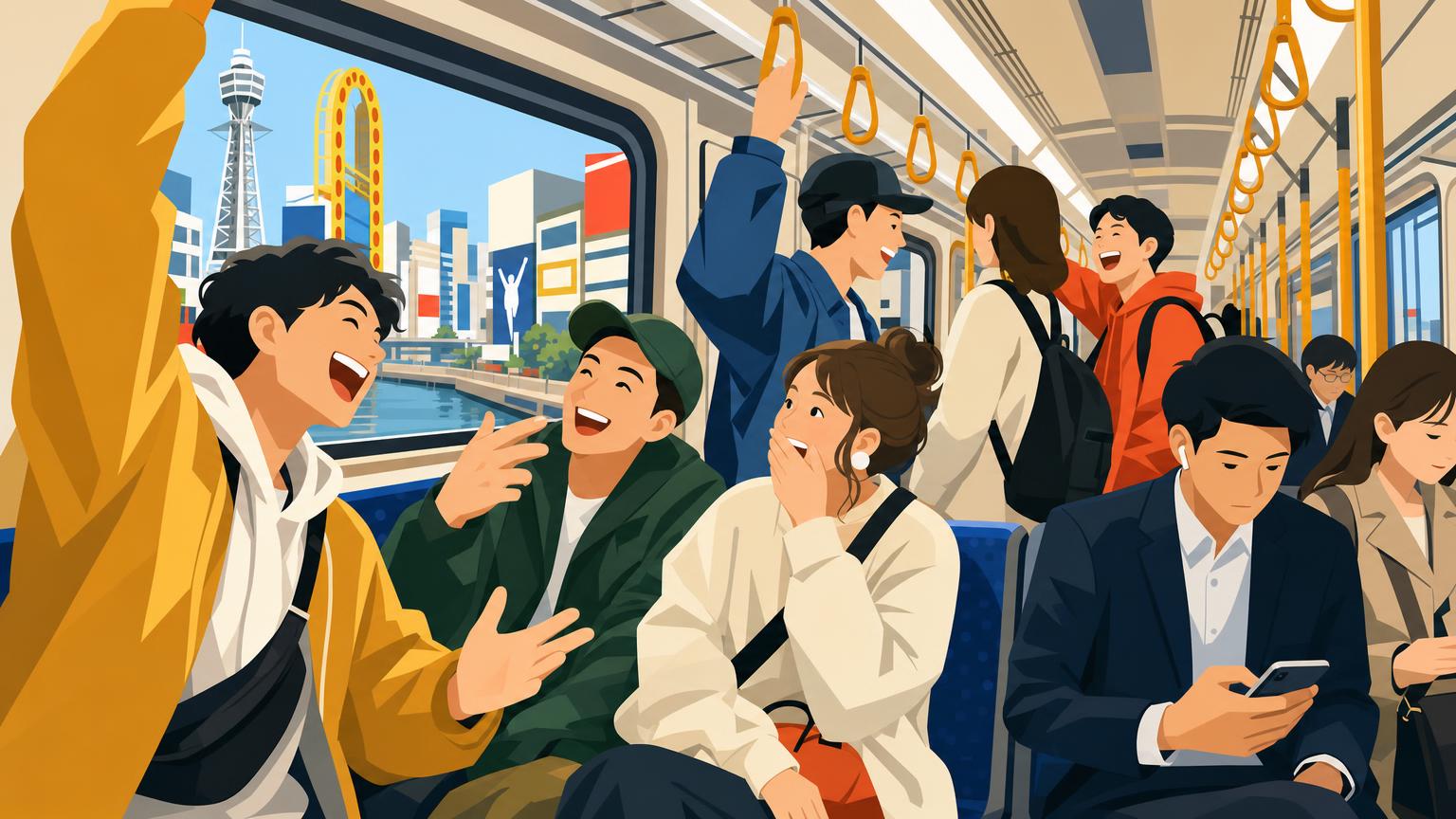
The morning air in Japan carries a distinct rhythm depending on where you stand. If you wake up in Tokyo, the march toward the local train station feels like joining a meticulously choreographed ballet. Millions of people move in a synchronized, silent flow, their eyes locked forward, their footsteps creating a low, steady hum against the pristine pavement. It is a marvel of modern civic engineering and unspoken social contracts. But if you wake up 300 miles to the west, stepping out into the humid, dashi-scented air of Osaka, the morning commute feels entirely different. You are no longer part of a silent ballet. You have just walked into a sprawling, kinetic jazz club.
As an American who has spent years navigating Japan’s culinary back alleys and crowded transit hubs, I have always been fascinated by how a city’s public transportation reveals its soul. You can tell a lot about a culture by how its people behave when they are packed shoulder-to-shoulder in a metal tube traveling at eighty kilometers per hour. For foreigners living in Japan, or those planning to make the leap, understanding the commute is the key to understanding the city itself. Many travelers arrive in Osaka expecting a slightly smaller, perhaps grittier version of Tokyo. They expect the same silent train cars, the same rigid adherence to personal bubbles, and the same atmosphere of isolated endurance. What they find instead is a metropolis that pulses with a completely different energy.
Osaka is a city of merchants, comedians, and unapologetic food lovers. Its people are famously pragmatic, wonderfully direct, and fiercely proud of their regional identity. This distinct personality spills over into every aspect of daily life, but nowhere is it more concentrated, visible, and visceral than on the daily commute. The way people line up, the way they navigate the sprawling underground labyrinths, the way they react to a delayed train, and even the side of the escalator they stand on all tell a story of a city that prioritizes human connection and practical reality over rigid formality.
This is not a guide to the best temples or the most picturesque photo spots. This is a deep, honest dive into the daily reality of the Osaka transit experience. It is an exploration of the structural differences between Japan’s two greatest metropolitan networks, the unspoken etiquette that governs the Kansai region, and the logistical realities of moving between these massive urban hubs. Whether you are trying to decide which city to call home, preparing for a long-term stay, or simply curious about why the atmosphere on the Midosuji Subway Line feels so radically different from the Yamanote Line, you must first understand the art of the Osaka commute.
Tokyo vs. Osaka Train Networks: What Travelers Need to Know
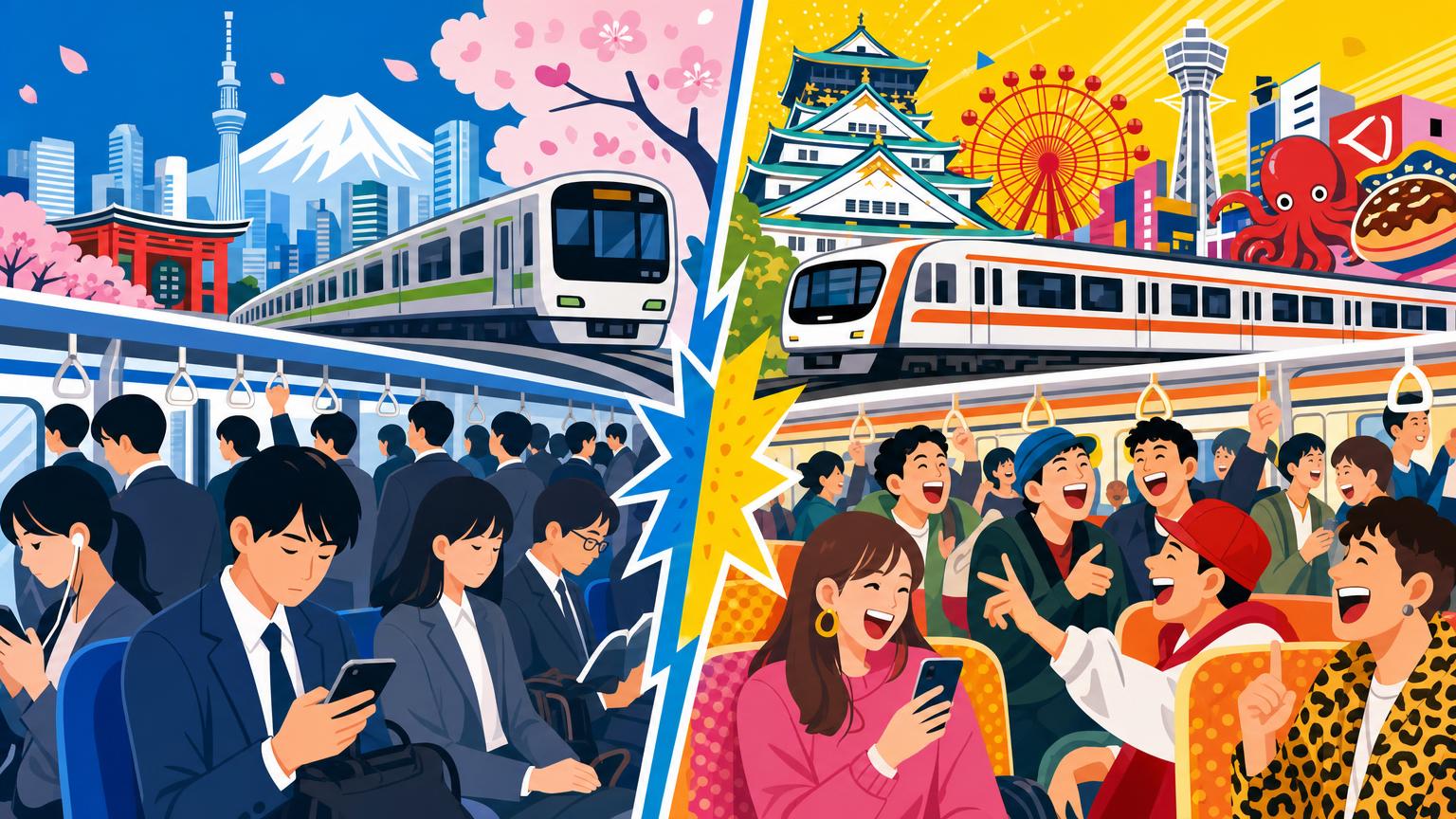
To grasp the commuting vibe, you first need to understand the foundations of the cities. The structural design of a transit network profoundly shapes how people engage with their surroundings. In Japan, the development of the railway was more than just laying tracks; it was about creating communities, influencing commerce, and molding the urban environment. The essential difference between commuting in Tokyo and Osaka lies in who constructed the railways and how they embedded them into the everyday lives of the people.
Navigating JR Lines and Subways in Tokyo
Tokyo’s transit identity is overwhelmingly shaped by the East Japan Railway Company, widely known as JR East, alongside the vast, sprawling subway networks run by Tokyo Metro and Toei Subway. When you think of Tokyo, the Yamanote Line immediately comes to mind—an iconic green loop encircling the city center and connecting major hubs like Shinjuku, Shibuya, Tokyo Station, and Ueno. The Yamanote Line acts as the city’s central nervous system. It is government-rooted, historically centralized, and engineered to carry an immense number of passengers with daunting efficiency.
Tokyo’s transit map resembles an extensive web radiating from a dense core. Because JR and subway networks are so comprehensive, many Tokyo residents rarely need to use private railway lines unless they live far out in the western suburbs. This JR dominance creates a standardized and uniform commuting experience. Stations are vast, functional, and designed for maximum passenger flow. The unspoken rule of commuting in Tokyo is invisibility: you scan your card, find your place on the platform, board the train, and retreat into your own world. The architecture of Tokyo’s transit system demands strict order, as any disruption could result in severe congestion.
The Power of Private Railways in Osaka
Osaka, true to its merchant heritage, was shaped by private enterprise. While JR West operates important lines like the Osaka Loop Line, it does not command the cultural prominence that JR East holds in Tokyo. Instead, the Kansai region’s heartbeat runs through a fierce, historic network of private railway companies. Hankyu, Hanshin, Keihan, Nankai, and Kintetsu are more than just transit operators; they are lifestyle brands, real estate developers, and retail powerhouses.
This legacy traces back to the early twentieth century, when visionary entrepreneurs like Ichizo Kobayashi, founder of Hankyu Railway, recognized that building a railway was only half the challenge. To encourage weekend train ridership, he created a massive department store at Umeda terminal, developed residential neighborhoods along the lines, and even formed an all-female theater troupe at the line’s end. This approach revolutionized Japanese urban planning.
As a result, commuting in Osaka is strongly connected to regional pride and corporate culture. The trains themselves have a unique character. Hankyu trains, for example, are known for their polished maroon exteriors, olive-green plush seats resembling vintage sofas, and faux-wood panel interiors. Riding the Hankyu line from northern suburbs into Umeda evokes a refined, old-world atmosphere. In contrast, the Hanshin line runs from Osaka to Kobe through gritty industrial coastal towns. Hanshin embodies the working-class spirit and the fanbase of the Hanshin Tigers baseball team. On game days, Hanshin trains buzz with rowdy fans clad in yellow and black, drinking canned highballs and debating baseball tactics.
Keihan links Osaka to Kyoto with double-decker premium cars, appealing to tourists and city commuters seeking a touch of luxury. Nankai serves the southern area, transporting passengers from the bustling neon-lit Namba district to Kansai International Airport and the mystical mountains of Wakayama. Kintetsu, the largest private railway network in Japan, spreads out toward Nara and Nagoya, connecting rural areas to the urban center.
For a foreigner living in Osaka, your local train line defines your neighborhood’s character. You aren’t merely a Tokyo commuter on a generic silver-and-green JR train; you are a Hankyu local, a Nankai resident, or a Hanshin loyalist. This fragmented, fiercely competitive corporate landscape means that major terminal stations in Osaka, like Umeda and Namba, are chaotic, multi-layered arenas where companies vie for your attention, dining choices, and daily commute.
Surviving the Commute: Rush Hour in Japan’s Biggest Cities
No matter how striking the maroon paint on a Hankyu train may be, rush hour in Japan is an intense and physically taxing experience. However, the nature of that intensity shifts dramatically when you cross the cultural divide from the Kanto region down to Kansai.
Tokyo Rush Hour: Peak Times to Avoid
The Tokyo rush hour is infamous. Between 7:30 AM and 9:30 AM, stations like Shinjuku, Ikebukuro, and Shinagawa transform into high-pressure human processing plants. The crowds are immense, but what truly stands out is the silence. Hundreds of thousands move with grim, practiced determination. On the trains, the physical crush is total—you’re pressed against the glass, elbows locked, briefcases squeezed between knees. Yet despite the extreme lack of personal space, everyone makes a concerted effort to act as if they are completely alone.
Eye contact is carefully avoided. Phones are angled just so, creating a tiny digital escape from the physical reality of the carriage. If someone steps on your foot in Tokyo during rush hour, there might be a subdued shuffle, a slight nod of apology, or a barely audible whisper of “sumimasen.” The collective goal is to endure discomfort without acknowledging it, maintaining harmony through mutual disregard.
Osaka Rush Hour: Is it Any Less Crowded?
If you move to Osaka hoping to escape the crushing crowds of Japan’s morning commute, you’ll be sorely disappointed. The Midosuji Subway Line, the massive red artery running north-south through the heart of Osaka’s business and entertainment districts, is infamous for its brutal rush hour congestion. Between 8:00 AM and 9:00 AM, platforms at Umeda, Honmachi, and Namba are packed tightly with commuters.
But the atmosphere is notably different. The Osaka rush hour isn’t silent; it’s vocal, pragmatic, and unmistakably human. When the train doors open on a packed Midosuji car, people don’t silently wait for the crowd to part miraculously. You hear grunts, sighs, and clear vocal expressions. People say “sumimasen” or the more casual “gomen” as they push their way out. The physical pressing is less rigid and more fluid. In Tokyo, you stand firm and withstand the pressure like a stone wall; in Osaka, the crowd flows like an agitated school of fish, shifting, nudging, and adjusting to accommodate movement.
This absence of rigid pretense makes the Osaka commute feel somewhat more chaotic, but psychologically much more relaxed. In Tokyo, the silent endurance creates a high-tension environment where a sudden loud noise feels like a social offense. In Osaka, if someone drops their umbrella, a fellow commuter will likely pick it up, hand it back, and maybe even offer a brief, sympathetic chuckle. The invisible barriers between individuals in Tokyo are far thinner in Osaka.
Local Train Etiquette: Spotting the Regional Differences
Grasping the unwritten rules of Japanese transit is a rite of passage for any foreign resident. It marks the transition from a bewildered tourist to a functioning member of the local community. While the broad principles of Japanese etiquette apply nationwide, their specific implementation varies greatly between Tokyo and Osaka.
Escalator Rules: Left in Tokyo, Right in Osaka
This difference is the most famous, visible, and long-lasting distinction between the two cities. To identify a Tokyoite in Osaka, simply observe their behavior when stepping onto an escalator. In Tokyo, and indeed most of Japan, the rule is straightforward: stand on the left, walk on the right. This system is deeply ingrained.
Conversely, in Osaka, the rule is reversed. You stand on the right and walk on the left.
The reason behind this difference is a subject of ongoing local debate and historical speculation. The most widely accepted explanation traces back to the 1970 World Expo held in Osaka. Preparing for a large influx of international visitors, local authorities noticed that in many Western countries, people stood on the right side of escalators. Aiming to appear cosmopolitan and accommodating, Osaka led a campaign encouraging citizens to adopt this right-side standing rule. The habit stuck, became a matter of fierce regional pride, and continues to this day. Another theory suggests that Tokyo, historically a city of samurai who wore their swords on their left hip, walked on the left to avoid bumping scabbards, while Osaka, a city of merchants, protected their coin purses on the right.
Regardless of its origin, adjusting to this difference requires mental effort when moving between the cities. Interestingly, if you commute from Osaka to Kyoto, which is only a forty-five-minute train ride away, the rule reverts to standing on the left. Kyoto, deeply connected to tradition and heavily influenced by historical ties to the capital, declined to adopt Osaka’s right-side rule. As a commuter in the Kansai region, you quickly learn to read the situation, watching the person ahead before choosing a side.
Priority Seating and Boarding Manners
The cultural contrast is perhaps most apparent in priority seating. In Tokyo, priority seat rules are observed with strict, almost anxious vigilance. Young, healthy people often leave these seats empty, even on crowded trains, fearing they might be seen as rude. When an elderly person boards, offering the seat is usually done silently—the younger person simply stands and moves aside, allowing the elderly passenger to sit without forcing a socially awkward exchange of thanks.
Osaka operates on a more pragmatic and openly communal wavelength. When an older person boards a train in Osaka, you’re much more likely to witness a direct, verbal exchange. An Osaka local may tap the elder’s arm, point to the seat, and boldly offer it. This often leads to a brief, friendly conversation.
Moreover, the renowned “Osaka Obachan”—the middle-aged or elderly woman, often dressed in leopard print or bright colors—redefines train etiquette. Known for her fearless, loud, and warm nature, an Obachan will simply announce that she is sitting down. She’s also likely to start a conversation with strangers, compliment children, ask foreigners where they’re from, or offer hard candy from her purse. This kind of spontaneous, unprompted interaction is virtually unimaginable on a Tokyo commuter train, where maintaining personal privacy is paramount.
The Culinary Commute: Eating Your Way Through the Stations
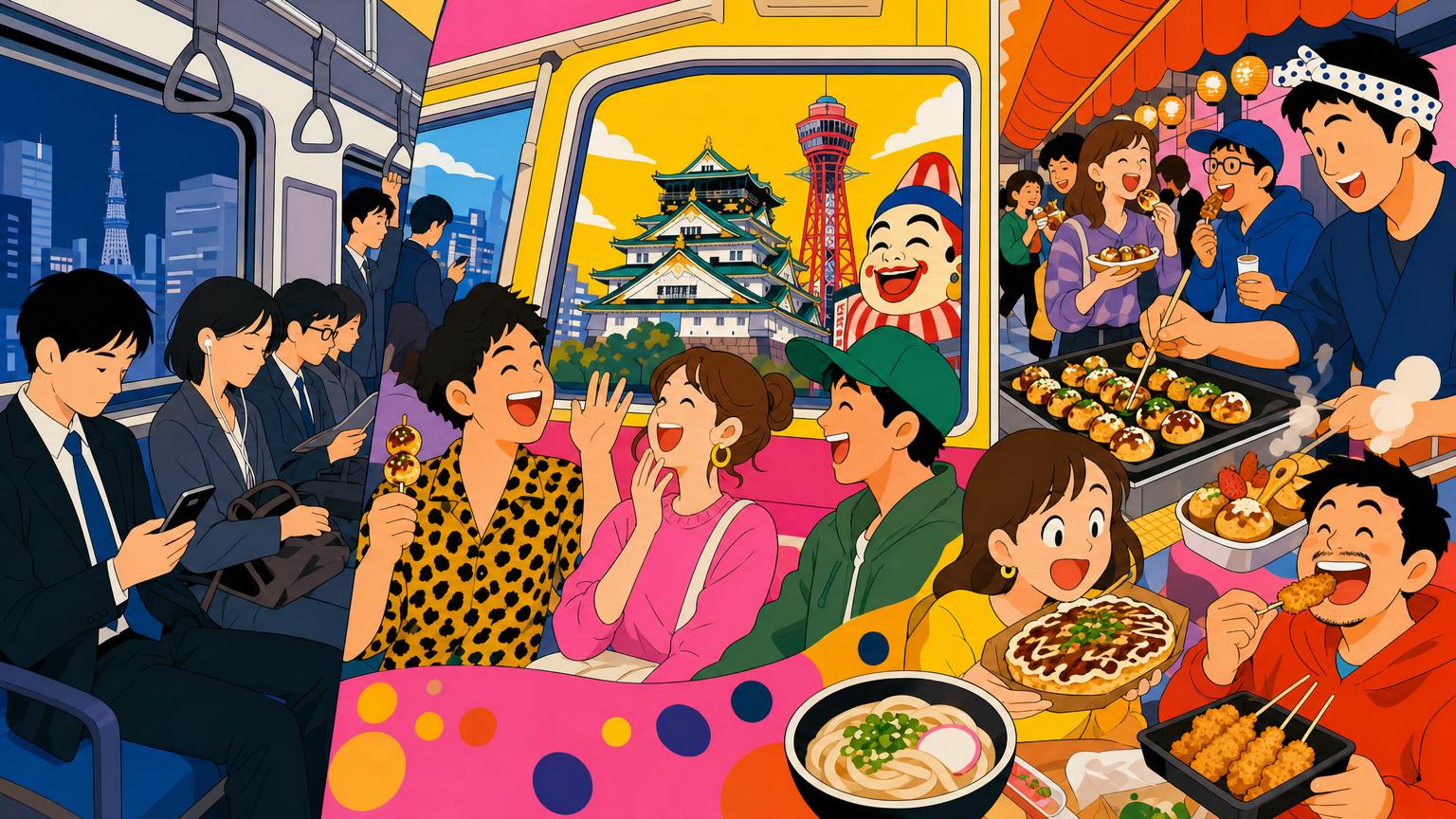
As a food enthusiast, my view of any city is inevitably shaped by its culinary offerings. The Japanese commute is closely intertwined with food culture, yet Tokyo and Osaka each approach eating on the go with distinctly different philosophies.
Tokyo’s Ekiben and Polished Food Halls
In Tokyo, train station cuisine is an art form focused on precise packaging and tidy consumption. The renowned “Ekiben” tradition is firmly established here. These beautifully arranged regional bento boxes are sold at major stations for long-distance travelers. Everything about Tokyo’s transit food is crafted to be neat, odorless, and perfectly contained. You purchase your ekiben, take it onto the Shinkansen, and eat quietly, leaving no crumbs and emitting no strong smells that might bother fellow passengers. Within commuter stations, food choices favor refined bakeries, upscale wagashi counters, and spotless convenience stores.
Osaka’s Standing Noodle Bars and Commuter Comfort Food
Osaka’s transit food culture is notably louder, smellier, and more visceral. Walking through the underground corridors of Namba, Umeda, or Tennoji stations, you are immediately greeted by the rich, savory scent of dashi broth, frying batter, and grilling meat. Osaka commuters have a strong attachment to their “Tachigui” standing noodle bars. These small, open-air stalls are tucked into platform corners and station hallways, where commuters—from students to tired salarymen—gather around counters, quickly slurping bowls of kitsune udon topped with large pieces of sweet, fried tofu. Eating is fast, the broth is piping hot, and interactions with the cook are brief but often accompanied by a booming “Ookini,” the local dialect word for thank you.
Then, there is the iconic 551 Horai. You cannot discuss commuting in Osaka without mentioning these steamed pork buns. 551 Horai stands are ubiquitous in Kansai train stations, with commuters lining up daily to buy boxes of these dense, juicy, and pungently fragrant buns to bring home to their families. The scent of a 551 Horai pork bun is the unofficial aroma of the Osaka evening commute. In Tokyo, bringing strongly scented hot food onto trains is considered a major faux pas. In Osaka, spotting a businessman carrying a white paper bag emanating the smell of pork and onions on the local Hankyu line is simply a sign that he’s a devoted husband bringing home a treat.
IC Cards and Ticketing: Suica vs. ICOCA
For a foreign resident, mastering the IC card system is the essential first step to navigating the city. These prepaid smart cards act as magic keys to the transit network, letting you seamlessly tap in and out of ticket gates, purchase drinks from vending machines, and pay for groceries at the conbini. However, even these smart cards carry a strong sense of regional rivalry.
The Battle of the Mascots and Regional Pride
In Tokyo and the larger Kanto region, the Suica card reigns supreme. Issued by JR East, it boasts a sleek, minimalist design featuring a cute, slightly aloof penguin mascot. The name Suica is a clever acronym for Super Urban Intelligent Card, while also referencing the Japanese word for watermelon and the sound “sui sui,” which suggests moving smoothly and effortlessly through the gates.
Down in Osaka and the Kansai region, JR West issues the ICOCA card. Its mascot is a blue platypus named Ico. ICOCA officially stands for IC Operating Card, but every local in Osaka knows the true origin of the name. In the Kansai dialect, “Ikoka?” literally means “Shall we go?” This brilliant, welcoming pun perfectly captures the friendly, action-oriented spirit of the city. While Suica emphasizes sleek urban efficiency, ICOCA extends a casual invitation to travel.
Digital Integration and Seamless Travel
In the past, carrying the wrong card meant you were out of luck. A Tokyoite visiting Osaka couldn’t use their Suica on the local subways. Thankfully, those days are long gone. Due to a nationwide integration effort, the major IC cards are now fully interoperable across regions. You can use your Tokyo Suica to ride Osaka’s Midosuji line and your ICOCA on Tokyo’s Yamanote line.
Today, choosing between cards is mostly about aesthetics and digital convenience. Apple Wallet and Google Pay allow users to easily download a digital Suica or Pasmo, making these options especially popular with foreign tourists who want to set up transit payments before arriving in Japan. Digital ICOCA integration came later but is now widely available. Still, many foreign residents living in Osaka prefer to carry a physical ICOCA card. Pulling out the blue platypus at the ticket gate is a subtle, quiet way to show that you’re not just a tourist visiting from Tokyo, but a local who belongs to the Kansai rhythm.
Commuting Between Tokyo and Osaka: The Intercity Guide
While understanding local subway networks is essential for daily life, many foreign residents, digital nomads, and business professionals in Japan find that their “commute” sometimes involves traveling between the two massive metropolitan hubs. The journey between Tokyo and Osaka is not merely a trip; for many, it is a routine intercity commute. Knowing how to navigate this specific route efficiently is a crucial survival skill.
Shinkansen Options: Nozomi, Hikari, and Kodama
The Tokaido Shinkansen is the vital steel artery linking Tokyo and Osaka. Standing on the platform at Tokyo Station or Shin-Osaka Station, you witness the height of Japanese logistical excellence. Trains leave every few minutes, sleek white arrows cutting through the landscape. However, not all Shinkansen trains are the same.
For business commuters or weekend travelers between the cities, the Nozomi reigns supreme. It is the fastest choice, skipping smaller stations and covering Tokyo to Shin-Osaka in about two hours and thirty minutes. The Nozomi is the lifeline of corporate commuters, with cabins filled with suited professionals busily typing on laptops, accompanied by the faint scent of canned coffee.
The Hikari is the mid-tier option. It stops at a few additional stations, pushing travel time to just under three hours. Among many foreign residents, the Hikari is cherished because it was historically the fastest train included in the Japan Rail Pass.
The Kodama is the local Shinkansen, stopping at every station along the route. Taking the Kodama from Tokyo to Osaka is a test of patience, requiring around four hours. Much of the journey is spent idling at stations while faster Nozomi trains speed past. Yet, Kodama tickets are often deeply discounted through special advance-purchase deals like the “Platt Kodama,” making it an attractive choice for budget travelers who prioritize savings over time.
Ticket Costs and How to Purchase
The cost of this intercity commute is considerable. A standard reserved seat on the Nozomi from Tokyo to Shin-Osaka is just under 15,000 yen one way, meaning a round trip approaches 30,000 yen.
For residents, mastering the ticketing process is important to reduce stress. The traditional option is to queue at the Midori no Madoguchi (the green ticket windows) at major JR stations, but during peak times or busy holiday periods such as Golden Week, lines can be very long. A smarter choice is to use the SmartEX app. This app, available in English, lets you link your credit card and IC card to your Shinkansen reservation. You can book tickets on your phone, then at the Shinkansen gate tap your Suica or ICOCA card, and the gate issues your seat assignment. This system eliminates hassle and often offers small discounts for early booking.
Using the Japan Rail Pass for this Route
For years, the Japan Rail Pass was the ultimate bargain for foreigners. However, recent steep price increases have significantly changed the calculation. A one-week nationwide pass now costs about 50,000 yen. Since a round-trip ticket between Tokyo and Osaka is roughly 30,000 yen, simply commuting between the two cities no longer justifies the pass’s cost. To break even, you need to add significant additional long-distance travel. Moreover, the base JR Pass still does not cover the fastest Nozomi trains without paying an additional premium. For a foreign resident living in Osaka who occasionally travels to Tokyo for work, buying individual tickets via SmartEX is now almost always the most practical and cost-effective choice.
The Social Dynamics of the Osaka Train Car
Once you pass through the ticket gates and board a local train in Osaka, the real cultural immersion begins. The social dynamics within the confined space of a train car perfectly illustrate why Osaka feels so distinctly different from Tokyo. It all comes down to how people handle space, sound, and interaction.
Conversations and Volume Levels
If you board a Tokyo train at 2:00 PM on a Tuesday, you’ll likely encounter near-total silence. Passengers read books, scroll through their phones, or nap. When two friends travel together, they speak in hushed, conspiratorial whispers. The unspoken social rule is to keep your personal volume low so as not to disturb the mental space of those around you.
In contrast, boarding a train on the Osaka Loop Line at the same time offers a very different auditory experience. Osaka is a city that loves conversation. The Kansai dialect, Kansai-ben, is renowned throughout Japan for being melodic, rhythmic, and highly expressive. It is the language of Japanese comedy and carries a warmth that standard Tokyo Japanese sometimes lacks. On an Osaka train, you’ll hear lively conversations—high school students laughing loudly, housewives chatting about grocery prices across the aisle, and businessmen animatedly discussing baseball scores.
This is not considered rude in Osaka; it is seen as completely normal. The city has a different approach to public space. In Tokyo, public spaces are treated as silent voids to pass through. In Osaka, public spaces are extensions of the living room, places where life continues. For a foreigner, this can be wonderfully refreshing. The pressure to maintain total silence is lifted, replaced by a gentle hum of human activity that makes the city feel instantly more vibrant and inviting.
Personal Space and Interactions
The way personal physical space is managed also varies. In Tokyo, commuters go to great lengths to avoid physical contact. They twist their bodies, pull in their shoulders, and lock their arms to maintain an invisible barrier between themselves and the person next to them. If contact is unavoidable, it is met with stiff tolerance.
By contrast, Osaka commuters are much less protective of their personal space. Bumping shoulders on a crowded Nankai train is a routine occurrence and rarely causes alarm. If you accidentally bump someone, a quick “Sumimasen” is usually met with a dismissive wave or a friendly nod. The boundary between “me” and “you” is more relaxed.
This openness leads to unexpected interactions. It’s not uncommon for a foreigner standing on an Osaka train platform looking confused at a map to be approached by a local offering help in broken yet enthusiastic English. In Tokyo, a local might notice you are lost but hesitate to assist, fearing they might impose or embarrass you. The Osaka mindset skips this hesitation. They see a problem, step in to help, and move on. This straightforward, practical friendliness is a defining feature of the Osaka commute.
Moving to Osaka: Choosing Your Commuter Line
For those planning to live in Osaka, grasping the unique character of its various train lines is essential when deciding where to settle. Your daily commute will shape your lifestyle, dining choices, and how you engage with the city.
The North: Hankyu Line Elegance and Expat Havens
The northern suburbs of Osaka, stretching toward Suita, Toyonaka, and Minoh, are mainly served by the Hankyu Railway and the Kita-Osaka Kyuko Line (an extension of the Midosuji subway). This area is widely regarded as the most upscale and family-friendly part of the city. The commute on the Hankyu line is refined. Stations are spotless, the neighborhoods abound with bakeries and cafes, and the atmosphere is decidedly calm. For foreign expats with families, living along the Hankyu line provides a peaceful escape from the neon frenzy of central Osaka while still offering a convenient thirty-minute commute to Umeda.
The South: The Gritty Reality of the Midosuji and Nankai Lines
If you want to live in the vibrant, unfiltered core of Osaka, head south. Neighborhoods along the southern stretch of the Midosuji and Nankai lines, extending past Namba toward Tennoji and Sakai, provide a completely different vibe. This is the older, rougher, and far more lively side of the city. The commute here is louder, more crowded, and heavily infused with the working-class spirit of Kansai. Rents are lower, local izakayas are truly authentic, and the daily journey feels like diving into the heart of Osaka culture. You’ll trade the plush seats of the Hankyu line for the raw, unapologetic energy of the southern crowds.
The East and West: Commuting the Peripheries
On the eastern edge of the city, served by the Keihan and Kintetsu lines, you’ll find excellent connections for those who frequently travel to Kyoto or Nara. The neighborhoods around Kyobashi are well-known for their inexpensive standing bars and a distinct retro, post-war charm. The commute from the east is efficient and quick.
To the west, the Hanshin line links the port areas and heads toward Kobe. Historically industrial, this area is now rapidly gentrifying. Commuting on the Hanshin line offers a front-row view of the passion of Kansai sports fans and a grittier, less polished perspective on the city’s coastal economy.
Frequently Asked Questions (FAQs)
Navigating the complexities of the Osaka transit system naturally raises many practical questions. For foreign residents trying to adjust their daily routines, the details are important.
Is Osaka’s transit easier to use than Tokyo’s?
In terms of size, Osaka is smaller and somewhat less overwhelming than Tokyo. However, because Osaka depends heavily on multiple competing private railway companies, navigating large terminal stations like Umeda can be quite confusing. Transferring from a JR line to a Hankyu line means leaving one company’s network and entering another’s, often requiring you to navigate extensive underground shopping malls. Once you’ve memorized your specific daily route, it’s easy, but the initial learning curve can be steep.
Can I use my Tokyo Suica card in Osaka?
Yes, definitely. Thanks to the nationwide integration of IC cards, Suica, Pasmo, ICOCA, and most other regional cards work interchangeably on nearly all trains, subways, and buses in both cities. You can also use your Suica to pay at convenience stores and vending machines in Osaka without any problems.
What is the absolute worst time to ride the Midosuji Line?
The peak crush on the Midosuji Line happens on weekdays between 8:00 AM and 9:00 AM, especially on northbound trains from Namba toward Umeda, and southbound from Shin-Osaka toward Honmachi. If possible, delaying your commute until after 9:30 AM will significantly improve your experience.
Why do people stand on the right on Osaka escalators?
The most commonly accepted explanation is that the right-hand standing rule was introduced during the 1970 Osaka World Expo to align with international standards and accommodate foreign visitors. The habit stuck and eventually became a source of regional pride, distinguishing Osaka from Tokyo’s left-hand rule.
Is it considered rude to talk on an Osaka train?
While shouting or playing loud music is universally frowned upon, having a normal-volume conversation with a friend on an Osaka train is perfectly acceptable. Osaka trains tend to be naturally louder and more conversational than Tokyo trains, reflecting the warmer, more communicative Kansai culture.
Can I bring food onto the local trains in Osaka?
Technically, no strict rules prohibit bringing food onto local trains, but cultural norms discourage eating anything messy or strongly scented on crowded commuter trains. Eating a small pastry or drinking from a plastic bottle is generally fine. However, eating a hot bowl of noodles or a pungent pork bun on a local subway would be considered rude. Save heavier meals for the Shinkansen or station platforms.
How much does a monthly commuter pass cost in Osaka?
The cost depends entirely on the distance and the specific lines used. A typical monthly pass (teikiken) for a 20-minute subway commute will cost around 8,000 to 10,000 yen. In Japan, most employers fully reimburse employees for their daily commute expenses.
What happens if you accidentally board a women-only car?
Both Tokyo and Osaka have women-only train cars during rush hours to provide a safe, comfortable space for female passengers. These cars are clearly marked with pink stickers on the platforms and train windows. If you’re a man and accidentally board one, you’ll likely receive uncomfortable looks and possibly a polite verbal reminder from a passenger or conductor. Simply apologize, get off at the next station, and move to a different car.
Are Osaka train stations difficult to navigate for foreigners?
Major stations offer excellent English signage, color-coded lines, and station numbering systems (e.g., M16 for Namba on the Midosuji Line). Still, the sheer size of stations, especially the “Umeda Dungeon,” can be disorienting. Relying on Google Maps is essential, but be sure to pay close attention to exit numbers on the app, since choosing the wrong exit could leave you several blocks from your destination.
What is the most scenic commuter route in Osaka?
While most central commutes are underground or in densely urban areas, riding the Hankyu Kyoto Line north toward the mountains or taking the Nankai Line south toward the ocean and Wakayama offers beautiful transitions from dense cityscapes to lush hills and traditional architecture.
Ultimately, the Osaka commute is a vivid reflection of the city’s culture. It’s a daily, unfolding theater where Kansai’s pragmatism, humor, and warmth are on full display. It lacks Tokyo’s pristine, silent perfection but replaces it with something more vital: a sense of shared humanity. When you stop bracing for impact, surrender to the flow, and maybe buy a steaming pork bun for the ride home, you’ll know you have truly arrived in Osaka.