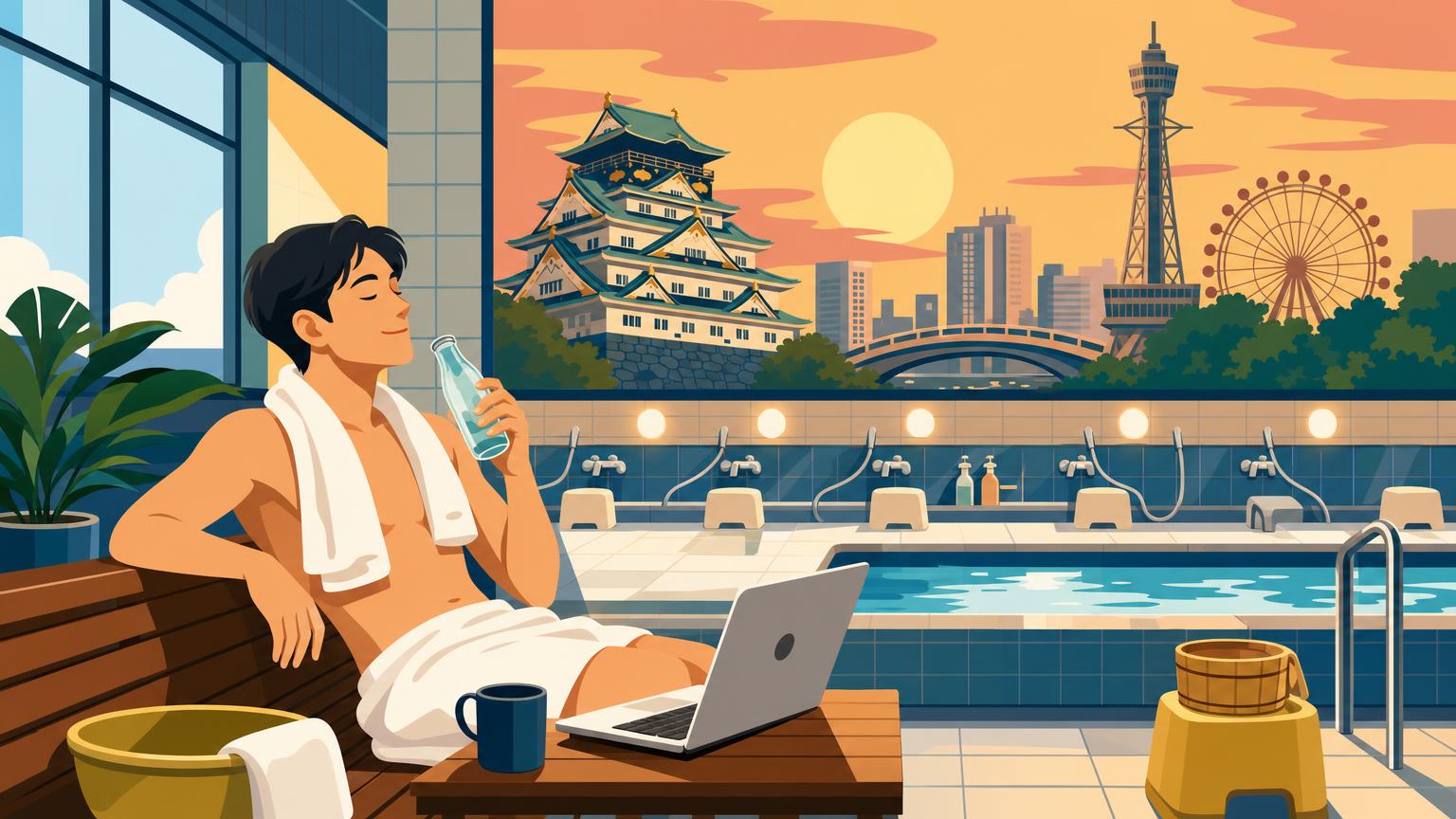
You close the laptop. The screen goes black. The low, mechanical hum of the air conditioner suddenly feels deafening in the quiet of your room. It is eight in the evening. You have spent the last ten hours staring at pixels, typing messages to colleagues in different time zones, and breathing the exact same recycled indoor air. The walls of your Osaka apartment, perhaps a modest space in Nishi-ku or a quiet residential block up north in Suita, begin to feel as though they are slowly shrinking inward. This is the modern remote worker’s dilemma. You live in one of the most vibrant, chaotic, and gloriously loud cities on the planet, yet your daily existence is confined to a desk, a chair, and a glowing rectangle. The boundary between your living space and your working space has completely dissolved. Your kitchen table is your boardroom. Your sofa is your breakroom. Your bed is dangerously close to your office. You need a physical barrier. You need a hard reset. You need to leave the building. You need a bath.
Living in Osaka as a digital nomad or an expat remote worker is a unique psychological experiment. The city outside your window is relentlessly alive. Osaka does not whisper; it shouts. It is a city of merchants, of endless food stalls, of bicycles dodging pedestrians, of neon lights reflecting off the dark waters of the Dotonbori canal. It is a city that demands participation. Yet, the nature of remote work demands isolation. This friction between the kinetic energy of Osaka and the static reality of working from home can lead to a very specific kind of burnout. You feel exhausted but you have not moved. You feel overstimulated but you have not spoken to a single human being in person all day. You try going to cafes, but the trendy coffee shops in Nakazaki-cho are small, crowded, and close at five in the afternoon. You try coworking spaces, but they often feel just as sterile and corporate as the offices you were trying to escape.
This is where the magic of the Japanese bathhouse comes into play. For the uninitiated, a sento might just seem like a place to get clean. For the seasoned Osaka remote worker, it is a sanctuary. It is the ultimate third space. It is a portal that transports you from the stressed, hyper-connected digital world into a deeply physical, communal, and grounding reality. In a city where personal space is measured in inches, the sento offers vast rooms of steam, echoing ceilings, and the profound equalizer of shared humanity. Nakedness strips away the corporate hierarchy. You are no longer a project manager, a software engineer, or a freelance writer. You are just a person in the neighborhood, sitting on a small plastic stool, washing away the invisible grime of a purely digital day.
The people of Osaka understand this intrinsically. The sento is not a luxury here; it is a fundamental pillar of neighborhood infrastructure. It is where gossip is exchanged, where the day is processed, and where the transition from labor to rest is physically enacted. By adopting this deeply local ritual, you do not just find a way to de-stress. You find a way to plug into the very heartbeat of the city. You learn how Osaka breathes when it is not working. You learn the unwritten rules of local respect. You learn how to completely and utterly switch off. If you want to survive and thrive as a remote worker in this incredible city, you must master the art of the evening soak.
Why Osaka’s Sento Culture is the Ultimate Hack for Remote Workers
Beating WFH Burnout: The “Clock-Out” Ritual
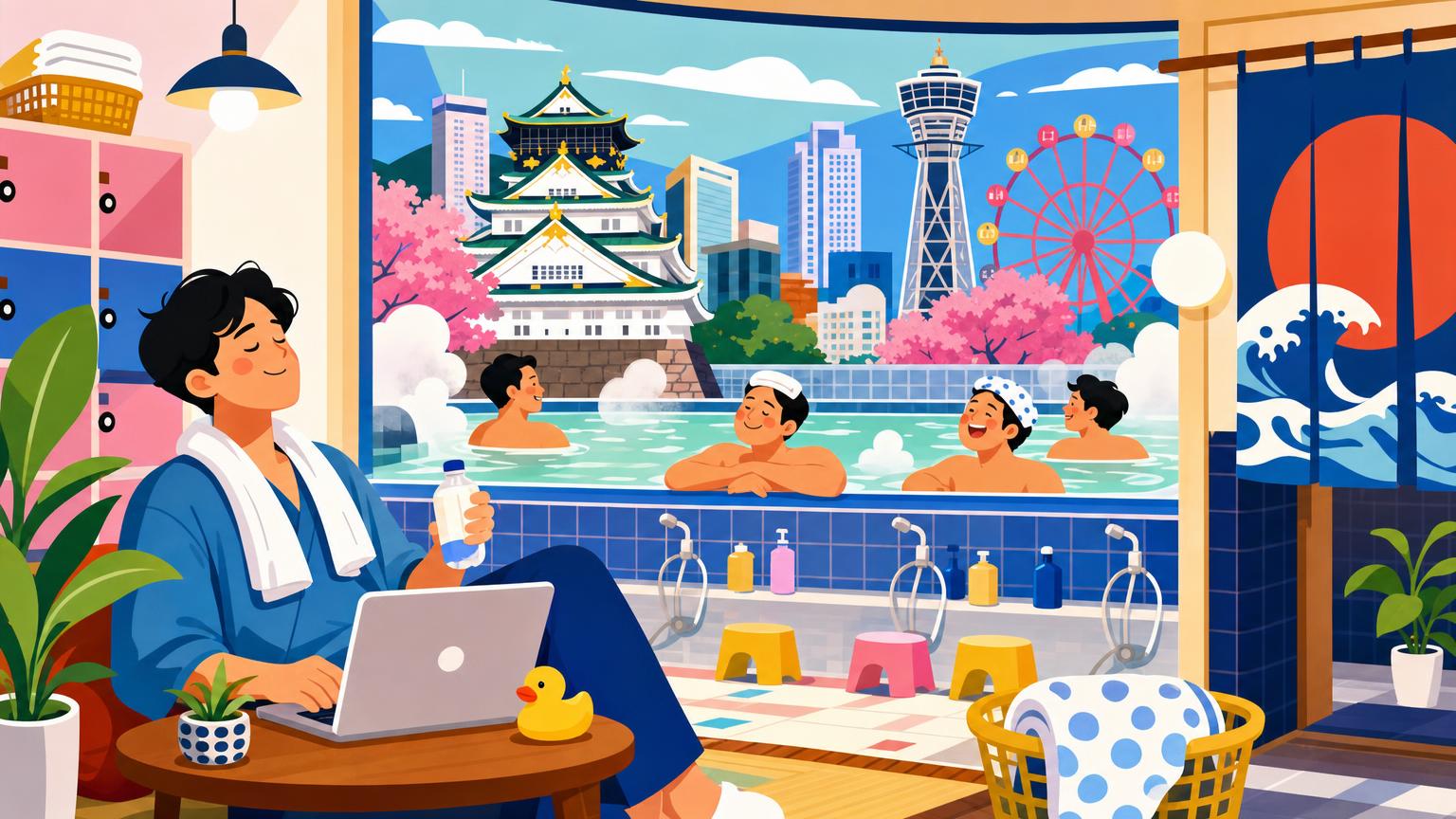
The biggest joy thief in the remote work lifestyle is the lack of a commute. For decades, we grumbled about the daily hassle of taking the train or driving through traffic. We despised rush hour congestion and longed to roll out of bed and start working instantly. But what we overlooked was that the commute played a crucial psychological role. It acted as a buffer zone—a transitional phase that helped the mind switch from home mode to work mode, and vice versa. When you work from an apartment in Osaka, that buffer zone vanishes completely. The distance between your desk and your bed is just four steps. You wrap up a stressful Zoom call with a client in London, close your laptop, and are expected to instantly shift into a relaxed, domestic mindset. It doesn’t work. The adrenaline is still flowing. The stress is still coursing through your veins. You carry the office energy straight into your living room.
In Japanese culture, there is a deep respect for boundaries. The concept of “uchi” (inside) and “soto” (outside) underpins daily life. Physical thresholds are everywhere. You remove your shoes at the genkan before entering a home, physically leaving behind the dirt and chaos of the outside world. For the remote worker, the sento becomes the ultimate external boundary. It replaces the lost commute with something infinitely more restorative. When you finish work, you don’t simply move to the sofa. You pack a small bag. You leave your apartment. You step out into the muggy heat of an Osaka summer or the crisp chill of a Kansai winter. You stroll through the neighborhood, absorbing the city winding down — the rattle of a passing train on the Loop Line, the aroma of dashi broth from a local udon shop, the clatter of bicycles over tactile paving.
This walk marks the start of the “clock-out” ritual. It compels your eyes to focus on distances beyond two feet. It makes your lungs inhale air not filtered through your apartment’s wall unit. By the time you reach the bathhouse, you’ve already begun unwinding from work. Then comes the physical ceremony of the bath itself. Removing your clothes symbolizes shedding the day. You shed the stress of deadlines, annoying emails, imposter syndrome, and isolation. You enter the cavernous bathhouse room, filled with thick steam and the sound of splashing water echoing off tall tiled walls. You sit, wash yourself carefully—not just a quick shower to wake up, but a mindful scrubbing away of the day’s residue.
When you finally sink into the intensely hot water of the deep tub, a physical transformation takes place. The heat prompts your muscles to release tension held from hunching over your keyboard. The water’s temperature commands your full attention. You can’t dwell on a bad line of code or a poorly phrased Slack message submerged in forty-two-degree Celsius water. Your brain is forced into the present moment. The sensory input is so complete and overwhelming that it erases digital anxiety. This is the secret: using an ancient cultural practice to short-circuit a very modern psychological challenge. When you step out of the bathhouse, core temperature raised and skin glowing, back into the cool night air, you are fundamentally different. The workday is definitively over. You’ve crossed the threshold. You’re finally home.
Sento vs. Super Sento: What Digital Nomads Need to Know
To effectively navigate Osaka’s bathing options, it’s crucial to understand the key difference between a traditional sento and a modern super sento. They serve very different roles in a remote worker’s life, and confusing the two can lead to frustration. A classic neighborhood sento is a practical, deeply historic establishment. These are small bathhouses tucked away in narrow residential streets, marked by tall chimneys and traditional noren curtains fluttering over the entrance, usually displaying the hiragana character for hot water.
Traditional sentos are inexpensive, with admission prices strictly regulated by the prefectural government. They are intensely local — the people bathing beside you have likely visited daily for decades. Amenities are minimal: you must bring your own soap, shampoo, and towel. There’s no air-conditioned lounge or attached restaurant. The process is straightforward: pay your fee, strip, wash, soak, dress, and leave. The traditional sento offers a quick, intense, and highly effective separation from the workday. It is an exercise in minimalism.
At the other end of the spectrum is the super sento: the bathing theme park. These massive complexes, often located on city outskirts or entertainment hubs, span multiple floors and offer a vast variety of services. If the traditional sento is a shot of straight espresso, the super sento is a large, complex cocktail. Admission is more expensive, but it grants you a full day of escape. Towels and loungewear are provided. Inside, you’ll find ten types of baths: carbonated baths that tingle, silk baths filled with micro-bubbles, outdoor baths surrounded by manicured rock gardens, multiple saunas at varying temperatures, and cold plunge pools.
For digital nomads, the true value of the super sento lies beyond the baths. These facilities encourage lingering. They feature expansive relaxation areas, dimly lit rooms with reclining chairs each equipped with personal TV screens, vast manga libraries where you can lie on tatami mats and read for hours. Crucially, there are often dedicated workspaces with tables, power outlets, stable free Wi-Fi, and restaurants serving massive plates of curry, cold soba, and frosty mugs of draft beer.
For a remote worker, a super sento is more than a post-work retreat; it’s a place to work during the day. It’s the ultimate alternative to noisy Shinsaibashi cafes. You can arrive at ten in the morning, work undisturbed in the lounge for three hours, then leave your laptop in a locker, strip down, and spend forty minutes cycling between hot baths and saunas. Refreshed, you eat katsudon in the dining hall before returning for another three hours of focused work. The super sento provides a self-contained ecosystem of productivity and relaxation unmatched by any Western coworking space. Knowing which type of bathhouse to choose on a given day is key to mastering both your workflow and mental health in Osaka.
Best Super Sentos in Osaka for Remote Workers (Work & Relax)
Facilities with Wi-Fi, Lounges, and Coworking Atmospheres
When the walls of your apartment feel completely confining and local coffee shops seem too crowded, Osaka’s super sentos offer a spacious, comfortable refuge. Not all super sentos are equally suited for remote work. Some cater mainly to families and can get noisy and chaotic on weekends. Others are designed with the modern, weary adult in mind. These facilities have adapted their lounge areas to support laptops, tablets, and the need for focused quiet, acknowledging the evolving nature of work.
In the city center, places like Taihei no Yu in Namba provide an amazing oasis just steps from the busiest retail district in western Japan. You can escape the overwhelming sensory overload of Dotonbori, ride an elevator up, and enter a completely different environment. The lounge space is vast. The Wi-Fi is dependable. You can settle into a corner, plug in your device, and gaze out over the expansive urban panorama of southern Osaka while working on your reports. The contrast is exhilarating. You are in the heart of the activity, yet utterly insulated from it.
Farther out, in neighborhoods like Tsuruhashi or near the bay area edges, complexes elevate the concept of a relaxation lounge to magnificent extremes. They offer dedicated “resting rooms” maintained in near-constant dimness and quiet. The rows of automated reclining chairs resemble a first-class airplane cabin. You can recline your seat, cover your legs with a blanket, and balance your laptop on your knees. The ambient hum of the facility is calming — the sound of muffled footsteps, distant flowing water, and gentle elevator chimes. It creates the perfect white noise for deep focus.
What makes working in these super sentos so profoundly effective is the total relief from domestic guilt. When working from home, you’re acutely aware of the laundry waiting to be folded, dishes in the sink, and dust on the floor. The home environment continuously calls for your attention. At a super sento, you are free from all that responsibility. Your only tasks are to work, eat, and bathe. The staff keeps the floors spotless. The restaurant prepares your meals. The water is always hot. You are fully cared for. This retreat into being completely serviced allows your brain to devote all its energy to the task at hand.
And when the work is complete, or when you encounter an insurmountable creative block, the solution is just a locker room away. You don’t need to pack up, brave the train, or walk through rain to find relief. Simply stow your computer, change out of your loungewear, and enter the bathing area. Spend thirty minutes floating in an outdoor bath, watching the clouds drift over the Osaka skyline, letting the tension in your lower back melt into the hot water. By the time you return to your laptop, the problem that seemed impossible an hour before has often resolved itself. It’s a work cycle that borders on the miraculous.
Combining Saunas, Hot Springs, and Focus Time
The integration of intense physical therapy into the workday is perhaps the strongest advantage of the super sento lifestyle. In recent years, sauna culture in Japan has surged in popularity. It’s no longer solely the preserve of middle-aged businessmen sweating out hangovers. It has evolved into a highly refined, passionately debated, and scientifically studied practice. The aim is to reach a state called “totonou,” which roughly means being perfectly tuned, balanced, or aligned. For a remote worker whose mind is constantly fragmented by digital distractions, achieving this state is like pressing the defragment button on a hard drive.
The process is intense and demands dedication. You enter the dry sauna, which in a premium Osaka super sento may be heated between ninety and one hundred degrees Celsius. The heat strikes you like a physical wall. You sit on the wooden bench, sweat streaming from your skin, heart rate climbing steadily. You remain until the heat feels nearly unbearable, pushing your physical limits and forcing your mind to focus solely on the sensation of your own body. You cannot think about emails or deadlines. The primal reality of the intense temperature overrides all higher-level anxiety.
When you can bear no more, you exit the sauna, rinse off sweat with a ladle of warm water, and step immediately into the cold plunge pool. The water is usually around fifteen degrees Celsius. The shock is absolute. Your blood vessels constrict sharply, sending a surging rush of blood back to your core and brain. Your breathing becomes rapid and sharp. You stay immersed for a minute or two, enduring the biting cold until it strangely starts to feel neutral.
Then comes the most crucial phase: rest. You step out of the cold bath, dry off partially, and find a chair, preferably outdoors. As you sit in the cool air, your body works rapidly to regulate its temperature. A tremendous wave of endorphins floods your system. Blood rushes back to your extremities. Your skin tingles. A profound, heavy calm sweeps over you. The edges of your vision may soften slightly. The chaotic noise of your anxious mind is completely silenced. This is the “totonou” state. You feel light, clear, and fully present.
Imagine reaching this profound neurological reset at two in the afternoon on a Tuesday. Imagine carrying the deep, quiet clarity of the post-sauna trance back to your laptop. The usual after-lunch brain fog is completely erased. The afternoon slump vanishes. You sit in the lounge, open your document, and the words flow with surprising ease. The complex problem frustrating you all morning suddenly seems simple. By weaving these intense physical resets into your remote work routine, you’re not just surviving the digital grind; you’re actively hacking your physiology to sustain peak mental performance and emotional balance.
Classic Neighborhood Sentos for the Perfect Post-Work Reset
Authentic Local Bathhouses to Fully Unplug
While expansive super sentos provide a comprehensive lifestyle solution for remote workers, there are times when you don’t want a theme park experience. There are moments when you prefer not to be surrounded by manga libraries or digital nomads typing intensely in reclining chairs. When the digital world has drained you so completely that even the sight of another screen in a relaxation lounge feels unbearable, you need to turn to Osaka’s heart: the classic, Showa-era neighborhood sento.
These local bathhouses are dotted across every ward of the city. You’ll find them tucked away in narrow alleys in Fukushima, nestled between old wooden homes in Nakazakinicho, or standing proudly in the deeply working-class areas of Nishinari and Tennoji. They don’t advertise online and lack slick websites. Their existence depends entirely on their surrounding neighborhoods. Stepping into one of these sentos is like boarding a time machine set to 1975. The architecture is unmistakable—the high, curved roofs, the worn wooden shoe lockers with wooden keys that clack satisfyingly when removed, and the central bandai, a raised counter where the proprietor, usually an elderly woman or man, keeps an eye on both the men’s and women’s changing rooms simultaneously.
The ambiance is beautifully analog. Floors are covered with woven rattan mats. Walls are lined with vintage massage chairs that require a hundred-yen coin to vibrate vigorously. The scales are large mechanical devices with sliding weights. There’s no background music or televisions blaring variety shows. The only sounds are the hum of old fluorescent lights, the rhythmic splash of the bathing area’s water, and the loud, uninhibited chatter of the locals.
Here, you witness the true, unfiltered spirit of Osaka. Visitors from Tokyo are often surprised by the noise level and friendliness found in an Osaka bathhouse. In Tokyo, sentos are usually silent, reserved spaces where people keep to themselves and avoid eye contact. In Osaka, the sento functions as an extension of the living room, a communal gathering spot where the famous “Naniwa” spirit thrives. Don’t be shocked if a friendly older man next to you strikes up a conversation while scrubbing his back. He’ll ask where you’re from, what brought you to Osaka, and likely share unsolicited thoughts on the Hanshin Tigers baseball team or the current cabbage prices.
This openness and quick breaking down of personal barriers is incredibly refreshing for foreigners used to the often rigid politeness found in Japanese corporate or public life. In the bathhouse, everyone is literally stripped bare—no suits to denote rank, no briefcases to signal importance. The older man scrubbing your back might be a retired CEO or a construction worker. It makes no difference. The hot water is the ultimate equalizer.
For remote workers feeling isolated from the city around them, the neighborhood sento offers an immediate injection of community. You don’t need full Japanese proficiency to join in. A simple nod, a polite “konbanwa” (good evening), and a shared grimace at the shock of the hot water suffice to make you part of the group. You participate in the daily rhythm of the neighborhood, no longer just an expat tucked away in an apartment with a laptop—you become a local, taking your evening bath like everyone else.
The Post-Bath Ritual: Coffee Milk and Local Streets
The restorative power of the classic sento experience doesn’t end when you step out of the water. In fact, the physical and emotional reset completes itself through a series of deeply rooted post-bath rituals. When you emerge from the bathing area, skin flushed, core warm, and mind free of work stress, you partake in the most iconic sento tradition: the cold beverage.
Next to the bandai, there’s always a refrigerated glass case. Inside, neatly lined up, are small, heavy glass bottles. These are the sacred post-bath drinks. The choices are the same nationwide: regular milk, fruit-flavored milk, and the undisputed favorite, coffee milk. You hand your coins to the attendant, take a heavy glass bottle, and don’t ask for a straw or pour it into a cup. You pop the paper cap off with the small metal opener attached to the fridge by a string, place one hand firmly on your hip, strike a pose of total satisfaction, and gulp down the ice-cold, exquisitely sweet coffee milk.
The contrast between your heated body and the freezing sweetness hitting your stomach is sublime—a sensory full stop at the end of the bathing sentence. It’s a moment of pure, unfiltered analog pleasure. You sit on a worn leather bench beneath rotating fans cooling your damp skin. You observe the locals—the grandmother donning her jacket, the young father drying his toddler’s hair—the neighborhood cycle continuing exactly as it’s done for decades.
The walk home from the sento feels fundamentally different than the walk there. The transition is complete. Your shoulders are no longer tense. The noise in your head has quieted. Stepping out into the Osaka night, which might have felt heavy or humid on the way in, now feels cool and refreshing against your warmed skin. The cityscape changes; the harsh glare of convenience store signs softens, and traffic noise becomes muted.
You stroll home leisurely, perhaps stopping at a brightly lit FamilyMart or Lawson for a cold beer or strong chu-hi. Maybe you pause at a small, open-air takoyaki stand under the train tracks, the smell of burnt sauce and dashi coaxing you into a late-night snack. You engage with the city not as a stressed professional rushing between stops, but as a relaxed local flowing through the streets.
When you finally unlock your apartment door, the space no longer feels like the cramped office it was hours earlier. Your laptop remains closed, the desk just a piece of furniture again. You’ve successfully drawn a boundary around your workday—using heat, water, community, and Osaka’s deeply rooted culture to wash away the digital world. You lie down, fall asleep instantly, and are ready to do it all again tomorrow.
Essential Sento Etiquette for Foreigners in Japan
The Golden Rules of Washing and Modesty
The sento offers profound relaxation but is also governed by strict, unspoken rules. For a foreigner in Osaka, not understanding these rules can quickly turn a calm evening into a stressful experience, marked by the silent, intense stares of locals. These rules are not meant to exclude or complicate; they are based on two essential principles: absolute cleanliness and communal respect. When sharing hot water with twenty strangers, hygiene is not optional—it is a sacred responsibility.
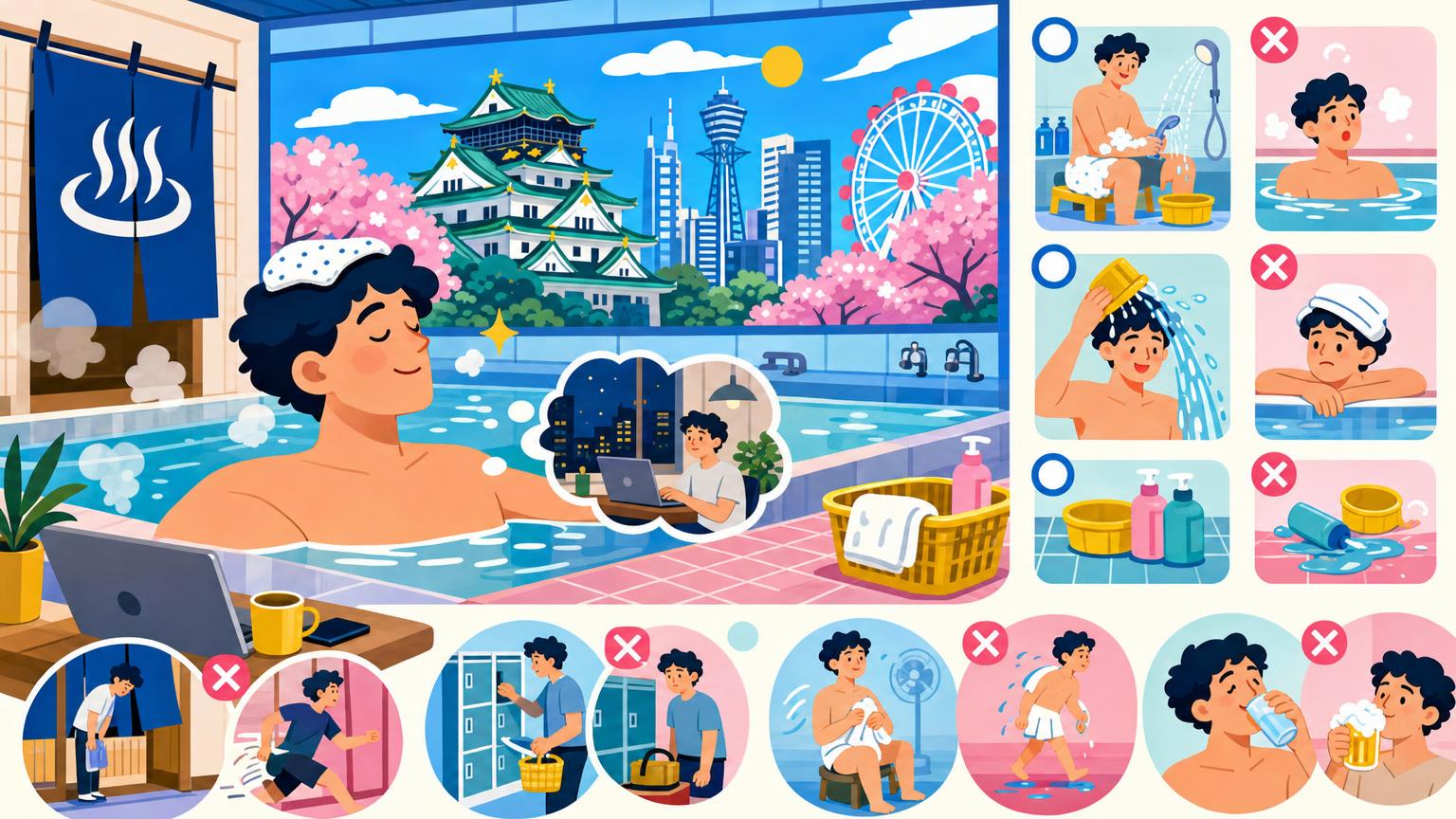
The bathhouse ritual begins as soon as you enter through the sliding glass doors. You immediately face a row of small wooden lockers—this is the shoe zone. You remove your street shoes without hesitation. Never step onto the raised floor of the sento wearing shoes. Secure your shoes in a locker, take the wooden key, and head to the counter. Pay your fee. If you didn’t bring a towel, purchase a small, thin sento towel. Then approach the curtains—red for women, blue for men. This is no time for distraction. Part the curtain and step inside the changing room.
Here, you confront the reality of the Japanese bathhouse: complete, unapologetic nudity. There are no private cubicles or changing stalls. Find an empty locker, undress, and fold your clothes neatly into the basket provided. Only bring your small towel, locker key (worn on wrist or ankle), and soap into the bathing area. Modesty in a sento is about attitude, not concealment. You do not stare at others. Use your small towel, held strategically in front of you, when walking from the locker room to the bathing area. This small towel is the sole allowance for modesty.
The most crucial sento rule, the one that must never be broken, is the order of operations: never enter the bath first. The bath is for soaking, not washing. Since the water is shared, it must remain absolutely pure. Before approaching the large hot pools, you must use the washing stations along the walls.
Sit on a small plastic stool, take the plastic basin provided, fill it with warm water from the faucet, and splash it over your body to rinse off sweat—this is “kakeyu.” Then scrub every inch of your body with soap, shampoo, and your towel. Wash thoroughly—your back, legs, and between toes—and rinse repeatedly, ensuring no soap residue remains on your skin.
While washing, be mindful of those around you. Don’t splash the person beside you or spray someone walking behind. Keep your movements controlled and respectful. When completely clean, rinse your stool and basin with hot water, leaving the station as you found it. Only then, clean and rinsed, may you enter the bath.
Enter the tub carefully, sliding in slowly. The water is often very hot, and thrashing around disturbs the surface and annoys elderly men silently soaking with their eyes closed. Never let your small towel touch the bath water—this is a major faux pas. The towel is deemed “dirty” after washing. Fold it and place it on your head or lay it gently on the tub’s edge, out of the water. Relax and soak.
When finished soaking, one last wet zone rule applies. Before returning to the changing room, wring your small towel tightly and use it to dry your entire body. Do not drip water on the locker room floor. The transition from wet to dry zones must be clean. Dry off, return to your locker, dress, and move on to the final phase of your experience.
Navigating the Tattoo Policy in Osaka
No discussion of Japanese bathhouses is complete without addressing the complex and deeply rooted issue of tattoos. For many foreigners, tattoos symbolize art, memories, or simply an aesthetic choice. In Japan, however, tattoos carry a very different cultural significance. Historically, tattoos, or irezumi, have been closely linked to organized crime, especially the yakuza. While younger generations in cities like Osaka are increasingly embracing tattoos as fashion, public bathing rules remain very strict and conservative.
As a remote worker eager to embrace sento culture, you must understand the landscape. If you have tattoos, your options are limited but not nonexistent. The cardinal rule is this: large super sentos, spa resorts, and wellness complexes enforce zero-tolerance policies. Entering a sprawling super sento in Umeda with a full sleeve will likely result in being stopped at the front desk. If you manage to undress unnoticed, staff will ask you to leave, causing an awkward situation for all. Don’t attempt to sneak in or argue cultural differences—the rule is absolute. Some progressive super sentos may permit small tattoos if covered completely by a flesh-colored sticker (often sold at the front desk), but this is an exception rather than the rule.
The great advantage of living in Osaka, as opposed to a smaller, more conservative prefecture, is the abundance of traditional neighborhood sentos. Here, the rules change significantly. Showa-era sentos tend to be much more lenient or indifferent about tattoos. These communal baths serve local residents, and in deeply local areas, you might even see older men quietly bathing with traditional Japanese body suits. The owners of these small bathhouses run a tough business and typically care far more about your 520-yen admission fee than judging your ink.
If you have tattoos and want to bathe, the strategy is straightforward: find the oldest, most weathered sento in your area. Enter respectfully. If concerned, you can politely point to your tattoo and ask the attendant at the bandai, “Tatoo daijobu desu ka?” (Are tattoos okay?). Nine times out of ten, in a small local Osaka sento, they will welcome you with a smile.
Osaka is a pragmatic city where straightforward interaction is valued over strict protocol. If you are respectful, follow washing rules carefully, and behave like a quiet, polite community member, your tattoos will largely be overlooked in neighborhood sentos. Finding your “home” sento may take some trial and error, but once you do, you unlock an essential part of local culture—tattoos and all.
Practical Tips: Bring Your Towel and Cash
To smoothly integrate the sento into your daily life as a remote worker in Osaka, preparation is key. You cannot just show up empty-handed and expect a hassle-free experience. Build a “sento kit” and understand the old-fashioned financial customs of local businesses in Japan.
Your first stop should be a 100-yen shop like Daiso or Seria, where you assemble your essentials. Buy a small, breathable mesh bag—crucial because it will get wet and must drain quickly. Inside, pack travel-sized bottles of body wash, shampoo, and conditioner; do not assume the sento provides any. Also, include a small, thin towel. Avoid large, fluffy Western-style towels in the wet zone—they become waterlogged, heavy, and slow to dry. Use thin, inexpensive Japanese towels that can be easily wrung out, used for scrubbing, covering, and drying. You can keep a larger towel in your locker for drying off before dressing, but the small towel is your main tool.
The most vital practical tip involves money. Although Japan is rapidly shifting to a cashless society, with mobile payments common for trains, convenience stores, and cafes, traditional sentos remain a cash-only world. If you enter a neighborhood bathhouse with only your Apple Watch and American Express card, you will not be bathing.
Carry physical yen—specifically coins. The current admission fee is 520 yen. Handing the attendant a 10,000-yen bill for a 520-yen fee is considered rude. Break your bills in advance at a convenience store. Most importantly, keep a steady supply of 100-yen coins. Lockers often require a 100-yen coin deposit, returned when you unlock them. If you want to use a hair dryer after your bath, expect to pay coins—usually 20 yen for three minutes of hot air. Mastering the quick task of drying your hair before time runs out becomes a familiar dance.
Many local sentos also have coin laundries attached. For the ultra-efficient remote worker, the ultimate hack is to load dirty clothes into the washing machine outside the sento, enjoy an hour-long bath, and emerge perfectly clean as your laundry finishes. This, of course, demands even more 100-yen coins.
By preparing your sento bag and hoarding coins, you eliminate friction from the experience. No second-guessing; you close your laptop, grab your mesh bag and coin purse, and step out into the Osaka night. Follow the neon signs to the local bath, shed digital noise, physical tension, and remote work isolation. Wash, soak, reset. For a few hours, become just another local, perfectly attuned to the city’s rhythm. This is not merely a way to de-stress—this is how you survive and truly live in Osaka.