You step out of the station into the electric hum of Namba, and the first thing that hits you is not the neon reflecting off the Dotonbori river, nor the scent of grilled octopus and rich takoyaki sauce drifting through the heavy evening air. The first thing that truly hits you is the sheer, unadulterated volume of the voices. Osaka does not whisper. Osaka does not deal in the hushed, carefully measured tones you might have grown accustomed to if you started your Japanese journey in Tokyo. Here, in the sprawling concrete maze of the Kansai region’s beating heart, communication is a full-contact sport. It is a rapid-fire exchange of passion, opinion, comedy, and dramatic flair. You find yourself pulled into an izakaya under the rumbling train tracks of Shin-Umeda, sitting shoulder-to-shoulder with locals whose laughter bounces off the smoke-stained walls. A new friend leans across a bubbling pot of motsunabe, their eyes wide with intense conviction. They spend the next ten minutes passionately detailing why a specific, hidden vintage shop in the labyrinthine alleys of Nakazakicho sells the absolute best denim in the entire world. They give you the meticulous history of the fabric. They break down the eccentric life story of the shop owner. They give you turn-by-turn directions from the nearest subway exit. You are completely captivated. You are sold. You are ready to map out your morning specifically to find this legendary shop. And then, right at the very precipice of this glorious, convincing monologue, they take a sip of their frosty draft beer, wave their hand dismissively through the air, and drop a phrase that instantly dismantles the entire architectural integrity of everything they just told you. They look you dead in the eye and say, ‘Shiran kedo.’
You freeze. You mentally rewind the tape. You ask yourself why you just invested your complete attention into a ten-minute, impassioned lecture that concluded with the phrase, ‘I do not know, though.’ This is your baptism into Osaka’s conversational waters. This is your first true encounter with the most chaotic, brilliant, and deeply frustrating linguistic loophole in the entire Kansai dialect. You have just been introduced to the ultimate escape hatch. You have just experienced the verbal sleight-of-hand that defines the rhythm of this city. If you plan on living in Osaka, if you are considering packing your bags and moving to this vibrant metropolis, or if you simply want to understand the psychological wiring of the people who call this city home, you cannot simply learn standard Japanese grammar. You must learn the unspoken rules of the streets. You must learn how to navigate a culture that values comedic timing just as much as factual accuracy. You must understand the profound, multifaceted nuance of ‘shiran kedo.’ It is not just a phrase. It is a philosophy. It is a shield. It is a punchline. And depending on who is listening, it is either a stroke of conversational genius or the most infuriating sound in the world.
What Does “Shiran Kedo” Mean in Japanese?
To truly understand the mechanics of this phenomenon, we must first break the phrase down to its fundamental elements. We need to examine the raw linguistics before appreciating the cultural structure built upon it. When you hear ‘shiran kedo’ resonating through the bustling shopping arcades of Tenjinbashisuji or bouncing off the counter of a standing bar in Tenma, you are encountering a localized, heavily stylized variation of standard Japanese. Standard Japanese—the clear, polite language taught in textbooks worldwide—requires a certain level of precision and formality. But Osaka is a city historically rooted in trade, bargaining, and quickly breaking the ice with strangers to close a deal or make friends. Naturally, the language has evolved to match the pace and informal warmth of the streets. The phrase ‘shiran kedo’ perfectly embodies this evolution. It is quick. It is sharp. It leaves a distinct impression in the air. Yet if taken completely literally, it sounds like a sudden admission of ignorance. The literal translation is roughly, ‘I don’t know, but…’ or ‘I don’t know, though.’ However, translating it literally is like studying a photograph of the ocean and believing you understand the tides. The literal meaning is only the surface. The true meaning lies in how it shifts the tone of the conversation. It serves as a disclaimer. It is a verbal asterisk placed at the end of a long, loud sentence.
Breaking Down the Words (Shiran + Kedo)
Let’s analyze the phrase’s structure. The first part is ‘shiran’ (知らん). In standard, textbook Japanese—the kind spoken by news anchors in Tokyo or found in language manuals—the phrase for ‘I do not know’ is ‘shiranai’ (知らない). The verb is ‘shiru’ (to know), with ‘nai’ as the negative suffix. It is straightforward and clinical. But in the Kansai dialect, which covers Osaka, Kyoto, Kobe, and surrounding prefectures, the negative suffix ‘nai’ is often, almost aggressively, replaced with an ‘n’ sound. ‘Wakaranai’ (I do not understand) becomes ‘wakaran.’ ‘Dekinai’ (I cannot do it) becomes ‘dekin.’ And ‘shiranai’ shortens to the punchy, abbreviated ‘shiran.’ This sound is inherently more casual, carrying a slightly rough, street-level texture. It rolls off the tongue faster, requires less effort, and feels less like a formal declaration of ignorance and more like a casual shrug captured in phonetic form.
The second part is ‘kedo’ (けど). This conjunction exists in both standard and Kansai Japanese. It translates directly to ‘but,’ ‘however,’ or ‘although.’ Typically, ‘kedo’ links two contrasting ideas: ‘It is raining outside, but (kedo) I will go to the store.’ However, in colloquial speech, ‘kedo’ has evolved into a sentence-ending particle. It softens statements and leaves thoughts intentionally unresolved. Ending a sentence with ‘kedo’ signals to the listener that you are not quite finished, that there is room for their input, or that you are deliberately avoiding a definitive conclusion. It allows the sentence to drift rather than come to a firm stop.
Combining these two elements—the rough, abbreviated ‘shiran’ and the softening, trailing ‘kedo’—creates a remarkably versatile linguistic tool. The direct translation of ‘shiran kedo’ (I don’t know, though) doesn’t capture the phrase’s performative aspect. You’re not genuinely declaring ignorance. If you truly didn’t know, you wouldn’t have just spent five minutes discussing the topic with the passion of a seasoned debater. What you’re really saying is, ‘I’ve just given you a great deal of information, presented it as absolute fact, expressed this opinion with full conviction, but please don’t hold me accountable if I turn out to be completely wrong.’ It’s the colloquial equivalent of throwing a smoke bomb at the end of a magic trick. It obscures the exit, removes liability, and leaves the listener both entertained and unmoored.
The Cultural Nuance: More Than Just “I Don’t Know”
Living in Osaka quickly reveals that communication here is seldom about the strict transmission of information. If someone from Tokyo gives you directions to a restaurant, they will likely use landmarks, exact distances, and might even open a map app to make sure you don’t get lost. The aim is precision, to avoid any mistakes. Conversely, if someone from Osaka gives you directions, they’ll probably tell a story. They’ll describe the chef’s vibrant personality, imitate the sound of meat sizzling on the grill, vaguely gesture a direction, and tell you to turn left when you catch a delicious aroma. The aim is connection, to entertain. Because the goal is entertainment, facts sometimes become collateral damage in the pursuit of a good tale. This cultural environment is exactly where ‘shiran kedo’ flourishes. It isn’t meant to deceive, but to smooth social interactions. It allows people to speak openly, boldly, and without the paralyzing fear of being wrong.
The Ultimate Conversation Escape Button
It’s important to grasp the enormous psychological weight that assertion carries in Japanese society. To state a fact is to bear the heavy, invisible burden of its truth. If you confidently say a train arrives at three o’clock, but it actually shows up at three-oh-five, you have failed. You disrupted the schedule’s harmony, provided incorrect information, and caused inconvenience. Traditional Japanese communication manages this pressure through layers of polite ambiguity: softening verbs, hedged statements, and sentences fading without firm claims. It’s a linguistic tightrope walk. Everyone fears making definitive assertions because doing so invites responsibility.
Osaka, however, rejects walking on eggshells altogether. Locals stomp through the kitchen in heavy boots. They want to make bold, assertive claims about train schedules, weather, the best ramen in the ward, or global politics. They thrive on the thrill of debate, the heat of conversation, loudly proclaiming the Hanshin Tigers as the greatest baseball team ever, regardless of recent stats. Yet they remain Japanese and feel the cultural pressure of responsibility. So how do they balance this urge to be loud and assertive with society’s demand to avoid binding claims?
They pull the ripcord with ‘shiran kedo.’ It’s a stunning linguistic magic trick: the exhilaration of a bold statement without the cost of liability. They give you a dazzling fireworks display of their opinions but refuse to stay and clean up the mess. It’s the ultimate escape button in conversation. It grants complete psychological safety. You can spin wild rumors about celebrities, predict the local economy’s future, or explain a movie plot you barely saw, and as long as you end with ‘shiran kedo,’ you’re shielded. Later, if someone points out factual inaccuracies, you just smile and say, ‘Well, I told you I didn’t know!’ It’s airtight, bulletproof, and remarkably effective.
The Deep Connection to Osaka and Kansai Dialect
To truly understand this conversational quirk, you need to consider Osaka’s historical and cultural foundations. Osaka has long been known as ‘Tenka no Daidokoro,’ the Kitchen of the Nation. During the Edo period, while Tokyo (then Edo) was the strict, hierarchical political capital ruled by samurai and rigid class systems, Osaka was the chaotic, bustling merchant capital. It was a city of traders and business owners who earned their living not by wielding swords but by drawing crowds. In a merchant city, the ability to talk, negotiate, entertain, and instantly connect with strangers was essential for survival. You had to be quick-witted, charming, and skilled at keeping conversations flowing so commerce would thrive.
This merchant DNA remains fiercely alive on Osaka’s streets today. It explains why people here walk faster, speak louder, and stand closer than their Tokyo counterparts. Intrinsically tied to this merchant spirit is the culture of ‘owarai,’ or Japanese comedy. Osaka is Japan’s undisputed comedy capital. The massive entertainment firm Yoshimoto Kogyo is based here, and the rhythms of professional stand-up comedy saturate everyday speech. In Osaka, every conversation is secretly a comedic act, with an unspoken expectation that when you speak, you’re setting up a joke or preparing to deliver a punchline.
The dynamic between ‘boke’ (the humorous, foolish, or exaggerated character) and ‘tsukkomi’ (the straight, rational character who corrects the boke) forms the core of Kansai communication. ‘Shiran kedo’ plays a crucial role in this exchange. When someone launches into a passionate, detailed monologue and then suddenly undercuts their own authority with ‘shiran kedo,’ they’re performing the ‘boke.’ They deliberately make themselves look a bit foolish and set up the joke, inviting the listener to take the ‘tsukkomi’ role and point out the absurdity. The phrase acts like a comedic drum fill, signaling the end of the bit. It’s the rhythmic conclusion of a spoken-word jazz solo. Without understanding this comedic undertone, ‘shiran kedo’ can sound like a frustrating lie. But viewed through the lens of Osaka’s merchant charm and comedy obsession, it becomes a brilliant, collaborative performance art.
How to Use “Shiran Kedo” Like a Local in Japan
Grasping the theory behind the phrase is one thing, but deploying it effectively in real-life situations demands a finely tuned sense of timing, tone, and situational awareness. You can’t just tack ‘shiran kedo’ onto the end of every English sentence you say while living in Osaka and expect to be accepted as a local. It calls for the right context, the right company, and the proper buildup of energy. It’s strictly a casual expression. It belongs in neon-lit back alleys, crowded yakitori bars, cramped university dormitory elevators, and bustling informal workplace break rooms. It serves as a bridge between friends and acquaintances.
Example Scenarios in Casual Conversations
Let’s paint a vivid picture of how this phrase works in everyday life. Imagine you’re at a tachinomi (standing bar) in the heart of Umeda. The air is thick with the scent of fried skewers (kushikatsu) and spilled draft beer. You’re talking to an Osaka local named Kenji, and you ask him where you should take your partner for a romantic date this weekend.
Kenji’s eyes light up. He slams his glass on the sticky counter and leans in, fully in performance mode.
Person A (Kenji): “Ah, you have to go to the top of the Umeda Sky Building exactly at sunset. Not five minutes before, not five minutes after. Exactly at sunset. The way the light hits the city makes everyone look incredibly cinematic. I guarantee if you take them there, they’ll fall deeply in love with you forever. It’s the most powerful romantic spot in all of Kansai. It has an absolute one hundred percent success rate for proposals.”
Kenji pauses, making sure you’ve absorbed the weight of his advice. He picks up his beer, takes a long sip, looks up at the ceiling, and adds:
Person A (Kenji): “…Shiran kedo.” (Phonetic: Shee-ran ke-do / Translation: I don’t know, though.)
Notice the structure of this exchange. Kenji delivers a bold, wildly exaggerated claim, promising a one hundred percent success rate for romance. He knows it’s an impossible guarantee, and you know it too. By adding ‘shiran kedo,’ he’s acknowledging the absurdity of his own certainty. He’s essentially saying, “I highly recommend this place, but obviously I can’t guarantee your romantic success—don’t blame me if your date goes badly.”
Now consider another example. You’re walking down a shopping street with a coworker, hunting for a lunch spot. You point out a new ramen shop that just opened.
Person A (Coworker): “Oh, I heard that new ramen shop is run by a chef who spent twenty years training alone in the mountains of Hokkaido. The broth supposedly takes three weeks to boil down. People say it’s the greatest bowl of noodles ever made in human history.”
Person A (Coworker): “…Shiran kedo.”
They’re sharing a rumor, trying to spread exciting gossip and build anticipation. But they don’t want to be held responsible if the ramen actually tastes like salty dishwater. ‘Shiran kedo’ shields them from potential disappointment. It lets the rumor exist as entertaining hearsay, not verified fact.
How to React: The Perfect “Tsukkomi” Response
This is where many foreign residents and even Japanese people outside of Kansai stumble. They hear ‘shiran kedo’ and freeze. They take it literally, looking confused and asking, “Wait, you don’t know? Then why did you tell me all that?” Reacting this way kills the rhythm, drops the ball, and ruins the comedic tension.
Remember the ‘boke’ and ‘tsukkomi’ dynamic. When a local says ‘shiran kedo,’ they’re playing the ‘boke’ (the fool). It’s now your social role to step up as the ‘tsukkomi’ (the straight person) and playfully call out their absurdity.
If Kenji tells you the Umeda Sky Building guarantees a one hundred percent romance success rate, ending with ‘shiran kedo,’ the best response is a sharp, slightly loud, incredulous retort.
Person B (You): “Shiran no kai!” (Phonetic: Shee-ran no kai! / Translation: You don’t know?!)
This is the golden key to unlocking Osaka. ‘Shiran no kai!’ is the classic, textbook ‘tsukkomi’ response. You’re aggressively but playfully calling them out for dodging responsibility. You’re saying, “How dare you speak with such confidence and then backtrack at the last moment!” When delivered with good timing, the entire dynamic changes. The local laughs, respects you, and you’ve joined the cultural dance. You’re no longer just an observer but an active participant in Osaka’s communication style. You can also use variations like ‘Sekinin mote yo!’ (Take some responsibility!) or ‘Tekitou na koto iu na!’ (Don’t just say random things!). But ‘Shiran no kai!’ remains the unbeatable comeback—short, using their exact phrase against them, and instantly creating a bond of camaraderie.
When to Avoid Using “Shiran Kedo”
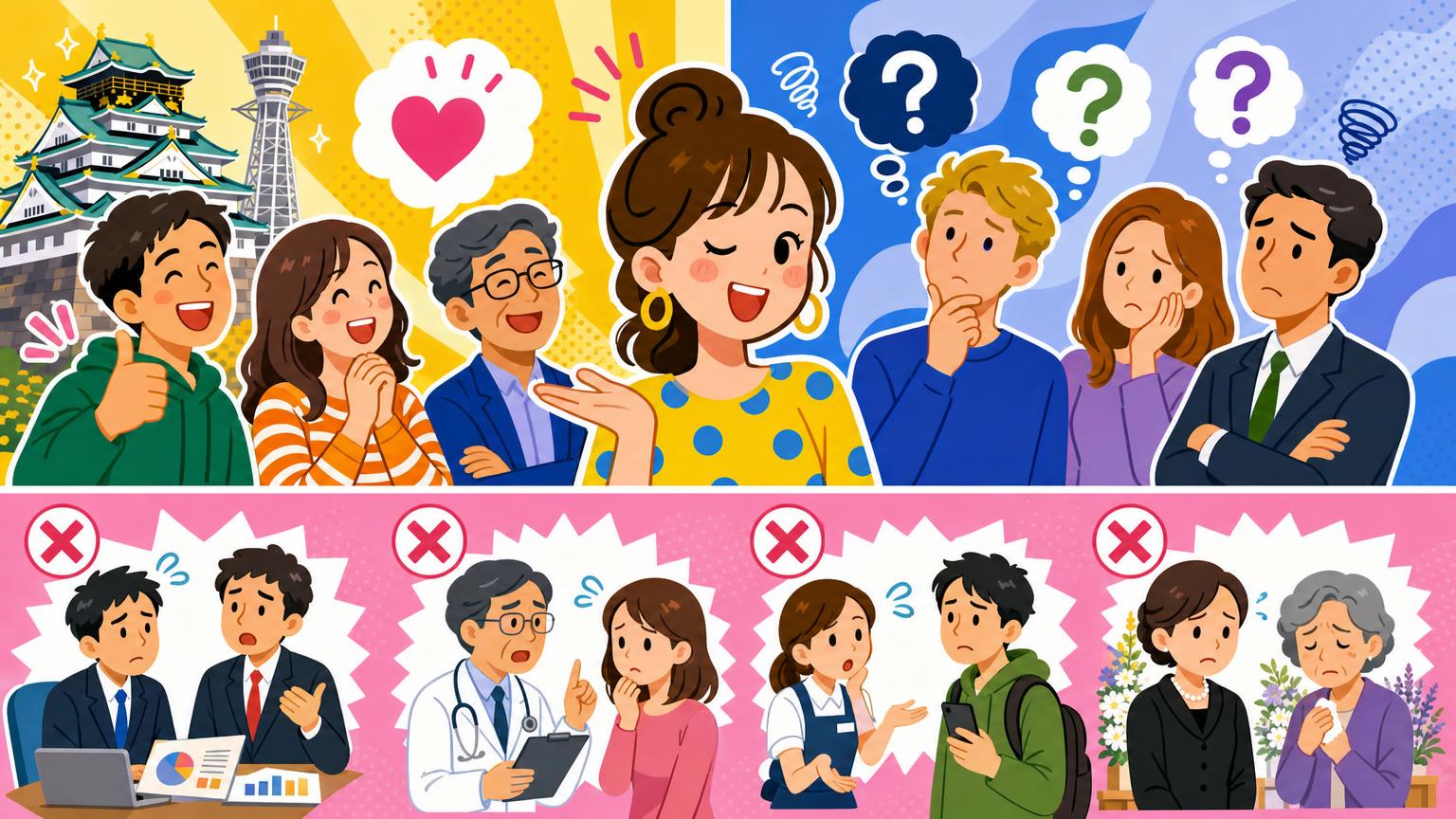
While mastering this phrase marks an exciting milestone in your integration into Osaka culture, it is equally important to recognize its potentially harmful impact. ‘Shiran kedo’ acts like a conversational scalpel. When used skillfully, it delivers precise comedic effect. When misused, it can damage professional relationships, offend superiors, and make you seem untrustworthy. This colloquialism is steeped in nuance, and there are settings where using it amounts to social sabotage. If you live in Osaka and work in a Japanese corporate environment, navigating these boundaries with great care is essential.
Why It Can Be Annoying or Offensive to Some
We must acknowledge the phrase’s darker side. A quick internet search for ‘shiran kedo’ will often lead to a frequently searched related query: ‘知らんけど 不愉快’ (Shiran kedo fuyukai / ‘Shiran kedo’ is unpleasant/offensive). Why does a phrase intended as a harmless comedic disclaimer provoke such genuine irritation in some people?
The root cause lies in the clash between Osaka’s casual merchant culture and the strict expectations of standard Japanese society. For someone from Tokyo, or anyone who values precision and sincerity, repeated use of ‘shiran kedo’ does not come across as humorous. Instead, they hear someone evading responsibility—a person lacking the courage to stand behind their words. To a listener unaccustomed to Kansai’s rhythm, the phrase can feel uncomfortably close to gaslighting.
Imagine you are sharing a deeply personal problem, feeling vulnerable, and seeking advice. The other person responds with a thoughtful, lengthy answer, only to finish abruptly with ‘shiran kedo.’ In this context, the phrase hits hard emotionally. It effectively says, “I gave you advice, but I don’t actually care about the outcome and refuse to be emotionally invested.” It trivializes the conversation and reduces a serious moment to a punchline.
Moreover, chronic overuse of the phrase can become irritating even to other Osaka natives. If every opinion or piece of advice is followed immediately by a disclaimer of ignorance, the speaker starts to sound evasive—like someone eager to enjoy the spotlight without accepting accountability. This can come across as manipulative because people want to feel that their conversation partner genuinely believes what they say. When ‘shiran kedo’ is overused, it erodes trust, leaving the listener feeling uncertain and unstable about the speaker’s true thoughts or feelings.
Politeness Levels and Formal Situations
This should be obvious but bears emphasizing for foreigners learning Japanese: ‘shiran kedo’ is entirely inappropriate in business contexts, formal situations, or any setting that requires ‘keigo’ (polite/honorific Japanese).
Picture yourself in a boardroom in the business district of Yodoyabashi. You’re presenting the quarterly sales forecast to your department manager and confidently explain that revenue should rise by twenty percent in the next three months due to a new marketing strategy. Then, you casually mutter ‘shiran kedo’ as you switch slides. You’ll probably be packing your desk before the day ends. In professional environments, dodging responsibility is no joke—it is a serious flaw. You’re paid to know and to take responsibility for your data. Using a casual street-level phrase to shield oneself from corporate liability is a grave breach of etiquette.
The same principle applies when dealing with city hall, signing a lease, talking to police, or apologizing for a mistake. If you accidentally bump someone on the crowded Midosuji subway and spill their coffee, you don’t follow your apology with ‘shiran kedo.’ Doing so completely undermines the sincerity of the apology. The phrase is designed for informal contexts and requires a foundation of casual intimacy to work. Without that intimacy, or when strict adherence to facts and responsibility is necessary, keep the phrase firmly out of use. Stick to standard Japanese. Be precise. Take ownership of your words. Save the comedic escape hatch for the izakaya after work.
Why Learning Local Slang Enhances Your Japan Trip
If you are a foreign resident trying to establish a life in Osaka, or even a traveler planning an extended stay in the Kansai region, you might wonder why you should bother learning the nuances of a phrase like ‘shiran kedo.’ You already face the challenge of memorizing standard vocabulary, conjugating polite verbs, and remembering the stroke order for kanji. So why add the unpredictable layer of regional dialect to your mental load?
The reason is simple: language is not just a tool for conveying information. Language is the lens through which a culture perceives the world. When you rely solely on textbook Japanese, you communicate in a sterile, universal style. You will be understood, yes. You’ll be able to order food, buy train tickets, and ask for directions. But you will remain fundamentally an outsider. You will be engaging with a polished, formal version of Japan designed specifically for public consumption.
However, when you learn the local slang, grasp the rhythm of the dialect, and can successfully navigate the cultural nuance of a phrase like ‘shiran kedo,’ you break through that invisible barrier. You signal to the locals that you are not just a passive consumer of their city. You show that you are paying attention. You demonstrate appreciation for the unique flavor of their home.
Osaka is a city fiercely proud of its distinct identity. It defines itself in opposition to Tokyo. While Tokyo is seen as cold, polite, and distant, Osaka prides itself on being warm, loud, funny, and deeply human. To understand ‘shiran kedo’ is to understand that human element. It is to grasp a culture that values laughter over strict accuracy, a culture that delights in spinning a good yarn, a culture eager to connect with you so much that they’ll invent a confident opinion just to keep the conversation alive.
When you master this phrase, and even more importantly, when you master the ‘shiran no kai!’ response, you are no longer just a foreigner speaking Japanese. You become part of the local rhythm. You turn a simple transaction at a bar into a moment of genuine cultural exchange. You show that you understand the soul of the city. You realize that beneath the noise, neon, and chaotic energy of the streets, Osaka is a place where people want to talk, laugh, and share a moment together, free from the heavy burdens of perfect accuracy. You appreciate the profound beauty of a conversation that doesn’t need to be correct, as long as it’s enjoyable. That is the true magic of Osaka. That is the secret hidden within the dialect. And that is why mastering this one simple, maddening phrase will fundamentally transform how you experience daily life in the Kansai region. It unlocks a warmth and camaraderie that textbooks simply cannot teach. You will finally hear the city as it hears itself. Or, at least, that is the theory. Shiran kedo.