
Moving to Japan is a shock to the system. Moving to Osaka is a shock to the soul. You arrive in this country with preconceived notions of a rigid, hyper-polite, completely silent society where everything runs on invisible tracks of unspoken rules. You expect the sterile perfection of a Tokyo subway car. You expect people to keep to themselves, to avoid eye contact, to apologize for simply existing in your general vicinity. Then you step off the Midosuji line at Namba or you wander into a neighborhood shotengai in the sprawling wards of this relentless city, and the noise hits you. The glorious, unfiltered, chaotic noise. Bicycles rattle past your elbows with a sharp ring of the bell. Shopkeepers stand out on the pavement, shouting out the evening discounts in a thick, rolling Kansai dialect. Grandmothers with dyed purple hair haggle loudly over the price of daikon radishes. It is loud. It is vibrant. It is profoundly alive. Tokyo is a city of observation. Osaka is a city of participation.
As someone who spends half the week analyzing anime storyboards to meet international publishing deadlines and the other half trying to navigate Kansai’s vast, concrete urban sprawl, I had to learn the rhythm of this city the hard way. Coming from a Korean-American background, I thought I understood the Asian metropolis. I thought I knew how to navigate dense neighborhoods and decode the hidden language of grocery shopping. But Osaka requires a different kind of fluency. This is a city built on the concept of ‘Kuidaore,’ famously translated as ‘eat until you drop’ or ‘ruin yourself by eating.’ Food is not just sustenance here; it is the currency of social interaction, the bedrock of the local economy, and the absolute center of everyday life. The people of Osaka do not eat to live; they live to eat, to talk about eating, to plan their next meal while finishing their current one, and to aggressively ensure that you are eating well, too.
But what happens when you cannot eat everything? What happens when you arrive in the undisputed kitchen of Japan, a city completely obsessed with pork broth, beef tallow, hidden fish extracts, and a seemingly infinite variety of animal-based umami, and you have strict dietary restrictions? For Muslim residents looking for halal ingredients, or for vegans and vegetarians trying to maintain a plant-based lifestyle, Japan can initially feel like an impenetrable fortress of hidden dietary pitfalls. You hear the horror stories before you even arrive. You hear about the seemingly innocent potato chips laced with pork extract. You hear about the plain white bread that somehow contains emulsifiers derived from animal fat. You panic. You pack your suitcases full of lentils, spices, and safe snacks from home, convinced you will be living on plain rice and raw cabbage for the duration of your stay.
Yet, the reality of living in Osaka with dietary restrictions is far more nuanced, far more forgiving, and ultimately far more rewarding than the internet forums would have you believe. Because beneath the intimidating language barrier and the complex food labeling laws, you discover the fundamental truth about Osaka: it is, at its core, a merchant city. And merchants are pragmatists. In Tokyo, you might find a high-end, perfectly curated vegan cafe in Aoyama charging two thousand yen for a small plate of organic vegetables. It is an aesthetic experience, a lifestyle brand, a deliberate statement of modern urban purity. Osaka does not care about your aesthetic. Osaka cares about the transaction. Osaka cares about the relationship. The shopkeepers here do not offer vegan or halal options because they are trying to be trendy; they offer them because they see a demand, because they have foreign students in their neighborhoods, and because a true Osaka merchant hates to turn away a paying customer.
The beating heart of this pragmatic food culture is the shotengai, the traditional covered shopping arcades that spiderweb across every single neighborhood in the city. These covered streets are the lifelines of local communities. They are where the sterile convenience of modern supermarkets gives way to the messy, human reality of independent vendors. Here, the butcher, the baker, and the tofu maker have been operating in the same narrow stalls for generations. Sourcing halal, vegan, and organic groceries in these environments is not a matter of looking for a certified green sticker on a pristine shelf. It is a matter of communication. It is a matter of understanding how Japanese ingredients work at a fundamental level. It is about realizing that naturally plant-based foods have existed in Japan for centuries, long before the word ‘vegan’ was ever uttered.
This is not a tourist guide. We are not going to talk about where to get the most photogenic matcha ice cream or how to find the most famous takoyaki stand. We are going to talk about survival. We are going to talk about daily life. We are going to explore how you stock your pantry, how you decode the complex kanji on the back of a sauce bottle, and how you build relationships with local vendors who will eventually start pointing out which products are safe for you before you even have to ask. We are going to look at the massive wholesale supermarkets where international residents gather, the tiny specialty marts hidden near university campuses, and the unspoken rules of navigating a culture that wants nothing more than to feed you, even if they do not quite understand your diet yet.
To understand Osaka, you have to walk its markets. You have to feel the humidity of a summer evening pressing down on the glass roof of the shotengai. You have to smell the rich, heavy scent of roasting green tea mixing with the sharp tang of pickled vegetables. You have to embrace the chaos, discard your expectations of Tokyo-style perfection, and dive into the practical, honest, and deeply human experience of sourcing your daily bread in the kitchen of Japan.
A Guide to Finding Halal and Vegan Groceries in Osaka
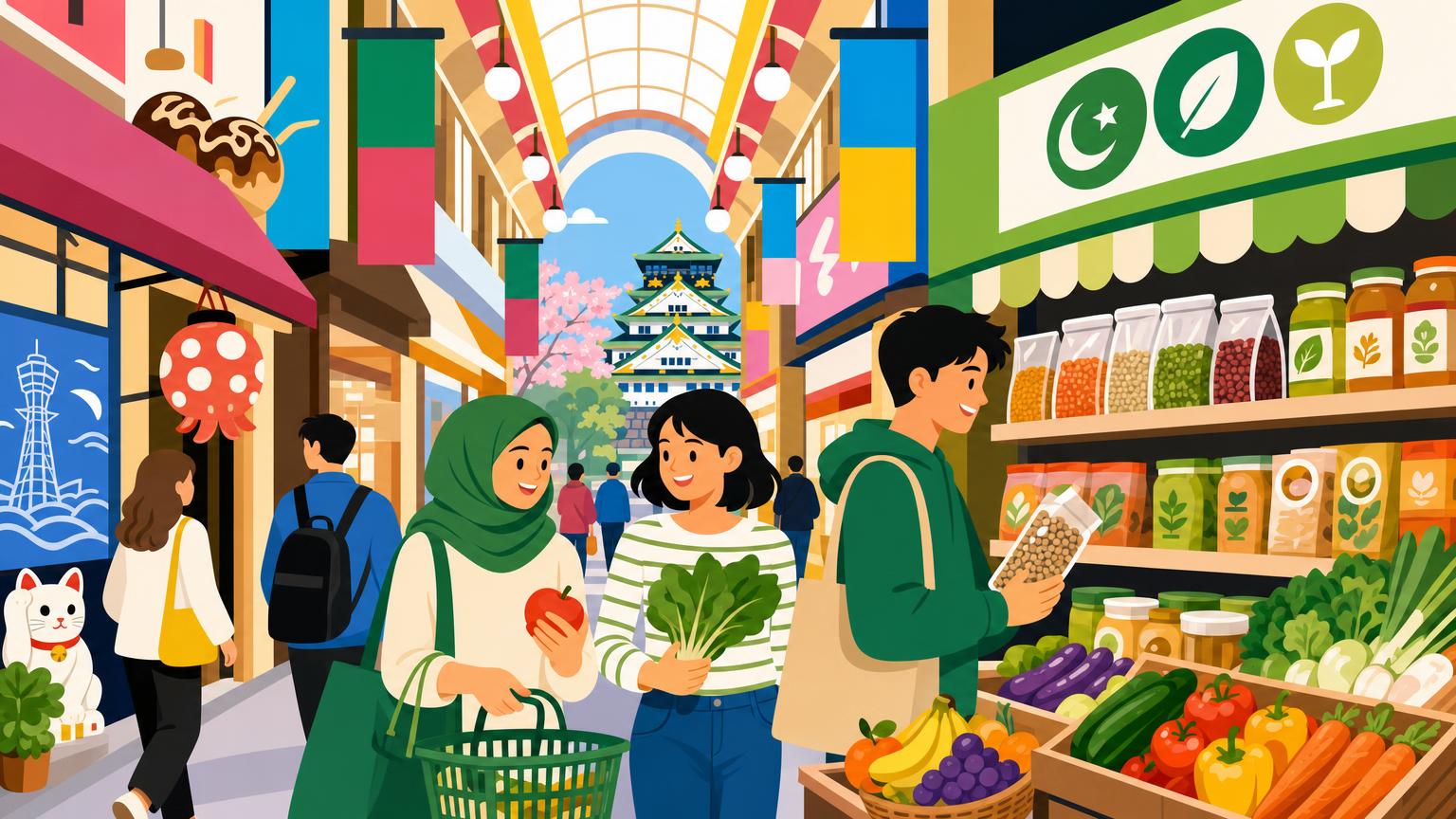
When you first try to buy groceries in Osaka, the overwhelming density of the environment can feel immobilizing. Japanese supermarkets bombard the senses with bright fluorescent lights, overlapping jingles from small screens, and shelves so tightly packed they seem to defy logic. For an expat carrying a mental list of dietary restrictions, this setting is a minefield. You might grab a package of miso soup, assuming it contains only fermented soybeans and seaweed, only to later discover the broth heavily depends on bonito fish flakes. Or you pick up a seemingly harmless vegetable snack, only to find chicken powder listed midway through the ingredients. Frustration mounts quickly. It’s easy to withdraw, stick to imported foods that cost three times as much, and resent the local food culture for being so inflexibly rooted in tradition.
However, that resentment often stems from a misunderstanding of how Japanese cuisine is crafted. The Japanese diet centers on umami—the fifth taste, a savory, deep, and complex flavor that makes food deeply satisfying. In Japan, umami is primarily drawn from the sea and land in ways that are intricately connected. Dashi, the essential broth forming the base of nearly all traditional Japanese cooking, is typically made from dried kelp and smoked, fermented skipjack tuna. Even dishes that appear purely vegetable-based almost always carry the invisible influence of dashi guiding their flavor. Similarly, the rapid westernization of the Japanese diet over the past century has led to a focus on rich, heavy flavors, frequently achieved by adding small amounts of animal fats, pork extracts, and dairy-derived emulsifiers to everyday products to enhance their perceived quality and texture.
Osaka, however, provides a unique balance to this umami-heavy tradition. As a city of merchants, Osaka is also a city of remarkable adaptability. Its residents are not strictly bound by tradition when breaking it proves practical. They are open, curious, and highly attuned to the changing makeup of their neighborhoods. Over the last decade, Osaka has experienced a significant influx of international students, tech workers, language teachers, and long-term residents from South Asia, Southeast Asia, and the Middle East. This demographic shift occurred not in the polished, costly corporate centers of Tokyo but in the gritty, affordable, sprawling residential districts of Osaka. Where people settle, merchants follow.
The Growing Accessibility of Muslim-Friendly and Plant-Based Foods
The evolution of Osaka’s grocery scene has been subtle yet profound. It was not driven by large government programs or major PR efforts but happened organically, fueled by local demand. Step into a neighborhood supermarket in districts like Yodogawa or Suita, and you’ll notice quiet changes: a small shelf dedicated to halal-certified spices, a freezer stocked with imported flatbreads and large bags of frozen halal chicken, and a modest display of soy-based meat alternatives placed alongside regular ground pork.
For Muslims living in Osaka, the concept of halal is gradually gaining recognition—not necessarily as a deep religious principle among locals but as a specific set of dietary rules that businesses respect to thrive. Osaka residents are highly practical. If a local butcher in a shotengai learns that ten families in his neighborhood exclusively buy meat slaughtered in a particular way, he won’t argue; instead, he will find a way to source that meat or direct customers to a supplier who does. This practical accommodation defines Osaka’s culture. It’s not about virtue signaling but about straightforward supply, demand, and mutual respect.
For vegans, the path differs, relying heavily on rediscovering traditional, naturally plant-based elements of Japanese cuisine that predate modern meat-based flavorings. Tofu, natto, konnyaku, wakame, edamame, and an impressive variety of seasonal mushrooms and mountain vegetables create a rich, naturally vegan pantry—affordable, plentiful, and deeply rooted in everyday shotengai life. The challenge is not locating vegan food but learning to navigate around modern additions of fish broth and hidden dairy. Once you master these guidelines, local neighborhood markets open up to reveal a bounty of fresh, seasonal produce that puts the sterilized, shrink-wrapped vegetables of Western supermarkets to shame.
Best Supermarkets for Halal and Vegan Finds
Knowing where to shop is the crucial first step to thriving and surviving in Osaka. You cannot depend on a single store to meet all your needs. Grocery shopping in Japan often involves a modular approach: you buy fresh vegetables from the local greengrocer in the shotengai, bulk staples from a wholesale market, and specialty imported goods from niche retailers. You must be ready to pedal a rusty mamachari bicycle between three different stores on a Tuesday evening to get exactly what you need. It sounds tiring at first, and indeed it is, but soon it becomes a ritual—a way to map your neighborhood, recognize familiar faces in your community, and truly become part of the city’s fabric.
Gyomu Super: The Top Choice for Halal Meat and Frozen Foods
If there is one institution that single-handedly sustains Osaka’s international population, it is Gyomu Super. Recognizable by its stark, somewhat faded green and white signage, Gyomu Super literally means ‘business supermarket.’ Originally created to supply restaurants and caterers with bulk ingredients at rock-bottom prices, it has become a holy grail for expats, students, and anyone trying to survive on a budget in Japan. Walking into Gyomu Super is an exercise in chaotic utility. There is no mood lighting or curated background music. The aisles are narrow, products are stacked high in their original cardboard shipping boxes, and the freezer section’s aggressive air conditioning requires a winter coat even in August.
But for halal-conscious residents, Gyomu Super is an oasis. Years ago, buyers at Gyomu recognized a huge, untapped market for affordable halal-certified meat among the growing foreign population. Today, almost every sizable Gyomu Super in Osaka boasts a dedicated freezer section stocked with halal chicken imported directly from Brazil. You can find massive two-kilogram bags of chicken thighs, drumsticks, and breasts, all clearly labeled with recognized halal certification logos. They also offer halal-certified frozen beef, lamb, and various processed meats like sausages and burger patties. Prices are incredibly low, often undercutting non-halal domestic meats sold in regular supermarkets by a significant margin.
For vegans, Gyomu Super is equally invaluable, though it requires a bit more label scrutiny. It’s the best place to buy bulk bags of frozen vegetables, which are flash-frozen and generally free from hidden additives. You can find large bags of frozen broccoli, spinach, edamame, and mixed berries, saving you a fortune during winter months when fresh produce prices soar. More importantly, Gyomu is a treasure trove of inexpensive imported pantry staples. You’ll find large jars of tahini, massive bags of dried lentils, chickpeas, and kidney beans, imported Italian pasta, and enormous cans of crushed tomatoes. They also offer accidentally vegan snacks from Europe and Southeast Asia, dark chocolate bars, and various plant milks including soy, almond, and oat milk, usually priced well below standard grocery stores.
The checkout line at an Osaka Gyomu Super is a microcosm of the city’s shifting identity. You might find yourself behind a local takoyaki stand owner buying ten bags of flour, a group of international students from Indonesia pooling money for halal chicken and spicy noodles, or an elderly Japanese woman carefully inspecting a bag of discounted sweet potatoes. It’s loud and fast, with cashiers ruthlessly efficient. You pack your own bags at the crowded counter near the exit, wrestling frozen goods into reusable tote bags before biking home through the humid night air. It’s not glamorous, but it’s the raw, beating heart of practical survival in Osaka.
Aeon & Daiei: Everyday Vegan Staples and Fresh Produce
While Gyomu Super covers bulk and frozen goods, you’ll eventually need a dependable, standard supermarket for fresh produce, delicate tofu, and domestic staples. This is where major retail chains like Aeon and its subsidiary Daiei come in. These stores are ubiquitous across Osaka, ranging from massive multi-story shopping malls in the suburbs to smaller neighborhood grocery stores near major train stations.
Aeon is notable for its corporate commitment to catering to health-conscious consumers and diverse dietary needs through its private label brand, ‘Topvalu.’ The Topvalu brand is divided into tiers, and the ‘Topvalu Green Eye’ line specifically focuses on organic, natural, and eco-friendly products. Recent years have seen Aeon aggressively expand its plant-based selection under this label. You can easily find clearly marked vegan items such as soy-based ground meat alternatives, plant-based hamburger patties, and dairy-free cheeses and yogurts—typically located in a designated health food section or alongside traditional tofu and natto displays.
For vegan shoppers, the reliability of a large chain like Aeon is reassuring. Labels are standardized, ingredient lists are clear, and you face fewer inconsistencies than at mom-and-pop stores. Moreover, the produce sections in these bigger supermarkets offer vastly superior variety. You’ll find an attractive array of seasonal Japanese vegetables—takenoko (fresh bamboo shoots) in spring, which require boiling with rice bran to remove bitterness, and in autumn, shelves brimming with dozens of mushroom varieties, from meaty king oyster mushrooms to delicate, cluster-like maitake.
The authentic Osaka supermarket experience at Daiei or Aeon peaks around eight o’clock in the evening—the sacred discount hour. In Tokyo, shoppers might discreetly grab a discounted bento box; in Osaka, snagging discounted items is competitive. Shoppers literally follow the employee wielding the red and yellow discount sticker gun. As soon as fresh produce, premium tofu, or prepared foods receive a “20% off” or “half price” sticker, hands dart out to seize them. For foreigners, joining in this evening ritual is a rite of passage. Hunting bargains is a point of pride in Osaka; scoring a premium organic maitake mushroom pack at half price means you’ve successfully assimilated into Kansai’s local culture.
Kaldi Coffee Farm: Imported Vegan Snacks and Halal Condiments
When the sheer practicality of Gyomu Super and corporate predictability of Aeon start to wear on you, when you crave a specific flavor from home, or when you want a treat that doesn’t require hours of kanji translation, you turn to Kaldi Coffee Farm. Kaldi stores are typically found in major shopping centers, train stations, and underground malls throughout Osaka, easily recognizable by the rich scent of freshly roasted coffee beans.
Walking into Kaldi feels like stepping into a chaotic, overflowing pantry. The aisles are deliberately narrow and confusing, encouraging you to slow down and inspect every item on the floor-to-ceiling wooden shelves. It’s a treasure hunt and, for those with dietary restrictions, one of the most reliable places to find specialized imported goods.
For vegan residents, Kaldi is a lifesaver. It’s where you find high-quality imported olive oils, balsamic vinegars, and authentic Italian pasta not modified for the Japanese palate. You can buy jars of Mexican salsa, cans of refried beans, Indian curry pastes, and Thai coconut milk. They stock an impressive range of accidentally vegan cookies from Europe, dark chocolate bars with high cocoa content, and various health-food snacks like roasted nuts, dried fruits, and organic granola. When you tire of rice and tofu and want to make a massive bowl of authentic, plant-based spaghetti arrabbiata, Kaldi provides the essentials.
For halal shoppers, Kaldi is equally crucial for sourcing condiments and flavorings rarely found in standard Japanese supermarkets. They offer a wide range of Southeast Asian and Middle Eastern spices, genuine basmati rice, halal-certified instant noodles from Indonesia and Malaysia, and various imported sauces. While prices at Kaldi are undeniably higher than at Gyomu Super due to import taxes and convenience, what you’re really paying for is peace of mind. It’s immensely comforting to pick up a jar of peanut butter or a box of tea and read the ingredients in English, knowing immediately that it’s safe to consume without needing a translation app.
Halal Marts and Specialty Stores in Osaka
While the major supermarket chains have adapted to offer the essentials, the true richness of Osaka’s international food scene lies in the independent specialty marts. These small, often cramped, and deeply personal shops are run by immigrants and long-term foreign residents. They serve not only as retail spaces but also as community hubs, information centers, and lifelines for those striving to preserve their cultural and religious identities in a foreign land. Here, you won’t find spotless aisles or corporate marketing; instead, you’ll see handwritten price tags, smell the intense aroma of cumin and coriander, and encounter shopkeepers who remember your face and ask about your family.
Asian Halal Mart (Near Osaka University)
To grasp the ecosystem of these specialty stores, you need to consider the city’s demographics. Northern Osaka, particularly areas like Suita and Minoh, hosts the sprawling campuses of Osaka University. This institution attracts thousands of international students and researchers annually, creating a dense, diverse micro-community. The neighborhoods around the university are scattered with small, unpretentious storefronts catering specifically to this population.
Stores such as the various Asian Halal Marts in these neighborhoods are crucial for daily life. When you push open the glass door, you’re instantly transported outside Japan. The shelves are stocked with large sacks of basmati rice, a variety of lentils and dal, jars of ghee, and complex spice blends rarely found in Japanese grocery stores. For Muslim residents, these shops serve as the only reliable source of fresh, halal-slaughtered mutton and beef, usually kept in chest freezers at the back.
But the real value of these shops lies in the personal interaction. The shopkeepers are generally well-integrated into the local international community. They know which Japanese products are silently halal despite lacking certification, which bread from the local bakery contains animal shortening, and which doesn’t. If you’re a newcomer looking lost or overwhelmed, the shopkeeper will often guide you through the store, explaining exactly what you need. In Osaka, communication is key. You don’t just buy your groceries quietly and leave; you chat, ask questions, and forge relationships. The shopkeeper might inform you about an incoming shipment of specific dates next week or warn you that a popular local snack recently changed its recipe to include emulsifiers. This word-of-mouth network is far more reliable and timely than any internet forum.
Halal and Vegan-Friendly Shops in Namba and Umeda
In contrast to the quiet, residential feel of the university marts, the intense, neon-lit chaos of Namba and the sprawling subterranean maze of Umeda present a different kind of specialty shop. These stores are often hidden in multi-tenant buildings, located on the fourth or fifth floor above a bustling izakaya or karaoke bar. You have to know where to look and actively seek them out.
In places like Namba, especially around Nipponbashi and Dotonbori, larger, well-established halal supermarkets cater both to the local immigrant workforce and the massive influx of international tourists. These shops typically offer a wider range of products, including fresh halal bento boxes, imported cosmetics, and specialized cooking tools. The atmosphere is fast-paced and transactional, mirroring the energy of the surrounding entertainment district.
For vegans, the central districts provide access to specialized natural food shops and organic markets. In Umeda’s vast underground malls underneath the towering department stores, you can find small stores dedicated entirely to macrobiotic and organic lifestyles. These shops are immaculate, quiet, and pricey. They sell exquisite artisanal soy sauces brewed in wooden barrels, organic brown rice from independent farmers, and exceptionally pure, additive-free condiments. They stand as the complete opposite of the hectic shotengai experience. While these shops are essential for obtaining high-quality, pure ingredients, they represent a different facet of Japanese culture—an exacting, perfectionist dedication to quality. They serve as a necessary counterbalance to the low-cost bulk buying at Gyomu Super, enabling you to elevate your home cooking when your budget allows.
Where to Buy Halal and Vegan Snacks for Souvenirs

Living in Osaka inevitably means facing the common request from friends and family back home: ‘Send Japanese snacks.’ Japan is renowned worldwide for its quirky, beautiful, and highly refined snack culture. Entire aisles in convenience stores are dedicated to seasonal, limited-edition potato chips, chocolates, and rice crackers. However, when you need to send souvenirs that comply with strict halal or vegan guidelines, the enjoyable, carefree experience of snack shopping becomes a stressful and meticulous exercise in reading labels. The Japanese snack industry heavily relies on animal-derived flavor enhancers. Pork extract is commonly used to add depth to potato chips. Gelatin is widespread in gummies and marshmallows. Milk powder is often found in the darkest chocolates. Finding safe, authentic Japanese souvenirs requires a strategic approach.
Are MUJI Snacks Halal or Vegan?
One of the most frequent questions from international visitors and new residents is whether the immensely popular snacks at MUJI are safe to eat. With its minimalist design, unbleached packaging, and aura of clean, simple living, MUJI naturally conjures an image of health and purity. The stores are tranquil, lighting is soft, and the products look entirely untainted. It’s easy to assume that a company so committed to minimalism would avoid unnecessary animal-derived additives.
However, MUJI is a Japanese company operating within the Japanese food system. Their minimalist packaging hides the very same complex, umami-rich ingredients found in brightly packaged convenience store snacks. There is no universal rule for MUJI products. They are neither inherently halal nor inherently vegan. The aesthetic can be deceiving; always check the back of the package.
That said, MUJI can be an excellent place to find safe souvenirs if you know what to seek. The key is to focus on their traditional, minimally processed Japanese snacks. For vegans, their sweet potato snacks (imo-kenpi), roasted chestnuts, and simple salted rice crackers (senbei) are usually reliable choices. They also offer small bags of dried fruit, plain roasted nuts, and konnyaku jellies that are naturally plant-based. For halal shoppers, these same simple snacks are generally fine, as long as they do not contain hidden alcohol flavorings or mirin.
The risk with MUJI lies in their complex savory snacks and their very popular instant curry packets. Their potato chips, flavored pretzels, and well-known baumkuchen cakes often include animal fats (doubutsusei yushi), emulsifiers of unclear origin, and margarine that heavily contains dairy. Moreover, their instant curries, even those labeled ‘vegetable curry,’ frequently contain beef or chicken extracts in the roux base. The minimalist packaging means the kanji on the back can be very small, so vigilance is essential. The general MUJI rule is simple: the fewer the ingredients, the safer the snack. Stick to raw, roasted, and dried items to create a beautiful, aesthetically pleasing, and entirely safe souvenir package.
Hunting for Plant-Based Finds at Don Quijote (Donki)
If MUJI represents the calm, minimalist zen garden of Japanese retail, Don Quijote is the loud, chaotic, neon-soaked rave. Lovingly called ‘Donki,’ this vast discount chain is an iconic part of Osaka’s landscape. The Donki in Dotonbori, with its towering yellow Ferris wheel overlooking the canal, is a monument to excess. Inside, it’s a sensory overload. The aisles are extraordinarily narrow, shelves piled high with everything from luxury watches to toilet paper, and the store’s catchy, maddening theme song loops incessantly.
For tourists, Donki is the go-to destination for inexpensive souvenir shopping. For residents with dietary restrictions, it can be an overwhelming maze. However, with the right knowledge, Donki can yield amazing, budget-friendly treasures. The first thing you’ll notice approaching any major Donki in Osaka is the smell of roasting sweet potatoes. At the entrance, a machine usually roasts whole Japanese sweet potatoes (yaki-imo) on hot stones. These are cheap, incredibly sweet, completely natural, and both vegan and halal—a perfect street food to keep you energized while you navigate the store’s chaos.
Inside, skip the huge displays of KitKats and local Pocky. Despite their tempting looks, nearly all contain dairy, emulsifiers, or shortening that excludes them from strict vegan or halal diets. Instead, explore deeper into the grocery section. Donki is fantastic for finding traditional Japanese ingredients at great prices. Look for high-quality, pure matcha powder; it’s a lightweight, widely appreciated gift and naturally safe. Seek out pure sesame oil, premium nori (roasted seaweed), and dried soba noodles (check that ingredients are just buckwheat and wheat, without egg or flavorings).
For actual snacks at Donki, hunt for hidden traditional gems. Large bags of roasted soybeans— a traditional, healthy, and safe snack—are often available. Look for hard candies made from pure Okinawan brown sugar (kokuto). With such a vast selection, Donki conceals pockets of pure, traditional Japanese ingredients amid the highly processed junk food. Donki’s chaotic atmosphere perfectly mirrors the Osaka spirit: overwhelming and loud, yet if you search well and know what to look for, you’ll always find a bargain.
How to Read Japanese Food Labels for Dietary Restrictions
The biggest obstacle to living comfortably in Japan for anyone with dietary restrictions is the food label. Japanese food labeling regulations are stringent, but they are primarily intended to protect local consumers from allergens and ensure manufacturing standards, rather than to accommodate religious or ethical diets. The labels are dense, printed in tiny font, and rely heavily on complex kanji characters. You can examine a bread package for ten minutes and still not be completely certain if it’s safe to eat. To thrive in Osaka, you must memorize a specific set of characters. You need to become a linguistic detective, constantly searching for the hidden components of the Japanese umami engine.
Essential Kanji for Vegans and Muslims to Avoid
Let’s break down the absolute essentials. These are the characters you must engrain in your memory. When you turn over a package, your eyes should instinctively scan for these symbols, like a predator scanning the brush for prey.
First, the obvious meats. 豚肉 (Butaniku) – Pork. This is an unequivocal red flag for Muslims and, of course, vegans. You should also watch for 豚 (Buta / Ton) in compound words. 牛肉 (Gyuniku) – Beef. 鶏肉 (Keiniku / Toriniku) – Chicken.
However, merely spotting the word ‘meat’ is insufficient. Japan extensively uses extracts and powders to flavor snacks and broths. This is where the trap lies for both vegans and Muslims. You must look for the word ‘extract,’ usually written in katakana as エキス (Ekisu). So, if you see ポークエキス (Pork Ekisu), ビーフエキス (Beef Ekisu), or チキンエキス (Chicken Ekisu), the product is off-limits. Additionally, 魚介エキス (Gyokai Ekisu) means seafood extract, which is acceptable for pescatarians and Muslims but strictly prohibited for vegans. Due to the widespread use of dashi, you must constantly watch for かつお (Katsuo – bonito/skipjack tuna) and こんぶ (Konbu – kelp, safe for vegans but often combined with katsuo).
For vegans, dairy and egg pitfalls are everywhere. 乳 (Nyuu) means milk. You’ll find it in terms like 乳製品 (Nyuseihin – dairy products) and 粉乳 (Funnyuu – milk powder). 卵 (Tamago) means egg.
Next comes the ambiguous, highly processed ingredients causing the greatest headaches. 動物性油脂 (Doubutsusei yushi) means animal oils/fats. This catch-all term indicates fat that could come from beef, pork, or any other animal, making it completely unsafe for vegans and halal diets. If you see 植物性油脂 (Shokubutsusei yushi), it means vegetable oil/fat, which is theoretically safe, though heavily processed.
乳化剤 (Nyukazai) means emulsifier. This is the great unknown on Japanese food labels. Emulsifiers are used in nearly all processed baked goods, chocolates, and ice creams in Japan. The issue is that Japanese law does not require manufacturers to specify whether the emulsifier comes from plants (like soy lecithin) or animals (like pork fat). Unless the manufacturer explicitly states it is plant-based, most strict vegans and Muslims avoid products containing nyukazai to be safe.
Finally, for halal diets, the presence of alcohol is a significant concern. Traditional Japanese cooking relies heavily on cooking wine. 酒 (Sake) means alcohol. みりん (Mirin) is sweet cooking rice wine, used in almost every traditional sauce, including soy sauce glazes and teriyaki. 洋酒 (Youshu) means Western liquor, often found in chocolates and cakes. 酒精 (Shusei) is edible alcohol, frequently used as a preservative in fresh noodles and miso paste.
Learning these characters is a survival skill. It transforms the grocery store from a daunting landscape of unknown threats into a readable map. It empowers you to confidently enter a local Osaka supermarket and know exactly what you’re putting into your basket.
Best Translation Apps to Make Grocery Shopping Easy
While memorizing the core kanji is crucial, you cannot memorize everything. There will always be new chemical compounds, unusual regional spellings, or stylized fonts that confuse you. We live in the future, and leveraging technology is the only way to stay sane while grocery shopping in Japan.
The undisputed champion for daily survival is the Google Translate app, especially its live camera feature. Holding your phone up to a package of crackers and instantly seeing the tiny Japanese text transform into English on your screen feels like magic. It’s incredibly useful for a quick, initial scan of a product. If you point your camera at a bag of chips and words like ‘pork,’ ‘chicken,’ or ‘fat’ pop up immediately, you know to put it back and move on.
However, Google Translate has serious limitations, and relying on it blindly is a mistake. The live camera translation struggles with curved packaging, reflective plastic, and the stylized calligraphy fonts often used on traditional Japanese products. More importantly, it often misinterprets complex food chemistry. It may translate ‘nyukazai’ simply as ‘additive,’ hiding its potential animal origin. It might mistranslate a specific fish extract into an innocuous term.
For detailed, accurate analysis, rely on apps like DeepL. When you find a product that seems promising but has a complicated ingredient list, the safest method is to take a clear photo, use an OCR (Optical Character Recognition) tool to extract the Japanese text, and paste it into DeepL. DeepL better handles the nuances of Japanese grammar and technical vocabulary than Google Translate, providing a more accurate breakdown of emulsifiers and extracts.
Ultimately, your best tool in Osaka is your own voice. Tokyo may be a city where people rely on silent app interactions, but Osaka thrives on communication. If you’re in a local shotengai, staring at homemade konnyaku or a freshly fried vegetable croquette and unsure if animal fat was used in the fryer, just ask.
Phrases like ‘Sumimasen, kore wa niku ya sakana no ekisu ga haitte imasu ka?‘ (Excuse me, does this contain meat or fish extract?) or ‘Doubutsusei no mono wa tsukatte imasu ka?‘ (Are animal products used in this?) will take you far. The shopkeeper might be surprised initially, need a moment to think, or even call their supplier on the spot to check. But they will appreciate your inquiry and respect your desire to buy food on your own terms.
That is the soul of Osaka. It’s a city that can seem loud, brash, and overwhelmingly dense. It’s a city that will frustrate you with hidden dashi and ubiquitous pork extracts. But it is also a city that wants to nourish you. It’s a place where a shopkeeper will remember the foreigner on a bicycle doesn’t eat meat, and the next time you visit, point out a new safe product they ordered just for you. Finding halal, vegan, and organic groceries in Osaka’s neighborhood shotengai isn’t just about meeting your dietary needs; it’s about finding your place in the city’s relentless, practical, and deeply human rhythm. You stop being a tourist observing culture from the outside and become a participant, haggling over daikon radishes, decoding complex kanji, and truly understanding the people of this extraordinary, chaotic city.