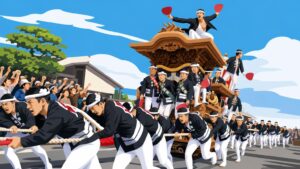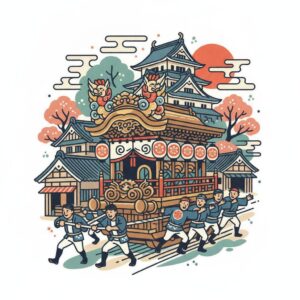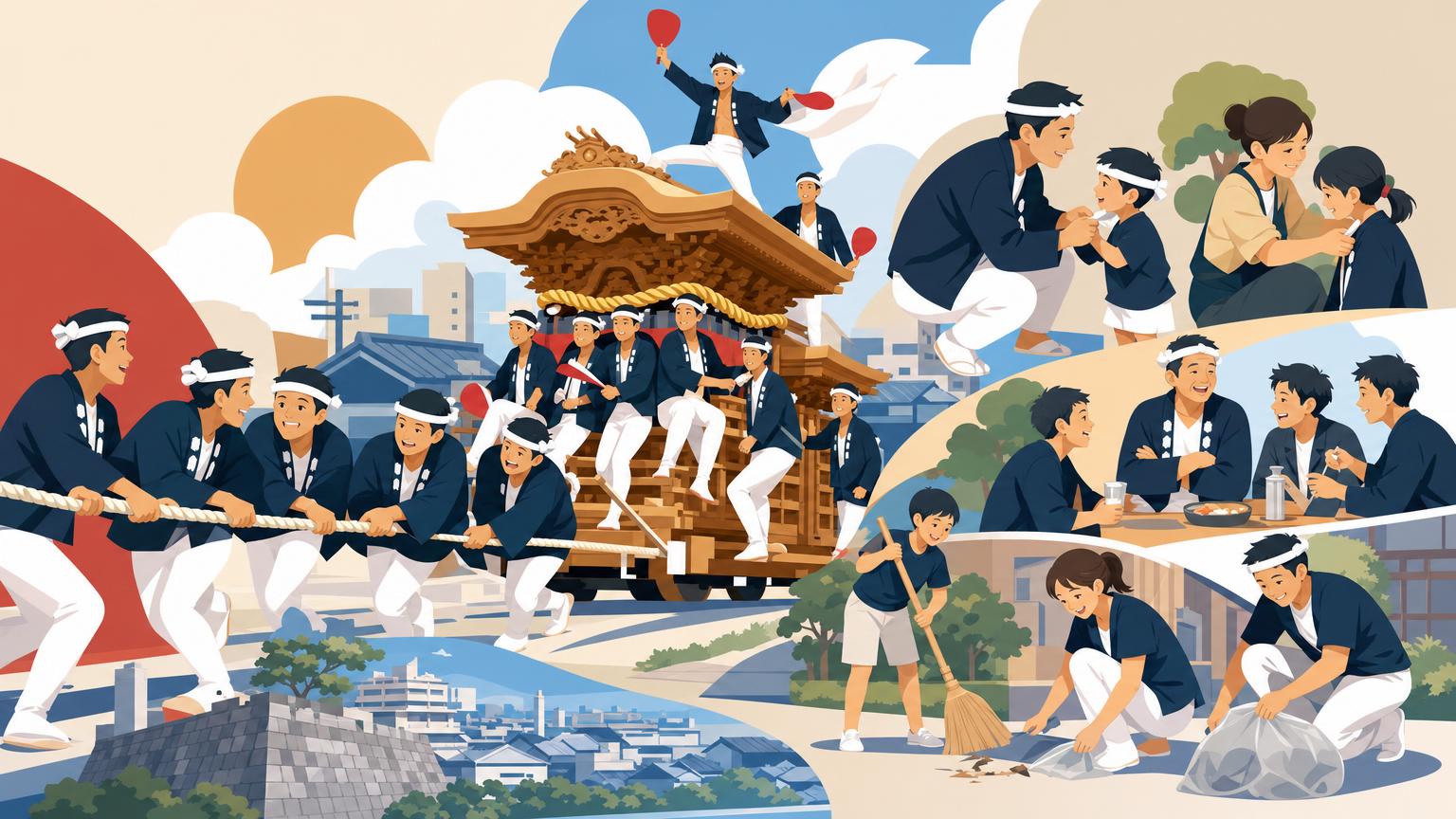
A foreign resident in Osaka may first encounter Kishiwada through a dramatic image: a huge wooden float racing around a corner, people shouting, ropes pulled tight, and a young man balancing on the roof. It is easy to think of the Kishiwada Danjiri Matsuri as an extreme weekend event, separate from ordinary life.
That interpretation misses the deeper point.
In Kishiwada, Danjiri is not only something people watch in September or October. It is one of the ways the town organizes relationships, teaches responsibility, gives young people a place in the community, and preserves a local idea of pride. The festival can affect who knows whom, who helps whom, how children grow up, and how residents understand the word “community.”
This does not mean every person in Kishiwada is equally passionate about Danjiri. Some residents love it. Some tolerate it. Some worry about its noise, pressure, drinking culture, accidents, or demanding social expectations. A realistic understanding must include all of those reactions.
The useful question is not simply, “Is Kishiwada’s festival exciting?” It is this: What kind of everyday society is created when a neighborhood spends much of the year preparing to move a massive float together?
The answer helps explain Kishiwada, southern Osaka, and an important difference between living in Osaka and observing Osaka as a visitor. It also explains why Osaka people can appear informal and approachable while still operating within strong local rules that are not immediately visible to foreigners.
The Danjiri Festival Is a Neighborhood System, Not Just a Festival
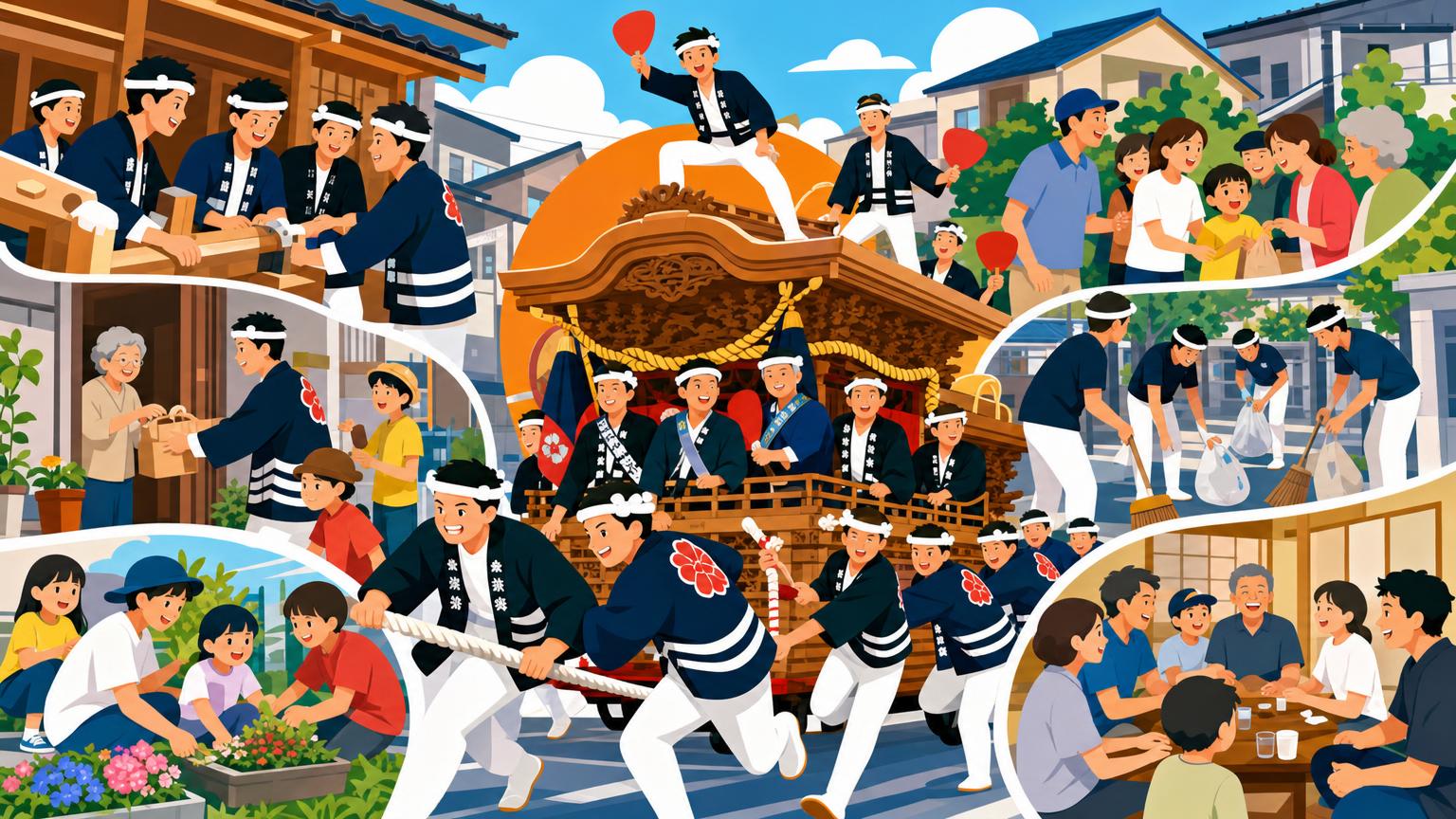
The first misunderstanding stems from the word “festival.” In English, a festival often implies a temporary event: buy food, watch a performance, take photographs, and then go home. The Kishiwada Danjiri Matsuri is certainly an event, but the social system supporting it functions year-round.
Kishiwada City explains that each town with a Danjiri divides responsibilities among age groups, ranging from children to older residents. The local organization includes roles for neighborhood leaders, senior advisers, adult coordinators, younger leaders, youth groups, and children’s groups. These groups are active not only on the main festival days but also engage in preparation, community service, social activities, and the ongoing work of sustaining the local organization.
This structure is important because it provides the neighborhood with recurring opportunities to meet face to face.
People may encounter the same individuals at neighborhood meetings, at the Danjiri shed, during children’s activities, while cleaning the area, or when preparing equipment. Children grow up recognizing the adults responsible for safety. Teenagers learn that older residents preserve the rules and history. Working adults might be expected to contribute their time, money, physical effort, planning skills, or social coordination.
This kind of community is very different from one based solely on apartment buildings or online groups.
Many urban residents in Japan have neighbors they greet but do not know well. They often work long hours, commute across multiple cities, and spend most of their free time with family or friends outside the neighborhood. Kishiwada’s Danjiri culture counters that anonymity by repeatedly reminding residents: you are not just an individual household. You are part of a town, a group, and a chain of responsibility.
That message can be both comforting and burdensome.
What “Community” Means in Kishiwada
In a foreign context, “community” may sound warm and voluntary. You join a club because you share an interest, attend when convenient, and leave when your schedule changes. In Kishiwada, however, the local community tends to be more relational and inherited. Your connection might come from where you live, where your family has lived, which neighborhood organization you belong to, or which group your child joins.
This doesn’t mean everyone is forced to participate equally. It does mean that local identity is often more apparent than a foreign resident might expect.
A resident may ask which neighborhood you live in before inquiring about your job. They might want to know whether you are near the castle area, the station area, or another district. This is not just geography. In a Danjiri town, local boundaries carry history, relationships, and pride.
The float belongs to a specific area. Its design, decorations, music, clothing, and style of movement express that area’s identity. Kishiwada’s official materials describe the different town floats and their unique carvings, colors, flags, sounds, and traditions.
For a foreign resident, this can feel surprisingly similar to supporting a football club, representing a village, and belonging to an extended family all at once. The comparison is not perfect, but it helps explain why outsiders may underestimate the emotional intensity.
The Danjiri is not merely a beautiful object. It is a public symbol of who “we” are.
Why the Festival Creates Strong Bonds Between Generations
One of the key features of Kishiwada’s system is its age-based structure. The official description identifies groups such as the youth association, younger children’s groups, adult coordinators, and older advisers. Each group holds different responsibilities, with roles evolving as individuals grow older.
This establishes a clear social progression.
A child might start near the safer front of the rope. As they mature, they may learn festival music, local customs, or take on other duties. A young adult could become one of the primary pullers. Later, they might assume roles in planning, coordination, safety, or negotiation. Eventually, older residents may serve as advisers who preserve neighborhood traditions and explain the reasons behind specific procedures.
The outcome is not just involvement. It is preparation.
Young people learn how to listen to elders. They learn how to move cohesively as part of a group. They understand that courage is not about acting alone. They realize that a mistake in a crowded street can impact many. They also absorb public etiquette: how to greet, stand, wait, follow signals, and take responsibility when things go wrong.
These lessons can influence everyday life even when no Danjiri festival is happening.
A teenager entrusted with demanding festival duties may become more confident when speaking with adults. A younger child may come to see local adults as familiar rather than strangers. Retired residents often remain socially engaged because their knowledge continues to be valued. The organization fosters intergenerational reliance.
This is one reason the Danjiri spirit remains strong, even for residents uninterested in religious rituals or historical context. The festival offers a practical social experience. People rely on each other to make it succeed.
The Importance of Being Seen Doing Your Part
Kishiwada’s local culture values visible effort. Pulling, carrying, repairing, organizing, cleaning, preparing, and simply showing up are concrete actions, noticed by neighbors.
This helps explain an Osaka-style attitude that foreigners sometimes find puzzling. A person may speak casually, joke loudly, or use rough language while still taking responsibility very seriously. Warmth in language and strict expectations coexist.
In more formal settings, respect is often shown through careful wording, titles, and controlled behavior. In Kishiwada, respect is also measured by practical contributions. Did you come when needed? Did you help your group? Did you protect the younger members? Did you remember the local rules? Did you stay until the work was completed?
Those who do the work often earn more respect than those who speak eloquently about it.
While not unique to Osaka, this attitude is especially understandable in a community where collective physical effort has such a visible public presence. The Danjiri moves not because one person has a good idea, but because many people coordinate their bodies, timing, voices, and judgment.
This presents a powerful image of community, but also a demanding one.
Osaka Directness and the Danjiri Idea of Trust
Foreigners often hear that people from Osaka are “friendly,” while those from Tokyo are described as “cold” or “formal.” These characterizations are too simplistic to be truly helpful. The real difference often lies in how trust is built and how language is used.
In Osaka, especially in the southern part, direct speech often serves to bridge social distance. A shopkeeper might tease you. A neighbor might ask personal questions sooner than you expect. Someone might openly criticize your behavior rather than offer a polite smile and remain silent.
This doesn’t always indicate deep intimacy; it can simply mean that the conversation is less formal.
Danjiri culture illustrates why directness can coexist with loyalty. Participants need quick, clear communication. During preparation or movement, indirect language can cause confusion. Someone must say where to stand, when to stop, what is unsafe, and who is responsible. The group shares an understanding that straightforward speech isn’t necessarily hostile.
For foreigners living in Osaka, adjusting to this style is important. A blunt comment may be practical rather than personal. A joke may be an invitation to engage rather than an insult. However, genuine criticism can also be hidden within humor. Laughing along isn’t always sufficient; you may need to decipher which behavior the group expects you to change.
Osaka Compared With Tokyo
Tokyo often values careful boundary management. The city is vast, transient, and professionally diverse. People may maintain polite distance because they cannot know which social network a stranger belongs to or how long they will stay in the area.
Osaka has large, anonymous spaces too; Osaka City isn’t a single, tight-knit neighborhood. But many interactions in Osaka, especially outside central business districts, tend to be more openly conversational. People may test your personality earlier. They might ask if you understand local customs. They often expect a response rather than a silent nod.
Kishiwada takes this further because the neighborhood itself remains a strong point of reference. The town’s Danjiri groups foster regular face-to-face interactions that extend beyond work and family.
The contrast isn’t simply “Tokyo is unfriendly and Osaka is friendly.” A more accurate distinction is:
- Tokyo often normalizes and makes social distance feel safe.
- Osaka often normalizes and makes social approach feel negotiable.
- Kishiwada can make local participation feel more visible and meaningful.
These are tendencies, not absolutes. A foreign resident might find Tokyo welcoming and Kishiwada challenging, or vice versa. Factors like personality, age, workplace, neighborhood, language ability, and family situation all play a role.
Still, this distinction is useful when choosing where to live. If you want maximum privacy, a large, anonymous city may feel easier. If you want more chances to become known locally, a smaller city in the Osaka area might offer more opportunities—but also come with higher expectations.
The Everyday Meaning of the Danjiri Shed
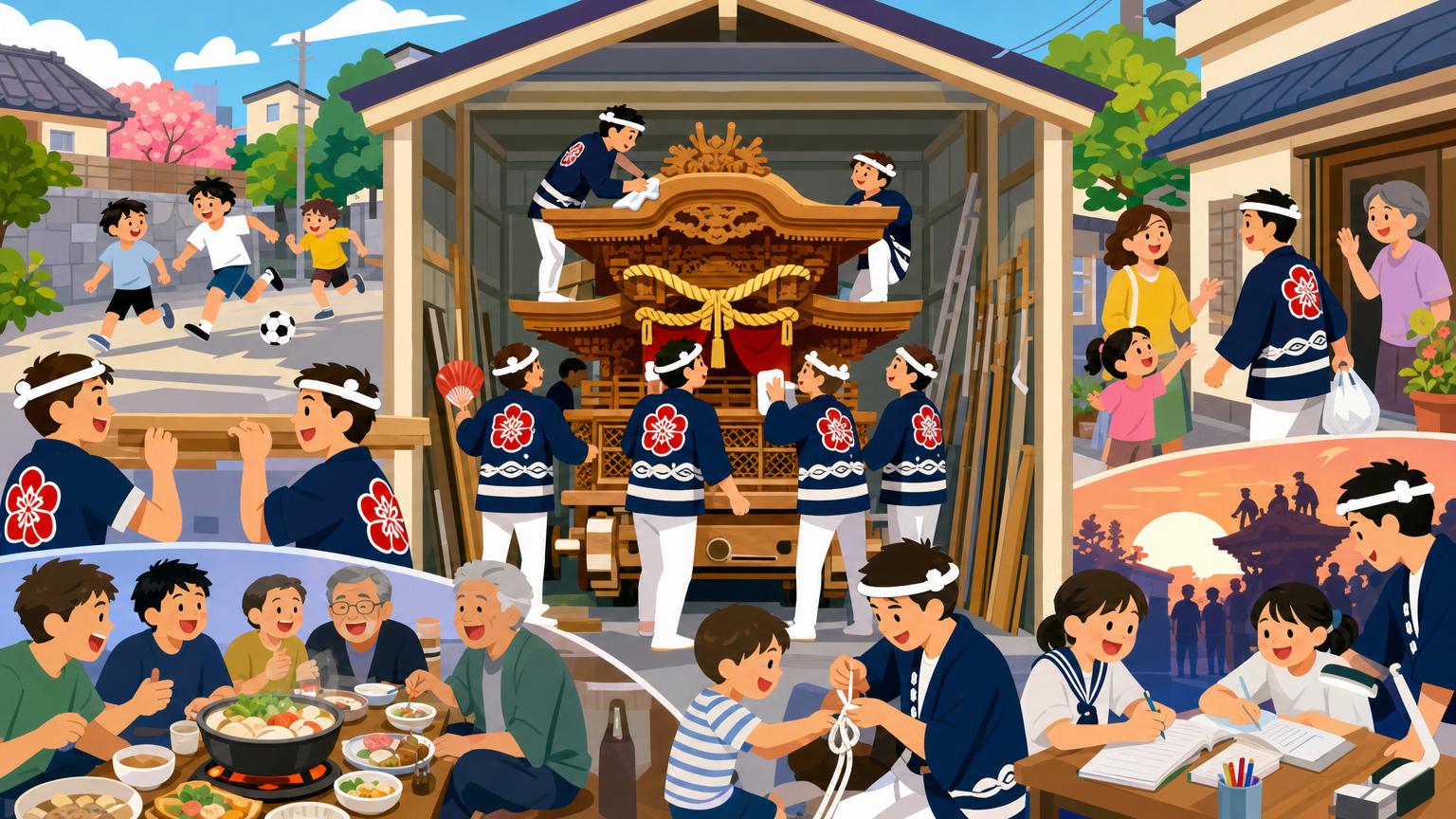
The Danjiri shed holds significant symbolic value as it serves as a tangible reminder that the neighborhood collectively owns something. The float requires storage, protection, maintenance, and preparation—it does not simply appear out of nowhere on festival morning.
Official explanations of Kishiwada’s festival organization reveal that each town’s structure includes leadership and age-based groups, while the city’s information highlights year-round preparation and community activities.
For local residents, a shed represents more than just storage. It can act as a place of memory, a meeting spot, a space where children interact with elders, and a visible symbol of neighborhood identity.
To a foreigner, a shed might look like a closed building. To a local, it embodies decades of family involvement, past festival incidents, disputes, repairs, changes in membership, and the names of those who have passed away.
This is why casual curiosity should be approached with care. Asking about the float can be a good conversation starter, but touching equipment, entering restricted areas, or treating the shed as a photo backdrop can be disrespectful. The local rule is simple: interest is welcome, entitlement is not.
Why Local Knowledge Matters More Than General Information
A foreign resident can grasp the broad story of the festival in an afternoon. However, understanding the local web of relationships is much more challenging.
Which streets belong to which group? Who takes care of the children? Which roads become difficult during preparations? Which sounds signal practice rather than the official procession? Which activities are open to outsiders, and which are reserved for members? When is it appropriate to ask questions, and when should you step aside?
This knowledge is typically gained through repeated interactions. You notice familiar names. You greet the same people. You ask before making assumptions. You accept corrections without taking them personally.
This approach is also how life in Osaka generally works. City living becomes smoother when you look beyond written rules. While written rules matter, daily comfort often relies on local customs: how garbage is placed, how bicycles are parked, how greetings are exchanged, how much noise is tolerated, and how neighbors respond when someone needs help.
Danjiri culture makes these invisible customs unusually visible because the entire town becomes public during the festival season.
The Spirit of Mutual Help Beyond Danjiri
It would be an overstatement to claim that Danjiri resolves every community issue. Kishiwada, like many other Japanese cities, faces challenges such as an aging population, demographic shifts, demanding work schedules, declining participation in some neighborhood organizations, and difficulties in attracting younger generations.
Local planning documents have highlighted both the strength of community ties rooted in Danjiri and concerns about sustaining neighborhood engagement. One regional planning document from Kishiwada explains how Danjiri can encourage youth involvement and emergency cooperation while also acknowledging a decrease in membership in traditional neighborhood or senior groups.
This tension is key to understanding contemporary Kishiwada.
The Danjiri system continues to be a strong source of belonging, but it cannot automatically include everyone. People have varying work hours. Families move into the area without local relatives. Some residents abstain from drinking, are unable to perform strenuous physical labor, dislike hierarchical organizations, or simply lack interest in festivals. Women and foreign residents might not experience participation in the same way as long-established local men. Although the organization can evolve, change is likely to be gradual.
At the same time, the relationships formed through festival activities can be leveraged for other types of community work. Kishiwada’s youth organization has outlined activities related to local revitalization, youth development, neighborhood service, pest control, and disaster volunteering. It has also linked the spirit of Danjiri participation with directly helping others.
The crucial point is not that every volunteer project stems from the festival, but that the festival provides people with practice in organizing, mobilizing, and responding collectively.
When a storm damages a neighborhood, when a local event requires volunteers, or when an elderly resident needs practical help, those who already know how to coordinate may be able to act more swiftly. This is an inference based on the organization’s year-round structure and community efforts, rather than a claim that every Danjiri group functions as an emergency service. Nevertheless, the connection is significant: repeated cooperation fosters social readiness.
A Local Definition of Responsibility
In many foreign cultures, responsibility is closely linked to the individual. You pay your bills, obey the law, manage your career, and make decisions for your household. In Kishiwada, individual responsibility is important, but an additional layer often emerges: responsibility to the group around you.
This is evident in the way different roles are assigned during the festival. The official structure delegates distinct responsibilities to neighborhood leaders, senior advisers, adult coordinators, younger leaders, youth groups, and children’s groups.
The key lesson is not simply that “older people are in charge.” Rather, it is that everyone has a role, and each role comes with duties.
In daily life, this can show up in small ways:
- A parent is expected to watch over not only their own child but also nearby children.
- A neighbor might inform you if your garbage placement is causing a problem.
- A local shop owner may remember your household and inquire about a family member.
- A resident may attend a meeting even if they would prefer to stay home because the issue affects the street.
- A young person may be considered capable because they have already demonstrated reliability in group activities.
These behaviors might feel intrusive to someone from a highly individualistic society. They can also feel supportive when something goes wrong.
The same system that asks, “Why didn’t you come?” can also ask, “Do you need help?”
That is the emotional trade-off of a strong neighborhood culture: you sacrifice some anonymity and receive social support in return.
What Foreign Residents Often Misunderstand
“Everyone in Kishiwada Must Love Danjiri”
No. While the festival is well-known and influential, the city is not socially homogeneous. Some residents are deeply involved, while others are merely spectators, critics, or people who prefer a quieter autumn.
A person can be proud of Kishiwada yet dislike the noise. A parent might value the children’s social experience but worry about safety. A resident can respect tradition while believing some older practices should evolve.
Do not assume that one passionate speaker represents the entire city.
“The Loudness Is Just Osaka Personality”
The noise, shouting, music, and movement are linked to a specific organized event. Osaka residents are not constantly performing the Danjiri festival in everyday conversation.
At the same time, the festival illustrates why loudness doesn’t necessarily mean anger. Volume can express energy, urgency, celebration, or group coordination. You still need to read the context, but don’t interpret every loud voice as aggression.
“If People Joke With Me, We Are Friends”
Humor can open a door but doesn’t guarantee close acceptance. Osaka-style joking might serve as a social test to see if you can respond appropriately, understand the tone, or avoid taking offense easily.
True trust builds over time. Return to the same place. Keep your promises. Show up when you say you will. Remember names. Offer practical help. Don’t make every interaction about your foreignness.
“Community Means I Can Join Immediately”
Interest isn’t the same as membership. A neighborhood may welcome visitors but reserve certain roles for those who have trained, paid dues, or been part of the local group for years.
This isn’t necessarily anti-foreigner. It involves safety, trust, and accountability. If a group is responsible for moving a heavy float, they need to know who is trained and will follow instructions.
A good approach is to ask what’s open, what’s appropriate, and how you can help without adding extra work.
“Japanese Society Is Quietly Polite Everywhere”
Kishiwada can be more expressive than the stereotype many foreigners bring about Japan. People may argue, tease, speak quickly, or give direct instructions. This doesn’t imply formal manners have vanished; it means social politeness is conveyed in a different style.
You may still be expected to greet people, avoid interrupting, respect seniority, and recognize when a conversation has ended. The tone can be casual while the social structure remains serious.
Gender, Age, and Access to the Community
A comprehensive article about Danjiri influence must avoid portraying the festival merely as a tale of male courage and local pride. The visible image of men pulling the float represents only a portion of the broader organization.
Women, children, parents, older residents, organizers, cooks, cleaners, fundraisers, administrators, and supporters all play vital roles in the social life surrounding the festival. Kishiwada’s public information has also emphasized activities that highlight the involvement of women in Danjiri and neighborhood work.
However, participation may not feel equally accessible within every group or role. Traditional organizations often maintain longstanding expectations about gender, age, behavior, and status. A foreign woman, a foreign man, a young couple, or someone who does not fit local family patterns may need to observe carefully before deciding how to engage.
The practical take-away is not to assume either total exclusion or complete openness.
Ask specific questions. “Can foreigners join?” is often too general. More precise questions include:
- “Is this activity open to residents who have recently moved here?”
- “Are children welcome to observe or participate?”
- “Is there a women’s group or family activity?”
- “Do I need to register or speak with the neighborhood association?”
- “What kind of help would actually be useful?”
Specific questions demonstrate respect for the organization’s actual structure and also spare the local person from having to explain everything all at once.
Why Language Matters More in Local Osaka Than in Central Osaka
A foreign resident can get by in Osaka using standard Japanese, English, translation apps, and polite gestures. However, to truly feel comfortable in a neighborhood like Kishiwada, language serves more than just conveying information—it expresses a willingness to be involved.
You don’t need perfect Kansai dialect. In fact, trying to force the dialect can often sound unnatural. Instead, you should learn key social vocabulary related to local life:
- 町会, or chōkai, meaning neighborhood association
- 町, or chō, meaning a local town or district
- 青年団, or seinen-dan, meaning a youth association in this context
- 宵宮, or yoimiya, meaning the festival eve or preliminary main celebration
- 本宮, or honmiya, meaning the main festival day
- だんじり小屋, or danjiri-goya, meaning the shed where the float is stored
- やりまわし, or yarimawashi, meaning the fast corner turn characteristic of Kishiwada’s Danjiri style
Vocabulary alone won’t make you a local insider. However, it demonstrates that you appreciate the festival as more than just an exotic event—it’s a community institution with its own language.
The same idea applies to everyday life. Understanding the distinctions between garbage categories, neighborhood notices, school communications, train announcements, and casual local speech can transform your experience of Osaka far more than simply memorizing sightseeing phrases.
How Danjiri Shapes Children’s Experience of the Town
For many children in Kishiwada, the town is more than just a place where adults live; it is a space they can actively represent.
The city’s description of the festival situates children’s groups within a broader age-based structure and notes that children gradually learn the basics of pulling the float from a safer position. It also highlights the evening lantern procession as a moment when children become central participants.
This holds psychological significance. Children are not only told they belong to the community, but they are also given visible roles that affirm that belonging.
A child may learn that adults will look out for them, and they may also realize that other adults are observing their behavior. Did they listen? Did they stay in the right place? Did they handle the equipment carefully? Did they greet others properly?
In a society where children often travel independently to school and activities, this kind of local participation can enhance their sense of responsibility. However, it can also create pressure. A child who does not want to participate may feel different from classmates or relatives, and a family with limited time may find it difficult to meet expectations.
This balance is important for foreigners to understand. Traditional community systems can provide children with confidence, relationships, and practical skills, but they can also make it harder to choose an alternative identity.
The Cost of Belonging
The Danjiri spirit has genuine strengths, but belonging is never without cost.
It can demand time and money. It may require attending meetings, preparing, cleaning, practicing, and participating in local events. It might involve accepting a hierarchy that feels uneasy to someone from a more individualistic background. It can create pressure to join in, even when work, health, parenting, or personal preferences make participation challenging.
There are also physical risks. Kishiwada’s festival is famous for its fast, heavy floats and sharp corner turns. This danger is part of the festival’s character, but it should not be idealized. The city provides safety and traffic information, and residents assign specific roles to manage movement and handle accidents.
Alcohol and masculine group culture may bring additional concerns. A local planning document notes both positive aspects of Danjiri-related youth activities and worries about alcohol use and negative behavior in certain situations.
For a foreign resident, the honest conclusion is that a strong community can be both generous and demanding. You should not relocate to Kishiwada expecting a picturesque village where everyone warmly welcomes you into a timeless tradition. Nor should you assume that a strong local identity is automatically narrow-minded.
Pay attention to what happens in the specific neighborhood where you live.
Do residents greet each other? Are newcomers given information? Are rules explained or simply enforced? Are women, children, older people, and foreign residents treated as full participants or merely as spectators? Does the neighborhood ask for help while also offering support?
These questions reveal more about whether a place feels comfortable than the festival’s reputation alone.
Is Kishiwada a Good Place to Live for Foreigners?
The answer depends on what you seek from daily life.
Kishiwada might be suitable for a foreign resident who desires:
- A more local and less anonymous experience compared to central Osaka
- Closer engagement with neighborhood life
- A city where local history remains evident in everyday streets
- Access to Osaka while living in a less central area
- Opportunities to develop relationships through frequent local interactions
- A community where practical contribution matters more than polished self-presentation
It may be less suitable for someone who wants:
- Complete privacy from neighbors
- A highly international social environment nearby
- No involvement in local events or neighborhood expectations
- A lifestyle centered mainly around central Osaka’s nightlife and business districts
- A place where participation in local activities goes unnoticed
Neither option is morally superior; it’s a matter of personal fit.
Living in central Osaka may make it easier to maintain social independence. You can change neighborhoods, restaurants, gyms, and friend groups without drawing attention. In Kishiwada, repeated encounters can help you build a genuine local network but may also make your habits more visible.
For some foreigners, this embodies what “living in Japan” means. For others, it may feel like too much social responsibility after a long workday.
A Practical Way to Test the Fit
Before committing to a long lease, spend time in the neighborhood at various times of day. Avoid visiting only during the festival.
Stroll around on a typical weekday morning. Observe school routes, traffic, convenience stores, small businesses, and the spacing between houses. Return in the evening, noting sound levels. Visit on a weekend without major events. If possible, attend a local information session or speak with a community organization.
The International Friendship Association of Kishiwada provides multilingual Danjiri information for foreign visitors and operates an information center during the September festival. Their materials demonstrate the city’s recognition of the need to communicate the event across languages.
This support is helpful, but it should not be mistaken for a guarantee that every neighborhood interaction will be available in English. If you are considering living locally, learn enough Japanese to understand notices, introductions, and basic questions. Even limited Japanese becomes much more valuable when relationships are recurring.
How to Build Trust Without Pretending to Be Local
Foreign residents sometimes make one of two errors: they either keep a complete distance or exhibit an exaggerated version of local enthusiasm.
Neither approach is effective.
You don’t need to pretend that Danjiri has always been your passion. There’s no need to shout, drink, wear festival attire, or mimic local customs to show respect for Kishiwada. Forced enthusiasm often feels less sincere than genuine curiosity.
A more effective approach is gradual and practical:
- Greet people consistently.
- Learn the name of your neighborhood.
- Always ask before photographing people, floats, sheds, or private preparations.
- Follow traffic and crowd instructions immediately.
- Avoid blocking narrow streets just to get a better photo.
- Offer help when tasks clearly involve residents.
- Keep appointments and return borrowed items.
- Learn how the local garbage and recycling system operates.
- Accept corrections without turning them into debates about cultural differences.
- Admit when you don’t understand instead of pretending.
These actions may seem simple. That is exactly the point. Trust is built through ordinary reliability.
In Osaka, someone might say, “Come and join us sometime,” casually. Take the invitation seriously but don’t assume it’s a formal membership offer. Ask when, where, and what would be appropriate. If the invitation is genuine, clarifying details will benefit both sides.
What to Say When You Cannot Participate
A foreign resident might be invited to a local activity but be unable to attend due to work, childcare, religious practices, disability, health, or other commitments. You don’t have to say yes to everything.
The key is to respond clearly and respectfully. Express appreciation for the invitation, provide a brief reason if comfortable, and ask if there’s another way to help. A small contribution, sharing information, or attending a less demanding event might be possible.
Silence can be misunderstood as disinterest. A vague promise can be taken as a commitment. Clear but polite communication is generally kinder.
This is another area where the Danjiri model offers a valuable lesson. Coordination only works when everyone knows what each person can realistically contribute.
The Difference Between Osaka Hospitality and Osaka Inclusion
A foreign visitor might experience warm hospitality during the festival. Someone may offer to explain the route, give directions, or assist with translation. While this is valuable, hospitality and inclusion are not the same.
Hospitality says, “You are welcome to experience this.”
Inclusion says, “Your presence and contribution have a place in our ongoing relationships.”
The latter requires more time.
Kishiwada’s multilingual information efforts demonstrate an active attempt to make the festival accessible to foreign visitors. However, a multilingual map cannot convey every local expectation, and a friendly conversation at an event does not automatically create a sense of year-round belonging.
For foreigners considering living in Osaka, this distinction is crucial. You may be welcomed in different ways as a customer, guest, student, worker, parent, neighbor, or volunteer. Each role carries different expectations.
If you seek deeper connections, move beyond consumption. Support local businesses repeatedly. Learn people’s names. Participate in activities that are truly open. Attend neighborhood meetings when relevant. Help with cleanup. Take part in children’s or community events if you have children. Ask how local decisions are made.
Do not view the neighborhood as a cultural performance put on for your education.
What the Danjiri Spirit Reveals About Osaka
The Danjiri spirit does not encompass all of Osaka culture, and Kishiwada is not an exact miniature version of Osaka City. However, the festival highlights several patterns that help foreigners gain insight into life in the region.
Pride Is Often Local Before It Is National
A person may feel a strong connection to a specific town, district, or neighborhood. This pride isn’t always expressed through official slogans; it may show in the condition of a float, the upkeep of a street, the food served at an event, or the confidence with which someone recounts local history.
In a mobile global city, local pride provides people with a stable point of reference.
Relationships Are Built Through Repetition
One intense conversation does not integrate you into a community. It’s more important to see the same people regularly, observe their predictable behavior, and witness their ongoing contributions.
This holds true throughout Japan, but the Danjiri system makes this pattern especially apparent.
Informality Does Not Mean the Absence of Rules
Osaka can come across as casual. People might joke, use dialect, and speak frankly. Beneath this informality lie detailed rules regarding timing, responsibility, territory, safety, and respect.
Foreigners who notice only the casual style may overlook the underlying structure.
Tradition Survives by Adapting
The Danjiri festival has a history spanning over three centuries, starting in the early eighteenth century according to Kishiwada’s official record. The city continues to present it as a tradition passed down through local generations, but the organization also adapts to modern realities such as foreign visitors, public safety, shifting participation, and community development.
A tradition that endures is not static; it negotiates with the present.
Belonging Includes Disagreement
A healthy local culture is not one in which everyone praises the same custom. Rather, it is one where people can debate issues like noise, safety, participation, gender, alcohol, money, and the future, while still acknowledging a shared bond.
That process can be uncomfortable. Yet it is what distinguishes a living community from a museum display.
Living With the Festival Without Making It Your Entire Identity
If you live in Kishiwada, the festival may become a regular part of your life even if you never pull a float. You might hear practice sounds, encounter road closures, see neighbors preparing clothing, equipment, food, or schedules, and notice that some conversations grow more animated as autumn approaches.
You can respect the event without letting it define your entire identity.
Learn the basic safety rules. Avoid restricted areas. Keep children close during crowded times. Do not assume a moving float will stop for you. Respect residents who are working, resting, or trying to get home. Remember that the streets are more than just a stage.
If you participate, receive instruction before acting. Don’t grab a rope just because it looks exciting. Avoid standing near corner turns for the dramatic view. Do not enter a local group’s preparation area without permission.
If you do not participate, you are still part of the neighborhood during the event. Plan transportation, shopping, work, and childcare around the disruptions. Talk with your landlord or neighbors if you are unsure about access. Keep your frustrations specific and calm—a complaint about a particular safety issue is more effective than a general criticism of the entire tradition.
This balanced approach is common in long-term local life. You can appreciate a community custom while encouraging it to become safer and more inclusive.
Frequently Asked Questions About Danjiri and Daily Life in Kishiwada
Does Danjiri influence people who do not participate?
Yes, both indirectly and sometimes directly. The festival impacts streets, schedules, noise levels, neighborhood relationships, local identity, and the visibility of community organizations. Even residents who don’t take part in the procession may live near preparation activities or need to adjust their daily routines.
The extent of this influence varies depending on the neighborhood. Kishiwada’s social dynamics differ from one district to another.
Do I need to join a neighborhood association to live in Kishiwada?
Not necessarily. Housing contracts, local customs, and neighborhood expectations differ. However, joining or at least being familiar with the local association can simplify daily life, especially when you need information about garbage collection, disaster preparedness, community announcements, or local events.
Check with your landlord, local city office, or nearby residents to understand what is customary, rather than assuming every neighborhood functions the same way.
Are Osaka people really more direct than people in Tokyo?
Some interactions in Osaka may seem more informal, humorous, and openly conversational compared to those in Tokyo. However, personality and context matter far more than a simple regional stereotype. Directness can convey comfort, urgency, humor, or criticism.
It’s important to interpret the situation, not just focus on volume or wording.
Can a foreign resident become part of a Kishiwada community?
Yes, but inclusion typically develops through repeated interactions rather than a single enthusiastic visit. Learn local customs, communicate honestly, and contribute in meaningful ways. Do not expect immediate access to every role, especially those involving safety or long-established trust.
The city and local international organizations have worked to provide multilingual festival information, which helps newcomers understand the public event.
Is Kishiwada a good place for someone who wants privacy?
It can be, depending on your housing and neighborhood, but it may feel more socially visible than a large, anonymous area in central Osaka. If privacy is your top priority, research the specific area carefully and inquire about local expectations before moving.
What is the biggest cultural lesson for foreigners?
The key lesson is that friendliness and obligation often coexist. A local person might joke with you, offer help, and at the same time expect something in return. This is not necessarily a contradiction. In many Osaka communities, relationships are built through practical give-and-take.
What should I do if I feel pressured to participate?
Be polite but firm about your limits. Ask what is mandatory, what is optional, and whether there are ways to contribute with lower commitment. If the pressure persists or feels unsafe, you have the right to step back.
Respecting tradition does not mean compromising your health, beliefs, work responsibilities, or personal boundaries.
The Real Meaning of “Beyond the Festival”
The deepest impact of the Kishiwada Danjiri Matsuri is not the sound of the drums or the speed of the float, but rather the practice of organizing life around repeated cooperation.
Children observe that the town holds memories. Young adults understand that energy and responsibility can earn respect. Older residents recognize that their knowledge remains valuable. Families learn that public identity extends beyond work or school. Neighbors find out who can be trusted when a task is difficult, crowded, noisy, or urgent.
This system can be proud, competitive, hierarchical, exhausting, and imperfect. It can welcome newcomers while still maintaining insider boundaries. It can encourage mutual help while also creating pressure. It can preserve local identity while facing the challenge of becoming more inclusive.
These contradictions are not a failure of Kishiwada; they reflect the reality of a living community.
For a foreigner trying to understand daily life in Osaka, the Danjiri spirit offers a valuable key. Osaka is not simply a place where people are cheerful, talkative, or fond of food. In many neighborhoods, people value visible effort, quick communication, practical loyalty, and the ability to stay connected through everyday obligations.
Kishiwada makes these values particularly visible because, once a year, the entire community pulls them into the street.
The more important work happens afterward: remembering who helped, teaching the next generation, negotiating what should change, and continuing to live together once the ropes are put away.