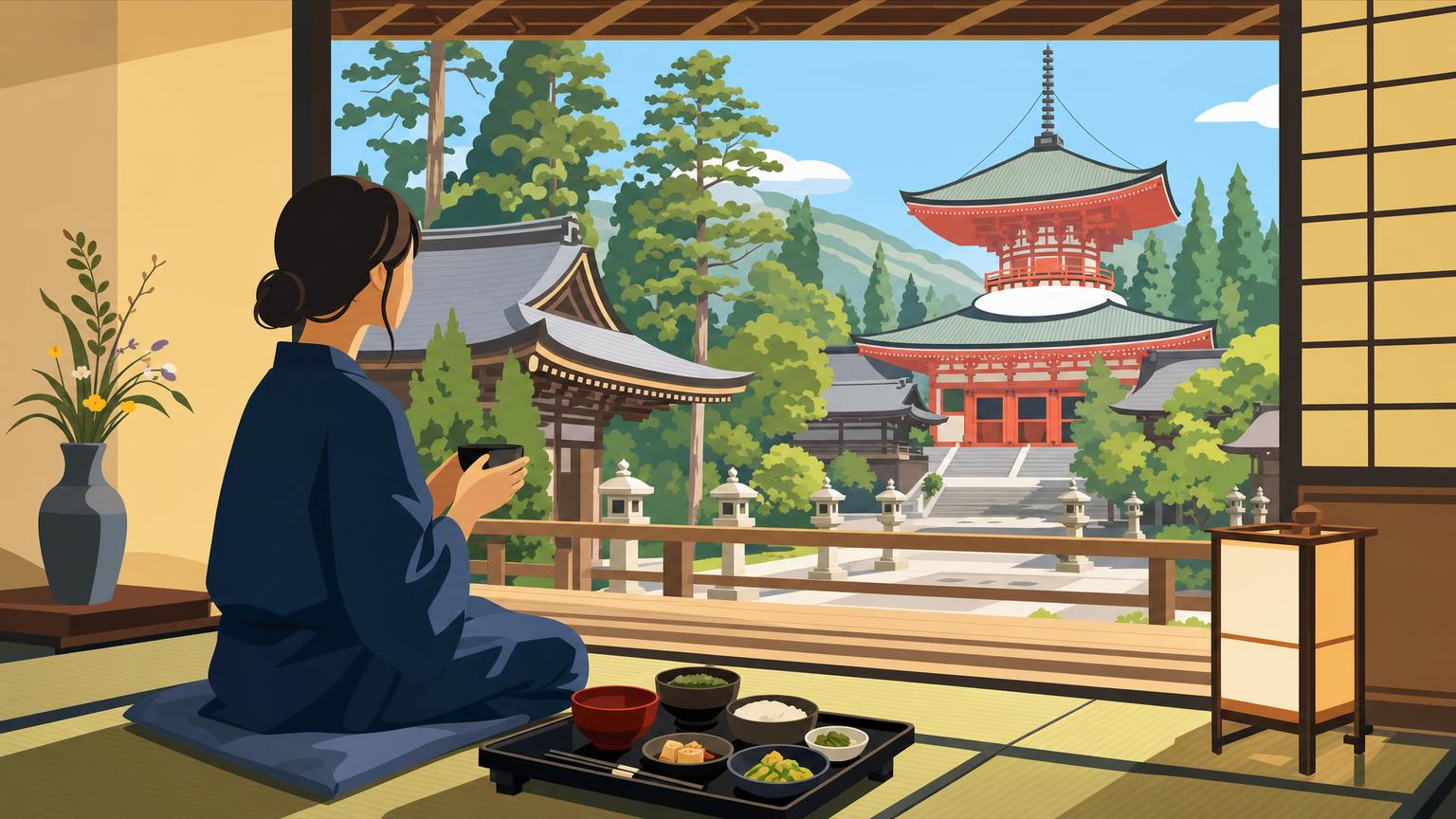
The question Osaka residents often ask is not, “Where can I see the most famous temple?” It is closer to, “Where can I go for one night without having to perform being on holiday?”
That difference matters. Living in Osaka teaches you to value places that let you breathe normally. A weekend away does not always mean a packed schedule, a famous photograph, or a hotel with a rooftop bar. Sometimes it means leaving Namba after breakfast, watching the city thin into mountain roads, eating quietly before sunset, and waking up before most of Osaka has finished sleeping.
Koyasan is a natural choice for that kind of reset. It is close enough to reach from Osaka for a one-night escape, yet far enough away to interrupt the city’s rhythm. The overnight experience is called shukubo, or temple lodging. You sleep in a temple complex, eat shojin ryori, join a morning Buddhist service if the temple allows it, and follow a schedule shaped less by tourism than by religious practice.
For foreigners living in Osaka, the interesting part is not simply that Koyasan is beautiful. The interesting part is how the stay reveals something about everyday Japanese behavior: why punctuality is treated as consideration, why “quiet” does not mean cold, why a small meal can feel generous, and why Osaka people may complain about an inconvenience while still respecting it.
A temple stay is not a luxury hotel with incense. It is also not a punishment retreat. It sits somewhere between accommodation, cultural exchange, and participation in a living religious environment. The better you understand that balance, the more comfortable the weekend becomes.
Why Koyasan Feels Like an Osaka Local’s Escape
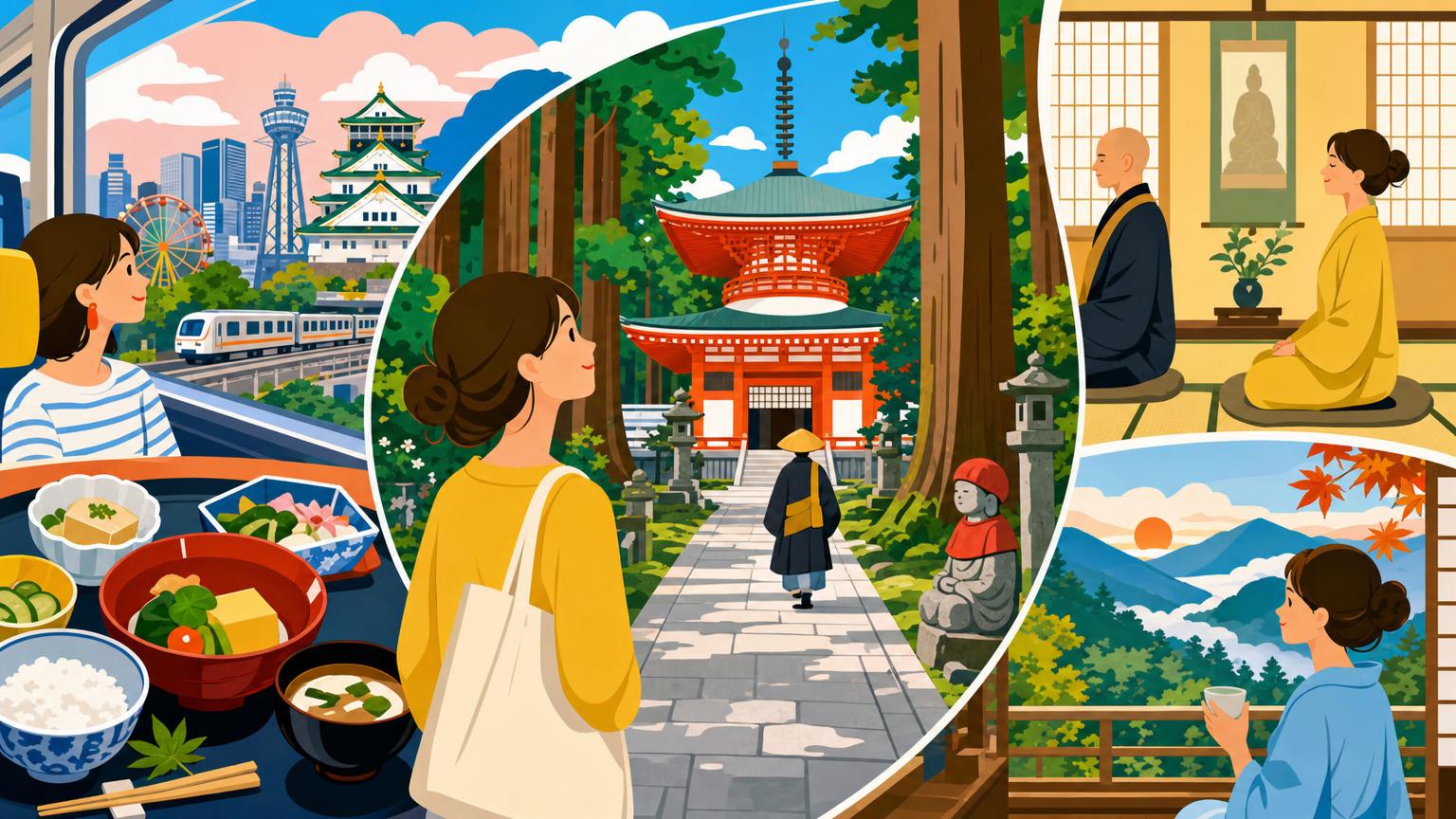
From Osaka, Koyasan feels close in distance but far in tempo. The usual route starts around Namba, where trains, announcements, department stores, takoyaki stands, office workers, students, and tourists all compete for attention. The Nankai Koya Line gradually carries you away from that density. At Gokurakubashi, the cable car climbs into the mountain landscape, and the final bus ride spreads the town across a high plateau instead of presenting it as one compact attraction. The Japan National Tourism Organization describes access from Namba via the Nankai Koya Line and cable car, while local tourism information emphasizes that the journey itself is part of the change in atmosphere.
That transition is valuable for people who live in Osaka because Osaka rarely offers silence by accident. Even peaceful neighborhoods have delivery trucks, bicycles, train crossings, school announcements, restaurant ventilation fans, and the background noise of people talking. In Koyasan, quietness feels more deliberate. You notice footsteps on wooden floors. You notice a door closing in the next room. You notice when your phone is the loudest object nearby.
This is not necessarily “better” than Osaka. It is simply a different social setting. Osaka life is fast, expressive, and practical. Koyasan encourages you to slow down, observe, and avoid taking up too much space.
Osaka and Tokyo: Different Ideas of Personal Space
Visitors often compare Osaka and Tokyo through stereotypes: Osaka is supposedly warm and funny, while Tokyo is supposedly formal and distant. That is too simplistic to be useful.
A more practical difference lies in how people manage interaction. In Osaka, casual conversation can begin quickly. A shopkeeper may comment on your choice, a stranger may offer an opinion about the train, and a restaurant owner may gently tease you if you hesitate too long. This does not mean that everyone wants a deep relationship. It means verbal contact is often treated as a form of social ease.
Tokyo can feel more controlled because people are highly conscious of not disturbing the surrounding crowd. Osaka also values avoiding disturbance, but the city often allows more verbal looseness within that boundary. People may complain, joke, negotiate, and then cooperate immediately afterward.
A temple stay in Koyasan offers a different version of the same social intelligence. You are not expected to remain silent every second. You are expected to understand when silence is appropriate. You can ask questions at check-in, explain a dietary restriction, and join a meditation session as a beginner. But once a ceremony begins, you follow the atmosphere instead of trying to turn it into a personal performance.
That is a useful lesson for foreigners living in Osaka. Japanese politeness is not always about using perfect phrases. Often, it is about reading the moment correctly.
What Is a Shukubo, Really?
A shukubo is a temple lodging that historically accommodated pilgrims and religious visitors. Today, many Koyasan temples welcome international guests as well as Japanese visitors. Koyasan has more than one hundred temples, and several dozen provide overnight lodging. Accommodations range from very simple traditional rooms to more comfortable temple facilities with private bathrooms, beds, gardens, and bathing areas.
The phrase “temple stay” can create the wrong expectations. You are not becoming a monk for twenty-four hours. You are a guest within a functioning temple. The monks and staff have religious responsibilities, family obligations, administrative work, and visitors beyond those included in your booking. Their priority is not to entertain you continuously.
That is precisely why the experience can feel more genuine than a staged cultural activity. You are provided with a room, meals, instructions, and opportunities to participate. What happens beyond that depends on your attention.
The Spiritual Meaning of Koyasan
Koyasan is associated with Kukai, also known as Kobo Daishi, the founder of the Shingon school of Buddhism. The mountain is home to Kongobu-ji, the head temple of Koyasan Shingon Buddhism, and Okunoin, where Kukai is believed to remain in eternal meditation. Koyasan is therefore not merely a collection of old buildings. It is a religious center where memorial practices, prayers, education, administration, and hospitality continue today.
You do not need to be Buddhist to stay there. However, you do need to accept that you are entering a sacred environment. This means your behavior matters even when nobody is correcting you.
A foreign visitor may think, “If I paid for the room, I should be free to do whatever I want.” In ordinary accommodation, that logic is reasonable. In a shukubo, the price covers hospitality within a religious institution. You are free in many ways, but not free from the surrounding context.
The distinction is similar to entering a quiet church, mosque, synagogue, or shrine during a service. You may be welcome, but being welcome does not erase the character of the place.
Shojin Ryori: Why the Food Is Part of the Lesson
Meals at many Koyasan temple lodgings consist of shojin ryori, Buddhist vegetarian cuisine. The food generally avoids meat and fish, and traditional descriptions also mention ingredients such as green onion, garlic, and other stimulants. The exact menu depends on the temple and season, but tofu, yuba, sesame, vegetables, mushrooms, mountain plants, rice, pickles, and carefully prepared broth are common elements.
The important point is that shojin ryori is not simply “vegan Japanese food.” It reflects an attitude toward ingredients, balance, restraint, and seasonality. A small dish may require more preparation than a large bowl of noodles. The presentation is quiet rather than dramatic.
For people accustomed to Osaka’s generous food culture, this can feel surprising. Osaka is famous for eating well, eating socially, and discussing food enthusiastically. Koyasan offers another kind of pleasure: noticing texture, temperature, color, and how much food you actually need.
Do not arrive expecting a replacement for yakiniku. Do not assume that “vegetarian” means bland. At the same time, do not assume that every shukubo can accommodate every allergy. Tell the temple in advance about allergies, medical restrictions, religious requirements, and ingredients you cannot eat. “I do not like it” and “I cannot safely eat it” need to be communicated differently and clearly.
A Realistic One-Night Temple Stay from Osaka
The exact schedule varies by temple and season, so confirm the details when booking. Still, a one-night stay generally follows this pattern: arrive in the afternoon, settle in before dinner, join an optional activity, observe the nighttime schedule, attend morning service, have breakfast, and depart by late morning.
The schedule may feel strict to someone accustomed to Osaka’s late-night restaurants and flexible weekend routines. That is not a flaw. The structure is part of the experience.
8:00 a.m. – Leave Osaka Without Rushing
Set out from Namba or another convenient station with enough time for delays and transfers. The aim is not to arrive at the last possible moment. A temple stay can become stressful if you spend the mountain journey checking whether you will reach the temple before dinner.
Bring breakfast or eat before departing. Once you enter the mountain area, your food options become more limited and the timetable becomes more important. This is one of the small differences between living in Osaka and visiting Osaka: residents often understand that the city’s convenience fades gradually rather than ending suddenly.
At Namba, no one minds if you are carrying a large suitcase. At a temple, that same suitcase can become troublesome on tatami, in narrow corridors, on stairs, and along uneven paths.
11:00 a.m. to 2:30 p.m. – Arrive, Store Luggage, and Walk Slowly
If your room is not ready, ask whether the temple can store your luggage. Some temples offer luggage storage before check-in and after check-out, but policies vary. Eko-in, for example, says that guests may store luggage before and after their stay and lists a 2:00 p.m. check-in time, with final check-in at 7:00 p.m.
Spend the afternoon walking, but avoid turning it into a race. Koyasan extends across a mountain town, and buses connect its different areas. The local map is not merely a sightseeing aid; it also helps you understand how daily travel works. A temple that appears nearby on a map may still require a bus ride or a longer walk, particularly if you have luggage or it is raining.
If you are arriving from Osaka, you may notice the lack of the city’s constant commercial pressure. Shops and restaurants are available, but the town does not encourage you to keep consuming throughout the day. Depending on your habits, this may feel either refreshing or inconvenient.
3:00 p.m. – Check-In and Learn the Rules
Check-in is the most important conversation during your stay. Politely and directly ask about dinner, morning service, meditation, bathing, Wi-Fi, the location of toilets, luggage, and the curfew or final re-entry time.
Do not depend on a general Koyasan schedule. Every temple operates differently. Eko-in says that it has no fixed curfew, while other temples require guests to return by a specific hour. Kodai-in’s English FAQ, for example, states that guests cannot re-enter until the following morning after its 9:00 p.m. closing time.
This is an area where foreign guests sometimes misunderstand Japanese service. A staff member may explain the rules once, quietly, without repeatedly checking whether you understood. They may expect an adult guest to remember them. If anything is unclear, ask again.
In Osaka, corrections may be expressed more casually. In Koyasan, the tone may be gentler and more formal. A soft tone does not mean the rule is optional.
4:00 p.m. – Change Pace, Not Just Clothes
Your room may feature tatami flooring, sliding doors, futons, a low table, and a simple view of a garden or wooded landscape. Some accommodations also provide rooms with beds. Eko-in lists both traditional Japanese-style rooms and some rooms equipped with beds.
Remove your shoes where indicated. Do not pull luggage across the tatami. Keep wet umbrellas and outdoor clothing away from the bedding. If you are given a yukata, ask whether it is meant only for indoor use. Koyasan’s official worship guidance specifically asks visitors to change into regular clothing when entering a main hall or attending morning service.
The room is not intended for constant activity. You may feel tempted to fill the silence with music, phone calls, or scrolling. Try not to. A temple stay is partly an opportunity to discover how much stimulation you truly need.
4:30 p.m. – Meditation, Sutra Copying, or Quiet Observation
Some temples offer ajikan meditation, a Shingon Buddhist meditation practice. Others provide shakyo, or sutra copying. Activities may require advance registration, and programs differ from temple to temple. Eko-in lists ajikan meditation, sutra copying, religious services, and a Goma fire ritual among its possible experiences.
For a first-time participant, the main difficulty is not spirituality but discomfort. Your legs may ache. You may not understand every instruction. You may wonder whether you are doing everything correctly.
The Osaka approach is helpful here: do not overcomplicate things. Observe, imitate when appropriate, and ask if anything is unclear. There is no need to pretend to understand a ritual you have never encountered before.
The opposite mistake is to treat the activity as a performance for social media. A brief photo may be acceptable in certain areas, but ask first. Never photograph people, ceremonies, altars, or private spaces without permission.
5:30 p.m. to 6:00 p.m. – Dinner Before the Night Gets Dark
Dinner is often served earlier than foreign visitors expect. Eko-in lists dinner at 5:30 p.m. and asks guests arriving later to contact the temple. Other lodgings commonly serve dinner around 5:30 or 6:00 p.m.
You may dine in your room, a private dining space, or a shared hall. The meal may consist of many small dishes, but the pace is not always leisurely. If you arrive late, the kitchen and staff may need to reorganize the entire service.
This is one reason Osaka residents often value the experience. Osaka’s food culture is relaxed in conversation but highly precise behind the scenes. A restaurant may appear casual while its staff work according to careful preparation. At a temple, that normally hidden precision is more visible.
Eat slowly, but do not feel obligated to identify every ingredient. Simple questions such as “Is this vegetarian?” or “Does this contain fish?” are sufficient. If you have a serious allergy, bring a translated card and contact the temple before arriving.
7:00 p.m. – Walk, Reflect, or Join a Night Cemetery Tour
After dinner, the town takes on a different character. The commercial atmosphere recedes, the air becomes cooler, and the mountain darkness is more apparent. Some visitors join a guided night walk around Okunoin or the cemetery area. Availability depends on the season, the guide, and your temple’s schedule.
The key local rule is straightforward: check your curfew before joining. A night tour is not worthwhile if it ends after your temple has locked its gate. Some guests book a temple because they want to take the cemetery walk, only to discover later that the return time is incompatible. Eko-in is often selected by visitors seeking greater flexibility because its official information says there is no fixed curfew, but you should still confirm the current arrangements directly.
Treat Okunoin as a sacred cemetery, not as a horror attraction. The lanterns, graves, trees, and darkness may seem cinematic, but the atmosphere is connected to mourning, prayer, and memory. Loud jokes, careless photography, and climbing on structures are particularly inappropriate.
A foreign visitor may wonder why no one says, “Please behave respectfully,” every few minutes. Japanese public behavior often relies on self-control rather than constant supervision. The lack of a warning is not permission to act carelessly.
9:00 p.m. – The Difference Between Curfew and Freedom
Curfew is one of the main practical concerns associated with shukubo. The honest answer is that Koyasan has no single rule. Some temples have a fixed closing time. Some permit later entry. Others may ask you to contact them in advance if you expect to return late. Official information from different temples shows this variation.
When booking, ask four questions: What is the final check-in time? When does the entrance close? Can I re-enter after dinner? What happens if transportation is delayed?
Do not assume that a key card will resolve every issue. You may be staying in a religious compound where doors, gates, and staff availability follow a nighttime schedule.
For Osaka residents, this may feel surprisingly strict because Osaka is a late-night city. You can eat ramen at midnight, catch a last train, find a convenience store, or travel between neighborhoods long after sunset. Koyasan reminds you that this convenience comes from urban infrastructure and is not a universal Japanese custom.
6:00 a.m. – Morning Chanting and Otsutome
Morning service, often known as otsutome or asagongyo, commonly begins around 6:00 a.m., although the precise time differs by temple. Guests may sit with monks as Buddhist sutras are chanted in the main hall.
Arrive early. If the service starts at 6:00, do not enter the hall at 6:03 carrying a phone, coffee, and a confused expression. Prepare your clothes the previous night. Set an alarm. Ask where you should sit. Turn your phone off completely.
The ceremony may be difficult to understand linguistically, but that does not make it meaningless. Sound, rhythm, incense, offerings, and movement communicate through repetition and atmosphere. You are not expected to chant perfectly. You are expected to be present and respectful.
Some temples also offer a Goma fire ritual, during which wooden prayer sticks are burned as part of a Buddhist ceremony. The fire is not a theatrical display. Its solemnity comes from the intentions, prayers, and ritual structure surrounding it. Arrive on time, follow the instructions, and do not treat the flames as a photo opportunity unless photography is clearly allowed.
This may be the sharpest contrast with an ordinary morning in Osaka. In the city, a 6:00 a.m. alarm usually signals work, a flight, or an early shift. In Koyasan, the early hour is not a sacrifice made for productivity. It signals the beginning of a religious day.
7:00 a.m. to 8:00 a.m. – Breakfast and Conversation Without Pressure
At many temples, breakfast follows the morning service, often around 7:00 a.m. Shukubo meals typically include rice, soup, pickles, tofu, vegetables, and other vegetarian foods.
You may find breakfast more filling than expected. That is useful because another meal may not be available immediately after checkout. Eat what you need, but try not to waste food.
This is a suitable time to ask a monk or staff member a question, as long as they are not busy serving other guests. Do not assume that every monk is available for an extended personal conversation. A short, thoughtful question is generally better than demanding an explanation of every symbol in the building.
9:00 a.m. to 10:00 a.m. – Check Out Without Leaving Abruptly
Many lodgings require checkout at around 10:00 a.m.; Eko-in lists a 10:00 a.m. checkout time.
Leave the room in reasonably good order. Check for chargers, passports, wallets, and clothing. Ask where to return keys or room cards. If the temple is holding your luggage, confirm the pickup time and location.
The final impression of a temple stay is often not a grand ceremony. It is the small exchange at the entrance: a bow, a thank-you, a question about the bus, and the realization that the staff have been working since before you woke up.
How Much Does a Koyasan Temple Stay Cost?
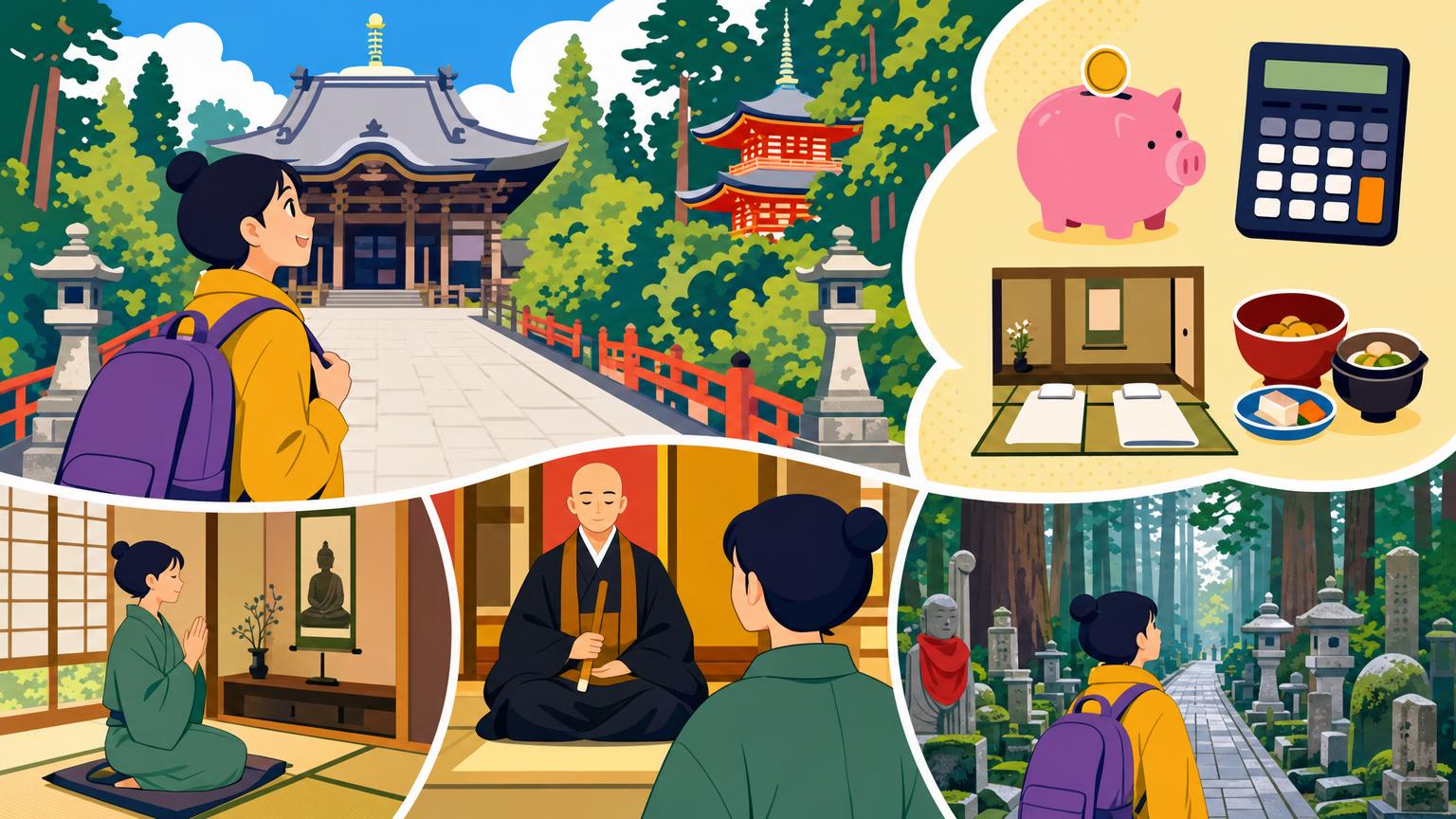
Prices vary depending on the temple, room type, season, meal plan, and booking channel. As a practical planning range, budget approximately ¥15,000 to ¥35,000 per person for one night with dinner and breakfast, or roughly US$95 to US$220 based on an exchange rate of around ¥159 to US$1. The dollar amount is only an estimate, as exchange rates and temple prices can change. A current market reference dated September 24, 2026, listed USD/JPY at around ¥158.92 per US$1.
Higher-end rooms, private bathrooms, special meals, seasonal demand, and premium temples can push the total above this range. Lower prices may also be available, especially for simpler rooms or local booking plans, but you should check exactly what is included.
What the Price Usually Covers
A typical temple-stay price may cover the room, dinner, breakfast, bedding, and access to standard guest facilities. Some activities are included, while others require an additional fee or reservation. Meditation, sutra copying, fire rituals, guided walks, and private baths are not standardized across all lodgings.
Transportation from Osaka is separate, as are local buses, snacks, drinks, temple donations if requested, and personal purchases. Cable car, train, and bus connections can add a noticeable amount to the weekend budget, particularly if you choose limited express services.
Is It Expensive Compared With an Osaka Hotel?
Compared with a business hotel room in Osaka, a shukubo may seem expensive. Compared with a traditional inn that offers two meals, guided cultural experiences, historic surroundings, and staff service, however, the price becomes easier to understand.
The more useful comparison is not “bed versus bed,” but “ordinary accommodation versus a structured cultural stay.” If you only want a quiet place to sleep, a temple may not offer good value. If you want to experience a different daily rhythm, the meal and morning service are part of what you are paying for.
Choosing a Temple Based on How You Actually Travel
Do not choose based solely on photographs. Choose according to your habits. Do you need English support? Would you like a bath? Are you looking for a quiet, traditional room? Do you care about returning late after a night walk? Do you need a bed instead of a futon?
Koyasan’s official lodging association provides reservation information and increasingly supports online booking and request-based matching. Because popular dates can sell out, especially on weekends, during autumn foliage periods, holidays, and other busy seasons, book as early as possible and confirm the details directly.
Eko-in: Best for English Support and Organized Activities
Eko-in is a common choice for international visitors because its official website offers detailed English information about rooms, meals, activities, luggage, check-in, and curfew. It provides experiences such as meditation, sutra copying, religious services, and a Goma fire ritual. It also states that there is no set curfew, although you should still follow any instructions given during your stay.
This may suit first-time temple-stay guests or solo travelers who want clear information. The trade-off is that a well-known, English-friendly temple may feel more visible to international tourism. That does not make the experience inauthentic, but it may make it less private than staying at a smaller, less internationally oriented lodging.
Fukuchi-in: Best for Travelers Who Want Bathing Facilities
Fukuchi-in is often considered by visitors who want a more comfortable temple-stay setting and access to communal bathing facilities. Confirm the current bath hours, room features, meal details, and availability before booking, as facilities and conditions may change.
This can be a good choice for people who like the idea of temple lodging but are not seeking an extremely austere experience. If you are comparing it with an Osaka hotel, think of it as a bridge between traditional atmosphere and practical comfort.
Soji-in: Best for a More Refined, Formal Stay
Soji-in appeals to travelers who want a polished temple environment, carefully presented shojin ryori, and a more formal atmosphere. It may suit visitors who appreciate gardens, architecture, quiet service, and a sense of occasion.
The key question is whether you want to observe the environment or participate actively. A refined temple stay can be beautiful, but it may feel less casual. You should not arrive expecting the relaxed, joking atmosphere of a neighborhood Osaka restaurant.
Muryoko-in: Best for Travelers Seeking Traditional Atmosphere
Muryoko-in may appeal to guests who prioritize traditional architecture, a religious atmosphere, and a quieter setting. However, room standards, language support, schedules, and facilities should be confirmed directly before booking rather than assumed from a photograph or an outdated review.
This is a general rule for Koyasan: temple names are not product labels. Two rooms in the same institution may provide very different experiences. Ask about heating, bathroom access, bedding, meal times, and whether your room is near a public corridor.
A Better Way to Ask the Association for Help
If the booking system seems confusing, explain your actual needs instead of simply asking for “the best temple.” Mention whether you are traveling alone, whether you need English communication, whether you want to take a night walk, whether you need a bed, whether you have allergies, whether you want a private bathroom, and what your budget is.
A useful request should be practical: “I am looking for one night with dinner and breakfast, English support, access to morning service, and a curfew that allows me to return from an evening walk.” This gives the reservation staff something specific to work with.
What Foreign Residents of Osaka Often Misunderstand
“It Is a Hotel, So I Can Arrive Whenever I Want”
Not necessarily. Dinner, meditation, bathing, and evening access may take place at fixed times. Arriving late can mean missing a meal or facing a difficult check-in. Contact the temple immediately if your train is delayed.
“If I Do Not Understand the Ritual, I Should Not Attend”
You can often attend even if you are not Buddhist or cannot understand Japanese. The Japan National Tourism Organization describes morning prayer, meditation, sutra copying, and shojin ryori as central parts of the shukubo experience, while individual temples explain participation in different ways.
You do not need to claim a religious identity you do not have. You only need to enter respectfully.
“Quiet Japanese People Do Not Want Questions”
This is a common misconception. Staff may not initiate a long conversation, but they generally need you to ask practical questions. The key is timing and tone. Ask clearly, avoid interrupting a ceremony, and listen to the response.
In Osaka, questions may be expressed with humor or casual speech. In Koyasan, a direct and polite approach is safer. You do not need elaborate Japanese. “Dinner time?” “Morning service time?” “Curfew?” and “Where should I leave my shoes?” are all useful questions.
“Vegetarian Means Every Food Restriction Is Automatically Covered”
It does not. Buddhist vegetarian cooking and allergy-safe cooking are two different systems. Fish stock, soy, sesame, wheat, nuts, mushrooms, and other ingredients may be important to different guests. Contact the temple before arrival and bring a written explanation of any serious restrictions.
“The Mountain Will Be Cool Because Osaka Is Hot”
The mountain climate can be cooler and wetter than central Osaka, and conditions vary by season. Bring layers, comfortable walking shoes, rain protection, and warm sleepwear during colder months. A traditional room may not feel like a centrally heated hotel room.
“A Yukata Is Fine Everywhere”
Some temples provide yukata for indoor use, but Koyasan’s official guidance asks visitors to change into regular clothing for the main hall and morning service. Revealing clothing, short skirts, and shorts are not appropriate in religious areas, particularly around Okunoin.
Packing Like Someone Who Lives in Osaka
Pack less than you think, but do so intelligently.
A small backpack or soft overnight bag is easier to manage than a hard suitcase. Bring socks without holes, as you may need to remove your shoes repeatedly. Add a thin jacket, rainwear, medication, a portable battery, earplugs, and a small amount of cash. Some facilities accept cards, but local tourism information notes that payments at Koyasan lodgings are often cash-only, so do not rely entirely on contactless payment.
Bring toiletries only if you need specific products. Temple bathing facilities may provide basic items, but this varies. If you need a hair dryer, ask rather than assume.
Luggage forwarding can make the trip easier. Send large bags to your next Osaka or Kansai-area accommodation if the service and receiving hotel allow it. Keep one overnight bag with the essentials. This is especially helpful if your route includes buses, stairs, rain, or a long walk through town.
The local Osaka skill here is not minimalist travel for its own sake; it is about reducing friction. Osaka residents are usually good at identifying the one thing that will become annoying later and dealing with it early.
How to Behave Without Feeling Nervous
Use the Entrance Properly
Remove your shoes in the designated area, not wherever you happen to be. Place them neatly if instructed to do so. Keep outdoor dirt away from tatami and indoor floors.
Keep Your Voice Low in Shared Areas
You do not need to whisper in your room, but corridors, halls, gardens, and bathing areas are not appropriate places for loud phone calls or group joking. Headphones can be useful.
Ask Before Taking Photographs
The outside of a building may be suitable for photography, while a hall, altar, ceremony, garden detail, monk, or another guest may not be. Look for signs and ask the staff.
Follow Bathing Etiquette
Wash before entering a communal bath, and keep towels out of the bathwater. Follow gender-separation instructions and operating hours. If you have tattoos, ask about the temple’s policy before arrival instead of discovering it in the changing room.
Respect Religious Objects
Do not touch statues, scrolls, offerings, bells, altar objects, or decorations unless you are clearly invited to do so. Do not sit on steps that serve as entrances to sacred spaces.
Do Not Make the Staff Manage Your Confusion
If your schedule conflicts with dinner, a tour, or morning service, raise the issue early. A temple can often help when informed in advance, but it is much harder to solve a problem after the kitchen has closed or the gate has been locked.
How Long Should You Stay in Koyasan?
For most foreigners living in Osaka, one night and two days is the best starting point. It gives you enough time to experience the journey, settle into the temple, enjoy both dinner and breakfast, attend morning service, and walk through the town without turning the trip into a rushed day excursion.
A day trip lets you see the buildings and mountain scenery, but it does not reveal how the town changes after dinner or how morning service shapes the day. Two nights can be worthwhile if you want to take longer walks, meditate more, visit Okunoin at a slower pace, or spend time without constantly checking the return train.
Still, one night is the practical sweet spot. It fits a typical Osaka weekend, keeps costs manageable, and gives the experience a clear beginning and end.
Choose Two Nights If You Need a Deeper Reset
Two nights may be suitable if your working week is intense, you are recovering from city overstimulation, or you want to combine a temple stay with longer mountain walks. It also gives you greater flexibility if bad weather disrupts your plans.
Choose One Night If You Are Testing the Experience
One night is better if you are unsure about futons, early mornings, vegetarian meals, silence, or shared baths. You can treat it as an introduction rather than making a major commitment.
Do not book two nights simply because the photographs look peaceful. Peaceful places can still be physically demanding, chilly, structured, or socially unfamiliar.
Is a Koyasan Temple Stay Worth It for Someone Living in Osaka?
It is worth it if you want to understand a side of Japan that does not appear in shopping districts, nightlife areas, or typical sightseeing routes. It is especially worthwhile if you are curious about how religious practice fits into daily life, how hospitality can be structured without becoming entertainment, and how a quiet environment can change your own behavior.
It may not be worth it if you want late dinners, spontaneous nightlife, a large Western-style breakfast, a private bathroom, and complete control over your schedule. You can find those things more easily in Osaka.
The real value of Koyasan is not escaping Japanese culture. It is gaining a closer look at it.
For an Osaka local, the weekend also reveals an important contrast. Osaka teaches you to respond quickly, speak plainly, eat well, and keep moving. Koyasan teaches you to arrive on time, lower your voice, accept a schedule, and notice what usually disappears beneath the noise of the city.
The two places are not opposites. They are connected by the same practical intelligence: understand the situation, respect the people around you, and avoid creating unnecessary trouble for others.
That may be the most Osaka-like way to approach a temple stay. You do not need to become mystical, nor do you need to pretend that every ritual will transform your life. You simply need to show up, pay attention, and allow one weekend to move at a slower pace.
By Monday morning, Osaka will still be noisy. The trains will still be crowded. Someone will still be cheerfully arguing about the best place to eat near Namba. But you may see the city differently. After hearing a mountain temple gong before sunrise, even the sound of a train crossing can feel like part of a much larger rhythm.