
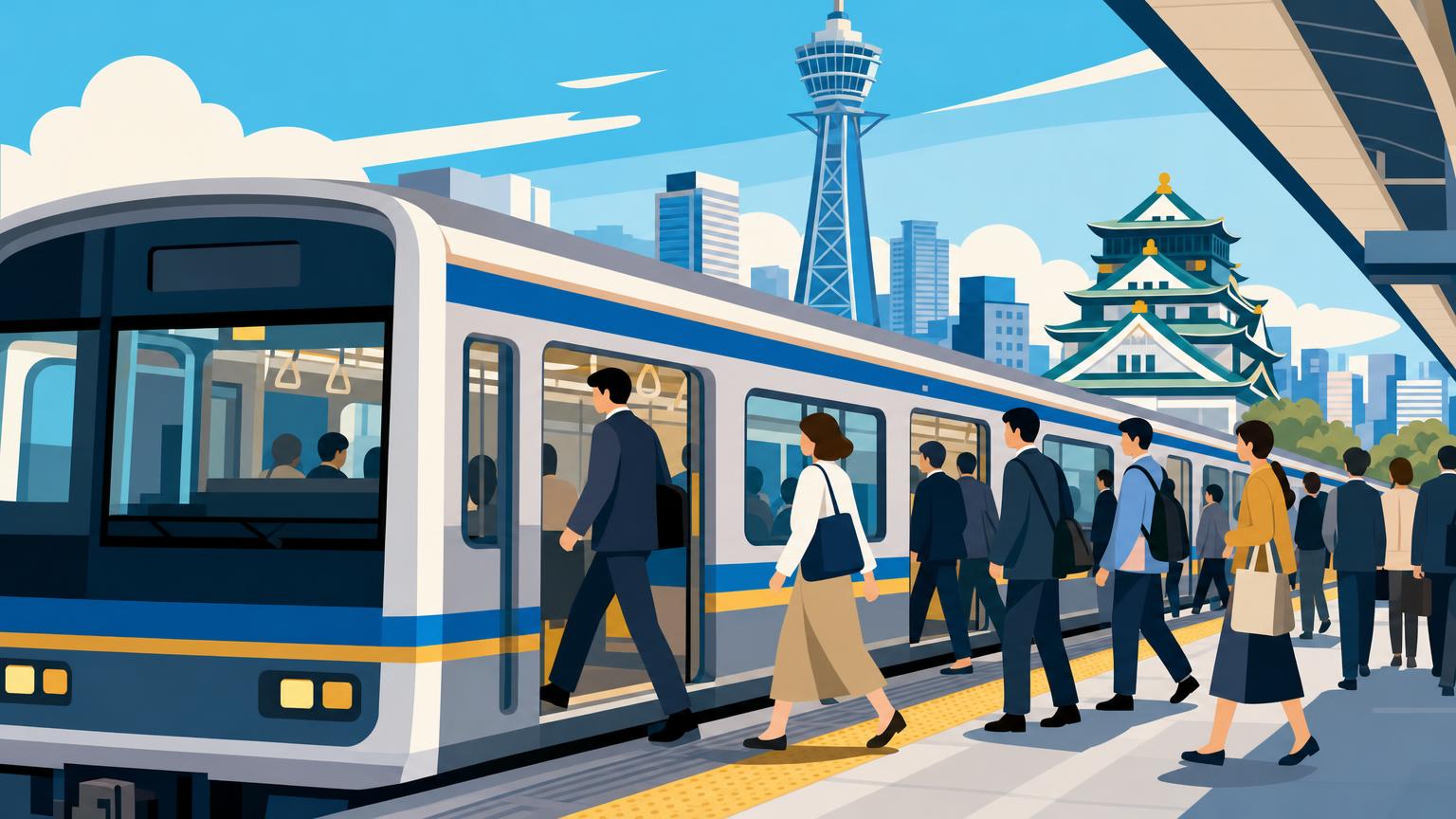
A foreign resident may first notice Osaka’s trains because they are efficient. After a few weeks, you notice something else: the city’s transit system is also a social system. People do not simply move from one station to another. They follow small rituals, remember invisible boundaries, recognize which railway company they are using, and develop personal opinions about the best exit at Umeda, the least stressful transfer at Namba, and the correct moment to stand near a train door.
This often creates a particular kind of confusion for people living in Osaka. You may understand how to tap an ICOCA card, yet still wonder why your colleague uses a commuter pass, why the same destination appears under several station names, or why a short journey can involve three different railway companies. You may also notice that Osaka people seem more willing than Tokyo commuters to speak to strangers, make jokes in crowded places, or complain openly about a delay. These differences are not only about personality. They are connected to how Osaka works as a city.
Osaka’s daily transit ritual is practical, commercial, and strongly shaped by local habits. The important question is not simply, “Which train should I take?” It is, “How do people here make the city manageable every day?” This guide explains that question through ICOCA cards, commuter passes, station behavior, railway boundaries, and the small choices that reveal what living in Osaka is really like.
Osaka’s Transit System Is Part of Everyday Social Life
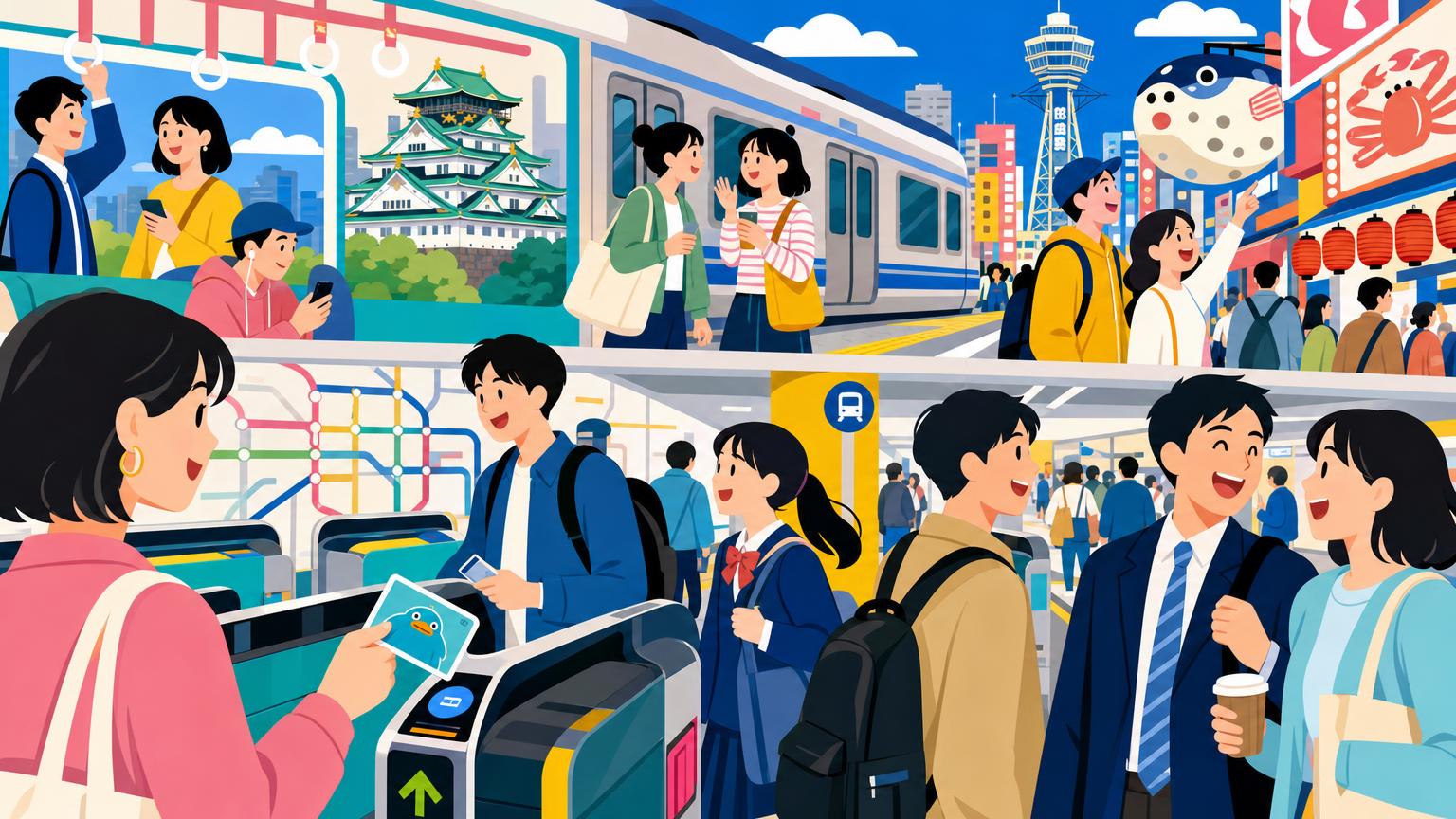
For a newcomer, Osaka’s railway map can seem like a collection of unrelated colors and company logos. For a resident, it gradually turns into a mental map of work, errands, friendships, and obligations. The differences between Osaka Metro, JR West, Hankyu, Hanshin, Kintetsu, Nankai, and Keihan are not merely technical. Each railway serves a different direction, workplace pattern, and style of movement.
A person living in Tennoji may take Osaka Metro to reach Honmachi, JR to visit relatives in the southern suburbs, and Kintetsu for a weekend trip toward Nara. Someone living in Juso may use Hankyu every morning but switch to Osaka Metro at Umeda. A worker near Kyobashi may take JR or Keihan depending on where they live. These choices become part of a person’s daily identity.
This is one reason foreign residents sometimes feel that Osaka’s transportation system is more complicated than it should be. The city does not have a single transport authority controlling every route. Instead, it has a network of companies whose lines overlap, compete, and cooperate. The system is confusing at first, but it also helps explain why Osaka has many different centers rather than one overwhelming central area.
Why Osaka commuters develop strong opinions about routes
People in Osaka often discuss routes in terms of comfort, not just speed. The fastest route may require an unpleasant transfer through a huge underground passage. A slightly slower route may be preferred because the platform is calmer, the train is less crowded, or the station exit is closer to the office.
This practical attitude is common in everyday Osaka life. People often ask whether something is worth the trouble. A restaurant may be excellent, but if getting there requires two awkward transfers, a local person may decide it is not worth visiting on a weekday. A cheap apartment may seem attractive, but if the commute involves a difficult transfer at Umeda, the low rent may not feel like much of a bargain.
Tokyo commuters make these calculations as well, of course. The difference often lies in how openly people express them. In Osaka, everyday inconvenience is more likely to become a topic of conversation. People joke about a poorly designed station, complain about a train company, or tell you that your proposed route is “too much trouble.” This directness can sound harsh to foreigners who expect more indirect communication, but it is usually practical criticism rather than personal rejection.
The Main Railway Networks Residents Actually Use
Osaka Metro: The city’s practical inner network
Osaka Metro is the railway system many residents rely on for everyday travel within Osaka City. Its lines connect major employment districts such as Umeda, Yodoyabashi, Honmachi, Shinsaibashi, Namba, Tennoji, and the bay area. The Midosuji Line is particularly important because it runs north to south through the city’s main commercial corridor.
For daily life, Osaka Metro often feels like the city’s internal skeleton. It is useful for commuting to work, visiting a ward office, going to a clinic, meeting friends after work, or traveling between neighborhoods without leaving Osaka City. The system is separate from JR, and a Metro station may be physically close to a JR station while still requiring a different fare and transfer arrangement.
Osaka Metro stations use line colors and alphanumeric station codes. For example, M16 is Umeda on the Midosuji Line, while Namba is M20 on the same line. These codes are helpful when Japanese station names are difficult to read or announcements are unfamiliar. A station code is not a “public transportation number” like a phone number or bus route number. Instead, it is a navigation label that helps passengers confirm their location on a particular line.
Residents use these codes almost unconsciously. They look for the colored line, check the letter and number, and confirm the direction of the train. For foreign residents, developing the same habit can remove much of the anxiety. Rather than trying to recognize every kanji character, you can look for a line symbol such as M, T, Y, or C and then compare the station number.
Osaka Metro also accepts ICOCA and other compatible IC cards. Contactless credit and debit card payment is available on Osaka Metro subway and New Tram services, while Osaka City Bus and Imazato Liner services have also introduced contactless payment on applicable routes. However, contactless payment is not a complete substitute for an ICOCA card, especially if your routine includes JR, private railways, buses, or commuter-pass functions.
JR West: Regional movement and the logic of larger distances
JR West becomes important when your daily life extends beyond the central Osaka Metro area. JR lines connect Osaka with suburban residential areas, Kansai International Airport, Kyoto, Kobe, Nara, Wakayama, and other parts of western Japan. Even within Osaka, JR may be the most practical option for certain trips.
The main difference is not that JR is for tourists while Osaka Metro is for residents. Both are used by local residents. Rather, the difference lies in the geography served by each network. Osaka Metro is often more convenient for travel within the city, while JR is often better for longer journeys and suburban commuting, although there are many exceptions.
At Osaka Station and in the surrounding Umeda area, JR station names can be especially confusing. “Osaka Station” is the JR name, while Umeda, Higashi-Umeda, and Nishi-Umeda are nearby Osaka Metro stations. They are connected by underground walkways, but they are not simply different entrances to the same railway system. A transfer may require leaving one company’s ticket gates and entering another company’s gates.
This distinction is important when using an ICOCA card. You can normally tap in and out across compatible operators, but the system still calculates the journey based on the companies and routes used. If you go through the wrong gate, fail to tap, or combine a commuter pass with a journey outside its valid section, you may need assistance from a station attendant.
JR West’s ICOCA system allows the card to be used on railways and buses throughout Japan wherever compatible IC-card marks are displayed. The same card can also be used at many stores. For residents, the important point is that ICOCA is not a special tourist product. It is a standard prepaid payment tool that fits naturally into everyday life in Kansai.
Private railways: Different companies, different commuting worlds
Private railway companies are essential to understanding where Osaka residents live and work.
Hankyu serves northern Osaka and routes toward Kobe and Kyoto. Its Osaka-Umeda terminal is closely connected to the Kita area and the suburban neighborhoods north of the city. Hanshin links Osaka with Kobe and the southern part of Hyogo Prefecture. Kintetsu serves eastern Osaka, Nara, and parts of Mie. Nankai is central to travel toward southern Osaka and Wakayama, while Keihan connects Osaka with the eastern suburbs and Kyoto.
To a foreign resident, these companies may seem interchangeable. To local commuters, however, they are tied to housing choices, schools, shopping areas, and family histories. Someone may say they live “along Hankyu” or “near Kintetsu” as naturally as another person might name a neighborhood.
Private railway stations also shape local commercial life. A station building may include a supermarket, department store, clinic, bakery, bank, and dental office. In many Osaka neighborhoods, the station is more than a transportation point; it is where daily life is organized. You may commute through the same station for years without visiting the city center because the station area already offers most ordinary services.
This is one way Osaka differs from the image of Tokyo as a city organized around a few dominant business centers. Osaka has major centers, but it also has many strong local hubs. Tennoji, Kyobashi, Juso, Hirano, Nishikujo, and other areas have their own routines and reputations. Daily transit allows people to move between these worlds, while local identity remains strong.
Buses and taxis: The slower side of city life
Buses can be less predictable for newcomers because they do not always appear as clearly on railway maps. They are useful in areas between stations, especially in neighborhoods where the nearest subway station is not within a comfortable walking distance. Osaka City Bus is part of the municipal transportation network, but private buses also operate in and around the city.
Many residents take buses when the weather is poor, when carrying groceries, or when traveling with children. A twenty-minute bus ride may be more practical than walking through a lengthy station transfer. At the same time, bus journeys depend on traffic, so people who are running late for work may prefer a train even if it involves more walking.
Taxis are generally viewed as a practical solution rather than a casual everyday habit. A local person may take a taxi late at night, while carrying heavy luggage, or when several people can share the fare. Osaka’s direct culture can also appear in taxi interactions: passengers may give short, clear instructions, and drivers may respond with efficient familiarity. Politeness remains important, but unnecessary ceremony is often minimized.
ICOCA: The Card That Fits Osaka’s Daily Rhythm
ICOCA is a prepaid IC card, not a commuter pass
An ICOCA card is a prepaid IC card. You load money onto it before traveling, then tap it on the reader at the ticket gate. The fare is automatically deducted when you exit. The card can be used on compatible trains, subways, buses, and at participating stores.
For most foreign residents, ICOCA is the easiest place to start because you do not need to understand every fare table. You do not have to decide in advance whether a journey falls within a particular zone. Simply keep enough money on the card and tap in and out.
ICOCA is one of the most widely accepted payment methods for trains, subways, and buses in the Kansai region. It is also useful outside Kansai wherever compatible IC-card systems operate. The card does not provide a special discount on every ride, but it saves time and reduces the minor stress of buying a ticket for each trip.
The key limitation is that ICOCA does not automatically become a commuter pass. It remains a stored-value card unless you add a valid commuter pass to it through an appropriate railway service. This distinction is important. Many newcomers use ICOCA for months without realizing that their regular commute might be cheaper or more convenient with a commuter pass.
Buying and recharging an ICOCA
You can generally buy an ICOCA from compatible ticket vending machines or railway ticket offices. The machines may offer an English-language option. Depending on the operator and card type, you may pay a deposit in addition to the initial stored value. A standard physical card commonly includes a refundable deposit, while the conditions for mobile versions or special products may differ.
The basic process is simple:
- Select the ICOCA or IC-card option on the ticket machine.
- Choose the initial amount to load.
- Pay with cash or an accepted payment method shown on the machine.
- Take the card and any receipt.
- Tap the card on the reader when entering and leaving a compatible gate.
To recharge the card, use an IC-card-compatible ticket machine, fare-adjustment machine, or another supported recharge point. Osaka Metro states that reloading can be done at compatible ticket vending machines and fare-adjustment machines at subway stations, as well as on buses where the service is available. Reload amounts are generally added in units of 1,000 yen, although some fare-adjustment machines allow smaller amounts. The maximum balance is 20,000 yen.
A useful habit for residents is to recharge before the card becomes nearly empty. If your balance is insufficient when leaving the subway, you may need to reload it at the fare-adjustment machine before passing through the gate. You cannot always load only the exact shortfall in the way a foreign visitor might expect. Keeping a few thousand yen on the card prevents an unnecessary stop during the morning rush.
Why residents often carry more than one payment option
Many Osaka residents use an ICOCA card, a smartphone payment option, and a bank card at different times. A mobile IC card can be convenient, but foreign-issued cards, phone settings, battery failure, or regional restrictions can cause problems. A physical ICOCA is still useful as a backup.
Some stations and services now support contactless bank-card payments. This is convenient for occasional journeys, but it may not work across every private railway, every bus, or every type of transfer. It also does not replace the functions of a commuter pass. If you use the same route every weekday, the important question is not whether you can pay by card. It is whether the system recognizes your regular fare arrangement.
A local friend may tell you to “just use ICOCA” because it is the simplest answer for most occasional travel. That advice makes sense when your schedule changes, you work from home several days a week, or you are still deciding where you want to live. It becomes less complete once your commute has settled into a fixed pattern.
Commuter Passes and the Meaning of a Regular Route
What a commuter pass actually represents
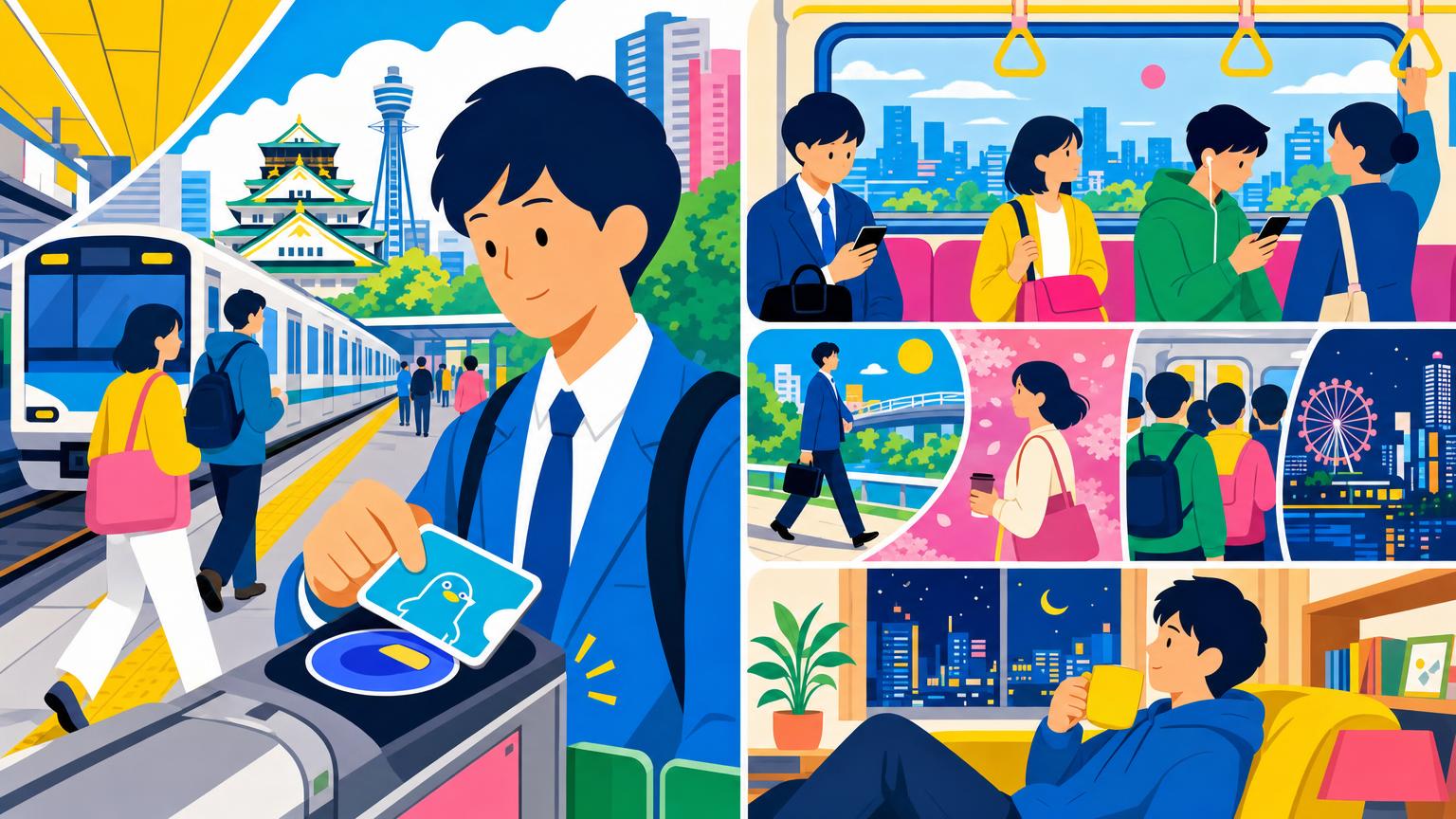
A commuter pass is more than a discounted ticket. It represents a stable relationship between your home station and your workplace, school, or another approved destination. The railway company records a specific route and validity period, allowing you to travel repeatedly within that arrangement without purchasing a separate ticket each time.
This structure reflects an important aspect of Japanese working life. The daily commute is treated as a predictable institutional journey. Your employer may reimburse transportation costs based on the approved route, while your school may issue documentation for a student pass. The pass connects your personal travel with an organization’s expectations.
For a foreign resident, this may feel stricter than expected. You may know that two routes reach the same office, but your company may ask you to register one route based on cost, safety, or company policy. You may also assume that a commuter pass allows unlimited travel anywhere between the two stations. In reality, validity depends on the railway company, route, fare rules, and type of pass.
How commuter passes work with ICOCA
Osaka Metro commuter passes can be issued as IC cards or magnetic passes, while interline commuter passes are issued as IC cards. If you purchase a commuter pass on a new ICOCA, you may need to pay both the pass fare and a deposit. If you already have an ICOCA, the commuter pass can be loaded onto that card without paying an additional deposit.
This is useful because a single physical card can hold both commuter-pass information and stored value. The commuter pass covers the valid section, while the stored balance pays for journeys outside that section, provided the route and operators support the necessary fare calculation.
For example, your pass may cover the route between a residential station and your office. On a weekend, you can still use the same card to travel elsewhere, but the fare for that separate journey will be deducted from the stored balance. You should not assume that having a commuter pass makes all travel free.
Why the same route can have different commuter-pass prices
The price may depend on the specified route, distance, railway company, and whether the pass crosses between operators. Two routes connecting similar areas may not have the same commuter fare. A route that appears longer on the map may be cheaper, while one with fewer transfers may cost more.
For this reason, residents often compare routes before purchasing a six-month pass. The decision may involve more than speed. People also consider station access, crowding, reliability, transfer difficulty, and whether the route remains useful outside working hours.
A foreign employee should ask their workplace which documents are required and which route has been approved. Railway staff can explain the available passes, but they may not know your employer’s reimbursement policy. If your address or workplace changes, do not assume that your existing pass is still appropriate.
Monthly, three-month, and longer passes
Commuter passes are commonly sold with different validity periods, such as one month, three months, or six months. A longer pass may offer better value if you are certain that you will continue living and working along the same route. A shorter pass may be safer if you are in a probationary job, considering a move, or working on a fixed-term contract.
This is one situation in which Osaka’s practical mindset becomes visible. People do not automatically choose the lowest price on paper. Instead, they consider whether the commitment is useful. A six-month pass may be economical, but a one-month pass may be wiser if your housing situation is unsettled.
ICOCA or a Commuter Pass? A Decision Based on Real Life
ICOCA is usually better when your schedule is flexible
Choose regular ICOCA use when:
- You work from home several days a week.
- Your workplace changes, or you travel to different branches.
- You are still deciding where to live.
- You commute fewer days than a typical office worker.
- You frequently use different railway companies.
- You want simple payment without registering a fixed route.
The financial break-even point depends on the exact fare and pass price, so do not rely on a general rule. Check the route using the railway operator’s official fare calculator or a reliable transit app. A commuter pass may not save money if you work remotely for most of the month.
A commuter pass is usually better when your route is stable
A commuter pass is worth considering when:
- You travel the same route to work or school on most weekdays.
- Your employer reimburses or supports the purchase of a pass.
- Your home and workplace will remain stable for the entire validity period.
- You make regular extra journeys within the valid section.
- The pass provides a simpler transfer between railway companies.
The additional benefit is psychological. With a commuter pass, the daily ride becomes a background activity. You do not need to think about the cost of each morning journey. This is one reason Japanese commuters often seem to move through stations without hesitation. Their route is not a series of individual purchases; it is part of a monthly routine.
The emotional difference between a stored-value card and a pass
ICOCA encourages flexibility, while a commuter pass encourages belonging to a route. This may sound abstract, but it affects how people experience the city.
With ICOCA, you are always making choices: take the faster train, walk from a different station, stop somewhere after work, or change your destination. With a commuter pass, certain movements become almost invisible because they are already included in your daily routine.
Many Osaka residents move between these two modes. They use the commuter pass on weekdays, then use the stored balance for errands, restaurants, or social visits outside the pass section. The card becomes a small record of their lives: home, work, supermarket, gym, school, and the occasional journey that costs extra.
Osaka Station Names and the Geography of Confusion
Why Umeda and Osaka Station Are Not Exactly the Same
Foreign residents often wonder whether Umeda and Osaka Station are the same place. The short answer is that they belong to the same broad urban area, but they are not one single station. JR uses Osaka Station, while Osaka Metro uses Umeda, Higashi-Umeda, and Nishi-Umeda. Hankyu and Hanshin also have their own Osaka-Umeda stations.
The stations are connected, but transferring may involve walking through underground passages, following signs, and locating the correct ticket gate. A map may show the area as one cluster, while you experience it as several separate stations.
Local people often give directions using exits rather than street names. They may say, “Meet me near Exit 4,” or “Come out at the Hankyu side.” These instructions are efficient for people who already understand the station’s internal geography. As a foreigner, ask which railway company, which line, and which exit. Do not feel embarrassed about repeating the question.
Namba Is Another Example of Layered Railway Identity
Namba may refer to Osaka Metro Namba, Nankai Namba, or the nearby JR Namba area, which is not physically identical to every other Namba station. Kintetsu and Hanshin also have Namba terminals. The names overlap because the city developed through multiple railway companies rather than a single unified system.
This layered identity affects local behavior. A resident may describe a meeting point based on the railway company they use. “At Nankai Namba” is not the same practical instruction as “at Osaka Metro Namba.” If you simply say “Namba Station,” two people may picture different parts of the area.
When meeting someone, confirm the railway operator and the exit number. This small habit can prevent the kind of delay that makes a person appear unreliable, even when they have arrived in the correct general neighborhood.
Station Numbers Are a Quiet Form of Language Support
Osaka Metro’s station numbering system is especially helpful for people who cannot read Japanese quickly. Each station has a letter representing the line and a number indicating its position. If you know that Namba is M20 on the Midosuji Line, you can follow the Midosuji color and compare the number, even if the written name is unfamiliar.
Station numbers also reduce stress when announcements are difficult to hear. Japanese trains may announce the next station in Japanese and English, but platforms can be noisy. The code on the sign provides visual confirmation.
Think of station numbers as a universal layer beneath language. They do not solve every transfer problem, but they allow you to navigate without translating every sign.
How Osaka People Behave on Trains
Quietness is expected, but not absolute silence
Train etiquette in Osaka is often described as quiet, but the reality is more flexible than that stereotype suggests. People generally avoid loud phone calls, keep their voices at a moderate level, and try not to disturb others. At the same time, groups of friends, families, and older passengers may speak animatedly, particularly outside the busiest commuting periods.
The practical rule is to stay aware. If everyone around you is quiet, lower your voice. If the carriage feels relaxed and people are talking, ordinary conversation is acceptable. A foreign resident may attract less negative attention for speaking another language than for ignoring the surrounding atmosphere altogether.
Phone calls are generally discouraged on trains. Texting, messaging, and using a phone silently are normal. During crowded periods, people may also avoid opening large bags or eating strong-smelling food.
Queueing is strict, but boarding is not always elegant
Passengers generally line up at the marked positions on the platform. Let people exit before entering, and do not stand directly in front of the doors when others are trying to get off. During rush hour, the process may appear highly organized, but the actual boarding experience can be physically intense.
Osaka’s directness is sometimes visible here. People may move quickly, protect their position, or squeeze into a crowded carriage without apologizing. This does not necessarily mean they are angry. The train is a shared space with limited time, and commuters are trying to complete a familiar task.
If you are carrying a large suitcase, move to the side of the door area or use a less crowded carriage when possible. A suitcase in the middle of a packed train creates difficulties for everyone, regardless of nationality.
Priority seats are about consideration, not a performance
Priority seating is intended for older people, pregnant passengers, people with disabilities, and passengers with small children. You may not always immediately recognize the need. Someone who looks young may have a medical condition, while a person who is standing may be saving the seat for someone else.
Some passengers turn off their phones near priority seating, while others use silent mode in accordance with current railway guidance. Follow the signs and local announcements. The broader point is not to police other passengers, but to remain aware that public space is shared with people whose needs may not be visible.
Escalators reveal different regional habits
In Osaka, people traditionally stand on the right side of an escalator and leave the left side open for those walking. Tokyo is commonly associated with standing on the left. Actual practice can vary depending on the station, crowd, safety campaigns, and congestion, and many operators discourage walking on escalators.
For a foreign resident, the safest approach is to observe the people around you and avoid blocking the entire width. If station signs ask passengers to stand still, follow them. The difference between Osaka and Tokyo is a useful cultural observation, but it should not be used as an excuse to ignore current safety instructions.
Rush Hour Is a Different City
Morning commuting in Osaka
Morning rush hour changes the city’s emotional atmosphere. Between approximately 7:30 and 9:30 on weekdays, stations near business districts become more focused and less conversational. People walk quickly, wait in predictable lines, and often avoid unnecessary eye contact.
The busiest times and routes vary depending on the line and direction. A train heading toward central Osaka may be crowded in the morning, while the reverse direction is less busy. In the evening, the pattern changes. Apps and route planners can provide congestion information, but the most reliable knowledge often comes through repeated experience.
If you are new to Osaka, try traveling at different times during your first week. You may find that leaving home fifteen minutes earlier makes the journey calmer, while leaving ten minutes later creates an entirely different experience.
Why residents sometimes choose a slower route
A route planner may recommend the fastest journey, but residents may choose a different route to avoid a crowded interchange. This is especially common at large stations. Saving three minutes is not appealing if it means walking through a packed passageway, changing platforms twice, or competing for space on a train.
This preference reflects Osaka’s practical sense of value. Time matters, but so does effort. A route that takes five minutes longer may be preferable if it gives you a seat, keeps you out of the rain between buildings, or leaves you closer to the supermarket.
The evening changes the rhythm
After work, stations become less uniform. Some commuters go straight home, while others stop for dinner, drinks, shopping, or a brief conversation with colleagues. Osaka’s station districts often accommodate this flexibility because restaurants, supermarkets, and small businesses are woven into the areas surrounding the platforms.
A foreign resident may notice that “going home” does not always mean leaving the city center right away. A colleague may suggest a quick meal near the station and then continue talking longer than expected. The transit system supports these informal extensions of the working day.
Reading Osaka Through Station Areas
Tennoji and Abeno: A southern center with its own rhythm
Tennoji and Abeno are important because they bring together transport, offices, hospitals, schools, shopping, and residential neighborhoods. The area connects Osaka Metro, JR, and Kintetsu services, and residents often move through it without needing to travel to Umeda or Namba.
This is a useful reminder that Osaka is not organized around a single downtown. People in southern Osaka may have a complete daily life centered on Tennoji. Their preferred station exits, supermarkets, clinics, and lunch spots may matter more to them than famous destinations in the city center.
Kyobashi: A transfer point with an everyday personality
Kyobashi connects JR, Keihan, and Osaka Metro services. It is a good example of how a transport hub can feel less polished and more ordinary than a major commercial center. People use it for work, shopping, school, and evening meals. The area’s personality comes from repeated local use rather than from a single landmark.
For a foreign resident, Kyobashi can reveal an Osaka preference for practical neighborhoods that serve many purposes at once. Not every area needs to look elegant; it needs to be convenient, affordable, and socially lively.
Juso and the northern railway world
Juso is closely associated with the Hankyu network and lies between Osaka’s central areas and northern residential routes. The area demonstrates how a station can have a strong identity while remaining connected to the wider city.
Residents may choose housing based on the railway line rather than the municipal ward. The question is not only, “Which neighborhood is this?” but also, “Which train will I rely on every day?” This is a useful way for foreigners to evaluate apartments. A map radius does not show you what a commute feels like.
Nishinari, Hirano, and the importance of not judging from one station exit
Some Osaka neighborhoods have reputations that outsiders simplify. A person may hear a name and imagine poverty, nightlife, danger, or old-fashioned local culture. Daily reality is more mixed. Streets can change dramatically within a short walk, and a station’s reputation may not reflect the experience of every resident.
When considering where to live, visit at different times of day. Pay attention to the route between the station and the apartment, the availability of supermarkets, nighttime noise, lighting, and how you feel while walking there. Osaka people often judge a place through practical details rather than an abstract reputation. Foreign residents should do the same.
Checking Schedules Without Becoming Dependent on Printed Timetables
Google Maps is useful, but understand what it shows
Google Maps is often the easiest place to start when checking an Osaka public transportation schedule in real time. It can display different operators, transfer points, platform information, walking routes, and estimated arrival times. However, the suggested route may not match the route your employer expects or the route covered by your commuter pass.
Before boarding, check the railway company, train destination, transfer station, and whether the route includes a reserved-seat or additional-fee service. A route that appears faster may involve a train that requires a separate surcharge.
Railway operator apps and local tools
Official railway apps and regional transit tools can provide more precise service information, particularly during delays. JR West services, Osaka Metro information, and private railway announcements may report disruptions that are not immediately apparent in a general map application.
A sensible daily approach is to use one map app for route planning and the relevant operator’s official service page when the weather is severe or a delay has been reported. Do not rely solely on a printed timetable. Construction, seasonal schedules, weather, accidents, and maintenance may change the usual pattern.
What to do when the app and station signs disagree
Follow the station’s current platform announcement and staff instructions rather than an old screenshot or saved route. If a train is delayed, the app may continue to display a theoretical route while the railway manages the situation in real time.
Station staff may not always speak fluent English, but showing the destination name, line symbol, or station code can be helpful. A short phrase such as “Is this train for Midosuji Line M20?” is often more effective than a lengthy explanation.
If you have a commuter pass, show the physical card or the relevant app screen. Staff can confirm the valid section and advise whether you need an additional ticket.
Free PDF Maps and the Resident’s Need for a Stable Mental Map
A search such as “Osaka train map for tourist PDF free download” may seem like a travel-related query, but route maps are also useful for residents. They help you understand how the city’s railway companies overlap and where a future apartment might be located in relation to work.
Official PDF route maps can be downloaded directly from the Osaka Metro and JR West websites. These maps are generally more reliable than images shared on social media, as railway lines, station names, and service information can change. Save a current PDF to your phone, but check the publication date and official website again when planning a major move or commute.
A paper map can still be helpful in daily life. Phone batteries can die, underground signals may be weak, and a large network map can reveal connections that a route app may hide. You may find that two areas are close by bicycle even though the railway route requires a lengthy transfer.
The best map is not necessarily the one that shows the fastest route. It is the one that helps you understand the shape of the city.
Tourist Passes Are Usually Not Resident Tools
Why the Osaka Amazing Pass Differs from ICOCA
The Osaka Amazing Pass is designed around transportation and admission benefits rather than ordinary resident commuting. The current product offers unlimited rides on eligible non-JR trains and buses, along with free entry to participating attractions and other benefits. Because the exact price, validity, eligible operators, digital-ticket rules, and participating facilities may change, check the official information before purchasing.
This pass can be useful when someone plans to spend a concentrated day visiting several participating facilities and making repeated trips on eligible public transportation. However, it is usually not the right replacement for ICOCA when commuting to work, visiting friends, shopping, or making ordinary local journeys.
The pass also does not make every railway journey free. JR services are generally not included in the same way as eligible Osaka Metro, bus, and participating private railway services. If you travel outside the valid area, you may need to pay an additional fare. Some express or reserved-seat services also require extra fees. Digital-ticket rules are important as well, including the activation period and smartphone requirements.
The Osaka Metro One-Day Pass and Ordinary Life
The Osaka Metro one-day pass, sometimes associated with the Enjoy Eco Card, can be useful for a day involving numerous Osaka Metro journeys. Its value depends on the current price, the number of trips, and whether your route includes buses or other railway companies.
For a resident, the pass may be practical on a day spent apartment hunting, traveling between government offices, visiting several clients, or exploring neighborhoods as potential places to live. It is not automatically cheaper than ICOCA, so calculate the number of journeys and check the current fare rules before buying.
A common misunderstanding is that a one-day pass serves as a general Osaka pass. It does not. Read the valid transport area carefully. A pass covering Osaka Metro does not necessarily cover JR, Hankyu, Kintetsu, Nankai, or Keihan services.
The Japan Rail Pass and Daily Osaka Commuting
The Japan Rail Pass is intended for eligible long-distance JR travel under its current conditions. It should not be treated as a general commuter pass for daily travel around Osaka. Even when the pass covers a JR journey, it does not automatically cover Osaka Metro or private railway lines.
If you live in Osaka, choose your payment method based on your actual repeated route. A Japan Rail Pass is not a substitute for an Osaka Metro commuter pass, a JR West commuter pass, or ordinary ICOCA use. Always check the current eligibility and validity rules if you are considering a national or regional JR product.
What Osaka People Often Mean by “Convenient”
When an Osaka resident says a place is convenient, they may not mean that it is close to a famous center. They may mean that the supermarket stays open late, the station has multiple exits, the bicycle route is flat, the clinic is nearby, and the commute does not involve changing trains at a stressful station.
This is an important cultural difference for foreigners comparing Osaka and Tokyo. Tokyo can make distance feel abstract because many destinations are accessible through a dense, highly connected network. Osaka also has extensive connections, but residents often evaluate convenience based on everyday cost and effort. A small apartment near a reliable local station may be more appealing than a larger apartment far from the line that governs your daily life.
Osaka residents are often described as friendly, but daily transit reveals a more specific form of that friendliness. It may take the form of a station attendant walking you to the correct gate rather than simply pointing. It may be a passenger telling you that you are waiting on the wrong side of the platform. It may also be a blunt warning that your planned route is inefficient.
The tone can be direct because the aim is practical assistance. A foreigner who interprets every blunt comment as hostility may overlook the useful information it contains. At the same time, directness does not justify rudeness. Osaka communication can be warm, teasing, impatient, or generous, depending on the situation.
Common Misunderstandings for Foreign Residents
“One city means one ticket system”
Osaka is one city, but its railways are operated by several companies. A single journey may involve different fare rules, platforms, gates, and commuter-pass conditions. Learn to identify the operator before entering a station.
“ICOCA is always the cheapest option”
ICOCA is often the easiest option, but it is not always the cheapest. If you travel the same route every weekday, compare the total ICOCA fare with the cost of a commuter pass. If your work pattern is irregular, the pass may not save you money.
“A commuter pass covers every trip from my home station”
A commuter pass covers only its registered route and conditions. Extra travel outside the valid section is normally charged from the stored balance or requires an additional payment. Check the route shown when purchasing the pass.
“Umeda, Osaka Station, and Osaka-Umeda are identical”
They refer to a connected central area, but different railway companies use different station names. Confirm the operator and exit when meeting someone or transferring.
“The fastest app route is the best daily route”
The fastest route may be crowded, complicated, or uncomfortable. Residents often choose a slightly slower route that is more predictable and less tiring.
“Osaka people are casual with everyone”
Osaka may feel more conversational than Tokyo, but social distance still exists. A joke, question, or practical comment may be an opening for interaction, rather than an immediate invitation to become close. Read the context carefully, especially at work.
Building Your Own Osaka Transit Ritual
The easiest way to feel at home in Osaka is to develop a small personal system.
Keep your ICOCA card topped up, even if you primarily use a mobile payment method. Save your home and workplace stations in a map app. Learn which railway operator serves your usual commute. Memorize the station codes for the two or three stations you use most often. Identify a quiet exit, a dependable convenience store, and a place where you can wait without obstructing foot traffic.
If you commute every day, determine whether a commuter pass makes sense once your work schedule becomes stable. Ask your employer about reimbursement policies before purchasing a long-term pass. If you are choosing an apartment, test the journey at your actual working time instead of judging it based on a weekend visit.
When traveling through Umeda or Namba, allow extra time until you become familiar with the station’s internal geography. When using a private railway, learn its terminal name rather than relying solely on the general neighborhood name. When a delay occurs, remain calm, read the signs, and ask staff using the line name and destination.
Over time, these actions become automatic. You stop thinking of the city as a puzzle made up of colored lines. You begin to recognize the difference between a station that is convenient for changing trains and one that is suitable for waiting. You learn which side of the platform your regular train arrives on. You recognize the people who commute at the same time as you, even if you never speak to them.
That is the deeper meaning of Osaka’s daily transit rituals. The system is not merely a way to get somewhere. It is a repeated negotiation between individual convenience and shared space. ICOCA offers flexibility. A commuter pass provides stability. Station numbers reduce language barriers. Railway companies divide the city into practical territories. Local habits make those territories feel familiar.
For someone deciding whether Osaka is a good place to live, this matters more than the beauty of a route map. Daily life depends on whether the commute is manageable, whether the station meets your needs, whether people offer useful help, and whether you can establish a routine without spending all your energy trying to understand the system.
Osaka does not become comfortable all at once. It becomes comfortable through repetition: the same gate, the same platform, the same short walk from the station, and the same ICOCA tap at the beginning and end of the day. Eventually, you are no longer simply visiting the city’s transport network. You are participating in it.