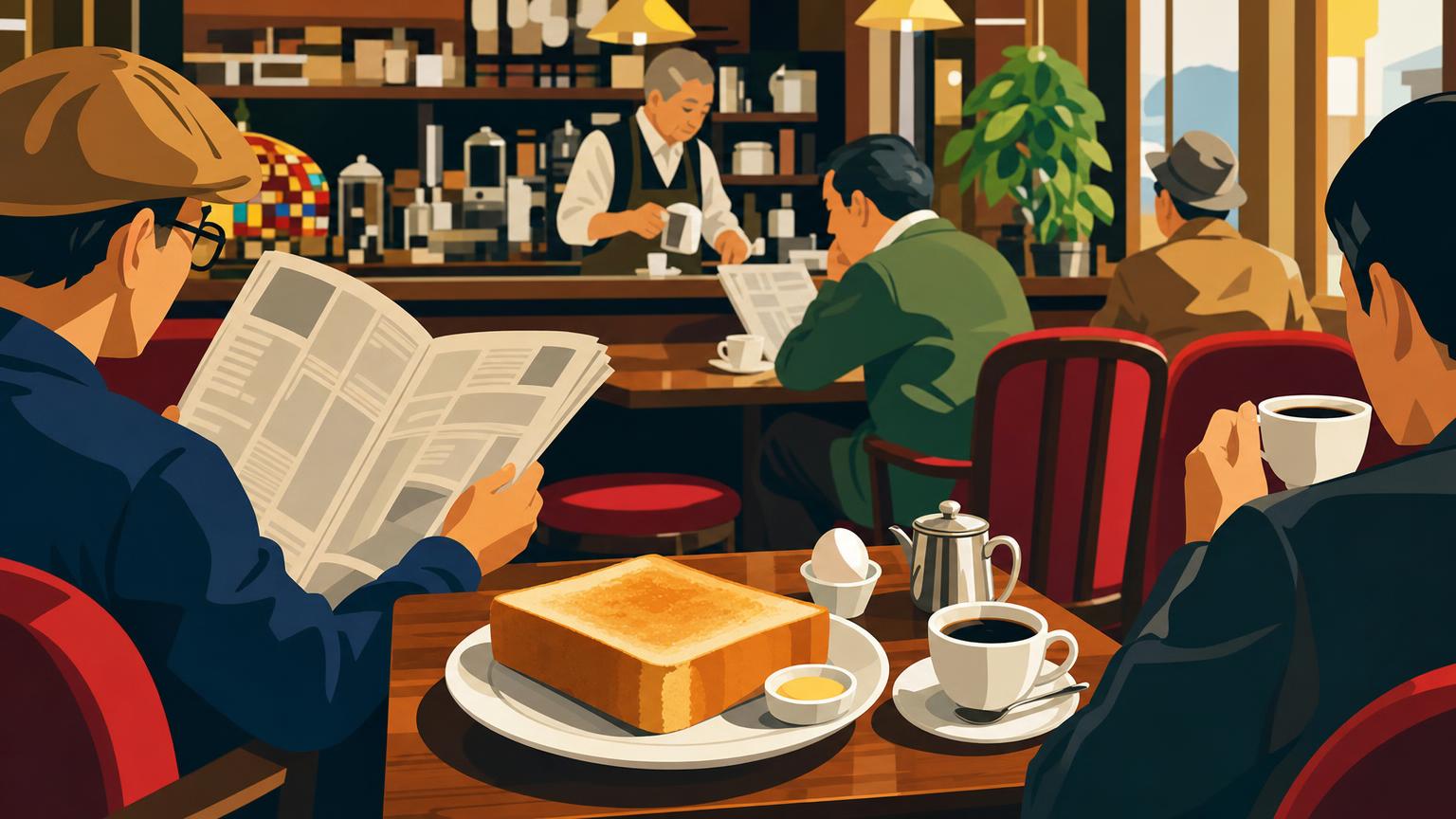
A foreign resident can live in Osaka for years and still misunderstand the morning routine of a traditional kissaten. From the outside, it may look like a simple breakfast: coffee, toast, perhaps a boiled egg. But in a shitamachi neighborhood, the morning set can be part of a much larger ritual. People arrive at nearly the same time, sit in familiar places, read the same newspapers, exchange a few words with the owner, and leave with the day already organized in their minds.
The question is not only, “Where can I eat thick toast in Osaka?” It is also, “Why do people keep returning to the same small coffee shop when they could make breakfast at home?” The answer explains something important about living in Osaka. A kissaten is often less about speed, fashion, or coffee expertise than about maintaining a comfortable connection with the neighborhood.
For foreign residents, this is one of the clearest ways to observe Osaka as a lived city rather than a collection of famous places. You see how regulars communicate without making a performance of friendliness. You see how silence can be comfortable. You see how a shop can function as a dining room, waiting room, informal information desk, and daily checkpoint at the same time.
The morning set is usually modest. A cup of blended coffee may arrive with thick-cut toast, butter, and a boiled egg. Some shops add salad, jam, ham, or a small portion of fruit. The price can be surprisingly reasonable, although prices and menus vary widely. Osaka’s morning culture is not frozen in the past, and every shop has its own rules. Some are clean-air spaces. Some still have designated smoking areas. Some accept electronic payments; others expect cash. Some welcome a foreign customer immediately, while others communicate mainly through gestures, familiar routines, and a menu with little English.
This article looks at what these breakfast rituals reveal about Osaka people, how Osaka differs from Tokyo in everyday social rhythm, what foreign residents often misread, and how to enter a local kissaten without treating it like a museum. The examples below include well-known traditional coffee shops and neighborhood-style places, but the real subject is the behavior around the table: the newspaper, the toast, the short conversation, and the sense that a regular morning can hold a small amount of social security.
Google Maps embed: Use Google Maps → Share → Embed a map and insert the exact iframe provided for the selected Osaka kissaten morning-set area here. Do not replace it with a manually constructed or guessed Google Maps URL.
What a Shitamachi Kissaten Morning Really Is
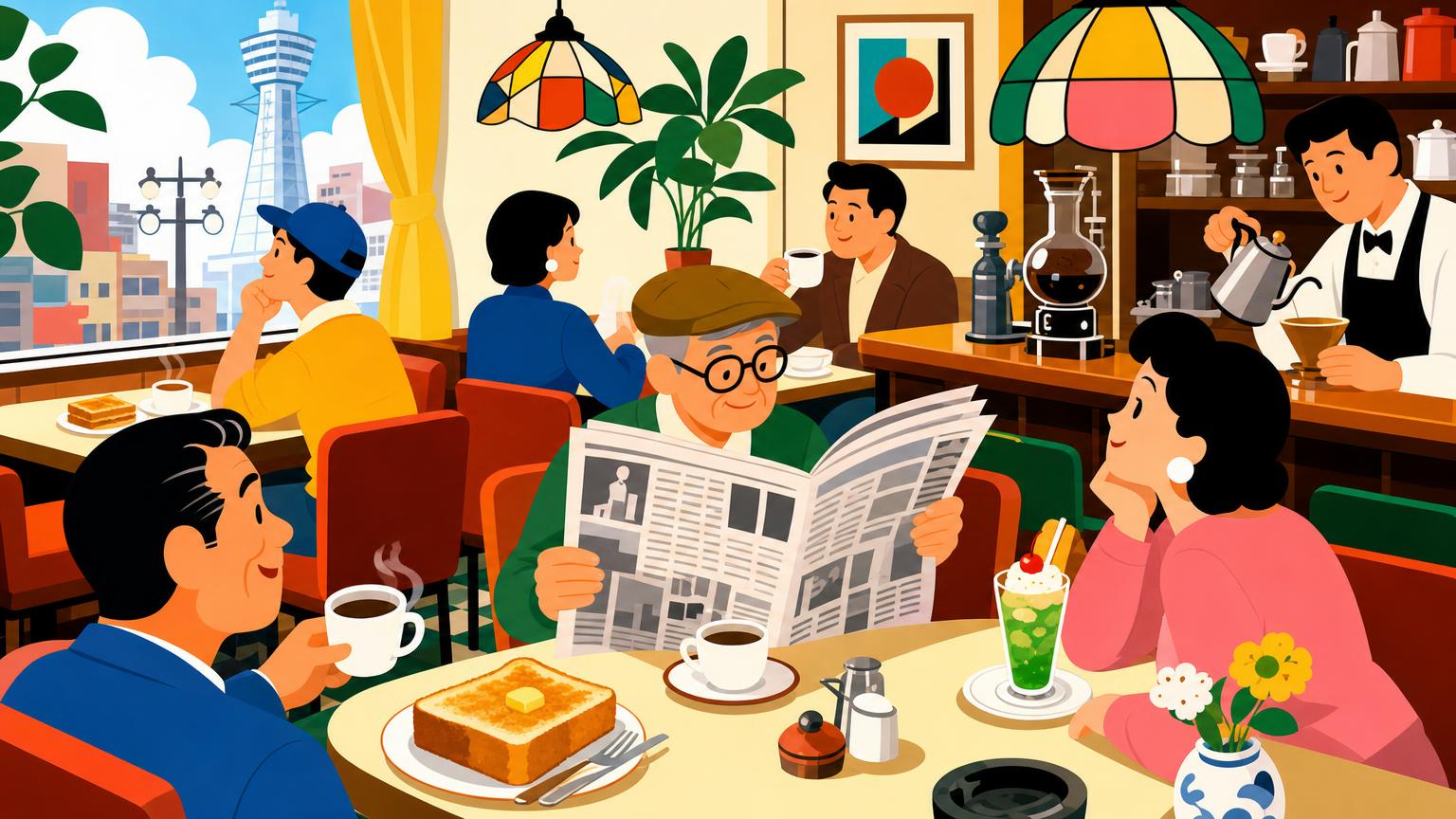
A kissaten is a traditional Japanese coffee shop, but translating it simply as “café” overlooks much of its social role. The term suggests a place centered on coffee, light meals, and an old-fashioned atmosphere. In Osaka, many kissaten developed as local businesses serving office workers, shopkeepers, older residents, factory workers, students, and people running errands in the neighborhood.
A contemporary café often expects you to choose a drink, find a seat, and manage your own experience. A kissaten can feel more relational. The owner may recognize your order, and the server may know whether you prefer hot or iced coffee. A regular may enter, nod, and sit down before saying anything. There is still a commercial transaction, but repeated visits create a thin layer of familiarity around it.
“Shitamachi” is also more than an aesthetic label. It generally refers to older, lower-lying urban districts associated with working neighborhoods, small businesses, narrow streets, shopping arcades, row houses, and long-established local relationships. In Osaka, that atmosphere can be found in parts of areas such as Nishinari, Tennoji, Abeno, Ikuno, Taisho, Higashinari, eastern Naniwa, and older sections around shopping streets. It can also survive in basement restaurants and station-building coffee shops surrounded by modern offices.
A shitamachi kissaten does not necessarily have peeling wallpaper or a dramatic Showa-era interior. The more important signs are behavioral. Customers may arrive alone and stay longer than a visitor expects. They may read a newspaper rather than look at a phone. They may speak with the person behind the counter in a practical, unsentimental way. The room may be quiet without feeling formal.
The morning set, or “morning service,” usually begins when the shop opens and ends at a stated time. In some shops, it is available for only a few hours. In others, a breakfast menu continues late into the morning or even into the afternoon. Coffee shops are not legally required to follow one citywide definition of “morning,” so you must check each shop’s schedule.
A common set includes:
- Blended coffee, black coffee, tea, or milk
- Thick-cut toast, often buttered after grilling
- A boiled egg or fried egg
- Salad, fruit, jam, or a small side dish
- Occasionally ham, bacon, an egg sandwich, or a larger plate
The famous image of coffee with free toast and an egg is strongly associated with Japanese kissaten culture, especially in central Japan. Osaka’s versions can be generous and practical rather than delicate. A slice may be thick enough to require two hands. Butter may be spread into the surface while the toast is still hot. The plate may look simple, but the portion is designed to carry you through the first part of the working day.
The value is not only financial. A morning set eliminates decisions. You do not need to plan a meal, shop for ingredients, wash dishes, or decide where to sit. You enter, order a familiar combination, and let the room establish the pace of the morning for you.
Why Thick Toast Matters in Osaka Daily Life
Foreign residents sometimes describe a Japanese breakfast as rice, miso soup, grilled fish, and pickles. That is certainly part of Japanese food culture, but it is not the only everyday pattern. In Osaka, a kissaten breakfast may be more like toast, coffee, and a boiled egg. For people commuting early, running a shop, or living alone, this is an ordinary and practical meal.
Thick toast creates a different emotional impression from packaged sandwich bread. It is warmer, softer in the center, and more substantial. The crisp exterior gives way to a tender interior. It pairs well with strong coffee because it is not overly sweet and does not demand much attention. You can read while eating it, talk while eating it, or finish it quickly or take your time.
The thickness also reflects a particular idea of generosity. Osaka’s reputation for value is often reduced to jokes about saving money, but the deeper point is that customers notice whether a business gives them a satisfying amount for what they paid. A small coffee with a thin slice of bread can feel disappointing. A hot cup, a generous piece of toast, and a simple egg convey that the shop understands the customer’s morning needs.
This does not mean that every Osaka resident expects the cheapest possible meal. A regular may pay more for carefully roasted coffee, handmade sandwiches, or a particular atmosphere. What matters is that the exchange feels fair. Osaka customers can be direct about price, portion, and quality. That directness is not always a complaint; it can be a way of showing that the customer is paying attention.
At the table, thick toast also creates a brief pause. Many people in Osaka spend the rest of the day moving between trains, offices, schools, clinics, shopping streets, and family responsibilities. The toast is an edible boundary between home and the city. It is not an elaborate wellness ritual, but a dependable start.
The Social Ritual of Communal Newspaper Reading
One of the most revealing sights in a traditional morning kissaten is a group of newspapers spread over different tables. Older shops may keep several daily papers for customers to share. One person reads the local news, another checks the sports section, and someone else turns to the business pages. A regular may fold the paper neatly and leave it somewhere the next person will understand that it is still being used.
This is communal reading without direct conversation. The newspapers belong to the shop, not to any individual customer. The arrangement creates a subtle form of shared space. People do not need to introduce themselves, yet they are participating in the same information environment.
For many years, reading a newspaper at breakfast was not simply a way to get the headlines. It was part of how people prepared to talk at work, at home, and in the neighborhood. The morning paper provided customers with a common set of topics: the weather, local incidents, baseball, politics, prices, and changes around the city. Even when customers did not speak to one another, they were often reading about the same world.
The habit has changed as smartphone use has spread, and some kissaten no longer provide newspapers. Even so, the old pattern remains visible. One customer may read a paper while checking a phone. Another may watch the television mounted above the counter. A third may listen as the owner discusses the rain or a local road closure. Information moves through the room in several different forms.
For foreign residents, communal newspaper reading can be easy to misunderstand. It may appear lonely because everyone is reading separately. In reality, the shared newspaper can be a sign of belonging. The customer is not isolated in a private digital bubble; they are occupying a common room with a common rhythm.
There is also an unspoken rule about handling the paper. Do not pull it suddenly from another customer’s hands. If several sections are available, take one. When you finish, fold it back into a usable shape and return it to the table or rack. If you are unsure, observe what the regulars do. In a small kissaten, imitation is usually safer than explanation.
Newspapers also reveal Osaka’s communication style. The room may not be silent because nobody wants contact. It may be quiet because people are comfortable sharing space without constant verbal reassurance. Later, a brief comment can start a conversation: the weather is unusually cold, the Hanshin Tigers lost, the roadworks are inconvenient, or the price of something has risen. The newspaper provides a starting point for conversation without requiring personal disclosure.
Osaka People, Small Talk, and the Meaning of “Friendly”
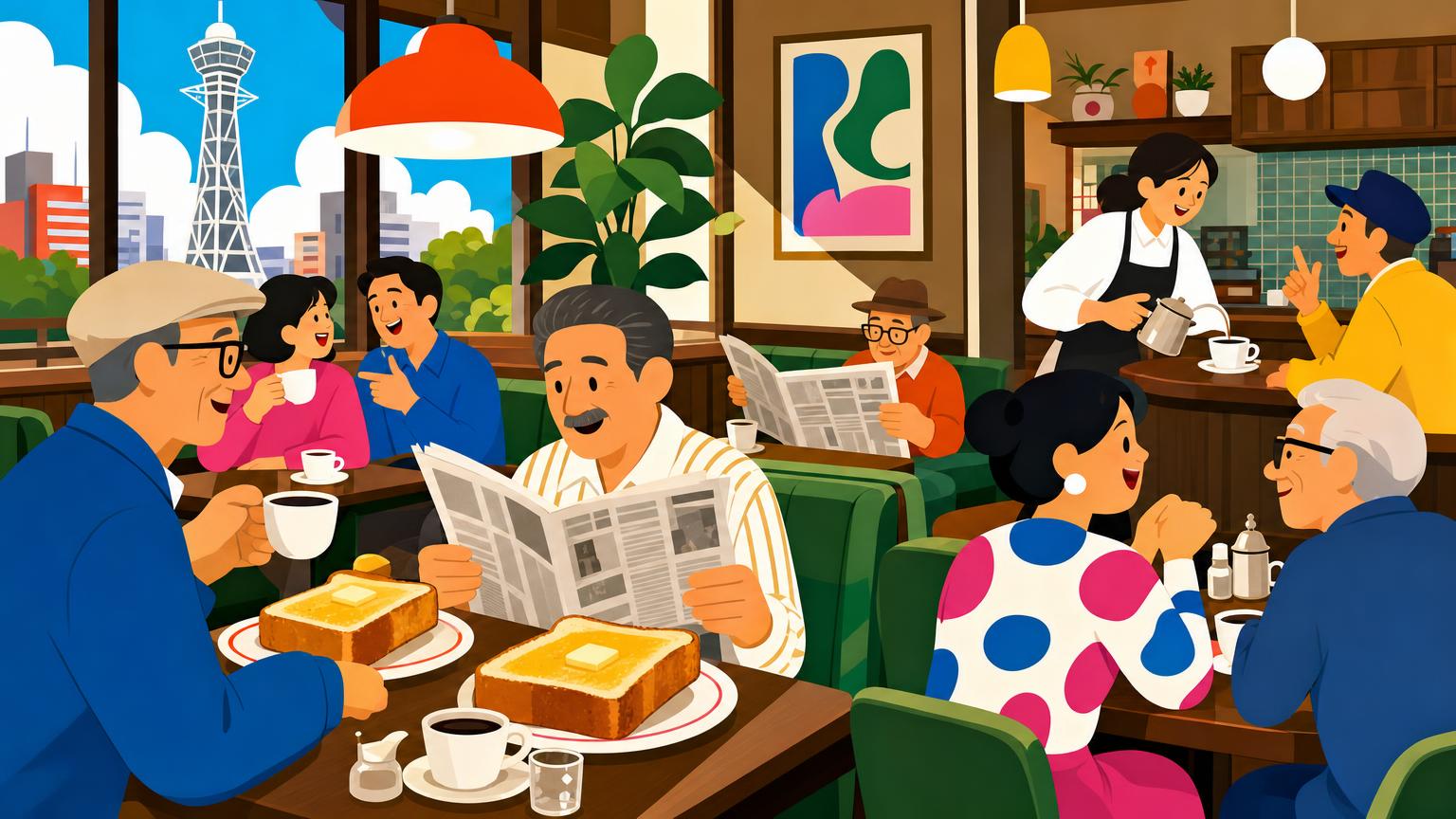
Foreigners are often told that people in Osaka are friendly. This may be true, but the word is too vague to be especially useful. Osaka friendliness is not always gentle, formal, or immediately welcoming. By the standards of other cultures, it can be quick, teasing, practical, and slightly intrusive.
Someone may ask where you are from after only a few sentences. An older customer might comment on your Japanese pronunciation. The owner may tell you that you ordered too much food or suggest trying a different menu item next time. Someone might make a joke that would sound blunt in another city.
The important question is whether the interaction creates pressure or eases it. In Osaka, a joke can be a way of making a stranger feel less formal. A practical comment can be an invitation to join the ordinary flow of the room. The tone matters more than the literal wording.
This does not mean that foreigners should accept every comment or assume that all teasing is harmless. Osaka’s talkative style can cross personal boundaries, particularly regarding age, nationality, marriage, appearance, and language ability. You are allowed to smile briefly, give a minimal answer, and return to your coffee. Being open does not mean giving up your privacy.
A foreign resident may also expect “friendly” to mean that staff will explain everything. Traditional kissaten often operate differently. The owner may be kind but not fluent in English, and the menu may be entirely in Japanese. Customers are expected to observe, point, and handle a small amount of uncertainty. This can feel cold to someone accustomed to detailed service, but it is usually not personal.
In Osaka, warmth often emerges through repetition. The first visit may be quiet. By the fifth visit, the owner may remember your order. By the tenth, they may comment on your work schedule. A regular relationship is built by showing up, rather than through one dramatic conversation.
Osaka Compared with Tokyo: Why the Morning Feels Different
Comparisons between Osaka and Tokyo are never perfect because both cities include many different neighborhoods. Even so, the contrast can help foreign residents recognize the social atmosphere.
Tokyo often feels more segmented. People move through highly specialized spaces: the office café, the chain coffee shop, the commuter station, the residential neighborhood, the department store, and the private apartment. Service tends to be efficient and controlled, while personal boundaries are often clearer in public. A person can spend a long time among strangers without being spoken to.
Osaka also has modern, efficient spaces, but older neighborhood commerce remains visibly social. A customer may know the shop owner, the person at the next table, or the person running the store next door. Transactions may include small talk, and a practical favor may be offered without a formal relationship. Over time, the boundary between “customer” and “local person” can become less distinct.
This does not mean that every Osaka neighborhood is intimate. High-rise buildings, commuter districts, universities, and international areas can all feel anonymous. Nor does Tokyo lack neighborhood relationships. The difference is one of emphasis: Osaka often makes informal contact more visible and more acceptable.
The kissaten morning illustrates this contrast clearly. In Tokyo, a coffee shop may be chosen because it is nearby, quiet, stylish, or useful for work. In Osaka, those same reasons apply, but a customer may also choose it because the owner knows their order, the toast is filling, and the regulars provide a familiar background.
Foreign residents sometimes interpret Osaka’s conversational style as a demand for instant integration. Usually, it is less serious than that. You do not have to become a performer or make everyone laugh. You simply need to respond in a way that keeps the interaction comfortable. A small “そうですね,” a smile, or a brief answer may be enough.
What Foreign Residents Often Misunderstand About Kissaten
A quiet room is not necessarily an unfriendly room
A kissaten may be quiet because people are resting. Customers may be reading, thinking, or preparing for the day. Do not assume you need to start a conversation to show that you are sociable. Your quiet presence can be perfectly acceptable.
A short order is not necessarily a rejection
When the staff speaks quickly in Japanese, they may be handling several orders at once. Traditional shops often have a concise service style. Listen for the key words, point to the menu, and ask them to repeat themselves if necessary.
A familiar atmosphere does not mean every behavior is informal
The room may feel like someone’s living room, but it is still a business. Do not move chairs without asking. Do not place your luggage on another seat during a busy period. Do not photograph customers, newspapers, or staff without permission. Avoid making long video calls, especially in a small room.
A regular’s bluntness is not the same as permission to be blunt
You may hear customers speaking directly to the owner. That relationship may have developed over many years. Copying their words without having the same relationship can sound rude. Begin with polite Japanese and let familiarity develop naturally.
A low price does not mean unlimited time
Some people stay for a long time, but they are regulars who order drinks and food. If the shop is crowded, do not treat one coffee as a guaranteed office rental. A kissaten is often more relaxed than a chain café, but it still depends on customer turnover.
Smoking policies are not always obvious
Japan’s indoor smoking rules have changed, and many restaurants are now non-smoking or have designated smoking areas. Older kissaten may have different arrangements, including smoking seats or a separate smoking room. Check the signs at the entrance and look for symbols near the counter. If smoke affects you, ask before taking a seat.
Osaka Kissaten Morning Sets Worth Understanding
The following places are useful examples because they reveal different versions of Osaka’s morning culture. They are not intended as a sightseeing checklist. Each one demonstrates a different relationship between coffee, neighborhood identity, and the city’s changing habits. Opening hours, menus, payment methods, and smoking arrangements may change, so confirm the details directly before visiting.
Kissa Sunshine, Umeda: A Working-City Morning with a Long Memory
Kissa Sunshine opened in 1973 and remains closely associated with Osaka’s traditional coffee-shop culture. Its current official information describes morning service from opening until 11:00, with later opening on weekends and holidays. The shop presents its morning service as a long-established local habit rather than a novelty experience.
Its location near the Osaka Station area makes the social atmosphere particularly interesting. Umeda is one of Osaka’s busiest business centers, yet an old-style coffee shop can still create a slower pocket within that constant movement. Office workers, shoppers, older regulars, and visitors may share the same room for different purposes.
The important point is not just the toast or coffee. It is the coexistence of speed and lingering. One customer may have ten minutes before work, while another may stay with a newspaper. Someone else may order a more substantial morning plate. The shop allows several versions of “morning” to exist side by side.
The official menu information includes free or low-addition morning options connected to drink orders, as well as thicker toast and sandwich choices at an additional cost. This structure is typical of kissaten logic: the drink anchors the order, while the food can be adjusted according to appetite and budget.
For a foreign resident, Sunshine offers a useful way to observe how a traditional shop continues to operate in a modern office district. It is not a sealed time capsule, but a working business adapting old habits to a changing city.
Mazura Kissaten, Osaka Station Area: A Basement Community Inside a Business District
Mazura is known for its distinctive interior and long history near the Osaka Station area. Reports on the shop describe a traditional morning menu, a location in the Osaka Station Building, and separate smoking and non-smoking seating. Available information also states that card payment is unavailable, so prepare cash or another accepted payment method. Since details may change, confirm them at the shop before relying on this information.
Mazura demonstrates an aspect of Osaka that foreign residents often overlook: a business district can contain intensely local spaces. The surrounding streets and buildings may be associated with offices, commuters, and nightlife, yet the kissaten operates according to its own regulars and routines.
The basement location is psychologically significant. You leave the bright activity of the station area and enter a lower, enclosed room. The sound changes, the light changes, and the city becomes less visible. That separation allows people to settle into a routine even as the neighborhood outside is continually redeveloped.
If you see someone reading a newspaper over coffee and toast, do not assume they are waiting for a tourist attraction to open. They may simply be starting an ordinary workday. This is one reason to approach the shop as a local public room rather than an Instagram backdrop.
Marufuku Coffee Ten Sennichimae: Deep Coffee and the Memory of Minami
Marufuku Coffee Ten Sennichimae was founded in 1934, and its official store information lists opening hours from 8:00 to 23:00. The shop is non-smoking and offers morning service on weekdays. Its location places it in the dense Minami area near Sennichimae, Dotonbori, and Hozenji, but the interior is focused on coffee, conversation, and traditional furnishings rather than fast-paced sightseeing.
Marufuku is a useful example of how “old Osaka” can survive within a busy commercial area. The surroundings may be crowded and loud, but the shop maintains a different tempo. Its coffee is known for a strong, deep flavor, and the store’s history forms part of its identity. The official information also highlights its traditional hotcake, which is cooked to order on a copper plate.
For someone living in Osaka, the lesson is that a kissaten does not need to be tucked away in a residential alley to feel local. A long-established shop can remain part of everyday life even in a district frequented by visitors. Weekday morning service is especially relevant for residents because it reflects a working routine rather than a weekend outing.
Marufuku also serves as a reminder that not every traditional kissaten still permits smoking. Do not make assumptions based on age or interior design. Check the current policy each time, especially if you are sensitive to smoke.
Jun-Kissa American, Dotonbori: A Famous Name That Does Not Fit the Early-Morning Pattern
Jun-Kissa American opened in 1946 and is one of Osaka’s best-known traditional coffee shops. Its official website describes its long history, handmade food, and location in Dotonbori. The currently listed opening time is 10:00, so it may not serve as an early-morning destination in the same way as a neighborhood shop opening at 7:00 or 8:00.
That distinction matters. Foreign residents often look for a famous kissaten and assume it represents the everyday breakfast routine of local people. In some cases, it represents a later part of the day instead. A shop can be historically important and visually traditional while still serving its main role from late morning onward.
American’s menu includes toast, sandwiches, coffee, tea, milk, café au lait, and substantial dishes such as omurice and curry. The official description emphasizes handmade preparation and the restaurant’s long history of serving the Minami area.
In other words, American is useful for understanding continuity, but do not force it into a morning-set narrative if your schedule starts at dawn. If you want to observe the newspaper-and-toast routine of workers and older residents, a smaller local shop with an earlier opening may show it more clearly.
Kissa Y, Nakatsu and Toyosaki Area: When Morning Means a Full Meal
Kissa Y offers a very different kind of morning experience. Recent coverage describes large portions, a morning menu available until 10:30, and dishes that may include rice, ham and eggs, toast, sandwiches, or curry. The reported morning price for several options is around 1,000 yen, and customers are advised to order only what they can finish.
Kissa Y challenges the assumption among foreign visitors that a Japanese morning set must be small. The meal can be generous, home-style, and emotionally direct. The food may feel closer to something from a family kitchen or neighborhood canteen than to a minimalist café.
The shop’s social atmosphere is equally significant. Coverage describes customers returning for the owner’s generosity and the warmth of the food, not simply for its visual appeal. The “large portion” forms part of the relationship. It communicates that the customer is being properly fed.
For foreign residents, Kissa Y is a good example of Osaka’s tendency to express care through quantity. This should not be romanticized, however. Large portions can be difficult if you do not eat much in the morning, and the shop’s popularity may result in waits. Order conservatively if you are unsure. If you finish comfortably, you can return another day and try something more.
The main lesson is that Osaka’s value culture is not limited to inexpensive food. It is also about the feeling that the person serving you has made a serious effort. A plate can be excessive and still feel sincere.
Cafe Flat, Tennoji: A More Accessible Version of the Morning Set
Cafe Flat in the Tennoji area represents a more structured and community-oriented form of the breakfast routine. Its menu information lists a morning set with coffee or tea, half a slice of bread, and a boiled egg, using beans selected for morning drinking.
The word “half” is important. A smaller portion may be more practical for older customers, people with limited appetites, or anyone who wants coffee and a light bite rather than a large meal. The traditional pattern is flexible. Thick toast does not necessarily mean a giant breakfast.
A neighborhood morning shop can also matter to people who do not want to be alone at home. The staff may not ask intimate questions, but the room offers human presence. You hear cups, chairs, newspapers, and brief exchanges. This is a form of social contact that does not require a planned appointment.
Foreign residents often look for formal community activities when they want to meet people in Osaka. A kissaten can provide a quieter entry point. You can become familiar with a place before becoming familiar with its people.
Coffee Kissa Pearls, Tennoji: A Long-Running Shop Adapting to Contemporary Customers
Coffee Kissa Pearls describes itself as a coffee shop founded in 1950 near Tennoji and lists morning service from 7:30 to 15:00. Its current offerings include traditional coffee-shop items alongside newer menu choices, and the shop explicitly presents itself as suitable for solo customers and people taking breaks during daily errands.
Pearls demonstrates how a long-established kissaten can adapt without giving up its fundamental identity. Morning service extends well beyond the early commuter hours, making it suitable for people with different work schedules, parents, freelancers, and residents who do not follow a conventional nine-to-five routine.
This is increasingly relevant to foreign residents. Osaka is no longer a city where everyone follows one fixed office timetable. There are remote workers, shift workers, students, international employees, and people managing irregular schedules. A morning set available until the afternoon can serve as a practical meal rather than simply a symbolic breakfast.
The shop also shows that tradition does not mean refusing change. A kissaten can preserve its long history while adding new dishes, welcoming different customers, and adjusting its opening hours.
Mixed Juice and Other Osaka-Specific Signals
Osaka’s mixed juice offers another useful clue to local tastes. It is usually a blended fruit drink made with ingredients such as banana, orange, milk, and other fruits, although recipes vary. It is creamy, sweet, filling, and less formal than a carefully presented juice or smoothie.
The drink reflects Osaka’s practical approach to refreshment. Soft fruit that might otherwise become overripe can be turned into a satisfying drink. The result is not intended to look austere; it is generous and familiar.
Mixed juice is also associated with Osaka’s traditional kissaten and department-store food culture. The exact recipe and availability vary, so do not expect to find it at every café. When it appears on a menu, it may indicate that the shop is connected to an older local style rather than focused only on contemporary coffee trends.
For foreign residents, mixed juice can be a better introduction to Osaka’s everyday food personality than an expensive specialty drink. It is easy to share an opinion about it, and people may disagree about the ideal fruit balance, whether it should be thick, or which shop prepares it properly. Food preferences can become a low-pressure way to start a conversation.
How to Enter a Local Kissaten Without Feeling Lost
Start at the entrance and observe before choosing a seat
Some shops seat you immediately, while others expect you to wait near the door. If the room is small, look for a sign or listen to the staff’s instructions. Do not assume that an empty table is available; it may be reserved, uncleared, or part of a designated smoking area.
Use simple Japanese whenever possible
You do not need advanced Japanese. “One person” can be said as “hitori desu.” “Hot coffee” is “hotto koohii.” “Iced coffee” is “aisu koohii.” “Thank you” is “arigatou gozaimasu.” If you cannot read the menu, point politely and ask, “Osusume wa nan desu ka?” meaning “What do you recommend?”
A translation app can be helpful, but do not place your phone directly in front of the staff and expect them to resolve every detail immediately. Show the screen briefly, then listen and confirm.
Understand that the drink may be the main order
At many traditional coffee shops, the morning food comes with the drink. You may order coffee and automatically receive toast and an egg, or you may choose from several morning additions. Read the wording carefully. If the menu says “drink price plus” a certain amount, the food is an add-on. If it says “morning service included,” the food may be included in the drink price.
When unsure, point to the set and ask, “Kore wa setto desu ka?” This means, “Is this a set?”
Bring cash even if you prefer cashless payments
Cash-only service remains common in small, traditional shops, although some long-established businesses accept cards, electronic money, or QR payments. The accepted payment methods can change when a shop changes its register or payment provider. Do not assume that a place in central Osaka will accept foreign cards.
Keep small yen notes and coins on hand. Paying with exact change is not always necessary, but it can make a busy morning smoother. If you have only a large bill, ask before ordering if you are concerned about receiving change.
Ask about smoking before sitting down
Smoking policies are among the most important practical differences between traditional kissaten. Some shops are entirely non-smoking. Others have separate smoking areas. Some older listings may be outdated. A designated smoking room may not be easy to notice in online photographs.
Look for the Japanese words “禁煙,” meaning non-smoking, and “喫煙,” meaning smoking. If you cannot read the sign, ask “Kitsuen dekimasu ka?” for “Is smoking allowed?” or “Kitsuen seki wa arimasu ka?” for “Is there a smoking seat?” If you want to avoid smoke, say “Kitsuen nashi no seki ga ii desu,” meaning you would prefer a non-smoking seat.
Never light a cigarette simply because someone else is smoking. Follow the shop’s current rules and use only the designated area.
Do not treat the newspaper as personal property
If the shop provides newspapers, handle them gently and return them neatly. Do not cut out articles or photograph other people while they are reading. Do not spread every section across a small table if other customers are waiting.
A newspaper may look like a free prop for a photograph, but it is part of the room’s shared equipment. The same applies to magazines and television remotes.
Keep calls brief and your voice low
A kissaten may allow conversation, but a loud video call can quickly change the atmosphere. Step outside for a long call. If you are working remotely, check whether laptops are allowed and avoid occupying a large table during the busiest breakfast period.
The room is public, but it is not necessarily a coworking space. A regular may be sitting quietly because the shop is one of the few places where they can begin the day without noise.
Morning Hours Are Local Rules, Not Universal Rules
There is no single Osaka-wide schedule for morning sets. Some shops open around 6:00 or 7:00, while others begin service at 8:00. Some start later but still call their first meal “morning.” Some stop serving at 10:00 or 11:00, while others extend the service into the afternoon.
This variation reflects real life. A shop near a market may serve early workers. A shop in an office building may align with commuter hours. A family-run shop may open when the owner is able to staff it. A neighborhood café may continue offering morning food for people who work late or wake up slowly.
Check the current details on the shop’s official site, social media, phone recording, or an in-store notice. Online listings may not reflect the latest information. Holidays, renovations, staffing shortages, and seasonal schedules are common reasons for changes.
If you arrive after the morning period, do not argue that the website said breakfast was available. Ask what can be ordered at that time. The staff may offer toast, a sandwich, or another menu item even after the formal set has ended.
Why the Morning Set Matters to People Living in Osaka
The morning set is easy to underestimate because it is inexpensive and ordinary. It does not appear to be a major cultural event. Yet daily life is built from repeated, low-intensity routines. The same table, the same cup, the same newspaper, and the same toast can create a sense of continuity in a city that otherwise feels fragmented.
For older residents, the kissaten may serve as part of a social safety net. The owner recognizes familiar customers, and regulars notice when someone is absent. A person who lives alone can spend thirty minutes among other people without having to arrange a meeting. The shop does not replace family, medical care, or formal support, but it can help a neighborhood feel less anonymous.
For workers, the morning set can mark the transition into responsibility. The meal is affordable, quick enough, and consistent. For self-employed people, it may offer a place to read and think before opening a shop. For foreign residents, it can provide a way to become visible in a neighborhood without requiring immediate intimacy.
That last point is important. Many foreigners in Osaka worry that they must speak perfect Japanese before participating in local life. A kissaten suggests another path. You can begin through repeated presence. Learn the order. Learn where to put your umbrella. Learn how the newspaper is shared. Notice which tables are usually occupied. Smile at the owner. Over time, the room may begin to recognize you.
Is Osaka a Good Place to Live? The Kissaten Answer
A city is not livable simply because it has interesting restaurants. It becomes livable when everyday life offers enough places to pause, recover, and connect without spending much money or planning everything in advance.
Osaka’s traditional kissaten illustrate one reason many residents find the city livable. They offer small-scale public spaces and allow informal conversation without requiring a reservation. They can be affordable and practical, and they often permit a little more individuality than a strictly controlled service environment.
However, these same spaces can also be difficult for outsiders. The language barrier is real, accessibility may be limited, smoking can be uncomfortable, and menus and payment methods may be unclear. A shop that feels welcoming to a regular may seem closed off to a first-time visitor. It is better to acknowledge this than to repeat the simple claim that Osaka is friendly.
Osaka becomes easier to understand when you recognize its local rhythm. Friendliness may take the form of teasing. Care may appear as a generous portion. Respect may mean not interrupting someone reading the newspaper. Trust may develop only after repeated visits. A quiet breakfast can be social even when nobody speaks to you.
That is the deeper meaning of the thick-toast morning set. It is not merely an inexpensive breakfast. It is a small agreement between a neighborhood and the people who use it: come in, settle down, eat something warm, read the news, and begin the day among familiar signs of ordinary life.
A Practical First Visit for Foreign Residents
Choose a shop that opens at a time convenient for your schedule rather than pursuing the most famous name. Check whether it is smoking or non-smoking. Bring cash. Arrive early enough to observe the entrance and read the menu. Order one drink and one morning set unless you are very hungry. Sit where you are directed. Keep your voice at a moderate level. Treat the newspaper as shared property. If communication becomes difficult, smile, point, and ask for repetition.
Do not expect the owner to perform Osaka for you. Do not expect every regular to welcome you with conversation. The point is not to consume a staged local experience, but to enter an existing routine respectfully.
Return if you enjoyed the atmosphere. On your second visit, order the same thing. On your third, try the mixed juice or a different kind of toast. Eventually, you may hear a brief comment about the weather or your work schedule. That small exchange may feel more meaningful than a polished introduction because it has been earned through ordinary repetition.
For someone trying to understand what Osaka people are really like, that is where the city becomes clearest: not in a slogan about friendliness, but in the shared newspaper on the next table, the butter melting into thick toast, and the quiet knowledge that the same people will probably be there the following morning.