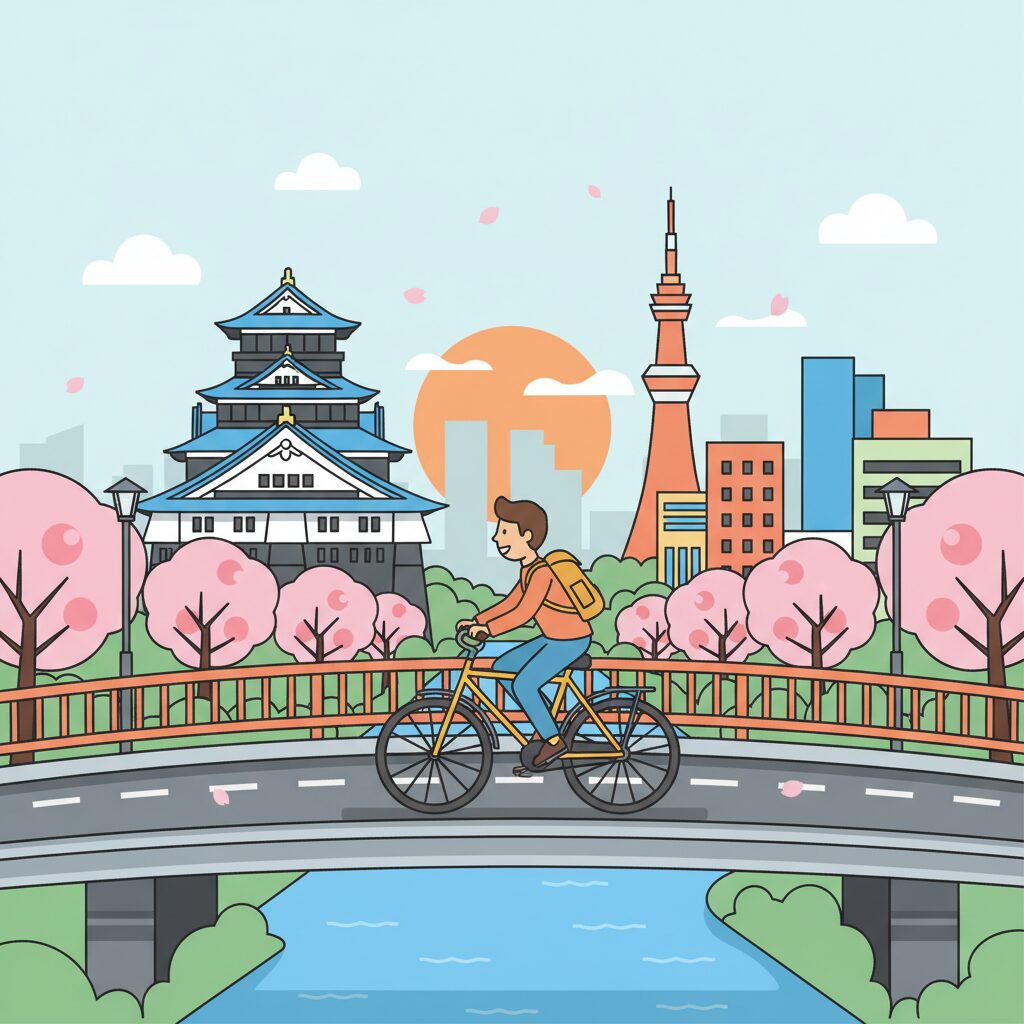
Step out of any train station in Osaka, and the first thing that hits you isn’t the neon glow of Dotonbori or the imposing height of the Umeda Sky Building. It’s the sound. A low, constant hum, punctuated by the sharp chirin-chirin of a thousand tiny bells. It’s the sound of the city’s true lifeblood: the bicycle. In Tokyo, life is dictated by the rhythmic chime of the JR line and the subterranean ballet of the subway. In Osaka, life happens at street level, propelled by two wheels and a chain. This isn’t the sleek, carbon-fiber world of weekend warriors. This is the realm of the charinko, the affectionate, slightly playful slang for a bicycle. It’s the kingdom of the mamachari, the mighty “mom’s chariot” that serves as a family minivan, a grocery hauler, and a personal mobility device all in one. To the newcomer, the endless streams of cyclists weaving down sidewalks, balancing umbrellas, and parking in what appears to be a state of total anarchy can feel like chaos incarnate. But it’s not chaos. It’s a system, a complex, unwritten social contract that reveals the very soul of Osaka: pragmatic, efficient, and relentlessly down-to-earth. To understand the charinko is to understand the city itself.
Osaka’s pragmatic bicycle ballet also hints at hidden urban refuges where locals unwind in spaces like the Super Sentos living room that redefine community life.
The Iron Steed of Naniwa: Why the Bicycle Rules Osaka
To understand why Osaka became Japan’s bicycle capital, you need to consider two factors: a map and a mindset. The city is relentlessly and wonderfully flat. Unlike the hilly areas of Tokyo or the mountain-bordered streets of Kobe, the Osaka plain is a cyclist’s paradise. You can smoothly ride from Tennoji to Umeda without breaking a sweat, fueled by nothing more than last night’s okonomiyaki. This geographical advantage created ideal conditions for two-wheeled transportation to flourish, but it’s the local attitude that truly sealed the deal.
Flat City, Frugal Mindset
Osakans are famously known for their financial savvy. This is not the same as being cheap, a nuance outsiders often overlook. A Tokyoite might call it kechi, meaning stingy. An Osakan would call it shori, meaning resourceful and smart. Why pay 180 yen for a one-stop subway ride when you can cover the same distance in ten minutes on a bike, free of charge? That 180 yen, saved daily, adds up. It’s money for a better lunch, an extra beer after work, or simply the satisfaction of outsmarting the system. The bicycle is the ultimate symbol of Osaka pragmatism. It’s an investment that pays off within weeks, freeing you from train schedules, crowded platforms, and the burden of monthly transport passes. It stands for freedom and financial savvy—two key pillars of the Osaka identity. This mindset permeates every part of everyday life, turning a simple machine into an emblem of urban independence.
The Mamachari Marvel
At the core of this culture is the mamachari. Forget about sleek road bikes or rugged mountain bikes; the mamachari reigns supreme on Osaka’s streets. It’s less a bicycle and more a utility vehicle. Built for stability rather than speed, it’s the workhorse of Japanese households. Imagine a sturdy steel frame with a low step-through design for easy mounting—even while wearing a skirt. Up front, a strong basket deep enough to hold a week’s worth of groceries from the local Tamade supermarket. At the back, a durable rack, often equipped with a child seat or sometimes two—one behind, one on the handlebars. These bikes come with built-in wheel locks, dynamo-powered headlights that hum as you pedal, and kickstands sturdy enough to park the bike at a steep angle. They’re built to endure and carry loads. They transport children to daycare, haul bags of rice and crates of beer, and serve as the main mode of transport for every variety of errand. Riding a mamachari isn’t about fitness or sport; it’s about living. It signals that you’re part of the neighborhood fabric, a participant in the city’s daily rhythm.
Reading the Unwritten Rules of the Road
For anyone used to the strict order of Tokyo’s streets, Osaka’s cycling culture can come as a surprise. What seems like chaos actually follows a deeply embedded, though invisible, set of rules. It’s a fluid negotiation, where strict compliance with official regulations gives way to situational awareness and a shared understanding of how to navigate crowded spaces without causing disruption.
Sidewalks are Mostly Fair Game
Technically, bicycles are vehicles and should be ridden on the road in Japan. In Osaka, this is more of a suggestion than a rule. Most charinko activity takes place on the sidewalks. This isn’t meant to antagonize pedestrians; it’s a mutual understanding born out of necessity. The roads are narrow and dominated by cars and trucks, making them feel unsafe for the average mamachari rider. So everyone opts for the pavement. The unspoken rule is simple: pedestrians have the right of way, but they must also take part in the dance. You don’t walk four-abreast, blocking the whole path. You keep to one side. As a cyclist, you don’t speed. You weave slowly, with a gentle ring of the bell as a heads-up rather than a demand. It’s a constant, low-stakes game of human Tetris—and remarkably, it works. People move around each other with instinctive grace, sharing the goal of arriving with minimal fuss.
The Art of ‘Sumi-masen’ Parking
Bicycle parking—or the frequent lack thereof—is another area where Osaka’s spirit shines through. Outside any supermarket, train station, or popular shotengai shopping arcade, you’ll encounter a bicycle tsunami: a chaotic, metallic wave of parked charinko covering nearly every available inch. While Tokyo enforces strictly designated parking with an iron fist, Osaka takes a more… organic approach. There are marked lots, but the unwritten rule is to park considerately. You don’t block a shop entrance or chain your bike to a railing in a way that prevents wheelchair access. You gently nudge another bike aside to create a sliver of space, and expect the same courtesy in return. It’s a system built on ‘sumi-masen’—a versatile “excuse me” or “pardon me.” You’re excused for contributing to the pile, as long as you do so thoughtfully. It perfectly captures Osaka society: seemingly chaotic but functional because everyone implicitly agrees on managing the shared mess.
Bell Etiquette: A Tale of Two Cities
The humble bicycle bell reveals cultural differences clearly. In Tokyo, a ring is a timid, apologetic request. A polite chirin from a safe distance means, “Excuse me, sorry to bother you, but may I pass when you have a moment?” In Osaka, the bell serves as direct communication. A sharp, insistent CHIRIN-CHIRIN! from close behind means, “I’m here, I’m moving, please step aside.” It’s not rude—just efficient. Osakans value directness. There’s no time for the subtle, unspoken social cues that Tokyo relies on. The bell is a clear, unmistakable signal in a crowded space. To outsiders, it may sound aggressive, but for locals, it’s simply clear communication—a sonic prompt to keep the human river flowing.
The Dark Side of the Charinko Life
Life on two wheels in Osaka isn’t always a smooth ride through quaint backstreets. There’s a rougher side to the city’s dependence on the charinko, filled with challenges and risks every resident eventually learns to manage. From the ever-present danger of your trusty bike disappearing to the physics-defying risks riders face daily, the cycling culture comes with its own set of hardships.
The Bicycle Removal Truck: A Menace on the Streets
Every cyclist in Osaka harbors a lingering fear of the bicycle removal truck. These flatbed vehicles, operated by the city, patrol the streets to enforce parking rules in busy areas. Warning signs near major stations clearly state: park here, and your bike will be taken (`tekkyo`). One day, you’ll return to where you left your bike, only to find a chalk outline or a small sticker on the ground—your charinko has been confiscated. This ordeal is something of a rite of passage. Retrieving it involves a bureaucratic nightmare: a trip to a distant impound lot, proof of ownership, ID, and a fine of several thousand yen. It’s a frustrating and costly lesson in the limits of Osaka’s lenient parking culture. While the city allows a lot, certain zones enforce their rules strictly and swiftly.
Rain, Umbrellas, and Defying Physics
When it rains in Osaka, a peculiar and fascinating scene plays out. Hundreds, sometimes thousands, of people bike while holding umbrellas. This practice, known as kasa-sashi unten, is technically illegal and extremely hazardous. It means steering with one hand, battling gusty winds with the other, all while navigating wet, slippery sidewalks. Yet, it is commonplace. It epitomizes Osaka’s pragmatic spirit, where the urgent need to stay dry takes precedence over traffic laws, safety, and basic physics. This “whatever works” attitude is also visible in riders texting on the move, hauling enormous loads in front baskets, or wearing headphones, oblivious to their surroundings. Although the national government has recently encouraged the use of bicycle helmets, making them recommended though not mandatory, uptake in Osaka remains slow. The culture values convenience, and the perceived inconvenience of helmets or proper rain gear usually loses out to lifelong cycling habits on the charinko.
So, You Want to Join the Charinko Brigade?
If you plan to live in Osaka, getting a bicycle is not just a good idea; it’s almost essential for experiencing the city like a local. It opens up neighborhoods, makes errands easier, and connects you to the everyday rhythm of the streets. However, becoming a true charinko rider requires more than just purchasing a bike.
Acquiring Your Ride
The first step is to get a bike. You can pick up a new, no-frills mamachari for a surprisingly affordable price at hardware superstores like Cainz or discount retailers such as Don Quijote. Alternatively, numerous second-hand bike shops offer reconditioned models for even less. Wherever you buy it, completing the bouhan touroku, or crime prevention registration, is mandatory. This process places a unique sticker on your bike and registers your information with the police. It costs a few hundred yen and serves as your best—and only—defense if your bike is stolen and later found. It is the single most important administrative task for anyone cycling in Osaka.
Parking Like a Pro (or at least, avoiding being towed)
To steer clear of the dreaded impound truck, mastering strategic parking is essential. While the chaotic stacks outside supermarkets are generally safe, areas near train stations carry a higher risk. Your safest bet is using a paid `churinjo`, or bicycle parking lot, which are found everywhere. Some are simple lots where an attendant collects your fee, while many operate automated systems where you lock your bike in place and pay to release it. The cost is usually minimal—often around 100-150 yen for several hours or a full day. Paying this small fee invests in your peace of mind and costs far less than reclaiming an impounded bike. Learn to recognize these lots and make them your go-to choice when near major transit hubs.
Embrace the Flow, Not the Chaos
Ultimately, cycling in Osaka is less about rigid rules and more about tuning into the street’s rhythm. It’s about making eye contact with pedestrians, anticipating cars emerging from blind alleys, and reading the subtle cues of fellow cyclists. Though it may seem like an anarchic free-for-all to outsiders, it’s actually a highly functional, self-regulating system. It captures the city’s spirit: a bit rough around the edges, somewhat noisy, and not always pretty, yet profoundly human and remarkably efficient. Once you stop seeing the chaos and start sensing the flow, you’ll know you’ve moved beyond being a visitor—you’ll be riding like an Osakan.