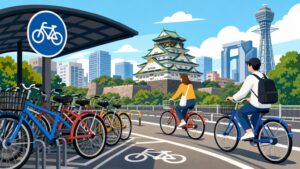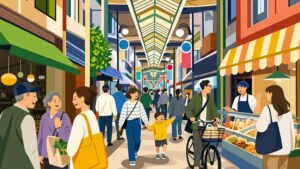
Walk through any residential neighborhood in Osaka, from the quiet streets of Tezukayama to the bustling alleys of Fukushima, and you’ll see them. They’re chained to fences, lined up in front of supermarkets, and parked in staggering numbers at every train station. They aren’t sleek carbon-fiber road bikes or trendy fixed-gear messengers. They are humble, practical, and often a little bit rusty. They are the ‘mamachari,’ the undisputed king of Osaka’s streets. To the uninitiated eye, they might look clunky, old-fashioned, a throwback to a simpler time. You might wonder, in a country famous for its technological prowess and bullet trains, why does this basic machine dominate the urban landscape? The answer isn’t about nostalgia or a lack of options. The answer is a philosophy, a deeply ingrained cultural calculation that defines the very essence of what it means to live, not just survive, in Osaka. It’s a concept that Tokyoites might find pragmatic but Osakans have elevated to an art form: `kosupa`, or cost performance. This isn’t just about saving money; it’s about extracting the maximum possible value out of every single yen. And in that grand calculation, the mamachari isn’t just a bicycle; it’s a financial instrument, a tool for freedom, and your ticket to understanding the real rhythm of this city.
Embracing more than just cost-effective transportation, exploring Osaka’s vibrant supermarket culture offers another window into the city’s unique blend of tradition and ingenuity.
The Unspoken Hierarchy of Transportation in Osaka
To understand why the mamachari is so vital, you first need to grasp how Osaka functions. It’s a city built in layers, where different transportation methods serve specific, non-overlapping roles. It’s not chaotic; it’s a finely tuned system born of necessity and a collective focus on efficiency.
The Train is King, But the Bike is Queen
Let’s be clear: Osaka’s public transit is exceptional. The Midosuji subway line can carry you from the northern hub of Umeda to the southern bustle of Namba in minutes. The JR, Hankyu, Keihan, and Hanshin lines connect the city to Kyoto, Kobe, and Nara with remarkable precision. For traveling long distances, the train is the undisputed king. It’s fast, reliable, and the backbone of the Kansai region.
However, trains have a fundamental limitation: they run on fixed routes. Your life doesn’t. Your home, favorite bakery, local clinic, and that quirky bookstore are rarely right next to a station. This is known in urban planning as the ‘last-mile problem.’ In Osaka, the ‘last mile’ might be a 15-minute walk. In the mild autumn air, that’s a pleasant stroll. But try that walk in August’s stifling humidity or during a freezing winter downpour, and it becomes a daily hassle. This is where the queen steps in. The mamachari owns that last mile, turning a 15-minute walk into a 4-minute ride. It bridges the gap between the fixed train system and the fluid reality of your daily trips. The train gets you to the neighborhood; the bike gets you home.
Why Not a Car? The Osaka Calculation
For many foreigners, especially from North America, a car is the default choice for personal transportation. In Osaka proper, however, owning a car is often financial self-sabotage. The Osaka mindset, tuned for `kosupa`, immediately rejects the idea. First, there’s the cost of the car itself. Then the mandatory bi-annual inspection, the `shaken`, which can easily cost thousands of dollars. Add insurance, soaring gasoline prices, and the biggest expense of all: parking.
In central Osaka neighborhoods, monthly parking can range from 20,000 to 40,000 yen—equivalent to rent for a small apartment in some areas of Japan. You’re paying a fortune just to store a metal box you rarely get to use. The streets are narrow, often one-way, and congested. Finding a parking spot for a quick errand is a nightmare. A car here isn’t a symbol of freedom; it’s a burden. It drains both money and time with little practical benefit. The cost-performance ratio is terrible, and in Osaka’s unspoken language, that makes car ownership a fundamentally flawed choice.
Deconstructing the ‘Mamachari’: A Masterpiece of Practicality
The mamachari is not a single brand or model but represents an entire category of bicycle, embodying a design philosophy honed over decades. Every feature directly addresses the needs of urban Japanese life. It is the result of evolution, not a fashion trend.
More Than Just a “Mom’s Bike”
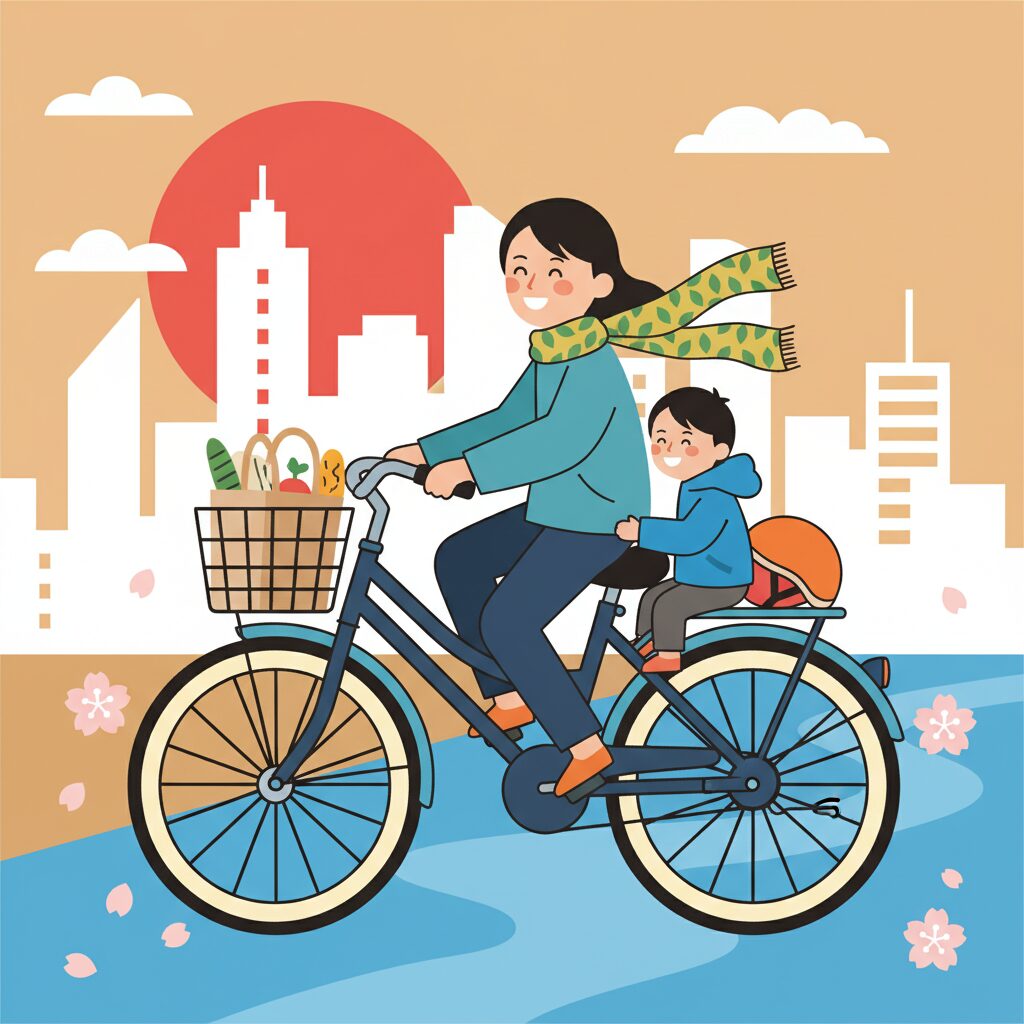
The name itself, `mama` (mom) and `chari` (a colloquial term for bicycle), reveals its origins. It was designed to give mothers the freedom to transport children to kindergarten, shop for groceries, and manage household tasks—all without relying on a car. The step-through frame makes mounting and dismounting easy, even when wearing a skirt. The built-in child seats are both sturdy and secure.
However, to view it solely as a “mom’s bike” misses the larger point. Its brilliance lies in its universal practicality. Look around, and you’ll see people from all walks of life riding one. University students in their club jackets, salarymen in suits carrying briefcases in the front basket, and elderly grandfathers heading to the park for a game of Go. The mamachari has outgrown its initial demographic to become the default mode of transport for anyone living within a three-kilometer radius. It is democratic, classless, and wholly practical.
The Anatomy of Value
Every part of a mamachari is a testament to function over style. It’s a mobile toolkit for city life.
- The Basket (`kago`): This is the heart of the bike. It’s not an optional accessory but an essential feature. This basket carries life’s essentials—a ten-kilogram bag of rice from the supermarket, your laptop bag on the way to a café, a six-pack of beer, or a stack of borrowed books. In Osaka, a bicycle without a basket has failed to fulfill its purpose.
- The Built-in Lock (`ringu rokku`): Mounted on the rear wheel frame is a simple ring lock. With a twist of a key, a metal bolt slides through the spokes, immobilizing the wheel. It’s not impenetrable, but it’s sufficient for a quick stop at FamilyMart. It’s designed for effortless security—no need to lug around a heavy, greasy U-lock or chain. The lock is integrated and instantly usable.
- The Kickstand: Most mamachari feature a robust, double-legged center stand rather than a flimsy side-stand. When parked, you rock the bike back, and it stands upright and steady. This is vital. A bike loaded with a week’s groceries won’t fall over in a breeze. It’s all about balance and dependability.
- The Dynamo Light: The front light is usually powered by a dynamo that engages with the front tire. Pedaling generates your own light, so you’re never caught out with dead batteries. It’s a self-contained system that requires no thought. The soft hum of the dynamo is a familiar sound in Osaka’s evening streets.
- The Upright Posture: Riding a mamachari doesn’t mean crouching like a Tour de France cyclist. You sit straight up. This isn’t about aerodynamics but about awareness. This posture offers a high vantage point to watch for pedestrians, weaving motorbikes, and opening car doors. It helps you navigate the controlled chaos of a `shotengai` (shopping arcade) with ease and safety.
The ‘Kosupa’ Mindset: Osaka’s Core Economic Philosophy
To genuinely appreciate the mamachari, you need to grasp the cultural framework it operates within: `kosupa`. This concept is essential to understanding the Osaka mindset. It’s the unseen force shaping countless everyday choices.
It’s Not About Being Cheap; It’s About Being Smart
A foreigner might look at a decade-old mamachari, with its rusted patina and slightly shaky basket, and think, “That’s cheap.” An Osakan sees the same bike and thinks, “That’s smart.” `Kosupa`, or cost performance, isn’t about finding the lowest absolute price. It’s about attaining the highest possible balance of utility and satisfaction relative to the cost incurred. It’s about maximizing your return on investment, whether that investment is 100 yen or 100,000 yen.
A brand new, no-frills mamachari might cost 15,000 yen. With minimal maintenance, this bike will reliably serve you for five, maybe even ten years. Contrast that with a sleek, 50,000 yen cross bike. It might be lighter and faster, but is it really three times as practical for everyday use? Can it carry your groceries? Is it less likely to be stolen? According to the `kosupa` calculation, the answer is no. The mamachari provides 95% of the utility at a fraction of the cost. The extra spending on the fancy bike is viewed as wasteful, poor value. In Tokyo, a stylish bicycle might be a fashion statement or an expression of personal brand. In Osaka, your brand is defined by how smartly you live. A well-used mamachari is a mark of pride, a quiet declaration that you know how the game is played.
The Ripple Effect of a Mamachari Investment
The initial price is only the start of the savings. The mamachari is an investment that yields daily returns. Let’s do the math. The minimum fare for a subway trip in Osaka is 190 yen. A round trip to the supermarket two stops away costs 380 yen. If you make that trip twice a week, you save over 3,000 yen a month. Your 15,000 yen bicycle pays for itself in five months. Every ride after that is pure profit.
But the benefits aren’t just financial. They’re also about time. No more checking train schedules. No more waiting on crowded platforms. No more walking home from the station. Your time becomes your own. Perhaps most importantly, it transforms your relationship with the city. On a bike, you are not a passenger; you are an active participant. You explore the geography of your neighborhood, discover the tiny `takoyaki` stand always packed with locals, the quiet shrine nestled between apartment buildings, and the park with the best cherry blossoms that doesn’t appear in any guidebook. You feel the slopes of the land, smell the yakitori grills firing up at dusk, and hear the city’s sounds unfiltered. The mamachari connects you to Osaka on a deeply human scale.
Navigating the Streets: Unspoken Rules of the Road
Now, cycling in Osaka isn’t a free-for-all. It functions as a system of organized chaos, guided by a set of unwritten yet widely understood rules. Learning this etiquette is essential for peaceful coexistence.
The Sidewalk is a Shared Space
This is where most newcomers encounter confusion and tension. By law, bicycles are vehicles and should generally be ridden on the left side of the road. However, on many of Osaka’s crowded, narrow streets, this is dangerous. The reality is that cyclists, pedestrians, and cars have formed a complex, informal truce. On most main roads, you’ll see everyone—from schoolchildren to police officers—riding their bikes on the sidewalk.
The cardinal rule is this: pedestrians are paramount. You, as a cyclist, are a guest in their space. You should not weave through them at high speed. Instead, ride slowly and cautiously, always ready to stop. Your bell isn’t a horn to demand right of way. A single, gentle `chirin-chirin` politely signals, “excuse me, I am quietly passing behind you.” Aggressive bell-ringing is extremely rude. This delicate dance of mutual respect exemplifies Osaka’s preference for practical solutions that preserve group harmony over strict adherence to official rules that don’t suit the situation.
Bicycle Parking (`Churinjo`) and the Consequences
While movement rules can be flexible, parking regulations are strict. Illegally parked bicycles create a major public nuisance by cluttering sidewalks and blocking entrances. This is where the city enforces a firm boundary. Near every train station and major commercial area, you’ll find designated bicycle parking, or `churinjo`. Some spots are free; others charge a small fee (usually 100-150 yen per day).
Disregard these at your own risk. If you leave your bike chained to a guardrail near a station, you’ll eventually find a bright warning tag on it. Ignoring the tag will result in your bicycle being impounded. Retrieving it is a frustrating challenge. You need to find out which impound lot holds your bike (often in remote industrial areas), travel there, show your ID and bike key, and pay a fine of about 2,500-3,000 yen. The entire process is designed to be inconvenient and costly enough to prevent repeat offenses. It’s a lesson in civic responsibility: your convenience must never come at the cost of public order.
Buying and Maintaining Your Urban Workhorse
Acquiring your mamachari is the first step. The process is simple but has some distinctively Japanese nuances.
Where to Buy: New vs. Used
You have several choices. Large chain stores like Cycle Base Asahi offer a wide range of new bikes at competitive prices. Smaller, independent neighborhood bike shops (`jitenshaya-san`) provide more personalized service. There are also second-hand shops selling refurbished bikes. While a used bike might seem like the ultimate `kosupa` option, it’s often wiser to buy new. A cheap used bike can come with hidden issues—worn brakes, a rusty chain, or a bent frame—that will end up costing you more. A new, entry-level mamachari is a dependable, predictable choice.
Wherever you buy, you must complete the `bohan toroku`, or crime prevention registration. For a small fee of about 600 yen, a sticker with a registration number is placed on your bike, and your information is entered into a police database. This proves the bike is yours and is crucial if it ever gets stolen. It’s mandatory, and any reputable seller will require it.
The Simplicity of Maintenance
The charm of the mamachari lies in its ability to handle a fair amount of benign neglect. Still, a bit of care makes a big difference. The most important task is keeping the tires properly inflated. Low tire pressure is the leading cause of `panku`, or flat tires. Fortunately, almost every bike shop in Japan has a communal air pump outside, free for anyone to use. It’s a small but wonderful public service.
For anything more complicated—a flat tire, brake adjustment, or squeaky chain—you rely on the local `jitenshaya-san`. This person is more than just a mechanic; they’re a neighborhood institution. For about 1,000-1,500 yen, they’ll patch your tire with practiced skill, often while offering unsolicited but usually spot-on commentary on the Hanshin Tigers’ latest game. Building a good relationship with your local bike shop is part of integrating yourself into the community.
Conclusion: More Than a Bike, It’s a Statement of Identity
Ultimately, the mamachari represents far more than just an affordable and convenient mode of transportation. It embodies the very essence of the Osaka way of life. Opting for a mamachari instead of a flashier, pricier option is a deliberate choice. It signifies valuing practicality over vanity, lasting worth over temporary fads, and sensible wisdom over showy consumption.
Riding a mamachari aligns you with the genuine rhythm of the city. You cease to be a tourist watching life pass by from a train window. Instead, you become part of it. You navigate the same narrow lanes, park alongside the same salarymen and grandmothers, and partake in the same daily balancing act of `kosupa`. It dissolves the divide between you and your surroundings. The modest mamachari is not merely a means of transporting your body from point A to point B. It is a vehicle that bridges a cultural gap, leading you to a deeper, more sincere understanding of what living in Osaka truly means.