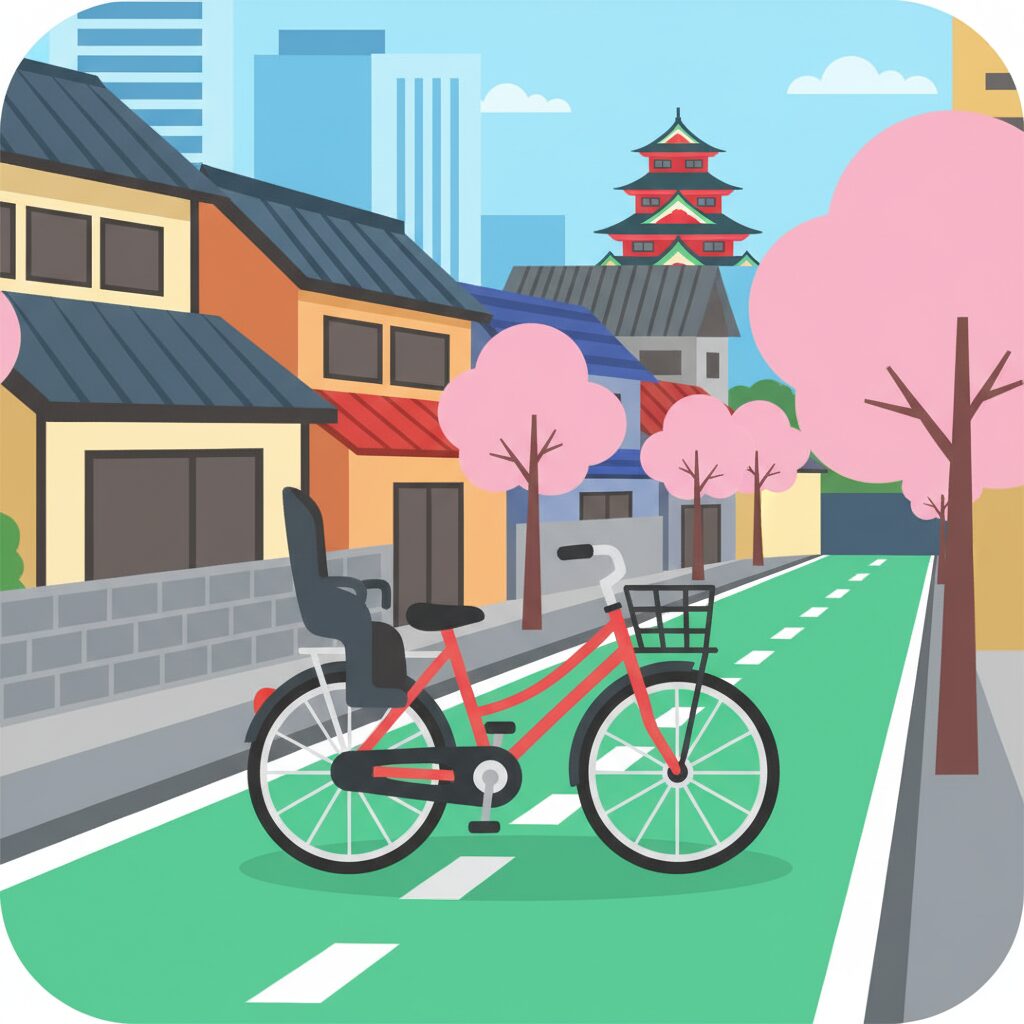
Hello from Osaka! It’s Sofia. The other day, I was standing near the Tenjinbashisuji Shotengai, that wonderfully chaotic covered shopping street, just watching the world go by. And that’s when I saw her, the quintessential Osaka queen. She was gliding down the crowded sidewalk on a bicycle that seemed to defy the laws of physics. A toddler was strapped securely into a seat on the handlebars, giggling. Another, slightly older child, was perched on a seat behind her. The front basket was overflowing with daikon radishes and a bag of rice, while a tote bag full of groceries dangled precariously from a handlebar. To top it all off, she was navigating this entire mobile command center with one hand, because the other was holding a smartphone to her ear. She wasn’t wobbling. She wasn’t stressed. She was simply on her way. This wasn’t a special event; this was just a Tuesday afternoon. In that moment, I knew. If you want to understand the soul of Osaka—the real, unfiltered, everyday rhythm of this city—you don’t start with the castle or the flashy lights of Dotonbori. You start with the humble, indestructible, and utterly essential bicycle known as the mamachari.
For anyone new to Japan, the sheer number of bicycles is a surprise. But in Osaka, it’s a whole other dimension. This isn’t the sleek, lycra-clad road bike culture of some Western cities. Nor is it the occasional, cautious cycling you might see in Tokyo’s hilly, train-dependent neighborhoods. Here, the bicycle, specifically the ‘mama’s chariot’ or mamachari, is the lifeblood of the city. It’s the family car, the delivery truck, and the school bus all rolled into one sturdy, unassuming frame. It’s how life gets done. Forget everything you think you know about traffic laws and personal space. Welcome to the rolling, weaving, beautiful chaos of Osaka’s bicycle lanes, which, more often than not, are the sidewalks themselves. Understanding this machine and its unwritten rules is your key to deciphering the pragmatic, community-oriented, and refreshingly direct mindset of the Osakan people.
Unmistakably, the city’s dynamic rhythm is mirrored in the way local riders forge tight-knit communities, as seen in the Kyobashi cycling tribe that transforms everyday rides into vibrant cultural exchanges.
The Mamachari: Osaka’s Urban Workhorse
Before you can grasp the rules, you need to understand the vehicle. The mamachari is a masterpiece of practical Japanese design. It’s the complete opposite of a performance machine, and that is precisely the point. It’s built for utility, not speed; for endurance, not style.
What Defines This Machine?
First, examine the frame. It features a low, step-through design, making it easy to mount and dismount, even if you’re wearing a skirt or carrying a child. This isn’t about aerodynamics; it’s about accessibility. The handlebars are high and swept back, encouraging an upright, relaxed posture. You’re not racing; you’re surveying your surroundings, keeping an eye out for bargains at the local supermarket. The chain is usually enclosed in a plastic guard to keep your pants clean—a small but essential detail for everyday use. The kickstand is a marvel of engineering. It’s a wide, double-legged stand that lifts the entire rear wheel off the ground, creating an incredibly stable platform. You can load and unload children and groceries without any fear of the bike tipping over. This isn’t an afterthought; it’s central to its purpose.
Next are the accessories, which aren’t really accessories but standard-issue equipment. A large front basket is non-negotiable. It’s for school bags, groceries, and occasionally, a small, well-behaved dog. A sturdy rear rack is essential, often fitted with a child seat that resembles a high-tech throne. You’ll find padded headrests, five-point harnesses, and even clear plastic rain covers for winter. A built-in lock is integrated into the rear wheel—a simple but effective ring that immobilizes it with the turn of a key. A dynamo-powered headlight turns on automatically as you pedal, so you never have to worry about batteries. Every feature is designed to eliminate a friction point from daily life.
The Lifeline of the Neighborhood
The reason the mamachari dominates in Osaka is deeply tied to the city’s geography and urban planning. Unlike Tokyo, with its network of hills and valleys, Osaka is gloriously and relentlessly flat. It rests on a plain, making cycling an energy-efficient delight. You can glide for kilometers without breaking a sweat. The city is also a dense mosaic of residential neighborhoods, shotengai (shopping arcades), parks, and schools, all packed closely together. A trip to the butcher, daycare, and post office might all be within a ten-minute bike ride. Driving a car on these narrow streets is a nightmare due to one-way systems and exorbitant parking fees. The train is great for crossing the city, but for life within your local two-kilometer radius, the mamachari is king. It offers a level of freedom and spontaneity that other modes of transport can’t match. It’s the ultimate tool for living locally, and in Osaka, life is intensely local.
The Unspoken Rules of the Road, Sidewalk, and Everything In-Between
Now we arrive at the core of the issue. Riding a mamachari in Osaka is less about strictly adhering to written traffic laws and more about engaging in a complex, unspoken social choreography. To an outsider, it may seem like complete chaos, but there is a method behind the madness. It’s a system founded on mutual awareness, subtle signals, and a generous dose of practicality.
The Sidewalk is the De Facto Highway
This is the first and most startling rule for anyone from the West. In Osaka, bicycles are ridden on the sidewalk. All the time. Yes, signs say ‘No Bicycles,’ but these are generally regarded as mild suggestions at best. The reason is simple and highly practical: the roads are reserved for cars. They are narrow, often lack shoulders, and traffic moves fast. For a parent cycling with two children, riding on the road simply isn’t safe. So, everyone defaults to the sidewalk. This isn’t a form of rebellion; it’s a silent, collective agreement—this is just how it’s done. The police are aware of this, and unless you’re genuinely reckless, they will usually look the other way. This reveals something fundamental about the Osaka mindset. The official rule matters less than the practical solution that works for everyone. It’s a city that operates on common sense rather than rigid enforcement of rules that don’t match street reality.
The Dance of Negotiation
If the sidewalk is the highway, then pedestrians are obstacles you must move around gracefully. The system functions because of an ongoing, subtle negotiation for space. A cyclist won’t charge through a crowd. Instead, they slow down, ring their bell with a gentle chirin-chirin—not a harsh clank—and seek the path of least resistance. Pedestrians are accustomed to this and don’t panic. They instinctively shift to one side, creating a clear channel for the bike to pass. It’s a fluid, intuitive dance. Eye contact plays a key role. A quick glance and slight nod often suffice to signal your intention to pass. This stands in sharp contrast to the anonymous, heads-down atmosphere of a Tokyo subway car. Here on Osaka’s sidewalks, you are in constant, silent communication with those around you. You share a space, and the system depends on everyone being predictable and aware.
The Art and Terror of Bicycle Parking
If riding is a ballet, parking is a battlefield. The sheer number of bicycles means parking is a constant challenge. Outside every train station, supermarket, and public building, you’ll find what can only be called a ‘bicycle graveyard’—a sprawling metallic sea of parked mamacharis. There are two main approaches to parking: the legal and the optimistic.
The legal approach involves using designated, often multi-level, bicycle parking garages. You pay a small fee—usually around 100-200 yen per day—and your bike remains secure. The optimistic approach, much more common, is to find a stretch of railing, a forgotten corner of a public plaza, or any out-of-the-way spot, and simply leave your bike there. This creates the sprawling, chaotic bicycle landscapes that characterize the city.
However, this comes with a risk: the dreaded silver removal notice. City workers periodically sweep busy areas, tagging illegally parked bikes with warning stickers. If you don’t move your bike within a few hours or by day’s end, it will be towed to a municipal impound lot miles away. Retrieving it involves a frustrating return journey, a lecture, and a fine of a few thousand yen. Every Osaka resident has a tale of a frantic dash back to the station, hoping their bike remains untouched. This ongoing, low-level anxiety around parking is a shared civic experience. It reflects a city bursting at the seams, struggling to keep pace with its citizens’ habits.
The Holy Trinity: Rain, Umbrella, and Smartphone
Certain feats of mamachari multitasking are uniquely Osaka. The most impressive is riding in the rain. Locals don’t let a downpour stop them. They ride one-handed, holding a full-sized umbrella overhead to shield themselves from the rain. It’s a display of balance worthy of a circus performer. To make this easier, an entire accessory industry has emerged, led by the kasasuta—a device that clamps onto handlebars, holding your umbrella and creating a personal, mobile rain shield.
This one-handed riding skill extends to smartphone use. It’s surprisingly common to see people of all ages gliding down the sidewalk while texting, scrolling social media, or holding a phone to their ear. It looks dangerously risky, and technically it’s illegal, but it’s deeply embedded in the culture. This reflects an attitude of supreme confidence and an unyielding drive for efficiency. Why waste precious commuting seconds when you could be answering emails or catching the news? It’s a calculated risk many Osakans accept, prioritizing productivity over strict adherence to safety rules. This is the mamachari mindset at its purest: maximum utility, no matter what it takes.
How the Mamachari Explains the Osaka Mindset
This isn’t merely about transportation. The mamachari serves as a rolling symbol of the city’s character. Watching how people use these bikes reveals more about Osaka than any travel guide ever could.
Pragmatism Over Polish
Tokyo culture often emphasizes form, presentation, and strict adherence to rules. There is a correct way to do things, and everyone is expected to follow it. Osaka, with its merchant city roots, has a different focus: results. Does it work? Is it efficient? Is it good value for money? The mamachari culture embodies this mindset. A brand-new, gleaming bicycle is less impressive than a decade-old, slightly rusty one piled high with a week’s shopping and two happy children. The aim isn’t to look good; it’s to live life effectively. The readiness to bend rules by riding on sidewalks, creative parking methods, and the one-handed umbrella trick all stem from a fundamentally pragmatic outlook. The unwritten rule is “if it’s not harming anyone and it helps you get by, it’s probably fine.” Outsiders might misread this as rudeness or inconsideration, but it’s more accurately seen as a collective emphasis on function over formality.
A Slower, More Human-Scaled City
Although a weaving, phone-checking cyclist might seem hectic, the mamachari overall slows the city down and connects people more closely to their immediate surroundings. In Tokyo, daily life often consists of disconnected points linked by underground subway tunnels. You emerge from the station into your office, then descend again to return home. In Osaka, life unfolds at street level. On a bicycle, you witness the seasons shift in the park, smell the takoyaki stall firing up its grill, and can instantly stop to chat with a neighbor watering their plants. The mamachari promotes a strong sense of place and neighborhood identity. You aren’t just an Osaka resident; you live in Tamatsukuri, or Nakazakicho, or Showacho. The bicycle is your means to experience that neighborhood intimately and on a human scale. This core difference explains why Osaka feels distinct from Tokyo. Its rhythm isn’t governed by train timetables but by the pedal’s turn.
Community in Constant Motion
The mamachari acts as a great equalizer and a potent community-building tool. Everyone rides them, from students to grandmothers to salarymen in suits. On a weekday morning near any local kindergarten, you’ll see the ‘mamachari brigade’—a procession of mothers and fathers cycling together to drop off their children, exchanging greetings and gossip as they go. This shared experience creates a visible, active public square that is always in motion. You are not an anonymous passenger in a metal box; you are a fellow citizen moving within a shared space. These constant, low-key interactions—the bell ring, a nod, a slight swerve to let someone pass—build a subtle yet strong social fabric. It’s one reason Osaka is often called ‘friendly.’ It’s not only that people are more likely to talk to you; it’s that daily life’s very structure nudges you toward awareness and casual cooperation with those around you.
Your Guide to Joining the Mamachari Brigade
So, you’re convinced. You want to swap your train pass for a set of wheels and experience the city like a local. Here’s how to begin.
Acquiring Your Chariot
Your first stop should be a local bicycle shop or a ‘Recycle Shop’. New mamacharis are affordable and remarkably reliable. Used ones are even cheaper and come with a touch of local character. The most important step is the `bouhan touroku`, or bicycle crime prevention registration. For a small fee, the shop will register your bike’s serial number with the police under your name and address. This is mandatory. It’s a rite of passage for any long-term resident and will save you a lot of trouble if the police ever stop to check your bike (which they often do). Consider it your official entry into the mamachari club.
Mastering the Osaka Weave
Your first few rides on a crowded sidewalk may feel intimidating. The key is to be predictable. Avoid sudden movements. Ride at a steady, moderate pace. Use your bell, but ring it gently and well in advance. Think of it as a polite “excuse me,” not an aggressive “get out of my way.” Make eye contact with pedestrians and fellow cyclists. Be ready for people stepping out of shops or children darting suddenly. You’re not an island; you’re part of a constantly flowing river of traffic. Your goal is to blend with the current, not fight against it. Over time, you’ll develop a sixth sense for it—an intuitive understanding of the city’s rhythm.
Gearing Up for Practicality
Embrace the accessories. Get a good basket liner to stop small items from falling through. Invest in a rain poncho that covers both you and your handlebars. If you have kids, get weatherproof covers for child seats. The women of Osaka are experts in sun protection; you’ll see them wearing long “UV cut” gloves that reach their biceps and wide-brimmed visors that would rival those of poker players. This isn’t about vanity—it’s a deep, cultural dedication to practical solutions for everyday challenges. The more you equip your mamachari for any situation, the more you’ll feel like a true Osakan.
The mamachari is far more than just a simple bicycle. It is the beating heart of Osaka’s daily life, a symbol of the city’s pragmatic spirit, fierce local pride, and wonderfully unpretentious way of getting things done. It represents a life lived at street level, fully visible to the community, connected to the changing seasons and the people you share the sidewalk with. To ride a mamachari through the bustling shotengai and quiet residential lanes of this city is to grasp its true character. It might not always be graceful, nor strictly by the book, but it is real, efficient, and the only way to truly keep pace with the rhythm of Osaka.