Welcome to Osaka. You’ve unpacked your bags, figured out the subway, and maybe even tried your first takoyaki. But then you step outside, and you see it. The chaos. A flowing, ringing, weaving river of steel and rubber that seems to defy all logic. I’m talking about bicycles. Before I moved here from Tokyo, I thought I understood bicycles in Japan. They were for students, or for a leisurely ride to the station. Neat, orderly, and parked in designated spots. Then I came to Osaka, and I realized I knew nothing. Here, the bicycle isn’t a hobby; it’s the lifeblood of the city. It’s the unofficial, undisputed king of local transport, a rolling symbol of the Osaka mindset itself. You’ll see them everywhere, a metallic tide lapping against the walls of buildings, flowing down sidewalks, and congregating in shimmering seas around every station and supermarket. It looks like total anarchy. But it’s not. This is your first and most important lesson about living in this city: what looks like chaos to an outsider is actually a complex, unspoken system. It’s a dance, and if you want to live here, you need to learn the steps. This guide isn’t about the official traffic laws you can find online. This is about the real rules, the ones written in the movements of a million cyclists every single day. This is how you survive, and thrive, in the mamachari kingdom.
Understanding the unspoken order behind Osaka’s cycling chaos paves the way to appreciating how the city’s distinct Kita vs. Minami mindset shapes its vibrant local culture.
The “Mamachari” Kingdom: Osaka’s Unofficial Vehicle
More Than Just a Bike
First, let’s pinpoint the vehicle of choice. It’s not a sleek road bike or a rugged mountain bike. It’s the humble, indestructible mamachari—the “mom’s bike.” These bicycles serve as the workhorses of Osaka. Featuring a low, step-through frame for easy mounting, a wide, comfortable seat, and a large front basket, they are designed for practicality, not speed. But the basic version is only the start. The genuine Osaka mamachari is a customized workhorse. You’ll find them outfitted with a child seat on the back, sometimes another in front. Handlebar covers for chilly days, a clip-on umbrella holder, and a strong electric-assist motor to tackle the city’s subtle hills with two kids and a week’s groceries in tow.
In Tokyo, a bike like this is mainly for, well, moms. It’s a specialized vehicle for a specific need. Here in Osaka, the mamachari is universal. It’s ridden by university students in skinny jeans, grandfathers wearing baseball caps on their way to the local park, and salarymen in full suits who have traded crowded trains for a refreshing ten-minute bike ride to the office. The bicycle acts as a great equalizer. It’s the ultimate symbol of practicality. Why walk fifteen minutes when you can bike in five? Why pay for a train for just two stops when you can simply hop on your bike? This isn’t about exercise or saving the environment; it’s about pure, straightforward efficiency. Life is lived at the neighborhood level, and the mamachari is the ideal tool to navigate that life.
The Psychology of the Mamachari Rider
To grasp how people ride in Osaka, you have to understand the rider’s mindset. The person on that mamachari isn’t leisurely sightseeing. They are on a mission. They have a child to drop off at daycare, a sale to catch at the supermarket, an appointment to make. Their thinking operates on the principle of maximum efficiency. The shortest distance between two points is a straight line, and anything that obstructs this—be it a red light, a crowd of pedestrians, or a designated bike lane with a longer route—is viewed as an obstacle to navigate, not a rule to blindly follow.
This creates a riding style that can seem aggressive and assertive to newcomers, especially those from Tokyo where deference and strict adherence to rules is paramount. An Osaka cyclist is continually calculating, evaluating, and moving. They ride with a confident sense of ownership over their space. This attitude doesn’t come from malice or rudeness; it stems from practical pragmatism. The city’s infrastructure of narrow streets and busy shopping arcades wasn’t built for cars but is perfectly suited for nimble, adaptable bicycles. The mamachari rider is simply maximizing their tool’s potential to get things done. It’s a straightforward, no-nonsense approach to mobility that perfectly reflects the direct, no-nonsense character of Osaka itself.
Navigating the Streets: The Unspoken Rules of the Road
Sidewalk or Street? The Eternal Osaka Question
For anyone accustomed to cycling elsewhere, this is the first major shock. The law classifies bicycles as vehicles and mandates they belong on the street. In Osaka, however, that law is treated more like a gentle suggestion. The vast majority of daily cycling takes place on the sidewalk, weaving alongside pedestrians. Riding on some of Osaka’s narrow, busy streets is a terrifying prospect, with cars, taxis, and buses squeezing you into mere inches of space. As a result, everyone defaults to the sidewalk. This is the first unspoken rule: you ride with the flow. If you see a hundred bikes on the sidewalk, you don’t stick rigidly to the law and cycle in the gutter. You join the crowd.
But this comes with its own set of rules. Cycling on the sidewalk is not a license to intimidate pedestrians. There is a delicate, unwritten etiquette at work. As the cyclist, you are faster and more agile. Therefore, the responsibility falls on you to avoid collisions. You must weave, slow down, and anticipate pedestrian movements. Pedestrians, in turn, are used to this arrangement. They generally walk in a predictable line and are mindful of the constant presence of bicycles. They won’t jump out of your way abruptly, but they also won’t make sudden, erratic moves. It’s a shared space, a constant, low-key negotiation for positioning. You learn to read the subtle signals of the crowd, anticipate when someone will pause to look at a shop window, and glide through the narrowest gaps. Mastering this is your first step to becoming a true Osaka resident.
The Art of the “Suman” Bell Ring
In many cultures, ringing a bicycle bell is a cheerful, friendly gesture. In Osaka, it serves as a finely tuned instrument of communication with a complex vocabulary. The bell is not an apology; it’s a statement of intent. The most common usage is a quick, sharp chirin-chirin when approaching a pedestrian from behind. This isn’t a plea for them to get out of the way. It’s a signal meaning, “I am here, I’m passing you on your left, please continue walking predictably.” It’s the audible counterpart of a car’s turn signal. It’s a courtesy born of efficiency, preventing surprises.
The tone and pattern of the bell ring are crucial. A single, gentle ring from a distance is a polite heads-up. A rapid series of insistent rings when you’re right behind someone carries a different message entirely. That one means, “You’re blocking the entire path, and a queue of cyclists is building up behind me. Please move.” This is often aimed at groups of tourists who have stopped mid-shopping arcade to take photos. To an outsider, it can sound impatient and rude. To an Osakan, it’s simply clear communication. Why waste time with subtlety when a direct signal solves the issue immediately? It’s the sonic embodiment of the local phrase chotto suman, a quick, multi-purpose “pardon me/excuse me/coming through.”
The Four-Way Stop Shuffle
Nowhere is Osaka’s unwritten cycling dance more evident than at a small neighborhood intersection without traffic lights. In Tokyo, there would be hesitant pauses, bows, and “after you” gestures. In Osaka, it’s a fluid, fast-paced negotiation. It’s a game of chicken played through subtle shifts in weight and speed. Everyone slows down slightly on approach, but no one fully stops unless collision is imminent. Eye contact is crucial. You lock eyes with other cyclists and drivers, assessing their speed, trajectory, and, most importantly, their determination.
A slight acceleration signals your intent to cross first. A tap on the brakes is a concession. An obachan (middle-aged or older woman) riding an electric-assist mamachari almost always has the right of way; she is an unstoppable force of nature, never to be challenged. It’s a system based on momentum and mutual understanding, not rigid rules. It works because everyone understands the stakes and shares the same non-verbal language. This ability to read the situation, make a quick decision, and commit to it is a skill that serves you well throughout Osaka life. It’s about being present, aware, and assertive.
The Parking Predicament: Where Your Bike Lives
Official Parking vs. “The Gray Zone”
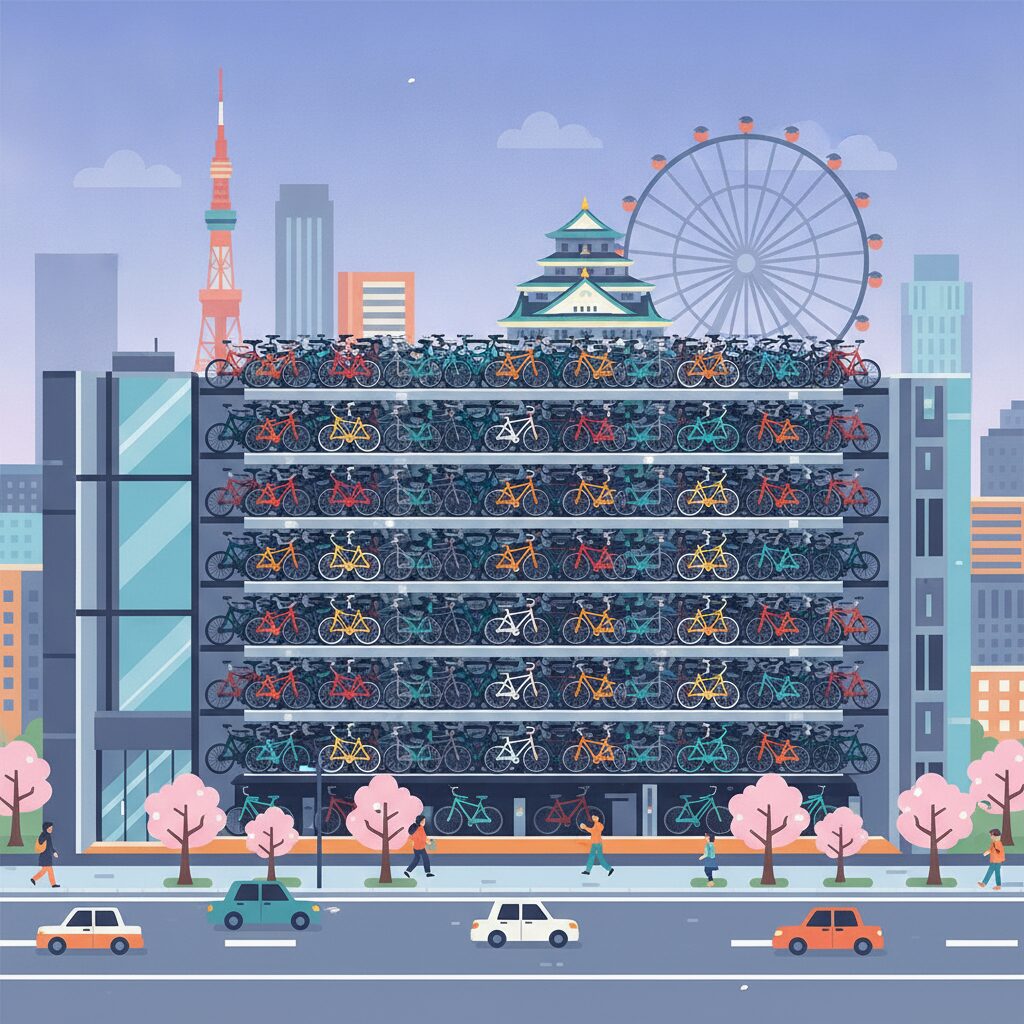
You’ve reached your destination. Now, what do you do with your bike? Near major train stations like Umeda or Namba, you’ll find official, multi-level bicycle parking lots, or churinjo. Some offer a few hours of free parking, while others require a small fee. These facilities are the city’s official solution to the issue. However, they are often full, somewhat inconvenient, or simply absent in the residential neighborhood where you actually are. This is where you encounter Osaka’s most distinctive visual characteristic: the vast sea of parked bicycles.
This is what I call “The Gray Zone.” It’s the thousands upon thousands of bikes parked along sidewalks, chained to guardrails, clustered in front of convenience stores, and lined up against apartment walls. In Tokyo, this would be unimaginable. Teams of ward employees would quickly descend, plastering bikes with warning stickers and hauling them off to an impound lot within hours. It would be considered a public order violation, an eyesore. In Osaka, it’s just business as usual. It’s an unspoken, accepted part of the urban landscape, a practical response to a logistical challenge.
The Logic of the Sidewalk Sea
Why is this vast, technically illegal parking system tolerated? The answer, once again, is pragmatism. There simply aren’t enough official spots for the sheer number of bikes. The city government seems to realize that strict, Tokyo-style enforcement would disrupt residents’ daily lives. Without their bikes, people couldn’t get to work, shop, or pick up their children. The city would come to a standstill.
So, an unspoken compromise exists. As long as you adhere to community rules, your bike is likely to be left undisturbed. Rule one: don’t be a nuisance. Don’t block shop entrances, fire hydrants, or tactile paving paths for the visually impaired. Leave sufficient space for wheelchairs or strollers to pass. You’ll notice that bikes are almost always parked in neat, single-file lines, pushed close to walls. This is community self-policing. Rule two: follow the leader. If you see a line of twenty bikes parked along a certain railing, it’s almost certainly a safe place to add yours. An empty stretch of sidewalk, by contrast, is often empty for a reason—possibly a designated removal zone. The logic is communal; the wisdom of the crowd determines the safe spots.
The Impound Truck: The Unspoken Threat
This tolerance isn’t unlimited. The city must maintain some order, so the dreaded impound truck does make its rounds. But its arrival is rarely unexpected. The system has a built-in warning mechanism. One or two days before a scheduled cleanup in a particular area, city workers attach brightly colored paper tags or stickers to every bicycle in the designated zone. These tags serve as the official warning: “We are clearing this area on this date. Move your bike, or we will move it for you.”
This is the city’s side of the deal. They are saying, “We’ve allowed this to continue for some time, but it’s gotten out of hand. It’s time for a reset.” As a resident, your responsibility is to stay alert. You learn to check your bike for these warnings when you return to it. If you spot them not only on your bike but on others nearby, you know it’s time to find a new spot for a few days. This cycle of accumulation and removal forms the rhythm of Osaka’s parking etiquette. The threat of the impound truck prevents the gray zone from descending into chaos. It’s a constant, low-level tension that keeps this fragile system balanced.
What This Teaches You About Osaka
Pragmatism Over Polish
At its core, Osaka’s bicycle culture embodies the city’s fundamental philosophy: pragmatism over polish. While Tokyo values form, order, and appearance—where rules are followed simply because they exist, and public spaces are kept impeccably clean—Osaka prioritizes function. Does it work? Does it help people get through their day? A cluttered sidewalk full of bikes may appear untidy, but if it enables a mother to finish her shopping or a student to reach their part-time job, then it fulfills its purpose. The outcome matters more than the aesthetics.
This approach is reflected throughout Osaka, seen in the straightforward, unembellished manner of speech and the preference for good, affordable food rather than fancy restaurant interiors. The city is built on the principle of jitsuyō-teki, meaning practical use. People don’t waste time on unnecessary formalities. While it can be surprising initially, you soon come to value its honesty. Osaka isn’t striving to be something it’s not; it’s a living city, and life here is sometimes messy.
Assertiveness is Communication, Not Rudeness
One of the biggest challenges for foreigners—and even Japanese from other areas—is understanding Osaka’s straightforwardness. The seemingly aggressive bell-ringing, riding on sidewalks, and parking everywhere can come across as extremely rude. But you need to shift your perspective. In Osaka, this isn’t rudeness; it’s clarity. It’s a communicative system tailored for a dense, fast-moving environment.
In crowded spaces, ambiguity is risky. A hesitant, overly polite cyclist causes confusion and accidents, whereas a clear, assertive cyclist signaling their intentions allows others to respond and adapt accordingly. It’s a collective effort to keep things flowing. Osakans value efficiency and expect you to recognize that their directness isn’t personal. It’s simply the most practical way to navigate shared spaces. Once you understand this, offense fades, and you begin to appreciate the cooperative elegance behind it.
The “Akan Yakedo, Maa Ee Ka” Mentality
If one phrase sums up Osaka’s approach to bicycle rules, it’s “Akan yakedo, maa ee ka.” Loosely translated, it means, “Technically, you’re not supposed to do that, but… oh well, it’s fine.” This is the formula that makes the city function. Yes, there’s a rule that bikes should be parked in designated areas. (Akan yakedo…) But since there are no spots and everyone parks on the sidewalk without blocking anyone, (…maa ee ka.) it’s accepted. Yes, the rule says bikes should be on the street. (Akan yakedo…) But since the street is dangerous and everyone is safely using the sidewalk, (…maa ee ka.) that’s overlooked. This isn’t a rejection of rules but a flexible interpretation. The belief is that the spirit of the law—to ensure safety and smooth public flow—matters more than the literal wording. As long as no real problems are caused, a degree of rule-bending is understood and accepted. Learning this balance—knowing when a rule is strict and when it’s a guideline—is the final key to embracing the Osaka mindset.
A Foreigner’s Survival Guide to Osaka Cycling
To Ride or Not to Ride?
Get a bike. I can’t emphasize this enough. If you plan to live in Osaka, having a bicycle is essential. It will completely change how you experience the city. Distances will shrink, new neighborhoods will open up, and you’ll connect to the daily rhythm of life in a way that the cold, underground subway never can. On a bicycle, you’ll discover that tiny, perfect coffee shop, that lively local festival, or a beautiful temple tucked away down a side street. It’s your key to seeing the real Osaka.
Your First Steps
Don’t spend on a fancy, expensive bike. Visit a local bike shop and pick up a simple, used mamachari. It’s affordable, practical, and instantly helps you blend in. A flashy road bike shouts “tourist” or “enthusiast” and is a prime target for theft. When you buy your bike, make sure to register it with the police (bōhan tōroku). This is mandatory and can help you recover it if stolen. Before you start riding, spend an afternoon observing. Sit at a café near an intersection or inside a shopping arcade. Watch how people ride, where they park, and how they interact. Observation is your best teacher.
The Golden Rules
- Be Predictable. The whole system relies on everyone anticipating each other’s moves. Avoid sudden stops, swerves, or turns without checking. Hold a steady line whenever you can.
- Use Your Bell, But Don’t Overuse It. A quick ring is a useful signal. Constantly leaning on your bell marks you as rude. Use it deliberately to announce your presence only when needed.
- Pedestrians Are the Final Boss. Always, without exception, yield to pedestrians. They have the ultimate right of way. You’re in their space on the sidewalk and it’s completely your responsibility to navigate safely around them.
- Lock It or Lose It. Invest in a strong, solid lock that secures both your frame and a wheel. Bike theft is common. Make your bike a less attractive target than the one next to it.
- Learn Your Local Parking Rhythm. Notice where bicycle clusters form and where they don’t. Pay attention to when warning tags appear and disappear. Each neighborhood has its own unique ebb and flow.
Conclusion: It’s Not Chaos, It’s a Different Kind of Order
From the outside, the world of Osaka bicycles appears to be a whirlwind of anarchy. It’s loud, it’s fast, and it seems to follow no rules whatsoever. But as you begin to live in it, get your own mamachari, and join the flow, you start to notice the patterns. You observe the unspoken communication, the shared understanding, and the deep-rooted pragmatism that governs it all. You come to realize it’s not chaos—it’s simply a different, more organic kind of order.
This order is based on human interaction rather than rigid regulations. It’s a system that values function over form and community consensus over abstract rules. Riding a bike in Osaka is a daily immersion into the city’s soul. It teaches you to be more aware, more direct, and more adaptable. It challenges you to let go of your preconceived notions of how things should be and accept them as they are. So, get your bike, take a deep breath, and dive into the stream. The dance might feel intimidating at first, but once you find the rhythm, you’ll never want to stop.