Walk out of a gleaming Osaka department store, its basement a pristine food hall where melons sit in cushioned boxes like crown jewels and perfectly marbled beef is presented by staff in crisp uniforms. The air is cool, silent, reverent. It’s a world of polished perfection, with prices to match. Now, walk ten minutes in any direction, duck under a faded archway, and step into the shotengai. The air immediately changes. It’s thick with the scent of grilling eel, sweet soy sauce, and fried tempura. The sound is a chaotic symphony: the rhythmic clang of a butcher’s cleaver, the gravelly shouts of vendors hawking today’s specials, the cheerful rumble of conversation, and the squeak of bicycle brakes. This isn’t a curated experience; it’s the raw, unfiltered engine of daily life in Osaka. For many newcomers, the shotengai, or local shopping arcade, seems like a relic, a chaotic and slightly grimy throwback to a bygone era. But to dismiss it as such is to fundamentally misunderstand Osaka. This is not a tourist attraction. This is the city’s secret weapon. It is the very heart of an affordable, sustainable, and deeply human way of life, and mastering its rhythm is the true key to living well in Japan’s kitchen.
Local residents not only thrive in the shotengai but also embrace a vibrant cycling culture, as illustrated by this bicycle survival guide that offers practical tips for navigating Osaka on two wheels.
The Soul of Commerce: More Than Just a Shopping Street

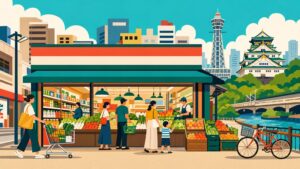
In Tokyo, the supermarket dominates. It serves as a temple of convenience, a one-stop shop where you can find everything from milk to lightbulbs all in one place. The experience is efficient, anonymous, and standardized. Osaka has supermarkets too, but the city’s heart for daily essentials remains the shotengai. It’s important to recognize that a shotengai is more than just a collection of stores. It’s a carefully balanced ecosystem of independent specialists. It functions like a living organism, not a corporation. You don’t visit the shotengai to buy “groceries.” Instead, you go to the butcher for meat, the fishmonger for fish, the greengrocer for vegetables, and the tofu maker for tofu. Each shop is generally a small, family-run business, often handed down through generations. This setup cultivates a level of expertise that a mega-mart can’t duplicate. The fishmonger didn’t simply stock the fish this morning; their grandfather likely sold fish to your neighbor’s grandfather. They know which cut of tuna is best for sashimi today and which mackerel is ideal for grilling. The butcher isn’t just a cashier; they ground the pork for the gyoza you plan to make and can advise on the optimal fat-to-meat ratio. This model replaces the corporate focus on “efficiency and scale” with a community emphasis on “expertise and trust.” It represents a fundamentally different philosophy of commerce, one that values the product and the person over the process.
The Unspoken Language of Value: “Nekiri” and the Art of the Deal
At the heart of the Osaka mindset lies something that often confounds outsiders, especially those accustomed to Tokyo’s fixed-price culture. In Osaka, value isn’t a negative term; it’s a virtue. The shotengai is where this virtue is practiced daily. The first idea to understand is `nekiri`, commonly translated as “price reduction” or “haggling,” but it’s much more subtle than aggressive bargaining. Often, the seller is the one who initiates it. As closing time nears, the vegetable vendor might hold up a bag of slightly imperfect cucumbers, exclaiming, “Saigo, saigo! How about these for 100 yen?” The baker may bundle the last three loaves of bread and sell them for the price of two. This isn’t desperation; it’s a deeply rooted cultural practice tied to the concept of `mottainai`, the Japanese aversion to waste. It’s deemed wiser to sell something for a small profit than to let it go unused. This gives rise to `mi-kiri-hin`, or “clearance items.” In a supermarket, this could be a forlorn package of meat with a bright yellow sticker. In a shotengai, it’s an active, verbal negotiation with the expert seller. The fishmonger might say, “This sea bream is beautiful but should be cooked tonight. I’ll slash 200 yen off for you.” This creates a win-win scenario: the customer gets a great deal, and the seller avoids waste. It reflects a practical, intelligent approach to commerce. Complementing this is `omake`, a small gift or extra that shopkeepers might throw in for a regular customer—it could be an extra potato, a bunch of green onions, or an additional piece of fried chicken. It’s a gesture meaning, “I see you. I appreciate your business.” It transforms a simple sale into a relationship. You won’t find `omake` at a self-checkout.
A Symphony of Specialists
The true strength of the shotengai ecosystem emerges when you consider its individual players. Each shop is a master in its specialty, creating a constellation of quality rarely found elsewhere. The `yaoya` (greengrocer) bursts with seasonal colors. Unlike the uniform, plastic-wrapped produce of supermarkets, here you find vegetables in their natural form—bumpy, asymmetrical, and full of flavor. The owner has likely sourced them from local farms and can inform you which spinach is best for a quick sauté and which daikon radish is sweetest for grating. Next door, the `nazi` (butcher) offers not only cuts of meat but also a lifeline for busy households. For around 100 yen each, you can buy freshly fried `korokke` (potato croquettes), `menchi-katsu` (minced meat cutlets), or `tonkatsu` (pork cutlets). These `sozai`, or side dishes, are essential to daily Osaka life, providing an affordable, tasty, and hot meal component that saves people from cooking everything from scratch every night. The `sakanaya` (fishmonger) is another key figure. The variety is staggering, and freshness is paramount. They will gut, scale, and fillet your fish on the spot, a service largely lost in most modern stores. And we mustn’t overlook the supporting cast: the `okomeya` (rice merchant), who can custom-mill rice to your preferred texture; the `tsukemonoya` (pickle shop) with its vast barrels of seasonal pickles; and the `tofuya`, where fresh tofu is often made daily on-site, still warm when purchased. Each contributes a vital part to the culinary puzzle.
The Human Algorithm: Why Relationships Trump Convenience
In today’s digital age, retail is driven by data. Supermarkets use loyalty cards and purchase histories to build algorithms that predict your behavior. The shotengai, however, operates on a much older, more potent system: the human algorithm. Shopkeepers are the processors. They don’t need a database to recall that you prefer your chicken deboned, that your children love the sweet tamagoyaki from the egg shop, or that you’re searching for ingredients for a particular dish. This personalized service isn’t a premium extra; it’s the default. It creates a strong bond of trust and loyalty. When you have a relationship with your food provider, you trust their recommendations. This encourages a more adventurous and seasonal way of eating. The greengrocer might introduce you to an unusual mountain vegetable that’s just arrived, or the fishmonger might suggest a fish you’ve never heard of because it’s especially good that day. This direct link from producer to consumer, mediated by a trusted expert, serves as a powerful antidote to the alienation of modern food systems. It may be less convenient than grabbing a pre-made bento from a 24-hour convenience store, but it’s far more rewarding—for both the palate and the wallet.
Decoding the Shotengai: A Practical Guide for Newcomers
For a foreigner, the first few visits to a shotengai can be overwhelming. The noise, the crowds, and the absence of English signage can make it feel like sensory overload. The secret is to start small and embrace the chaos. Don’t try to do all your weekly shopping on your first trip. Instead, focus on a single task. Buy one item—maybe a `yakitori` skewer from a stall or a piece of fruit from a friendly vendor. The language barrier is not as big an obstacle as you might expect. Pointing is a universal way to communicate, and holding up fingers to show quantity works well. A simple “Kore, kudasai” (“This one, please”) will take you far. Most vendors are businesspeople looking to make a sale, and they are generally patient and appreciative of anyone who tries. It’s also important to dispel the myth that shotengai are “dirty.” They may not be sterile, but they are clean. These are professional food sellers adhering to strict Japanese hygiene standards. The floors might be wet from the fishmonger washing down his stall, and the air may be filled with cooking smoke, but this indicates a working kitchen, not a lack of cleanliness. The best approach is to become a regular. Choose a few shops and make a habit of returning. Even with limited Japanese, the shopkeepers will begin to recognize you. A nod, a smile, and consistent visits are the foundation of a shotengai relationship. Before long, you’ll find yourself receiving a little `omake` and feeling like a true local.
Beyond the Groceries: The Shotengai as a Community Lifeline

The shotengai’s role goes well beyond just food. It serves as a comprehensive support system for the neighborhood. Nestled between the butcher and the baker, there’s a small pharmacy where the pharmacist knows the local families and their health concerns. Nearby, you’ll find a tiny stationery store, a family-run clinic, a dry cleaner, and a budget clothing store catering almost exclusively to the area’s elderly residents. These arcades are essential social hubs, especially for Japan’s aging population. They are safe, pedestrian-friendly, and sheltered from rain and summer sun. This is where neighbors meet, pause to chat, and catch up on local news. You’ll see benches occupied by elderly friends sharing a can of coffee. The shotengai acts as a de facto community center, a “third place” that is neither home nor work. It offers a crucial social safety net, a place where people are known and cared for. This community role is something a sprawling, impersonal shopping mall on the outskirts of town can never replicate.
Shotengai vs. Supermarket: A Tale of Two Cities (in One)
Choosing between shopping at a shotengai and a supermarket reflects two distinct philosophies of life. It also vividly highlights the cultural divide commonly seen between Osaka and Tokyo. The supermarket embodies the Tokyo ideal: efficient, polished, convenient, and predictable. Its emphasis lies on presentation and brand names, catering to a fast-paced lifestyle where time is a precious commodity and shopping is a task to be completed swiftly. In contrast, the shotengai represents the Osaka spirit: pragmatic, value-conscious, and relationship-oriented. It may be a bit chaotic and noisy, but it operates with its own kind of efficiency. The focus is on freshness, seasonality, and securing the best product at the best price. Here, shopping isn’t a chore but an experience—an opportunity to interact, learn, and connect with the community. It’s for those who enjoy the process, value human connection, and celebrate the thrill of a good deal. An Osakan will proudly share the excellent price they scored on fatty tuna at the shotengai—a badge of honor and a sign of their savvy nature. This practical pride defines the city’s essence.
Your local shotengai is not a museum, nor a theme park preserving a romanticized past. It is a living, breathing, and highly effective model of urban life. It’s what makes a city of millions feel like a series of close-knit villages. It’s where the city’s heart beats strongest. If you’re new to Osaka and want to truly understand how this city functions, skip the polished department stores and sterile supermarkets. Immerse yourself in the vibrant, functional chaos of your neighborhood arcade. Get to know the vendors’ faces, sample the seasonal specialties, and master the art of the deal. In doing so, you’ll not only discover a more affordable way of living but also uncover the vibrant, practical, and profoundly human spirit of Osaka.