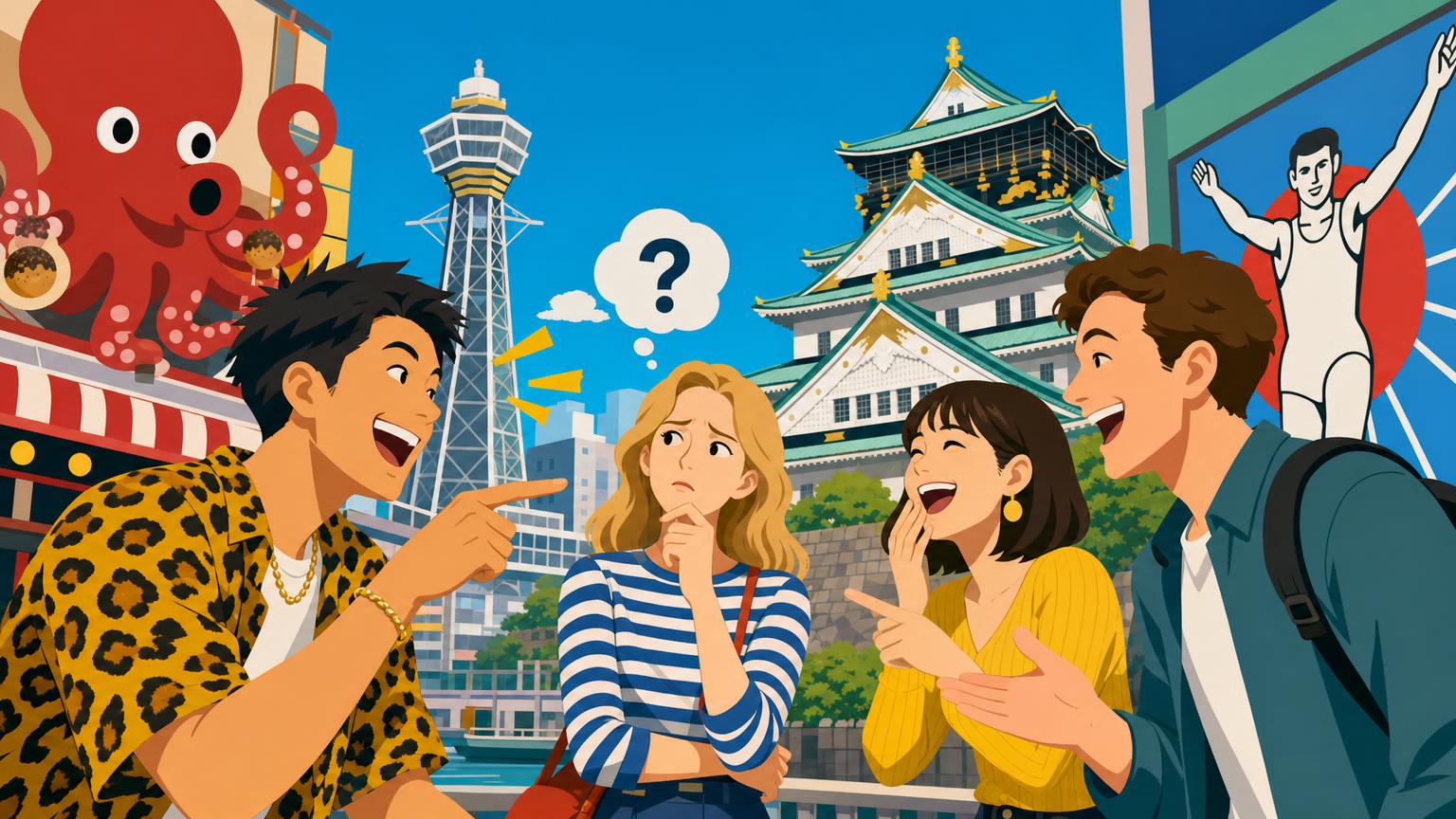
A colleague says, You’re looking healthy today, so you must have stopped working. A neighbor complains that your bicycle is too clean. The person behind the counter at a small restaurant asks whether you are lost, even though you have been going there every week for six months.
Are these insults? Is someone angry? Should you apologize, explain yourself, or laugh?
If you are living in Osaka, or seriously considering it, you will eventually face this small communication puzzle. Osaka conversation often carries two messages at once: the literal message and the social message hidden inside the joke. The words may sound sharp, but the intention may be warm. A complaint may be an invitation. A strange question may be a way to start a relationship.
This does not mean that every person in Osaka is naturally funny, endlessly outgoing, or interested in performing comedy for strangers. That stereotype is too simple. Osaka is a large, busy city with quiet office workers, private families, stressed commuters, reserved students, and people who would rather not speak to anyone before coffee. The difference is that everyday Osaka communication often gives humor more room to appear in ordinary situations. Local speech can make a casual relationship feel possible before people know each other well.
For a foreign resident, this can be one of the pleasures of life in Osaka. It can also be exhausting. If you interpret every sentence literally, you may miss the invitation hidden inside the teasing. If you assume every joke means friendship, you may cross a line. The skill is not simply learning funny phrases. It is learning when banter is being used to create closeness, when it is being used to test the atmosphere, and when it is only being used because the speaker happens to enjoy talking that way.
The map below is not a sightseeing recommendation. It is a visual reminder of the city’s urban center, where office districts, residential neighborhoods, shopping streets, old merchant areas, and commuter routes overlap. Osaka’s conversational style is not found in one attraction. It is heard in the spaces between work, errands, meals, and repeated encounters.
The Real Question: Is Osaka Actually More Humorous?
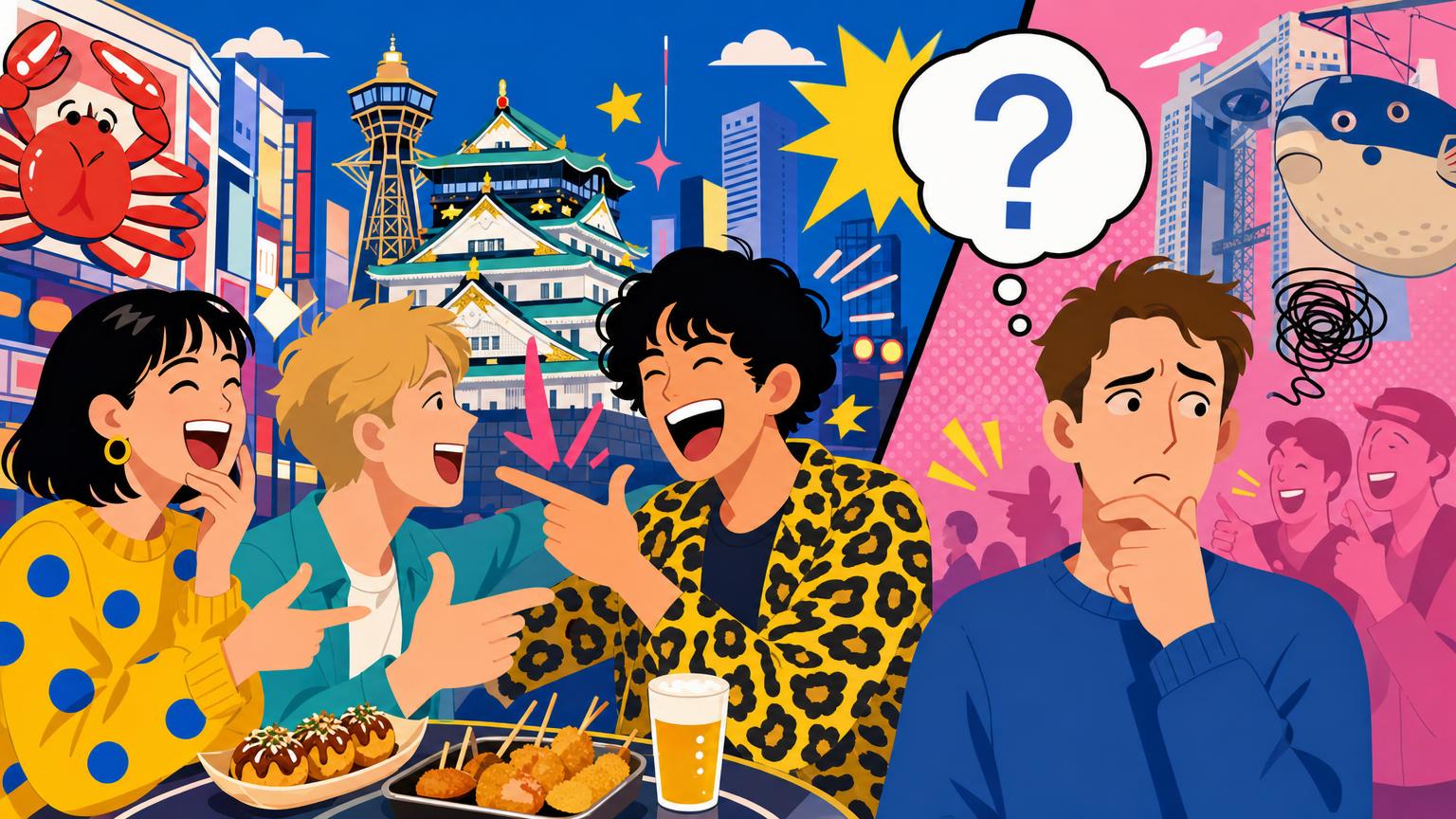
The honest answer is both yes and no.
Osaka has a strong public reputation for humor. The city is closely associated with manzai, a two-person comedy style built on rapid exchanges, misunderstanding, correction, and rhythm. Kansai television has helped spread local performers and speech patterns throughout Japan. Osaka’s dialect is recognizable nationwide, and many Japanese people expect Osaka residents to be more direct, playful, or comfortable with teasing than people from other regions.
However, a reputation is not a personality test. People from Osaka are not born with an obligation to entertain. What feels different is less about constant joking and more about the acceptable range of everyday interaction. Someone may show more personality during a brief conversation. A shopkeeper may respond to a simple question with a small joke instead of a neutral sentence. A colleague may complain about your lunch while offering you half of theirs. A neighbor may comment on the weather in a way that sounds like criticism but is actually an attempt to make the encounter feel less formal.
The University of Osaka describes comedy as something ordinary people may incorporate into daily communication, to the point that bringing two people from Osaka together is popularly compared to creating a comedy team. This is a cultural observation, not a rule that every interaction becomes a performance.
The important point for expats is that Osaka humor often functions as social glue. It reduces distance and gives people a way to be informal without making a serious declaration of intimacy. Instead of saying, “I want to know you better,” someone may say, “You are still using that broken umbrella?” Instead of saying, “I am worried about you,” a friend may say, “At this rate, even your rice cooker is going to leave you.”
The joke carries the relationship.
Osaka Versus Tokyo: A Difference in Social Temperature
Foreign residents often wonder whether Osaka is friendlier than Tokyo. The question is understandable, but the word “friendly” can conceal too much. It may mean polite, generous, talkative, informal, helpful, curious, or simply less intimidating. Osaka and Tokyo contain all of these qualities, but they often express them in different ways.
Communication in Tokyo can feel more carefully managed in public. Someone may be warm while still maintaining a clear boundary between stranger, coworker, customer, and friend. This is particularly noticeable in professional settings, where standard Japanese, controlled facial expressions, and polite distance help people navigate a crowded and hierarchical city.
Osaka also has hierarchy and formality. A senior manager remains a senior manager. A customer remains a customer. A landlord remains a landlord. Humor should not be mistaken for the disappearance of social rank. However, Osaka conversation may soften those roles through more visible personality. A polite interaction might include a teasing phrase, a dramatic reaction, or an intentionally exaggerated complaint.
This can make Osaka feel accessible more quickly. It can also make the city more difficult to read because the boundary between politeness and informality is less visually obvious. Someone may use a friendly tone without offering deep friendship. A joke may serve as a temporary bridge rather than a permanent invitation.
Tokyo and Osaka are both major cities with large populations of newcomers. Neither city has a single personality. The contrast is best understood as a difference in communication habits and regional expectations, rather than as a moral distinction between kinder Osaka people and colder Tokyo people. Osaka’s reputation for outgoing, playful interaction is widely recognized, while official explanations of Kansai speech also emphasize that speakers choose among standard Japanese, dialect, polite forms, and familiar forms depending on the situation.
For someone deciding where to live, the practical distinction may feel something like this:
- In Tokyo, you may wait longer before a stranger makes a personal comment.
- In Osaka, a personal comment may come sooner, but it may not mean that you have become close.
- In Tokyo, a neutral reply can keep an interaction running smoothly.
- In Osaka, a neutral reply may sometimes feel as though you have missed an opening.
- In both cities, the workplace may be much more formal than the neighborhood bar.
These are tendencies, not rules. Age, profession, neighborhood, language ability, and social class matter enormously. A young designer in Nakazakicho, a hospital worker in Sumiyoshi, a retired shopkeeper in Tennoji, and an international consultant in Umeda may all use humor in different ways.
What Osaka Banter Is Doing Beneath the Words
Osaka banter usually serves a purpose, even when that purpose is not obvious to a foreign listener. It may be doing one thing or several things at once.
Testing Whether the Conversation Has Energy
A joke can test whether you are willing to participate. The speaker is not necessarily asking for a clever response. They may simply want to see whether you recognize the playfulness.
Imagine that you arrive at work five minutes late because of a train delay. Your coworker says, “Ah, the celebrity has finally arrived.” They probably know that you are not a celebrity. The point is not the content itself, but whether you respond with a small smile, a self-deprecating comment, or a serious explanation.
A literal response such as, “No, I am not famous,” may be grammatically correct but socially flat. A better response might be, “The fans at Kyobashi station were impossible today,” or, “Please save your applause until payday.”
You are not expected to become a comedian. You are simply showing that you understand the conversational mode.
Lowering the Cost of First Contact
In a reserved environment, starting a conversation can feel risky. Humor lowers that cost because the speaker can retreat if the other person does not respond. If the joke fails, it was only a joke. If it succeeds, the two people have shared a moment.
This is one reason Osaka banter can feel welcoming to foreigners. Someone may not have enough English to hold a long conversation, but they can still make a playful remark about your umbrella, your pronunciation, or the amount of food you ordered. The interaction becomes human before it becomes linguistically sophisticated.
Making Complaints Less Heavy
People in Osaka complain often enough to be misunderstood. Complaining about the heat, rain, prices, trains, work, or a restaurant queue does not necessarily mean that the speaker is deeply unhappy. It can simply be part of the conversational rhythm.
The complaint may create a shared target. The weather is ridiculous. The train was too crowded. The supermarket discount started too late. The landlord sent another mysterious message. Once the complaint has been made, both people can stand on the same side of the problem.
This is different from aggressive negativity. The tone, timing, and follow-up all matter. If the person complains and then changes the subject, laughs, offers food, or asks about your day, the complaint was probably social. If the person repeats the issue, asks for a solution, or becomes quiet, treat it as a genuine problem.
Giving Advice Without Sounding Too Serious
Direct advice can threaten a person’s pride. A joke can make the advice easier to accept.
You have been cycling in the rain without a proper jacket. A friend might say, “Are you training to become a wet dog?” The surface is comic, but the practical message is clear: buy better rainwear. Someone may tease you for always forgetting your residence card before reminding you to check your wallet. The teasing gives the correction a softer landing.
Foreign residents sometimes make the opposite mistake. They hear the joke and overlook the advice. Osaka banter can contain useful information. Laugh first, then pay attention to what the person is actually telling you.
Why Literal-Minded People Struggle at First
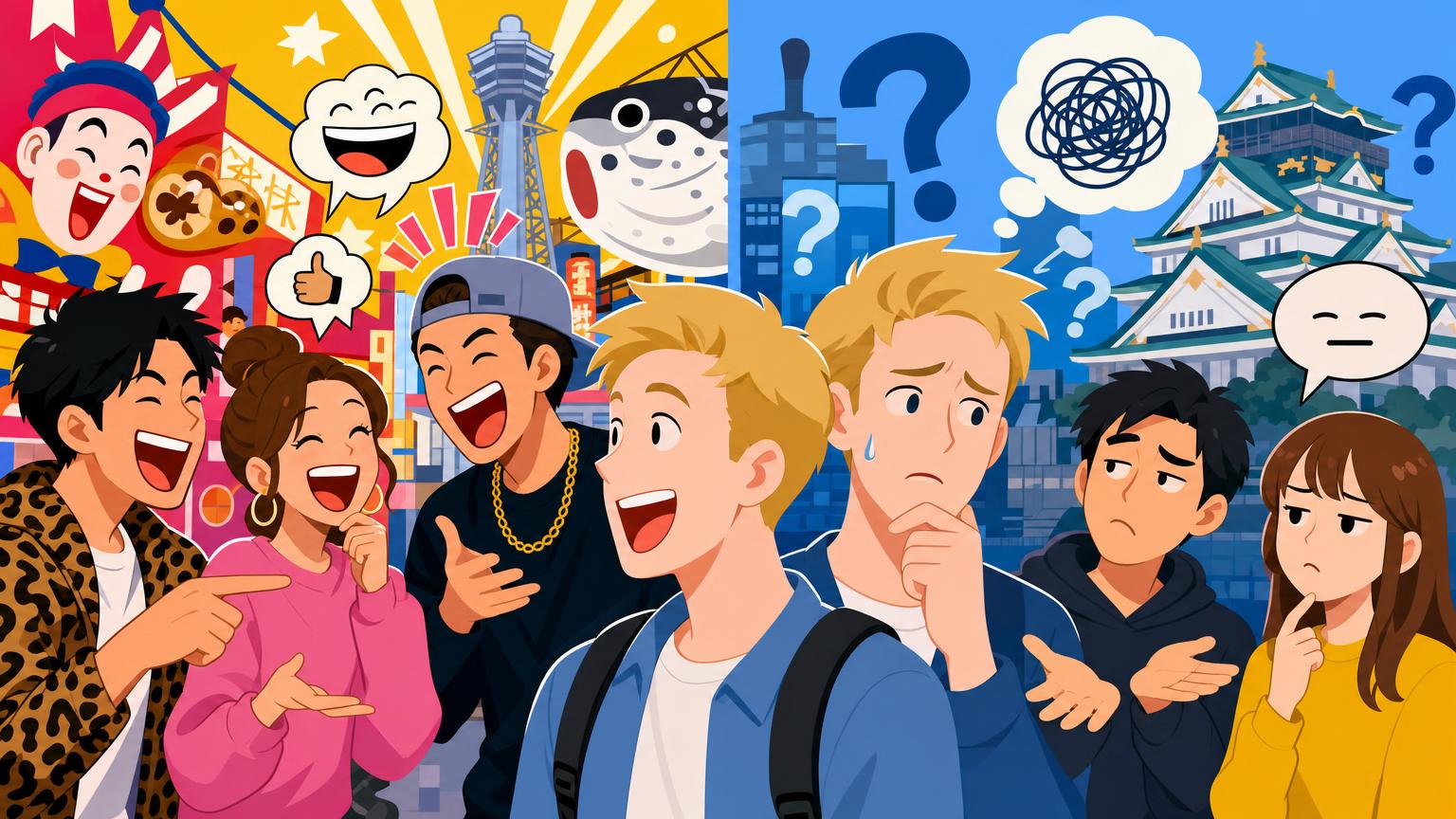
Taking language literally is not a personal weakness. It is often a survival strategy for living in a second language. You listen carefully, translate every word, look for the correct social meaning, and avoid making assumptions.
That strategy works well for instructions, contracts, medical appointments, and train announcements. It does not always work with Osaka banter, because the social meaning may be conveyed through exaggeration, timing, tone, or a shared understanding that the words are not meant literally.
A person says, “You are eating again?”
The literal interpretation is a criticism of your appetite. The social interpretation may be, “I recognize you, I have noticed your habits, and I feel comfortable enough to tease you.”
A person says, “You are very Japanese now.”
This could be sincere praise for your ability to sort recycling. It could be a joke about you bowing too deeply. It could also be criticism if the person thinks you are becoming too cautious. The sentence cannot be understood without considering the surrounding relationship.
A person says, “You look tired. Are you secretly running a company?”
The first part may express genuine concern. The second part is a humorous explanation that lets the speaker show concern without becoming emotionally heavy.
The safest approach is not to settle on one interpretation immediately. Hold two possibilities in mind for a moment. Ask yourself:
- Is the speaker smiling, relaxed, or continuing the conversation?
- Has this person joked with others in the same way?
- Is the remark about a harmless habit, or does it target identity, money, appearance, gender, nationality, or private circumstances?
- Does the speaker help you after teasing you?
- Do they accept your attempt to joke back?
Humor is not automatically kind. Osaka’s reputation for banter should never be used to excuse harassment, workplace bullying, discrimination, or unwanted comments. A joke becomes a problem when the target cannot safely refuse it, when the same person is always targeted, or when the speaker uses humor to avoid responsibility.
The Mechanics of Manzai in Daily Conversation
Manzai is often translated as Japanese stand-up comedy, though the comparison is imperfect. Traditional manzai is generally a two-person routine. One performer, the boke, creates confusion, makes an absurd claim, misunderstands something, or behaves foolishly. The other, the tsukkomi, reacts, corrects the mistake, points out the absurdity, and brings the exchange back to reality.
The famous slap or sharp physical gesture associated with some comedy performances is not the essence of the relationship. The deeper structure is contrast: one person pushes the conversation away from normal expectations, while the other restores order.
You can see a mild version of this structure in everyday Osaka conversation.
A: I walked from Namba to Umeda this morning.
B: Why?
A: To save money.
B: You bought coffee halfway there.
A: That was medical treatment.
B: For what?
A: Tired legs.
B: So you spent money to avoid spending money.
The exchange is not a formal comedy routine, but it follows a familiar logic. One person offers a story, and the other identifies the contradiction. The first person protects the story by exaggerating, while the second returns the conversation to reality.
In Osaka, this rhythm may appear in conversations about food, shopping, commuting, work, weather, and family. The people involved do not need to be professional comedians; they only need to recognize the pattern.
Boke: The Person Who Opens the Door to Absurdity
Boke is often described as the silly one, but that explanation can be misleading. The boke creates an opening. They may say something technically incorrect, deliberately exaggerate, pretend not to understand, or take a familiar phrase in an unexpected direction.
In daily life, boke can be directed at oneself. You say that your Japanese is fluent, then immediately misunderstand a simple question. You announce that you will become an early riser, then show up at work carrying breakfast at noon. You claim that your apartment is perfectly organized while a tower of delivery boxes leans toward the door.
Self-directed boke is often a safe starting point for foreigners. It signals confidence without requiring another person to become the target. It also reduces the pressure to appear perfect in Japanese.
Tsukkomi: The Person Who Restores Reality
Tsukkomi is not simply criticism. It is a reaction that shows everyone where the boundary of normality lies. It can be verbal, facial, or physical in a very mild sense: a pause, a look, a raised eyebrow, or a quick “What are you talking about?”
When a colleague says, “I am going to quit my job and open a takoyaki stand on the moon,” the tsukkomi response might be, “Start with a business plan on Earth.” The reply brings the conversation back without destroying the fantasy.
Foreigners sometimes interpret tsukkomi as hostility because the response is direct. In a relationship where banter has been established, however, directness may indicate participation. A person who says nothing may be more distant than someone who corrects you energetically.
Still, do not imitate the strongest version immediately. Tsukkomi depends on timing and relationship. A correction that is funny among close friends may sound humiliating in front of a manager, customer, or new acquaintance.
The Shared Responsibility of the Exchange
A successful banter exchange requires cooperation from both sides. The boke offers something that can be played with, while the tsukkomi reacts without damaging the other person’s dignity. The boke then accepts the correction or extends the joke.
If one person keeps making jokes while the other silently absorbs them, the exchange is not balanced. If you are always the target, you are not necessarily being welcomed. If a coworker says, “We are only joking,” after you have clearly shown discomfort, the phrase may be an excuse rather than reassurance.
The best Osaka banter leaves both people feeling more connected than they did before.
Kansai-ben: Why the Dialect Changes the Feeling
Kansai-ben refers to the Kansai family of dialects, while Osaka-ben more specifically describes speech associated with Osaka. These labels encompass regional varieties rather than one single, uniform language. Someone from Kyoto, Kobe, Nara, or Osaka may sound different, and people also adjust their speech based on age, work, family, and audience.
For foreign residents, the first challenge is not vocabulary but emotional interpretation. Kansai speech often has a different rhythm, melody, and range of endings from textbook standard Japanese. A sentence that sounds neutral in Tokyo may feel more intimate, dramatic, or playful in Osaka. Likewise, a sentence that sounds strong in standard Japanese may become softer or more comic in a local dialect.
The Japanese Agency for Cultural Affairs provides examples showing that speakers choose between standard Japanese and Kansai dialect, as well as between polite and familiar styles, depending on the situation and the person they are addressing. That flexibility is important. Kansai-ben is not simply a fixed accent that every local speaker uses throughout the day.
A few expressions are particularly useful for understanding the atmosphere.
Nandeyanen
Nandeyanen roughly means Why the heck is that? or What are you talking about? In comedy, it is a classic tsukkomi reaction. In daily life, its tone can range from genuine irritation to affectionate disbelief.
If your friend says they bought an expensive jacket because it was on sale, you might respond with nandeyanen. The meaning is not a serious request for a philosophical explanation; it highlights the contradiction.
Use it with care. A flat, forceful delivery can sound rude, while a smile, light tone, or laugh makes the intention clearer.
Honma
Honma means really or seriously. It is commonly heard in Kansai speech and can convey surprise, agreement, disbelief, or emphasis.
Honma? can mean Are you serious? Honma ni? can mean Really?, depending on the tone. When a colleague tells you that the office printer has stopped working again, you may hear Honma? as an expression of shared exhaustion rather than a request for evidence.
Meccha
Meccha means very or extremely. It is common in casual speech and often adds energy to a statement.
Meccha atsui means it is extremely hot. Meccha oishii means it is really delicious. A local speaker may use it casually, while a foreign speaker using it with exaggerated enthusiasm can also create a friendly moment.
Ookini
Ookini is a traditional Osaka and Kansai expression associated with thank you. You may hear it from older shopkeepers, in traditional businesses, or in stylized local speech. It is not a universal substitute for arigatou in every modern context.
If you say ookini to everyone in every situation, you may sound theatrical or as though you are imitating a character. Listen first. In a small shop, repeating it lightly after a local person uses it can be charming. In a formal office email, use standard polite Japanese instead.
Maido
Maido is associated with a welcoming, familiar style of greeting in Osaka commerce. It can serve as a casual welcome or as a phrase acknowledging a returning customer. You may hear it in restaurants, shops, and business settings with a traditional flavor.
It is one of the expressions that shows how commercial relationships can become personal in Osaka. The customer is not merely an anonymous buyer; they may be a regular, a neighbor, or someone whose face is remembered.
Seyanen
Seyanen is often used as a humorous expression of agreement, roughly meaning exactly or that is how it is. It is strongly associated with Kansai-flavored speech and entertainment, so foreigners should avoid forcing it into every conversation.
The broader lesson matters more than memorizing phrases. Osaka communication depends heavily on melody. A foreigner can use the correct words and still sound too serious, too aggressive, or too theatrical. Begin by listening to where local speakers pause, soften, stretch, or laugh.
When a Joke Means You Are Being Welcomed
One of the most encouraging experiences for expats is realizing that teasing can be a form of recognition. A shopkeeper who remembers your order may joke that you have come to eat the same thing yet again. A neighbor may comment on your umbrella. A coworker may ask whether you have finally learned how to separate plastic waste.
The content itself may be unimportant. What matters is that the person noticed you.
Osaka’s dense neighborhood life makes this possible. In areas such as Tennoji, Tsuruhashi, Tamatsukuri, Joto, Sumiyoshi, and the older shopping streets throughout the city, you may repeatedly see the same people at the station, supermarket, bicycle parking area, coffee shop, clinic, or local restaurant. This repetition creates opportunities for small jokes. You do not need a dramatic moment of friendship. You become familiar through accumulated recognition.
This is one reason Osaka can feel different from a highly anonymous urban environment. Familiarity is often built through small exchanges rather than formal introductions. Someone learns your schedule, food preferences, level of Japanese, or tendency to forget an umbrella, and then uses that information as material for conversation.
For foreigners, being teased may initially feel like being singled out. Sometimes it is. Often, however, it means you have moved from being a stranger to becoming a recognizable person. The important question is what happens next. Does the person help you, remember you, include you, or make room for you? If so, the joke may be part of belonging.
When Banter Is Not Friendship
This is where overly positive explanations of Osaka can become dangerous. Not every direct comment is an expression of warmth. Not every joke is a cultural misunderstanding. Sometimes, a rude person is simply being rude.
You should be cautious when:
- The same person repeatedly targets your nationality, accent, body, gender, age, religion, or immigration status.
- The joke is made in front of people who have power over you, such as a manager or landlord.
- You are expected to laugh but are not permitted to respond.
- The speaker becomes angry when you ask them to stop.
- The comment affects your work, housing, safety, or access to services.
- The person invokes Osaka’s humorous reputation to dismiss your discomfort.
A practical response does not have to be dramatic. You can say that you do not understand the joke or that the comment makes you uncomfortable. You can change the subject, leave the situation, or speak with someone you trust. If the setting is a workplace, keep a record of repeated behavior and use the appropriate internal or external support system.
Cultural understanding should help you recognize intent. It should not pressure you to tolerate disrespect.
Daily Life Examples That Confuse Foreign Residents
At the Office
Japanese workplaces vary more than foreigners often expect. Some companies are formal and hierarchical, while others are relaxed, international, technical, creative, or family-run. Osaka humor may appear differently in each environment.
A senior coworker might tease you for bringing a sandwich from home instead of eating with the team. This could be an invitation to join them, or it could simply be a comment. Pay attention to whether they make room for you at lunch. A joke without practical inclusion may be merely performative.
A manager may say that your presentation was so long that the audience had time to grow a beard. If the manager then provides specific feedback, the joke is serving as a softener. Do not focus only on the joke; write down the actual correction.
If you are new, avoid trying to become the office comedian. First learn who jokes with whom, which topics are safe, and whether juniors are expected to respond. A self-deprecating joke about your own imperfect Japanese is usually safer than teasing someone about their appearance or personal life.
At a Neighborhood Restaurant
You order the same curry three times in one week. The owner says, “Again? Your stomach has no imagination.”
This may be a sign that you are becoming a regular. You can reply, “My stomach is loyal,” or, “I am conducting important research.” You do not need perfect Kansai-ben; a smile and a short response are enough.
If the restaurant is busy, do not turn the exchange into a lengthy conversation. Osaka warmth still operates within practical limits. People have work, other customers, and bills to manage.
At a Supermarket or Convenience Store
Cashiers generally do not expect banter, and service interactions may remain brief. However, in smaller neighborhood shops, a familiar employee may comment on your shopping choices. If you buy only instant noodles, someone might jokingly ask whether your kitchen is under renovation.
Do not assume that every employee wants a personal conversation. Service workers may be using a practiced style, and you should respect the pace of the line. Humor is more likely to be welcome when there is an existing relationship and the other person is not being pressured to entertain you.
On the Train
Osaka trains are not comedy clubs. Most commuters are tired, and crowded trains require consideration. Loud conversation, blocking the doors, and ignoring personal space do not become acceptable simply because Osaka has a humorous reputation.
The banter you hear may be taking place between friends, families, or older passengers who know one another. Do not treat the entire train as an invitation to join the performance. Observe before participating.
In an Apartment Building
Neighbors may comment on your garbage separation, bicycle placement, or delivery boxes. A joking tone does not eliminate the practical rule. If someone says, “The crows are holding a meeting about your trash,” separate it correctly.
The best response is action. Say sorry, fix the problem, and perhaps add a small joke once the issue has been resolved. Humor cannot replace responsibility in shared housing.
The Osaka Mindset Behind the Joke
Osaka’s humor is often attributed to merchant culture, lively markets, entertainment traditions, and the city’s history as a commercial center. These explanations are useful, but they can become overly romanticized if treated as a complete theory.
A more practical interpretation is that Osaka has long valued communication that is quick, expressive, and socially useful. In commercial settings, people needed to attract attention, build trust, negotiate, remember regular customers, and keep interactions lively. A dry exchange could complete a transaction, while a lively one could encourage a customer to return.
That does not mean every person in Osaka is calculating a sales strategy when joking. Rather, it means that verbal skill and personality have long held visible value in the region’s public culture. Osaka’s entertainment industry, particularly Yoshimoto Kogyo and the broader manzai tradition, made this communication style recognizable across Japan. Manzai itself became an important bridge between regional speech and mass entertainment, helping Osaka-style rhythms reach audiences throughout the country.
The result is a city where conversational boldness can be socially rewarded. Someone who responds quickly, notices a contradiction, or makes a difficult moment lighter may be appreciated. Someone who remains completely literal may be seen as serious, cautious, or simply difficult to read.
This is not a demand to perform. It is an invitation to understand that conversation may be judged not only by its accuracy but also by its energy.
How Expats Can Participate Without Pretending to Be Osaka Locals
You do not need to imitate a television comedian. In fact, exaggerated imitation can feel less natural than simply participating attentively.
Start With Reactions
Use brief responses before trying to create jokes. A laugh, a surprised expression, or a simple “That makes no sense” can show that you understand the exchange.
Use Self-Directed Humor
Make yourself the joke when the situation is safe. If you forget a word, say that your Japanese has gone on vacation. If you arrive late, say that your alarm clock has resigned. Keep the joke brief and move on.
Ask What a Phrase Means
If someone says something you do not understand, ask whether they are joking. Many people will explain. You can say, “I am still learning the Osaka version of this conversation.” That turns confusion into a shared moment.
Do Not Rush Into Teasing
The fact that someone teases you does not automatically give you permission to tease them in the same way. Relationships have different boundaries. A local may joke about your own mistake but not appreciate a foreigner joking about their age, family, or income.
Watch the Follow-Through
The most reliable clue is how the person behaves after the joke. Do they help? Do they listen? Do they respect your answer? Do they include you when the practical part begins? Warmth is shown through actions, not just laughter.
Learn the Difference Between Casual and Polite Japanese
A person may speak casually because they are relaxed, older, working in a service role, or choosing a local style. You should not automatically copy their level of speech. Use polite Japanese with people whose position or relationship is unclear, then adjust gradually.
The Challenge of Humor at Work
For expats making real decisions about living in Osaka, employment matters more than the charm of neighborhood conversation. Humor can improve the workplace, but it can also conceal unfair expectations.
Some offices use jokes to welcome new employees, while others use them to pressure people into drinking, staying late, attending social events, or accepting behavior they might otherwise question. A coworker may say, “Come on, don’t be so foreign,” when you decline an invitation. That is not necessarily Osaka banter; it may be social pressure.
You are allowed to distinguish between belonging and compliance. You can enjoy casual conversation without attending every after-work gathering. You can laugh at a joke without agreeing to unpaid work. You can be friendly without sharing private information.
Foreign residents sometimes feel additional pressure because they worry that saying no will make them seem unable to adapt. In reality, clear and calm boundaries are more sustainable than pretending to enjoy everything. A light response can help: “I am culturally flexible but physically exhausted.” Or: “I will join next time, but tonight my apartment needs emergency maintenance.”
If the relationship is healthy, the other person will respect the boundary. If that person becomes hostile, the problem is not your lack of humor.
Is Osaka a Good Place to Live If You Do Not Speak Japanese Well?
Osaka can be easier than expected in some social situations and more difficult in others.
The easier part is that a local person may be willing to communicate through gestures, simplified Japanese, humor, or patience. The city’s conversational culture can make it less embarrassing to make a mistake. Someone may laugh with you rather than letting the moment become painfully formal.
The difficult part is that humor depends heavily on language, tone, context, and timing. A foreign resident may understand the vocabulary but miss the intended meaning. A translation app may translate the words accurately while losing the relationship between the speakers. You may know that nandeyanen means something like “why,” but not know whether the speaker is amused, annoyed, or inviting you to answer.
Your Japanese does not need to be perfect before you participate. However, improving your listening skills will change your daily life. Pay attention to endings, pauses, laughter, and what happens after a sentence. Learn how people speak when they are genuinely angry, not just how they speak in comedy. Learn how to apologize clearly and refuse politely. These skills will protect you more than memorizing colorful phrases.
Living in Osaka is not a permanent language lesson in which every local becomes your teacher. Some people will be patient, while others will be rushed. Some will be curious, and some will not care that you are foreign. That variety is a normal part of city life.
What Foreigners Commonly Misunderstand About Osaka People
Friendly Does Not Mean Available
A person may chat with you at a bar and still not want to exchange contact information. A neighbor may joke with you while still preferring privacy. Casual warmth is not a contract.
Direct Does Not Always Mean Honest
Osaka banter may feel direct, but people still use politeness, indirectness, and strategic silence. A joke may avoid expressing something plainly. Ask when the practical meaning matters.
Loud Does Not Mean Confident
Some people speak loudly because of the setting, their dialect, or their social style. Others speak quietly. Do not interpret volume as a complete reflection of personality.
Teasing Does Not Always Mean Equality
Friends may tease each other equally, but a manager teasing a junior employee is a different situation. Power matters.
A Laugh Does Not Always Mean Agreement
People laugh to reduce tension, acknowledge a joke, avoid confrontation, or keep the conversation moving. If you need a clear answer, ask for one.
Osaka Is Not One Neighborhood
The city changes noticeably between central business districts, older residential areas, waterfront zones, university communities, and the wider suburbs. The social rhythm of a small shopping street is not the same as that of a multinational office near a major station.
A Practical Reading Method for Everyday Osaka
When you hear a surprising comment, move through the moment in three stages.
First, Receive the Energy
Do not freeze immediately just because the words sound strange. Notice whether the speaker is starting a conversation, correcting you, or genuinely criticizing you.
Second, Separate the Joke From the Information
Ask yourself what practical message remains once you remove the funny part. Maybe you are expected to clean the shared kitchen. Maybe your coworker is inviting you to lunch. Maybe the person is concerned that you look sick.
Third, Choose a Small Response
You can laugh, respond lightly, ask for clarification, or acknowledge the practical issue. You do not need to come up with a perfect comeback. A calm response is better than a forced performance.
This method works beyond Osaka. It is simply especially useful in a city where humor often appears in everyday conversation.
The Best Kind of Osaka Banter
The best banter is not the loudest or most clever; it is the kind that gives everyone room to remain human.
Someone makes a mistake, and the joke keeps shame from taking over. Someone is new, and a playful question offers them a way into the group. A difficult day becomes a little lighter. A neighbor who might otherwise remain a stranger becomes familiar. A foreign resident can speak imperfect Japanese without feeling that every error is a public test.
That is why Osaka can be such a rewarding place for witty expats. The city often appreciates people who notice absurdity, respond with imagination, and do not treat every small embarrassment as a disaster.
It can also be challenging for the literal-minded, because the city does not always spell out its emotional instructions. There may be no sign saying, “This person is teasing you because they are trying to be friendly.” There may be no subtitle explaining that a complaint is actually an invitation. You learn through repetition, careful listening, and observing what people do after they speak.
If you are considering living in Osaka, do not ask only whether people are friendly. Ask whether you enjoy communication that is energetic, imperfect, and slightly unpredictable. Can you accept a joke without assuming it defines the relationship? Can you set a boundary without becoming defensive? Can you laugh at yourself while still taking practical problems seriously?
If the answer is yes, Osaka may feel unusually alive—not because every day is a comedy show, but because ordinary life leaves more room for personality. The convenience-store run, the office complaint, the rainy bicycle ride, the neighborhood restaurant, and the awkward first conversation can all become small moments of connection.
And if you do not understand the joke, that is fine. Smile, ask what it means, and listen to the answer. In Osaka, the explanation may be the start of the conversation rather than the end.