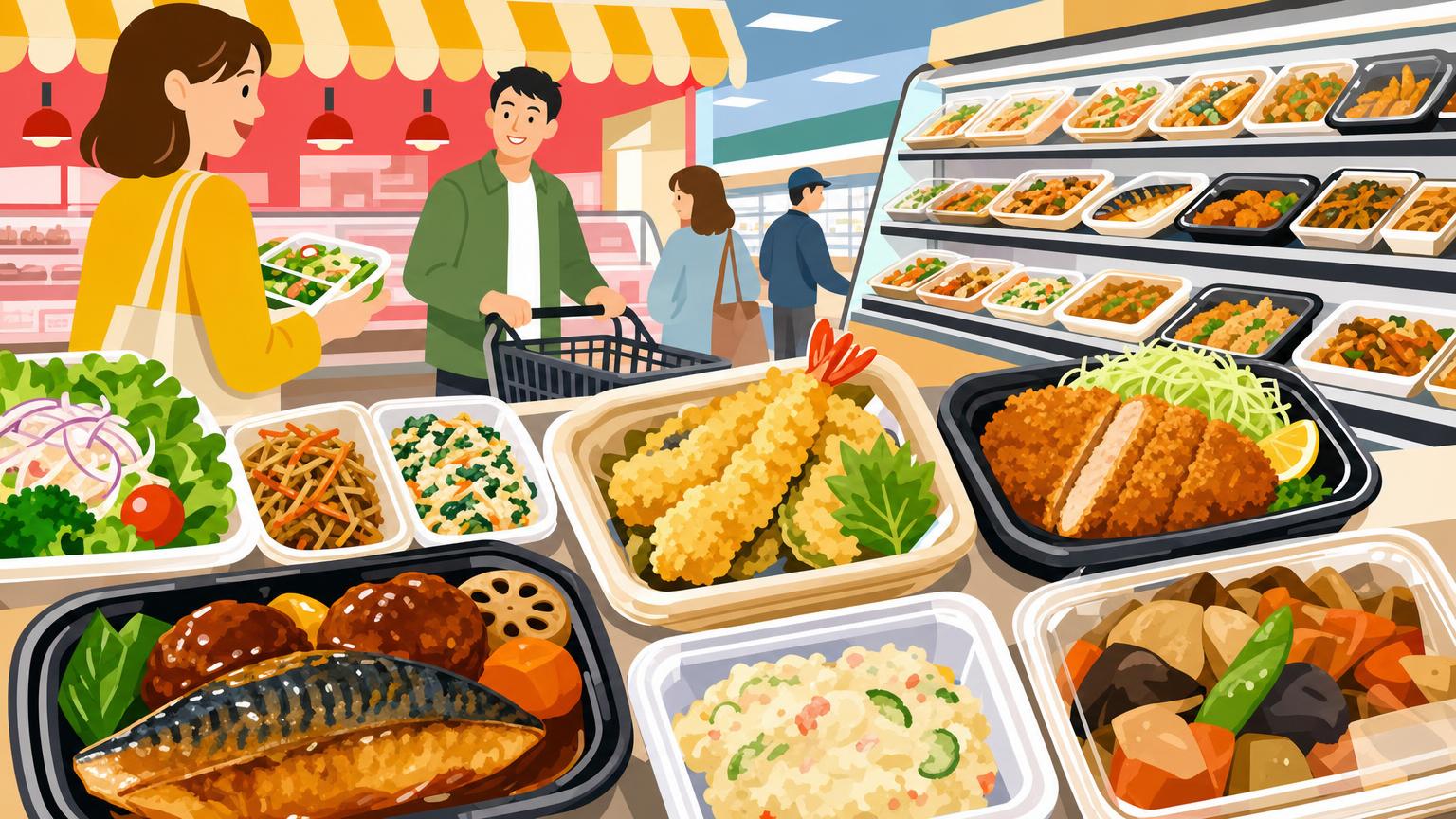
You may notice something slightly confusing when you first live in Osaka, Japan. A supermarket can look like a place for ingredients, yet many local people walk out carrying dinner that is already cooked. There may be fried fish, simmered vegetables, sushi, grilled chicken, rice balls, noodles, and a small dessert—all arranged in tidy trays and bags. Nobody seems embarrassed about buying a ready-made meal. In fact, this is often a sensible, ordinary, and sometimes very good way to eat.
The key word is souzai (惣菜). Souzai means prepared deli food: dishes made in advance and sold for eating at home, rather than meals eaten in a restaurant. The word covers much more than “takeout.” It belongs to the rhythm of ordinary Japanese life. A busy office worker may buy two side dishes after work. A parent may add croquettes to a home-cooked dinner. A single resident may choose a bento, miso soup, and fruit instead of cooking for one. An older person may visit the supermarket daily, buying only what is needed for that evening.
To understand souzai is to understand something important about living in Osaka. The city is not only loud streets, comedy, food signs, or fast conversation. It is also practical domestic life. People compare prices, avoid waste, know which shop has better fish, and make small decisions that save time without making dinner feel careless. The supermarket is one of the clearest places to observe this mindset.
This article explains how souzai works, what Osaka residents actually buy, how people use ready-made meals at home, and what foreigners often misunderstand about supermarket food culture. It is not a sightseeing checklist. It is a guide to the everyday Osaka behind the front door.
What Souzai Means in Everyday Osaka Life
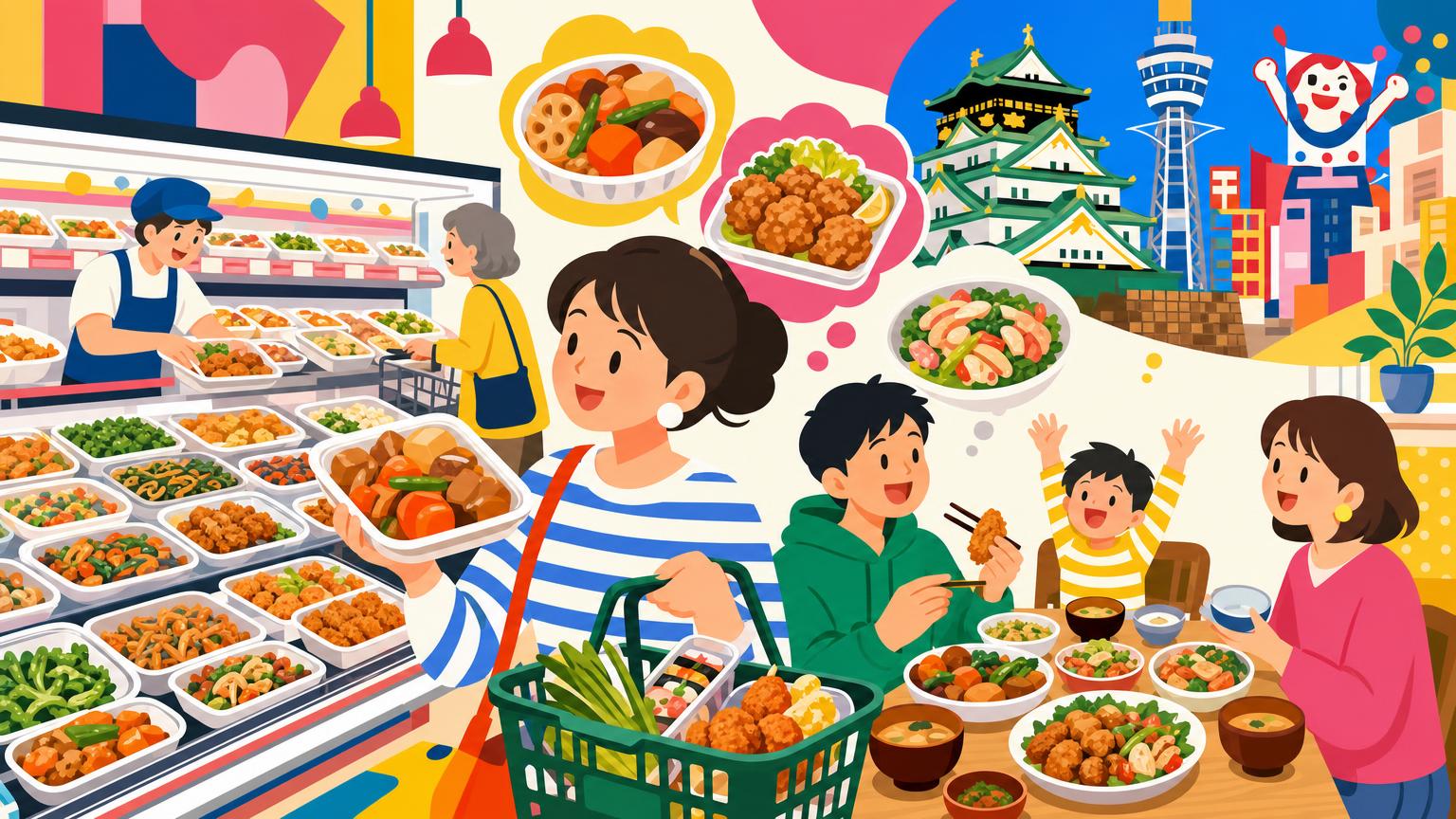
Souzai is easiest to grasp when you stop translating it simply as “prepared food.” In Osaka, it forms part of the home meal system. A Japanese dinner doesn’t always rely on one large dish made from scratch. Instead, it can be composed of several small elements: rice from the cooker, miso soup from a packet or pot, vegetables from the previous day, grilled fish from the supermarket, and a few pieces of karaage (fried chicken) bought on the way home.
This doesn’t necessarily mean the household has stopped cooking. Many people prepare some parts of a meal and buy others. One person might make rice and a salad but purchase croquettes. Another could cook a large pot of curry and use supermarket side dishes on a busy evening. A family might prepare breakfast and lunch at home but rely on souzai after a late shift.
The key idea is combination. Japanese food culture often prioritizes a balanced table with a variety of tastes and textures. Souzai enables that balance without requiring every dish to be made from raw ingredients.
Why the word matters
A bento is a complete boxed meal. Souzai is broader. It includes individual dishes sold by weight, in small containers, or on trays. A supermarket may have a deli counter offering:
- Simmered pumpkin
- Spinach with sesame dressing
- Potato salad
- Hijiki seaweed
- Pickled vegetables
- Fried oysters
- Tempura
- Grilled mackerel
- Yakitori-style chicken
- Chinese-influenced stir-fried vegetables
- Sushi rolls and inari sushi
Customers choose how much to buy. This is important in a city with many small households and numerous people living alone. You don’t have to buy a family-sized package just because you want one portion of vegetables.
The word also implies a different attitude toward convenience. In some English-speaking cultures, “ready-made meal” can sound industrial, lonely, or nutritionally poor. In Osaka supermarkets, the category is more flexible. Some souzai is inexpensive and mass-produced. Some is carefully prepared in-store. Some is intended for a family dinner. Some is a snack to enjoy with a drink. Some is a seasonal dish that would take too long to prepare at home.
So, when an Osaka resident buys souzai, the choice may have little to do with laziness. It may be about time, portion size, price, energy, household size, or simply wanting a particular dish.
The Osaka Mindset Behind Supermarket Meals
Osaka is often contrasted with Tokyo using broad personality labels. Tokyo is seen as formal, competitive, and status-conscious, whereas Osaka is viewed as relaxed, humorous, and straightforward. However, these descriptions are overly simplistic and unreliable. They can also cause issues for foreigners by turning social behaviors into personality stereotypes.
A more practical distinction lies in orientation. In Osaka, affection is often shown through usefulness. People might tell you where to find a cheaper option, recommend a better store, ask if you’re eating well, or tease you for paying too much. This isn’t necessarily about being universally warm or informal; it’s a style of interaction that can be direct, efficient, and personal all at once.
Supermarkets illustrate this style well. The question isn’t just, “Does this look appealing?” but also:
- Is the portion worth the price?
- Can I use this with rice tomorrow?
- Is the fish fresh enough for the discount?
- Is this a good deal, or just flashy packaging?
- Can I feed two people without spending restaurant money?
In Osaka, discussing value openly is common. People freely talk about price, quantity, and whether a purchase is worthwhile. The term okaido is sometimes used for bargains or good-value items, though most shoppers might simply say something is yasui (cheap) or otoku (good value). The language is straightforward because decisions are practical.
Cheap does not always mean low status
Foreign residents sometimes assume buying discounted supermarket food indicates financial struggle. While this may be true for some, the assumption is too broad. Many middle-class families buy discounted prepared foods because wasting food is wasteful, and there’s no need to pay full price late at night.
A person in work clothes might stand next to a student or elderly neighbor, all waiting for the same discount stickers. This scene isn’t dramatic but simply efficient. The food is still edible, the timing is right, and the price has dropped.
Osaka has a strong culture of distinguishing cheap from good value. Cheap items may be low quality, but good-value items can be fresh, filling, and versatile. Experienced shoppers don’t just chase the lowest price; they consider the date, portion size, ingredients, cooking method, and whether their household will actually eat it.
Humor and the supermarket experience
Osaka’s humor style can show up in everyday shopping but is usually subtle. A friend might joke you bought “too much luxury” for picking expensive sashimi. A cashier might make a small comment about unusually hot weather. A family member might criticize an impractical purchase while eating half of it later.
Foreigners often misunderstand Osaka directness in two opposite ways: some think every joke signals deep friendship; others take blunt remarks as insults. Neither is always accurate. Context is key. Supermarket conversations tend to be brief and practical, while family and neighborhood interactions allow more teasing.
The safest approach is to gauge the level of relationship. Don’t mimic strong Osaka-style joking with strangers just because you’ve seen it on TV. But don’t assume a practical comment about your shopping is hostile either. In daily life in Osaka, criticism and care often go hand in hand.
How a Typical Supermarket Dinner Comes Together
A ready-made meal in Osaka is seldom consumed exactly as it is purchased. Many locals enhance, divide, or combine the items. This is one reason why souzai feels more like homemade food than restaurant fare.
A typical evening meal might consist of a bowl of rice, supermarket-grilled fish, a packaged salad, and miso soup. Another option could be a bento shared with some extra fruit. A single person might buy a small sushi pack, add a convenience-store-style cup of soup, and save yogurt for later. Someone working late might opt for noodles, fried chicken, and a green vegetable dish.
The meal is often tailored according to appetite and available time. A tray can become lunch the next day, although fried items may lose their texture overnight. Rice and side dishes are sometimes separated. Larger packages can be transferred onto plates instead of being eaten directly from the container, especially when dining with others.
The role of rice
Rice remains a key staple, even when main dishes are purchased. Supermarket meals are often designed to be paired with rice. Fried shrimp, grilled salmon, pickles, and simmered vegetables all complement a bowl of plain rice.
This contrasts with the Western notion that a ready-made meal should be self-contained. In Japan, a supermarket side dish may not appear filling by itself because it’s not meant to be the whole meal. It’s intended as part of a larger spread.
Foreigners living in Osaka sometimes buy a small tray of fried food and find it unsatisfying. The missing element is not necessarily more meat; it could be rice, soup, or a vegetable side dish. Once the intended combination is understood, supermarket food becomes much easier to enjoy.
Portion size and household size
Many Japanese apartments have limited kitchen and storage space. Refrigerator sizes vary, and not everyone wants to cook a large pot for one person. Souzai addresses this issue by offering small portions.
For a single resident, buying a small pack of spinach, two pieces of grilled fish, and one bowl of rice can be more practical than purchasing ingredients that may spoil. For couples, multiple side dishes provide variety without producing leftovers for days. For families, larger trays and multi-piece packs facilitate a quick dinner.
This is why the supermarket deli section can feel more significant in Osaka than foreigners might expect. It is not merely competing with restaurants; it is supporting everyday household needs.
The Foods Osaka Residents Commonly Buy
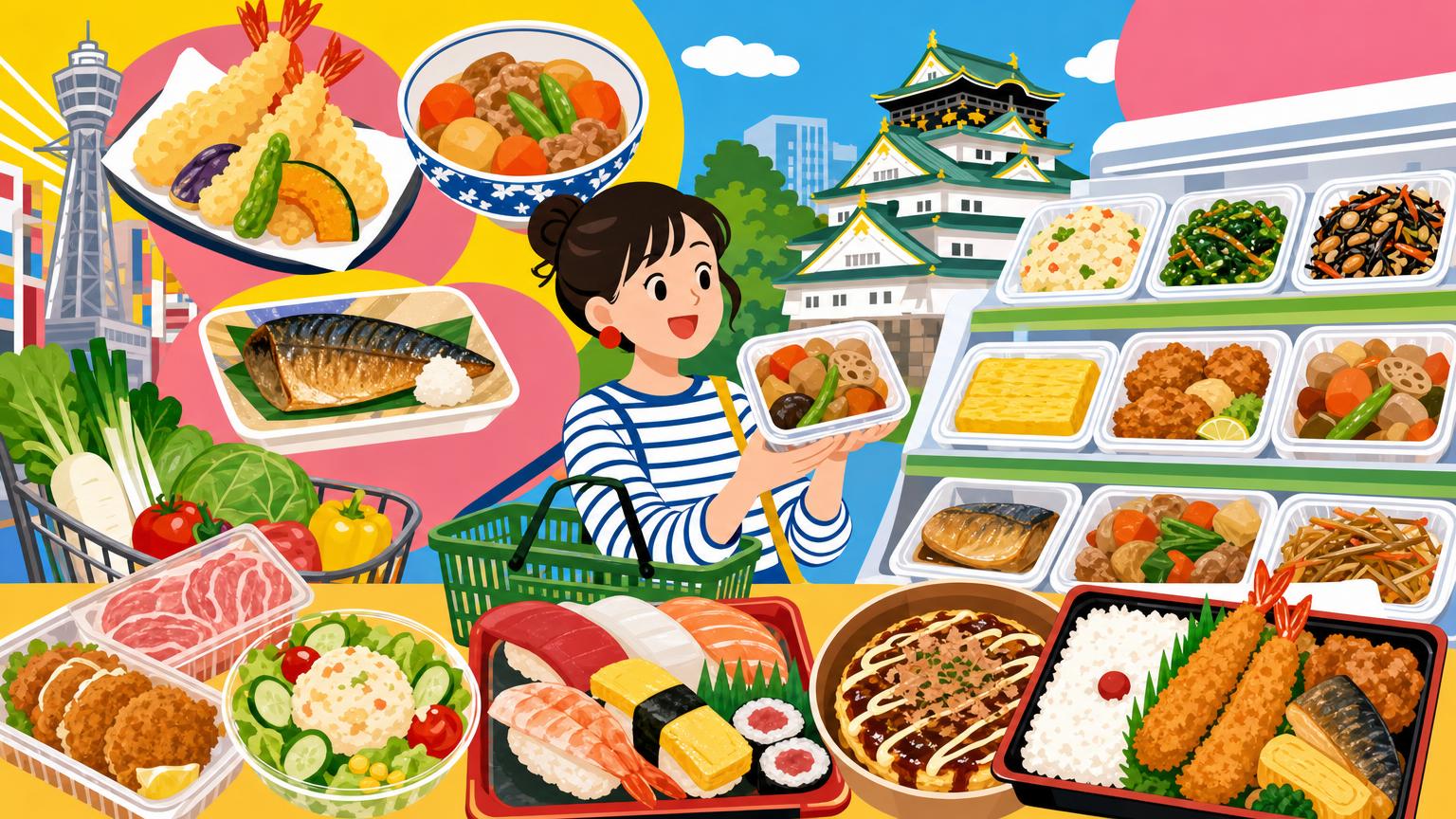
Osaka is famous for dishes like takoyaki and okonomiyaki, but the local supermarket culture encompasses much more than just these specialties. Often, the most telling foods are everyday items: fish, fried vegetables, rice, noodles, pickles, and prepared dishes that fit seamlessly into work and family life.
Grilled fish and simmered dishes
The fish section offers a great insight into Japanese supermarket cooking. You might find grilled salmon, mackerel, saury, eel, or seasonal fish prepared with salt, soy sauce, miso, or a sweet-savory glaze.
The texture is typically soft and moist, rather than heavily seasoned. Grilled mackerel often has crisp skin and rich fat, while a salmon fillet may be salty enough to enjoy with plain rice. Simmered fish tends to be tender, with a sauce that complements rice when spooned over it.
These dishes are especially helpful for foreign residents seeking a Japanese-style dinner but who aren’t yet comfortable cooking fish themselves. They also demonstrate how a home meal can be assembled rather than strictly following a single recipe.
Be cautious of bones; even fish labeled as prepared or grilled may contain small bones. Eat slowly, particularly if you are unfamiliar with the species.
Karaage, croquettes, and tempura
Fried foods form a major part of the souzai section. Karaage is bite-sized fried chicken, usually marinated with soy sauce, ginger, garlic, or sake before being coated and fried. Good karaage features a crisp crust and juicy interior. Supermarket varieties vary widely but are often convenient for a quick dinner or packed lunch.
Croquettes, known as korokke, may include mashed potato, minced meat, cream sauce, crab, corn, or vegetables. A simple potato croquette is inexpensive and filling, while a cream croquette offers a softer texture and can be surprisingly rich.
Tempura may feature shrimp, eggplant, sweet potato, pumpkin, lotus root, or green pepper. It’s best eaten soon after purchase, though reheating in an oven or toaster oven can restore some crispiness. Microwaving will warm it but usually softens the coating.
These foods reflect Osaka’s preference for hearty, straightforward satisfaction. They aren’t always elegant, but they are warm, salty, crunchy, and pair well with rice—often exactly the point.
Takoyaki and okonomiyaki in supermarkets
Takoyaki is deeply associated with Osaka, but supermarket takoyaki is quite different from the freshly cooked versions found on streets or in restaurants. Fresh takoyaki has a soft, almost liquid center and a hot, delicate exterior, while supermarket takoyaki tends to be firmer after cooling and reheating.
Nonetheless, it can serve as a convenient household snack or casual meal. Add sauce, mayonnaise, green seaweed, and bonito flakes if they aren’t already included. Reheat gently, as the center can become extremely hot before the outside feels warm.
Okonomiyaki is a savory pancake typically made with cabbage and batter, with variations containing pork, seafood, or other ingredients. Supermarket versions are practical dinners when you want something satisfying without dining out. The cabbage provides softness and volume, while the sauce adds sweetness and salt.
For Osaka residents, these dishes are everyday food rather than cultural performances. Someone may buy okonomiyaki simply because it’s convenient on a rainy evening, not to celebrate “Osaka food culture.” This distinction is important: local identity often resides in ordinary repetition, not just famous dishes.
Sushi, inari, and makizushi
Supermarket sushi is common in Osaka households, especially on busy evenings, weekends, or when someone prefers a lighter meal. You can find mixed sushi trays featuring salmon, tuna, shrimp, squid, egg, and seasonal fish. Inari-zushi is sushi rice encased in sweet soy-seasoned tofu pockets, and makizushi refers to rolled sushi.
Quality and price vary widely. A basic tray may be designed for a quick meal, while larger sets include better fish and more careful presentation. Always check the sell-by time and keep sushi cool—don’t leave raw fish in a warm room for hours.
Sushi demonstrates how supermarkets provide flexible meal options for different households. One person might buy six pieces; a family can buy a larger tray. Those who avoid raw fish can choose grilled, cooked, or vegetable varieties.
Noodles and rice bowls
Look for chilled udon, soba, yakisoba, and pasta dishes, often designed for microwave reheating. These meals tend to be more filling than a small bento and easier to eat at a desk or at home.
Rice bowls may include beef, pork, chicken, curry, eel, or vegetables. A donburi is a bowl meal served over rice. Supermarket varieties are handy when you want a complete single portion without purchasing multiple dishes.
The Osaka approach often adapts meals to the day. After a long commute, a hot rice bowl might suffice. On a lighter day, sushi and fruit could be preferable. The supermarket makes these adjustments simple.
Souzai Is Not the Same as Convenience-Store Food
Foreigners often lump all Japanese ready-made food together, but supermarkets and convenience stores cater to different needs.
A convenience store prioritizes speed and accessibility. It is handy late at night, near transit stations, or when you need a single item quickly. The food is usually standardized, individually packaged, and ready to eat without extra preparation.
A supermarket typically offers greater variety in quantity, cooking methods, freshness, and price. You can purchase a family-sized tray, a single side dish, raw ingredients, fruit, pantry staples, and dessert all in one trip. The deli section is just one part of a larger household-focused store.
This difference is key to understanding daily life in Osaka. A convenience store can save you on a late night, while a supermarket supports daily routines. Many locals shop at supermarkets with a plan, even if that plan is simply “find something for tonight without spending too much.”
How Discount Stickers Work
One of the most practical everyday supermarket customs is the use of discount stickers. In Japanese, people often refer to half-price discounts as han-gaku (半額). Other reductions might be indicated by percentages such as 20 percent or 30 percent off.
These discounts usually apply to food items that need to be sold quickly, like sushi, bentos, fried foods, salads, or bakery goods. The exact timing varies depending on the store, day, weather, stock levels, and staff schedules. There is no universal rule that half-price stickers are put on at a fixed time.
A typical pattern is that discounts become more apparent in the late afternoon or evening, though this should not be relied upon as a certainty. Busy stores might sell out before the deepest discounts appear. Quiet stores might start discounting earlier. Rainy weather can affect demand, and holiday periods can influence the quantity of food prepared.
The etiquette of discount hunting
There is an unspoken social rule: wait until the staff have finished applying the stickers. Do not block the workers, reach over their hands, or pressure them to apply discounts immediately. If several shoppers are waiting, stay calm and let the process proceed smoothly.
People may gather nearby, but the atmosphere tends to remain controlled. The aim is not to create a public competition but simply to purchase food at a reasonable price.
Do not peel off a sticker from one item and put it on another. Do not open a package to check the food unless the packaging is damaged and you require assistance. Avoid buying more than you can eat simply because the price is appealing. Cheap food that ends up wasted is no bargain.
How to judge whether a discount is worthwhile
Check the sell-by date and the condition of the food. A discount sticker does not indicate the food is unsafe, but it does mean you should follow the handling instructions carefully. Eat chilled dishes promptly and refrigerate them as needed.
Consider reheating options. Fried foods might still be enjoyable when reheated, while delicate sushi should not be heated. Salads and sashimi differ from cooked dishes in this regard. If you are buying food after work and won’t eat it until much later, the lowest price may not be the best choice.
Experienced shoppers in Osaka often assess the full value: price, quantity, freshness, appetite, and convenience. You can develop the same habit quickly.
How to Reheat Supermarket Food at Home
Japanese supermarket foods often include reheating instructions, though these may be written only in Japanese. Look for a microwave symbol, wattage, and heating time. Common instructions often indicate 500W or 600W, followed by a specific number of seconds or minutes.
Microwave power differs between models. If your microwave is more powerful than the instructions suggest, use a shorter heating time and check the center of the food. Covering the food can help prevent splatters, but do not microwave sealed packaging unless it is explicitly designed for that purpose.
Foods that reheat well in the microwave
Rice bowls, curry, noodles, takoyaki, okonomiyaki, and many cooked bentos generally reheat well. Open or loosen the film as instructed. Some containers have a corner that should be lifted before heating.
If possible, stir sauces or dense foods. The center may stay cold while the edges become very hot. Let the food stand briefly before eating.
Foods that require different treatment
Tempura and croquettes are usually better reheated in a toaster oven, oven, or air fryer if you have one. Microwaving them warms the food but softens the coating. Grilled fish can be microwaved carefully, though the smell may linger. Sushi should generally be eaten chilled or at room temperature according to the product instructions, not reheated like a rice bowl.
Plastic film, trays, and small sauce packets may have different heating guidelines. Remove anything that is not microwave-safe. When unsure, transfer the food to a ceramic plate.
Using a shared kitchen or workplace microwave
If you live in a shared house or use an office microwave, be considerate of others. Fried fish can leave a strong odor. Heat food in short intervals and clean the microwave if anything spills. Avoid bringing strongly scented food into small communal spaces if others are eating nearby.
This reflects a small example of Japanese public etiquette: convenience is accepted, but it should not cause problems for others.
Where Osaka Residents Buy Souzai
The best supermarket varies depending on your neighborhood, schedule, budget, and level of cooking experience. There is no single “best supermarket in Osaka” that suits everyone.
Life and Central Square stores
Life is a well-known supermarket chain in Osaka and other parts of Japan. Its stores typically offer a wide range of fresh food, prepared meals, household items, and everyday groceries. Central Square locations are larger and often feature a broader selection of prepared foods and premium ingredients compared to smaller neighborhood branches.
Life Central Square Namba, located in Minatomachi near JR Namba, is open from 9:00 a.m. to midnight based on current store hours, though individual departments and services may have different operating times. Its size and location make it convenient for residents of Naniwa, Namba, and surrounding areas, illustrating a broader point: a large urban supermarket can serve commuters, families, elderly residents, and individuals living alone all at once.
When selecting a Life store, consider the neighborhood instead of just the brand name. A store near apartment complexes might have high demand for bentos and side dishes in the evening, while one near office areas may focus more on single-portion lunches. Larger stores often provide superior fish, meat, bakery products, and seasonal items.
Aeon and larger food halls
Aeon and Aeon Food Style stores are helpful when you want reliable basics, private-label products, household supplies, and a wide selection all in one location. Some stores are large, while others are smaller urban versions, with product ranges varying accordingly.
For foreign residents, larger supermarkets can be less overwhelming because categories are well-organized and there is generally enough space to compare products. However, bigger stores don’t necessarily mean better quality for every item. Smaller neighborhood supermarkets may have closer ties with the local community and stocks that better reflect the specific tastes of that area.
Super Tamade and discount-focused shopping
Super Tamade is known for low prices and a distinctive, bold appearance in Osaka. Its attraction is straightforward: shoppers searching for affordable groceries can find basic staples, drinks, snacks, and prepared foods at competitive prices.
The shopping environment can be more intense compared to polished suburban supermarkets. Prices, promotions, and store conditions can vary between branches. If you’re comparing stores for regular shopping, visit at your usual shopping time. A store that excels in low-cost staples may not be the best choice for every type of fish, produce, or specialty ingredient.
This highlights another way Osaka differs from a simple tourist image: “cheap” doesn’t necessarily mean “best.” Residents often use multiple stores for different needs—one shop for rice and drinks, another for vegetables, and yet another for quality sashimi or prepared fish.
Neighborhood supermarkets and small food shops
Do not overlook smaller local supermarkets. In residential districts such as Tennoji, Joto, Higashiyodogawa, Nishinari, or parts of Sumiyoshi, a modest shop may be more central to daily life than a well-known chain.
Small stores can reveal local food preferences. One location might have an outstanding fried-food counter, another may specialize in fish, and another could offer affordable vegetables, catering to older residents who cook regularly. How products are displayed can indicate what the neighborhood values most.
If you’re deciding where to live in Osaka, proximity to supermarkets matters. A beautiful apartment far from affordable grocery options can quickly become inconvenient. Consider your route home, store closing times, bicycle parking availability, and whether the store carries the types of food you typically buy.
What Foreign Residents Often Misunderstand
“Buying prepared food means people do not cook”
This is a common misconception. Many individuals who purchase souzai also cook at home. They might use prepared food as just one part of the meal, rather than a complete substitute for home cooking.
Cooking in Japan can be both physically and mentally challenging. Ingredients must be shopped for, washed, chopped, stored, and cleaned up afterward. Sometimes, making rice and soup alone feels like enough effort for one evening. Buying a vegetable side dish doesn’t diminish the meal; it helps make the meal more manageable.
“All supermarket food is highly processed”
While some items are indeed highly processed, as is the case everywhere, others are simple cooked dishes made from recognizable ingredients. The deli section offers a variety of options, from fresh-cut fruit and grilled fish to fried foods, salads, and industrially packaged meals.
If you have allergies or dietary restrictions, be sure to read labels carefully. Prepared foods may contain soy, wheat, eggs, milk, sesame, shellfish, fish extracts, or meat-based stocks. Japanese labels are detailed, but you might need assistance with translation. Don’t assume a vegetable dish is vegetarian; dashi, sauces, and garnishes often include fish or animal products.
“Osaka food is always bold and heavy”
Osaka’s cuisine includes rich, salty, sweet, fried, and sauce-packed dishes, but everyday meals are not always intense. Many residents eat plain rice, grilled fish, tofu, vegetables, and miso soup. Supermarkets stock both robust flavors and milder foods.
Famous dishes represent just one aspect of Osaka’s culinary identity. Everyday Osaka also embraces seasonal produce, affordable fish, home-style simmered dishes, and small servings of a variety of foods.
“People are more casual, so rules do not matter”
Although Osaka residents may seem more verbally expressive than those in Tokyo, this doesn’t mean public manners are ignored. Queuing, payment procedures, recycling, food handling, and consideration for others are still important.
A cashier might speak in a conversational tone, but the transaction follows a clear structure. A neighbor may joke with you, but immediate familiarity should not be assumed. Even in a relaxed-looking store, you should not photograph employees or customers without permission. Casual speech and respect for social boundaries coexist.
Osaka Compared with Tokyo Through Supermarket Habits
The difference between Osaka and Tokyo is not that one city cooks while the other does not. Both cities feature supermarkets, convenience stores, department-store food halls, local markets, and bustling households.
The distinction is better grasped through atmosphere and scale. Tokyo’s supermarket experience can feel highly segmented by neighborhood, income level, and commuting habits. In Osaka, there is often a more apparent blending of practical shopping styles. A discount-oriented store, a typical chain supermarket, a specialty fish shop, and a department-store basement can all serve different roles in a single person’s life.
Osaka’s urban geography also influences food routines. Dense neighborhoods around Namba and Tennoji encourage late shopping and support smaller households. Residential areas farther from the city center may facilitate larger weekly purchases. Areas near Umeda cater to office workers and apartment residents with varying schedules. Waterfront, suburban, and older neighborhoods each foster distinct shopping patterns.
Tokyo may feel more anonymous in certain interactions, whereas Osaka might invite more verbal engagement. However, this should not be taken as a fixed rule. A Tokyo supermarket worker can be friendly, and an Osaka cashier may be reserved. The meaningful difference is not a personality contest but rather how the city’s practical culture often manifests openly through price discussions, recommendations, teasing, and direct comparisons.
How to Become Comfortable Shopping in Osaka
You don’t need to be fluent in Japanese to start shopping at supermarkets, but knowing a few words can make daily life much easier.
Useful words and labels
- Souzai — prepared deli food or side dishes
- Bento — boxed meal
- Han-gaku — half-price
- Wari-biki — discounted or reduced price
- Shōmi kigen — best-before date, usually indicating quality rather than immediate safety
- Shōhi kigen — use-by date, which applies to foods with a stricter safety deadline
- Atatamete kudasai — please heat it up
- Fukuro — bag
- Hashi — chopsticks
- Spoon — spoon, often written in katakana as supūn
- Reji-bukuro — checkout bag
While it’s important to understand the difference between best-before and use-by dates, proper handling of products is still essential. Keep chilled items refrigerated and follow the instructions on the packaging.
Watch how regular shoppers behave
Pay attention to shoppers’ movements. Most people keep their carts or baskets nearby, avoid blocking narrow aisles, and decide quickly once they’re familiar with the store layout. At deli counters, shoppers often use tongs or trays provided by the store. At checkout, payment is sometimes made at a separate machine even when a staff member is scanning items.
Don’t worry if you’re slower at first. You can step aside to let others pass and take your time reading labels. The aim isn’t to copy everyone exactly but to avoid creating unnecessary pressure in crowded areas.
Build your own shopping route
A practical routine could include one main supermarket near your home, a cheaper store for staples, and a shop with higher-quality fish or specialty products. You’ll learn which days have better produce, what times offer discounts, and which checkout lanes are faster.
This routine can help you feel more settled in Osaka. Getting to know a city isn’t just about learning train routes; it’s also about knowing where to buy dinner when you’re tired, where to find food after work, and which stores still have good vegetables late in the day.
Souzai and the Reality of Living in Osaka
The supermarket deli section reveals a subtle truth about urban life: people are constantly balancing ideals with their available energy. They may desire healthy food, low prices, variety, freshness, and a clean kitchen. On a busy weekday, achieving all five is challenging.
Souzai offers a compromise. It can be economical without feeling entirely cheap, convenient without being completely disposable, and local without demanding specialized cooking skills. It allows people to maintain a familiar home-cooked meal even when time is tight.
This is especially relevant to foreigners considering life in Osaka. The city can be exciting, but everyday life is not an endless food festival. You will face wet laundry, late trains, paperwork, work stress, small kitchens, and evenings when cooking feels overwhelming. Knowing how to navigate supermarkets effectively is not just a minor travel tip; it’s essential for living comfortably.
You may also observe that supermarket food creates a connection between independence and community. You select your own meal, yet the food reflects local tastes, supply chains, seasonal habits, and neighborhood demand. You can eat alone without feeling that every meal requires dining out. You can host a casual dinner without preparing everything from scratch. You can buy food for a sick friend or a tired colleague without making a grand gesture.
That practical care is easy to overlook if you only focus on famous Osaka dishes. It shows up in the small container of simmered vegetables, the carefully arranged fish, the discounted bento, and the extra croquette someone brings home because they know you like it.
Frequently Asked Questions About Supermarket Food Culture in Osaka
What is the best supermarket in Osaka for everyday meals?
There is no definitive answer. Life is often a reliable all-around choice for prepared foods, fresh ingredients, and household shopping. Aeon can be convenient for a wide selection and essential basics. Discount stores like Super Tamade may appeal to shoppers prioritizing low prices. Smaller neighborhood supermarkets might offer the best local value in specific areas.
The best supermarket is usually the one that fits your route home, budget, cooking habits, and food preferences. Visit more than once before making a decision. A single trip can be affected by holidays, bad weather, or unusual stock.
What is souzai in Japan?
Souzai refers to prepared deli foods or ready-made side dishes sold for eating at home. This includes fried items, grilled fish, salads, simmered vegetables, sushi, noodles, and other cooked dishes. It is not limited to a single complete boxed meal.
Is supermarket food in Osaka healthy?
It can be, but it depends on what you choose and how frequently you eat it. Supermarkets offer vegetables, fish, tofu, fruit, plain rice, and lightly cooked dishes, as well as fried and salty foods. A balanced meal can be created from several smaller items.
If you rely heavily on souzai, try to vary your choices. Add fruit, vegetables, soup, or plain rice when appropriate, and be mindful of salt, sugar, and portion sizes.
When do Osaka supermarkets put on half-price stickers?
There is no set citywide time. Discounts often appear later in the day, especially on items meant to be sold soon, but the timing depends on the store, demand, weather, and remaining stock. Observe the store over several visits instead of expecting a guaranteed time.
Can I ask a supermarket to heat my food?
Some stores provide microwave ovens or heating services, while others do not. If you want your food heated, ask politely with “atatamete kudasai.” If the store does not offer this service, take it home and follow the package instructions. Do not assume every container is microwave-safe.
What food should I buy when I am new to Osaka?
Start with familiar combinations instead of trying to understand everything at once. Buy rice or a rice bowl, one cooked protein such as grilled fish or karaage, one vegetable side dish, and fruit or yogurt. Then gradually try takoyaki, okonomiyaki, inari sushi, simmered vegetables, and seasonal items.
Is supermarket food cheaper than eating at a restaurant?
Often, especially when buying a single portion or using discounts, but not always. Premium sushi, wagyu, prepared salads, and imported products can be costly. Compare the full meal rather than individual items. A cheap bento may be less satisfying than rice with two small side dishes.
What do Osaka people eat on an ordinary evening?
There is no single typical Osaka dinner. A household might eat rice, miso soup, fish, vegetables, tofu, pickles, and a small souzai dish. Another person might have curry, noodles, sushi, okonomiyaki, or convenience-store food. The usual meal is flexible and influenced by work, family, appetite, and budget.
The Small Lesson of the Supermarket Aisle
If you want to understand what people from Osaka are like, don’t focus solely on dramatic friendliness or loud humor. Observe how they handle everyday problems.
They compare two trays of fish, deciding if a discount justifies the date. They pick one side dish to avoid wasting ingredients. They complain about the price but buy it anyway. They tease a family member for choosing expensive sushi. They bring home food that isn’t completely homemade but still counts as dinner.
Souzai portrays Osaka as a city of practical compromises. People want good food, but they also have jobs, small kitchens, limited time, and real budgets. They don’t always pick the cheapest or flashiest option. They choose what works best.
This is why local supermarket food culture is important. It reveals how daily life is organized, how convenience becomes part of home cooking, and how Osaka’s straightforward, value-conscious nature shows up without pretense. Once you grasp souzai, a supermarket visit no longer seems like a confusing array of plastic trays. Instead, it becomes a map of the city’s everyday mindset.