You step out of your apartment building into the dense, humid morning air. The street is narrow, barely wide enough for a single car, flanked by low-rise apartment blocks and the tangled webs of utility lines overhead. The city is waking up, but the soundtrack is not the roar of heavy traffic or the distant wail of sirens. The soundtrack is a rhythmic, metallic symphony. You hear the sharp snap of a kickstand springing up. You hear the whir of well-oiled chains. You hear the low, steady hum of rubber tires pressing against the uneven asphalt. You hear the creak of heavy steel frames carrying the weight of the morning commute.
Before you have even reached the corner, three people glide past you. A middle-aged man in a sharp navy suit pedals furiously on a rented electric two-wheeler, his briefcase clamped tightly into the front basket. A high school student coasts by, hands completely off the handlebars, navigating the concrete curves with the fluid, effortless grace of water flowing downstream. Then comes the true monarch of the street: a grandmother on an impossibly heavy, silver-framed bicycle, an umbrella clamped to the handlebars, carrying two massive bags of groceries while effortlessly dodging a delivery truck. This is the heartbeat of the city. This is the rhythm of the streets. This is Osaka on wheels.
To understand Osaka, you have to understand the ‘chari’. The word itself is an affectionate, colloquial abbreviation for ‘jintensha’, the formal Japanese word for bicycle. But in Osaka, a chari is far more than a mode of transport. It is an extension of the self. It is a tool of pure, unadulterated practicality. Tourists and short-term visitors often look at the sprawling train maps of the Kansai region and assume that life here, much like in Tokyo, is dictated entirely by the railway timetable. They see the neon lights of Dotonbori, the towering steel of the Umeda Sky Building, and they imagine a life lived moving from one massive station to another. But those who live here know the truth. Trains are for crossing the city. The chari is for living in it.
Tokyo is a city of subterranean silence. It is a city of rigid order, where millions of people move underground with quiet, calculated precision. Tokyo waits for the pedestrian signal. Tokyo stands perfectly in line. Osaka, however, is a city of the surface. It is a city of the immediate, a sprawling, flat concrete grid built on ancient river deltas, perfect for human-powered momentum. Osaka does not wait. Osaka flows. Osaka finds the gap and takes it. The mindset of the people here is fiercely pragmatic. If there is a faster, cheaper, more direct way to get from point A to point B, the people of Osaka will take it. And ninety-nine times out of a hundred, that way is the chari.
For a foreigner arriving in this city, whether moving here to study at a local university, taking up an office job in the business district, or simply seeking to immerse themselves in the local culture, the sheer volume of bicycles can be overwhelming. The streets can feel like a chaotic, swirling vortex of metal and motion. You might step onto a sidewalk expecting a quiet stroll, only to find yourself engaged in a high-stakes dance with dozens of fast-moving cyclists rushing to the supermarket. You might buy a cheap bike thinking it will be a simple joyride, only to find yourself towed, fined, or yelled at for breaking rules you never knew existed. This guide is born from the reality of the streets. It is an honest, unfiltered look at the rules, the realities, and the deeply ingrained, unwritten social contracts of navigating Osaka on two wheels. You are about to learn how the city really moves.
Introduction to Cycling in Osaka: Fast, Fun, and Convenient
The geography of Osaka shapes its culture profoundly. Unlike the rolling, steep hills of Kobe to the west or the mountainous basin of Kyoto to the north, central Osaka is predominantly flat. Built on the sediment of the Yodo and Yamato rivers, the city stretches out like a vast, paved pancake. From the northern commercial centers of Umeda down the long, straight spine of Midosuji Avenue, all the way south to the lively, neon-lit districts of Namba and Tennoji, the elevation barely changes. This geographical advantage has influenced both the physical and psychological landscape of the city. You don’t need to be an athlete to cycle across Osaka. You don’t need twenty-one gears or a carbon fiber frame. You just need a destination.
The Anatomy of the Mamachari: The Unsung Hero of the Streets
Walk past any major train station in Osaka, and you will see vast rows of bicycles parked side by side, thousands of them gleaming in the afternoon sun. If you look closely, a clear uniformity emerges. Very few of these are sleek, aerodynamic road bikes you might spot racing down a Californian highway. Very few are rugged, heavily suspended mountain bikes designed for dirt trails. The vast majority belong to a unique Japanese class of bicycle known as the ‘Mamachari.’
The term roughly translates to ‘Mom’s bike,’ but the name is misleading. Everyone rides a Mamachari. Its design is a triumph of pure utilitarian engineering over aesthetics. These bikes are heavy. They are made from thick, unyielding steel. They feature a low-slung, step-through frame, allowing riders to mount and dismount easily, whether wearing a tailored business suit, a tight skirt, or loose summer clothes. They have a large, sturdy wire basket attached to the front handlebars, perfectly sized to carry a heavy bag of rice, a briefcase, or a small dog. Many are outfitted with a heavy-duty rear rack, often fitted with a plastic child seat. They come with a built-in rear wheel lock, an attached dynamo headlight that softly whines against the front tire at night, and a wide, heavily padded saddle designed for comfort rather than speed.
The Mamachari isn’t built for speed or style. It’s designed to endure. It can withstand torrential summer downpours, searing August heat, and carry astonishing loads over uneven pavement for years without any maintenance. In a city that values practicality above all else, the Mamachari perfectly embodies the Osaka mindset. It’s affordable, reliable, and gets the job done without any unnecessary flair.
Tokyo Politeness versus Osaka Practicality
To understand the cycling culture here, you must first grasp the fundamental personality difference between Japan’s two largest cities. In Tokyo, there is a strong cultural emphasis on not causing inconvenience to the group. Rules are followed strictly not just because they are laws but because they preserve the delicate, quiet harmony of a densely packed city. Tokyo residents will wait patiently at a red pedestrian light at two in the morning, even if no cars are visible for miles.
Osaka runs on a very different wavelength. Historically a city of merchants, traders, and hustlers, Osaka values efficiency, directness, and speed. The people here are warm, loud, and incredibly funny, but also deeply pragmatic. If a rule doesn’t make immediate practical sense at the moment, an Osaka resident is likely to bend it. This pragmatic impatience directly influences how the city’s cyclists behave.
You will see people cutting corners, weaving through narrow gaps in crowds, and riding with an aggressive, fluid momentum that can initially feel frightening to outsiders. But over time, you realize it’s not chaotic or hostile. It’s a highly evolved, unspoken system of movement. Everyone is acutely aware of their surroundings. The grandmother weaving toward you won’t collide with you; she has calculated your speed, hers, and the precise trajectory needed to pass with inches to spare. It’s a city that communicates through motion. Still, to participate safely, you must understand the actual legal rules governing the streets, because while locals may bend the rules, the police do not.
The Golden Legal Rules of Biking in Japan (2026 Updates)
For a long time, the relationship between bicycles and the law in Japan was notably lenient. Bicycles existed in a legal gray zone, sometimes treated as pedestrians and other times as vehicles, depending on what was most convenient at the moment. Police officers often overlooked people riding the wrong way down streets or riding with umbrellas in the rain. However, that era is now completely over. The high number of accidents, combined with a nationwide push for traffic safety, has resulted in a significant crackdown.
The April 2026 Shift: A New Era of Enforcement
If you are arriving in Osaka now, you are entering a strictly regulated environment. The traffic law revisions that took full, uncompromising effect in April 2026 have fundamentally changed the scene. Police no longer offer polite warnings; they issue immediate, heavy fines. Checkpoints have been established near major intersections in Umeda, Namba, and along the busy Yodogawa River. They stop foreigners and locals alike with total impartiality. Ignorance of the law is no longer an acceptable excuse. As a resident, you must treat your bicycle exactly as the law does: as a light vehicle.
Keep to the Left: Road and Bike Lane Usage
The most basic, unbreakable rule of the road in Japan is that bicycles must ride on the left side of the street, traveling in the same direction as motorized traffic. For years, some ignored this rule, riding against traffic to save time. Do not do this. It is extremely dangerous, and under the 2026 enforcement guidelines, it will lead to an immediate police stop.
Over recent years, Osaka has painted vivid, unavoidable blue arrows on the left side of the road on nearly every major thoroughfare. These blue chevrons clearly indicate the space you are supposed to occupy. When cycling down Midosuji Avenue—the grand, tree-lined boulevard cutting through the city’s heart—you will find a dedicated, physically separated bicycle lane. It is a beautiful sight. But on most ordinary streets, the blue arrows simply mark the edge of the car lane.
This creates a daily challenge you must master: the careful negotiation with parked cars. Delivery vans, taxis, and quick-stopping drivers often block the blue arrow lane. When you encounter a parked vehicle, you must check over your right shoulder, ensure no car is rapidly approaching from behind, smoothly merge into the main traffic lane to pass the obstacle, and promptly return to the left edge. You must be decisive. Drivers in Osaka are aggressive but predictable; if you hold your line and clearly signal your intentions with body language, they will give you space. Hesitation, wobbling, or sudden swerves put you in great danger.
When Can You Ride on the Sidewalk?
This is perhaps the most confusing aspect of Japanese cycling law for newcomers. Legally, bicycles belong on the road. However, practically speaking, there are wide sidewalks everywhere, and thousands of locals can be seen riding on them.
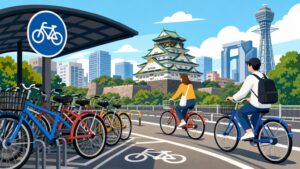
The law explicitly permits riding on the sidewalk only under specific conditions. First, if there is a circular blue sign showing both a pedestrian and a bicycle, the sidewalk is legally shared. Second, riders under thirteen, over seventy, or physically disabled may ride on the sidewalk. Third, and this is the critical gray area, you may ride on the sidewalk if road conditions make cycling on the street demonstrably unsafe.
However, the 2026 updates have tightened enforcement of this rule. If you ride on a shared sidewalk, you are a guest in the pedestrian zone. You must ride on the side of the sidewalk closest to the street, at a speed that allows you to stop immediately—defined by police as walking pace. You must never ring your bell to force pedestrians to move aside. Pedestrians have absolute, unquestioned right of way. If you hit a pedestrian while riding on the sidewalk, regardless of whether they stepped out suddenly, you will be found entirely at fault, facing severe financial liability.
Helmet Regulations Explained
For decades, the idea of wearing a helmet on a Mamachari was considered laughable by locals. Helmets were for serious road cyclists in spandex, not mothers heading to the bakery. But the April 2026 legal changes altered everything. Now, all bicycle riders, regardless of age, must wear certified helmets.
When the law was first announced, there was widespread resistance from Osaka’s fiercely independent residents. Complaints about heat, inconvenience, and messing up hair before work were common. In response, the Japanese market adapted rapidly. Visit any bicycle shop in the city today, and you’ll find not just aerodynamic sports helmets but also helmets cleverly disguised as stylish bucket hats, elegant straw summer hats, and understated canvas caps. These contain hard, certified protective shells inside but look perfectly natural with everyday outfits.
Police enforce this vigorously. If caught riding without a helmet, you will be stopped and fined heavily, and the discomfort of having your residence card run through police radio is significant. Don’t resist the cultural shift: get a hat-style helmet, wear it, and blend into the new street reality.
Strict Prohibitions: No Phones, Drinks, or Umbrellas
Three things will guaranteed lead to severe fines under the new laws.
First is the smartphone. The era of casually holding a phone in one hand for navigation while steering with the other is over. Police impose huge fines for distracted riding. If you need to navigate, you must use a secure, hard-mounted phone holder on your handlebars. Even then, you cannot operate or stare at the screen while moving. Pull over safely to the left, set your feet down, check your route, then continue riding.
Second is riding with headphones. Blocking your hearing cuts you off from the city’s auditory cues. You cannot hear approaching cars, bicycle brake squeaks, or emergency sirens. Police actively look for white earbuds during morning commutes and will stop riders seen wearing them.
Third is a ban that hits the core of traditional Osaka cycling culture: umbrellas. Historically, almost every Mamachari in Osaka was fitted with a device called a ‘sasube,’ a metal clamp on the handlebars holding an open umbrella so riders could stay dry or shaded while keeping both hands on the grips—an iconic, brilliant Osaka invention. The 2026 law completely bans riding with an open umbrella, even if fixed to a sasube. Police argue umbrellas catch wind, destabilize bicycles, and block vision. The ban devastated many local grandmothers, but enforcement is absolute. When it rains now, you must wear a full-body rain poncho. Thousands of people can be seen moving through the wet streets like brightly colored ghosts.
Unwritten Bicycle Etiquette in Osaka
Knowing the traffic laws will help you avoid trouble with the police. However, understanding the unwritten rules—the subtle social etiquette of the pavement—is what truly keeps you safe and earns you the respect of the locals. The legal codes are black and white; navigating the infinitely crowded city in daily life is a complex shade of gray.
Navigating the Local “Mamachari” Culture
When you merge into the flow of bicycles during the morning rush, you become part of a collective organism. There is a rhythm to it. The most crucial skill you can develop as a resident is situational awareness. You need to look not just at the space right in front of your tire, but twenty yards down the street.
You must anticipate sudden stops. In Osaka, people ride to run errands. This means that the rider cruising smoothly ahead of you might suddenly, without looking or signaling, slam on the brakes and veer sharply left because they noticed a discount sign at a vegetable stand. You cannot get upset about this. This is the nature of the city. You should maintain enough distance to react and always keep your hands covering the brake levers.
The Art of the Swerve: Body Language on Wheels
In Tokyo, when two cyclists meet head-on in a narrow space, they often come to a complete stop, politely bow, and awkwardly decide who goes first. In Osaka, stopping is a loss of momentum. The people here have perfected the art of the high-speed swerve.
Riding through a narrow residential alley where another cyclist approaches, you don’t stop. You lock eyes for a split second. In that fleeting exchange, a silent agreement is made based on speed, trajectory, and available space. A slight shoulder shift, a tiny lean of the front wheel, and both riders adjust their paths by inches, passing each other effortlessly without reducing speed. As a newcomer, this may feel like a high-stakes game of chicken. The instinct is to freeze and grab the brakes. Do not freeze. Hold a steady, predictable line. The local rider watches your shoulders. If you are predictable, they will flow around you. Panic and wobble, and you disrupt the calculation, making a crash inevitable.
How and When to Use Your Bell
Your bicycle has a bell. It is shiny and loud, but you should almost never use it.
In Western cycling cultures, ringing the bell is often a polite way of signaling “I’m passing on your left.” In Japan, especially in crowded Osaka streets, ringing your bell at pedestrians is seen as rude, aggressive, and entitled. The bell means “Get out of my way.” Legally, as mentioned before, you are absolutely forbidden from using a bell to clear pedestrians from sidewalks.
So, how do you get past a group of people slowly crossing a narrow street? You have a few options. The most common, and perhaps the most uniquely Japanese, is the tactical brake squeeze. By lightly feathering your brake levers, you intentionally cause the brake pads to emit a high-pitched squeak. This mechanical sound alerts pedestrians behind them that a bicycle is approaching, without the confrontational tone of a bell. The pedestrians will casually part, allowing you to slip through.
If your brakes are silent, use your voice. A quiet, polite “Sumimasen” (Excuse me) will suffice. If they don’t hear you, wait. Slow down to their pace and follow patiently until the road opens up. Never force the issue.
Rules for Shotengai: Covered Shopping Arcades
Osaka is famous for its ‘Shotengai,’ the vast networks of covered shopping arcades winding through the city. Tenjinbashisuji Shotengai, in the northern part of the city, is the longest straight shopping arcade in Japan, stretching over two and a half kilometers. These arcades are vibrant, chaotic arteries of local commerce, packed with butcher shops, tea vendors, cheap clothing stalls, and standing bars. They also generate frequent tension between pedestrians and cyclists.
At the entrance to nearly every major Shotengai, large signs clearly prohibit bicycle riding during daytime hours. You are expected to dismount and push your bicycle through the crowded arcade.
Here is where Osaka pragmatism clashes with the rules. You will see locals, especially the elderly, blatantly ignoring these signs. They ride their Mamachari straight into dense crowds, ringing bells, weaving between annoyed shoppers, unfazed by the chaos they cause.
As a foreign resident, you must not imitate this behavior. You are highly visible already and don’t want to add to the disorder. Locals tolerate the elderly riding through the arcade out of a complex neighborhood resignation, but they won’t extend that tolerance to you. When you reach a Shotengai entrance, squeeze your brakes, step off the pedals, and walk. It’s an opportunity to slow down, smell the fried croquettes, admire the displays, and really experience the neighborhood at a human pace.
Neighborhood Dynamics: How the Ride Changes Across the City
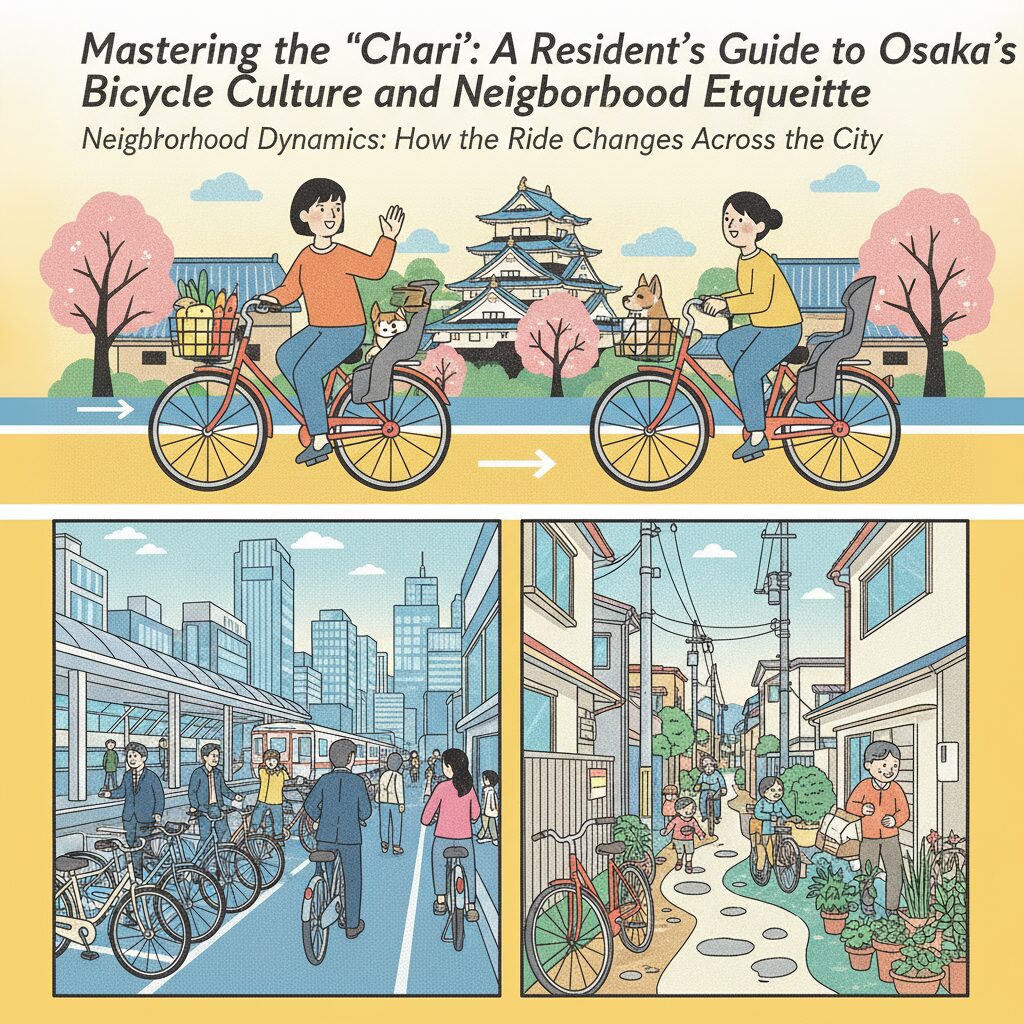
Osaka is a mosaic of distinct neighborhoods, each with its own unique character, architecture, and pace. The way you ride, along with the unspoken rules of the road, changes significantly depending on which part of the city grid you are navigating.
Umeda and the Northern Labyrinth
Umeda, the vast commercial hub in the north, stands as a testament to concrete, steel, and constant construction. It is an intimidating place to ride a bicycle. The roads are wide, multi-lane thoroughfares crowded with speeding taxis, heavy delivery trucks, and aggressive municipal buses. The intersections are large and confusing, often lacking clear, continuous bike lanes.
Additionally, Umeda is renowned for its underground maze. A large portion of pedestrian traffic flows through the extensive underground shopping malls linking the various train stations. Since the surface level is designed primarily for cars, cyclists are often pushed to the edges. Riding here demands intense focus, assertive lane positioning, and heightened awareness of turning vehicles. If at all possible, avoid cycling through the core of Umeda and opt for the quieter streets parallel to the main avenues.
Namba and the Neon Jungle
Traveling south along Midosuji Avenue takes you to Namba, the heart of the “Minami” (South) district. This is the Osaka showcased in tourist brochures: the neon lights of Dotonbori, the giant crab signs, and the relentless crowds of shoppers and partygoers.
Cycling through Namba’s core in the afternoon or evening is almost impossible. The sheer density of people makes forward movement futile. The streets around the iconic Glico Man sign are pedestrian zones, heavily monitored and packed to the brim. However, the real cycling culture in Namba thrives on the periphery. The narrow streets of Amerikamura to the west are alive with youth resting on fixed-gear bikes outside vintage shops. The alleys east of the station form a maze of late-night delivery riders carrying large backpack loads of food. In Namba, it’s best to leave your bicycle at the outskirts and explore the bustling center on foot.
Tennoji and the Deep South
Further south is Tennoji, a district that fuses sleek new skyscrapers with gritty, old-world Osaka character. Here, the terrain works against you. The Uemachi Plateau brings steep, long inclines that are absent in the northern districts.
Cycling in Tennoji is demanding. You’ll see riders standing on their pedals, struggling to push heavy, gearless Mamachari bicycles uphill toward the ancient Shitennoji Temple. The atmosphere here is more relaxed, grounded, and rough around the edges. The roads are somewhat wider, the pace slower, and the unwritten rules a bit more flexible. It’s a captivating area to explore by bike, as long as your legs are prepared for the climbs.
The Quiet Charm of Nakazakicho
For the pure joy of neighborhood cycling, head to places like Nakazakicho, just a short ride east of the Umeda skyscrapers. Miraculously spared from the heavy bombings of World War II, Nakazakicho is a dense, tangled network of very narrow alleys lined with pre-war wooden houses now converted into cozy cafes, vintage shops, and art galleries.
The streets here are too narrow for cars. It’s a sanctuary for pedestrians and slow-moving bicycles. Riding through Nakazakicho feels like stepping back in time. You glide over uneven pavement, maneuvering around potted plants left by residents, while hearing the soft hum of air conditioners and the clinking of coffee cups. Neighborhoods like this are where the chari truly shines, letting you effortlessly weave through the intimate, hidden fabric of the city.
Bicycle Parking in Osaka: Avoid the Tow Trucks
Owning a bicycle in Osaka offers incredible freedom. However, parking one is an absolute nightmare. This is the single most crucial practical lesson for any new resident. You cannot simply ride your bike to a store, station, or café, lower the stand on the sidewalk, and walk away. The city wages a relentless, unending battle against illegal parking.
The Dangers of Rogue Parking
Space in this city is too valuable, and the number of bicycles is too high. If everyone parked wherever they pleased, sidewalks would become completely blocked within hours. To prevent this, the city government deploys numerous parking enforcement officers. Typically, these are older men, easily recognized by their bright green or blue uniforms, who constantly patrol areas around train stations, major shopping districts, and office buildings.
If you park your bicycle illegally on the street, enforcement is swift and unforgiving. First, officers place a bright yellow warning tag on your handlebars. This tag clearly states the bicycle is illegally parked and must be moved immediately. The officers record the exact time of tagging.
If you do not return to move your bike within a very short timeframe—sometimes as little as thirty minutes—heavy machinery arrives. A flatbed tow truck pulls up at the curb. Officers cut any chain locks securing your bike to guardrails, lift your bicycle, load it onto the truck alongside dozens of others, and drive away.
The feeling of stepping out of a café, returning to the spot where you confidently left your trusted ride, and finding nothing but an empty patch of pavement is a rite of passage for every Osaka resident. It’s a sinking, deeply frustrating realization that your afternoon is ruined and your wallet has taken a hit.
How to Find and Use a “Churinjo” Parking Lot
To avoid this fate, you must learn to rely on ‘Churinjo,’ the designated bicycle parking lots. They are abundant but often hidden in plain sight.
Near major stations like Namba and Umeda, space is so limited that the city has constructed massive underground parking vaults. You’ll see simple ramps leading down from the sidewalk into brightly lit underground caverns packed with thousands of bicycles. Elsewhere, surface-level lots are tucked into narrow spaces between tall buildings or beneath elevated train tracks.
Always look for blue square signs with a white bicycle symbol—these mark official parking areas.
Deciphering Parking Signs and Machines
Using a modern Churinjo can be intimidating at first. The most common system consists of individual staggered metal racks with automated locking mechanisms.
You roll your front tire firmly into the narrow metal channel of an empty rack. As you push the wheel in, you’ll hear a sharp metallic click. A locking arm snaps up, securing your front wheel to the rack, preventing the bike from being pulled out. You memorize the number painted on the ground beside your rack.
When you return, you go to the central payment machine. The interface is almost always entirely in Japanese, but the process is straightforward. You enter your rack number on the keypad. The machine calculates the fee based on how long your bike was locked. Rates are very reasonable—usually about 100 to 150 yen for several hours, rarely exceeding 200 yen for a whole day. You insert coins or tap your IC transit card. The machine beeps, the rack’s locking arm lowers, and you have exactly three minutes to pull your bicycle out before it locks again.
Never try to force your bicycle out of the rack without paying. You risk bending spokes, damaging the mechanism, and angering the lot attendants.
What to Do if Your Bicycle Gets Impounded
If you risked illegal parking and lost, you must begin the humiliating trek to the city impound lot.
First, search around the area where you parked. Officers always leave a small paper notice taped to a nearby pole or wall. This notice explains that bicycles parked in that zone were towed and provides the address of the regional impound facility.
These lots are never conveniently located. They are always on the far, desolate, industrial outskirts of the city. You’ll need to take a train, then likely walk a long way through warehouse districts to reach the lot.
Upon arrival, you must present valid photo ID, such as your residence card or passport. You must also bring the key to your bicycle to prove ownership. Most importantly, you must pay the impound fee in cash. It is steep—usually around 2,500 to 3,000 yen. The attendant will take your money, handle the paperwork, and lead you into a massive warehouse filled with thousands of dusty, forlorn bicycles so you can retrieve yours. This miserable experience is designed to ensure you never park illegally again.
Etiquette for Renting and Sharing Bikes
Not every resident wants the responsibility of owning a bicycle. In recent years, the streets of Osaka have been transformed significantly by the surge of app-based sharing services.
The Rise of the Red Docomo Bikes and LUUP
The most prevalent service is the Docomo Bike Share system. You’ll notice these bright red, electric-assist bicycles docked at hundreds of small stations throughout the city. They are extremely popular among office workers moving between meetings and residents running quick errands who want to avoid sweating in the humid summer heat.
More recently, the streets have been filled with the distinctive turquoise electric kick-scooters and compact electric bicycles from the LUUP service. To ride these, a smartphone app, a registered credit card, and completion of a brief, in-app traffic law quiz are required.
Unwritten Rules for Shared Racks
While these services provide great convenience, they depend on users adhering to shared etiquette.
When renting a red Docomo bike, you need to check the battery indicator on the digital screen before unlocking it. Although the electric assist makes pedaling easy, the motor and heavy frame become very difficult to pedal if the battery runs out. You definitely don’t want to be halfway up the steep incline of a bridge over the Yodogawa River with a dead battery.
The most crucial rule involves returning the vehicles. You cannot leave a shared bike or scooter just anywhere. It must be returned to an officially designated port for that specific service. When docking at a crowded port, ensure you slot the vehicle neatly into the designated rectangle painted on the ground. Do not leave it sticking out onto the sidewalk, and do not block building entrances. The apps require you to take a photo of the parked vehicle to end your ride, and companies actively ban users who park irresponsibly or thoughtlessly. You’re sharing the city—act accordingly.
Buying, Registering, and Maintaining Your Chari
If you plan to stay in Osaka for more than a few months, renting a bicycle becomes economically impractical. You’ll want to have your own bike. Buying one here offers a truly local experience.
The Neighborhood Bike Shop
Although large chain stores line the major highways, the true essence of the culture lies within the small, independent neighborhood bicycle shops. Nearly every local shopping street has one. These shops are often cramped, filled with the scent of rubber and chain oil, and packed floor to ceiling with new and used Mamacharis.
These shops are run by highly skilled mechanics who have dedicated their lives to fixing flat tires and adjusting brakes. Purchasing a bike from your local shop helps build an important relationship. When your tire inevitably goes flat from running over a shard of glass in an alleyway or your brakes begin to squeal loudly, you return the bike to the shop. The mechanic will usually fix minor problems for a few hundred yen or might even do it for free if you are a regular customer.
Nearly all of these shops leave an air pump on the sidewalk outside their door during business hours. It is an unwritten community rule that anyone—regardless of where they bought their bike—can use the pump to fill their tires for free. This small gesture embodies the practical warmth of the Osaka community.
Anti-Theft Registration
When you purchase a bicycle, whether brand new from a shop or a rusty used model from a friend leaving the country, you must complete the ‘Bohan Toroku,’ the national anti-theft registration.
This is mandatory. It is a legal requirement. The shop will charge a small fee, usually around 600 yen, and ask you to fill out a form with your name, address, and phone number. They will then attach a brightly colored, serialized sticker to your bicycle’s frame. This sticker registers the bike to you in the central police database.
Why is this important? Because Osaka police often conduct random bicycle registration checks. They set up a small perimeter near busy intersections in the evening, stop cyclists, and ask to see their ID. They then radio the serial number on your sticker to headquarters. If the name in the database matches your residence card, they politely thank you and let you go.
If you bought a used bike from a friend but did not officially transfer the registration at a local bike shop, the database will show the bike as belonging to someone else. The police will treat this as potential theft. You will be detained, questioned extensively, and subjected to a stressful bureaucratic ordeal until they can contact the original owner to verify your story. Never buy a used bike without obtaining the original registration paperwork and transferring it to your name immediately.
Final Tips for a Safe Ride Around Kansai
Living in Osaka is an energetic, vibrant experience. The city doesn’t conceal its vitality behind closed doors; it spills out onto the streets, into the alleys, and across the bridges. To walk through Osaka is to observe the city. To ride through Osaka is to engage with it actively.
You will learn the subtle dips in the pavement that collect water during the rainy season. You will memorize the exact timing of the traffic lights along Sakai-suji Avenue. You will discover the hidden, narrow bridges that span the canals, bypassing the heavy traffic on the main roads. You will feel the oppressive, suffocating humidity of August pressing down on your shoulders, and you will feel the sharp, biting wind from the bay in January sting your knuckles.
Buy a sturdy bike. Keep your tires properly inflated. Oil your chain. Register your frame. Strap on your helmet. Keep your phone tucked away. Respect the pedestrians. Learn to smoothly read the shoulders of people riding toward you. Park exactly where you are supposed to.
If you master these rules—both the strict legal codes and the fluid social conventions—the city reveals itself completely. You stop being a tourist navigating an unfamiliar map. You become part of the rhythm. You become a resident. You become part of the endless, beautiful, chaotic flow of Osaka on wheels.