
You step off the Shinkansen at Shin-Osaka Station, and the atmosphere shifts immediately. The polished, quiet restraint of Tokyo vanishes. In its place, a vibrant, loud, and gloriously unfiltered energy takes over the streets. As someone who spends her days in Tokyo meticulously organizing events and cultural festivals, I am constantly trying to engineer the perfect social atmosphere. I spend weeks planning how to make people talk to each other. But here in Osaka, the city does that work effortlessly. The people of Osaka do not need ice-breakers. They do not need structured networking events. They only need a tiny wooden counter, a cold glass of beer, and a little bit of shared space. If you are a foreigner trying to build a life here, you might quickly realize that understanding Osaka means understanding its nightlife. And there is no better classroom for learning the true soul of this city than a local tachinomi, or standing bar.
Coming from Tokyo, where social circles can feel incredibly closed and private, stepping into an Osaka tachinomi for the first time felt like stepping onto another planet. People were loud. They were laughing with strangers. They were leaning across the counter to inspect what the person next to them was eating. To an outsider, this looks chaotic. It might even look a little intimidating. You might wonder how you could ever fit into such a tight, boisterous space without speaking perfect Japanese or knowing the local customs. But that is the great secret of Osaka. The city thrives on a kind of friendly friction. The people here are genuinely curious, fiercely proud of their local culture, and wonderfully eager to share it with anyone who shows a little bit of respect and a lot of good humor.
Learning to navigate a tachinomi is not just about getting cheap drinks. It is about unlocking the everyday reality of Osaka. It is about moving beyond the polite, transactional interactions you have at convenience stores or train stations, and stepping into the raw, honest heart of the community. In this guide, we are going to explore exactly how you can walk into a crowded standing bar, find your space, break the ice, and walk out with new local friends. You do not need to be fluent in Japanese. You just need to understand the rhythm of the room.
Why Tachinomi Are the Perfect Places to Meet Locals in Japan
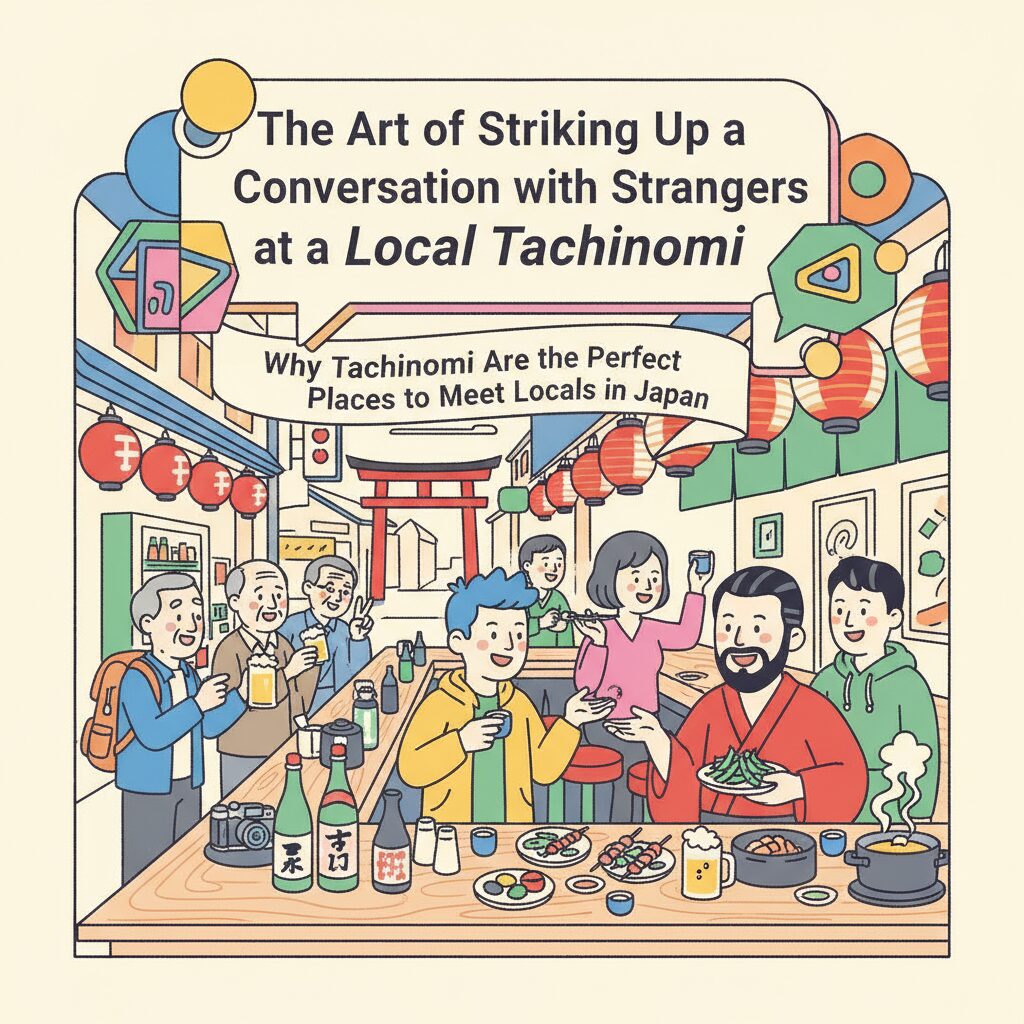
The fundamental design of a standing bar transforms the way people interact. Consider a traditional restaurant or a typical seated izakaya: you enter, the staff directs you to a table, you sit down, and instantly an invisible barrier forms around your group. You are confined to your booth, and the room’s layout dictates that you only engage with the people you came with. However, a tachinomi removes all of that—there are no chairs, no booths, no boundaries.
Because you’re standing, you are physically mobile. You can shift your weight, pivot on your heels to glance toward the doorway, or slide along the counter to make space for someone new. This continuous, subtle movement fosters a fluid social dynamic, making you aware of those around you. When you accidentally brush shoulders with the salaryman beside you, it breaks down the physical barrier that typically separates strangers in Japan. In Tokyo, such a bump might lead to a quiet apology and diverted eyes; in Osaka, the same bump becomes an opportunity—an excuse to smile, raise your glass, and start a conversation.
Additionally, standing lowers psychological defenses. Sitting down encourages people to settle in and become comfortable within their own private bubble. When standing, they remain in a state of transition, staying more alert and present in their surroundings. A tachinomi is designed for mingling, with small tables forcing patrons to stand close together. This proximity is the key ingredient. You don’t have to shout across the room to get someone’s attention—you simply turn your head. This makes the tachinomi the perfect venue for foreign residents to bridge the gap between being silent observers and active participants in local Japanese culture.
The Unwritten Rules of Socializing at a Standing Bar
While Osaka is known for its friendliness and openness, it is important to remember that this is still Japan. Beneath the surface lies a strong current of respect and social harmony that shapes people’s behavior, even when they are enjoying highballs after a long day at work. Understanding these unwritten rules distinguishes an annoying tourist from a welcomed foreign resident. Your aim should be to contribute to the bar’s atmosphere, not to disturb it.
Read the Room and Respect Boundaries
The key rule in any social setting is observation. Before starting a conversation, you need to read the room. Just because people are standing close together does not mean everyone wants to talk. Pay close attention to body language. If a lone drinker is absorbed in their phone, staring intently with their shoulders turned to the wall, they are seeking solitude. They treat the bar as a quiet refuge from work and home stress. Respect their peace.
On the other hand, look for open body language. A group of friends laughing loudly, scanning the room, and standing with their feet pointed outward are radiating outgoing energy. A solo drinker chatting lightly with the bartender and looking down the counter is open to interaction. The direction of their feet is a major clue. Feet pointed at the counter indicate focus on their food and drink; feet slightly turned toward the room or you suggest a subconscious invitation to engage. Always test the waters with a smile or small nod. If they respond warmly, you have the go-ahead. If they offer a tight, polite nod and quickly look away, leave them be.
The Magic of “Nomunication”
To fully grasp Japanese bar culture, you must understand the concept of nomunication. This clever blend of the Japanese word nomu (to drink) and the English word communication highlights a vital social tool. In a society that places great importance on daytime etiquette, hierarchy, and reading the air, alcohol acts as a crucial social lubricant. It provides a socially acceptable way to let down the corporate façade.
During the day, a junior employee would never casually speak to a senior manager. But under the glow of red paper lanterns at a tachinomi, rigid hierarchies soften. Nomunication is the great equalizer. As a foreign resident, you can embrace this cultural practice. Drinking at a local spot signals your willingness to join the evening ritual and engage on their level. People will overlook small language errors or minor social missteps because the act of drinking together grants you grace. Alcohol smooths over awkwardness, allowing genuine human curiosity to flourish.
How to Break the Ice with Japanese Strangers
Now that you’re familiar with the environment and mindset, it’s time to focus on practical strategies. Approaching a stranger and saying hello out of the blue can still feel a little awkward, even in a friendly Osaka bar. The key is to find a natural, situational anchor that gives you a reason to start a conversation. You want the interaction to come across as a spontaneous moment, not a rehearsed pickup line.
Ask for Food and Drink Recommendations
Food is the simplest, safest, and most universally loved way to start a conversation in Osaka. This city is known as the kitchen of Japan. The local motto, kuidaore, roughly means eating until you drain your wallet. Osakans take great pride in their food culture. If you notice someone nearby enjoying a dish that looks amazing, use that as your opening.
Lean in slightly, gesture toward their plate, and show genuine curiosity. Ask them what it is. Ask if they recommend it. People love to share their knowledge, especially about local specialties like doteyaki, a savory, miso-simmered beef sinew, or freshly fried kushikatsu. By asking for their recommendation, you’re elevating them to the role of a local guide and showing respect for their taste. More often than not, this small question about a dish will spark a ten-minute conversation about their favorite neighborhood restaurants—a perfect gateway to a deeper connection.
Use the Bartender as a Conversational Bridge
If approaching a stranger directly feels intimidating, use the bartender as a bridge. In a tachinomi, the bartender, often called the master or mama-san, is more than just someone who serves drinks. They orchestrate the social atmosphere. They know the regulars, who’s talkative, and the vibe of the room.
Start by engaging the master. Compliment the bar’s atmosphere. Ask how long they’ve been open. Once you establish a friendly rapport with the bartender, they’ll naturally draw you into the group conversation. The master might introduce you to a regular nearby, mentioning where you’re from. In Japanese culture, having a trusted third party make the introduction carries great weight. The bartender functions as a guarantor of your character. If the master likes you, the regulars will quickly accept you, eliminating the awkwardness of a cold approach.
Leverage Translation Apps and Body Language
For many foreigners, the language barrier is a big concern. You might worry your Japanese isn’t good enough for a full conversation. But in a loud, lively tachinomi, perfect grammar isn’t necessary. In fact, struggling with the language can be an advantage because it makes you seem approachable and humble.
Don’t hesitate to pull out your smartphone. Apps like DeepL or Google Translate are fantastic resources for nightlife socializing. Type a funny comment or a question and show the screen. Let them respond by typing back. This turns communication into a fun, collaborative game. You’ll both laugh at the quirky translations.
Beyond technology, your body language sends powerful signals. Keep your posture open and smile warmly. When someone catches your eye, raise your glass slightly. Toasting is a universal gesture. A simple clink of glasses breaks down any language barrier. If you radiate positive, relaxed energy, people will naturally be drawn to you, no matter how many words you know.
Essential Japanese Phrases for Tachinomi Mingling
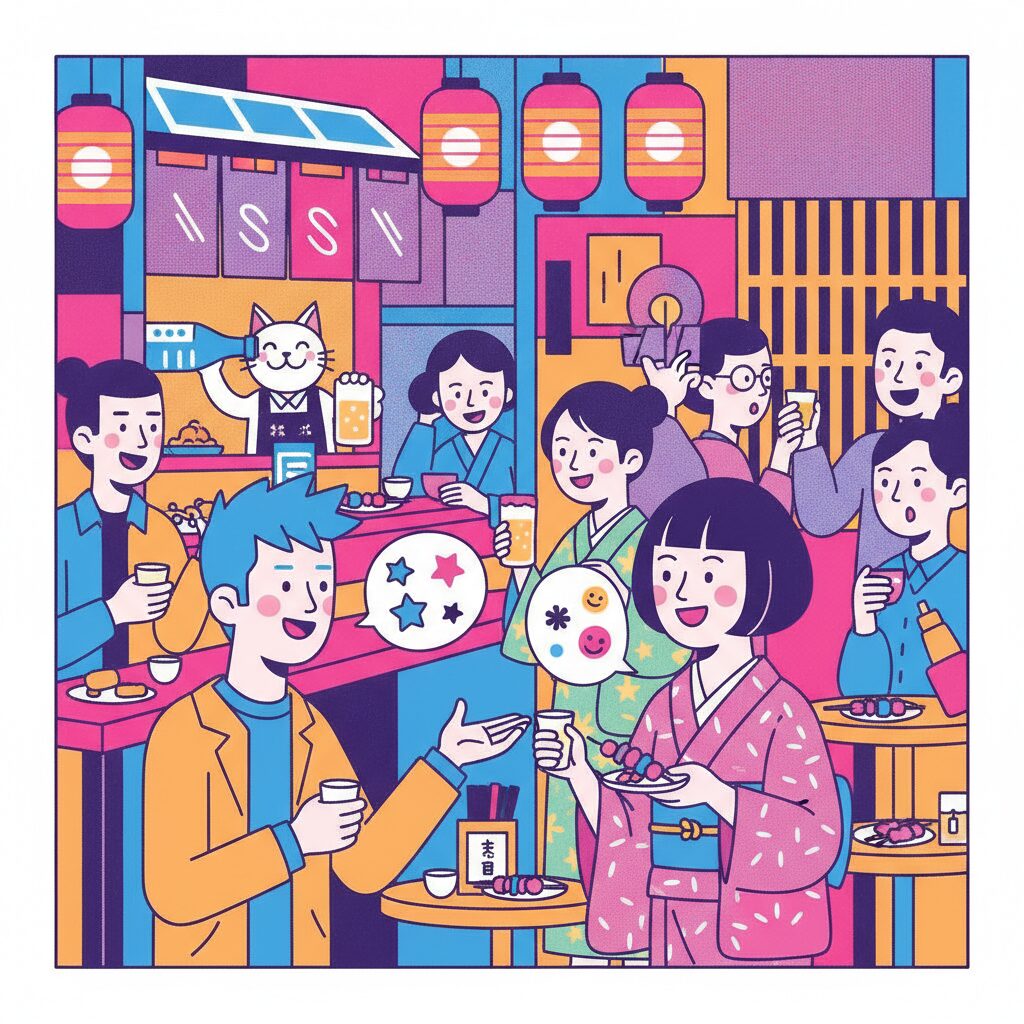
While perfect Japanese is not essential, knowing a few context-specific phrases will greatly enhance your experience. The Japanese taught in textbooks is often too formal and polite for a standing bar. Instead, you need phrases that sound natural, casual, and appropriate for the situation. Here are some essential expressions to add to your linguistic toolkit.
Casual Greetings and Starters
The best phrase to use when making a toast with someone next to you is Otsukaresama desu. Literally, it means “you must be tired,” but in practice, it serves as a universal cheers to hard work. It acknowledges that you’ve both made it through the day and are now enjoying a well-earned break. Saying this while raising your glass immediately creates a sense of camaraderie.
Another great way to break the ice is by asking what they’re drinking. You can say Nani nonderun desu ka?, which means “What are you drinking?” This is casual, friendly, and non-intrusive. If they’re enjoying a colorful local sour or a particular brand of sake, they’ll often be happy to share. It’s a soft, low-pressure question that invites conversation without demanding too much personal information upfront.
Complimenting the Food and Atmosphere
When you try the food they recommended, be sure to give feedback. Take a bite, open your eyes wide, and say Kore, mecha oishii desu ne! This means “This is insanely good!” The key word here is mecha. In standard Tokyo Japanese, you’d use totemo to mean very, but in Osaka and the Kansai area, mecha is local slang for very or super.
Using a bit of Kansai dialect is like a secret weapon for winning over locals in Osaka. It shows you’re not just a passing tourist but someone paying attention to their unique culture. They’ll love hearing a foreigner speak their local slang. You can also praise the bar’s vibe by saying Kono mise, ii fun-iki desu ne, meaning “This bar has a great atmosphere.” Compliments like these are always appreciated and show you have good taste.
Excusing Yourself Gracefully
Knowing how to end a conversation is just as important as knowing how to start one. You don’t want to trap someone in a chat or abruptly disappear when it’s time to leave. The goal is to leave a warm, lasting impression.
When you’re ready to go, catch their eye and say Sorosoro ikimasu, which means “I’m going to head out soon.” Follow it with Kyō wa tanoshikatta desu, meaning “Today was fun.” Before you walk out, turn to the bartender and say Gochisousama deshita. This is the standard, polite way to thank them for the meal and drinks. A graceful exit ensures that if you ever return, you’ll be welcomed back as a familiar, friendly face rather than an awkward stranger.
Best Tachinomi Districts for Foreign Travelers
To put all of this into practice, you need to know where to go. Osaka is expansive, but its standing bar culture is deeply rooted in a few select neighborhoods. As an event planner who studies crowds and atmospheres, I can assure you that not all districts are alike. Some are polished, while others are delightfully gritty.
First, you should visit Tenma. Located just one stop from the major transit hub of Osaka Station, the streets around Tenma Station form a maze of narrow alleys, glowing red lanterns, and inexpensive, amazing food. Tenma feels endless. You can hop from a standing sushi bar to a standing yakitori spot within thirty seconds. The crowds here include young professionals, longtime neighborhood regulars, and everyone in between. It is dense, lively, and incredibly welcoming.
If you want something a bit rawer and more authentic, head east to Kyobashi. This area is known for daytime drinking. You’ll find shift workers, retirees, and salarymen mingling by mid-afternoon. Kyobashi has a slightly rougher, working-class vibe compared to other districts, but that’s what makes it unique. The people here are straightforward and fiercely local. If you can make friends in a Kyobashi tachinomi, you’ve truly earned your Osaka stripes.
Finally, for a younger, more vibrant energy, explore Ura-Namba. Tucked away in the backstreets behind the sprawling Namba Station, this area has undergone a huge revitalization. The standing bars here often offer modern twists, serving natural wines and craft beers alongside traditional sake and shochu. The crowd is trendy, lively, and highly welcoming to international mingling.
Mastering the tachinomi experience is not just a fun weekend pastime. It represents a fundamental shift in how you engage with your new life in Japan. It teaches you to let go of rigid expectations and embrace the spontaneous, slightly messy, and deeply meaningful human connections that arise when people share a small counter, a cold drink, and a few hours of the night. Osaka is a city that rewards the bold and outgoing. So step inside, find a spot by the corner, order a highball, and simply say cheers.