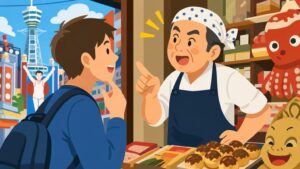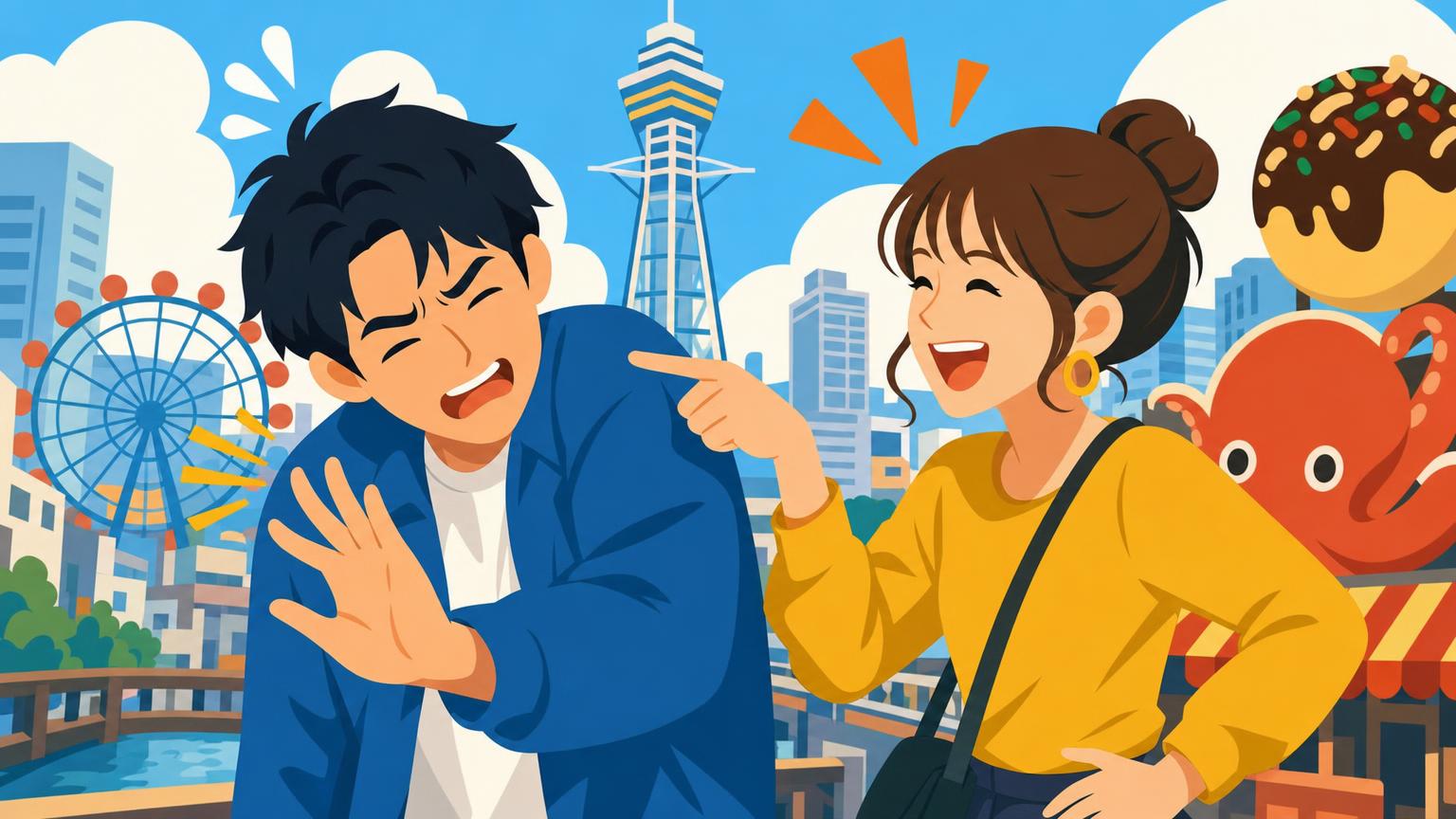
If you live in Osaka long enough, someone may suddenly look at you and say, “Nande ya nen?” after you make an ordinary comment. You may laugh because everyone else is laughing. You may also wonder whether you have just been welcomed into the group, corrected in public, or quietly insulted.
Usually, the answer depends less on the words than on the relationship, the timing, the voice, and what happens next.
This is the difficult part of Osaka’s tsukkomi culture. A sharp comment can be a sign of affection. A joke can be an invitation to join the conversation. A quick correction can mean, “I am paying attention to you.” But the same words, spoken by the wrong person or in the wrong situation, can feel rude, intrusive, or humiliating.
For foreigners living in Osaka, understanding this difference matters. Osaka is not simply a city where “people are friendly.” It is a city where conversation often works through reaction, timing, exaggeration, and playful resistance. People may show warmth by challenging what you said rather than politely accepting it. They may make a joke before offering help. They may tease you more after you become familiar.
That style can feel very different from the careful, low-pressure communication many people associate with Tokyo or more formal parts of Japan. It can also be misunderstood in both directions. A foreign resident may think a friendly joke is an insult, or may copy the words without understanding the trust that makes them safe.
The map below is included only to place the everyday Osaka discussed in this article: the broad urban area where workplace relationships, neighborhood shops, train platforms, family conversations, and entertainment districts overlap.
What Tsukkomi Really Means in Osaka
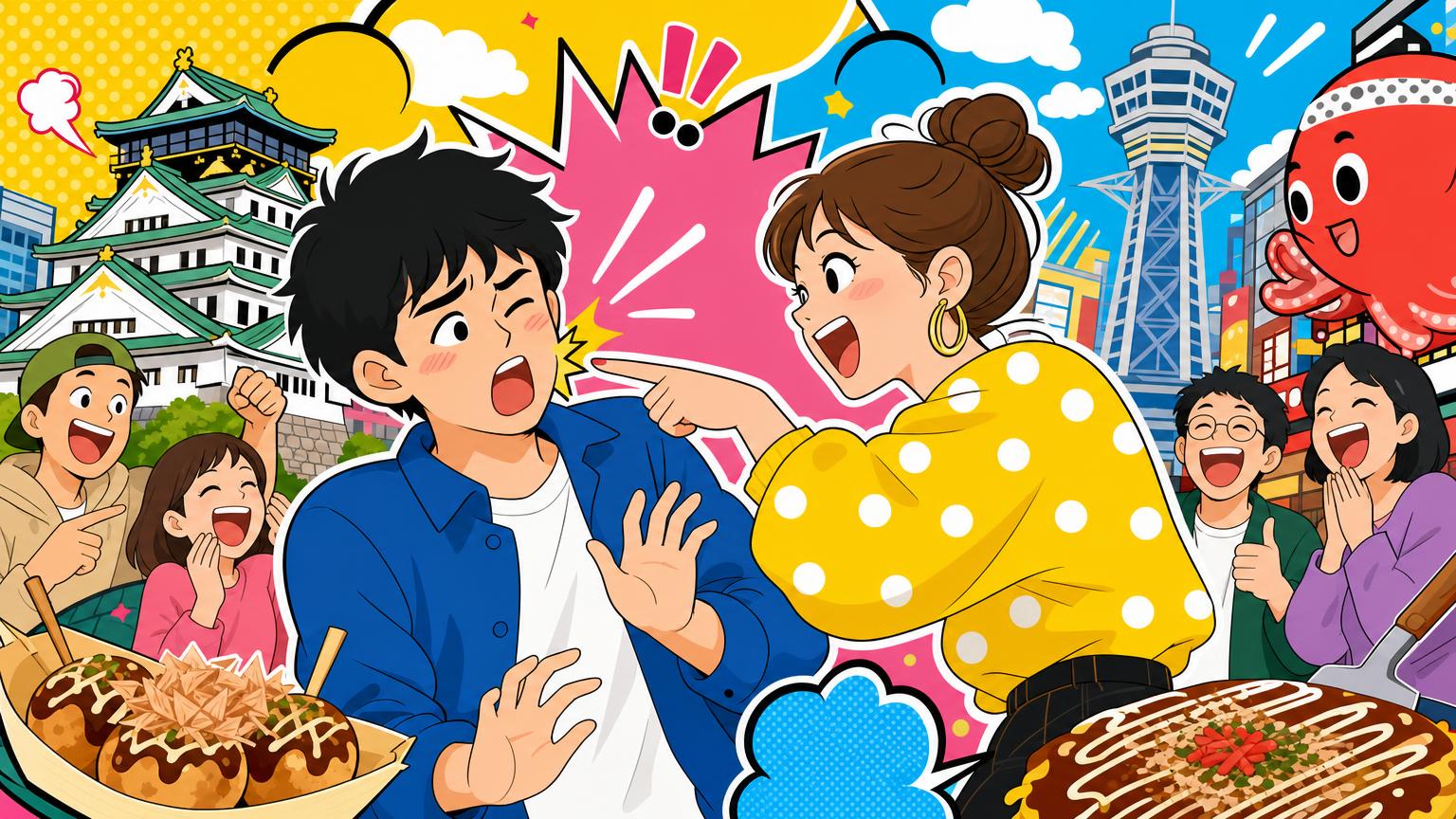
The word tsukkomi is frequently translated as “the straight man” in comedy. While this translation is helpful, it is not complete. In everyday Osaka conversation, tsukkomi refers to the person who reacts to an absurd remark, points out exaggerations, notices contradictions, or brings an overly dramatic story back to reality.
The person making the strange statement is called the boke. In comedy, the boke causes confusion, misunderstands something, tells an obvious lie, or acts as if an impossible idea is perfectly normal. The tsukkomi responds quickly and clearly. The humor arises from the interaction between these two roles.
A simple example might be:
Boke: “I walked from Umeda to Namba in five minutes.”
Tsukkomi: “That’s not walking. That’s teleportation.”
The second speaker is not necessarily upset. They are maintaining the shared reality of the conversation, saying, “I see what you’re trying to do, but let’s not pretend this is true.”
The basic structure resembles a Western comedy double act, particularly the dynamic between a funny person and a reactive straight person. However, Japanese manzai places special emphasis on speed, verbal rhythm, puns, deliberate misunderstanding, and the enjoyment of watching one performer resist the other’s control over the story. The modern professional style of manzai is closely linked to Osaka and Yoshimoto Kogyo, whose comedy culture developed in the city.
In everyday life, being a tsukkomi is not always a fixed role. The same person might be the boke in one conversation and the tsukkomi in another. A quiet colleague might suddenly say something ridiculous, while the usual joker may become serious when support is needed.
This flexibility is crucial. Osaka conversation is not rigidly divided between “the funny person” and “the serious person.” Roles shift. What matters is whether the group can maintain the rhythm.
Tsukkomi Is a Reaction, Not Just an Insult
Foreign residents sometimes hear an Osaka local make a blunt comment and assume the bluntness is the main point. Often, it is not. The core purpose is the reaction.
A tsukkomi can convey several messages simultaneously:
- “That statement is clearly exaggerated.”
- “I heard what you said.”
- “I know you well enough to challenge you.”
- “Let’s keep this conversation lively.”
- “You are part of this moment, so I expect you to respond.”
Though the comment may sound negative when translated literally, its social meaning can be positive. Calling a friend hen, or strange, might be criticism, but it can also mean the friend is entertaining, distinctive, and comfortable being themselves.
The difference is usually evident in the rest of the interaction. Does the speaker smile? Do they continue the conversation? Do they include you in the next question? Do they help you when practical matters begin? Do they allow you to tease them in return?
A joke that opens a conversation is different from one that closes it.
Why Osaka Developed This Reputation
Osaka’s reputation as a comedy-focused city stems from its long history as a commercial and entertainment hub. Its humor is often connected to merchant culture, popular theater, storytelling, and the practical need to build relationships quickly in a bustling urban environment. Osaka is also strongly associated with rakugo and manzai, two forms of Japanese comic storytelling, and the city remains a key place to experience professional comedy.
This history does not mean everyone in Osaka is constantly joking. Rather, humor holds a particularly prominent place in public identity. Comedy is not just a stage performance; it is a way to demonstrate intelligence, ease tension, test closeness, and make everyday situations more memorable.
In a city where people frequently move through crowded stations, compact restaurants, shopping streets, offices, schools, and family networks, conversation serves a purpose beyond simply exchanging information. A good interaction creates a small social bond. A quick joke can make a transaction feel less mechanical. A playful complaint can make an inconvenience easier to bear.
This is one reason foreign residents may notice more verbal play in Osaka than they expected. The humor is not proof that everyone seeks an intimate friendship. Rather, it is often a local way of making contact.
Is Tsukkomi a Sign of Friendship?
Sometimes, yes. However, the idea that “teasing equals friendship” is overly simplistic and can cause serious misunderstandings.
A tsukkomi is more likely to indicate familiarity when the speaker has already established a relationship with you. They understand your typical reactions, have shown you other signs of respect, and tease various people in a similar manner, including themselves. The joke is brief, and the conversation flows naturally afterward.
For instance, imagine telling a coworker, “I am going to become fluent in Japanese this month.” When they see you struggling with a vending machine, they grin and say, “Oh, so you’re already a professor?” That could be friendly teasing, acknowledging your ambition while pointing out the gap between your claim and the current reality.
If a manager makes the same comment in front of a group after you have made a serious mistake, the meaning might shift. Although the words remain unchanged, the power dynamic and public context are different.
The Signs of Affectionate Teasing
Affectionate tsukkomi often has a light, almost musical tone. The speaker might elongate the final sound, raise their eyebrows, tilt their head, or smile before finishing the sentence. They may laugh at their own comment and move on quickly without forcing you to defend yourself.
Other helpful indicators include:
- The speaker teases themselves as well as you.
- The joke revolves around a harmless mistake, exaggerated claim, or familiar habit.
- The speaker allows you time to respond.
- Other people in the group appear relaxed rather than uncomfortable.
- The speaker offers practical help after the joke.
- You remain included in the following part of the conversation.
- The relationship grows warmer over time, not more uneasy.
The last point is important. In Osaka, one joke alone is rarely enough to determine someone’s intentions. Observe the pattern. Someone who jokes with you but remembers your preferences, checks if you got home safely, explains local customs, or saves you a seat is likely expressing care through more than just words.
When Teasing Is Not Friendly
Not every sharp remark is cultural nuance. Sometimes, it’s just a sharp remark.
A person might use “Osaka humor” as an excuse for genuinely disrespectful behavior. You should not have to accept humiliation because someone claims they were joking. If the same person consistently targets your accent, nationality, gender, appearance, immigration status, religion, disability, or lack of Japanese ability, the situation should not be dismissed automatically as tsukkomi.
A joke becomes more troubling when:
- The speaker persists after you show discomfort.
- You are the only person targeted.
- The comment is made by someone with authority over your job or housing.
- The subject is private, sensitive, or linked to discrimination.
- The group expects you to laugh but doesn’t give you space to respond.
- The speaker becomes angry when you don’t enjoy the joke.
- The interaction leaves you feeling diminished each time it occurs.
Friendship doesn’t mean tolerating everything. In fact, a healthy relationship usually includes the ability to say, “That joke wasn’t funny to me.”
Osaka Communication Compared with Tokyo
Describing Osaka and Tokyo as two completely different species is risky. Both cities have quiet and loud people, formal workplaces and casual neighborhoods, international communities, and a wide range of personalities.
Still, many residents perceive differences in conversational atmosphere.
Tokyo often values restraint, indirectness, and smooth interactions. This doesn’t mean Tokyoites lack humor or warmth; rather, their humor tends to be more carefully separated from practical business, especially when social roles are unclear.
Osaka, on the other hand, can feel more openly reactive. People may challenge statements more quickly, shopkeepers might theatrically complain about the weather, colleagues could interrupt overly formal speech with jokes, and requests might be met with playful complaints before help is offered.
The practical difference is not that Osaka disregards politeness—politeness remains important. Instead, Osaka often overlays informality onto politeness when the relationship allows it.
A Tokyo-style interaction may show respect by maintaining distance, while an Osaka-style interaction might show respect by reducing that distance. Neither style is inherently better; they simply create different impressions for the listener.
Why Osaka Can Feel Warmer and More Challenging at the Same Time
A foreign resident may find Osaka easier to engage with because people often react more visibly and offer clearer conversational cues, making it quicker to tell if someone is amused, surprised, skeptical, or bored.
At the same time, the city can feel harder to interpret since those cues are not always literal. “You are hopeless” might mean “You are entertaining.” “What are you doing?” could mean “I noticed you.” “That is impossible” may mean “Try explaining it again.”
The emotional meaning often lies beneath the words.
This is why learning vocabulary alone is insufficient. Understanding local timing is essential. A sentence spoken with a grin and a brief pause can be playful, while the same sentence said in a flat tone in front of others might be a reprimand.
What Daily Tsukkomi Looks Like in Osaka
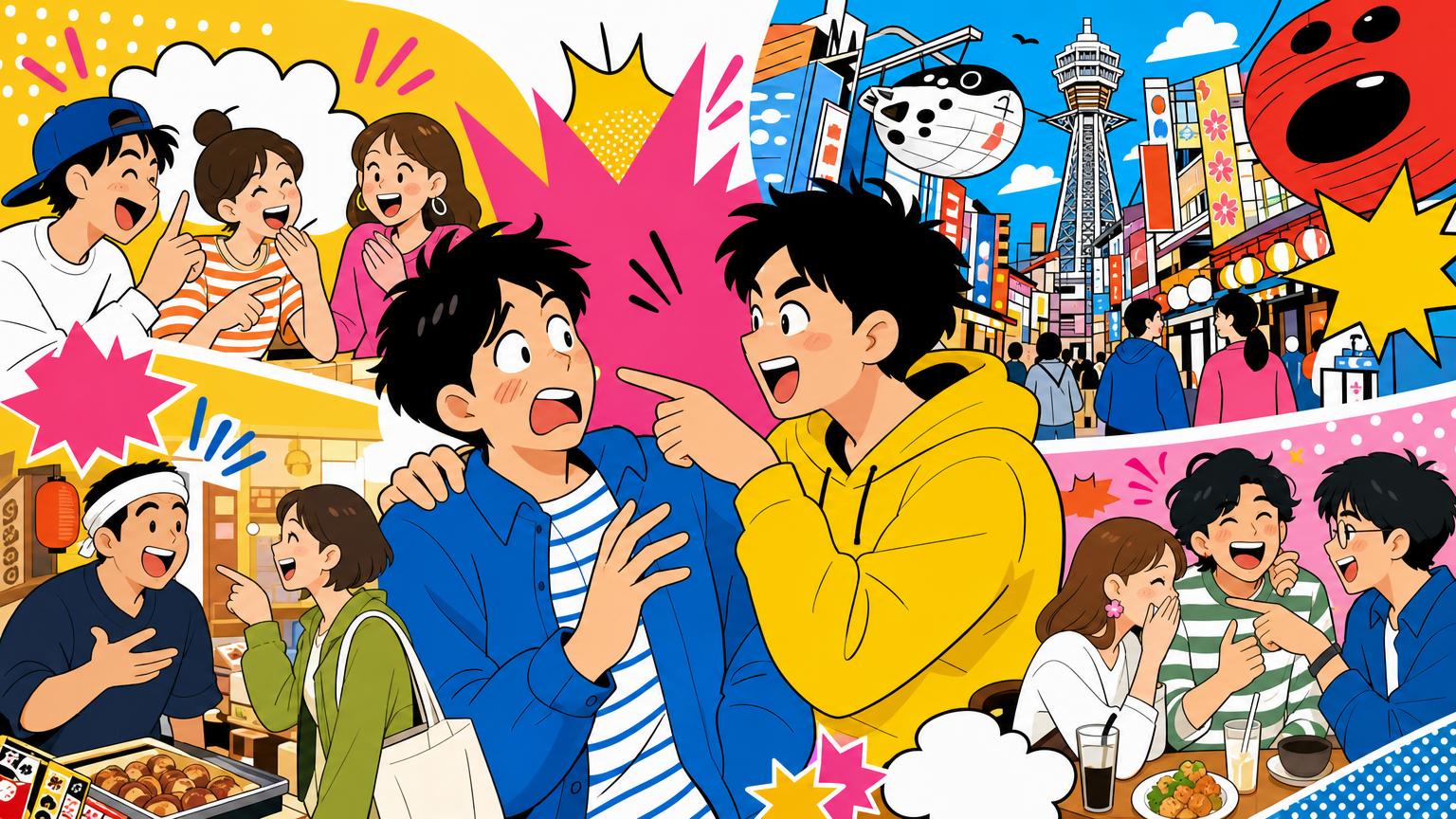
You don’t need to attend a comedy show to experience tsukkomi. It occurs in everyday settings where people are familiar with each other, or where a brief interaction unexpectedly becomes more personal.
At Work
In an Osaka office, a colleague might dramatically complain about a minor issue. For example, if the printer breaks down, they might declare that the whole company is collapsing. Another colleague might reply, “Yes, the economy is finished because of this printer.”
This response serves multiple purposes. It acknowledges the frustration without escalating it to a crisis, allows everyone to relax, and creates a shared moment before the machine is fixed.
Foreign employees sometimes mistakenly take the initial complaint too literally, offering detailed solutions while others are still playing along with the exaggeration. Although the solution may be appreciated, the timing can feel somewhat off.
A helpful strategy is to acknowledge the joke first, then address the problem second:
- “That serious? Should we call the prime minister?”
- “Let’s save the printer first, then the company.”
- “I’ll file the report, but I can’t promise the printer will survive.”
After the lighthearted response, return to the practical issue. Humor doesn’t replace competence; it helps people collaborate while dealing with inconvenience.
In Neighborhood Shops
Small shops, cafés, bars, and restaurants often offer more opportunities for tsukkomi than large chains. A staff member who recognizes you might comment on your usual order. If you order the same curry three days in a row, they might say, “Again? You have only one food in your life?”
This can be a sign of familiarity, but it’s important to listen carefully. The comment might also be a playful service style rather than a genuine personal invitation. You can respond lightly without assuming a closer friendship.
Safe replies include:
- “Yes. I’m loyal.”
- “It’s my research project.”
- “Today I’ll surprise you. Same order.”
The humor works because you’re not attacking the person; you accept the exaggeration and return it gently.
In Izakaya Conversations
An izakaya can be especially lively because people are relaxed, eating together, and interacting at various levels of familiarity. Someone might ask where you’re from, comment on your Japanese, or joke about how much you ordered.
Alcohol changes the mood but doesn’t erase social boundaries. A loud table isn’t an invitation for strangers to touch you, pry into your private life, or make comments about your body. The same principles apply: consider the relationship, power dynamics, subject, and whether you can comfortably leave the conversation.
If someone says, “Your Japanese is surprisingly good,” you might hear it as a compliment with a slightly awkward twist. A playful reply could be:
- “Surprisingly? My teacher will be disappointed.”
- “Please tell my grammar book.”
- “I’m still dangerous, so be careful.”
If you prefer not to joke, a simple “Thank you, I’m still studying” works perfectly fine. You don’t have to perform Osaka humor to fit in Osaka.
In Shopping Streets and Local Markets
Busy shopping districts often feature lively everyday conversations. Vendors may call out, complain about prices, praise products, or joke with regular customers. The tone can be energetic without feeling intimate.
Foreign residents might mistake this volume for anger. Osaka speech can sound sharper due to pitch, rhythm, local vocabulary, and the directness of exchanges. Pay attention to facial expressions and body language—a quick smile, relaxed shoulders, and an immediate return to service usually indicate that the intensity is part of the performance.
Don’t assume every loud exchange is a personal argument—or that every loud exchange is harmless. If an interaction involves threats, intimidation, or a refusal to respect your boundaries, treat it as a real issue, not just a cultural puzzle.
On Trains and in Shared Spaces
Not every place is suited for tsukkomi. Trains, hospitals, government offices, apartment buildings, elevators, and quiet queues usually require more restraint. Osaka’s humor doesn’t override public manners.
A common misunderstanding is thinking that because people joke in a restaurant, they will appreciate jokes everywhere. They might not. The local skill isn’t “always be funny” but knowing when a situation has enough social warmth for a joke.
How to Understand the True Intention Behind the Humor
When unsure if a comment is friendly, don’t rely solely on the words. Consider the entire exchange.
Listen for the Direction of the Joke
Ask yourself who is taking the risk. In friendly banter, the speaker often risks looking silly themselves. They might exaggerate their own faults, invite teasing, or make it easy to joke back.
In hostile teasing, the risk falls almost entirely on the listener. The speaker stays safe while you bear the embarrassment.
This distinction is especially useful in workplaces. A senior employee who jokes about their own mistakes and then gently teases yours may be fostering equality. A senior who only targets junior staff might be using humor to reinforce hierarchy.
Observe What Happens After You Respond
Your reaction provides feedback to the other person. A thoughtful individual adjusts accordingly. They might say, “Sorry, I was joking,” change the topic, or clarify their meaning.
Someone who insists you must laugh, repeats the joke louder, or tells others you’re too sensitive isn’t showing good tsukkomi. They’re demanding access to your discomfort.
Healthy Osaka-style banter is a two-way interaction, not a one-person show with you as a reluctant audience.
Notice Whether the Relationship Has Earned It
Japanese communication often evolves gradually as people get to know each other. A new colleague may start formally, shift to casual speech, then tease you about a known habit. This progression is meaningful.
If someone skips all signs of respect and immediately makes personal jokes, be careful. They might be simply outgoing, but you don’t have to match their style. You can remain friendly while keeping your distance.
Check the Topic
Some topics are safer than others. Forgetting an umbrella, being late due to a confusing train, ordering too much food, or making an exaggerated claim tend to be low-risk.
Money, immigration status, romantic relationships, family problems, illness, appearance, body size, religion, and language ability require more caution. Even among friends, acceptable boundaries vary individually.
When a joke touches a sensitive topic, intention isn’t the only factor. The impact matters as well.
Safe Tsukkomi Phrases for Foreign Residents
You don’t need advanced Japanese to join in. A few brief reactions can show you get the rhythm, but use them sparingly and avoid turning it into a performance.
“Nande ya nen?” — “What are you talking about?”
This famous phrase is linked to an Osaka-style tsukkomi. It can sound theatrical and is often used in comedy. In everyday conversation, a softer version like Nande yan? or Nande ya nen can be playful among people who already know each other.
Use a light smile, relaxed shoulders, and a rising or exaggerated tone. Avoid pointing aggressively. Don’t use it with customers, managers, older strangers, or anyone who’s visibly upset.
Example:
Friend: “I’m going to run a marathon tomorrow, even though I’ve never exercised.”
You: “Nande ya nen?”
The humor comes from reacting to the impossible confidence, not from attacking the person.
“Uso yaろ?” — “That cannot be true.”
Uso yaろ? is a casual way to question an unbelievable statement. The ending can be softened or exaggerated depending on your relationship.
For a safer option, you can say Hontō? meaning “Really?” with a smile. This lets the other person decide if they were joking without forcing a dramatic reaction.
“Honma?” — “Seriously?”
Honma? is a casual Kansai-style way of saying “Really?” It expresses surprise, doubt, or amusement without immediately accusing the other person of lying.
Say it with a curious face rather than a confrontational one. A brief pause afterward gives the speaker a chance to add more.
“Mata mata” — “There you go again.”
Use this phrase when someone repeats a familiar exaggeration or habit. It’s gentler than calling someone a liar and suggests you recognize the pattern.
Use it with someone you’ve met several times. With a new acquaintance, it might sound like you’re claiming too much familiarity.
“Sore wa chigau yaろ” — “That is not quite right.”
This can be playful but also a genuine correction. Use a smile and keep the subject lighthearted. If the point matters, follow up with accurate information rather than leaving it as a joke.
“Shiran kedo” — “Though I don’t really know.”
This phrase often follows a confident statement to undercut it. It creates a humorous contrast between the certainty of the sentence and the speaker’s lack of evidence.
For example: “This is definitely the best ramen in Osaka, shiran kedo.”
It’s safer to use this about your own opinion rather than someone else’s personal situation.
“Mō ē wa” — “Oh, enough already.”
This expression can sound friendly among close friends, especially when someone keeps repeating the same joke. It can also come across as genuinely irritated. Use it only when your facial expression clearly shows amusement and the other person understands your style.
If you’re unsure, say “You are still going?” in English with a smile, or just laugh and change the subject.
How to Reply When You Do Not Like the Joke
You can establish a boundary without ending the entire relationship. Communication in Osaka often emphasizes directness, but being direct does not mean being aggressive.
Helpful responses might include:
- “I know you are joking, but that topic is difficult for me.”
- “That joke is a little too personal.”
- “Please do not use my nationality as the punchline.”
- “I am okay with teasing, but not about work mistakes in front of everyone.”
- “I do not understand whether you are serious. Can you explain?”
- “Let us change the subject.”
In Japanese, chotto muzukashii can mean “that is a little difficult,” and it is frequently used to indicate discomfort without creating a dramatic confrontation. If you need to be more explicit, say sono hanashi wa yamete kudasai, meaning “please stop that topic.”
Don’t worry that setting a reasonable boundary makes you seem cold. Not everyone in Osaka expects constant comedy. Many will appreciate a clear explanation, especially if you provide it before resentment builds.
Foreigners’ Common Misunderstandings About Osaka Humor
“Everyone Who Teases Me Wants to Be My Friend”
Not always. Some people are simply talkative. Some enjoy entertaining a group. Some use humor to ease awkwardness with foreigners. Others are testing how comfortable you are.
Friendship is demonstrated through consistency, not just one funny comment. Look for reliability, genuine interest in your life, a willingness to help, and respect when you say no.
“If I Am Not Funny, People Will Reject Me”
You don’t need to be quick with jokes. Listening, smiling, asking follow-up questions, and responding honestly are enough. A simple “Really?” can be a good tsukkomi because it encourages the other person to continue.
Many foreign residents get worn out thinking every conversation demands a clever reply. It doesn’t. Osaka humor works best when it emerges naturally from the moment.
“I Should Copy Osaka Dialect Immediately”
Using a few local phrases can be endearing, but overdoing the dialect can seem like imitation. Nande ya nen is famous because it’s linked to comedy. If you say it every five minutes, it might sound like a TV impression rather than genuine participation.
Listen first. Let close friends teach you the expressions they actually use. Stick to standard Japanese when uncertain, and allow your own personality to shine through.
“Direct Speech Means People Are More Honest”
Sometimes direct speech reveals feelings more clearly. Other times humor conceals emotions. A person might complain because they’re genuinely upset, or because complaining is their way of sharing a moment. Someone may tease out of care or because they want status in the group.
Osaka communication isn’t a clear window. It remains communication influenced by context, politeness, hierarchy, and personal mood.
“Tokyo Is Cold and Osaka Is Warm”
This comparison is too simplistic to help you live in either city. Tokyo can be deeply supportive, while Osaka can involve loneliness, exclusion, and challenging relationships. A more useful distinction lies in conversational style.
Osaka may offer more obvious opportunities for informal contact, but that doesn’t guarantee emotional closeness. Trust still needs to be developed over time.
Tsukkomi, Friendship, and the Osaka Idea of Equality
One reason tsukkomi can feel friendly is that it temporarily lowers the formality of an exchange. A person might challenge a claim instead of silently accepting it because they want the conversation to feel more balanced. They are not treating you like a distant customer or a formal guest but as someone who can handle a bit of pushback.
However, this apparent equality has its limits. Factors like age, job position, family role, gender, language ability, and social confidence still influence who is allowed to joke and who is expected to absorb the joke.
The safest interpretation is not, “They teased me, so we are equals.” Rather, it is, “They might be inviting a more relaxed relationship, but I should observe whether they also respect my response.”
That second test is the crucial one.
If you tease back gently and the person laughs, explains, or lets the topic drop, the exchange may be progressing toward mutual familiarity. If they become offended by your response, they may have wanted submission rather than friendship.
Why Giving a Tsukkomi Can Be a Form of Attention
In many Osaka conversations, ignoring a strange statement can feel more distant than correcting it. Silence might leave the speaker unsure whether you understood the joke, missed it, or do not want to engage.
A small reaction can therefore be welcoming. “Really?” “No way.” “That is too much.” “You are exaggerating.” These responses show that you are present.
For foreigners, this is encouraging. You do not need perfect Japanese to participate. You need to notice what the other person is doing and respond in a way that matches the emotional intensity of the moment.
If the statement is mildly playful, offer a mild reaction. If the person is telling a serious story, do not force a joke. If you are unsure, ask a sincere question.
Where Comedy Fits into Osaka’s Everyday Identity
Professional comedy offers a public reflection of the same social dynamics found in everyday conversation. In a manzai performance, one performer introduces a claim, confusion, or fantasy, while the other brings balance through language and timing. The audience appreciates both the error and its correction.
Namba Grand Kagetsu stands as one of Osaka’s most iconic comedy institutions. Its lineup features manzai, rakugo, comedy sketches, and Yoshimoto Shinkigeki, making it a valuable cultural reference even for locals who don’t attend regularly. The theater presents itself as a dedicated comedy venue in Namba and serves as a key hub for Yoshimoto’s live shows.
There is no need to consider a comedy theater a must-see tourist spot. For Osaka residents, its significance lies in making a local conversational style observable. The pause before the correction, the audience’s reaction, the intentional misunderstanding, and the joy of calling out a ridiculous claim all manifest in smaller ways at work, in restaurants, and among friends.
Watching live comedy can help you understand why a sentence that seems rude in translation might be humorous in context. It also demonstrates what professional timing sounds like, which is helpful since ordinary people are not comedians. A friend might adopt the rhythm of comedy without intending the interaction to become a full performance.
A Practical Method for Reading Osaka People
When someone makes a humorous remark, consider these questions before interpreting their intent:
- What was the context before the joke?
- Are we already acquainted, or did this person just meet me?
- Is the topic harmless or personal?
- Are they laughing at themselves as well?
- Did their tone and expression seem playful?
- Can I respond without risking my job, housing, or safety?
- What occurs after I reply?
- Do they respect a boundary if I set one?
You don’t need to analyze every comment like a detective. The goal is to notice patterns. Over time, you’ll learn which people use humor to create connection, which use it to ease tension, and which use it to dominate the room.
The clearest sign often comes after the laughter. Does the person return to normal kindness? Do they listen? Do they offer help? Do they remember what matters to you? Or do they keep you in the role of the outsider expected to entertain them?
Living in Osaka Without Performing Osaka
Foreign residents sometimes feel pressured to be louder, faster, and funnier than they truly are. That pressure is unnecessary. You can understand Osaka without having to become a comedian.
You can be quiet and still feel included. You can respond in standard Japanese. You can admit when you don’t understand a joke. You can laugh a little late. You can ask what a phrase means. You can tell a friend when a topic is off limits.
In fact, genuine reactions often work better than forced local styles. If you’re surprised, say so. If you’re confused, ask. If something strikes you as funny, laugh naturally. If it doesn’t, smile politely and move on.
Osaka’s tsukkomi culture isn’t a requirement for everyone to be entertaining. It’s a way of making conversation dynamic. People respond, interrupt, exaggerate, correct, and reshape what’s just been said. Relationships develop through these small interactions.
The most generous form of tsukkomi isn’t the sharpest joke. It’s the reaction that allows someone to stay part of the conversation without losing dignity.
Embracing the Real Warmth of Osaka People
So, is teasing in Osaka a sign of friendship?
It can be. Often, it indicates that someone feels comfortable enough to lighten the conversation and make it less formal. It might mean they are paying attention, inviting a response, or trying to close the gap between you. However, teasing by itself doesn’t confirm friendship. The true proof lies in mutuality.
A friendly tsukkomi leaves space for both parties. It invites a reply and doesn’t rely on causing embarrassment. It doesn’t condemn you for being different. It can be sharp, but it is never thoughtless.
If you live in Osaka, are considering moving here, or want to understand the people of Osaka, keep this practical tip in mind: don’t translate every joke literally, but also don’t excuse every hurtful remark as culture. Observe the relationships behind the words.
Osaka may come across as direct because people often use reactions as a way to connect. The challenge is to learn which reactions bring you closer and which ones simply put you on display.
Once you start to recognize that difference, everyday life becomes easier to interpret. A complaint might open a door. A correction could be a welcome gesture. A laugh may signal that the conversation is lively. And a simple, well-timed “Nande ya nen?” could mean not “You are foolish,” but “I’m here with you, so let’s keep talking.”