If you are living in Osaka, or seriously considering moving here, you may eventually notice something strange about the city’s social life. People do not always make friends through formal introductions, company events, or carefully planned dinners. A conversation can begin beside a cash register. A neighborhood rumor can travel through three bars before dinner. A shop owner may know who has changed jobs, who is looking for an apartment, and who has just returned from abroad.
Often, this information moves through a very small space: the tachinomi.
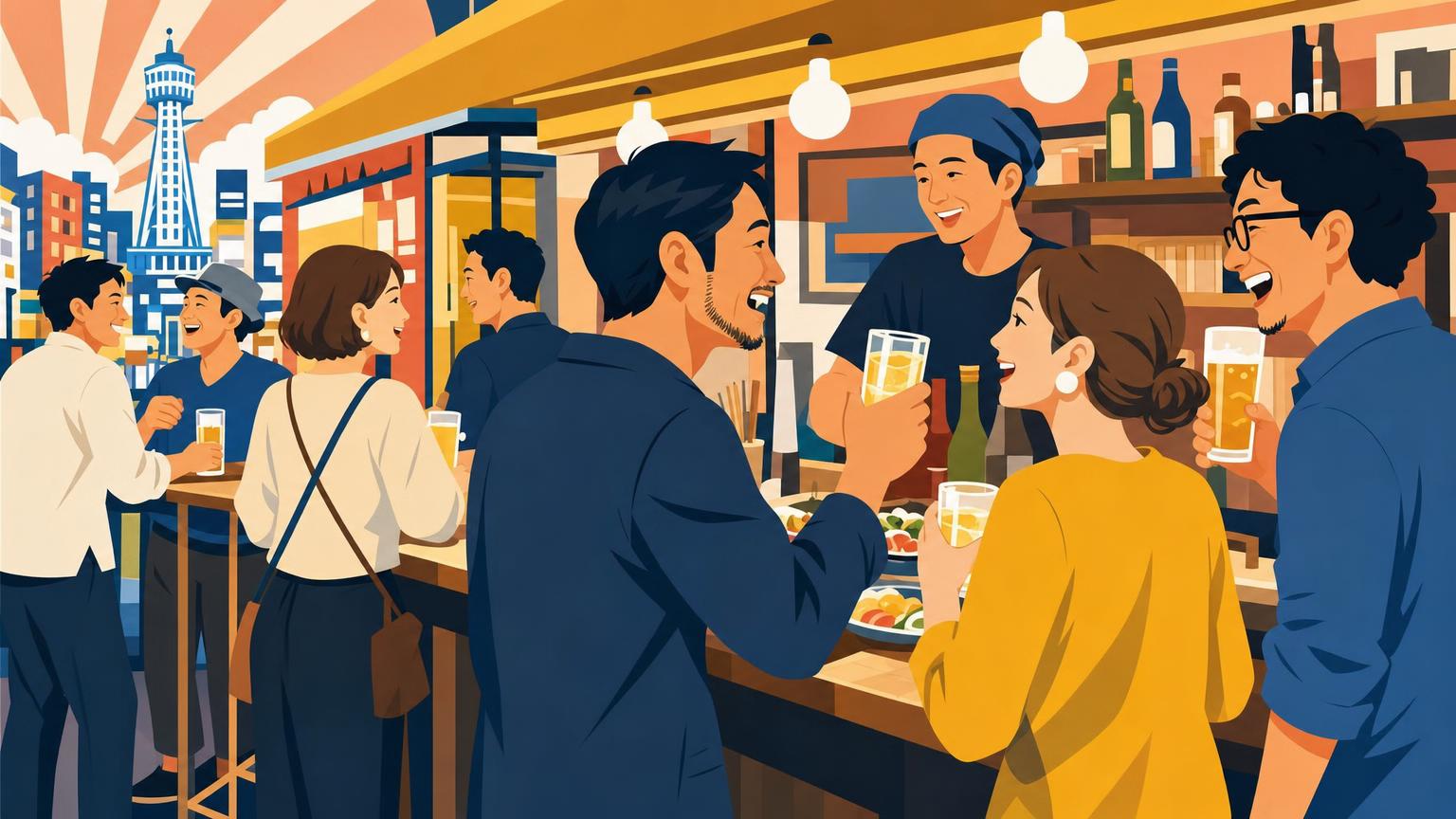
Tachinomi means “standing and drinking.” These are usually compact bars or izakaya where customers stand at a counter, order inexpensive drinks and small dishes, and leave after a short or medium-length visit. Some are rough around the edges. Others are stylish, modern, or designed around craft beer, natural wine, or creative food. What they share is not decoration. It is the way they allow people to enter everyday social life without making a large commitment.
For foreigners, this can be easy to misunderstand. A tachinomi may look like a casual drinking place, but it is often doing the work of a neighborhood living room, information exchange, informal office, and social safety net at the same time. It is one of the places where Osaka explains itself most clearly.
The important question is not simply, “Where can I find a good standing bar?” The more useful question is, “Why do these places matter so much to the people who live here?”
The answer has a lot to do with Osaka’s attitude toward conversation, status, money, humor, and daily contact. It also explains why Osaka can feel more immediately accessible than Tokyo while still having its own barriers for outsiders. You may be welcomed quickly, but you are not automatically part of the neighborhood. You still need to understand how to read the room.
The map below gives a general orientation around the Umeda area, one of the city’s major clusters of bars, underground drinking streets, office workers, commuters, and informal social spaces. It is not a tourist itinerary. Think of it as a starting point for understanding how Osaka’s social geography works.
The Real Meaning of Tachinomi in Osaka
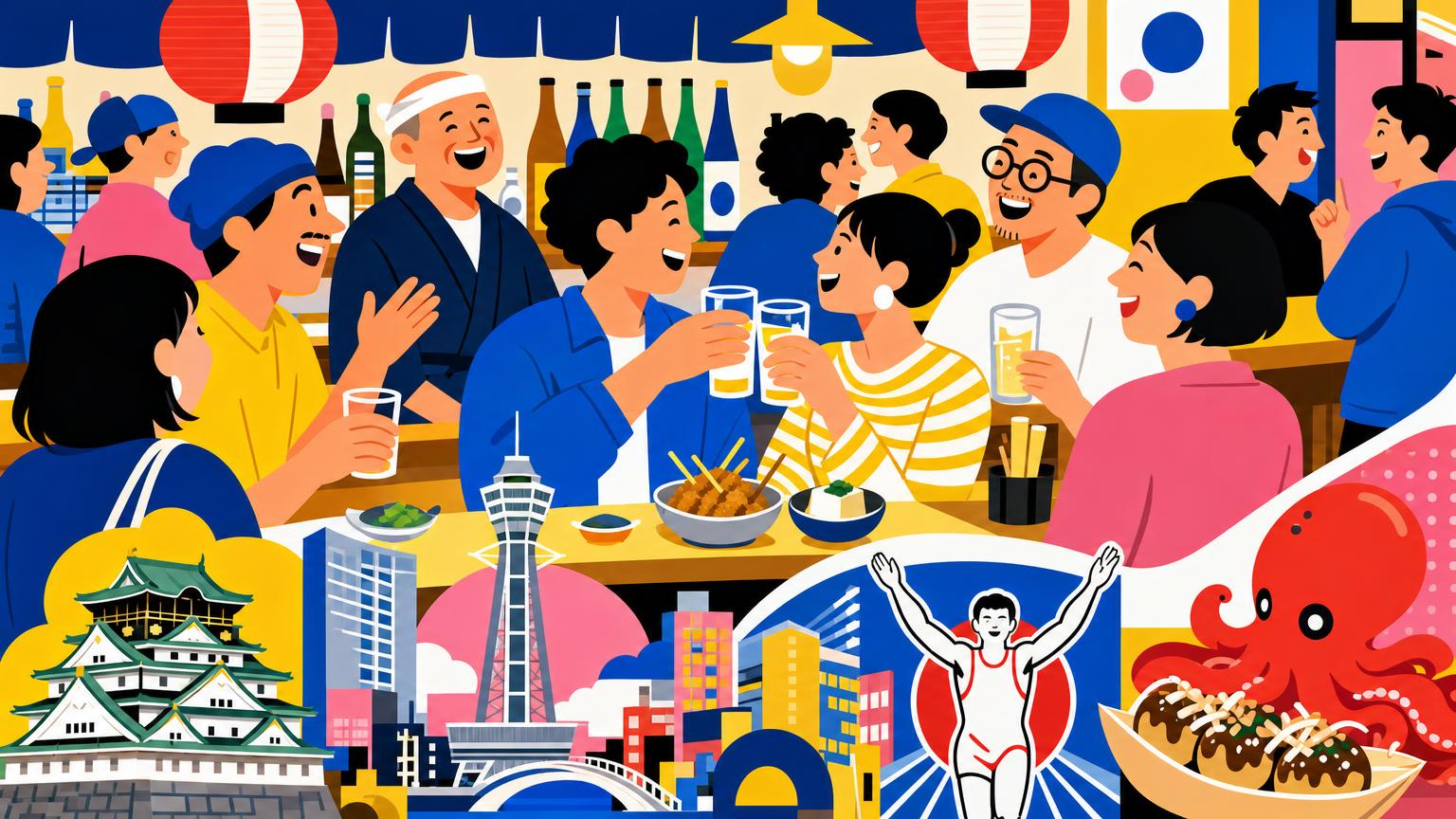
At the most basic level, tachinomi is a business model: remove the chairs, reduce the kitchen’s size, keep the menu moving, and serve affordable drinks and snacks to people who may not plan to stay all night.
Yet this practical design creates a particular kind of social environment. Standing changes the rhythm of interaction. Customers are not settled into private booths. They can turn toward the person beside them, move closer to the counter, make room for someone new, or leave without creating a dramatic end to the evening.
That physical arrangement matters.
A sit-down restaurant usually establishes a social boundary. Your table belongs to your group, while other tables remain separate. Even when you are seated at a counter, the arrangement often suggests that you should stay within your own space.
A tachinomi has fewer boundaries. Your drink may sit beside a stranger’s. Someone may ask what you ordered. The staff may place a shared dish between several customers. A regular may explain a menu item without being asked. A newcomer may arrive alone and become part of a small conversation simply because there is nowhere else to look except toward the people nearby.
This does not mean that every tachinomi is noisy or instantly friendly. Some are quiet, some regulars prefer not to talk, and some establishments are so busy that the staff barely has time to speak. The point is that the room makes contact easier.
That is why calling a tachinomi a “bar” is accurate but incomplete. It is also a social structure.
A low-cost way to be around people
One reason tachinomi remain important is that they provide a relatively inexpensive form of social life. A drink may cost a few hundred yen, and a small plate may cost a similar amount, although prices vary widely by neighborhood and type of business. In Osaka, affordable drinks, quick service, and small portions make it possible to visit without committing to a full restaurant bill. Recent local guides commonly list drinks in the approximate range of ¥300 to ¥500 and small dishes at around ¥200 to ¥500, though modern specialty bars may charge considerably more.
This is meaningful for people who live alone, work irregular hours, or do not have a large social circle. You can stop in for one drink after work, eat a little without cooking, and hear voices around you without having to host anyone at home.
In a city where many apartments are compact and work can be demanding, that option matters. Socializing does not have to be an expensive occasion; it can simply be part of an ordinary Tuesday.
A place where status becomes less important
Osaka is not free from hierarchy. Japanese workplaces, schools, neighborhood associations, and family relationships can be highly structured. Age and professional status still matter. Even so, tachinomi often soften those distinctions for a while.
A company manager, delivery driver, shop owner, retiree, university student, and foreign resident may stand around the same counter. They do not become equal in every aspect of life, but the situation gives them a shared language: the next drink, the food on the counter, the crowded train, the weather, the baseball game, or the strange thing that happened at work.
The conversation may be informal without necessarily being intimate. Osaka’s version of social connection often begins with practical subjects rather than personal confession. You talk about what is happening now, make a joke, complain about the heat, or argue about whether a dish needs more mustard. Only later might you discover that the person beside you owns a company or teaches at a university.
This is one reason tachinomi can feel more socially open than formal networking events. Nobody has to announce their job title before speaking, and nobody needs to exchange a business card immediately. The relationship can begin with something small and temporary.
Why Tachinomi Function as Neighborhood Social Hubs
A neighborhood social hub does not have to resemble a community center. In Osaka, it may consist of a narrow entrance, a refrigerator stocked with beer, a handwritten menu, and a counter that seats only ten people.
Its most important function is not its appearance. It is repetition.
The same people come back. The staff remembers their preferences. Customers recognize one another without necessarily becoming close friends. Information passes through repeated contact. This creates a kind of local familiarity that is easy to overlook if you visit only once.
They connect people who otherwise would not meet
Modern city life separates people by age, occupation, income, language, and daily routine. You may live in an apartment building with dozens of residents and know no one. You may work in a large office and speak only with colleagues from your own department. You may walk along a shopping street every day without having a meaningful conversation there.
A tachinomi disrupts that separation.
The bar does not erase social differences, but it brings different people into the same small physical space. A regular who works nearby might talk with a new resident. A business owner might hear that an apartment is becoming available. Someone may recommend a mechanic, dentist, tax accountant, language teacher, or dependable repair shop.
This is not formal networking. It is closer to social cross-pollination.
You do not go to the bar thinking, “I will build my local network tonight.” You go because you want a beer. Over time, however, repeated encounters create useful connections.
For foreign residents, this can be particularly valuable. Many newcomers first develop social networks through work, school, online groups, or other foreigners. Those networks are important, but they can keep you separate from the Japanese people living around you. A neighborhood tachinomi can offer a more natural point of contact.
It may not give you an instant best friend. Instead, it may first provide something more practical: recognition.
The staff starts to remember your order. Someone knows which train line you take. A customer asks whether you have found a good supermarket. You stop being an invisible person in the neighborhood.
They distribute local information
Neighborhood information in Osaka is often informal. People hear about a new restaurant before it appears in a polished article. They know which supermarket is cheaper, which clinic accepts walk-ins, which landlord is difficult, which street floods after heavy rain, or which festival will close the road the following weekend.
A tachinomi can serve as an information exchange because people are physically close and return regularly. The information is not always accurate, of course. Rumors remain rumors. But the bar gives local knowledge a place to circulate.
This is one difference between a social media network and a neighborhood social network. Online, you may receive large amounts of information from people you do not know. In a tachinomi, you often receive small amounts of information from people familiar with the same streets you walk every day.
That local specificity matters.
Someone may not know the answer to your immigration question or employment problem. However, they may know the owner of a nearby shop who can explain a form, recommend a translator, or tell you which counter at city hall is less confusing. They may know someone who has lived in the area for thirty years.
The value is not guaranteed. It accumulates through contact.
They create continuity in a changing city
Osaka is changing rapidly. New apartment buildings, offices, restaurants, and redevelopment projects are appearing alongside older shopping streets, small factories, family businesses, and postwar buildings. In areas such as Umeda, Namba, Tenma, Kyobashi, and Shinsekai, you can feel the relationship between old and new within a few minutes of walking.
Tachinomi often exist directly within that tension.
A modern standing bar may attract younger office workers, international residents, and people who have moved into a newly built apartment. An older shop may have served the same neighborhood for decades. A place like this becomes a meeting point for people who arrived recently and those who remember the area before redevelopment.
That does not mean every older bar welcomes every change. Some regulars dislike rising rents and new crowds. Some newcomers dislike smoky interiors or unclear menus. Friction is part of the story.
Even so, these businesses help preserve continuity. They allow a neighborhood to remain socially connected while its buildings and population change.
A city is held together not only by infrastructure, but also by places where people continue to see one another.
Osaka People, Conversation, and the Tachinomi Mindset
Foreigners often hear that people in Osaka are “friendly.” However, that description is too vague to be especially useful.
A more accurate explanation is that Osaka often makes social contact feel less ceremonious. People may speak more directly, joke more quickly, and respond more openly than you expect. The interaction can seem warm because it is active. Someone may tease you, correct you, complain beside you, or ask a personal question sooner than someone in Tokyo might.
However, this should not be mistaken for universal openness. People in Osaka are not automatically available for friendship. They may simply be more willing to create a moment of contact.
Tachinomi culture illustrates this distinction clearly.
Humor is a form of social testing
In Osaka, humor can be a way to see whether an interaction feels comfortable. A joke may come before a serious introduction. A staff member might make a playful comment about your Japanese pronunciation. A customer may laugh when you order a dish incorrectly.
To a foreigner, this can feel either welcoming or rude. The difference depends on the tone, the context, and whether the other person is also willing to laugh at themselves.
Sometimes, a joke is an invitation: “We are speaking casually now.” But it can also be a test: “Can you understand the mood of this room?”
You do not need to become a comedian. You simply need to avoid treating every comment like a literal business transaction. If someone makes a light joke, a smile and a simple response are often enough. If you do not understand, asking, “What does that mean?” is usually better than pretending.
The key is to participate without forcing yourself to perform.
Directness does not always mean intimacy
Conversation in Osaka can feel direct. Someone may ask where you are from, why you live in Osaka, whether you are married, how much Japanese you speak, or what you think of the food. These questions may seem surprisingly personal to someone from a culture where such topics are reserved for close friends.
In many cases, the question is not a demand for information about your private life. It is simply a way to introduce a topic quickly. The person may be trying to find common ground.
You can answer briefly, change the subject, or say that you would rather not discuss something. A friendly atmosphere does not take away your right to set boundaries.
At the same time, it helps to understand that social contact in Osaka often develops through quick, concrete questions. The question itself may matter less than the act of showing interest.
“Friendly” does not mean “English-speaking”
Another common misunderstanding is that a welcoming atmosphere will automatically eliminate the language barrier. It will not.
Many tachinomi depend on speed. Orders move quickly, menus may be handwritten, and staff may use local expressions or shortened names for dishes. Other customers may not feel confident speaking English, even if they are curious about you.
A room can be socially open and linguistically difficult at the same time.
This is normal. You do not need perfect Japanese, but knowing a few phrases can make a significant difference:
- “Nama biiru onegaishimasu” for a draft beer, if that is what you want.
- “Osusume wa nan desu ka?” when asking for a recommendation.
- “Kore wa nan desu ka?” while pointing to a dish.
- “Okaikei onegaishimasu” when asking to pay.
- “Arigatou gozaimasu” when leaving.
A translation app can help, but it should not become a barrier between you and the room. Try pointing, repeating the name of the dish, and accepting that a little uncertainty is part of the experience.
Osaka Versus Tokyo: Why Tachinomi Can Feel Different
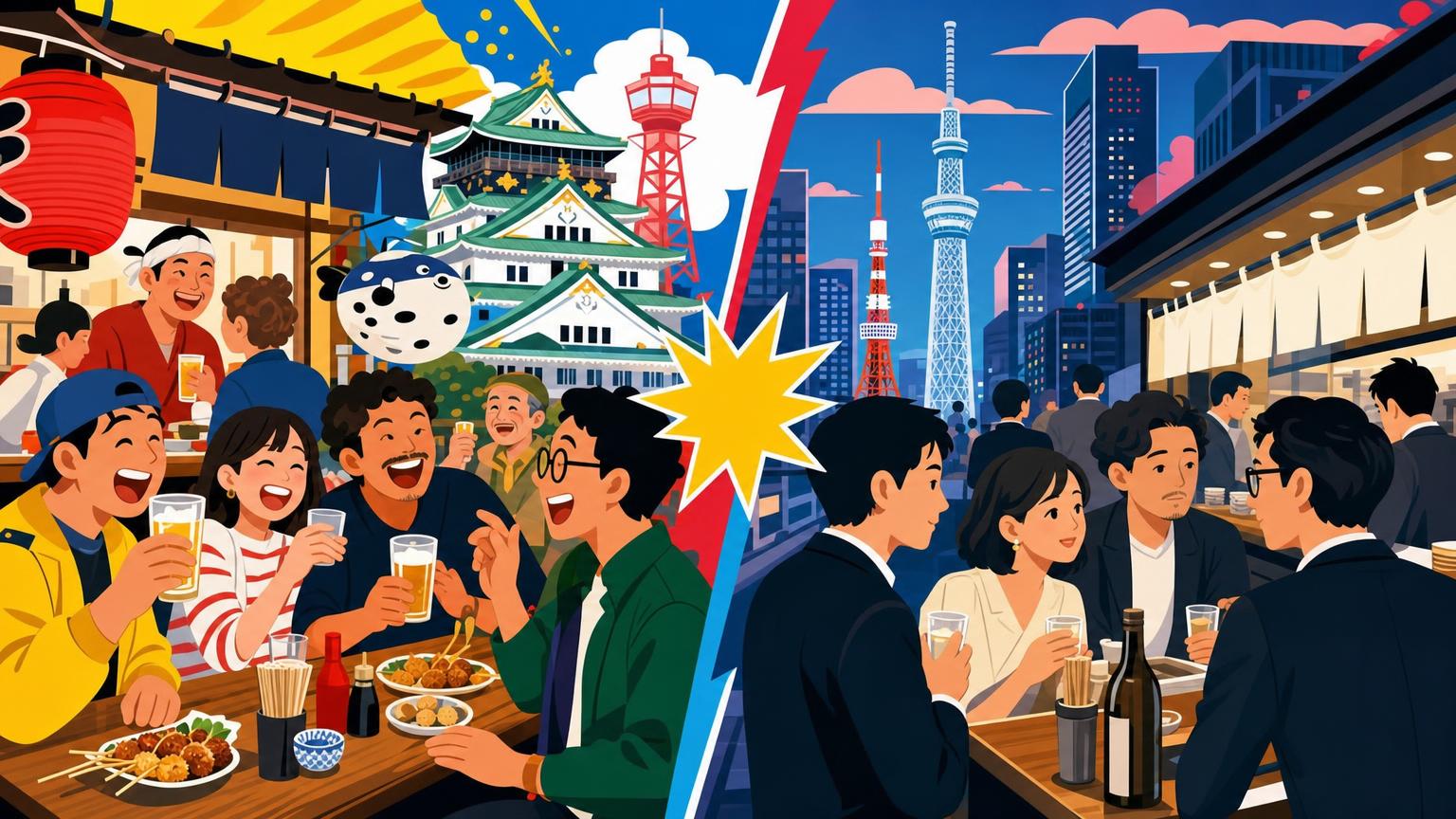
People often ask whether Osaka is friendlier than Tokyo. This comparison becomes unhelpful when it turns into a competition between personalities. Both cities are home to kind, cold, generous, impatient, formal, and eccentric people.
The difference is often structural rather than moral.
Tokyo is enormous, highly segmented, and filled with specialized social spaces. People can maintain separate networks for work, school, hobbies, neighborhood life, and private friendships. This can provide privacy and freedom, but it can also make everyday interaction feel more reserved or compartmentalized.
Osaka is also large and diverse, but many neighborhoods retain a more visible, street-level social rhythm. Shopping streets, small bars, family businesses, local restaurants, and commuter areas overlap more noticeably. A person may repeatedly encounter the same shopkeeper, bartender, delivery worker, and retired resident.
Tachinomi suits this environment because it is designed for brief, repeated contact.
Tokyo often protects personal space more carefully
In Tokyo, a crowded train may be extremely dense while personal interaction remains minimal. People are physically close but socially separate. Bars can be intimate, but that intimacy is often carefully controlled through reservations, groups, private tables, membership systems, or a clear division between staff and customers.
Osaka also has private and exclusive places. It is not one big open room. However, the tachinomi tradition creates more opportunities for brief interaction without a formal invitation.
You may stand beside someone you would never meet through your workplace. The encounter can remain brief. You do not exchange contact information; you simply share a few minutes.
That smallness is important. Osaka’s social life does not always require a lasting relationship before allowing conversation.
Osaka conversation can be less polished
Tokyo communication is often associated with careful politeness, indirect language, and sensitivity to social position. Osaka has those qualities as well, but casual interactions may become more visibly expressive. People may complain out loud, bargain humorously, react dramatically, or speak in a local dialect.
This can feel more honest to some foreigners and more intimidating to others.
The important point is that expressive speech is not automatically hostile. A loud voice may signal enthusiasm. A complaint may be a performance. A teasing remark may be an attempt to reduce distance.
You still need to observe the context. A busy worker who answers briefly may not be inviting conversation. A customer who smiles, asks questions, and turns toward you probably is.
Osaka has fewer guarantees of social polish
The same informality that makes tachinomi appealing can also create discomfort. You may encounter smoke, crowded spaces, blunt comments, unclear rules, or people who have been drinking heavily. A bar may be welcoming one night and feel too intense the next.
This is part of the trade-off.
Osaka’s neighborhood social life is often less curated than the polished image of urban hospitality. It can be generous, but it may not be perfectly organized for your convenience. If you want complete predictability, a standing bar may frustrate you. If you want to understand how local relationships form, the lack of polish is part of the lesson.
How a Tachinomi Differs from an Izakaya or Pub
The boundaries are not strict. Some tachinomi are technically izakaya, while some izakaya allow customers to stand. Some modern bars also use the term tachinomi to describe a style rather than a strict rule.
Still, these differences are useful for first-time visitors.
Tachinomi
A tachinomi typically emphasizes standing, quick service, compact spaces, small dishes, and low to moderate prices. You might order one drink and two dishes before leaving. The bar may function almost like a neighborhood counter, with people coming and going.
Izakaya
An izakaya generally offers a wider selection of food and may have tables, counters, or private seating. Customers often stay longer and order several rounds. The bill may include a seating charge, or otoshi, a small appetizer served automatically. Not every izakaya has one, but it is common enough that foreigners should be prepared for it.
Pub or Western-style bar
A Western-style bar may focus more on cocktails, spirits, music, or a particular atmosphere. Social expectations vary widely. Some bars welcome conversation, while others are designed for quiet drinking or dates.
The important distinction is not the label on the sign, but how the room expects you to behave.
If everyone is standing, the menu is posted on small cards, and people are ordering quickly at a narrow counter, you are probably in a tachinomi-style environment, even if the official name says otherwise.
The Social Rules That Make the System Work
Tachinomi culture may appear spontaneous, but it relies on unspoken rules. These rules are not meant to exclude foreigners; they help keep a small space functioning smoothly.
Order something soon
When you enter, acknowledge the staff and find a spot where you are not blocking the entrance. If the bar is busy, order a drink fairly quickly. You do not need to understand the entire menu before deciding.
A beer, highball, lemon sour, or tea is usually a safe first order. You can then take your time studying the food menu.
Avoid standing in the doorway while using your phone to translate everything. Move to the side if possible. In a small business, even a few seconds of blocked space can affect the entire room.
Keep your footprint small
Standing does not mean you can occupy a large area. Keep your bags close to your feet or place them in a designated spot. Avoid spreading coats, shopping bags, or phones across the counter.
If the bar becomes crowded, adjust your position. The social skill involved is simple: notice how much space others have and try not to take more than your share.
Do not treat the counter as a private table
A tachinomi counter is shared territory. You can talk with your companion, but do not create a private bubble that prevents others from joining the space. Loud group behavior can feel particularly intrusive in a small neighborhood bar.
This does not mean you have to remain silent. It simply means remembering that the room belongs to everyone using it.
Pay attention to payment habits
Some tachinomi establishments use cash on delivery. You place money on a small tray or pay each time you order. Others keep a running bill and charge you when you leave. Some accept cards or electronic payments, while older or smaller businesses may still prefer cash.
Do not assume contactless payment is available. Carry some yen, especially when visiting older neighborhoods or very small establishments.
Move on when the room is full
Tachinomi establishments are designed around movement. If customers are waiting outside and you have finished eating and drinking, it is considerate to leave or order one final item before settling the bill.
You do not need to rush through a meaningful conversation. However, staying for hours at a tiny counter on a busy evening can prevent the business from serving other customers.
Alcohol is not an excuse for disrespect
A casual atmosphere does not mean anything goes. Avoid touching strangers, shouting at staff, photographing people without permission, or assuming that a foreigner-friendly bar is a performance space for your entertainment.
If you become drunk, leave before the room has to manage you.
The real goal is not to imitate local behavior perfectly. It is to become someone the room can comfortably accommodate.
What Is Usually on the Menu?
The menu is one of the clearest windows into how tachinomi works. Dishes are generally designed to be eaten while standing, shared easily, prepared quickly, and paired with drinks.
Prices vary depending on the neighborhood, ingredients, rent, and reputation. A very inexpensive, worker-oriented bar may offer dishes for under ¥300, while a seafood-focused or modern standing restaurant may charge considerably more. Treat price ranges as practical estimates rather than guarantees.
Drinks
Common drinks include:
- Draft beer, often ordered as nama biiru.
- Bottled beer, including major Japanese brands and sometimes local craft options.
- Highballs made with whisky and soda.
- Lemon sours and other flavored shochu-based drinks.
- Shochu served with water, soda, tea, or on the rocks.
- Japanese sake, sometimes served by the glass or in a small metal cup.
- Plum wine and fruit-based drinks.
- Tea, soft drinks, and non-alcoholic beer.
A highball or lemon sour is often a practical choice for a short visit because it is relatively quick to serve and pairs easily with salty foods. Sake menus can be more difficult to understand when the labels are unfamiliar, so asking for the staff’s recommendation can be helpful.
Doteyaki
Doteyaki is a simmered dish strongly associated with Osaka’s drinking culture. Beef tendon and konnyaku are slowly cooked in a sweet, rich, miso-based sauce. It is soft, savory, and intended to accompany beer or sake.
Not every bar serves it, but when you see doteyaki on the menu, it provides a good example of how Osaka food works in a drinking environment: inexpensive cuts, lengthy cooking, bold flavor, and a dish that encourages one more drink.
Kushikatsu
Kushikatsu refers to deep-fried skewers. Ingredients may include beef, pork, chicken, seafood, onion, asparagus, lotus root, eggplant, and cheese. Prices are often listed per skewer, making it easy to order gradually.
The well-known etiquette about double-dipping in shared sauce applies especially to older kushikatsu establishments that provide communal sauce containers. Many modern places use individual dishes or squeeze bottles. Observe the setup before eating rather than assuming that every restaurant follows the same system.
Kushikatsu is not simply a tourist food. In a tachinomi setting, it is efficient social food. You can order a few pieces, compare choices with someone beside you, and continue drinking without committing to a large meal.
Sashimi and seafood
Many standing bars specialize in seafood. You may see tuna, mackerel, sardine, octopus, squid, or seasonal fish written on a board. These dishes can be excellent, but prices may change depending on the day’s supply.
If the menu does not show clear prices, ask before ordering. Pointing to the item and asking “Ikura desu ka?” can help prevent an uncomfortable surprise.
Seafood tachinomi also demonstrate that standing bars are not always rough or cheap in the narrow sense. Some are affordable because portions are small, not because the ingredients are poor.
Oden
Oden is a simmered assortment of daikon, eggs, tofu, fish cakes, konnyaku, and other ingredients. It is particularly comforting during the colder months, and both the broth and selection vary by shop.
Since each item may be priced separately, you can order only what you want. If you are unsure what something is, ask or point. Trying one unfamiliar item is often easier than attempting to decode the entire pot.
Small plates and daily specials
A tachinomi may offer a surprisingly wide range of small dishes:
- Potato salad.
- Pickled vegetables.
- Simmered pork or chicken.
- Grilled fish.
- Rolled omelet.
- Tofu with toppings.
- Fried chicken.
- Gyoza.
- Grilled pork belly.
- Seasonal vegetables.
- Cured meats or cheese in newer, more international bars.
The best choice is often the dish that appears most frequently on the counter. If several customers are eating the same thing, ask the staff what it is. A busy bar usually reveals its strengths through repetition.
The Neighborhood Differences Inside Osaka
There is no single tachinomi culture throughout the city. The social atmosphere varies according to each neighborhood’s history, customers, rents, transport connections, and relationship to tourism.
Understanding the area helps you understand the room.
Umeda and the Osaka Station area
Umeda is Osaka’s main northern business and transport hub. Around Osaka Station and its connected station complexes, you will find office workers, commuters, department stores, underground passages, hotels, and large commercial developments.
The Osaka Ekimae Buildings are especially useful for seeing how older and newer Osaka overlap. Their basement and lower-floor restaurant areas contain compact bars and inexpensive food businesses alongside offices and other services. Within minutes, you can move from a polished station environment into a more compressed drinking world.
The social rhythm here is often shaped by work. Customers may stop in before catching a train home. Some meet colleagues, while others drink alone. Conversations can be brief because the next train is important.
Umeda tachinomi may feel more anonymous than a small local bar in a residential neighborhood, but that anonymity also has advantages. You can enter without already knowing the community and observe how people use the city after work.
Tachinomi Shomin is one example of the standing-bar style that has spread throughout Osaka, including locations in areas such as Kyobashi, Tenma, Umeda, and elsewhere. Time Out describes the format as a recognizable part of Osaka’s drinking culture rather than a niche curiosity.
For someone living in Osaka, Umeda is useful when you want a low-commitment social stop near transport. It is less suitable if you expect every customer to act like a neighborhood regular. Many people are simply passing through.
Ura-Namba
Ura-Namba refers to the area behind Namba, particularly the network of smaller streets east of the main Namba and Sennichimae districts. It includes a mix of older businesses, newer restaurants, bars, standing counters, and highly concentrated nightlife.
The name itself explains the geography: it is not the formal front of Namba, but the spaces behind it.
Ura-Namba often feels more socially mixed than the larger entertainment streets nearby. Office workers, restaurant staff, younger residents, long-time locals, and visitors may all use the same narrow streets. The atmosphere can be lively, but the businesses are often small enough that the mood changes from one doorway to the next.
This area illustrates an important Osaka pattern. A neighborhood does not have to be quiet to be local. Local life can be noisy, commercial, crowded, and constantly changing.
Foreigners often make the mistake of assuming that Ura-Namba is simply a nightlife district for visitors. It is certainly popular with visitors, but its social meaning comes from the businesses and regular customers who use it as part of everyday life. The area’s bars and restaurants create a network of small encounters rather than one unified attraction. Osaka’s official tourism information also describes Ura-Namba as a backstreet area behind Namba with a wide range of restaurants and bars.
If you live nearby, Ura-Namba can become convenient rather than special. You might stop in for a quick drink, pick up some food, recognize a bartender, and leave before the streets grow crowded.
Tenma
Tenma is one of the clearest examples of Osaka’s neighborhood drinking culture. Around Tenma Station and the Tenjinbashisuji area, small restaurants, izakaya, standing bars, yakitori counters, and older shops fill the streets.
Tenma often feels less like a destination and more like a working urban district that happens to have an unusually high concentration of drinking establishments. Customers may live or work nearby, or they may use the station after shopping and running errands.
The social atmosphere can be energetic and direct. The spaces are often narrow, and you may stand close to people you do not know. Conversations move quickly because the room is filled with overlapping sounds.
Tenma is also useful for understanding how Osaka combines affordability with abundance. You can choose a bar based on the menu outside, the number of customers, the smell coming from the kitchen, or the music drifting through the doorway. There is no need for a perfect plan.
For foreigners, Tenma may be easier than an extremely small neighborhood bar because there are so many options. If one place feels too crowded or difficult, you can leave without considering the evening a failure. The area’s density makes experimentation possible.
Kyobashi
Kyobashi lies east of central Osaka and has strong ties to commuters, office workers, older commercial streets, and working-class nightlife. It is often less polished than Umeda’s high-rise image and less tourist-oriented than the central streets of Namba.
That does not mean Kyobashi is stuck in the past. New businesses and younger customers appear alongside long-established bars and restaurants. This contrast is part of its character.
Izakaya Toyo, a well-known food business in the Kyobashi area, is often discussed as an example of how a local drinking establishment can become widely recognized without losing its connection to neighborhood routines. It is not a straightforward model for every tachinomi, but it helps demonstrate how the local and the internationally visible can overlap.
Kyobashi is a good place to observe the difference between hospitality as service and hospitality as relationship. A busy owner may not have much time to explain everything to a newcomer. However, regular customers may help you understand what to order, where to stand, and when the space is full.
This is not polished hospitality. It is practical hospitality.
Shinsekai
Shinsekai is closely associated with older entertainment streets, kushikatsu restaurants, small bars, and a visible connection to Osaka’s working-class history. Jan-Jan Yokocho is one of the area’s covered food and drinking streets, and its atmosphere differs from the commercial centers around Umeda and Namba. Local sources describe Shinsekai as a district where small bars and kushikatsu businesses have served generations of customers.
Foreigners sometimes approach Shinsekai as a retro image, but that can be misleading. The area is not a museum of old Osaka. It is a living neighborhood with real businesses, residents, workers, regulars, and ongoing changes.
Some businesses are comfortable with visitors, while others focus more on their existing customers. A crowded small bar may not have the time or inclination to explain the rules of the room. This is not necessarily hostility; it may simply be a business operating at full capacity.
Shinsekai also shows why “local” does not always mean “authentic” in a simple or purely positive sense. Neighborhoods contain beauty, inconvenience, poverty, pride, noise, aging buildings, and commercial adaptation. A tachinomi can provide a valuable window into that complexity, but it should not be treated as a stage set.
What Foreign Residents Often Get Wrong
A tachinomi can be a useful introduction to life in Osaka, but foreigners sometimes misunderstand what the experience represents.
Mistaking access for belonging
If someone speaks to you warmly, you may feel that you have been accepted into the neighborhood. Perhaps you have made a new friend. Perhaps you have simply enjoyed a pleasant conversation.
Do not be too quick to decide.
People in Osaka can be generous during brief interactions. Someone may help you order, joke with you, or recommend food without expecting a long-term relationship. The moment is genuine, but it does not have to become a dramatic friendship story.
Belonging develops through repetition. Return, remember names, and behave considerately. Become familiar without becoming demanding.
Expecting the staff to entertain you
Some foreign visitors arrive expecting the bartender or regulars to explain everything. In a small neighborhood bar, that can create pressure. The staff is working, not conducting a cultural workshop.
Ask simple questions, accept brief answers, and observe. If the room is busy, wait patiently or come back at a quieter time.
Assuming every bar wants foreign customers
Many businesses in Osaka welcome foreign residents. Others may be cautious because of language barriers, previous bad experiences, limited staff, or simply because their regular customers prefer a quiet environment.
If a place looks full or the staff seems uncertain, do not argue. Move on. There are enough bars in Osaka that you do not need to force your way through one particular door.
A refusal, hesitation, or lack of English is not automatically discrimination. Sometimes it is a matter of capacity. Sometimes it may reflect a genuine preference. Either way, arguing will not create a better social experience.
Believing that casual means careless
The atmosphere may be relaxed, but small bars depend on cooperation. Customers need to share space, pay correctly, keep the noise manageable, and recognize when it is time to leave.
The informality is sustained by attentiveness.
Confusing Osaka dialect with a universal Osaka personality
You may hear Kansai-ben, the regional dialect associated with Osaka and the surrounding areas. It can sound more expressive or playful than standard Japanese. However, not everyone in Osaka speaks the same way, and dialect does not automatically indicate friendliness.
Someone can speak standard Japanese and still be deeply connected to Osaka. Another person may use dialect and still be impatient. Listen to the entire interaction instead of turning language into a personality stereotype.
Can Tachinomi Help You Make Friends in Osaka?
Yes, but not in the same way a networking event does.
If your goal is to exchange social media accounts with ten people in one night, a tachinomi may disappoint you. However, if your goal is to become a familiar face in the neighborhood, it can be surprisingly effective.
The strongest approach is gradual:
- Visit at around the same time so the staff and regulars begin to recognize you.
- Order simply and avoid asking for lengthy explanations.
- Ask about one dish or drink rather than trying to interview everyone.
- Respond when someone speaks to you, but do not force a conversation.
- Return the favor when someone helps you understand the menu.
- Leave politely while the atmosphere is still comfortable.
In Osaka, friendship often grows through repeated, low-pressure contact. You see someone again. You remember a detail. You ask how their work is going. You notice that they have changed their glasses or are not drinking that night.
These small observations create continuity.
For foreign residents, this can be more effective than immediately searching for people who share their nationality or professional background. You may still need international communities, language exchanges, and workplace networks. However, a neighborhood tachinomi can connect you with the ordinary social world around your home.
How to Enter a Tachinomi Without Feeling Lost
The first visit is usually the most challenging because you are trying to figure out the room, menu, payment system, and language all at once.
If possible, choose a place with a visible menu outside. Look through the doorway before entering, and if the room is extremely crowded, consider coming back earlier. In many areas, the atmosphere is more relaxed before the post-work rush becomes intense.
When you enter, a simple greeting is sufficient. Say “Konbanwa” in the evening, smile, and wait for staff guidance if the layout is unclear. If there is an open space at the counter, stand there without blocking the entrance.
Start by ordering a familiar drink. Then point to a reasonably priced dish with a clear name or photograph. If the menu is handwritten, use a translation app discreetly, but avoid spending five minutes blocking the counter.
You can also say:
- “Hajimete desu” to indicate that it is your first time.
- “Eigo no menu wa arimasu ka?” to ask whether there is an English menu.
- “Nihongo ga mada jouzu janai desu” to explain that your Japanese is still developing.
- “Kore o kudasai” while pointing at an item.
Most importantly, accept small mistakes. You may order the wrong type of drink, misunderstand whether the price is per piece, or stand in the wrong place for thirty seconds. Correct yourself, smile, and continue.
A neighborhood bar is not an examination room.
How Much Does a Tachinomi Visit Cost?
The answer depends on the business’s location and style. A very inexpensive visit might include one drink and two small dishes for around ¥1,000 to ¥2,000. A seafood-focused bar, modern standing restaurant, or venue offering premium sake may cost considerably more.
In 2026, some local guides list low-cost drinks in the ¥300 to ¥500 range, with small plates often starting at around ¥200. However, prices vary depending on inflation, ingredients, rent, and the bar’s positioning.
Budget is part of the culture, but tachinomi should not be reduced to “cheap food.” The low prices support frequent visits, allowing people to return often enough for recognition and local knowledge to develop.
For someone living in Osaka, that frequency matters more than the price of any single drink.
When a Tachinomi Is Not the Right Choice
Tachinomi are not ideal for every situation.
Choose another type of restaurant if you need a quiet conversation, a long formal meal, a comfortable chair, or guaranteed English-speaking service. A standing bar may be uncomfortable if you have mobility issues, an injury, or difficulty standing for long periods.
They may also be a poor choice when traveling with a large group. Six or eight people can overwhelm a small counter and unintentionally alter the atmosphere for everyone else.
If you are meeting someone for the first time and want privacy, choose a café or a regular izakaya. If you need to discuss a serious personal issue, do not assume that the loudest neighborhood bar is the right setting.
Tachinomi are powerful social hubs partly because they do not try to serve every purpose.
The Deeper Lesson About Living in Osaka
The importance of tachinomi reveals something broader about Osaka: the city’s social life often develops through repeated, informal contact rather than grand declarations.
People may not invite you into their private homes right away. They may not arrange a formal introduction or tell you directly that you have become part of their circle.
Instead, they may remember your preferred drink, save a dish for you, mention that someone asked about you, or complain when you have not visited in a while.
The relationship is communicated through behavior.
This can be confusing for foreigners who expect friendship to be defined by clear verbal statements. In Osaka, social connection may appear in routine before it becomes visible in language.
That does not mean you should romanticize every small bar as a perfect community. Some places are exclusionary, some customers are unpleasant, some owners are tired, and some friendships are temporary. Some neighborhoods are also under pressure from tourism and redevelopment.
But the underlying system is real: small businesses can create social infrastructure.
They provide a place where people are seen.
Is Osaka a Good Place to Live for Foreigners?
A tachinomi cannot answer that question on its own, but it offers several clues.
Osaka can be a good place to live if you value informal social contact, food-centered daily life, practical humor, brief conversations, and neighborhoods where different generations and occupations still overlap.
It may feel less comfortable if you prefer highly predictable service, strict privacy, quiet public interaction, or a city where everyone keeps their personal and professional lives completely separate.
For many foreigners, Osaka feels easier than Tokyo because small interactions begin more quickly. You may receive help at a shop, hear a joke from a stranger, or find an inexpensive place to eat without planning too far ahead.
But ease is not the same as instant belonging. You still need to learn the local rhythm and tolerate some ambiguity. You need to understand that a direct comment may be playful, that a quiet response may not indicate rejection, and that community is built by returning.
The tachinomi is a small-scale version of this entire process.
Enter carefully. Observe. Order something. Make room. Speak when invited. Listen more than you expect to. Return another day.
A Practical Way to Read the Room
When you enter a standing bar, look for a few signals before deciding how much to interact.
If customers are facing the staff and speaking quietly, the bar may be focused on quick, individual drinking. Keep your conversation subdued and order efficiently.
If several customers are turned toward one another, sharing dishes, and laughing openly, the room may be more conversational. You can respond if someone makes eye contact or asks you a question.
If the staff is moving quickly and customers are waiting near the entrance, keep your visit short and organized.
If someone explains a dish or asks where you live, respond warmly but briefly. Let the interaction develop instead of trying to turn it into a full cultural exchange.
If you feel uncomfortable, finish your drink and leave. You are allowed to decide that a particular room is not for you.
Social intelligence in Osaka is not about being fearless. It is about being observant.
The Future of Tachinomi in Osaka
Tachinomi are changing. New businesses are adopting the format for craft beer, wine, vegetarian food, specialty coffee, creative fusion dishes, and international menus. Younger owners may create brighter spaces with better ventilation, electronic payment options, and greater social media visibility.
At the same time, older shops face rising costs, changing customer habits, staff shortages, and redevelopment. Some disappear when landlords increase rents or owners retire. Others survive by adapting their menus and welcoming new customers without abandoning their regulars.
This transition reflects the broader question facing Osaka: how can neighborhoods remain socially connected while becoming more expensive, more international, and more commercially visible?
The answer will not come solely from preserving old buildings or promoting local food. A neighborhood remains alive when people can still meet without spending too much, small businesses can survive, and newcomers can enter without displacing those who were already there.
Tachinomi can contribute to that balance, but they are not immune to the pressures affecting the rest of the city.
A fashionable standing bar may attract new residents and support local jobs. It may also raise expectations regarding rents and customer spending. A traditional shop may preserve a familiar social world, but it may also be difficult for younger people or foreigners to enter.
The future will probably include both types: old-style counters with handwritten menus and newer standing bars designed for a more international Osaka.
Why These Bars Are More Than a Night Out
The phrase “social network” usually brings to mind apps, profiles, messages, and digital connections. But a real social network requires more than communication technology. It requires repeated contact, trust, memory, and local knowledge.
Tachinomi provide these things in physical form.
They connect workers after the office closes. They give solo residents somewhere to go. They help shop owners recognize the people who live nearby. They create opportunities for foreigners to be seen as neighbors rather than visitors. They share recommendations, complaints, jokes, rumors, and practical advice.
They also make space for people who do not want a formal social life. You do not need to host dinner. You do not need to join a club. You do not need to make a reservation weeks in advance. You can simply stand, eat, drink, listen, and come back.
That is why tachinomi are Osaka’s real social networks.
They are valuable not only because the drinks are inexpensive or the food is good, but because they make ordinary contact possible.
For a foreigner trying to understand what daily life in Osaka is really like, this is the central lesson: community may not come as an invitation. It may appear as a place where people continue making space for one another, one small order at a time.