Have you ever made what you thought was a friendly joke in Osaka, only to receive a completely serious reply? Or perhaps the opposite happened: someone you had just met teased you, laughed at themselves, and moved the conversation forward as if you had known each other for years.
This is one of the first confusing things about living in Osaka. People may speak casually, comment on your food order, joke about your Japanese, or turn a small inconvenience into a punchline. At the same time, Osaka is not a city where everyone is constantly performing comedy. The point is usually not to be hilarious. The point is to make interaction easier.
In Osaka, humor often works like social currency. It helps people show warmth, reduce distance, soften criticism, test trust, and keep a conversation moving. You do not need to become a comedian to live comfortably here. But understanding owarai—the broad Japanese word for comedy and comic entertainment—can help you understand what Osaka people are doing when they tease, exaggerate, complain, or invite you to laugh at an ordinary moment.
This article looks at Osaka from the inside: the small exchanges at work, in neighborhood shops, on trains, in restaurants, and among friends. It also considers Osaka vs Tokyo, what Osaka people are like in daily life, and what foreigners often misunderstand about the city’s reputation for being funny.
The map below is included only as a cultural reference point. The Namba area is strongly associated with Osaka’s commercial entertainment industry, but the social habits discussed here belong to the wider city—from Tenma and Fukushima to Higashinari, Sumiyoshi, Sakai, and the residential suburbs.
What Owarai Means in Everyday Osaka Life
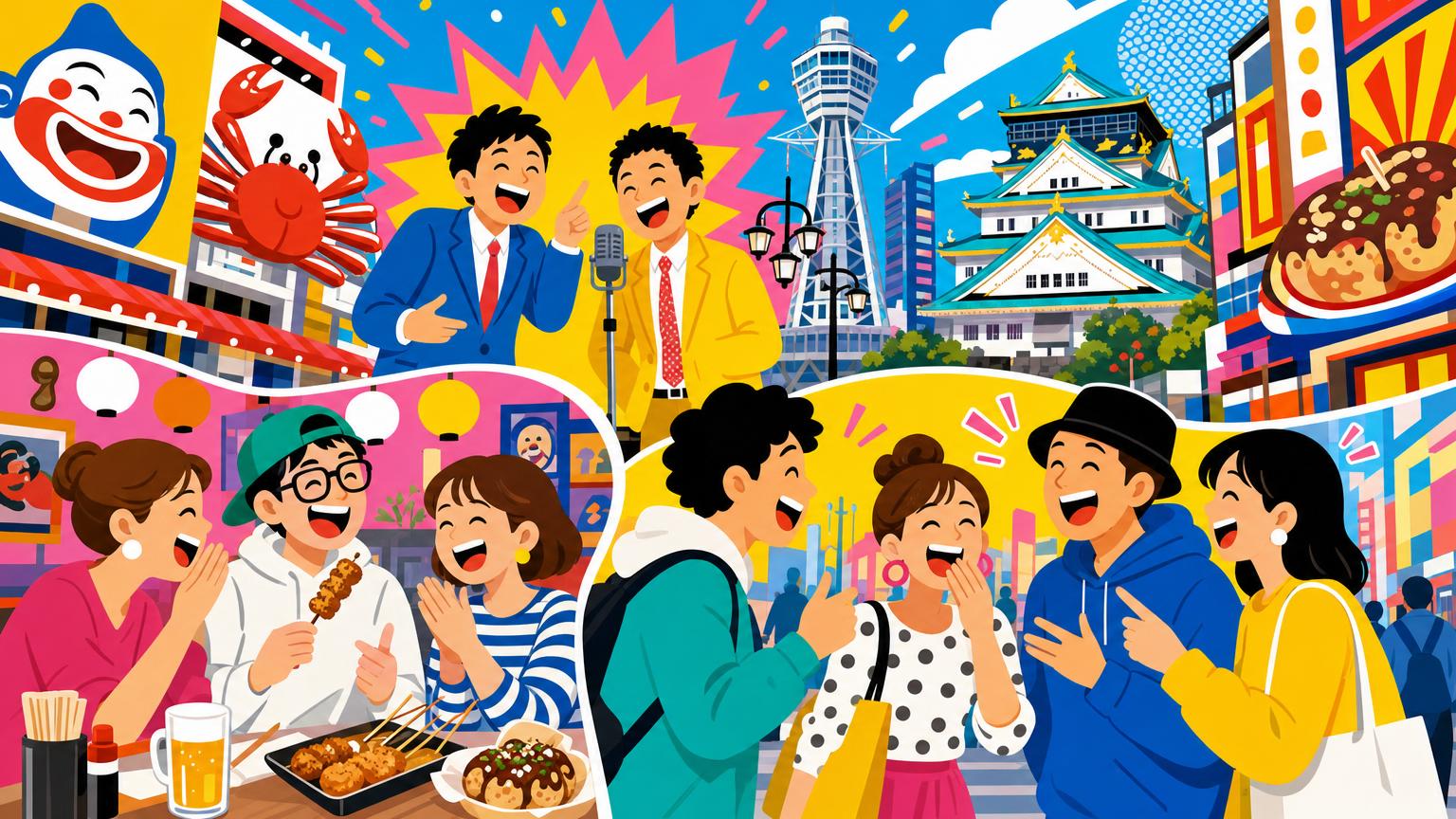
Owarai is often translated simply as comedy, but that translation can make the concept seem narrower than it really is. In everyday Osaka life, owarai may refer to professional comedy on television, a live manzai performance, a silly comment at the dinner table, or the habit of responding to a routine question with playful exaggeration.
It is not a single personality type. Rather, it is a way of navigating social situations.
When someone says, “I am exhausted,” another person might reply, “You only worked until five.” The response may not be intended as a factual correction. It may be a small invitation to play. When a colleague reveals a new haircut, someone might say, “You look like a different person,” with an expression that is clearly more amused than critical. When a restaurant is taking a long time, a customer may mutter, “Are they making the noodles from wheat?” The complaint feels lighter because it is framed as a joke.
For foreigners, this can be difficult to interpret. Is the person angry? Are they insulting me? Are they expecting a serious response? Sometimes the answer is yes. Sometimes it is no. The meaning depends less on the words themselves and more on timing, tone of voice, facial expression, the relationship between the people, and whether the other person is also willing to laugh at themselves.
The key point is that Osaka humor often values participation more than originality. You do not need to deliver a perfect punchline. A quick reaction, a playful complaint, or a small act of self-deprecation may be enough to keep the exchange going.
Humor as a low-cost way to build connection
Japanese society is often described as group-oriented, but that description can obscure how much local communication relies on subtle relationship-building. People do not always express their feelings directly. Instead, they observe how someone responds to small moments.
A joke can serve as a low-cost test of openness.
If a coworker lightly teases you and you respond with a smile or a modest joke about yourself, the coworker may take it as a sign that casual conversation is welcome. If you respond seriously, they may pull back. Neither reaction is automatically wrong. You are indicating the kind of relationship you prefer.
This is particularly visible in workplaces. A formal meeting may be conducted in standard business Japanese, with careful politeness and indirect disagreement. Afterward, the same people may joke about the coffee, the weather, a delayed train, or the manager’s complicated explanation. This shift does not necessarily mean that professionalism has disappeared. It means the social temperature has changed.
In Osaka, humor often helps bring about that change quickly.
The difference between friendliness and familiarity
Foreign residents sometimes hear that Osaka people are friendly and then feel disappointed when daily life does not involve constant conversation. Osaka friendliness is not always a form of warm, open-ended hospitality. More often, it is a willingness to make a brief interaction feel personal.
A shopkeeper may comment on your umbrella. A neighbor may ask whether you are adjusting to the summer humidity. A taxi driver may make a remark about the traffic. A colleague may complain with you about the price of vegetables. These moments can be brief. They may not develop into friendship. However, they lessen the feeling that every interaction must remain distant and formal.
That distinction is important. Osaka people can be socially direct without seeking a deep relationship. A joke does not always signal an invitation into someone’s private life. It may simply mean, “We can speak more naturally for the next thirty seconds.”
Why Osaka Developed This Communication Style
The idea that Osaka is Japan’s comedy capital is based on more than television celebrities or famous theaters. It is also connected to the city’s history as a commercial center and to the practical communication skills needed in a busy merchant society.
Osaka developed as a city of trade, distribution, markets, and negotiation. The Osaka Convention & Tourism Bureau describes the city’s merchant history in contrast to samurai-centered Edo and aristocratic Kyoto, highlighting Osaka’s role as a commercial city and a major center for food and distribution.
That history does not mean that every Osaka resident is descended from a traditional merchant, nor does it prove that one city has a fixed personality. Culture is never that straightforward. However, it helps explain why Osaka is often associated with practical speech, quick reactions, bargaining, lively storytelling, and a preference for communication that feels human rather than ceremonial.
Merchant culture and the value of quick understanding
In a commercial environment, communication needs to work. A seller must understand what a customer wants, while a customer needs to judge quality and price. Neighbors have to exchange information, and people need to resolve minor disagreements without turning every issue into a formal dispute.
A playful comment can make a negotiation feel less threatening. A sharp observation can show that someone is paying attention. A laugh can indicate that a disagreement is not yet serious.
This is one reason Osaka humor often feels practical rather than abstract. The joke may concern the price of lunch, the size of a fish, the weather, a confusing instruction, or a friend’s habit of arriving late. It develops from the immediate situation.
The humor stays close to everyday life. It does not always require a clever reference or a polished story. Instead, it requires noticing what is happening and presenting it from a slightly different angle.
The spirit of shimai and getting the balance right
Osaka is also associated with the idea of shimai, sometimes described as making full use of something while maintaining an appropriate overall balance. The word is more commonly discussed in connection with food, thrift, and avoiding waste, but the broader attitude is useful when considering Osaka communication.
People often appreciate a remark that makes something out of an ordinary situation. A small inconvenience should not go to waste. A long wait can become a story. A mistake can turn into a joke. A strange customer can become a memorable character. An inexpensive ingredient can become a satisfying meal.
This does not mean Osaka people are incapable of solemnity. Rather, it means that daily life often includes a strong instinct to make the most of what is available, including conversation.
Why complaining can sound cheerful
A foreign resident may hear people in Osaka complaining and assume they are angry. Complaints are common in every city, but Osaka complaints can be energetic, theatrical, and collaborative.
Someone might complain about a train delay while smiling. Another person may add an exaggerated detail, and a third might say that the railway company should provide dinner. The group is not necessarily seeking a formal solution. Instead, they are creating a shared mood around the inconvenience.
This is one practical difference in how Osaka people may come across. The complaint itself may matter less than the relationship formed through complaining together.
If you respond by offering an immediate solution, it may be appreciated—but it may also overlook the emotional purpose of the exchange. Sometimes the appropriate response is not advice but recognition: “That is ridiculous,” followed by a small laugh.
Osaka vs Tokyo: Is the Difference Really About Personality?
People often ask whether Osaka is friendlier, more relaxed, or more humorous than Tokyo. The honest answer is that the contrast is real in some situations but overstated in others.
Tokyo has plenty of humor, warmth, and casual conversation. Osaka has formal workplaces, quiet neighborhoods, reserved people, and social circles that can be difficult to enter. Neither city can be reduced to a single personality label.
The difference often comes down to public style and expectations.
A different default for public interaction
In Tokyo, especially in crowded central areas, strangers may be more careful not to intrude. People often move through public spaces with a strong awareness of personal boundaries, efficiency, and avoiding trouble for others. Conversations in shops or on public transport are often brief and task-focused.
Osaka also values efficiency and consideration. It is not a city where everyone talks to everyone else. However, there may be more tolerance for a comment that is slightly personal, playful, or unnecessary. The exchange can feel less scripted.
A cashier may make a comment about a product. A customer may respond with a joke. A staff member may smile and reply. The same exchange could happen in Tokyo, but it may be less expected. In Osaka, the possibility of such an exchange is more culturally available.
The role of dialect
Kansai speech, including the Osaka dialect, conveys emotional information that standard Japanese does not always express in the same way. To people familiar with it, the rhythm can sound more relaxed, expressive, or intimate. Even when the words themselves are not especially funny, the delivery can make a statement feel more conversational.
For learners of Japanese, this creates a potential trap. You may understand the vocabulary but miss the social meaning. A phrase that sounds aggressive in a textbook translation may be playful in context. A phrase that sounds friendly may be sarcastic. The pitch, timing, and relationship all matter.
You do not need to imitate the Osaka dialect right away. In fact, using dialect too confidently can sound unnatural or overly familiar. It is generally safer to understand it first and then borrow small expressions from people you know well.
Osaka is not a permanent comedy stage
Another common misunderstanding is that people in Osaka expect constant performance. They do not. Most residents are commuting, paying bills, raising children, studying, working, shopping, and dealing with the same ordinary frustrations as everyone else.
The comedy may appear for a moment and then disappear. Someone can make a funny remark at a convenience store and become completely serious while discussing a medical appointment. A colleague can tease you over lunch and then write a careful report in the afternoon.
The presence of humor does not make Osaka less serious. It changes how seriousness is approached.
The Basic Mechanics of Osaka Humor
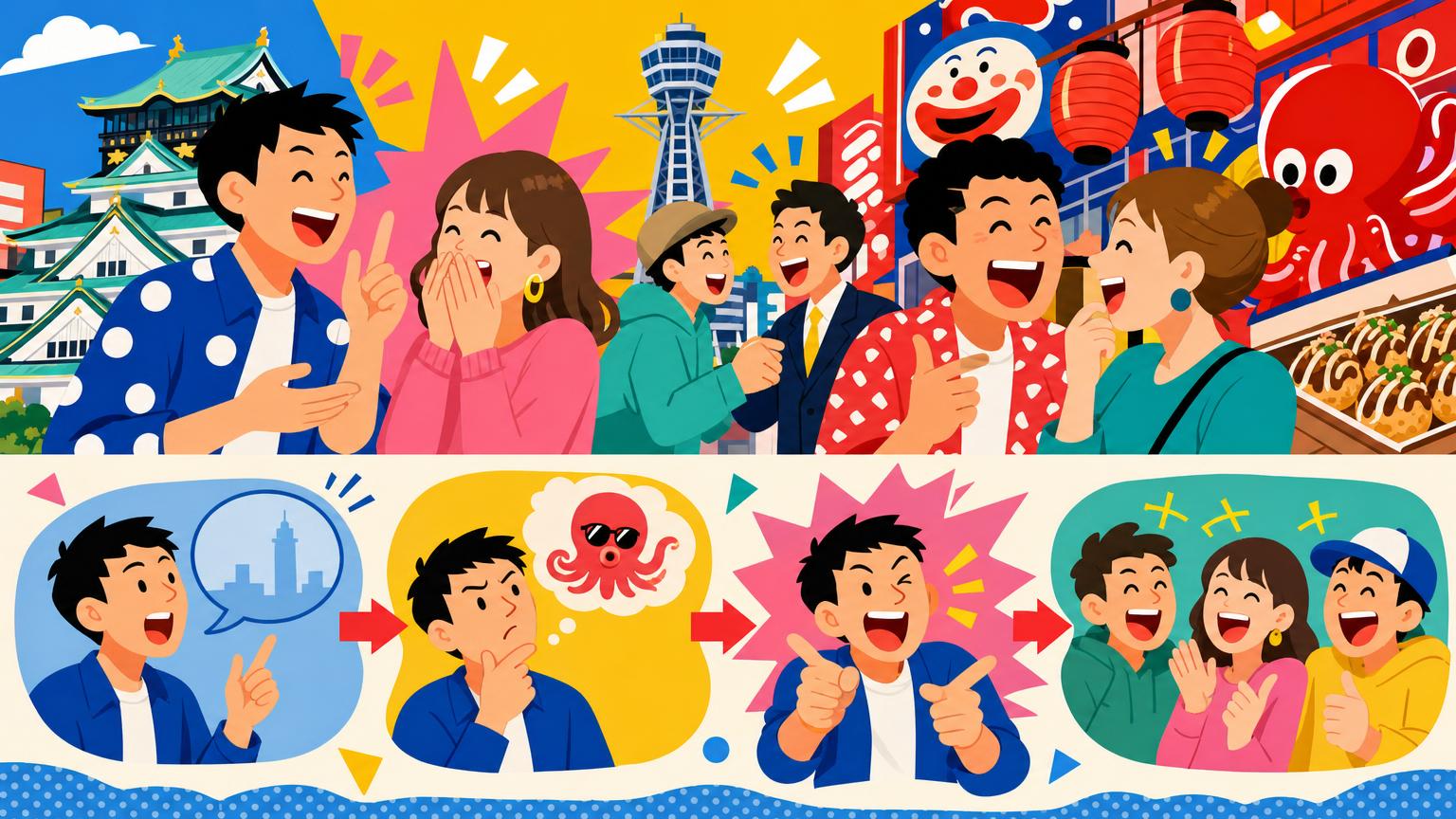
Understanding a few common patterns can make everyday interactions easier. These patterns are not strict rules, nor do they explain every joke. However, they offer a useful starting point for foreigners trying to understand the city.
Boke: the person who creates the comic opening
In comedy, boke is often translated as the funny person, the fool, or the person who says something strange. That translation is incomplete. A boke creates a gap between what is expected and what is actually said.
The person may deliberately misunderstand something, exaggerate, pretend not to understand, or make an obviously impractical suggestion. In everyday life, anyone can take on the boke role for a few seconds.
For example:
“I forgot my umbrella.”
“Good. Now you can finally become a fish.”
The second sentence does not solve the problem. Instead, it creates a comic turn. The speaker briefly acts as if the situation follows a ridiculous kind of logic.
Tsukkomi: the person who brings the conversation back
Tsukkomi is often translated as the straight man, but the term is more active than that. The tsukkomi points out the gap, corrects the exaggeration, responds to the absurdity, or brings the conversation back to ordinary reality.
The response might be verbal:
“That is not how umbrellas work.”
In professional comedy, it might also be physical, such as a light slap or gesture. However, physical contact is not something foreigners should casually imitate. In everyday conversation, the tsukkomi is usually a quick verbal response, a look, or an incredulous pause.
The relationship between the boke and tsukkomi is not always fixed. Friends may switch roles, and the same person may create the joke in one conversation and correct someone else in the next.
Why the reaction can matter more than the joke
In many Osaka interactions, the tsukkomi gives the group permission to laugh. Without a reaction, the joke may hang awkwardly in the air. With one, even a weak joke can become a shared moment.
This is why simply smiling politely can sometimes cause confusion. The speaker may be waiting for a more active response. You do not need to come up with a brilliant line. You can say:
“That is a serious proposal.”
“You really thought that would work?”
“Please do not make me responsible for that plan.”
The exact Japanese matters less than the rhythm: recognize the joke, respond briefly, and return to the situation.
Self-deprecation as a safe starting point
Self-deprecation is often the easiest type of humor for a foreign resident to use. You can joke about your own confusion, poor sense of direction, inability to handle humid summers, or habit of buying the wrong train ticket.
This works because you control the target. You are not making assumptions about someone else’s body, income, marriage, accent, age, or private life.
For example, after making a small mistake in Japanese, you might say, “My Japanese has chosen violence today.” The sentence is not a traditional Osaka joke, but it gives other people a comfortable way to laugh with you rather than at you.
Use self-deprecation lightly. If you constantly describe yourself as incompetent, people may eventually believe that you need help rather than humor. Osaka communication also values confidence. The goal is not to make yourself small, but to show that you are not afraid of making a small mistake.
How Japanese Comedy Styles Appear in Daily Life
Professional comedy gives Osaka residents a shared vocabulary for understanding humor. You do not have to watch every comedian to notice its influence. Television, family conversations, school culture, variety programs, and local theater have made certain structures familiar.
Manzai: fast-paced conversation between two people
Manzai is a two-person comedy style strongly associated with Osaka and the wider Kansai region. One performer typically creates the comic misunderstanding, while the other reacts, corrects it, or pushes the exchange forward.
The performance is built on timing, repetition, rhythm, wordplay, escalation, and the contrast between the two personalities. It often feels like an argument transformed into a precise musical form.
In everyday life, people rarely perform a complete manzai routine. However, its basic rhythm can appear in casual conversation. One person says something exaggerated, and the other responds immediately. The first person pushes the idea further, while the second rejects it. Everyone understands that the exchange is playful because the roles are clear.
The speed can be challenging for Japanese learners. If you are still translating every sentence, the conversation may be over before you find a response. Do not worry about matching the pace. A short reaction at the right moment is often more natural than a long explanation.
Rakugo: one person, many voices
Rakugo is a traditional storytelling form in which one performer sits and tells a comic story, using changes in voice, facial expression, and a small number of props. The performer usually plays several characters, switching between them through posture and the direction of their gaze.
Although rakugo is a stage art, its influence can be seen in Osaka’s love of stories featuring recognizable characters, reversals, misunderstandings, and memorable endings. Someone explaining a neighbor’s behavior may unconsciously tell the story like a small rakugo scene: setting the situation, introducing the characters, repeating a phrase, and ending with a twist.
Osaka has a strong Kamigata rakugo tradition. Venues such as Tenma Tenjin Hanjotei help preserve the form, while local stories and everyday settings keep it connected to the city.
For foreigners, rakugo can be more difficult to follow than visual comedy because its humor depends heavily on language, historical references, and character voices. Even when you miss the details, watching the performer manage several personalities can reveal something important about Japanese storytelling: a small change in delivery can completely alter the relationships between people in the scene.
Shin-kigeki: the rhythm of recurring characters
Osaka’s popular comedy tradition also includes Yoshimoto Shinkigeki, a theatrical style built around recurring character types, misunderstandings, physical comedy, exaggerated reactions, and familiar catchphrases. It has been performed through Yoshimoto’s entertainment network for decades and is associated with Namba Grand Kagetsu.
The official history of Shinkigeki traces its modern development to the late 1950s and its spread through theater and television. Namba Grand Kagetsu opened in 1987 and continues to present comedy, including manzai, rakugo, and theatrical comedy.
In daily life, the important lesson is not that Osaka residents expect life to resemble a stage show. Rather, it is that repeated social roles are easy to recognize. The overconfident person, the exhausted parent, the stingy customer, the overly serious manager, and the unlucky newcomer are all familiar comic figures.
When someone compares a real person to one of these types, they may be using a shared cultural shortcut. The comparison can be affectionate, but it can also be sharp. Context matters.
What Foreigners Often Misunderstand About Osaka Humor
The city’s reputation can cause problems when visitors or new residents arrive expecting a simple formula: Osaka equals jokes, and jokes equal friendship. Real life is more complicated.
Not every direct remark is an invitation
Someone may comment on your Japanese, clothing, lunch, or height without intending to form a friendship. Osaka communication can be direct, but directness does not automatically signal intimacy.
If a remark is repeated, humiliating, or focused on something sensitive, you do not have to accept it as cultural humor. You can change the subject, respond clearly, or say that the comment makes you uncomfortable. Understanding local communication does not mean giving up your boundaries.
Not every joke is harmless just because people are laughing
Groups may laugh because a situation is awkward, because they want to keep the mood light, or because one person holds more social power. Laughter does not prove that everyone feels comfortable.
This is especially relevant in workplaces. A senior colleague may joke about a junior employee, who may laugh because refusing is difficult. A foreign employee may be teased because they are viewed as an easy source of entertainment. If the pattern becomes one-sided, it is no longer simply a playful exchange.
Osaka’s humor can be generous, but it can also be used as a form of pressure. Pay attention to whether people can laugh at themselves and whether the target has a genuine opportunity to respond.
“Friendly” does not mean “easy to become close friends”
Many foreign residents find Osaka easier to approach than Tokyo, but approachability and friendship are separate stages. People may chat with you at a bar, share a joke at work, or help you understand a local procedure without inviting you into their private circle.
Long-term friendship usually develops through repetition: the same workplace, neighborhood, sports club, school, volunteer group, or hobby. Humor may open the door, but reliability keeps it open.
Kansai humor can sound harsher in translation
English speakers may translate a phrase literally and hear an insult where the original speaker hears playful disbelief. The opposite can also happen. A phrase that sounds gentle in English may feel condescending in Japanese, depending on the relationship.
Do not judge a single sentence in isolation. Listen for whether the speaker is smiling, whether they tease others equally, whether they repair the interaction afterward, and whether you are free to respond.
Foreignness is not a permanent punchline
Some residents are happy to discuss cultural differences. Others are tired of being asked where they are from or whether they can eat Japanese food. A foreigner who speaks Japanese may receive extra attention because people are surprised by their ability. That attention can feel positive at first and exhausting later.
A useful boundary is to decide when you want to be the interesting foreign person and when you simply want to be a customer, coworker, neighbor, or friend.
How Humor Works at Work in Osaka
Workplace culture can vary significantly by industry, company, age group, and language environment. Still, humor can help foreign residents recognize several common patterns.
The first joke may be a temperature check
A colleague may make a small joke during a break to find out whether you are open to casual interaction. You can respond with a smile, a brief comment, or a joke about yourself. You can also reply neutrally if you prefer to keep the relationship formal.
Your response shows people how to approach you. If you laugh at jokes about your private life even though they bother you, colleagues may not understand your boundary. If you never respond to casual humor, people may assume that you prefer distance, even if you are simply translating internally.
Humor can soften disagreement
A direct “No” may sound strong in some Japanese workplaces, while a joke can make resistance easier to accept. Someone might say, “That schedule is ambitious,” when they mean that it is unrealistic. Another person might reply, “Ambitious enough to become a legend,” acknowledging the problem without creating a confrontation.
As a foreign employee, do not depend on humor alone when an issue involves safety, money, deadlines, contracts, or legal responsibility. Follow the joke with a clear statement whenever clarity is important.
Do not mistake laughter for agreement
People may laugh at a proposal because the situation feels awkward. They may laugh politely, at the way an idea was presented, or because everyone understands that the idea is impossible. If you need a decision, ask for confirmation in plain language.
This is particularly important in multilingual workplaces. A humorous response can conceal uncertainty. Repeat the specific point: “So the deadline is Friday, correct?”
After-work gatherings are not mandatory comedy clubs
At an izakaya or company dinner, the conversation may become more relaxed, but employees still have different comfort levels. Some people enjoy teasing and storytelling, while others are quiet, tired, or concerned about hierarchy.
You can participate without putting on a performance. Ask about the food, listen to stories, respond to jokes, and make a brief comment about your own experience. You do not have to compete with the most talkative person in the group.
Humor in Neighborhood Life
If you want to understand life in Osaka, pay attention beyond the famous entertainment districts. Local humor is often easiest to notice in ordinary places such as shopping streets, supermarkets, schools, clinics, community centers, and small restaurants.
Shopping streets and familiar faces
In a neighborhood shopping street, repeated contact matters. A shopkeeper may remember what you bought, ask about your family, or comment on the weather. If you come from a culture with a stronger boundary between service and private life, the interaction may feel intrusive.
Over time, however, these remarks can become a form of recognition. A joke about your always buying the same bread means the shopkeeper remembers you. A complaint about the rain means you have become part of the day’s conversation.
You are not required to share personal information. A light response such as “I am still deciding whether Osaka’s summer is stronger than I am” can keep the exchange friendly without revealing anything private.
Apartment buildings and local expectations
Neighbors in Osaka are not automatically chatty, and apartment life can be anonymous. In some buildings, a greeting in the hallway is enough. In others, residents may talk more during garbage collection, neighborhood events, or children’s activities.
Humor is most useful once basic trust has been established. Trying to be funny before learning the building’s norms can sound careless, especially when the topic involves noise, recycling, pets, or shared spaces.
If someone complains about how you separate your garbage, do not joke first. Apologize, ask what needs to change, and perhaps make a small self-deprecating remark after the practical issue has been resolved.
Restaurants and small bars
In a small restaurant, the owner may comment on your order or ask whether you are accustomed to the flavor. A brief response can create a pleasant exchange. If you prefer quiet, you can remain polite and focus on your meal.
In a bar, especially one where people know one another, humor may move quickly. Listen before joining in. Notice whether people joke about everyone or whether one person is being singled out. If you cannot follow the language, it is perfectly acceptable to smile, say that you missed the last part, and ask for a slower explanation.
Many residents appreciate an honest remark such as, “I did not understand, but everyone’s reaction tells me it was dangerous.” This kind of comment turns your language limitation into a shared moment without pretending to understand.
How to Participate Without Pretending to Be Japanese
Foreign residents sometimes overcorrect. After hearing that Osaka values humor, they may start forcing jokes, using dialect, or making strong comments that would not feel natural in their own language.
You do not need to become an Osaka character. The most comfortable approach is to become more responsive rather than more theatrical.
Notice the opening
A conversation often contains a small opening: an obvious exaggeration, a dramatic complaint, a repeated phrase, or a pause that invites a reaction. You can respond with a short observation.
If someone says, “I have been waiting forever,” even though they have only been waiting ten minutes, you might say, “Should I contact the history department?”
If someone says, “This rain will never end,” you might answer, “I will start building a boat after lunch.”
These are not sophisticated jokes. They show that you understand the emotional direction of the conversation.
Keep the target safe
The safest targets are your own minor mistakes, shared inconveniences, food, weather, public systems, or an obviously exaggerated situation. Be cautious with jokes about appearance, nationality, religion, gender, disability, income, age, family status, and work performance.
Osaka humor can be direct, but directness is not a license to be careless. A local person may have a long-standing relationship that makes a particular joke acceptable, but you may not share that history.
Match the intensity
If someone makes a small joke, respond with a small joke. If you answer with a long performance, the interaction can become uncomfortable. If someone is speaking seriously, do not force a punchline simply because Osaka has a reputation for comedy.
The best timing is often one sentence, followed by a return to normal conversation.
Learn to laugh without agreeing
You can laugh at the form of a joke without accepting its opinion. Someone may make a playful complaint about a politician, company, neighborhood, or social group. You can respond to the humor while remaining neutral about the claim.
For example, “That is a dramatic way to describe the situation” acknowledges the style without saying that the statement is true.
Say when you do not want to joke
Boundaries can also be expressed lightly, but they do not have to be. “I know you are joking, but I would rather not talk about that” is clear and reasonable. In a healthy relationship, the other person should adjust.
If they continue and use “It is just a joke” to dismiss your discomfort, the problem is not that you have failed to understand Osaka. The problem is that they are ignoring your boundary.
Is Osaka a Good Place to Live If You Dislike Small Talk?
Yes, but your experience will depend on where you live, work, and spend your time.
Osaka is not one continuous conversation. You can live quietly, commute without speaking to anyone, shop online, and maintain a small social circle. You can also become involved in a neighborhood, sports group, language exchange, music scene, volunteer organization, or workplace where conversation is constant.
The city has room for both styles.
One advantage of Osaka humor is that it can make social contact feel less heavy. A joke may allow two people to interact without immediately discussing their personal histories. You can share a laugh while remaining independent.
The disadvantage is that direct teasing can become tiring, especially if you are still learning Japanese or if your workplace treats you as a source of novelty. You may need to state your preferences more clearly than you would in a culture where personal boundaries are assumed.
If you are choosing between Osaka and Tokyo, consider what kind of friction you prefer. Osaka may offer more informal contact in some settings, but it may also require more active interpretation of tone. Tokyo may offer more privacy in public, but building casual connections can take longer. Neither city is universally easier.
Where Professional Comedy Helps You Understand Local Culture
This article focuses on daily life rather than sightseeing, but professional comedy can offer useful cultural context. Watching a performance provides a concentrated version of patterns that appear more subtly in ordinary conversation.
Namba Grand Kagetsu is a major Yoshimoto theater in Namba. Its program features manzai, rakugo, comedy theater, and other performances, and the venue describes itself as a central source of Japanese comedy culture.
The practical point for residents is not that you need to attend a theater. Rather, comedians make the social mechanics of interruption, correction, exaggeration, repetition, and character contrast easier to see. Even with limited Japanese, you can observe when the audience laughs, how performers establish roles, and how a seemingly serious disagreement becomes playful.
English-language comedy events can also help foreigners compare stand-up traditions with Japanese comic timing. Osaka has hosted English comedy through venues and communities such as ROR Comedy Club, although schedules and locations may change, so residents should check current event information before attending. Older Osaka tourism materials describe ROR as an all-English comedy club and distinguish that style from manzai.
Watching both types of performance can clarify the difference between imported stand-up and local owarai. English stand-up often focuses on an individual performer’s point of view, personal story, social observation, or carefully developed premise. Manzai more often relies on the relationship between two performers and the rhythm of correction. The traditions overlap, but they teach audiences to notice different things.
Japanese Humor vs American Humor: A Practical Comparison
There is no single American style of humor, just as there is no single Japanese style of humor. Still, comparing common tendencies can help English-speaking residents understand why some exchanges feel natural while others become unexpectedly difficult.
The individual voice and the shared rhythm
American stand-up often presents the comedian as an individual voice explaining how they view the world. The performer may share a personal story, challenge a social norm, expose hypocrisy, or build a longer narrative toward a punchline.
Japanese comedy, especially manzai, often places greater emphasis on the relationship between performers. The audience observes a social system: who misunderstands, who corrects, who has authority, who loses face, and how the exchange returns to order.
In everyday life in Osaka, this means your reaction may matter more than your original comment. A good tsukkomi may be appreciated because it keeps the group’s rhythm moving.
Sarcasm and exaggeration
American speakers may use sarcasm to express the opposite of what they mean. Japanese speakers also use irony and sarcasm, but the signals may differ. Exaggeration is often easier to recognize than subtle sarcasm, especially across languages.
If you are uncertain, notice whether the speaker is creating an obviously impossible image. When the exaggeration is clear, you can respond to the comic structure without having to decode every implication.
Roasting and relationship
Roasting is familiar in many English-speaking cultures. Friends may affectionately insult one another, and the intensity of the insult can signal closeness. Osaka also has teasing and direct verbal play, but you should not assume that the same boundaries apply.
The safest test is reciprocity. Do both people tease each other? Does the target laugh freely? Can the target make a similar joke in return? If not, you may be seeing a hierarchy rather than friendship.
Silence and timing
English-speaking residents sometimes speak too quickly because they are uncomfortable with silence. In Osaka, a brief pause can give the joke time to land or create room for the tsukkomi. Wait half a second before filling every gap.
At the same time, lengthy explanations can weaken a casual joke. If your remark requires a paragraph of background, it may be better to tell the story later.
The danger of translated cleverness
Wordplay rarely carries over smoothly. A joke that is brilliant in English may become a confusing sentence in Japanese. A literal translation of a Japanese pun may sound meaningless in English.
Do not judge your social success by whether people laugh loudly. Sometimes the best sign is that the conversation continues naturally. A smile, a quick response, or a later reference to your comment may indicate that it worked.
Everyday Situations and Better Responses
The following situations are common enough to be useful, but every relationship is different. Treat them as patterns rather than scripts.
Someone teases your Japanese
A colleague says that your Japanese pronunciation sounds unusual. If the tone is light and you have a comfortable relationship, you might reply, “My pronunciation is taking a creative direction.” Then continue speaking clearly.
If the comment is repeated or humiliating, say directly that you are working on your Japanese and would prefer correction to teasing. A healthy relationship allows room for both humor and practical help.
Someone complains about the weather
Rather than immediately giving a weather report, you can share the mood: “This is not weather. This is a personal attack.” The remark is easy to understand and does not target anyone.
If the person is genuinely struggling with the heat or their health, shift to practical concern. Humor should not get in the way of care.
A coworker makes an exaggerated promise
Someone says, “I will finish this in five minutes,” while holding a complicated document. You might respond, “Then I will prepare the award ceremony.” This acknowledges the exaggeration without accusing the person of lying.
If the deadline affects your work, follow up clearly: “Seriously, when can I expect it?”
You make a mistake in public
A small mistake can feel less embarrassing if you acknowledge it first. “That was a confident wrong turn” or “My train strategy has failed again” lets others know that you understand what happened.
Do not over-apologize for every mistake. Osaka humor often respects people who can recover quickly.
You do not understand the joke
Say so. “I understood the grammar but not the damage” is a light way to ask for help, but simply saying, “Could you explain that?” is also fine.
People may enjoy explaining the local reference. If they refuse and make you feel stupid, that says more about the speaker than about your language ability.
The Limits of the Osaka Stereotype
Osaka’s reputation for comedy can become a source of pressure. Residents may feel expected to be entertaining simply because they are from Kansai. Foreign residents may feel expected to enjoy every direct comment because they have been told Osaka is friendly.
Both assumptions are unfair.
There are quiet Osaka residents, serious Osaka residents, shy Osaka residents, formal Osaka residents, and people who dislike comedy. There are also Tokyo residents who are exceptionally funny and warm. Regional culture influences the range of acceptable behavior, but it does not erase individual personality.
The stereotype is most useful when treated as a clue rather than a conclusion.
If you notice more casual joking in a workplace, ask what purpose it serves. If a shopkeeper remembers you, consider whether the relationship is becoming more familiar. If someone’s directness makes you uncomfortable, set a boundary instead of explaining it away as culture.
The goal is not to label every person as an Osaka type. It is to understand the local possibilities well enough to choose how you want to participate.
What Humor Reveals About Osaka People
Humor in Osaka often reflects a preference for communication that is immediate, responsive, and rooted in the situation. It can signal impatience with excessive formality, but it can also soften difficult truths. It may express affection, while also revealing hierarchy. It can draw you closer, but it can also test whether you know how to protect your own boundaries.
That complexity is what makes owarai important to daily life.
Osaka’s humor is not merely a collection of jokes. It is a form of social technology. It helps people negotiate distance, turns inconvenience into a shared story, allows criticism to land with less weight, and gives ordinary people a way to shape the mood of a room.
For someone living in Osaka, the most useful lesson is simple: listen for the relationship beneath the words.
Is the person trying to include you? Are they checking whether you can respond? Are they making a serious complaint seem lighter? Are they using humor to avoid responsibility? Are they laughing with you, laughing at you, or waiting to see what you will tolerate?
Once you start asking these questions, Osaka becomes easier to read. The city may still feel fast, loud, direct, and occasionally confusing, but its humor no longer seems like random teasing. You begin to notice the small negotiations behind it—the invitation, the correction, the boundary, and the repair.
That is why humor functions as a social currency in Osaka. It is not valuable because everyone is trying to be funny, but because a well-timed laugh can make everyday life feel less distant, less rigid, and more shared.