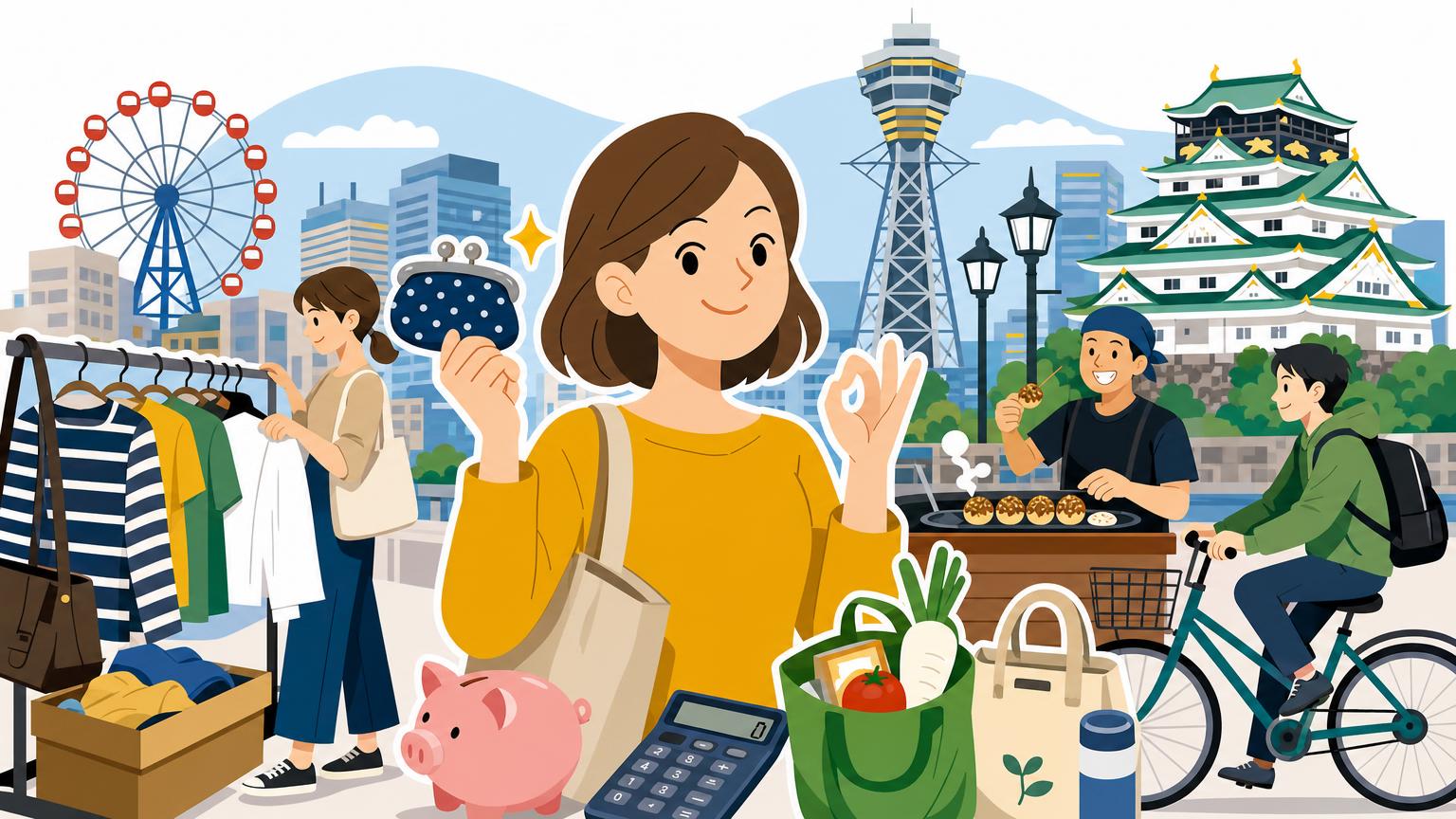
Have you ever been in Osaka and wondered why someone was carefully dividing a restaurant bill, refusing an unnecessary purchase, negotiating over a small discount, or pointing out that a service was not worth the price? Did the person seem sensible—or simply rude?
This article is about that confusing space between thrift and stinginess in Osaka daily life. You may have heard the word “ketai” used to describe this attitude. In everyday Japanese, however, the word most often connected with “stingy” is kechi(ケチ). “Ketai”(けったい)usually means strange, unusual, or peculiar in Kansai speech, so the terms can easily become mixed up by learners of Japanese.
When people describe Osaka as “kechi,” they are not always making a serious accusation. Sometimes they are criticizing someone who refuses to contribute, avoids paying their share, or cares about money more than relationships. At other times, they are using the word with affection to describe a person who dislikes waste, notices poor value immediately, and expects every yen to do useful work.
That distinction matters if you live in Osaka, are considering moving here, or simply want to understand what Osaka people are like in ordinary situations. Osaka’s practical mindset can make daily life feel relaxed and honest. It can also feel surprisingly blunt if you come from a culture where generosity is shown through paying more, giving more, or avoiding money talk.
The map below is included only as a geographic reference for the central Osaka areas mentioned in this article. It is not a sightseeing itinerary. Osaka’s mindset is easier to understand through neighborhood routines, shops, kitchens, offices, and conversations than through famous landmarks.
What Does “Kechi” Mean in Osaka Daily Life?
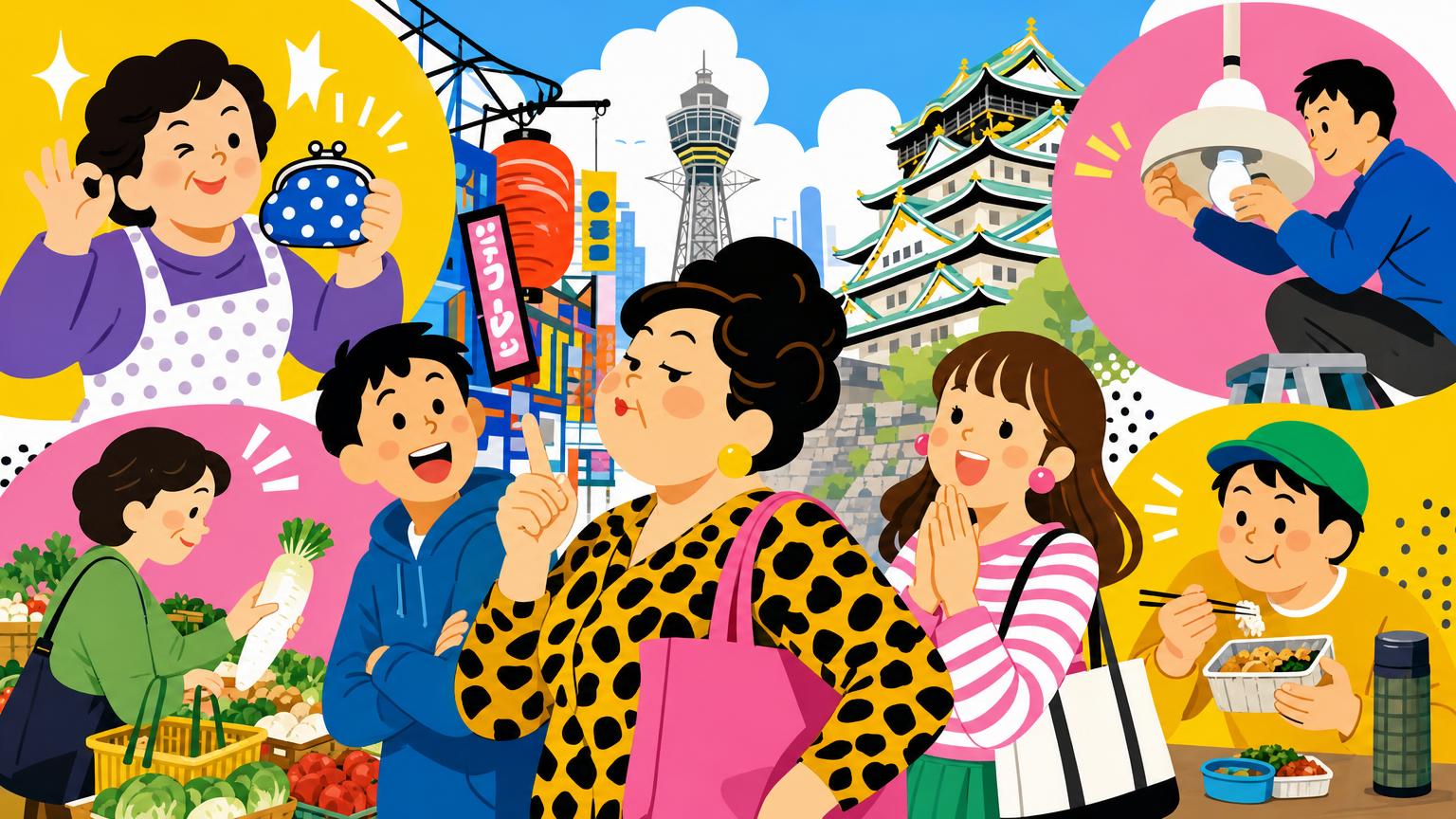
In English, “stingy” usually has a strongly negative connotation. It suggests that someone has money but refuses to spend it, especially when spending would be fair, kind, or socially expected. By contrast, “thrifty” can sound positive. A thrifty person avoids waste, plans carefully, and makes sensible choices.
The Japanese word kechi can carry both meanings, depending on the situation, the speaker’s tone, and the relationship between the people involved.
An Osaka person might call someone kechi because that person:
- refuses to pay their share after eating with friends
- complains about a small expense while spending freely elsewhere
- takes more than they give in a group situation
- avoids buying something necessary because they dislike spending
- asks for a discount even when the price is already fair
- insists on recovering every small expense
- throws away useful items instead of repairing or reusing them
In these examples, kechi is a criticism. The problem is not simply spending little; it is unfairness. A person who makes others pay, wait, work, or sacrifice while protecting their own money may be called kechi in Osaka, just as they might be anywhere else.
However, the same word can also describe someone who takes pride in finding value. They may say, “That’s kechi,” while laughing at themselves. They may refuse an expensive brand, choose a neighborhood shop over a fashionable chain, or bring home leftovers because wasting good food makes no sense. In this context, the word can be close to “careful,” “economical,” or “not easily fooled.”
The key question is not, “Does this person spend a lot?” but rather, “Does this person spend according to their values?”
This is why someone in Osaka may spend very little on a practical item but spend generously on food, a celebration, a gift for a parent, or an experience shared with friends. Their spending is selective rather than consistently cheap.
Why Osaka Developed This Practical Attitude
Osaka’s reputation for thrift did not arise from a simple personality stereotype. Rather, it is connected to the city’s long history as a commercial and trading center. During the Edo period, Osaka became known as Tenka no Daidokoro, often translated as “the Kitchen of the Nation,” because goods, rice, seafood, and other products moved through the city and into markets across Japan.
A commercial city teaches people to recognize value. Merchants must assess quality, calculate risk, remember customers, minimize waste, and maintain trust. A small loss repeated every day can become a serious problem, while a small saving repeated every day can become part of a stable business.
This background does not mean that every Osaka resident thinks like a shopkeeper. It does help explain why certain attitudes remain familiar:
- price and quality are expected to correspond
- unnecessary formality can seem inefficient
- waste is viewed as a practical problem, not merely a moral one
- people may openly compare their options
- a good deal is something worth discussing
- both the customer and the seller are expected to understand the value of the exchange
Osaka’s merchant culture also produced a distinctive combination of calculation and warmth. A shopkeeper may joke with you, complain about the cost of ingredients, and still give you a little extra food. A neighbor may ask exactly how much you paid for an appliance and then help you find a cheaper repair service. Such conversation can sound intrusive to a foreign resident, but it may also represent a form of practical care.
The city’s food history adds another layer. Osaka’s food culture developed around both frugality and enjoyment. Merchant households valued simple, efficient, and waste-conscious cooking, while prosperous commercial activity supported refined cuisine and elaborate meals. These two ideas are not opposites. A person can dislike wasting food and still love eating extremely well.
That combination helps explain the familiar Osaka pattern: save money where the value is limited, then spend confidently where the value is clear.
The Osaka Difference: Cheap Is Not the Same as Valuable
A foreign resident may notice that people in Osaka discuss costs more directly than expected. Someone might ask how much your rent is, whether your electricity bill has increased, or how much a repair cost. In a more reserved environment, such questions might feel private or impolite.
In Osaka, the question may be practical rather than judgmental. The person may be comparing information because they want to make a better decision for themselves. They may know of a cheaper supplier, a reliable technician, or a store that provides better service. They may also simply be curious. Conversations in Osaka often move quickly from personal experience to useful information.
This does not mean you have to answer every question. You can say:
- “I’m still comparing prices.”
- “I’d rather not discuss money.”
- “I’m not sure yet.”
- “That’s private for me.”
A direct answer is not always necessary. What matters is understanding that discussions about money may not carry the same level of embarrassment as they do in other cultures.
The practical Osaka question is often: What are we getting for what we are paying?
This question comes up in ordinary situations. If a building management company introduces a new fee, residents may ask what service it covers. If a restaurant raises its prices, customers may discuss whether the portion, taste, and service justify the increase. If a company requires employees to work late without clear compensation, people may complain that the arrangement is unreasonable.
From the outside, this can look like constant complaining. From the inside, it can be a way of checking whether the relationship is balanced.
Who Is the Osaka “Kechi” Mindset For?

The practical mindset often works best for people who value clarity, independence, and visible fairness.
It suits people who dislike waste
If you prefer repairing something before replacing it, cooking with leftover ingredients, comparing mobile phone plans, or reusing household items, Osaka may feel comfortable. The city has a strong tolerance for ordinary, imperfect, useful things. You do not always need the newest version or the most polished presentation.
This attitude is especially apparent in older shopping streets, small family-run stores, neighborhood supermarkets, secondhand shops, and local service businesses. The point is not that every shop is inexpensive. Rather, usefulness often matters more than image.
It suits people who want practical advice
Osaka communication can be generous with information. A colleague may point out that your current internet plan is expensive. A neighbor may explain which clinic has shorter waiting times. A restaurant owner may tell you which dish is better that day because the ingredients arrived fresh.
The advice may come without a polite introduction. It may sound like criticism. Often, however, it is intended to save you trouble or money.
It suits people who enjoy equal participation
In group meals, shared purchases, neighborhood activities, and workplace events, fairness matters. People may keep track of who paid, who brought something, and who has not yet contributed. This can feel less graceful than having one person quietly pay for everyone, but it helps prevent hidden resentment.
If you are new to Japan, keep some cash available, confirm whether a meal will be split, and do not assume that the oldest or highest-ranking person will automatically pay. In Osaka, the host may pay on some occasions, but everyday social life is often more balanced and negotiated.
It suits people who can laugh at money
Osaka humor often makes discussions about money feel less heavy. Someone may joke about being poor, overpaying, buying a discounted item, or refusing an unnecessary charge. Such a joke can make an awkward subject easier to discuss.
You do not need to joke about your own finances if you feel uncomfortable. However, you may find that a light response works better than a stiff defense:
“Very true. I should have compared the prices first.”
“I’m trying to become more Osaka-like with my budget.”
“I paid too much, but at least I learned something.”
The goal is not to perform Osaka humor. It is to recognize that a little self-mockery can ease social tension.
Who Might Misinterpret It as Rudeness?
The same behavior can be understood very differently across cultures. A practical Osaka interaction may feel comfortable to one person and offensive to another.
People from cultures where generosity means paying more
In some cultures, offering to pay for everyone is a way to show respect, affection, or social status. Refusing to pay may feel embarrassing, while discussing the exact amount may seem cold.
Osaka does not reject generosity, but generosity is not always measured by the size of the bill. Someone may show care by finding a good restaurant at a reasonable price, bringing extra food, helping you compare contracts, or ensuring that nobody is charged unfairly.
If someone refuses your offer to pay, it may not mean they dislike you. They may simply believe that the relationship should remain balanced.
People from cultures where prices are private
Direct questions about rent, wages, bills, or purchases can feel invasive. Osaka people are not entitled to your private information, and you can set boundaries. Still, it helps to distinguish curiosity from pressure.
Someone asking, “How much was your rent?” may be trying to understand the local market. Someone who keeps asking after you decline is crossing a boundary. The first may be practical, while the second reflects personal behavior, not Osaka culture as a whole.
People who expect indirect Japanese politeness
Foreign residents sometimes expect all Japanese communication to be soft, vague, and highly indirect. Osaka communication can be more expressive. A shopkeeper may say that your choice is expensive. A coworker may tell you that your plan is inefficient. A friend may ask why you bought something they consider unnecessary.
The wording may sound stronger than the intention. Pay attention to what happens after the comment. Does the person help you, offer an alternative, or continue the conversation warmly? If so, the directness may be part of a practical relationship rather than hostility.
People who interpret teasing literally
Osaka humor often involves exaggeration, mock insults, dramatic complaints, and playful criticism. Someone may call you “kechi” because you carefully counted the change, even though they respect your financial discipline. Another person may call themselves kechi while proudly explaining how they saved money.
Do not assume that every negative-sounding word represents a serious judgment. Listen to the tone, facial expression, timing, and relationship. If you are unsure, ask calmly:
“Are you joking, or do you really mean I was unfair?”
That question can clarify the situation without escalating it.
When Kechi Becomes a Real Problem
It would be too romantic to describe all of Osaka’s thrift as charming practicality. Some behavior is genuinely selfish, and a local stereotype should never excuse poor treatment.
Kechi becomes harmful when someone protects their own money by shifting costs onto others. Examples include refusing to pay an agreed share, taking free items without considering other people, repeatedly using someone else’s time, or demanding special treatment without giving anything in return.
It can also become harmful within families and workplaces. Someone may insist on cutting every small expense while ignoring safety, health, or the workload placed on another person. A company may call unpaid labor “efficiency.” A landlord may describe necessary maintenance as an unnecessary expense. A roommate may use shared supplies while refusing to replace them.
Osaka’s practical mindset is not meant to mean “pay as little as possible.” It is closer to use resources intelligently and do not let appearances control the decision.
This distinction is important for foreigners living in Osaka. You do not have to accept unfairness simply because someone presents it as a local habit. If the arrangement is unclear, ask about the terms. If a payment is shared, confirm the amount. If a workplace request has financial consequences, ask how those costs will be handled.
Practicality should protect relationships, not exploit them.
Osaka Compared With Tokyo: Different Social Temperatures
The comparison between Osaka and Tokyo is often exaggerated, but certain contrasts are still useful for understanding everyday interactions.
Tokyo often feels more formal, controlled, and institutionally organized. People may avoid drawing attention to money, disagreement, or personal preferences in public. A service interaction may follow a polished script, while a disagreement may be expressed through hesitation, silence, or carefully softened language.
Osaka can feel more conversational and open to negotiation. People may comment on the price, question the value, make a joke, or suggest an alternative. The interaction may appear less smooth on the surface but be more transparent underneath.
This does not mean that people in Tokyo are cold or that people in Osaka are always warm. Rather, the cities often organize social comfort in different ways.
In Tokyo, comfort may come from distance, predictability, and formal boundaries.
In Osaka, comfort may come from informality, verbal exchange, and the possibility of adjustment.
A Tokyo resident may think, “The price is fixed, so there is no point in discussing it.”
An Osaka resident may think, “Even if the price is fixed, we can still discuss whether the value is fair.”
A Tokyo customer may accept polite but disappointing service because complaining feels socially costly.
An Osaka customer may explain exactly what was disappointing and expect the seller to respond.
Neither approach is automatically better. The Osaka style can encourage useful honesty, but it can also become argumentative or overly familiar. The Tokyo style can protect personal space, but it may also leave problems unspoken.
For foreign residents, the practical lesson is simple: do not judge Osaka according to Tokyo’s social rules. Behavior that feels too direct in Tokyo may be ordinary in Osaka. Likewise, behavior that feels friendly in Osaka may seem intrusive to someone who prefers greater distance.
How This Mindset Appears in Daily Neighborhood Life
In supermarkets and local shops
Osaka shoppers often pay close attention to price, quantity, freshness, and timing. People may purchase discounted food near closing time without feeling embarrassed. They may compare two similar products while standing in the aisle or ask a staff member whether another item offers better value.
This does not mean residents buy only the cheapest products. Someone may pay more for a particular fish, rice, tea, or household item because they recognize the difference in quality. The decision reflects informed spending rather than an automatic desire to avoid spending.
If you are new to Osaka, observe how people distinguish between “cheap” and “good value.” A low price alone is not enough. The product must also be useful, fresh, durable, or satisfying.
In apartment buildings
Shared costs can become a topic of direct conversation. Residents may discuss cleaning fees, garbage collection, bicycle parking, repairs, and building rules. Someone may ask why a particular charge has increased or whether the service is actually being provided.
This can be helpful when you need information, but do not assume that every neighbor wants a lengthy conversation. A short, clear question is usually best. Bring documents if the issue involves money, and keep written records for formal disputes.
At work
Osaka workplaces are not all alike, and company culture matters more than regional stereotypes. Still, many workers appreciate clear explanations of costs, timing, and responsibilities. A vague request may be questioned, while a plan that appears expensive without a visible benefit may receive immediate criticism.
If you work in Osaka, be prepared to explain:
- what the expense is for
- who benefits from it
- why the timing matters
- whether a cheaper alternative exists
- what problem will arise if the expense is rejected
This kind of explanation is useful anywhere, but it may be expected more openly in a practical business culture.
In friendships and shared meals
Friends may tease one another about their spending habits. One person may always choose the cheapest drink, while another may insist on ordering the best dish. The group may also remember who paid last time.
If you are uncertain, do not wait until the bill arrives. Ask naturally:
“Are we splitting this evenly?”
“Should I pay for my own order?”
“Do you want cash or a transfer?”
These questions are not unfriendly; they prevent confusion. In Osaka, clarity can be more considerate than vague politeness.
How Foreign Residents Can Respond Without Becoming Defensive
If someone calls you kechi, do not immediately interpret it as “You are a bad person.” First, consider the context.
Were you refusing to pay an agreed amount? If so, the criticism may be justified.
Were you comparing prices or trying to avoid waste? The person may simply be teasing you.
Did the person smile, laugh, or continue helping you? The word may have been affectionate or playful.
Did the person become angry, exclude you, or pressure you to pay more? The situation may be serious and worth discussing directly.
A useful response is to ask what standard is being applied:
“What would be fair here?”
“Do you mean I should contribute more?”
“Is this a joke, or did I misunderstand the arrangement?”
These questions shift the conversation away from labels and toward behavior.
You can also explain your own cultural expectations. For example:
“In my country, offering to pay is a way of showing respect, so I may do that automatically.”
“I am used to keeping financial matters private, so I may not answer that question.”
“I want to be fair, but I need to understand how the bill is being divided.”
Most people can adapt when the reason is explained clearly. Osaka directness often responds well to directness in return, as long as it is not aggressive.
The Difference Between Saving Money and Saving Face
One of the most useful ways to understand Osaka is to recognize that people may care less about appearing wealthy than about making sensible choices.
In some social environments, spending more helps protect status. Choosing a premium product, paying for everyone, or declining a discount can communicate confidence. In Osaka, however, spending more without a clear reason may invite questions. Why pay extra? What are you getting in return? Is the brand really worth the cost?
This does not mean Osaka lacks ambition or luxury. The city has expensive restaurants, sophisticated stores, high-income professionals, and people who appreciate beautiful objects. The difference is that luxury often needs to make sense within a person’s values.
Someone may spend a great deal on a meal because taste and hospitality matter to them. They may spend little on clothing because fashion is not a priority. Another person may purchase a high-quality tool but refuse to pay for an expensive logo. Someone else may live in a modest apartment while spending freely on travel or hobbies.
The underlying principle is personal judgment rather than automatic displays of status.
This can be liberating for foreign residents. You may not need to maintain an expensive image in order to be respected. You can buy secondhand furniture, shop at discount supermarkets, repair appliances, and still participate fully in social life. Practical choices are not necessarily signs of failure.
What “Kechi” Reveals About Trust
Money behavior reveals how people understand trust. In Osaka, trust is often built through repeated, visible fairness.
A reliable person pays what they promised. They do not disappear when the bill arrives. They remember who helped them and return borrowed items. They do not waste another person’s time. They can joke about money without using humor to avoid responsibility.
This is why an Osaka person may criticize someone’s small spending while overlooking another person’s expensive purchase. The issue is not the amount; it is whether the choice demonstrates judgment and consideration.
Someone who spends ten thousand yen on a meal for friends may be praised as generous when the gesture is appropriate. Someone who refuses to pay the few hundred yen they clearly owe may be criticized as kechi. The social meaning comes from fairness, timing, and the relationship involved.
Understanding this can help foreigners interpret local behavior more accurately. Do not measure hospitality only by how much someone spends on you. Notice whether they include you, explain the rules, share useful information, and make room for your needs.
In Osaka, these actions may be more meaningful than polished generosity.
Living in Osaka Without Losing Your Own Values
You do not need to become “Osaka-like” to live comfortably here. You can maintain your own cultural habits while learning the local rhythm.
If you prefer to treat your friends, say so. If you would rather split the bill, explain that early. If you do not want to discuss your income or rent, set that boundary politely. If you enjoy buying premium products, you do not need to apologize. The goal is not to spend less all the time.
The helpful adjustment is to make your reasoning clear.
Explain why you are choosing something. Share what you consider fair. Ask what the group expects. Do not assume that silence indicates agreement. Do not assume that a friendly tone means the arrangement is informal. Do not assume that someone who jokes about money is comfortable with every question related to it.
A practical conversation might sound like this:
“I’m happy to split the bill evenly, but I didn’t drink alcohol. Would it be okay if I paid a little less?”
“I know this option is more expensive, but I prefer it because it lasts longer.”
“I want to contribute, but I need to understand whether this is a shared household expense.”
“I’m not trying to be kechi. I’m trying to avoid waste.”
These sentences are clear, calm, and easy to understand. They show that thrift is connected to responsibility rather than fear.
Experiencing the Practical Spirit of Osaka in Ordinary Life
The best way to understand Osaka’s “kechi” reputation is not to look for the cheapest way to live, but to observe how people make decisions.
Notice the shopkeeper who recommends a less expensive item because it better suits your actual purpose. Notice the family that uses every part of an ingredient while still preparing a generous meal. Notice the colleague who questions an unnecessary expense but contributes fully when the group genuinely needs help. Notice the friend who jokes about being cheap but quietly pays attention to everyone’s circumstances.
These actions reveal the stronger side of Osaka practicality: spend with intention, avoid waste, speak openly, and keep relationships balanced.
The weaker side is real as well: excessive bargaining, intrusive questions, selfish bill-splitting, and criticism disguised as humor. You should not overlook these problems. A local cultural explanation is useful only when it helps you distinguish ordinary differences from genuinely unfair behavior.
If you are deciding whether Osaka is a good place to live, ask yourself what kind of social atmosphere makes you feel secure. You may enjoy Osaka if you appreciate informal conversation, practical advice, humor, flexible relationships, and people who are willing to discuss what is actually happening. You may struggle if you need greater distance, indirect communication, or strict privacy around money in every situation.
Still, the city does not have a single personality. Osaka includes quiet neighborhoods, formal workplaces, international communities, traditional families, young professionals, and people who dislike the “Osaka character” stereotype altogether.
The word kechi is only a small window into a much broader local mindset. It shows how people in Osaka often evaluate daily life through usefulness, fairness, and value. It also explains why foreigners may misinterpret a practical comment as a personal insult.
Once you understand the difference between stinginess and considered spending, Osaka conversations become easier to interpret. A complaint may be an attempt to improve the situation. A joke may be a way to ease tension. A question about price may be an offer of useful information. A refusal to spend may be a rejection of waste, rather than a rejection of you.
And when someone truly is being unfair, you will be better prepared to say so clearly.
That balance—warmth without unnecessary performance, generosity without waste, and directness without cruelty—is one of the most revealing aspects of everyday life in Osaka.