There is a specific moment of profound disorientation that strikes almost every foreigner who moves to Osaka. You arrive with a head full of preconceived notions about Japan. You expect the quiet efficiency of Tokyo, the austere and ancient grace of Kyoto, the minimalist aesthetic popularized by lifestyle magazines. You expect silent trains, perfectly manicured zen gardens, and a general atmosphere of reserved, polite distance. Instead, you step off the train at Namba or Umeda and are immediately hit by a wall of sound, color, and relentless, chaotic energy. Osaka does not whisper. Osaka shouts. It grabs you by the collar, thrusts a skewer of deep-fried meat into your hand, and demands to know if you are getting a good deal. To truly understand this city, you cannot just look at its famous castles or its neon-drenched tourist traps. You must look at where the people actually live, breathe, and most importantly, shop. You must look at the neighborhood supermarket.
For those who live in Osaka, are thinking about settling down here, or simply want to strip away the tourist veneer to see the beating heart of the city, the local grocery store is your greatest classroom. It is an anthropological goldmine. The supermarket is where the legendary Osaka concept of ‘Kuidaore’—the act of eating yourself into bankruptcy—meets the equally legendary Osaka spirit of the ‘Akindo’, the shrewd merchant who demands absolute value for every single yen spent. Tokyo residents might shop with a quiet, detached efficiency, carefully avoiding eye contact while placing overpriced organic vegetables into their baskets. Osaka residents treat the supermarket aisles as a dynamic arena of commerce, social interaction, and tactical maneuvering. Here, hunting for the evening discount sticker is not a point of shame to be hidden from the neighbors. It is a competitive sport, and the victories are bragged about the next day over neighborhood gossip.
This guide is not your standard travel itinerary. We are not here to tell you to take a picture of the Glico Man. We are here to decode the unspoken rules, the hidden cultural rhythms, and the everyday reality of navigating Osaka’s food landscape. We will explore why a glaring, neon-draped, fiercely cheap establishment like Super Tamade could only exist and thrive in the specific cultural soil of this city. We will break down the differences between the high-end basement food halls of Umeda and the gritty, practical bulk stores of Minami. We will explain how the way an Osaka auntie, affectionately known as the ‘Obachan’, interacts with a supermarket cashier tells you everything you need to know about the social fabric of the Kansai region. By the time you finish this deep dive, you will not only know where to buy your groceries. You will understand the psychological machinery of the people standing in line next to you. You will begin to see Osaka not just as a fun, loud city, but as a fiercely proud community with a distinct identity built entirely around the joy of everyday life.
Why Visit a Supermarket in Osaka?
If you ask a casual visitor what their favorite aspect of Japanese daily life is, they will almost always mention the convenience store. The conbini is undeniably magical. It is clean, bright, open twenty-four hours a day, and offers a carefully selected range of items for any urgent need. Yet the conbini is also entirely sterile. It is a corporate behemoth designed to be identical whether you are in the frozen north of Hokkaido or the tropical heat of Okinawa. A 7-Eleven in Tokyo looks, feels, and largely tastes just like a 7-Eleven in Osaka. To truly experience the character of the city you live in, you have to step beyond the sliding doors of the conbini and enter the local supermarket. The supermarket is where the illusion of a homogeneous Japan shatters violently.
Osaka has been known for centuries as ‘Tenka no Daidokoro,’ the Kitchen of the Nation. During the Edo period, it was the central hub for the rice trade and the primary distribution point for ingredients coming from all over the archipelago. This historical fact fundamentally shaped the mindset of its people. In Tokyo, political power was the ultimate currency. In Osaka, commerce and food held that role. People were judged not by samurai lineage but by their business savvy and palate. This merchant spirit is deeply embedded in the DNA of everyone born in this city. It today manifests as a cultural obsession with ‘Cospa,’ or cost performance. An Osaka resident demands the highest quality food at the lowest possible price and refuses to compromise on either.
When you visit a supermarket here, you step into the physical embodiment of this philosophy. The aisles are narrower, the signs louder, and the promotions more aggressive. You will notice the absence of the quiet, restrained reverence often found in Japanese retail spaces. Instead, the infectious jingles of store theme songs loop continuously from ceiling speakers. Staff shout out daily specials with the rhythmic cadence of traditional market vendors. You will see grandmothers rigorously inspecting daikon radishes, testing firmness and weight with expertise gained from decades of managing household budgets. The supermarket is a place of blunt, unpretentious honesty. Here, the ‘Honne’—the true feelings and realities of the people—are laid bare, stripped of the ‘Tatemae’—the polite public façade defining so much of Japanese social interaction. In a Tokyo grocery store, asking the butcher for a custom cut might feel like an imposition, met with bows and apologies. In an Osaka grocery store, it is an expected negotiation, often accompanied by a joke about the weather or a grumble about gas prices. The supermarket removes the barrier between stranger and neighbor.
Best Supermarkets Near Major Hubs in Osaka
Navigating Osaka’s geography involves understanding its two massive centers of gravity: Kita, the northern hub focused around Osaka Station and Umeda, and Minami, the southern hub centered on Namba and Shinsaibashi. These two areas have strikingly different characters, and naturally, the supermarkets that serve them reflect these deep demographic and cultural splits. When you move to Osaka, your choice to live near the polished towers of Kita or the raw, pulsating heart of Minami will shape your daily life, right down to where you purchase your eggs.
Supermarkets Near Osaka Station and Umeda
Umeda is a maze. It is a sprawling, multi-level complex filled with upscale department stores, sleek office buildings, and underground malls that can absorb a newcomer for days. Historically, this area represents Osaka’s modern, corporate, and forward-thinking side. The residents around Umeda tend to be young professionals, corporate transferees from Tokyo, and relatively affluent families. Because of this, supermarkets close to Osaka Station skew heavily toward premium, convenient, and carefully curated offerings.
If you find yourself navigating the station’s underground passages, you’ll come across high-end grocery boutiques like Harves (ハーベス) inside the massive Links Umeda complex. Harves feels more like an upscale delicatessen than a traditional neighborhood grocer. Warm, dramatic lighting highlights perfectly marbled Wagyu beef and impeccably wrapped seasonal fruits. The emphasis here is on quality, curation, and catering to a time-pressed urban workforce. You’ll find an impressive variety of ready-to-eat gourmet meals, regional craft beers, and imported cheeses. It is designed for the corporate worker seeking a luxurious bento box on the way home to their high-rise apartment. It’s extremely convenient, but you’ll pay a premium for that convenience.
However, you don’t have to go far from the station to find options that serve everyday residents. On the outskirts of the main commercial area, large Life (ライフ) stores provide a vital anchor for the residential neighborhoods bordering the business district. These supermarkets act as a bridge, offering the cleanliness and organized layout favored by professionals while maintaining a vast selection of raw ingredients essential for families cooking at home. The Umeda supermarkets reflect a somewhat more reserved side of Osaka. Aisles tend to be wider, music is softer, and the clientele prioritizes efficiency above all else. Yet, a closer look in the deli section reveals unmistakable Kansai flavors: long rows of freshly fried kushikatsu and thick, sweet blocks of dashimaki tamago.
Supermarkets Near Namba and Shinsaibashi
If Umeda is Osaka’s polished brain, Namba is its wildly beating, slightly sweaty heart. The Minami district is a fusion of intense tourism, rich entertainment history, vibrant nightlife, and densely packed, older residential areas. This is the home of Dotonbori, neon-lit crabs, and endless arcades. Supermarkets here must cater to a chaotic mix of long-term locals, late-night hospitality workers, budget-conscious students, and a large transient population of travelers and short-term renters. The result is a dynamic and aggressive retail environment.
In Namba and Shinsaibashi, all pretenses fall away. Large flagship stores like Life Central Square (ライフセントラルスクエア) near Namba Station create an event-like atmosphere. The sheer volume of products moving through the doors is staggering. This store addresses neighborhood realities with extensive sections devoted to single-serving meals, pre-cut vegetables for tiny kitchens, and vast walls of inexpensive alcohol. The energy here is electric. People move with purpose.
Closer still to the entertainment districts, you’ll find Kohyo (コーヨー), a chain owned by Aeon but specifically tailored for Kansai’s urban market. Kohyo strikes a perfect balance, looking modern and clean and often staying open late to serve hospitality workers finishing shifts in the nearby Shinsaibashi bars. The Kohyo near Namba is an excellent place to witness the city’s nocturnal rhythm. At midnight, you’ll see a cross-section of Osaka society: chefs buying last-minute ingredients, hostesses grabbing late-night snacks, and foreign residents marveling at discounted sushi. Supermarkets in Minami do not aim for elegance; they strive to be everything for everyone, at all hours, with an unapologetic intensity that reflects the streets outside.
Iconic Local Supermarket Chains in Osaka
To truly understand the psychology of everyday life in Osaka, you need to be familiar with its local institutions. While national chains are present, the grocery market is overwhelmingly dominated by local giants that have spent decades fine-tuning their operations to meet the precise, demanding needs of Kansai consumers. These stores are more than just places to buy milk; they are cultural landmarks. Mention any of these names to an Osaka resident, and you will immediately spark a strong opinion, a cherished memory, or an earnest defense of their preferred point card system.
Super Tamade (スーパー玉出): Osaka’s Neon-Lit Icon
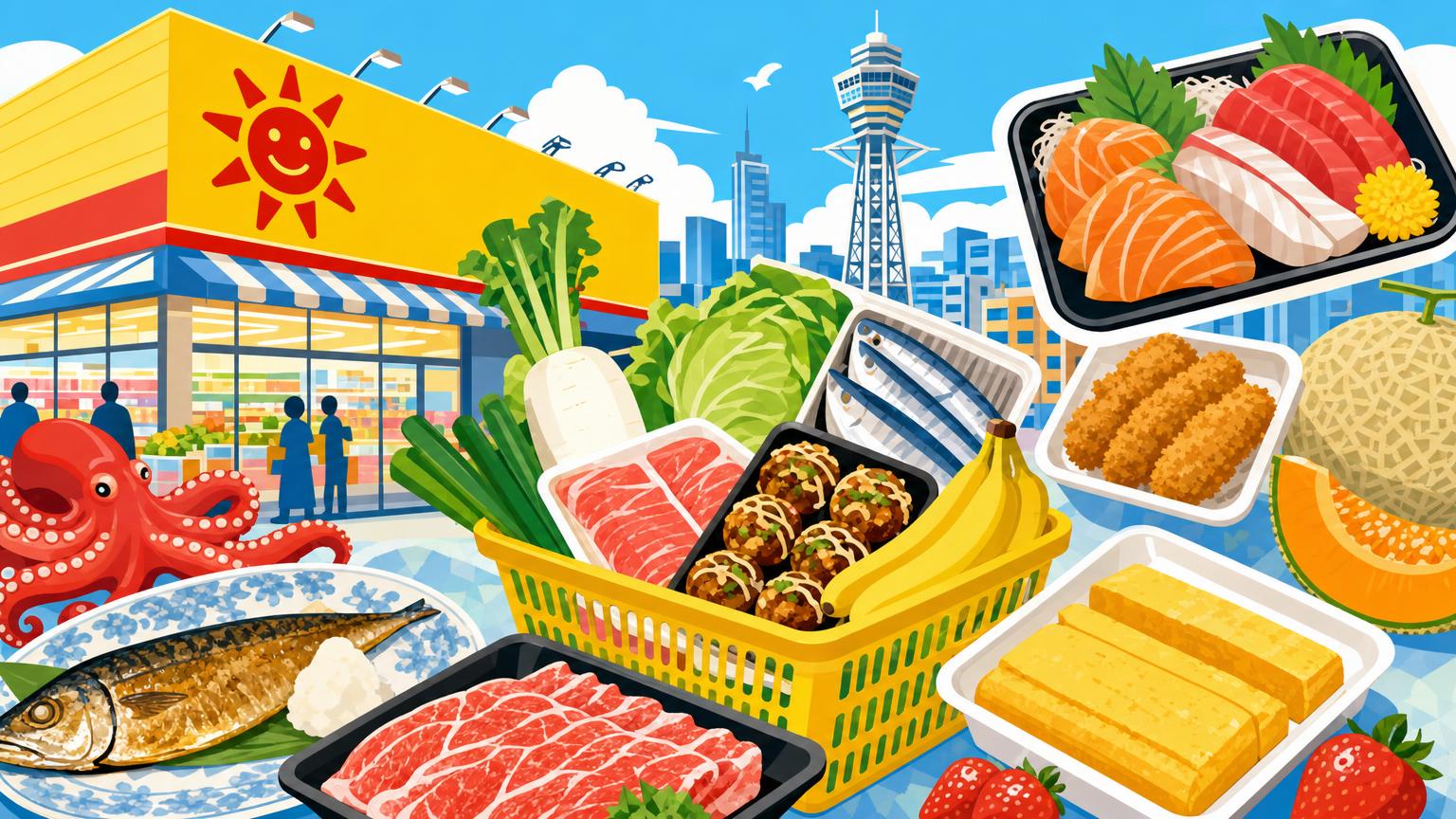
Nothing in the world quite compares to Super Tamade (スーパー玉出). For a foreigner stepping into a Tamade for the first time, it is a truly psychedelic experience. From the outside, it resembles less a grocery store than a vast, renegade pachinko parlor. The façade is completely covered with glaring yellow and red neon lights that flash aggressively against the quiet backdrop of residential streets. Inside, the sensory overload continues. The ceilings are festooned with plastic flowers, glittering disco balls, and crudely painted signs shouting daily discounts. It’s loud, chaotic, almost absurd—and universally beloved and passionately defended by Osaka’s residents.
Super Tamade stands as the ultimate rejection of Tokyo’s aesthetic. While supermarkets elsewhere in Japan vie for cleanliness, orderliness, and an atmosphere of calm sophistication, Tamade competes purely through unfiltered spectacle and rock-bottom prices. It originated in Nishinari ward, historically one of Japan’s poorest and roughest neighborhoods, with the founding mission of providing affordable calories to a community in dire need. That legacy is woven into its identity. Tamade is famed for its legendary ‘1-yen sales.’ Yes, literally one yen. If you spend a minimum amount—typically around 1000 yen—you can buy a specific daily item, such as a pack of noodles, a can of tea, or a bundle of enoki mushrooms, for a single yen coin. This clever psychological tactic perfectly encapsulates Osaka’s obsession with scoring a bargain.
But Tamade signifies more than just cheap food. It embodies Osaka’s deep lack of pretension. In many cultures, shopping at an ultra-discount store carries stigma; in Osaka, filling a cart with groceries at a fraction of the usual price at Tamade is a point of pride. You’ll see people from all walks of life in these glowing yellow aisles: grandmothers stretching pensions, foreign students making ends meet, businessmen in suits grabbing an inexpensive bento before returning to work. Tamade levels all socioeconomic boundaries. It makes no effort to appear classy, because classiness costs money—and that expense would be passed to the customer. The flickering neon isn’t just advertising; it’s a statement of principles. It says: ‘We know who we are, we know what you want, and we won’t sugarcoat it with polite fakery.’ Shopping at Super Tamade is a rite of passage for newcomers to Osaka, teaching that here, substance always triumphs over style.
Life (ライフ): The Dependable Standard with Excellent Deli Choices
If Super Tamade is the wild, eccentric uncle of Osaka’s supermarket scene, Life (ライフ) is the steady, hardworking parent. Originating in Kansai, Life is arguably the most recognizable and widely used supermarket chain for the typical middle-class household in Osaka. When locals say they’re ‘going to the supermarket’ without specifying which, chances are they’re heading to Life. The stores are everywhere, strategically located in nearly every major residential area, serving as the functional backbone of daily life in the city.
Life exemplifies balance. It lacks the chaotic bargain-bin vibe of extreme discount stores but also doesn’t carry the intimidating price tags of upscale department store food halls. Instead, it occupies a vast golden middle ground. A typical Life store often spans two floors. The first floor is a food lover’s dream—produce is meticulously organized, offering a mix of staple daily vegetables and slightly more premium seasonal items. But Life’s true dominance in Osaka lies in its deli section, known in Japanese as the ‘Sozai’ section.
Osaka is a city of working people, and the demand for high-quality, ready-to-eat meals is enormous. Life understands this well. Their bento boxes are legendary among locals—not the sad, preservative-heavy options you find in convenience stores, but freshly made meals from massive in-store kitchens continually producing batches of karaage (fried chicken), large tonkatsu (pork cutlets), delicate tempura, and perfectly seasoned potato salads. For foreigners living in Osaka, Life’s deli section is a lifesaver, letting them enjoy a diverse and genuinely delicious Japanese diet without cooking every night. Moreover, Life’s ‘LaCuCa’ electronic money and point card system is deeply embedded in the financial habits of local families. Watching an Osaka shopper breezily scan items at self-checkout, tap their point card, and bag groceries with practiced efficiency is like witnessing a well-choreographed domestic dance.
Mandai (万代): The Neighborhood Favorite
While tourists and central city residents often focus on Life or Tamade, no discussion of living in Osaka is complete without mentioning Mandai (万代). For those living in Osaka’s more suburban wards, the sprawling residential neighborhoods beyond the central loop line, Mandai reigns supreme as the local supermarket. It may be less flashy than Tamade and less refined than Life, but it commands fierce loyalty from local mothers and grandmothers managing household budgets.
Mandai’s philosophy centers on high volume and everyday low prices. Entering a Mandai, the first thing you notice is the sheer scale—wide aisles accommodate a steady flow of shopping carts, and displays are designed for bulk buying. Mandai’s true cultural phenomenon is its legendary Tuesday sale, the ‘Kayo-Ichi.’ On Tuesdays, prices across the store are dramatically lowered, transforming a routine grocery run into a highly coordinated tactical mission. Bicycle parking lots overflow onto the streets as neighborhood women with huge reusable bags descend on the store right at opening.
Navigating Mandai on a Tuesday morning requires specific skills: decisiveness, intimate knowledge of the store layout, and a willingness to politely but firmly hold your ground at the discounted meat section. For foreigners, witnessing this weekly ritual provides profound insight into the rhythms of Japanese community life. The women shopping aren’t just buying groceries; they’re exchanging information, checking in on neighbors, and collectively managing the economic realities of raising a family in a dense urban environment. Mandai stands untouched by tourism; it is fiercely local, brilliantly efficient, and absolutely critical for understanding the domestic pulse of Osaka.
Top Cheapest Supermarkets for Budget Travelers and Residents
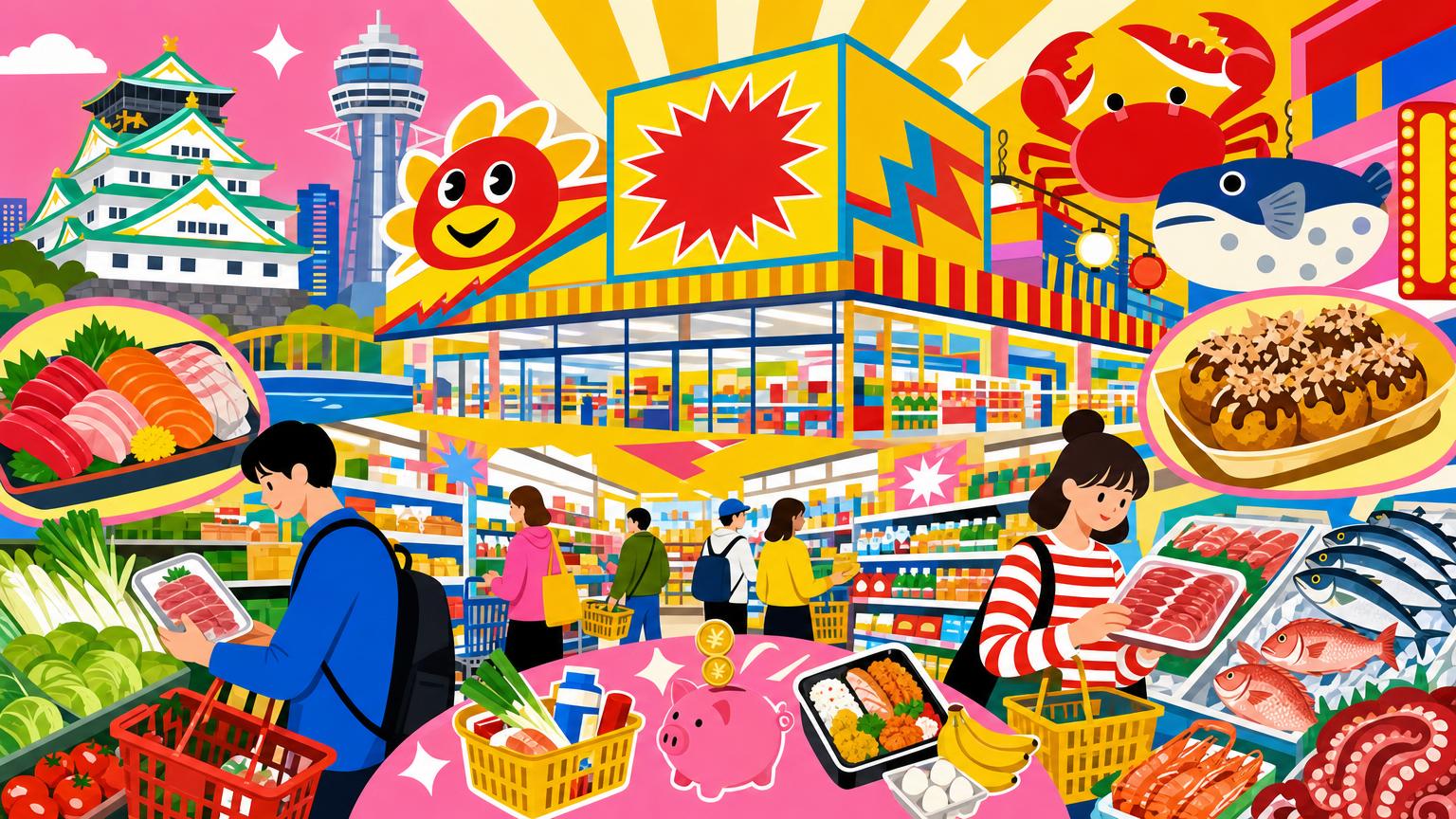
Living in a foreign country can be costly, and managing the cost of living is one of the main challenges for any expat, student, or long-term visitor establishing life in Osaka. Although the city is generally more affordable than Tokyo, food expenses can quickly escalate if you rely solely on convenience stores, restaurants, or upscale supermarkets. Fortunately, Osaka’s natural penchant for bargains has given rise to a network of extreme discount stores that become essential for anyone on a tight budget. Knowing how to make the most of these specific stores distinguishes the struggling newcomer from the experienced local.
Gyomu Super (業務スーパー): Bulk Buying and Unbeatable Prices
Gyomu Super (業務スーパー), which literally means ‘Business Supermarket,’ was initially created to supply restaurants, cafes, and small food vendors with bulk ingredients. However, it is fully open to the public and has surged in popularity among thrifty Japanese families and the international community alike. For foreign residents in Osaka, discovering your local Gyomu Super is a game-changer. It fundamentally reshapes your monthly budget calculations.
Gyomu Super follows a minimalist approach. There is no background music, no elaborate displays, and certainly no costly lighting. Products are often presented straight in the cardboard boxes they arrived in. A large portion of the store is devoted to frozen foods, where you will find huge one-kilogram bags of frozen broccoli, large blocks of frozen chicken breast, and towering bags of french fries. However, Gyomu Super is not solely about cheap calories—it has become a surprising sanctuary for expats due to its extensive import network.
If you crave tastes from home, Gyomu Super is often the only local spot where you can find authentic Italian pasta, gigantic jars of peanut butter, genuine tortillas, and a surprisingly extensive selection of Halal-certified meats and ingredients. The prices are so low they almost seem mistaken. A block of tofu might cost 30 yen, and a pack of udon noodles might be 15 yen. It forces you to reconsider the true cost of food once all the marketing, fancy packaging, and retail expenses are stripped away. Shopping at Gyomu Super requires some planning—you need freezer space in your small Japanese apartment to fully benefit from bulk deals—but it stands as the undisputed leader of extreme budget living in Osaka.
MEGA Don Quijote (MEGAドン・キホーテ): Groceries and Souvenirs in One Place
Don Quijote is known worldwide as Japan’s top discount store, a chaotic maze of cheap cosmetics, strange gadgets, and novelty costumes. But for Osaka residents, especially those near the massive ‘MEGA’ Don Quijote stores like the one in Shinsekai, it functions as a highly practical, extremely affordable supermarket. A MEGA Don Quijote dedicates an entire floor solely to groceries, fresh meat, produce, and alcohol, with fiercely competitive prices.
Grocery shopping at Don Quijote is a sensory challenge. The iconic theme song (‘Miracle Shopping’) plays nonstop. The aisles are deliberately maze-like, forcing you to pass thousands of impulse-buy items before reaching basics like eggs. Colorful, hand-drawn cardboard signs hang from the ceiling highlighting discounts. But if you can endure the visual and auditory barrage, the savings are substantial.
Don Quijote is especially important to locals because of its hours. Many branches are open until 3:00 AM or even 24 hours a day. If you finish a late work shift and realize you have nothing for breakfast, Don Quijote is there for you. It is also the go-to place for buying bulk staples of Osaka life. You can pick up huge jugs of cooking oil, family-sized bags of rice, and countless varieties of inexpensive canned chu-hi (shochu highballs). Moreover, their proprietary ‘Majica’ app and points system turn shopping into a game, offering digital coupons and rounding down final prices to avoid one-yen coins in change. It’s loud, overwhelming, and perfectly embodies Osaka’s love of abundance and savings.
Sandy (サンディ) and Lamu (ラ・ムー): Hidden Gems for Extreme Discounts
For those wanting to explore even deeper into the local economy beyond the neon glow of Don Quijote and the frozen aisles of Gyomu Super, you must find the true hidden gems of Kansai’s discount scene: Sandy (サンディ) and Lamu (ラ・ムー). These stores don’t appear in tourist guides and are tucked away in quiet residential areas, unconcerned with appearance and operating with a ruthless efficiency bordering on brutalism.
Sandy follows a ‘box store’ model. Upon entering, you’ll immediately notice nearly everything is still packed. The store is composed of open cardboard shipping boxes stacked on metal pallets. There is very little fresh produce or raw meat. Sandy specializes almost exclusively in non-perishable goods, snacks, bottled drinks, and daily essentials. With absolutely no spending on display labor, their prices for popular Japanese snacks, instant ramen, and bottled tea consistently rank as the city’s lowest. If you’re a foreign student stocking a pantry, Sandy is your sanctuary.
Lamu (ラ・ムー), run by the Daikokuten Bussan company, takes the warehouse concept to a full-service supermarket level. Lamu stores are usually large, warehouse-style buildings located somewhat further from the city center, often requiring a bicycle or car to visit. The sheer size of Lamu is American in scale, which is unusual for Japan. They offer remarkably cheap bento boxes, often priced under 200 yen, which have become legendary among budget-conscious locals. Outside many Lamu stores, you’ll find a small stand called ‘Pakupaku’ selling six pieces of hot takoyaki for just 100 yen. In a city famous for takoyaki, where tourist stalls in Dotonbori charge 700 yen, Lamu’s 100-yen takoyaki makes a powerful statement: food belongs to the people, and it doesn’t have to be expensive to be delicious.
What to Buy at Supermarkets in Osaka
Entering a supermarket in Osaka is not merely a task; it is a journey into a distinctly regional taste. Japan stretches geographically, and the culinary differences between the Kanto region (Tokyo) and the Kansai region (Osaka) are vast. The supermarket shelves serve as the battleground for this cultural divide. Anyone moving to Osaka must quickly become familiar with this unique flavor profile, realizing that what they might have known about Japanese cuisine in their home country—or even from a visit to Tokyo—does not fully apply here.
Local Kansai Flavors and Condiments
At the heart of Osaka’s cuisine is ‘Dashi,’ a savory broth made from kelp (kombu) and bonito flakes (katsuobushi). Historically, the best kombu from Hokkaido was transported down the Sea of Japan straight to Osaka via Kitamaebune trading ships. Paired with the notably soft water of the Kansai region, which draws out the umami from the kelp perfectly, Osaka’s culinary culture developed around light-colored, richly flavored, and highly nuanced broths. This contrasts starkly with Tokyo, which traditionally depended on dark, heavy soy sauce to mask the strong odor of fish caught in Edo Bay.
In the soy sauce aisle of an Osaka supermarket, you will find an extensive selection of ‘Usukuchi’ (light soy sauce). Usukuchi is saltier than regular dark soy sauce yet lighter in color, allowing the natural hues and flavors of vegetables and dashi to shine. You will also notice an entire section devoted to various grades and types of kombu—a rarity to see so prominently displayed elsewhere.
Then, there is the renowned sauce culture. Osaka is famously the capital of ‘Konamon,’ or flour-based foods, best represented by Okonomiyaki (savory cabbage pancakes) and Takoyaki (octopus balls). The condiment aisle in any Osaka supermarket reflects this passion. Instead of a single generic bottle of brown sauce, you will find a fiercely competitive variety of specialized sauces. There is Otafuku sauce, the sweet and thick classic; Oliver sauce, with a slightly spicier, fruitier flavor; sauces crafted specifically for Takoyaki—thinner to coat the balls evenly; and sauces made exclusively for Yakisoba. Selecting the right flour mixes—pre-seasoned with dashi powder for homemade Takoyaki—and the perfect sauce is a crucial milestone for any newcomer hosting their first ‘Tako-Pa’ (Takoyaki party), a quintessential social event in Osaka life.
Affordable and Delicious Ready-to-Eat Meals
For busy locals, hotel guests lacking a kitchen, or exhausted expats who dread cooking rice again, the ready-to-eat section of Osaka supermarkets is a modern marvel. The culture of ‘Sozai’ (side dishes and prepared foods) has been elevated to an art form here. Due to the principle of ‘Kuidaore,’ even the cheapest supermarket bento must maintain a strict standard of quality. Osaka consumers simply won’t accept poor food, no matter how inexpensive it is.
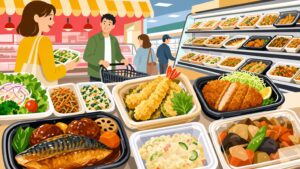
If you visit this section around 11:00 AM or 5:00 PM, when fresh batches are released, you will find large, beautifully arranged Bento boxes featuring grilled mackerel, deeply braised root vegetables, Hamburg steaks glazed with demi-glace, and perfectly fried Tonkatsu. The sushi sections in supermarkets like Life or Kohyo are leagues above the sad refrigerated sushi often found in Western countries. The fish is exceptionally fresh, the rice properly seasoned with vinegar, and the turnover so frequent that nothing lingers.
Yet the real treasures of the prepared food section are the hyper-local side dishes. Seek out ‘Doteyaki,’ a deeply savory and rich stew of beef sinew simmered for hours in sweet white miso. It is the quintessential Osaka soul food, and buying a small plastic container to heat up at home alongside a cold beer is the ultimate local experience. Look for freshly fried Kushikatsu, ready for reheating in a toaster oven. Also, find large slabs of Dashimaki Tamago, the rolled omelet made in Kansai with abundant dashi broth, making it juicy and savory, unlike the sweeter versions preferred in Tokyo.
Affordable Matcha Snacks and Sweets for Souvenirs
While this article mainly targets those living in or interested in Osaka’s everyday life, expats often need to buy gifts to send home, and visiting friends usually seek souvenirs. Purchasing souvenirs at the airport or in tourist shops around Dotonbori is a rookie error. The local supermarket is the best, most affordable souvenir shop in the country.
Japanese snack companies excel at producing hyper-seasonal, limited-edition flavors, and the supermarket is where these are displayed en masse. Entire endcap displays are dedicated to Matcha (green tea) flavored items: Matcha KitKats, Matcha Pocky, Matcha Oreos, Matcha soft cookies. Because these are made for domestic consumption, they are priced at normal retail rates—typically 200 to 300 yen per bag—rather than the inflated prices found in souvenir packaging.
Beyond Matcha, the supermarket offers a glimpse into the everyday sweets that genuinely fuel the local population. You can find bags of Senbei (rice crackers) flavored with Kansai soy sauce or sour plum. You can purchase exquisite individually wrapped Baumkuchen cakes. You can get large bags of Kasugai roasted peanuts and gummy candies. For foreigners, navigating the snack aisle is not just about picking up inexpensive gifts; it is about discovering the comforting, everyday flavors that shape Japanese childhoods and office break times.
Essential Tips for Supermarket Shopping in Japan
Understanding the physical layout and product selection of an Osaka supermarket is just part of the challenge. To fully integrate into the neighborhood, you need to grasp the behavioral mechanics of the shopping experience. Japanese supermarkets follow a strict set of unspoken rules, logistical systems, and social etiquettes. Ignoring these will not only frustrate you deeply at the checkout but also immediately mark you as an unobservant outsider. Mastering them, however, provides a quiet, immensely satisfying feeling of belonging.
Look for Evening Discount Stickers (Biki and Waribiki)
Arguably the most exciting, psychologically revealing, and economically important aspect of Japanese supermarket culture is the evening discount sticker. This system is rooted in two deeply valued Japanese principles: a profound cultural aversion to food waste (Mottainai) and a stringent regulatory and cultural insistence on absolute freshness. Fresh foods—like sushi, bento boxes, baked goods, and raw meat—are generally allotted only a single day on the shelf. Rather than discarding perfectly good food at closing time, supermarkets drastically reduce prices to ensure everything sells out.
This results in a daily, highly organized dance between store staff and local shoppers. Learning the vocabulary is essential. Look for bright yellow or red stickers. ‘Biki’ (引き) means a specific amount off. For example, ’50円引き’ means 50 yen off the listed price. The real prize is ‘Waribiki’ (割引), indicating a percentage discount. ‘2割引’ means 20% off. ‘半額’ (Hangaku) is the ultimate goal, meaning exactly half price.
In Osaka, pursuing the Hangaku sticker is a bold affair. In Tokyo, people might politely pretend to browse other aisles, waiting for the staff member with the label gun to finish before casually swooping in. In Osaka, there’s no such pretense. When the staff member emerges with the discount machine—usually around 7:00 PM to 8:00 PM depending on the store—they are often followed by a small, dedicated group of local shoppers affectionately called the ‘Discount Hunters.’
An intense, unspoken etiquette governs this hovering. You do not snatch the item from the staff member’s hand. Instead, you wait until the sticker touches the plastic wrap, then, with practiced speed, place it in your basket. Securing a large, beautiful tray of high-quality fatty tuna sushi for half price is a genuine thrill. It’s a small victory over the system. After moving to Osaka, your internal clock will quickly adjust to match the discount schedule of your local Life or Mandai. Your entire evening will revolve around the 7:30 PM markdown. It becomes both a survival skill and a deep integration into the local rhythm of life.
Bring Your Own Bag and Check Tax-Free Policies
The checkout process at Japanese supermarkets has evolved rapidly and can be highly stressful for newcomers. The most important rule is: bring your own bag. Japan, once notorious for obsessive over-packaging and distributing plastic bags excessively, now enforces a nationwide mandatory charge for plastic shopping bags. At the cashier, you’ll almost always be asked a rapid-fire question like: “Fukuro wa yoroshii desu ka?” (Are you fine without a bag?) or “Reji bukuro go-riyo desu ka?” (Will you use a plastic bag?).
If you don’t have your own ‘My Bag’ (eco-bag), you must explicitly answer “Yes” and pay a small fee for a plastic one. If you do have your own bag, simply say “Irimasen” (I don’t need one) or point to your tote. The bagging process itself is crucial. The cashier will not bag your groceries for you. This often confuses many Westerners. The cashier rapidly scans your items and transfers them from your original basket into a second, differently colored basket.
After that, you must carry this second basket to a designated bagging area—a long counter near the exit, stocked with rolls of thin, clear plastic bags (for raw meat or wet items) and damp towels for gripping bags. It’s your responsibility to move out of line immediately and pack your own groceries there. This system keeps the checkout line moving with remarkable efficiency. Trying to stuff a cabbage into your backpack at the register and blocking the line is a major faux pas.
Additionally, many supermarkets in Osaka have adopted ‘Semi-Self Checkout’ systems. The cashier scans your items and hands you a receipt with a barcode but doesn’t take your payment. You then take your basket to a row of payment machines, scan the receipt, and insert cash or tap your card. Although it can be intimidating at first—with flashing lights and robotic prompts—it eliminates human error in giving change and speeds up the process significantly.
Lastly, for short-term visitors, some large, tourist-friendly supermarkets like MEGA Don Quijote or certain branches of Life in Namba offer Tax-Free shopping for foreigners on short-term visas. However, if you live in Osaka with a resident card, this does not apply. You’re part of the system now. You pay tax, bring your own bag, and earn your discounts the hard way.
The Social Dynamics of the Osaka Checkout Line
To genuinely gauge the cultural vibe of Osaka, you need to pay attention to the small interactions that occur within the few minutes it takes to pay for groceries. The checkout line acts as a stage for human behavior. In Tokyo, the ideal checkout experience is entirely silent. The customer and cashier function like well-oiled, precise parts of a machine. Conversations are limited to standard, polite honorifics, with minimal eye contact. The aim is smooth, frictionless efficiency.
In Osaka, however, the checkout line serves as a social space. This is where you will meet the true force of nature known as the ‘Osaka Obachan’ (the middle-aged or elderly Osaka woman). The Obachan is the cultural backbone of the city—fearless, loud, aggressively friendly, and intolerant of any nonsense. If you find yourself in line at a Mandai on a busy Tuesday, observe how the Obachan interacts with the cashier. She won’t just hand over her money; she’ll comment on the price of the leeks, complain about the humidity, and ask the cashier if they have been working hard.
Importantly, the cashier will respond in kind. They will drop the stiff, robotic ‘Keigo’ (highly polite language) that is customary elsewhere in Japan and engage in a brief, genuine moment of Kansai-style banter. There’s a warmth to this exchange that becomes deeply comforting once you get used to it. As a foreigner, if you fumble with your coins or look unsure at the self-checkout machine, the Tokyo instinct among bystanders is to politely ignore you to prevent embarrassment. The Osaka instinct is quite different. An Obachan behind you is likely to literally reach around, physically point to the correct slot on the machine, explain loudly how to use it, then ask where you’re from and tell you that her nephew once went to America.
This disregard for personal boundaries can be surprising for newcomers, but it captures the essence of Osaka’s charm. The people here genuinely believe that everyone is in this messy, loud, challenging life together. The supermarket isn’t a cold, corporate space; it’s an extension of the neighborhood living room. When you embrace this, smiling and saying ‘Ookini’ (the deep Kansai dialect word for thank you) to the cashier instead of the standard ‘Arigatou gozaimasu,’ you’ll notice a visible change in how you’re treated. You are no longer just a foreign customer—you become a neighbor.
Seasonal Rhythms in the Supermarket Aisles
Living in Japan, one develops a deep, almost obsessive awareness of the changing seasons, most visibly tracked in the aisles of the local supermarket. The passage of time in Osaka is marked not just by the calendar but by the constant rotation of the front promotional displays, known as the ‘endcaps’.
Arrive in Osaka in spring, and the supermarket entrance will be bathed in pink. Even before the cherry blossoms bloom outside, the store is filled with sakura-flavored sweets, fresh bamboo shoots (takenoko), and the first tender spring cabbages. The deli section begins offering specific bento boxes meant to be taken to parks for Hanami (cherry blossom viewing) parties.
As the oppressive humidity of the Kansai summer sets in, the supermarket physically transforms to help people endure the heat. The front displays become dominated by massive boxes of Somen (thin white noodles eaten ice cold), giant bottles of concentrated noodle broth (Mentsuyu), and endless varieties of mosquito coils. By late July, the entire store pivots to focus on Unagi (freshwater eel), traditionally eaten on the Day of the Ox to boost stamina against the heat.
When autumn breaks the heatwave, the supermarket colors shift to deep browns and oranges. The air fills with the scent of roasted sweet potatoes, as many stores set up hot stone roasting carts right by the entrance. Pacific saury (Sanma), chestnuts, and the first crop of new rice (Shinmai) fill the aisles.
In winter, the supermarket becomes a temple to ‘Nabe’ (hot pot). Massive displays showcase clay pots, portable gas stoves, and hundreds of varieties of pre-made hot pot broths—kimchi flavor, soy milk flavor, sesame flavor. The vegetable sections overflow with large Chinese cabbages, daikon radishes, and leeks. Shopping in winter means gathering supplies to huddle around a boiling pot of broth in a cold, poorly insulated Japanese apartment.
For residents, paying attention to these shifts is deeply grounding. It connects you to the agrarian roots of the culture and guides your diet in a way that feels natural and inevitable. Here, you do not force summer foods in winter. Instead, you surrender to the seasonal logic dictated by the manager of your local Life or Mandai.
Finding Your Place in the Neighborhood Ecosystem
Living in Osaka means eventually surrendering to its rhythms. It means accepting that the city is loud, its aesthetics often questionable, and that pursuing a good meal at a low cost is the highest civic virtue. The neighborhood supermarket acts as the ultimate crucible for this transformation.
At first, the supermarket provokes anxiety. The kanji on the labels is indecipherable. The overwhelming variety of soy sauces is paralyzing. The loud ringing of checkout machines and the fishmonger’s shouting feel like an assault. You’ll likely buy the wrong kind of tofu. You’ll inevitably forget your own bag and have to mime an apology to the cashier. You’ll watch in amazement as an elderly woman expertly boxes you out to claim the last discounted bento.
But as weeks stretch into months, a profound change takes place. You learn the layout of your local Tamade or Life. You figure out the exact hour when discount stickers appear and time your evening walks perfectly to catch them. You discover which okonomiyaki sauce brand suits your taste perfectly. You master the quick packing of your groceries at the counter, moving with the same unconscious efficiency as those around you. You begin exchanging brief, knowing nods with the cashier.
When this happens, you have done more than just learn how to buy dinner. You’ve decoded a crucial part of the city’s cultural operating system. You’ve moved beyond the tourist’s view of Osaka as a quirky, neon-lit playground and embraced its reality as a deeply functional, fiercely communal, and intensely practical home. The supermarket transforms from a chaotic labyrinth into your pantry, your community hub, and your anchor in the Kansai region. You finally understand the Obachan, the neon lights of Super Tamade, and the profound, beautiful honesty of a city that simply wants to eat well without being ripped off.