If you are trying to understand daily life in Osaka, do not begin with a famous landmark. Begin before work, before the shopping arcades fill, before the trains become crowded. Walk into a small kissaten, order coffee, and watch what happens around you.
A salary worker may be reading the newspaper in silence. An older couple may be sharing toast without speaking much. The owner may recognize a regular customer before the customer reaches the counter. A television may be murmuring above the clink of teaspoons. The coffee may arrive in a thick cup, with toast, butter, and an egg appearing beside it for little or no additional cost.
This is the morning service, or モーニングサービス, at a traditional Japanese coffee shop. It is breakfast, but it is also a small social institution. It shows how Osaka values practicality, personal familiarity, direct service, and small pleasures that do not need to be announced as special.
For foreigners living in Osaka, the experience can be confusing at first. Why is breakfast attached to coffee? Why does the menu disappear at 11:00? Why is a retro café still filled with cigarette smoke? Why does the owner sometimes speak in a tone that sounds blunt but is not necessarily unfriendly? And why can a simple piece of toast tell you something about Osaka compared with Tokyo?
The answer is that an Osaka kissaten is not simply a place to consume food. It is a neighborhood room. It is a pause between home and work. It is a place where people manage the morning without making a performance of it.
The map below shows central Osaka, including the broad areas discussed in this article. A kissaten morning is usually most meaningful when you approach it through the surrounding neighborhood rather than treating the café as an isolated attraction.
What Is the “Morning Service” at a Japanese Kissaten?
A kissaten is a traditional Japanese coffee shop. The term, written as 喫茶店, literally means a place for drinking tea, although the typical kissaten is closely associated with coffee, toast, sandwiches, light meals, pudding, cream soda, and a slower pace of service.
The atmosphere generally differs from that of a modern café. You might find dark wood, patterned curtains, leather or vinyl seats, amber lighting, vintage speakers, a counter with coffee equipment, and a menu that has remained largely unchanged for several decades. Some shops feel carefully preserved, while others appear slightly worn in a way that suggests regular use rather than intentional design.
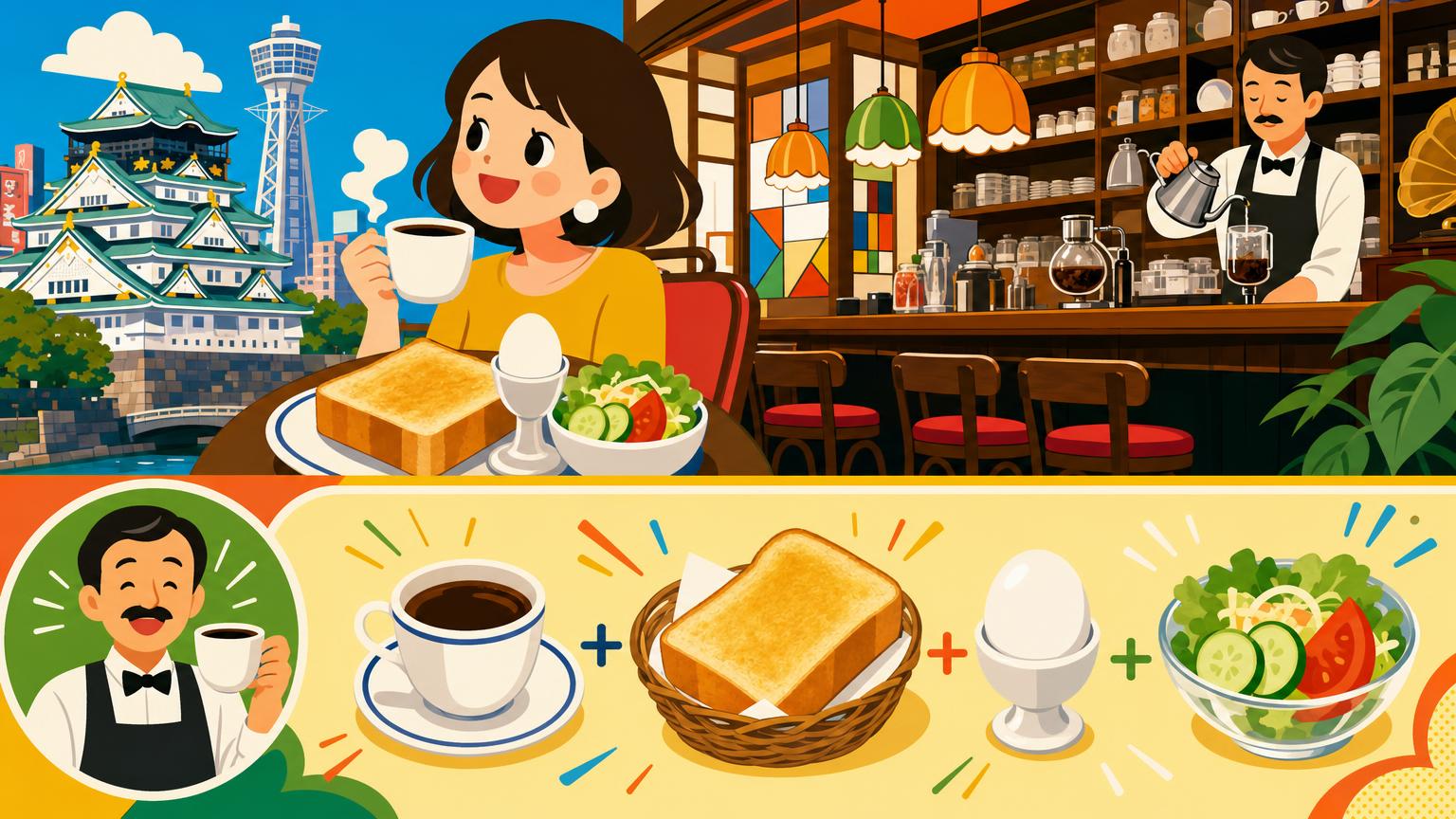
The morning service refers to the breakfast offerings available during the early part of the business day. In many shops, ordering coffee in the morning automatically includes a simple breakfast item. In others, you select a morning set from a small menu. Sometimes the food is complimentary with the drink, sometimes there is a small additional charge, and occasionally the combined price is nearly the same as that of the coffee alone.
The key point is not that every shop follows the same nationwide formula, but rather the connection between drink and food. Coffee is the main purchase, while toast, egg, salad, or yogurt serves as a morning gesture that makes the visit practical for workers and residents.
A typical morning service may run from around 7:00 or 8:00 a.m. until 10:30 or 11:00 a.m., though these times vary widely. Some independent shops open later, others stop serving breakfast earlier if they run out of bread or eggs. If you’re visiting mainly for the morning set, don’t casually show up at 10:59 expecting the menu to still be available. In many places, 11:00 is a firm cutoff, not merely a guideline. It’s best to check current hours and menus before you go, as small shops may alter their schedules for holidays, staff shortages, weather, or the owner’s health.
A well-known example in Umeda is Kissa Sunshine, a traditional coffee shop established in 1973. Its English-language information and morning menu make it accessible for those new to kissaten culture, but the key takeaway is not just its convenience. It demonstrates how a long-standing shop can coexist within a busy commercial district while maintaining the rhythm of an older Osaka morning.
The Holy Trinity: Coffee, Toast, and a Boiled Egg
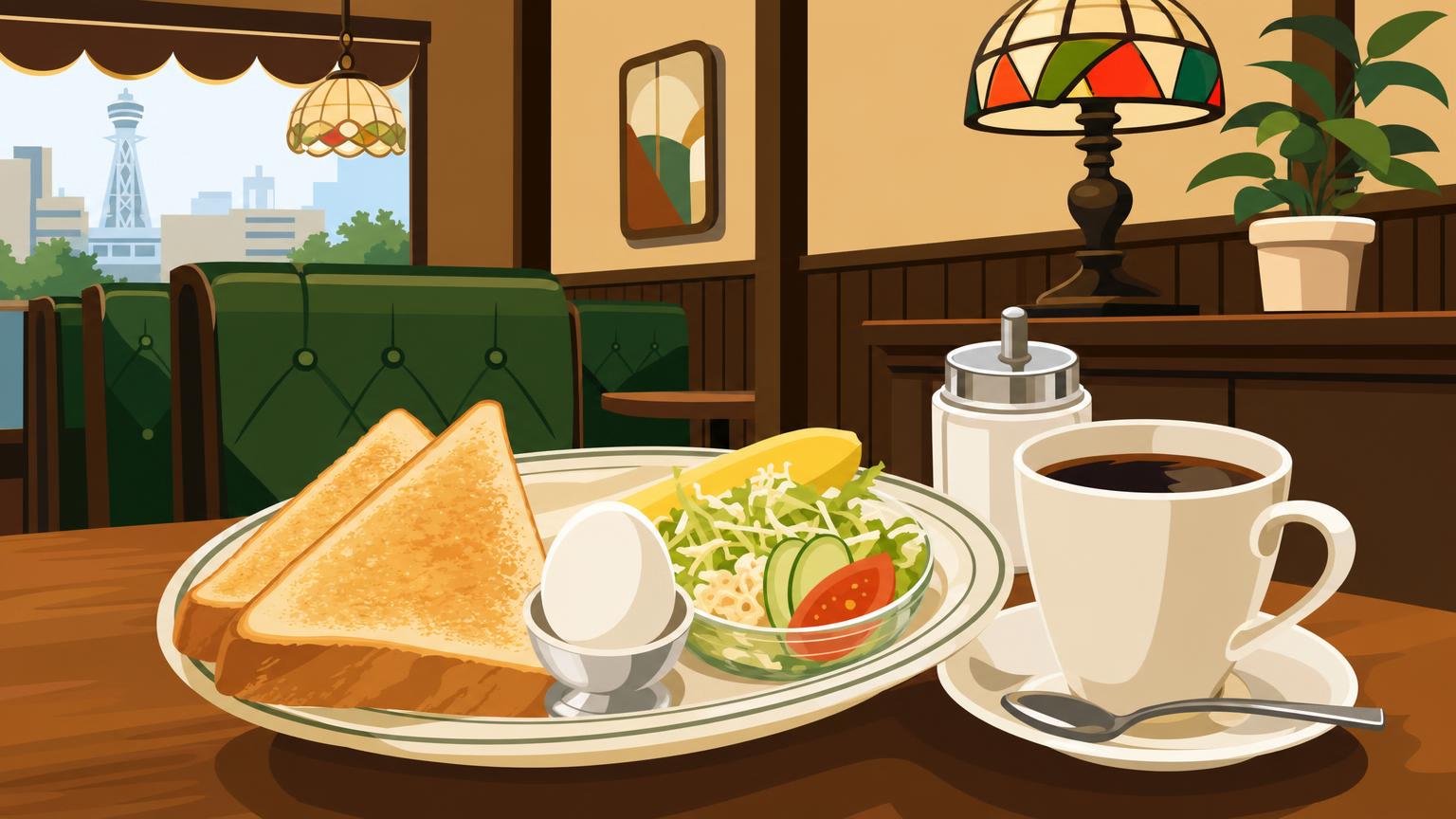
The classic morning set centers around three simple items: coffee, toast, and an egg.
The coffee is typically a house blend, brewed either through a drip machine or a siphon, depending on the shop. Its flavor is often darker and more familiar compared to the light, fruit-forward coffee common in many specialty cafés. The coffee may be served hot enough to require careful sipping. The cup might be heavy, the saucer slightly chipped, and the aroma rich with roasted beans.
Toast is rarely an afterthought. In a serious traditional kissaten, bread forms part of the shop’s identity. It may be thick-cut, with a crispy surface and a soft, steamy interior. Butter melts into the slices’ crevices. Jam might be offered on the side. Some shops toast the bread until the edges become firm while the center remains sponge-like; others serve a thinner slice with a crunchy texture.
The egg is often boiled, although fried, scrambled eggs, or egg salad are sometimes offered. The boiled egg may be served warm or at room temperature, placed in a small metal holder, on a plate beside the toast, or in a simple bowl. The presentation tends to be straightforward; its role is to make the coffee feel like part of a breakfast rather than just a standalone drink.
Additional items like a small salad, a spoonful of yogurt, fruit, ham, or a piece of toast with red bean paste may also be included. In Osaka, the set can feel a bit more generous than a minimalist coffee-and-toast combo. The practical intent is clear: if someone leaves home early for work, the morning service should provide enough nourishment to start the day without turning into a full restaurant meal.
This helps explain why breakfast in Osaka may feel different from what foreigners expect. The meal isn’t necessarily built around rice, miso soup, grilled fish, and multiple side dishes. Nor is it always a large Western-style plate. Instead, it’s a compact arrangement respecting time, appetite, and budget.
Morning service pricing is often designed to make customers feel they’re receiving a special deal. In Japanese, the word service can imply an added benefit, a complimentary item, or a special value. The shop isn’t always losing money. The morning offer encourages early visits, generates regular customers, and helps establish coffee as a habit.
How Osaka’s Morning Culture Differs from the Rest of Japan
Japan does not have a single unified kissaten culture. Morning service varies by region, neighborhood, and shop owner. Nagoya is known for breakfast sets that include toast and a boiled egg with coffee, sometimes featuring red bean paste or other local variations. Tokyo has many traditional coffee shops, but the experience is often influenced by dense commuting, office districts, and a greater expectation that cafés be quiet and private.
Osaka shares the national coffee-shop tradition but often gives it a more practical and conversational atmosphere. The mood may be less quietly formal. Customers might exchange a quick joke with the owner. Service might be swift without seeming hurried. A regular could call out an order from the doorway. The space often feels like a small neighborhood living room rather than a polished sanctuary from the city.
This doesn’t mean every Osakan is talkative, or every Tokyo café silent—these are tendencies, not rules. The meaningful contrast lies in the social warmth. In Osaka, friendliness emerges through small acts of straightforwardness: a comment about the weather, a reminder that the toast is hot, a suggestion to take an umbrella, or a teasing remark when a regular arrives late.
Osaka’s food culture also influences the morning service’s relaxed feel. Mix juice, or みっくすじゅーちゅ, is a classic Osaka-style drink made by blending fruit with milk or other ingredients. It’s associated with cafés and family restaurants, offering a sweet, thick alternative to black coffee. This drink reflects a local preference for options that are filling, familiar, and slightly playful.
Thick toast is another hallmark. Thin slices are acceptable, but a thick piece allows the shop to make breakfast feel generous without many extras. Texture matters: a good slice offers some resistance when cut, then softens as butter melts over its warm surface.
Thus, the Osaka difference lies not only in the recipe but also in the meal’s emotional logic. The morning service conveys: you’re busy, but you should eat; you’re paying, but you should feel cared for; you may be alone, but you’re still in a shared space.
For anyone considering living in Osaka, this holds significance. Daily life is often understood through repeated small transactions rather than grand cultural events. The same bakery, coffee shop, drugstore, dry cleaner, or neighborhood restaurant can become part of your local identity. A kissaten morning offers a way to observe this rhythm without needing advanced Japanese skills or close personal connections.
Unspoken Rules and How to Order Your Morning Set
The first visit to a Japanese kissaten can feel more intimidating than stepping into a large chain café. The space might be quiet. The menu could be entirely in Japanese. The owner may speak little English. The entrance might not clarify whether you should wait, choose a seat, or order at the counter.
The good news is that the basic etiquette is simple. Enter calmly, look for a staff member, and wait for a gesture or greeting. In many kissaten, a staff member will seat you. In smaller shops, you might be expected to pick an open seat. If unsure, a polite “sumimasen” with a small gesture toward the seating area is usually enough.
Once seated, look for a menu, wall board, or a small printed card. The morning service might be indicated in large letters as モーニング or モーニングサービス. You may also see phrases like ドリンク代のみ, meaning food is included in the drink price, or プラスいくら, meaning an extra charge applies.
Navigating the Menu and Ordering Like a Local
The simplest order is often:
“Blend coffee, morning service, please.”
You can say, “Burendo kōhī to mōningu sābisu onegaishimasu.” For iced coffee, say “aisu kōhī.” For hot coffee, “hotto kōhī” is usually understood, though “hotto no kōhī” is also clear.
Perfect Japanese isn’t necessary. Pointing at the menu and saying “mōningu” is usually enough. A small shop may ask if you want your coffee hot or iced, with milk, or sugar. If you don’t understand, say “sumimasen, wakarimasen,” meaning “Sorry, I don’t understand.” You can then use a translation app, but try not to turn the entire ordering process into a lengthy conversation if others are waiting.
Common words you’ll see include:
- モーニング, morning service
- ブレンド, house blend coffee
- アイスコーヒー, iced coffee
- トースト, toast
- ゆで卵, boiled egg
- サラダ, salad
- ヨーグルト, yogurt
- ミックスジュース, mixed fruit juice
- たまごサンド, egg sandwich
- あんトースト, toast with sweet red bean paste
Some menus offer several morning options. One might include toast and a boiled egg, another a small sandwich, and a third may substitute coffee with tea or fruit juice. Don’t assume “morning service” means the same everywhere or every day.
If the menu uses “A set” or photos, choosing is straightforward. If it’s entirely in Japanese, ask “Osusume wa nan desu ka?” meaning “What do you recommend?” The owner may point to the most popular set. This question is helpful because older kissaten often have a distinct house style not obvious from the menu.
The rhythm of ordering is part of the experience. In modern cafés, you may customize milk, syrup, temperature, and size. In a traditional kissaten, choices are usually limited. The shop offers a prepared morning set, not inviting you to redesign it. Flexibility is appreciated more than insistence.
The Smoking Situation in Retro Cafés
Foreign residents are often surprised by smoking in traditional kissaten. Japan’s smoking regulations have changed, and many places now restrict smoking or separate smoking and non-smoking areas. However, a retro coffee shop may still allow smoking, have a designated smoking room, or carry tobacco smells from areas that aren’t fully separated.
Don’t assume a charming Showa-era interior is smoke-free. Before entering, look for signs like 喫煙可 (smoking permitted), 分煙 (separated smoking and non-smoking areas), or 全席禁煙 (all seats non-smoking). If it’s unclear and smoke affects your health, ask before sitting down.
A smoking-permitted kissaten may smell of roasted beans mixed with old tobacco, fabric, and polished wood. Some find this nostalgic; others find it uncomfortable. Both responses are reasonable. Nostalgia isn’t a health guideline, and you shouldn’t feel guilty leaving if the air is difficult for you.
If you are with children, pregnant, or sensitive to smoke, choose carefully. Newer regulations have reduced smoking in many restaurants, but independent shops may vary and update policies slowly. The safest approach is to check the current policy on the shop’s official information or ask at the entrance.
The smoking issue also reflects a broader Osaka reality. The city has layers that don’t disappear all at once. New rules, multilingual signs, cashless payment, and modern workplaces coexist with older habits, buildings, and family-managed businesses. Living in Osaka often means learning how these layers overlap rather than expecting a single consistent standard.
Cash Is King: Payment Etiquette
Traditional kissaten often prefer cash. Some accept credit cards or electronic payments, but don’t assume this. Carry physical yen, especially coins and ¥1,000 notes. A small morning set may cost only a few hundred yen, and the owner might avoid processing card payments for such low amounts.
When paying, follow the shop’s system. Some cafés bring the bill to your table; others expect payment at the counter. If unsure, watch other customers or ask, “O-kaikei wa doko desu ka?” meaning “Where do I pay?”
Do not leave money on the table unless the shop clearly uses that system. In Japanese restaurants, payment often happens at a register near the exit. Place money or card in the tray if provided. If you receive change, take a moment to check quietly without making the transaction seem suspicious.
Tipping is not expected. A sincere “arigatō gozaimasu” is enough. If the owner remembers you on your second visit, that recognition often means more than leaving extra money.
The payment process may feel formal compared to the relaxed atmosphere inside. That contrast is normal. Conversation might be casual, but money handling remains orderly. Osaka directness doesn’t mean that every rule disappears.
Best Kissaten for Morning Service in Osaka by Area
The best way to explore Osaka’s traditional coffee shops is by neighborhood rather than relying on a single citywide ranking. Each area has its own distinct daily rhythm. Umeda connects office workers, department stores, train passengers, and older commercial streets. Namba and Shinsaibashi blend shopping, entertainment, dense local housing, and long-established food businesses. Tennoji and Shinsekai more clearly show how older neighborhood life persists alongside large redevelopment projects.
Shop hours, breakfast menus, smoking policies, and payment methods can vary. Consider the following places and area recommendations as starting points for understanding Osaka, not as guarantees. Check current details before heading out, and expect some shops to close when the owner takes a break.
Umeda Area: Showa-Era Nostalgia in the Modern Hub
Umeda is often seen as Osaka’s modern business center, but the area includes many older streets and basement cafés. This contrast is significant. You can step out of a glass office tower, pass through a station complex, and enter a kissaten where the furniture and service rhythm feel like a different era.
Kissa Sunshine is one of the clearest places to start. Located in Umeda and operating since 1973, it has a history that makes its morning service feel connected to the neighborhood rather than created for visitors. The coffee shop offers English information, which eases the anxiety of a first visit, yet the space still expresses the old kissaten balance: coffee at the center, breakfast as a practical complement, and an interior that invites you to slow down.
For a foreign resident, Sunshine demonstrates how a traditional Japanese coffee shop can serve a variety of customers. You might see visitors reading the English menu, office workers stopping by before meetings, and regulars who don’t even need to look at the menu. No one has to explain why they are there. The shop accommodates different levels of familiarity.
Pay attention to the details rather than treating the café as mere decoration. Notice where people take off their coats, how they place their bags, whether coffee arrives before the food, and how quickly the room quiets after a new customer enters. These small actions reveal Osaka more vividly than descriptions like “retro atmosphere.”
Around Umeda, you’ll find kissaten-style restaurants and older cafés near department stores, in station basements, and on the edge of Kitashinchi. Some open early for office workers, while others start service later in the morning. This is why an area-based approach is more reliable than assuming all cafés open at 7:00.
Morning in Umeda is often efficient. People may eat while checking messages or reading documents. The experience isn’t always leisurely; it can be a form of controlled calm before the workday rush. If you’re considering living and working in central Osaka, this routine can become truly useful: a dependable place to eat, sit, and reset without committing to a full restaurant meal.
Namba and Shinsaibashi: Deep Local Atmosphere and Hearty Sets
Namba and Shinsaibashi are frequently associated with nightlife and shopping, but their mornings can be surprisingly calm. Before the crowds gather, delivery workers, shop employees, office workers, and local residents move through the streets with purpose. A kissaten here often feels informal and closely connected to Minami’s working life.
Marufuku is a well-known name in Namba, with traditional branches that strongly preserve the Showa-era ambiance: dark wood, red or brown seating, old-fashioned lighting, and a service style that doesn’t try to imitate a modern café. A contemporary local guide highlights the Sennichimae branch as an especially vivid example of this aesthetic and notes the common morning routine of coffee with toast and egg before late morning.
The value of a place like Marufuku is not merely its aged look. Its atmosphere reflects a city that has long cherished food businesses as practical social spaces. There’s no need to dress up, take photos, or explain yourself. You can sit alone, eat, and leave at your own pace.
Near Namba, pay attention to how coffee shops relate to their surroundings. A kissaten might be above a narrow storefront, next to a pachinko hall, near a shopping arcade, or inside a building with a hard-to-spot entrance. The city doesn’t always separate residential, commercial, and entertainment areas neatly. Osaka’s neighborhoods often overlap.
Morning sets in Namba are simple but substantial: toast, butter, boiled egg, salad, and coffee. Some places serve sandwiches or larger portions because customers include workers starting long shifts. You might spot someone reading a sports paper, someone eating quickly before opening their shop, or someone lingering because the coffee shop is warmer and quieter than home.
If you are a foreign resident, don’t misinterpret a direct greeting as pressure. Staff may ask what you want in a tone that sounds abrupt if you’re used to more indirect service. In many Osaka settings, speed and friendliness coexist. The question is practical: the shop needs your order. A brief reply and a smile suffice.
Shinsaibashi also illustrates the difference between Osaka and Tokyo. The downtown areas in both cities can be expensive and crowded, but Osaka often reveals its older commercial life more openly at street level. A polished shopping street may stand just steps away from a small shop filled with decades of local memory. This contrast is embraced as part of the neighborhood’s character.
Tennoji and Shinsekai: The Raw, Authentic Soul of Osaka
Tennoji and Shinsekai are especially good for seeing how Osaka shifts from one block to the next. Large stations, high-rises, temples, department stores, old shopping streets, inexpensive restaurants, and long-standing local businesses all coexist within walking distance.
Here, a traditional kissaten may feel less like a preserved relic and more like an active neighborhood resource. The furniture may be worn, the menu short, and the owner may manage the kitchen, register, and customer interactions alone. The morning service can seem deeply ordinary, which is precisely its value.
In this part of Osaka, look beyond the “retro café” label. Consider what the shop provides the neighborhood. Does it offer older residents a place to sit? Feed workers before shifts? Provide a familiar spot for people living alone? Serve as a meeting point for customers who’ve known the owner for years?
The answer may be yes to all these. A kissaten is sometimes called a living room, but that only works if you understand the living room as public and commercial simultaneously. You pay for coffee, but the space’s value goes beyond the drink. It offers a place to exist without ordering a full meal or engaging in a formal activity.
Tennoji’s kissaten may also show greater variety in food. Alongside classic toast and egg, you might find thick egg sandwiches, fruit sandwiches, napolitan spaghetti, curry, rice dishes, or toast topped with red bean paste. These aren’t necessarily breakfast items but demonstrate how kissaten bridge café and small restaurant.
A morning set in Shinsekai might feel especially tied to Osaka’s working-class food culture. The meal is modest but unpretentious. Coffee, bread, egg, and a small salad can suffice. Customers may eat without commenting on ingredients. The pleasure lies in temperature, timing, familiarity, and atmosphere.
If you’re still learning Japanese, Tennoji and Shinsekai can be both easier and harder. Easier, because the food is simple and staff are used to diverse customers; harder, because menus and local speech can be less standardized. Don’t hesitate to point, repeat a word, or ask for the bill. What matters most isn’t perfect language but respectful attention.
Must-Try Morning Items Beyond the Classic Butter Toast
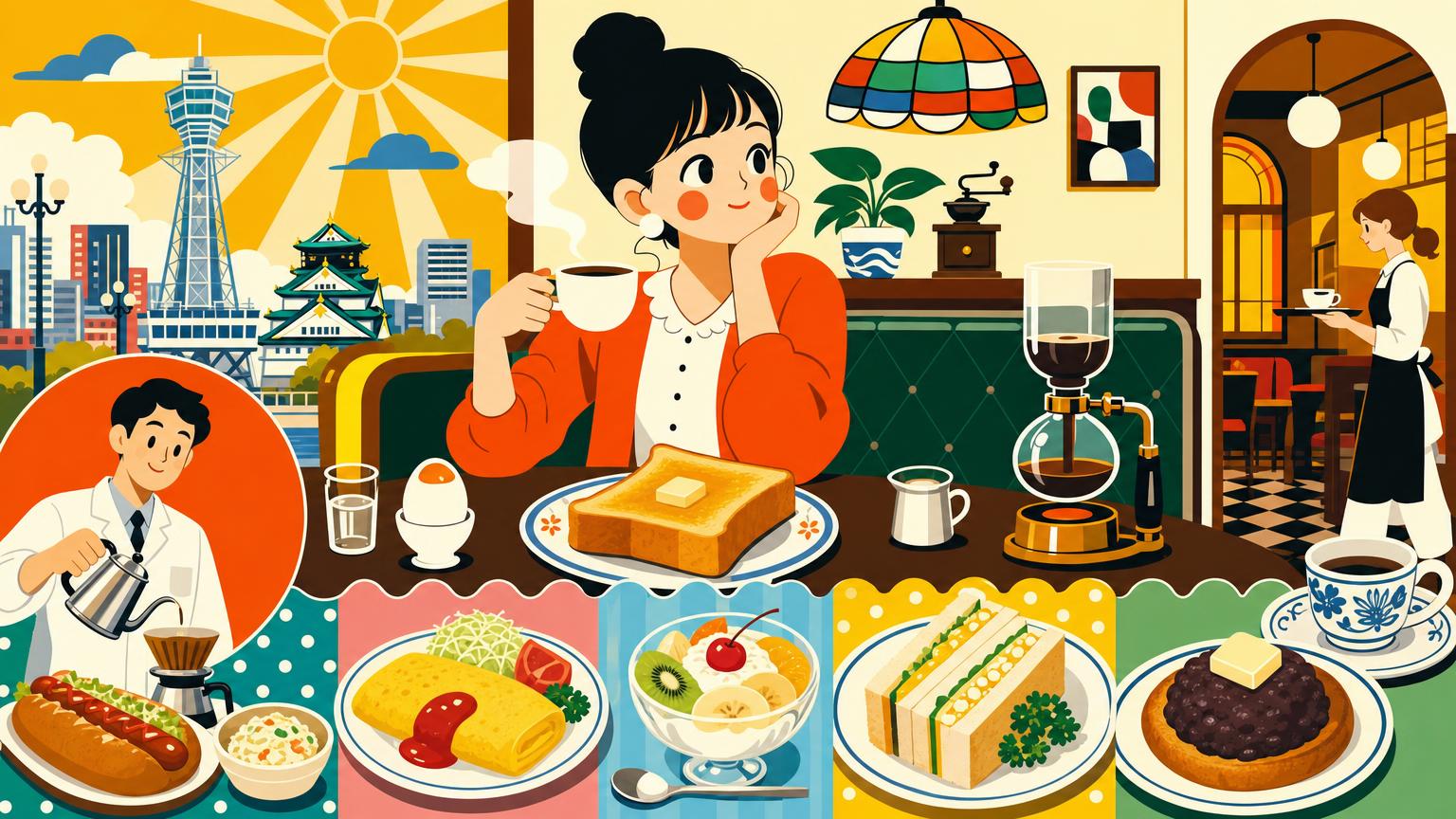
The standard morning service is a great place to start, but enjoying a kissaten breakfast can also give you a broader understanding of Osaka’s culinary preferences. The city’s morning culture extends beyond just coffee and bread. It encompasses sweetness, dairy, eggs, soft textures, and practical combinations that feel both familiar and unique.
Osaka’s Signature “Mix Juice”
Mix juice is one of the most iconic café drinks linked with Osaka. While recipes vary, it typically blends fruits like banana, peach, orange, or pineapple with milk or another creamy ingredient. The result is thicker and sweeter than typical fruit juice.
For a foreigner, the texture might be the first surprise. It often resembles a drinkable dessert or breakfast shake more than a regular glass of juice. This is part of its charm. It is satisfying without needing a large meal.
Mix juice also showcases Osaka’s practical approach to ingredients. A café drink can serve to use fruit, offer energy, and create a distinctive house specialty without becoming formal cuisine. It is colorful yet not delicate. Sweet but not overly luxurious. Slightly nostalgic and a bit indulgent in the best way.
Order it when you want something different from black coffee, but don’t assume every kissaten carries it. Some cafés treat it as a signature item, while others only serve coffee, tea, milk, and soft drinks. If you spot みっくすじゅーちゅ on the menu, it’s worth trying, especially alongside toast or an egg sandwich.
The Fluffy Tamago Sando, or Egg Sandwich
The Japanese egg sandwich, known as tamago sando, is another beloved kissaten offering. It comes in several varieties. Some use chopped egg salad mixed with mayonnaise between soft slices of bread, while others serve thick, warm omelet-style eggs. A particularly fluffy version might include a substantial block of seasoned egg that’s still slightly warm.
Texture is crucial. It should be soft, moist, and gentle rather than crunchy. The bread may be crustless or lightly toasted. The filling might include a touch of mustard, pepper, or subtle sweetness. Compared to Western breakfast sandwiches, it often feels less intense and more focused on the egg itself.
In Osaka, the tamago sando is especially rewarding because it aligns with the city’s preference for generous yet uncomplicated food. A thick egg layer makes a small sandwich feel hearty. It can be eaten quickly, but you can also appreciate the care taken in its preparation.
Check if the egg sandwich is available during the morning hours. Some cafés serve it all day, while others restrict it to a set menu or prepare it only after the kitchen is fully in operation. If you order one, be prepared for it to arrive later than coffee and toast since hand-cooked egg fillings can’t always be made as quickly as a standard morning set.
Anko Toast and Other Small Variations
Anko toast combines toast with sweet red bean paste, offering a flavor that bridges breakfast and dessert. The bean paste is thick and sweet, while the toast provides saltiness, warmth, and texture. Butter is sometimes added, creating a rich blend reminiscent of a sweet bun or simple pastry.
Some kissaten serve toast with jam, honey, cheese, ham, or a soft-boiled egg. Others may offer fruit, yogurt, or a small pudding. These variations are notable because they show how Japanese cafés adapt Western-style foods to local tastes. Toast isn’t just a neutral base; it becomes a platform for sweetness, saltiness, softness, or nostalgia.
Menus may also include items that Japanese customers consider light café fare but that foreigners might view as full meals: spaghetti, curry rice, pilaf, or a toasted sandwich. This is another reason not to define a kissaten too narrowly. It’s a coffee shop, but its social role can be akin to a small diner.
Why a Kissaten Breakfast Should Be on Your Osaka Routine
A kissaten breakfast is important because it allows you to experience Osaka on a human scale.
If you are visiting briefly, the morning service offers a glimpse into how locals start their day and handle everyday responsibilities. If you are thinking about living in Osaka, it provides something more valuable: a practical way to engage with local life without forcing familiarity.
You can go to a kissaten alone. You can speak very little Japanese. You can order a small meal, observe the atmosphere, and leave. You don’t need to understand every joke or become friends with the owner on your first visit. Repetition works. The second visit feels easier. The third visit might earn you some recognition. Over time, the shop becomes one of the places that make your neighborhood feel like home.
This is why the question “Is Osaka a good place to live?” cannot be answered solely by rent, transportation, salaries, or nightlife. Those factors matter, but daily contentment often comes from small points of belonging. A familiar coffee shop, a local bakery, a market stall, a neighborhood doctor, or a regular at the train station can make a city feel more navigable.
Osaka residents are often described as friendly, but that description is too vague to be meaningful. In a kissaten, friendliness can appear as practical involvement. Someone warns you that the toast is hot. Someone notices if you leave your umbrella behind. Someone jokes about your large order. Someone remembers that you prefer iced coffee. The warmth is not necessarily emotional openness. It is attention expressed through ordinary service.
This also helps explain why Osaka can feel different from Tokyo. Tokyo may offer more anonymity, more formal distance, and more polished versions of the same service. Osaka can provide a stronger sense that businesses are rooted in neighborhood relationships. The advantage is human warmth and recognition; the downside is that the interaction may feel more personal than you expect. A staff member might ask questions, comment on your choices, or suggest what you should order.
Don’t romanticize the difference. Osaka is not automatically easier for every foreigner. Some find local directness refreshing. Others find it intrusive. Some enjoy smoky, old-fashioned cafés. Others prefer clean air and contactless payment. Some appreciate a shop that closes when the owner needs rest. Others require predictable opening hours.
The honest way to understand Osaka is to recognize both sides. The city can be generous, but it is not a customer-service theme park. Independent businesses have their limits. Menus change. Shops close without dramatic announcements. Cash might be necessary. Japanese may be required. Smoking could be allowed. The owner may not tailor the entire business to international expectations.
That is not always a barrier. It can also be an invitation to adjust your own behavior. Carry cash. Learn a few phrases. Arrive before 11:00. Ask before taking photographs. Keep your voice moderate. Don’t occupy a table for a long time during a busy period after ordering the cheapest item. If the shop is clearly full, eat and leave at a natural pace.
These are not rules unique to Osaka, but the morning service makes them visible. You participate in a shared routine, not simply purchase an object. The coffee, toast, and egg are the surface. Beneath them lies a local understanding about how to share space.
How to Make the Morning Service Part of Daily Life in Osaka
If you are new to the city, start with one neighborhood close to your home or workplace. Avoid trying to visit every famous kissaten. Pick a shop you can realistically return to. A café ten minutes away is more valuable than a renowned one across town if you’re aiming to build a routine.
Go on a weekday if you can. Weekday mornings reveal the connection between the shop and working life. You might see customers in uniforms, office attire, delivery gear, or casual homewear. Weekend mornings tend to be slower and more social, but weekday service shows how the café fits into the city’s daily rhythm.
Bring a small amount of yen when you arrive. Check the entrance before going inside. See if the shop allows smoking or not. Notice if seats are assigned. Order a morning set. Observe how others behave, but don’t stare. Eat at a relaxed pace. Pay at the register unless instructed otherwise.
On your next visit, try using one more Japanese phrase. Say “itsumo arigatō gozaimasu” when leaving if the shop begins to recognize you. It means “Thank you as always” and can sound warm without being too familiar. If you want to ask if the morning service is still available, say “Mōningu mada daijōbu desu ka?”
Don’t be concerned if the owner replies quickly. Osaka speech can be fast, and local accents may make familiar Japanese sound different. Smile, repeat the key word, and use gestures. Communication in these situations is often collaborative. Fluency is not necessary.
Most importantly, don’t judge the experience solely by whether the food is exceptional. A morning service may be delicious, but its deeper value lies in the rhythm. The cup arrives. The toast cools. The egg is peeled. The television continues. People come and go. The city starts moving outside.
That ordinary sequence is what matters.
Final Thoughts: The Osaka Morning Is Small, Direct, and Shared
The ritual of morning service captures Osaka more accurately than many elaborate descriptions. It reveals a city that values practicality without dismissing pleasure, where conversations can be straightforward yet friendly, and where long-established businesses remain vital social hubs.
A kissaten breakfast is neither a luxury nor a spectacle. It is coffee with toast. A boiled egg alongside a warm cup. A few hundred yen exchanged over the counter. A regular customer occupying the same spot. An owner who remembers your order. The scent of roasted beans, butter, old tobacco, and warm bread blending with the cool morning air outside.
For foreigners living in Osaka, this ritual provides a practical lesson. Understanding a city goes beyond learning its official rules. It involves observing what people do repeatedly without explanation: where they sit, how they order, when they leave, how they show care, and what they consider worth paying for.
Start before 11:00. Carry cash. Order simply. Listen closely. Let the room teach you.
That is how to begin your day like an Osakan.