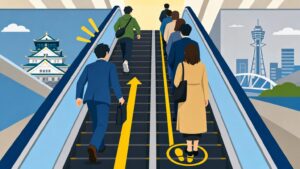
If you are living in Osaka, or seriously considering it, you may eventually face a surprisingly difficult question: where should you work when home feels too distracting?
The obvious answer is often, ‘I will just find a cafe.’ Then you discover that one cafe welcomes laptops, another quietly hopes you will finish your coffee within an hour, and a third has beautiful lighting but no usable power outlet anywhere except behind a plant. The plant, naturally, is already occupied by someone’s bag.
Osaka’s two major urban centers offer very different answers to this problem. Umeda, known locally as Kita, feels more structured, business-oriented, and connected to the machinery of corporate Osaka. Namba, known as Minami, feels more expressive, informal, commercial, and socially alive. These differences appear in the buildings, the station layouts, the cafes, and the way people use shared workspaces.
This is not simply a question of which area has better coffee. It is a question of what kind of daily life you want around your work. Do you want a quiet table near offices, trains, and formal meetings? Or do you prefer a workspace where errands, conversation, street noise, and an unplanned drink after work are all close together?
The distinction is not absolute. Umeda has lively corners, and Namba has serious business facilities. Still, after living in Osaka for a while, you begin to notice a pattern: Kita often asks you to be efficient, while Minami gives you more permission to be human in public.
The basic difference between Kita and Minami

Osaka’s geography is commonly described through a straightforward north–south contrast. Umeda lies in the north, centered around Osaka Station and a large cluster of railway terminals. Namba is located further south and serves as a major gateway to southern Osaka, Kansai International Airport, entertainment districts, and Minami’s bustling commercial streets. Official Osaka sources characterize Umeda as a key commercial and business district, whereas Namba is more closely linked to entertainment, nightlife, dining, and the flow of people through the southern part of the city.
While this description is helpful, it can come across as overly simplistic. The true distinction is less about a rigid boundary and more about a difference in social rhythm.
Umeda is the area of Osaka where people are typically heading somewhere specific. They’re changing trains, attending meetings, shopping after work, studying for exams, or navigating one of the vast underground pathways beneath the station. The city feels layered and vertical. Office towers stand alongside department stores, underground malls, hotels, restaurants, and railway platforms. You might spend ten minutes trying to find the right exit and still be technically within the same district.
Namba is busy too, but its energy is more diverse. Office workers, residents, restaurant staff, shoppers, students, nightlife employees, visitors, performers, and people who seem to have no particular destination all share the streets. That last group is significant. In Minami, lingering is part of the local atmosphere. Someone sitting outside with a drink, chatting near a shop, waiting for a friend, or wandering along a side street doesn’t feel out of place.
This difference influences cafes as well. In Umeda, cafes often act as extensions of offices, department stores, hotels, and transport hubs. In Namba, cafés are more likely to be tied to neighborhood character, independent businesses, fashion, music, food, or the surrounding street.
Neither style is inherently better. The practical question is which type of public environment helps you work without making you feel as though you’ve accidentally walked into a corporate training seminar.
What Umeda feels like when you work there
Umeda’s cafe culture is centered on movement and practicality
A Umeda cafe often functions as a temporary space in a city with limited spare rooms.
You might drop in because you have thirty minutes before catching a train, an online meeting between appointments, or a small task that cannot wait until you get home. Many cafes are located inside or adjacent to major commercial buildings, so they are designed to accommodate a steady stream of customers. People arrive, order, open a laptop, respond to messages, and leave.
This gives Umeda cafes a utilitarian character. Even when the décor is stylish, the fundamental question usually remains: can this place support a busy day?
You will frequently see people in business attire, employees from nearby offices, university students, job seekers, consultants, designers, and foreign residents working between errands. The atmosphere may be quiet, but not necessarily peaceful. Train announcements, escalators, delivery carts, department-store music, and the constant flow of people contribute to the soundscape.
For many locals, this is normal rather than bothersome. Osaka residents are accustomed to working amidst public life rather than waiting for perfect silence. A cafe doesn’t need to feel like a library; it only needs to provide a chair, a drink, and a reasonable chance of completing the task.
This practical mindset can surprise foreigners who expect a cafe to be either a social venue or a quiet laptop sanctuary. In Umeda, it might be neither. It may simply be a place that helps you keep your day moving.
The Umeda worker generally values predictability
Umeda is a solid choice when you need dependable infrastructure. The station area features extensive rail connections, covered underground pathways, large commercial buildings, hotel lobbies, chain cafes, and purpose-built workspaces. The underground network links many parts of the district, including Osaka Station, major department stores, and business areas around Nishiumeda and Dojima.
Predictability matters more than people often admit. If you live in Osaka, you may not be seeking an inspirational workspace every day. You might just need somewhere that opens at 8:30 a.m., offers reliable Wi-Fi, permits short visits, and is close to a station exit you can find without consulting multiple maps or asking a kind stranger.
This is where Umeda often excels.
CAFÉ ONthe in the Dojima underground area is a good example of the Kita approach. It describes itself as a cafe-like workspace with power outlets at every seat, high-speed Wi-Fi, flexible hourly use, a day pass, and enclosed booths suitable for web meetings. Its current listed prices include a 1-day pass for 2,500 yen or hourly use from 700 yen, with weekday hours from 8:30 to 21:00 and shorter weekend and holiday hours.
The key point is not that every Umeda cafe operates this way but that Umeda has a clear market for workspaces designed for short, practical use. You can arrive with a problem, pay for a solution, and leave without pretending your laptop is just for show.
Umeda’s social style can seem formal, but not necessarily cold
Foreign residents sometimes perceive Umeda’s business atmosphere as unfriendly. Usually, the reason is not hostility but role separation.
People in Umeda tend to be polite because they are functioning within defined roles. A staff member is serving you. You are a customer. A coworking manager is assisting you with registration. You are a user. Someone at the next table might be working and therefore unavailable for conversation.
This does not mean Osaka people are less open in Kita. It means the environment offers fewer invitations to strike up a conversation with strangers. Social norms are more professional and less spontaneous.
If someone in a Umeda cafe avoids small talk, don’t assume they dislike foreigners. They may be rushing to send a document before a 10:00 meeting. Osaka friendliness is not a magical force that overrides deadlines.
What Namba feels like when you work there
Namba’s cafe culture is more visible, diverse, and personal
Namba has a unique relationship with public spaces. Work, shopping, dining, entertainment, and social life blend more noticeably here. Official portrayals of Minami highlight Namba as a southern gateway and a hub for people, information, culture, cuisine, and nightlife.
This blend changes the experience of working there.
A Namba cafe often has a distinctive character. It may be linked to a roaster, a fashion district, a music scene, a small restaurant, a bookstore, or a local owner familiar with many regulars. The atmosphere is typically less neutral than that of a chain cafe near Osaka Station. You might hear more conversations, encounter more unusual patrons, or find yourself sitting close to people who are clearly friends rather than colleagues.
This can be invigorating if your work involves creativity, freelancing, online teaching, design, writing, or if you spend a lot of your day alone. The background life of Minami can make working on a laptop feel less like being confined to a tiny office and more like one activity among many.
However, it can also be distracting. Namba isn’t ideal if you need complete control over your environment. A cafe near a bustling shopping street may come with foot traffic, music, kitchen noises, and conversations in multiple languages. Even a quiet morning can grow livelier as the day goes on.
Namba’s strength lies not in perfect concentration but in its atmosphere and flexibility.
Minami makes work feel more integrated with everyday life
Namba appeals to those who dislike the sensation that work has taken over their entire day.
You can work for a couple of hours, buy groceries, meet a friend, enjoy an affordable meal, stroll through a neighborhood street, and return to your tasks later. The gap between work and life is minimal. This is part of why Minami can feel more relaxed, even when it’s busy and noisy.
This relaxed vibe doesn’t mean everyone is slow-paced. Namba’s workforce can be highly efficient. The difference is that efficiency coexists with visible daily life. In this area, people don’t always draw a sharp line between professional time and social time, unlike in more corporate districts.
Practically speaking, a workspace in Namba may be ideal if you want to feel connected to the city while working. You might exchange a few words with a barista, recognize familiar customers, or observe the neighborhood transitioning from a daytime shopping area to an evening social hub.
For foreigners, this offers a gentle way to understand Osaka. You don’t need to participate in cultural events or push yourself into language exchanges. You can simply observe how people share spaces, the volume at which they speak, their pace, and how naturally work sits alongside eating and conversation.
Namba’s informality has its boundaries
It’s easy to idealize Minami as the laid-back, friendly side of Osaka. That is only partly accurate.
Namba is informal, but it isn’t without rules. People still expect you to order something, respect seating limits, keep phone calls in check, and recognize when a cafe is too busy for lengthy laptop use. While the owner may be warm and sociable, that doesn’t mean buying a single coffee grants you the table for the entire afternoon.
This is a common misunderstanding among foreigners. Osaka’s public warmth doesn’t equate to unlimited freedom. A casual environment can still carry strong expectations regarding courtesy.
These rules may simply be conveyed less explicitly. Staff might not ask you to leave directly; instead, they may clear your cup, avoid eye contact, or gently mention that another customer is waiting. Learning to pick up these signals is part of living comfortably in Osaka.
Coworking culture: Kita is structured, Minami is flexible
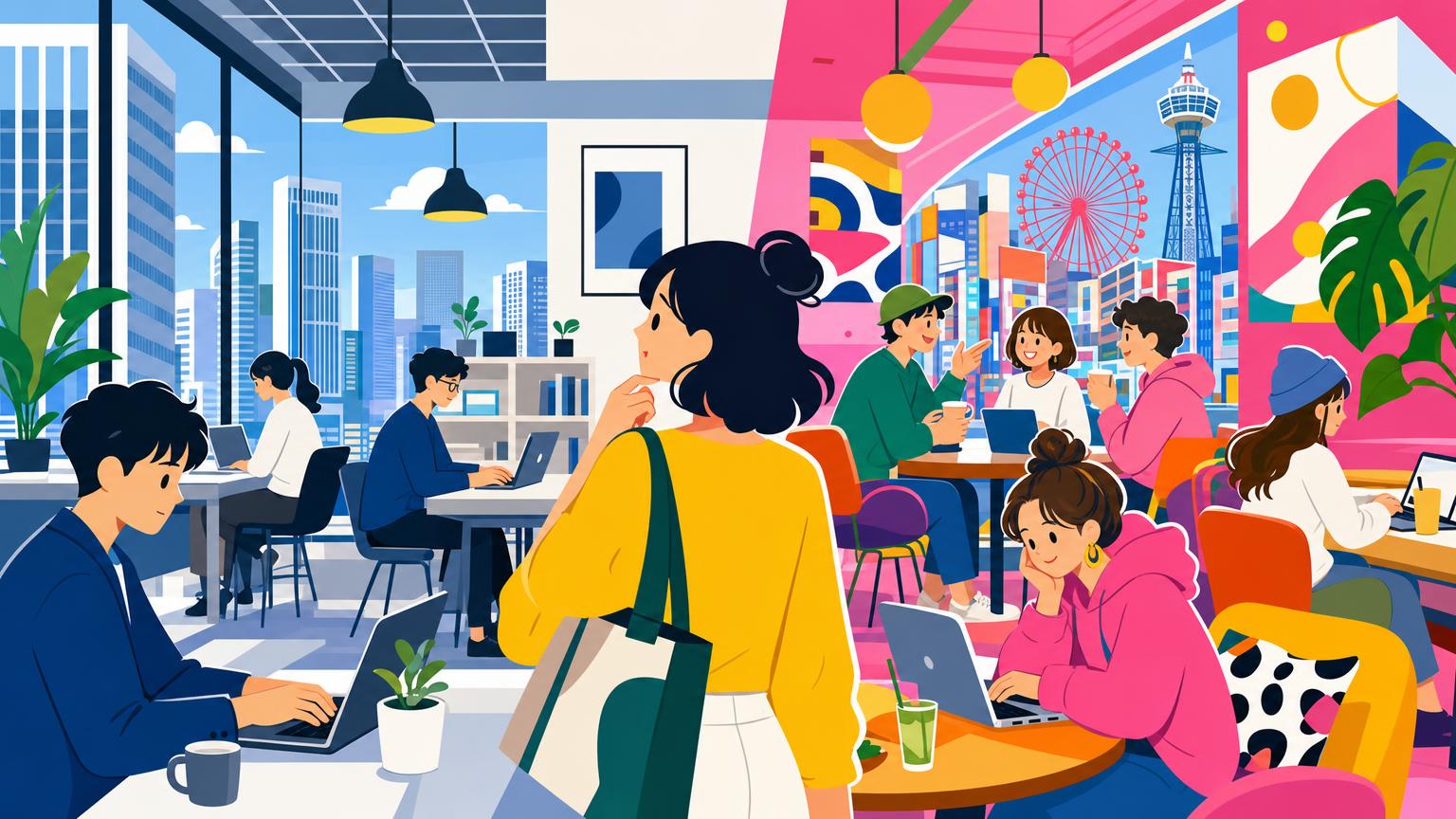
In Umeda, coworking often resembles an alternative office
Coworking spaces in Umeda commonly attract individuals seeking a professional environment without committing to a traditional office lease. The business-centric atmosphere of the area makes this feel natural. You’ll likely find reception desks, meeting rooms, phone booths, event spaces, private areas, and clear usage guidelines.
User expectations are simple: arrive, work, take calls, access facilities, and continue with your day.
For foreigners, Umeda can offer more administrative clarity. Structured coworking spaces typically provide consistent explanations about pricing, registration, access rules, and meeting-room use. It’s also easier to find a workspace near major train stations if your work involves frequent travel around Kansai.
The downside is that such structured spaces may feel socially neutral. You might work alongside others for months without ever learning their names. This isn’t a shortcoming; many choose these spaces specifically for focus rather than networking.
ONthe UMEDA exemplifies the community-oriented side of this model. Its facilities page highlights its proximity to Higashi-Umeda Station and details events, shared amenities, and opportunities for connection.
In Namba, coworking often feels more like a shared neighborhood room
While Namba coworking spaces can be just as professional, the surrounding culture shapes the experience differently. You’re more likely to move seamlessly between a workspace, cafe, restaurant, retail street, and informal meeting spots without feeling like you’ve entered a different world.
This suits freelancers and small business owners who don’t require a formal office identity. It also appeals to those working in creative fields, food, fashion, media, design, hospitality, or with international clients.
Namba’s southern city center has long been associated with entertainment, commerce, and cultural blending. While not every coworking space is automatically vibrant, the neighborhood offers more visible social texture around your desk.
The drawback is that Namba may be less consistent for deep work. The city is constantly bustling nearby. Sometimes that energy is just what you need; other times it turns a three-hour task into two hours followed by an unintended conversation about coffee beans.
Examples of practical workspaces around Kita
When comparing spaces, always verify current rules before visiting. Prices, staff schedules, and drop-in availability may change, especially around holidays or private events.
CAFÉ ONthe, Dojima and Nishiumeda
- Location: Situated underground in the Dojima area, on the Nishiumeda side of Umeda; connected beneath the business district around Dojima.
- Drop-in price: One-day pass listed at 2,500 yen; hourly starting at 700 yen, with additional 30-minute increments as specified by the operator.
- Drop-in hours: Weekdays from 8:30 to 21:00; weekends and public holidays from 8:30 to 19:00.
- English support: Some English information available, but confirm registration and web-meeting policies beforehand if you’re not comfortable with Japanese.
- Best suited for: Short work sessions, online meetings, or focused days when you want cafe comfort combined with coworking amenities.
This space is especially beneficial for foreign residents who have struggled speaking during video calls in regular cafes. The enclosed booths and work-oriented design address a common yet crucial issue.
Benkyo Cafe Osaka Nishiumeda
- Location: Near Nishiumeda Station, close to Exit 10 according to the operator.
- Drop-in price: The English page lists a one-day visitor fee of 1,000 yen plus tax, subject to visitor conditions.
- Drop-in hours: Weekdays 12:00 to 23:00; Saturdays 10:00 to 21:00; Sundays 10:00 to 20:00.
- English support: Limited; the operator notes that Japanese proficiency may be required for some applications, so contact the facility ahead.
- Best suited for: Quiet study, focused individual work, and those comfortable navigating Japanese rules.
This serves as a reminder that ‘English-friendly’ doesn’t mean ‘English-only.’ Even if a website offers English, the on-site registration often remains primarily in Japanese, which is typical in Osaka and worth checking before visiting.
A note about drop-in culture
In Japan, ドロップイン (drop-in) is widely used to describe short-term coworking access, typically hourly or daily without a monthly commitment. Osaka offers many practical options, but not every coworking space accepts walk-ins at all times.
The safest approach is to verify four things before you leave: whether drop-in access is available that day, if advance registration is required, whether you can pay by card, and if phone booths need separate booking.
Day passes are common and accessible, but the meaning of ‘drop-in’ varies locally. Some spaces allow walk-in payment at reception; others require online reservations. Some offer trial visits only during staff hours.
If you’re still learning Japanese, prepare a simple phrase on your phone: ‘I would like to use the drop-in plan today. Is English support available?’ You might also want the Japanese phrase ‘今日、ドロップインで利用できますか’ which means, ‘Can I use the drop-in service today?’ It’s not glamorous, but it’s better than finding out the reception closed twelve minutes ago.
Why cafes and coworking spaces feel different in Osaka
A cafe is part of the neighborhood economy
When you work in a cafe, you’re not just buying coffee; you’re engaging in a small social system.
You place your order with the staff. You occupy a table. Other customers need seats. The owner might be trying to balance regulars, families, students, remote workers, and those who only want a brief stay with a drink. Your behavior influences the atmosphere.
This is why extended laptop use can be more complex than foreigners anticipate. Some cafes welcome it because it brings steady business during slow periods. Others view a single customer occupying a table during peak hours as inconsiderate, even if no rule is posted in English.
In Umeda, the issue may be space and turnover speed. In Namba, it might be the cafe’s unique character and rhythm within the neighborhood. Either way, being aware of the environment is important.
A simple guideline is to order regularly, avoid spreading your belongings over multiple seats, keep calls quiet, and leave when the cafe is full if you’ve been there for several hours. If you need a guaranteed desk, pay for a workspace instead of hoping the barista quietly accepts your work habits.
A coworking space is a service, not a favor
Coworking spaces reduce some of the uncertainty. You pay for a workspace, usually including access to power, Wi-Fi, seating, and shared facilities. You can work longer without feeling guilty about occupying a cafe table.
The trade-off is cost and formality. A day pass may cost more than several coffees. Registration might take some time. Some spaces have rules about phone calls, food, noise, visitors, and meeting rooms.
For people living in Osaka, the value becomes clearer when work is a priority. If you have a deadline, an international meeting, a job interview, or a full day of remote work, a coworking space often costs less than losing half a day to poor focus.
The best option depends on the kind of inconvenience you prefer. Cafes bring uncertainty about seating and noise. Coworking spaces bring uncertainty about rules and price. Choose your preferred challenge.
How Osaka people use shared space
Quiet does not always mean silent
Foreign residents often look for a ‘quiet cafe’ and expect library-level silence. In Osaka, however, quiet usually means that people are not intentionally disturbing each other. Sounds like cups, conversations, chairs, music, and staff announcements may still be heard.
This is particularly relevant in Umeda, where many cafes are part of busy buildings, and in Namba, where the street life often spills into the ambiance. If you require complete silence for language lessons or legal meetings, it’s best to reserve a booth or private room.
People may be friendly without becoming personal
Osaka’s reputation for friendliness can lead to unrealistic expectations. A shopkeeper might joke with you, a barista may remember your order, or a stranger might help you find your way. These interactions are meaningful but don’t necessarily indicate the start of a personal relationship.
In everyday Osaka life, friendliness tends to be situational. It shows through practical help, humor, small remarks, and efforts to ease awkwardness. It may not extend into long conversations.
This is one reason why cafes are useful for observing local behavior. You can watch how people interact without expecting interaction from them. Regular customers might greet staff but never speak with the person at the next table. A coworking member may attend an event one week and work privately the next.
The city supports multiple levels of connection.
Humor is often a way to make situations easier
Communication in Osaka can sound more direct, playful, or expressive than in Tokyo. People may tease, exaggerate, complain dramatically, or use humor to soften requests. This doesn’t mean everyone in Osaka is trying to be a comedian, nor should you treat every interaction like a TV variety show.
The key is to listen for the intent behind the tone. A joking complaint can still be a genuine complaint. A smiling refusal remains a refusal. Someone saying your Japanese is ‘jōzu’ may be encouraging you rather than giving a precise language evaluation.
In cafes or coworking spaces, humor can create a relaxed atmosphere, but basic courtesy is more important than attempting to be funny. The quickest way to integrate into the local environment is usually by understanding the social norms, not by imitating a comedian.
Umeda or Namba: which area suits your daily life?
Choose Umeda if your life revolves around work and transportation
Umeda is often the better choice if you:
- Require dependable access to multiple train lines.
- Have frequent meetings with companies or clients.
- Prefer structured cafes and professional coworking spaces.
- Need a day pass, private booth, or formal workspace.
- Want to work near major offices, hotels, and commercial buildings.
- Favor a neutral environment where conversation is not expected.
Umeda is especially convenient for those working across Osaka, Kyoto, Kobe, or other parts of Kansai. Its role as a transportation hub makes it easier to coordinate work and appointments. The challenge lies in navigating the area mentally, as the district can feel like a vast indoor maze, particularly during your early months in Osaka.
Choose Namba if your life centers around people and neighborhoods
Namba might suit you if you:
- Favor independent cafes and spaces with unique character.
- Work in creative, freelance, hospitality, fashion, or media fields.
- Like to blend work with errands, dining, and social activities.
- Want your workspace surrounded by vibrant street life.
- Feel energized rather than distracted by conversation and movement.
- Prefer a less corporate atmosphere.
Namba is especially comfortable for residents who want work to feel integrated with everyday life, rather than separated. You can complete a task and immediately access food, shopping, friends, or late trains nearby. The challenge is knowing when to stop immersing yourself in the city and focus on your work.
Choose neither if you need a quiet home base
There’s no shame in working from home.
Some people move to Osaka expecting to work daily from stylish cafes, only to realize that a suitable desk, stable chair, reliable Wi-Fi, and a quiet room are more important than a beautiful interior. If your work involves frequent calls, sensitive information, or requires long stretches of concentration, a home setup may be your best daily solution.
Use cafes and coworking spaces strategically: a cafe can boost your energy when you feel isolated, and a coworking space can provide structure when home becomes too comfortable. Neither needs to define your entire work style.
What foreigners often misunderstand about Osaka’s cafe culture
‘Friendly’ does not mean every place is casual
Osaka may feel socially warm, but businesses still have operational limits. A friendly staff member might still ask you to place an order. A relaxed coworking space may require registration. A neighborhood cafe could welcome foreigners but prefer that customers don’t work for six hours during lunch.
Assume kindness and boundaries can coexist. This mindset will serve you well.
A busy cafe is not automatically a good work cafe
A cafe might serve excellent coffee but lack practical work conditions. Look for outlets, table size, Wi-Fi, seating time, noise level, and whether laptop use is common among patrons.
A beautiful cafe near Namba may be perfect for a short writing session but unsuitable for a three-hour video call. A plain cafe near Umeda may be far more functional because it offers the essentials that rarely get photographed.
English menus do not guarantee English administration
This is especially true for coworking spaces. A venue may provide English information, but staff communication, contracts, payment details, or rules might mostly be in Japanese. This isn’t necessarily an issue, but it’s a good reason to contact the facility beforehand.
If you’re living in Osaka, it’s also a chance to learn useful vocabulary. Terms like ドロップイン, 会員, 利用時間, 延長, 個室, and 会議室 are commonly found in workspace information. A translation app helps, but recognizing key words yourself gives you greater control.
Namba is not simply ‘fun Osaka’ and Umeda is not simply ‘business Osaka’
These labels reflect tendencies, not complete identities.
Namba includes serious offices, quiet residential streets, study areas, hotels, international businesses, and people just getting through an ordinary Tuesday. Umeda features bars, nightlife, independent cafes, students, artists, and plenty of people with no intention of discussing business.
The contrast is helpful only when it highlights how the city is organized. It becomes misleading when it turns neighborhoods into stereotypes.
Frequently asked questions
Is Umeda or Namba better for working in a cafe?
Umeda is generally better for predictable, practical work close to transport links and offices. Namba tends to be preferable for atmosphere, neighborhood character, and a more socially vibrant environment. Your choice should depend on whether you need focus or energy.
For an important online meeting, it’s best to choose a coworking space or a cafe with private booths rather than relying on chance. For example, CAFÉ ONthe in the Dojima area specifically promotes power outlets, Wi-Fi, and enclosed booths for web meetings.
Can I use a coworking space for only one day?
Yes. One-day use is common and widely available in Osaka, often through services known as ドロップイン. However, each facility has its own rules. Some accept walk-ins, others require online registration, and some only allow visitor use during staffed hours.
Check the current price, opening hours, payment methods, and availability of private booths before going. A typical one-day rate might range from 1,500 to 2,500 yen, although hourly plans and premium facilities can be more expensive. CAFÉ ONthe currently offers a 2,500-yen day pass, while Benkyo Cafe’s English page lists a 1,000-yen visitor day usage fee plus tax under its conditions.
Are cafes in Osaka suitable for remote work?
Some are, but it depends on the situation. Work for a shorter period, order something, avoid busy meal times, and don’t assume that a quiet-looking cafe allows long laptop use.
For regular remote work, a coworking space is usually more reliable. But for a change of pace, a cafe might be just right.
Do Osaka people talk to strangers more than people in Tokyo?
Sometimes, but the difference is often exaggerated. Osaka communication can feel more direct, humorous, and expressive, especially in informal commercial settings. However, many people still value privacy, particularly when commuting or working.
The more notable difference is that humor and casual comments play a larger role in everyday interactions in Osaka. You might hear more joking complaints, quick observations, and practical conversations. That doesn’t mean every stranger wants to become your new best friend.
Is Namba too noisy for concentration?
For deep focus, it can be. But for creative energy, it might be ideal. Namba’s mix of shopping, dining, entertainment, residential life, and transport creates a livelier backdrop than many office-focused areas of Umeda.
Try Namba in the morning if you want a calmer setting. The atmosphere usually becomes more social as the day progresses toward evening.
Is Umeda too corporate for ordinary life?
No, but its public spaces often feel more centered around large buildings, transport, and business activity. You can still find relaxed cafes and personal neighborhoods nearby, including areas around Fukushima, Nakazakicho, and the smaller streets beyond the main station district.
The key is to move a bit away from the largest station complexes. Umeda’s corporate atmosphere is strongest where the city is designed for business scale and movement.
What should I do if I need a private Zoom call?
Reserve a phone booth, meeting room, or enclosed workspace. Don’t assume a regular cafe table is suitable for a long call, even if others are also using laptops.
If you must call from a cafe, use headphones, speak quietly, keep the conversation brief, and avoid discussing confidential matters. In Japan, the concern is not just noise level—other customers may feel uncomfortable being unintentionally included in a stranger’s conversation.
The everyday decision: efficiency or atmosphere?
The best way to compare Umeda and Namba is not to ask which one is more authentic. Both represent real Osaka. Both are bustling, evolving, commercial hubs inhabited by people with everyday responsibilities.
Instead, consider what kind of support you need from the city on any given day.
Umeda is the ideal companion when you need structure. It offers transport links, formal workspaces, clear commercial services, and a reliable sense that the city is designed to help you reach your destination.
Namba is the better companion when you seek texture. It provides food, conversation, independent businesses, diverse crowds, and a stronger sense that work happens within everyday life rather than above it.
For foreigners living in Osaka, this difference can create a useful personal rhythm. Work in Umeda when your schedule is tight. Choose Namba when you want energy or a change of scene. Use a coworking space when the task is important. Use a café when atmosphere matters. And when both areas feel too hectic, go home, make tea, and remember that no city can offer a better desk than the one you already have.
That is perhaps the most Osaka answer: choose what works, don’t make a show of it, and leave enough time in the day to enjoy something good to eat.