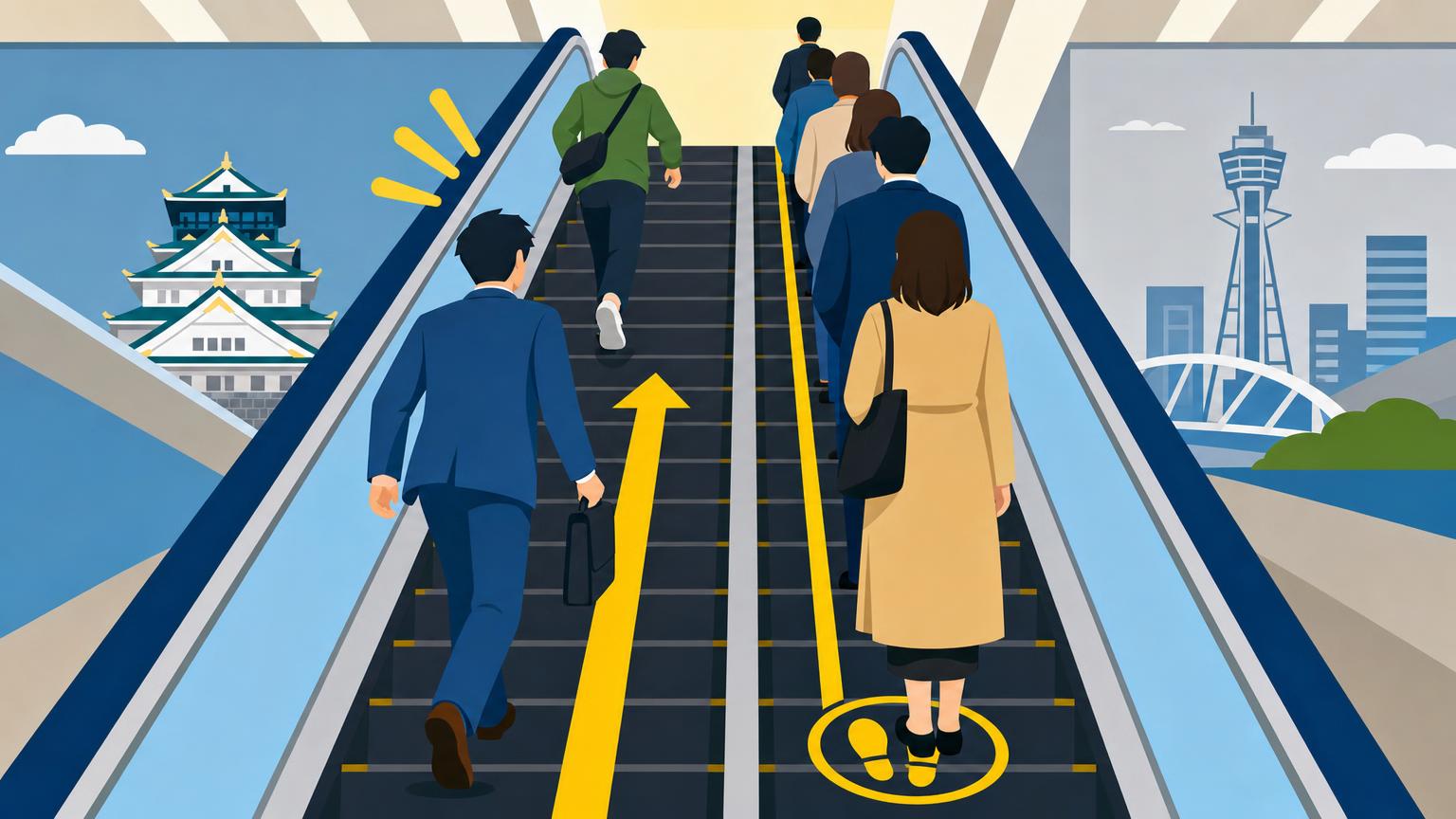
If you live in Osaka for even a short time, one small public-transport question appears almost immediately: why do people stand on the right side of the escalator?
The short answer is simple. In Osaka and much of the Kansai region, the traditional convention is to stand on the right and leave the left side open for people who want to walk. In Tokyo and much of eastern Japan, the convention is generally reversed: people stand on the left and leave the right side open.
That sounds like a neat national rule with a neat regional division. Daily life is less tidy. The Osaka convention still exists, but it is changing. Railway companies, local governments, and safety campaigns increasingly ask everyone to stand still on both sides. In some places, including Saitama Prefecture and Nagoya City, this is supported by local ordinances. Kyoto has also been running campaigns asking passengers to use two lines and avoid walking.
For foreigners living in Osaka, the important point is not simply memorizing “right in Osaka, left in Tokyo.” The deeper lesson is that Japanese public transport works through a mixture of written rules, local habits, crowd behavior, and quiet social adjustment. Osaka’s escalator custom shows how regional identity, historical memory, safety concerns, and everyday pragmatism can all exist in the same station.
The Basic Difference: Osaka Stands Right, Tokyo Stands Left
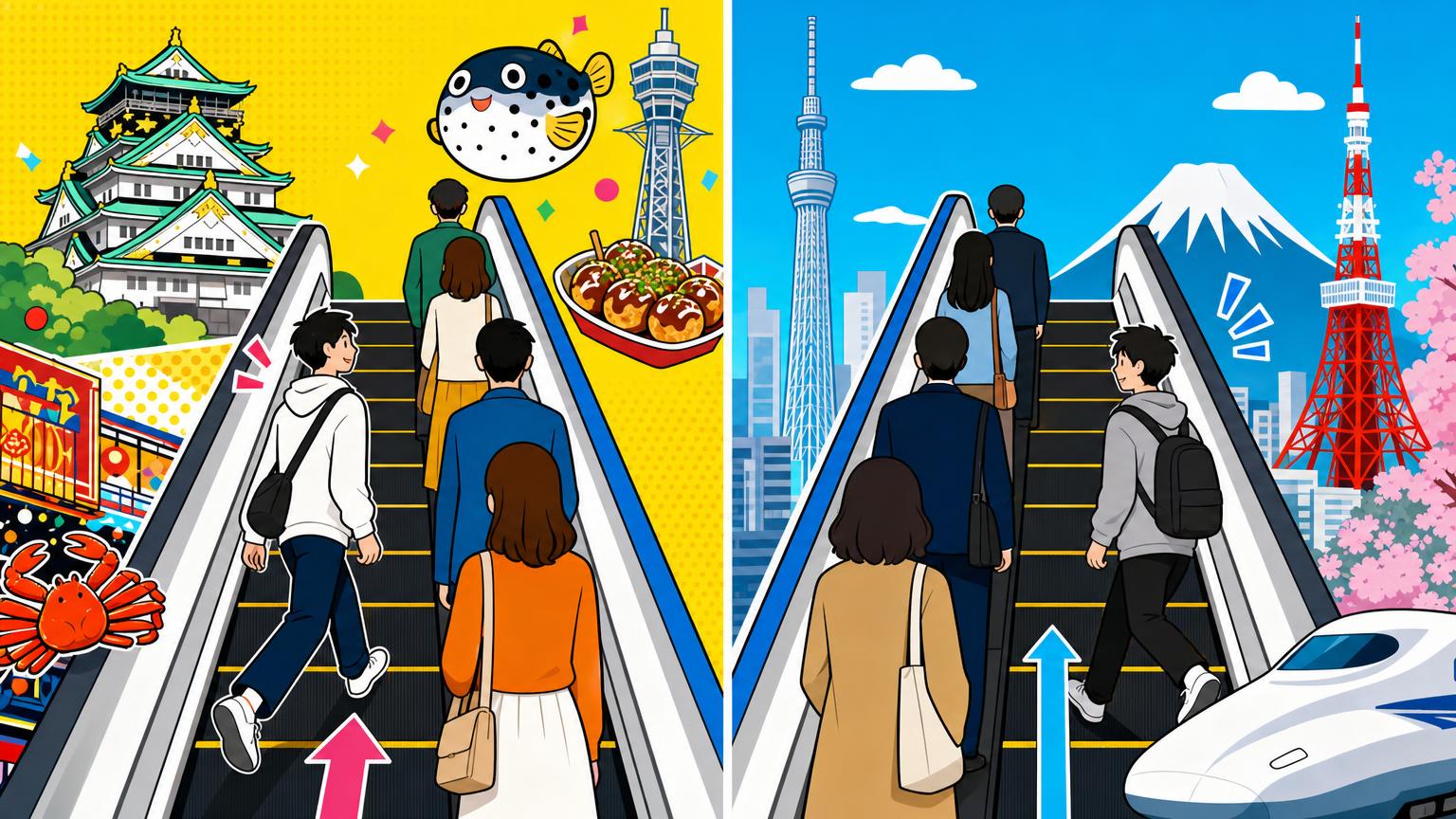
Osaka and Kansai: Stand on the Right
In Osaka, it is customary to stand on the right side of an escalator, leaving the left side open for those walking up or down.
This habit is most noticeable at major stations like Umeda, Namba, Tennoji, Kyobashi, and Shin-Osaka. During the morning rush, people line up on the right while the left side serves as a lane for moving pedestrians. A businessperson might hurry past, a student with a backpack may weave through, and someone with shopping bags might wait for an opening before proceeding.
This practice is rarely announced as a formal “Osaka rule.” Most locals learn it simply by observing others. The behavior becomes instinctive: people step onto the escalator, move right, face forward, and keep their bodies and belongings within their own space.
The custom is most evident when the station is crowded but not completely full. If the escalator is packed, the walking lane tends to disappear. When there are fewer people, the left side might stay open even if unused. Locals don’t view this empty space as wasted; rather, they see it as reserved for movement.
For newcomers to Osaka, the first surprise is that standing on the left can feel socially noticeable. While you might not get a direct complaint, someone behind you may hesitate, shift their position, or emit a subtle sound of irritation. This indirect signal means you are standing where people expect clear passage.
Tokyo and Eastern Japan: Stand on the Left
In Tokyo, Yokohama, and much of the Kanto region, the convention is reversed: people stand on the left and leave the right side open for walking.
As a result, someone traveling between Osaka and Tokyo might unknowingly breach local etiquette. A stance that appears normal in Osaka can seem inappropriate in Tokyo. This regional difference contributes to visitors’ perception that Japan’s rules are confusing. Despite sharing a language, similar rail systems, and comparable station designs, escalator behavior varies by location.
This difference isn’t absolute. Airport terminals, department stores, underground malls, and tourist-heavy stations can be less consistent. Some stations post signs asking passengers not to walk on escalators at all. Local campaigns may temporarily adjust the norm. Large luggage can also make it difficult to follow the usual single-file lane. In these cases, crowd conditions take precedence over traditional regional customs.
The safest modern guideline is this: Osaka traditionally stands on the right, Tokyo on the left, but many public venues now encourage passengers to stand still on both sides.
Why Did Osaka and Tokyo Develop Different Escalator Habits?
There is no single universally accepted explanation for the regional divide. The historical stories are popular because they make the difference easy to remember, but they should be regarded as cultural theories rather than definitive historical evidence.
The Samurai and Sword Theory
One explanation links the Tokyo-side convention to samurai culture. In the past, a samurai carrying a sword on the left side of the body might have preferred to keep the left side clear or protect the sword from contact with nearby people. According to some versions of the story, people in eastern Japan therefore became accustomed to standing on the left.
The story is appealing because it connects a modern station habit to the physical arrangement of clothing, weapons, and movement in old Japan. It also fits how cultural explanations are often passed down: a complex social custom is condensed into a simple historical image.
However, this is insufficient to prove that today’s escalator etiquette directly originates from samurai behavior. Modern escalators did not exist during the samurai era, and regional standing habits developed through more recent public campaigns, station design, and crowd behavior. The sword explanation is best understood as one aspect of cultural memory, rather than a complete origin story.
Osaka and the 1970 Expo Theory
Another common explanation centers on Osaka’s 1970 Japan World Exposition. Osaka hosted many international visitors, and organizers are often said to have encouraged people to stand on the right so the left side could remain clear for walking, aligning with conventions used in some overseas cities at the time.
This theory is often used to explain why the Osaka convention became particularly strong. The Expo helped Osaka showcase itself as an international and commercially vibrant city. A public-space habit that facilitated movement for visitors could quickly spread through stations and major facilities.
Nevertheless, the Expo story should not be considered the sole cause. People had already developed regional habits, and different railway companies and buildings may have implemented various instructions. Still, the 1970 Expo remains an important cultural reference because it aligns with Osaka’s longstanding connection to commerce, mass movement, and practical organization.
A More Practical Explanation
The simplest explanation may be less romantic. Escalator etiquette became local through repeated imitation. A railway company, department store, or event organizer encouraged people to leave one side open. Passengers followed the behavior of those around them. Over time, this conduct became automatic.
Once a city develops a strong pattern, people experience it as common sense. A Tokyo resident may not think, “I am following the Kanto escalator convention.” They simply move to the left. An Osaka resident may not think, “I am expressing a regional cultural identity.” They simply move to the right.
This is how many unspoken rules function in Japan. They are often learned through observation rather than explicit explanation. The rule feels natural because everyone around you seems to already know it.
What Osaka’s Escalator Habit Says About Osaka Culture
The right-side convention does not provide a complete picture of Osaka, but it does highlight several aspects of daily life in the city.
Osaka Prefers Practical Coordination
Osaka is a densely populated city. People share narrow sidewalks, underground passages, shopping streets, train platforms, and crowded station entrances. Many public behaviors are designed to keep people moving without the need for conversation.
Standing on one side creates a straightforward system. One line waits while the other side moves. The system is not elegant in a formal or ceremonial way; it is practical. People understand it from the shape of the crowd.
This practical approach shows up elsewhere in Osaka life. A shop worker may get straight to the main point, skipping unnecessary formalities. A neighbor might give direct advice about garbage collection or bicycles. A commuter may shift position quietly because the movement itself communicates cooperation.
Foreign residents sometimes interpret this indirectness as coldness, but it is often closer to efficiency. People tend to solve immediate problems without initiating public conversations around them.
Osaka Is Direct, Yet Not Always Confrontational
Osaka is known for direct speech and a strong personality. There is some truth to this, but directness does not always imply open confrontation.
For example, on an escalator, someone may not say, “Please stand on the right.” Instead, they might stand close behind you, glance toward the open side, or quietly move around if possible. In a supermarket line, a person may point out you are waiting in the wrong place, but their correction is usually quick and practical rather than a formal complaint.
The social aim often is to restore the flow. The person wants the line to keep moving, the train door to close, or the escalator lane to stay clear. This can feel less ceremonious than Tokyo manners but is not necessarily less considerate.
Osaka’s Warmth Often Emerges Through Interaction
Saying “Osaka people are friendly” is too vague to be helpful. A more precise description is that Osaka tends to allow more visible interaction in everyday public life.
People may comment on the weather, food, prices, baseball, or a minor mistake. A cashier may use a more relaxed tone. An older passenger may offer directions with many gestures and examples. A neighbor might ask a practical question that would seem unusually personal elsewhere.
This does not mean every Osaka resident seeks close relationships, but the boundary between stranger and acquaintance can be more conversational. The city often permits plain speaking in small moments.
That same openness can also provoke sharper reactions when someone disrupts a shared flow. If you stop at the top of an escalator, block a train door, or stand in the wrong queue, the response may be swift. Osaka’s informality can feel both welcoming and demanding at once.
The Rule Is Changing: Why Walking on Escalators Is Being Discouraged
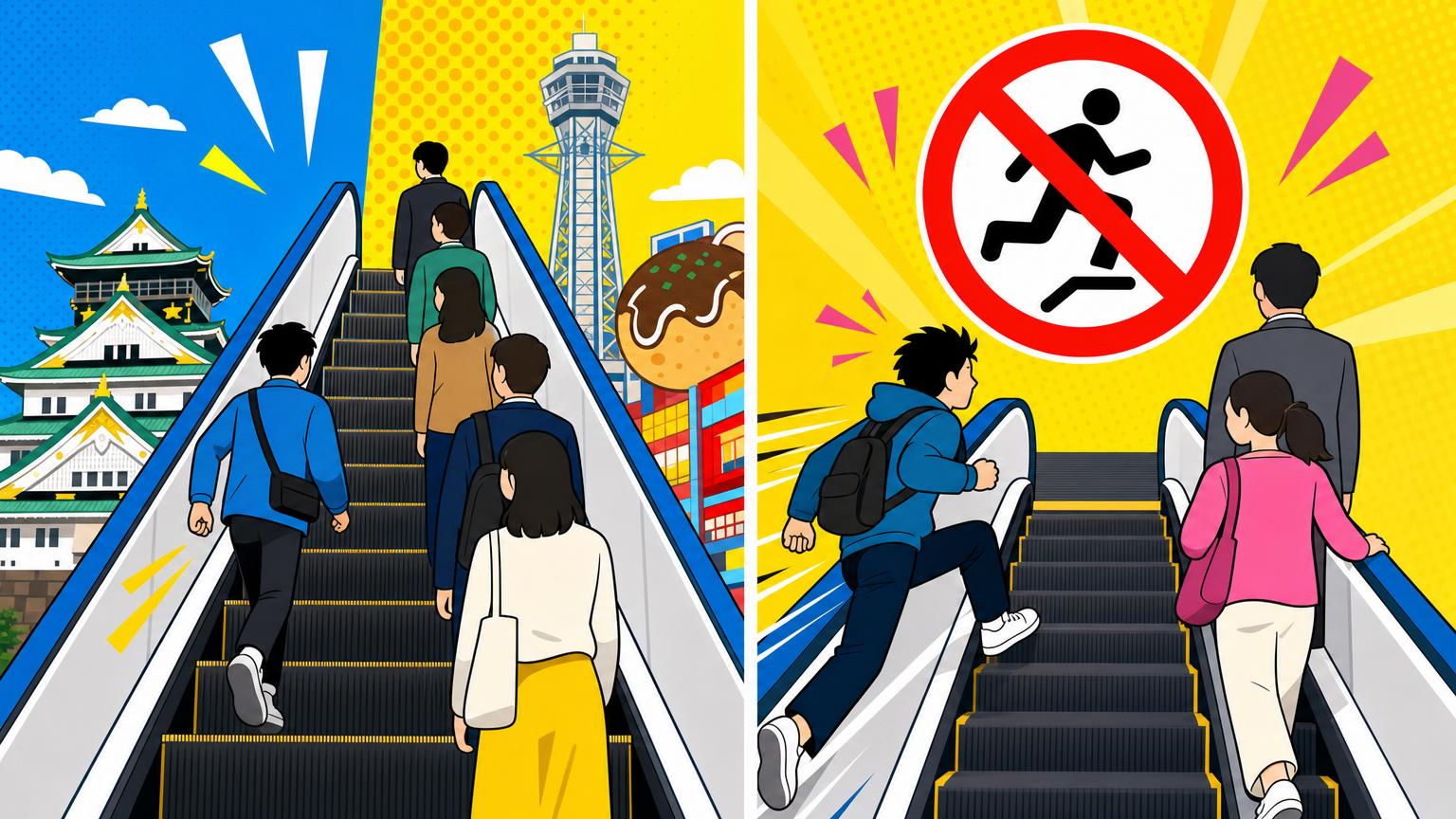
The old system presumed that two types of passengers could share one escalator: those who stood on one side and those who walked on the other. However, modern safety campaigns increasingly highlight that this setup is unsafe.
Walking passengers risk losing their balance. People standing still might be hit by a bag, shoulder, umbrella, or suitcase. Someone needing to hold a specific handrail may be pushed away from it. Parents may find it difficult to stand next to a child. Passengers using a cane or with disabilities might feel pressured into unsafe positions.
JR East now requests passengers not to walk on escalators and to hold the handrail. Its safety guidelines promote standing still as the safer behavior, rather than designating the open side as a permanent walking lane.
The issue extends beyond individual balance. Escalators are shared machines with moving steps and handrails. Walking introduces sudden movement into an area where people are standing closely together. If one person stops abruptly, those behind may have little room to react.
Safety Changes the Meaning of “Consideration”
Previously, etiquette often framed the open side as a courtesy for those in a hurry. The newer perspective poses a different question: who requires access to both sides for safety?
A passenger may need the right-hand rail due to an injury. Another might need to hold a child’s hand. Someone with visual or balance issues may feel safer without people walking past them. A person carrying luggage might need to stand firmly instead of moving aside at the last moment.
This represents an important cultural shift. Consideration now increasingly includes those who require stability, space, or the ability to stand beside someone else—not just helping the fastest person pass.
Saitama’s Ordinance
Saitama Prefecture’s ordinance on safe escalator use came into effect on October 1, 2021. It requires users to stand still on escalators, though it imposes no penalties. The prefecture also encourages standing on both sides rather than leaving one side open for walking.
The official explanation specifically mentions people who can hold only one handrail, those with injuries or disabilities, and children who need to stand next to a parent. It characterizes the older one-side-standing practice as a potential safety barrier.
This does not mean everyone in Saitama immediately stopped walking. Social habits change slowly, especially when commuters cross municipal and regional boundaries. A rule may exist on paper while old behavior persists in stations.
This gap between formal guidance and actual behavior is important for foreigners to understand. Japanese public etiquette is not always a straightforward division of legal versus illegal. A behavior may be discouraged, announced, and socially criticized without incurring fines or direct enforcement.
Nagoya’s Ordinance
Nagoya City also promotes safer escalator use through an ordinance. It asks passengers to stand still whether on the left or right side. Its English guidance warns that walking or running on escalators can result in falls or collisions. It also advises holding the handrail, standing inside the yellow line, preventing large belongings from causing hazards, and continuing to walk after stepping off rather than stopping on the landing.
Nagoya serves as a useful example because it shows this new safety-first approach is not limited to Tokyo or Osaka but is part of a broader national shift.
Kyoto’s Campaigns
Kyoto has traditionally followed the Kansai pattern of standing on the right, but current campaigns challenge that assumption. Kyoto City’s transportation authorities promote two-line use, asking passengers not to walk on escalators. Campaigns throughout the municipal subway system emphasize accident prevention and safety.
For a foreign resident traveling between Osaka and Kyoto, the practical advice is clear: don’t rely solely on the old “Kansai equals right” rule. Pay attention to signs, listen to announcements, and observe what people are doing on each escalator.
Escalator Etiquette in Other Major Japanese Cities
Kyoto
Kyoto’s escalator etiquette has traditionally aligned more closely with Osaka than Tokyo, so standing on the right side has been common. However, there is increasing visibility of campaigns encouraging passengers to stand in two lines.
Many stations in Kyoto see visitors carrying luggage, standing uncertainly, or stopping to read signs. The city’s practical expectation isn’t that foreigners know every local custom beforehand, but that passengers avoid blocking landings, hold the rail, and follow posted instructions.
Nagoya
Nagoya has a distinct urban identity and should not be viewed as simply halfway between Osaka and Tokyo. Older escalator behaviors may differ by station and crowd, but the city’s official safety guidance is to stand still on either side.
If you move through Nagoya following Osaka habits, don’t assume standing on the right is automatically correct. In stations with two-line signage, stand still and let the crowd self-organize around the instructions.
Sapporo
Sapporo generally follows the eastern Japanese pattern, so standing on the left has traditionally been common. Snow, bulky coats, boots, and winter luggage often make the one-sided system awkward. In bad weather, practical safety takes precedence over keeping an open walking lane.
Anyone carrying a large winter coat, backpack, or suitcase should avoid swinging their belongings into other passengers. The safest place is stable, near the center of the step, with bags controlled.
Fukuoka
Fukuoka is usually associated with western Japan, but escalator behavior can vary by facility. Major stations, shopping centers, airports, and subway areas may display different signs or attract people from various regions.
The city serves as a reminder that regional rules are tendencies, not guarantees. A busy interchange might include commuters who grew up with different habits elsewhere.
What Should You Do in Osaka If You Are Not Sure?
Follow the Person in Front of You
The most reliable guideline is straightforward: observe the nearest crowd and follow the person ahead of you.
If the majority are standing on the right, stand on the right. If a sign instructs everyone to stand on both sides, comply with the sign. If people form two lines and no one is walking, do the same. If the escalator is nearly empty, find a safe spot and keep your body and luggage controlled.
This advice works because Japanese station etiquette is very situational. Someone who adapts to the surrounding pattern is rarely seen as intentionally rude. Someone who insists on a rule from another city may cause more problems than someone who quietly adjusts.
Read the Sign Before Reading the Crowd
Signs and announcements take precedence over inherited customs. Look for phrases such as “stand on both sides,” “do not walk,” or “hold the handrail.” In Japanese, you might see instructions related to standing still, safe use, or refraining from walking on the escalator.
If the sign is unclear, observe whether people are using both sides. If an employee is directing passengers, follow their instructions. Public facilities may introduce temporary rules during events, construction, unusual congestion, or emergencies.
Do Not Stop at the Top or Bottom
One of the most common station errors is stopping immediately after stepping off the escalator. You might want to check a map, search for a platform number, or wait for a friend, but the landing is not the place to do so.
Keep walking several steps before stopping. If you need to get your bearings, move to the side without blocking those behind you. At busy stations like Umeda or Namba, the person behind you could be focused on catching a train and may have no room to avoid you.
This is a broader Osaka transit rule: do not stop where the crowd expects movement.
How to Handle Large Luggage on an Osaka Escalator
Large luggage presents challenges where the old and new systems intersect. A suitcase can take up much of the step, block the walking lane, or cause you to lose your balance.
Keep the Suitcase Close
Position the suitcase on the step directly in front of or behind you, depending on your height, balance, and available space. Hold the handle firmly. Avoid leaving it several steps away, where it might roll if the escalator suddenly stops.
If the suitcase is in front, stand close enough to manage it without leaning unsafely. If placed behind, keep a firm grip and ensure it isn’t pressing against the person behind you.
Do Not Force the Walking Lane
Under the traditional Osaka pattern, people expect the left side to be clear. A large suitcase can easily block this lane. If the suitcase is too wide to control safely, don’t attempt complicated maneuvers just to maintain the old custom.
Instead, stand securely, keep your luggage within your space, and use an elevator when available. Nagoya’s official guidance also advises against carrying belongings too large for safe escalator use.
Use Elevators Without Feeling Guilty
Some foreign residents avoid elevators, assuming they are only for people with visible disabilities. However, elevators are suitable for those with large luggage, young children, injuries, mobility issues, or heavy items.
You may face longer waits, especially in large stations, but this is a practical inconvenience, not a social failing. A safe elevator ride is far better than struggling on a crowded escalator and causing others to react.
Keep Backpacks and Shopping Bags Controlled
A backpack worn loosely and high can hit someone behind you. On crowded escalators, keep it close to your body. In very crowded stations, people may move backpacks to the front; adapt to local conditions.
Shopping bags should not dangle over the step edges. Umbrellas must be closed and controlled. Long items can catch on people or equipment if they swing outward.
Other Unspoken Rules in Japanese Train Stations
Escalator behavior is just one aspect of the broader public-transport culture. If you plan to live in Osaka, these other habits are often more important than the right-side rule itself.
Queue Where the Markings Indicate
Japanese platforms frequently display waiting lines or designated spots. Stand behind the marked area and allow passengers to exit before boarding.
At busy Osaka stations, multiple lines may correspond to different doors or train types. A queue might seem informal yet remain highly organized. People may not form a perfectly straight line but generally remember their place.
Let People Off Before Boarding
Avoid pushing onto a train the moment the doors open. Stand to the side and let passengers disembark first. During rush hour, those exiting may move quickly and might not apologize if they brush past you.
Once the doorway is clear, board without pausing to search for a seat. Move inside the carriage to allow those behind you to enter.
Do Not Block the Doorway
If you are standing near the door, step aside when the train stops to let passengers exit. In crowded situations, you might need to briefly step onto the platform and reboard.
This can feel unusual initially, but you are not losing your place permanently. Instead, you are helping ensure passengers board and exit efficiently.
Keep Phone Calls Quiet or Avoid Them
Talking on a mobile phone inside trains is generally discouraged. Osaka residents may be more open in social contexts than those in Tokyo, but loud phone conversations on public transport are not accepted.
Use messaging or keep calls brief and quiet if necessary. On crowded trains, avoid playing audio without headphones.
Give Priority Seats Real Priority
Priority seats are meant for elderly passengers, pregnant individuals, injured people, those with disabilities, and travelers with very young children. You may not always immediately see who needs the seat.
Don’t assume an empty priority seat is reserved indefinitely, but be ready to give it up promptly. During crowded times, keep bags off adjacent seats.
Keep Bags Off Other Seats
A bag on an empty seat may seem harmless when the train is sparsely populated, but as it fills, it signals you are not respecting shared space.
Hold your bag between your feet, place it on a luggage rack if available, or keep it on your lap. In Osaka, someone might directly ask you to move your bag if you ignore the crowd, so it’s better to be considerate beforehand.
Stand on One Side of Station Corridors
Underground stations often have narrow passages with people moving in both directions. Avoid walking in wide groups. Keep to one side once the flow is clear, and don’t stop in the middle to check your phone.
The correct side is less universal than on escalators; the practical approach is to follow the flow and avoid sudden changes in direction.
Move Away from Ticket Gates
After tapping your IC card or inserting a ticket, move past the gate before stopping. Someone behind you may be closely following. If you need to check fares, platforms, or routes, step to the side after clearing the gate.
This is particularly important for foreigners using commuter passes or transferring between JR, Osaka Metro, and private railways, as the systems may appear connected but often have separate gates or payment methods.
What Foreigners Often Misunderstand About Osaka
The Right Side Is Not a Personal Challenge
If someone signals for you to move right, it doesn’t necessarily mean they are upset with foreigners. They might simply be trying to maintain the expected flow. Osaka can sound direct, especially when someone is speaking quickly in Japanese or Kansai dialect.
The best response is usually subtle: move, nod, and keep going. A lengthy apology can make the situation more awkward than the initial mistake.
Not Every Osaka Resident Follows the Rule
You will notice people standing on the left in Osaka. You will also see people walking on the right, stopping in the middle, carrying large bags across both sides, or disregarding the custom altogether.
This doesn’t mean the rule is imaginary. It means public behavior is varied. Commuters may come from other regions. New safety campaigns might be changing habits. Different facilities may have distinct instructions.
Osaka Is Not One Personality
The city is home to long-term local families, people from other parts of Japan, international residents, students, office workers, factory workers, artists, and retirees. “What Osaka people are like” cannot be summed up with a single personality stereotype.
A more useful observation is that Osaka often has a visible, practical style of interaction. People may speak more plainly, joke more freely, or correct minor public mistakes more directly. At the same time, many forms of care remain indirect. Someone may help you without introducing themselves, point toward the correct platform, or quietly make room for your suitcase.
A Local Habit May Be Strong Without Being a Law
The escalator custom is a clear example of the difference between law, policy, and habit. For many years, standing on one side and leaving the other open was an unwritten convention. It was not a national law. New ordinances in places such as Saitama and Nagoya encourage standing still, but enforcement and public behavior are still evolving.
When living in Osaka, you will encounter many rules in this middle category. They might be printed on signs, announced by staff, or understood by regular users without legal penalties. Ignoring them may not lead to a fine, but it can make shared life more challenging.
Is Osaka a Good Place to Live If You Dislike Formal Rules?
Osaka may feel more approachable than Tokyo for those who find highly formal social behavior exhausting. Everyday interactions tend to be more relaxed, with people often more willing to explain things in simple language. Small talk can occur in situations where Tokyo’s social exchanges remain more reserved.
However, Osaka is not without rules. It has many, but they are not always conveyed through polished formal language. You are expected to be aware of queues, movement, noise levels, personal space, garbage schedules, bicycle parking, train etiquette, and neighborhood customs.
The city may be forgiving to beginners who clearly try to adapt, but it is less tolerant of those who consistently disrupt the flow while expecting others to accommodate them.
For foreign residents, the best strategy is not to imitate every Osaka mannerism but to become observant. Notice what happens before you act, watch how people use space, listen to announcements from staff, and learn which habits are firmly established, which are evolving, and which vary by neighborhood or facility.
The Practical Answer for Daily Life
If you are on an Osaka escalator today, the traditional regional rule is to stand on the right and leave the left side open.
A safer and more up-to-date approach is to look for signs instructing passengers to stand on both sides and avoid walking if the facility encourages no-walking. If no clear instructions are visible, follow the behavior of those ahead. Keep your luggage controlled, hold the handrail, avoid stopping at the landing, and use an elevator if your suitcase is too large or unstable.
When traveling to Tokyo, expect the customary standing side to be the left. In Kyoto, Nagoya, Sapporo, or Fukuoka, don’t rely solely on a regional rule—observe the local crowd and adhere to posted signs.
The deeper insight is about Osaka itself. The city’s public life is shaped by movement, adaptation, and shared practical sense. People may not explain every expectation, assuming you will read the situation and flow with it. Yet Osaka is not stuck in tradition; old habits are being reconsidered as safety, disability access, children, luggage, and crowded infrastructure call for change.
That’s why the escalator question remains relevant. It starts with a simple contrast—right side in Osaka, left side in Tokyo—but ends with a broader understanding of how Japanese cities function. Rules vary by region. Habits have historical roots. Safety standards evolve. And in everyday Osaka, the most dependable form of politeness is often straightforward: observe those around you, move along when others move, and make enough space for someone to stand safely beside you.