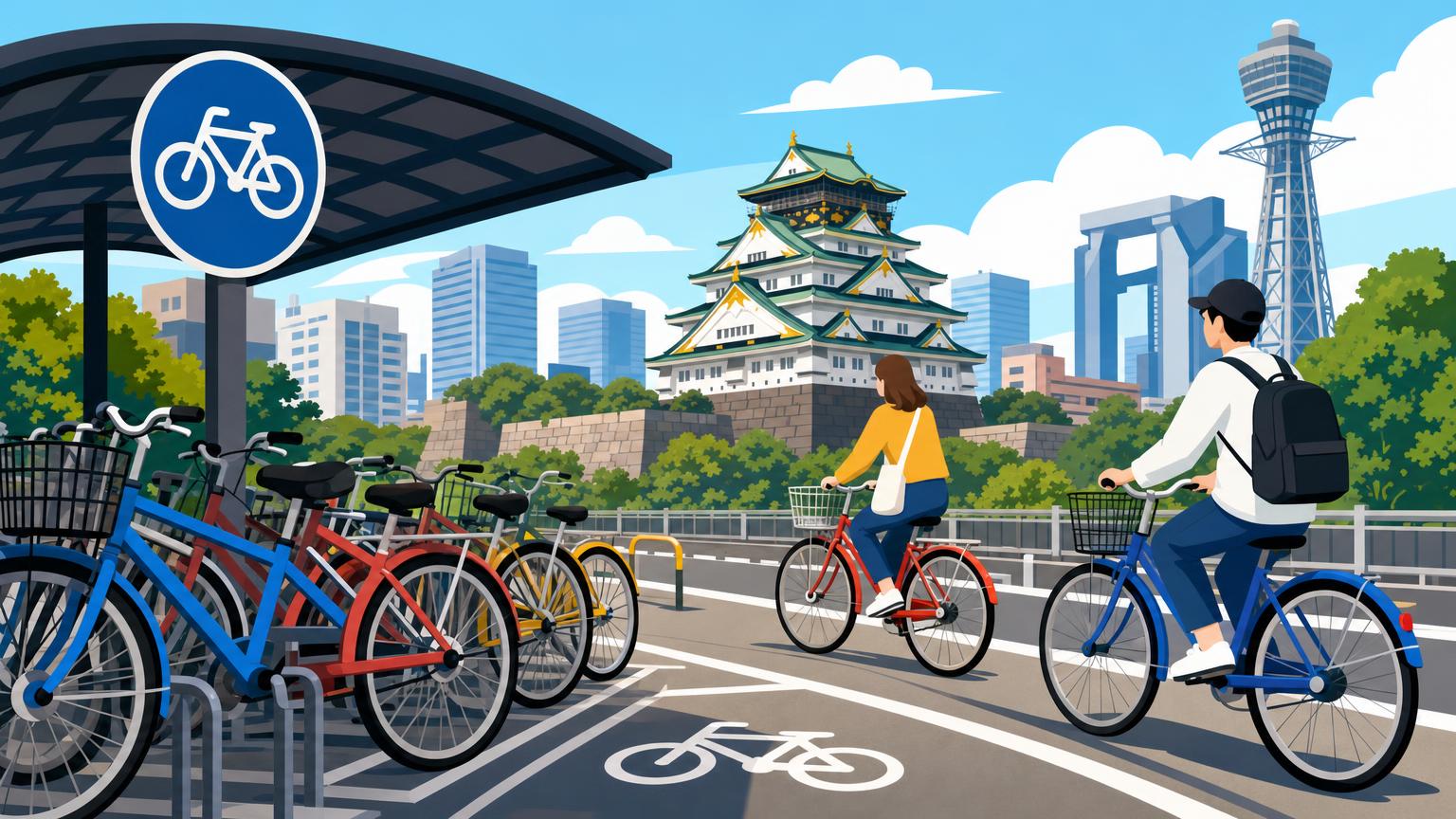
A common question from foreign residents is simple: why does everyone in Osaka seem to leave bicycles everywhere, yet some bicycles disappear almost immediately when you park in the wrong place?
The confusion comes from seeing two different realities at the same time. Osaka is one of Japan’s most bicycle-oriented large cities. People ride to work, to the supermarket, to the station, to school, and to a neighborhood clinic. A bicycle can be more convenient than a train for short trips, especially in a flat city where many daily destinations sit within a few kilometers of home. At the same time, Osaka has strict rules about where bicycles may be left. A bicycle that looks harmlessly parked for ten minutes may be treated as an illegally abandoned vehicle.
Understanding this difference is not only about avoiding a fine or recovering a removed bicycle. It is a way to understand Osaka itself. The city values speed, convenience, and practical movement, but it also depends on shared space. People often act informally, yet the informal behavior is usually built on rules that long-term residents understand without discussing them. Foreign residents may notice the relaxed surface and miss the invisible boundaries underneath.
This article explains how bicycles fit into everyday life in Osaka, how local people usually behave on the road, why Osaka can feel different from Tokyo, and what you need to know about parking, sidewalks, station areas, and neighborhood etiquette. The focus is daily life rather than sightseeing. The goal is to help you ride in a way that feels natural, safe, and respectful to the people who share the street with you.
Why Bicycles Matter in Everyday Osaka
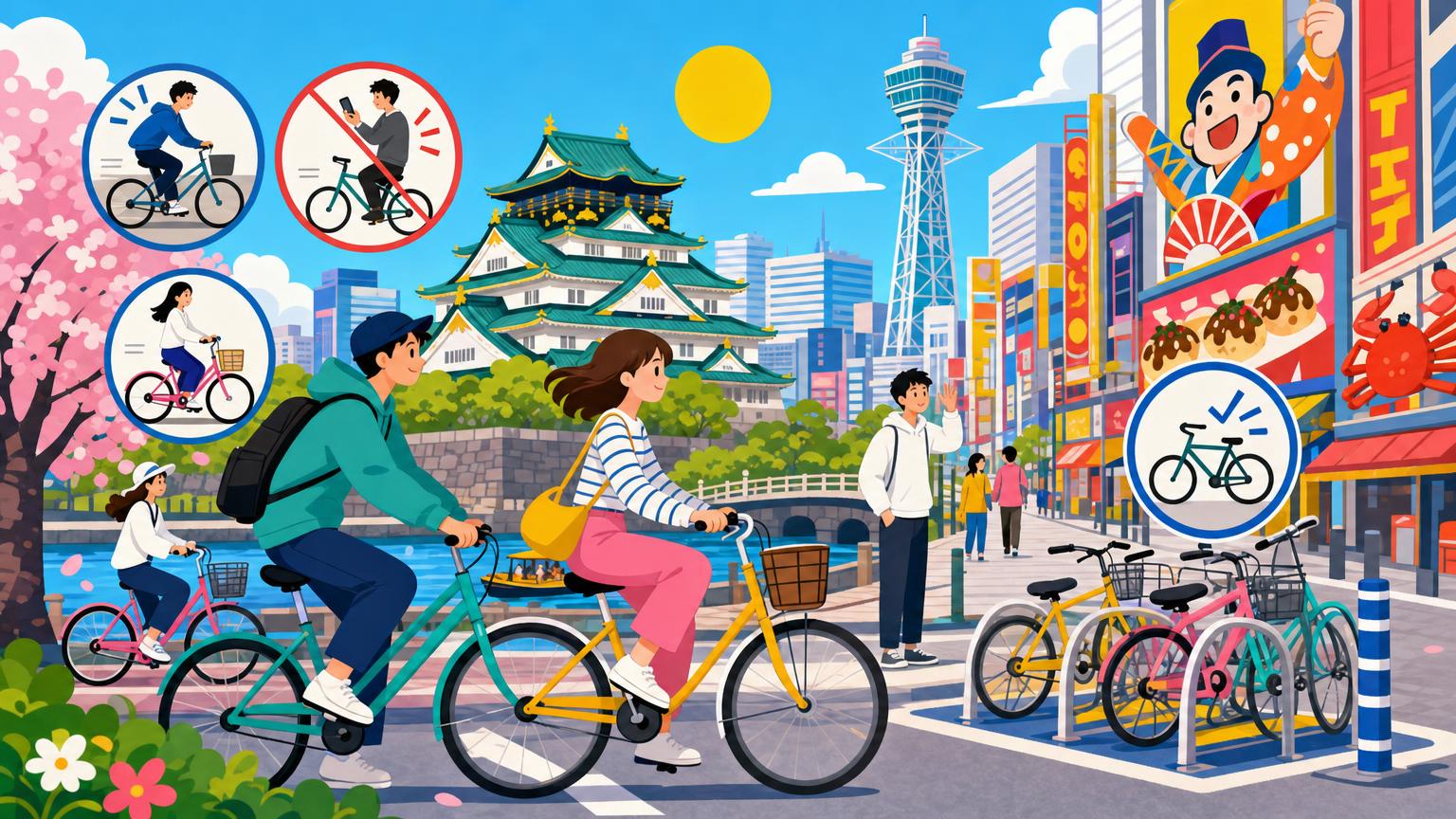
Osaka is a city of short, practical journeys
Many Osaka residents do not regard cycling as exercise or recreation. It is simply one of the easiest ways to handle an everyday task.
Someone might cycle from an apartment in Tennoji to a supermarket in Abeno, from a home in Joto to a station in Kyobashi, or from a workplace near Yodoyabashi to a restaurant in Fukushima. These journeys can be inconvenient by train because the stations are not always close to the final destination. Walking may take too long, while driving can create problems with traffic and parking. A bicycle fills that gap.
This is why bicycles are particularly common around residential districts. In areas such as Joto, Higashinari, Ikuno, Nishinari, Asahi, and parts of Suminoe, you will see bicycles outside small supermarkets, clinics, schools, coin laundries, and local shopping streets. Bicycles are part of the neighborhood’s infrastructure. They carry groceries, children, work bags, umbrellas, and sometimes an entire week’s shopping.
For a foreign resident, this may feel different from the image of urban transportation formed in Tokyo. Tokyo is also full of bicycles, but many central Tokyo journeys are structured around dense rail connections and long walks through large station areas. In Osaka, the practical distance between one station and another often makes cycling an attractive option. The city feels more spread out at street level, even when the train map appears dense.
The flat landscape changes the city’s rhythm
Osaka is mostly flat. There are exceptions, particularly toward the hills in the east and south, but much of the central city is easy to cross by an ordinary city bicycle. You do not need to be a serious cyclist to ride between neighborhoods.
The flat terrain influences more than transportation. It also shapes the pace of daily life. People can decide to make one more stop after work because a shop is only ten minutes away by bicycle. Parents can take a child to nursery school and continue on to the supermarket. A resident who has missed a train may cycle home instead of waiting for the next connection.
This practical flexibility is one reason bicycles are more visible in Osaka than many newcomers expect. A bicycle is not necessarily a sign that someone is trying to save money or avoid public transportation. It may simply be the most sensible option at that moment.
Osaka’s cycling culture is informal but not without structure
Osaka can look chaotic from a bicycle. Streets may be narrow. Cars may stop briefly in inconvenient places. Delivery scooters may emerge from side streets. Pedestrians may step into the road while looking at their phones. Bicycles may move in several directions near a shopping arcade.
Still, local riders generally understand a set of informal signals. They slow down near someone waiting to cross. They leave space beside a parked car because a door may open. They anticipate that a small truck may stop without much warning. They expect pedestrians to drift toward the curb near a convenience store. They may not signal every movement with their hands, but they watch the entire street rather than focusing only on the marked lane.
This does not mean that every local rider is careful. Osaka has dangerous cycling habits, just as every large city does. The point is that experienced residents read the street as a social environment. Foreign residents who treat the road as a simple traffic diagram may be surprised by how quickly the situation can change.
What Osaka People Usually Expect from Bicycle Riders
The rule is less about looking perfect than about not causing trouble
In Osaka, etiquette is often judged by its impact on other people. A rider who follows every formal rule but suddenly blocks a shop entrance may still be viewed as inconsiderate. A rider who briefly slows down, lets people pass, and parks in the proper facility will usually be accepted without much notice.
This practical attitude is important when learning how people in Osaka think. The city is not built around constant formal politeness in the way foreign residents sometimes imagine Japanese etiquette. People may speak directly, complain openly, or make a quick gesture instead of offering a lengthy apology. What matters is whether you recognize the inconvenience you are causing and correct it promptly.
For bicycle riders, this means several things:
- Do not stop in the middle of a narrow sidewalk while checking your phone.
- Do not leave your bicycle where people need to pass.
- Do not cut across pedestrians at a station entrance.
- Do not assume that a short stop is acceptable simply because other bicycles are nearby.
- Do not ring your bell instead of slowing down.
- Do not make people guess whether you are turning, stopping, or continuing straight.
The social expectation is straightforward: move predictably, make room, and avoid forcing other people to solve your problem.
Osaka directness can sound harsher than it is
Foreign residents sometimes interpret a brief comment from an Osaka resident as aggression. Someone may call out, “危ない,” meaning “dangerous,” or “そこ、あかんで,” meaning roughly “That’s not okay there.” The tone can be sharp, especially when a bicycle is blocking a doorway or moving toward pedestrians.
In many cases, the person is not trying to start an argument. They are providing immediate, practical information. Osaka communication often leaves less distance between noticing a problem and mentioning it. A Tokyo resident might ignore the behavior or make a softer, more indirect comment, while an Osaka resident may point directly to the problem.
The useful response is not to defend yourself immediately. Stop, look around, and check whether your bicycle is blocking a path or whether you are riding on the wrong side. A brief apology such as “すみません” is usually enough. Osaka people may complain quickly, but they also tend to move on quickly once the problem is fixed.
“Friendly” does not mean that every boundary is flexible
Osaka is often described as friendly, but that description can be misleading for foreign residents. People may speak casually, joke with strangers, or offer practical help. Shop staff may be more conversational than you expect. Neighbors may ask questions that feel personal. Someone may point out a mistake without the formal distance common in other places.
None of this means that rules can be negotiated individually. A friendly neighborhood still expects you to park your bicycle legally. A talkative shop owner may still refuse to let you leave your bicycle outside the entrance. Someone who helps you find a bicycle parking facility may also complain if you block the pavement the next day.
The local mindset combines warmth with clear limits. People may welcome you socially while still expecting you to behave properly in shared spaces.
The Basic Legal Position: A Bicycle Is a Vehicle
The road is the standard place for bicycles
Under Japanese traffic rules, bicycles are classified as light vehicles rather than pedestrians. The basic rule is that bicycles should travel on the left side of the roadway. Osaka Prefectural Police explains that bicycles should use the roadway in principle, while riding on the sidewalk is an exception rather than the standard choice.
This is one of the most important facts for foreign residents to understand. Many people arrive in Osaka after seeing bicycles being ridden on sidewalks and assume that bicycles are always allowed there. In reality, sidewalk riding is permitted only in certain situations, such as when a sign or road marking allows it, when the rider is a child, an older person, or a person with a disability, or when road conditions make riding on the roadway difficult or unsafe.
If you use a sidewalk where riding is permitted, you must travel slowly on the side closest to the roadway and give priority to pedestrians. If pedestrians may be obstructed, you must stop. Osaka’s police guidance emphasizes that sidewalks are primarily for pedestrians, even when bicycles are allowed to use them.
The “80 percent rule” is not a legal requirement
Foreign residents sometimes hear an informal explanation that bicycles should ride on the road “about 80 percent of the time” or “75 percent of the time.” This is not a legally defined percentage. There is no official rule stating that bicycles may use the sidewalk for a particular proportion of a journey.
The actual principle is simpler:
- Use the roadway by default.
- Use the sidewalk only where it is permitted or genuinely necessary for safety.
- Slow down considerably on the sidewalk.
- Stop when pedestrians need priority.
Thinking in percentages can lead to the wrong habit. A rider may spend most of a trip on the road but still cause a serious problem by speeding through a crowded sidewalk for thirty seconds. The specific location and traffic conditions are more important than the total length of the journey.
Left-side riding also applies to one-way streets and narrow roads
Riding on the left is not only a matter of remembering which side of a large avenue to use. It also applies to narrow residential streets, one-way streets, and the blue arrows painted on some roads.
A bicycle approaching you on the wrong side can be difficult to anticipate, especially near a parked vehicle or a blind corner. Local drivers may also not expect a bicycle to approach them in the opposing lane. Even if other people ride against traffic, copying them does not make the behavior safe or legal.
Some one-way signs have an additional sign that excludes bicycles from the restriction. You must read the sign rather than assume that every one-way road allows bicycles to travel in both directions. When the markings are unclear, take the safer route or dismount and walk.
Signals, stop signs, and crossings still apply
Bicycle riders should obey traffic signals and stop signs. This is especially important at intersections with poor visibility, railway crossings, and locations where a bicycle path crosses a side road.
Osaka has many small intersections where a rider can see only a few meters in either direction. A cyclist who continues through a stop sign may feel that the street is empty, but a car or scooter can suddenly appear from behind a building. Stopping completely, checking both directions, and then proceeding is not excessive caution in this environment. It is normal road behavior.
At pedestrian crossings, do not assume that you have priority simply because you are riding a bicycle. If people are crossing, slow down and give them enough space. If a crossing is crowded, dismounting may be the most considerate option.
Night riding requires a light
Many commuter bicycles in Osaka have automatic front lights, but not every bicycle does. If you are using a rental bicycle, check that both the front and rear lights work before setting off. Do not rely solely on streetlights or the brightness of your phone screen.
Streets can be particularly challenging at night near supermarkets, restaurants, and convenience stores. People may suddenly step out, delivery vehicles may reverse into the road, and parked cars can reduce visibility. A light helps others see you while also helping you see the road.
Mobile phones, umbrellas, and alcohol are serious issues
Using a mobile phone while riding, riding under the influence of alcohol, riding without effective brakes, and engaging in other dangerous behavior are prohibited. Osaka Prefectural Police states that a bicycle is a vehicle and lists mobile-phone use, alcohol-related riding, failure to stop, wrong-way riding, and other conduct among the dangerous violations.
The rules became more consequential on April 1, 2026, when Japan introduced the bicycle “Blue Ticket” traffic violation system for people aged 16 and older, including foreign nationals. Osaka police guidance gives examples such as a ¥12,000 penalty for using a mobile phone while cycling, ¥5,000 for riding with an umbrella, and ¥3,000 for riding double.
For residents, the practical lesson is to stop treating bicycle traffic rules as suggestions that apply only to tourists or schoolchildren. If you live in Osaka, these rules affect your everyday commute.
How to Ride on Osaka Sidewalks Without Frightening People
Slow means slow enough to stop immediately
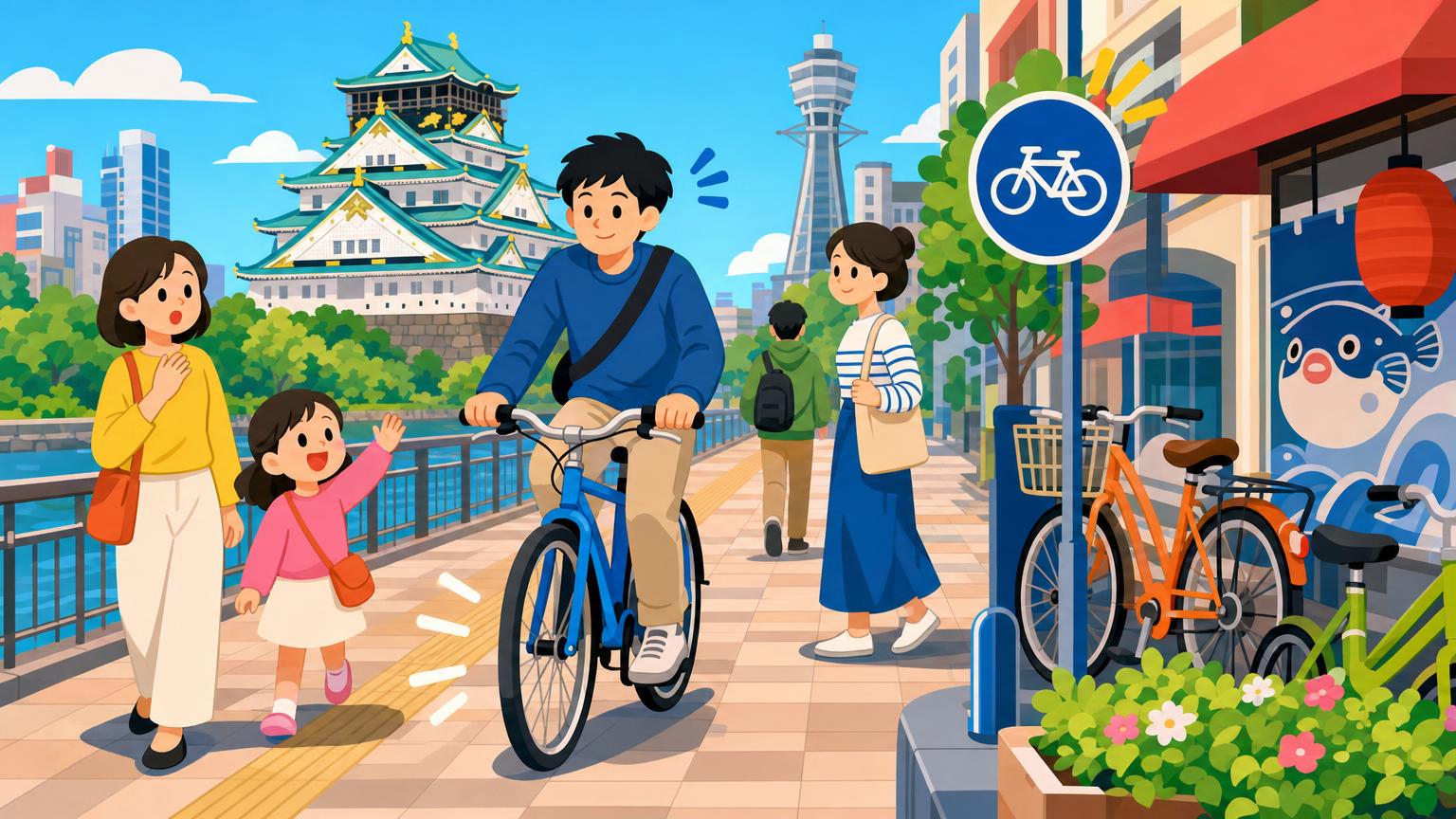
When bicycles are permitted on a sidewalk, the appropriate speed is not simply “slower than on the road.” You should be able to stop immediately if a pedestrian suddenly changes direction.
This matters because Osaka sidewalks often serve several purposes at once. Someone may be walking while carrying shopping bags. An older person may be moving slowly near a curb. A parent may be guiding a child. A restaurant worker may be carrying a tray from a building to a vehicle. Someone exiting a doorway may not see you at all.
If you are passing someone, leave plenty of space. If there is not enough room, wait. If the sidewalk is crowded, dismount. Walking beside your bicycle for thirty seconds is often easier than trying to squeeze through and making everyone uncomfortable.
Do not ring the bell aggressively
A bicycle bell is not intended to order pedestrians out of your way. Repeatedly ringing it from behind can feel threatening, especially when the person has nowhere safe to move.
A quiet verbal warning, slowing down, or simply waiting is usually better. In Osaka, you may hear residents use a brief “すみません” or “通ります,” meaning “excuse me” or “coming through.” The tone is practical rather than ceremonial.
If you use the bell, do so only when necessary to prevent an immediate collision. Do not use it simply because you want to maintain your speed.
Be especially careful near shopping arcades
Covered shopping streets and arcades are an important part of everyday Osaka. They may look like roads because bicycles are visible there, but their social function is closer to that of a pedestrian market.
During quiet hours, local residents may cycle slowly through an arcade. During busy periods, riding may be inappropriate or prohibited. Signs can vary by time of day. A bicycle that seems acceptable early in the morning may become a serious obstruction around lunchtime or after work.
Near Tenjinbashisuji, Tsuruhashi, Komagawa, Kuromon, and smaller neighborhood shopping streets, look for local signs and observe how residents behave. If people are walking in the center and bicycles are being pushed by hand, do the same.
Avoid the station-front rush
Station areas are challenging because people are moving in several directions at once. Bicycles often approach from side streets, while commuters leave station buildings without checking the pavement.
Do not ride quickly toward a station entrance, taxi stand, bus stop, or pedestrian crossing. Even if there is technically enough space, people may not expect a bicycle there. Slow down before reaching the crowded area instead of braking suddenly in front of it.
This is also where parking mistakes are most likely to occur. A rider may think, “I will be inside for five minutes,” and leave the bicycle beside a station wall. Those five minutes are exactly when the bicycle may obstruct the flow of people or be removed.
Understanding Bicycle Parking in Osaka
A bicycle is not legally parked simply because it is locked
This is the most important parking lesson: locking a bicycle does not make the location legal.
Many foreign residents assume that attaching a lock to a railing, pole, sign, or fence makes the bicycle secure and therefore properly parked. In Osaka, however, a locked bicycle may still be considered abandoned or illegally parked. It may be removed even if you are nearby, intend to return soon, or see other bicycles parked in the same place.
The right question is not, “Can I lock it here?” but, “Is this a designated bicycle parking area?”
Station areas are especially strict
Osaka City designates areas around many railway stations as bicycle no-parking zones. The city explains that these areas generally extend approximately 300 meters around stations, and that bicycles left on roads or station plazas within the zones may be removed immediately, even if they have only been left for a short time.
The exact boundary may vary. Look for signs, painted markings, barriers, and bicycle parking guidance near the station. If you see many bicycles lined up along a road but no clear sign allowing parking, do not assume the location is acceptable. Some bicycles may belong to residents taking a risk, may be awaiting removal, or may be parked on private property rather than public space.
Use a paid bicycle parking facility when available
Osaka’s bicycle parking facilities range from open-air lots to multi-level buildings and station-managed spaces. Some charge by the day, while others offer hourly or monthly arrangements. Many use an automated wheel-lock system.
The usual process is straightforward:
- Find an available space.
- Place the front or rear wheel into the designated rail.
- Confirm that the lock engages.
- Note the space number if required.
- Pay at the machine before leaving.
- Keep the receipt or remember the payment procedure until you retrieve the bicycle.
Do not assume that a bicycle parking facility is free simply because no staff member is visible. Many systems are automated, and payment is required at a machine near the exit.
If you are parking an electric-assist bicycle, make sure its heavier frame is properly seated in the rail. If the bicycle has a child seat, basket, or wide tires, check that the equipment does not obstruct the adjacent space.
Short stops still require a legal place
A common habit in Osaka is to leave a bicycle outside a convenience store or restaurant while buying a single item. Sometimes this is tolerated when the bicycle is placed neatly and does not interfere with anyone, but it is not automatically legal.
A better practice is to look for a bicycle parking sign before entering. Some stores have a small designated area, while others have an arrangement with a nearby paid parking facility. If staff members ask you to move the bicycle, do not argue that you will only be inside for a minute. They are usually dealing with a recurring problem involving many customers, rather than judging your individual intention.
Never block entrances, tactile paving, or curb ramps
Even when a bicycle is not removed, it can create a serious problem by blocking a doorway or accessibility route.
Keep clear of:
- Station entrances and exits.
- Fire exits.
- Building entrances.
- Bus stops and taxi areas.
- Tactile paving for people with visual impairments.
- Curb ramps and wheelchair routes.
- Narrow corners where pedestrians need to turn.
- The space beside parked cars where doors may open.
Osaka’s sidewalks can already be narrow. A bicycle placed diagonally may reduce the usable path more than you expect. When parking is permitted, place the bicycle parallel to the edge, and do not leave bags or locks extending into the walking route.
What Happens If Osaka Removes Your Bicycle
Removal is not the same as theft
If your bicycle disappears from the place where you left it, first check whether the city removed it before reporting it as stolen. Osaka City warns that bicycles parked in no-parking zones may be removed immediately. Bicycles left outside those zones for an extended period may also be removed. From October 1, 2026, Osaka City changed the removal threshold outside no-parking zones from seven days to three days.
This is especially important for people who travel or move apartments. Leaving a bicycle outside for several days is not a reliable storage strategy, even if the location is not near a station.
Keep the registration details
Bicycles in Japan are generally registered for theft prevention. If you buy a secondhand bicycle, make sure the registration transfer has been completed. If you use a rental or shared bicycle, keep the service information available in the app or confirmation message.
When collecting a removed bicycle, you may need identification, the bicycle key, and the removal fee. Osaka City’s current information lists a ¥3,500 removal and storage fee for bicycles and states that removed bicycles are stored for 20 days before disposal.
The exact procedure may vary depending on the removal location, so read the notice left at the site or check the city’s bicycle removal information. Do not wait several weeks before dealing with the matter.
Why residents become irritated about abandoned bicycles
Foreign residents may sometimes view bicycle removal as unnecessarily strict. To understand the local reaction, consider the cumulative effect. One bicycle beside a station may not seem serious, but hundreds of bicycles can block emergency access, reduce sidewalk space, interfere with buses, and make it difficult for older people or wheelchair users to move through the area.
Osaka has a long history of people solving small practical problems informally. However, when too many individuals make the same exception, the result becomes a citywide problem. Bicycle parking rules are one area where the city chooses enforcement over personal judgment.
Osaka Bike Share and the Difference Between Renting and Parking
Shared bicycles must be returned to a designated port
Osaka Bike Share, operated through the Docomo Bike Share system, allows users to rent a bicycle and return it at a bicycle port. The official service states that bicycles cannot be returned outside a bicycle station, and charges continue as long as the bicycle remains outside the port.
This differs from borrowing a bicycle from a shop. Your rental is not finished simply because you have reached your destination. You must complete the return procedure in the app or at the port and confirm that the bicycle has been locked properly.
If the port is full, the return may not be completed. Check the app before ending your journey, particularly around busy stations and office districts. Leaving a bicycle beside the port while assuming the rental has ended can result in continued charges and may be considered improper parking.
The app is part of the parking process
When using shared bicycles, check the port map before starting your trip. Do not select a destination unless you have a realistic place to return the bicycle.
A practical routine is:
- Search for an available bicycle near your starting point.
- Check the destination area for available return spaces.
- Reserve a bicycle only when you are ready to leave.
- Confirm that the bicycle is locked after returning it.
- Check the app to verify the completed return and final charge.
The current Osaka Bike Share rate information lists one-time use at ¥165 for the first 30 minutes, plus an additional ¥165 for each subsequent 30-minute period. It also lists monthly and one-day plans, but prices and conditions may change, so check the official service before relying on a specific amount.
Bike sharing fits Osaka’s short-trip culture
Shared bicycles are useful for residents who do not need a bicycle every day. They can help with the final distance between a station and a workplace, errands that are inconvenient by train, or occasional trips when your own bicycle is being repaired.
They are less convenient when you need to carry a large amount of shopping, leave a bicycle outside a destination for several hours, or make multiple stops in areas without nearby ports. The service is designed for circulation rather than private storage.
Insurance matters for daily riders
Osaka Prefecture requires bicycle users to have liability insurance under the prefectural bicycle safety ordinance. Osaka City explains that bicycle insurance is mandatory and notes that bicycle accidents can lead to substantial compensation claims.
When using a shared bicycle or rental service, check what insurance or compensation coverage is included. If you own a bicycle, check whether your renter’s insurance, employer plan, credit card, or separate bicycle policy covers liability in Japan. Do not assume that health insurance or ordinary travel insurance covers damage caused to another person.
Osaka Compared with Tokyo: Why the Streets Feel Different
Tokyo Often Feels More Station-Centered
A foreign resident comparing Osaka and Tokyo may notice that daily life in Tokyo is often organized around major stations. Neighborhoods can be dense, vertical, and highly connected by rail. Cycling exists, but much of everyday movement is shaped by station entrances, department stores, office towers, and long walking transfers.
Osaka also has major stations, but daily life often feels more neighborhood-centered. A person may have a preferred supermarket, clinic, barber, bakery, bicycle repair shop, and small restaurant outside the main station district. The bicycle connects these places directly.
This is not an absolute difference. Tokyo has many bicycle-oriented neighborhoods, and Osaka has highly urban station areas. The contrast is mainly one of street-level feeling. Osaka often gives you more reasons to move horizontally through local streets rather than vertically through a station complex.
Osaka Can Seem Less Formal, but the Boundaries Are Still Real
Tokyo is sometimes perceived as more restrained and Osaka as more expressive. In daily cycling, this may appear in the form of more direct comments, more visible negotiation between road users, and a greater willingness to use small streets creatively.
However, informality does not eliminate rules. A local rider may take a shortcut through a narrow road, speak casually to a shop employee, or stop for a quick conversation. That same person may become very strict about a bicycle blocking a doorway, a wrong-way rider approaching a child, or a bicycle left near a station.
A foreign resident’s mistake is to confuse casual communication with casual responsibility. People in Osaka may be relaxed about conversation while remaining strict about shared space.
Osaka Residents Often Prioritize Practical Results
When a problem occurs, many interactions in Osaka quickly move toward a solution. If your bicycle is blocking a delivery entrance, the person may not explain the building’s history or discuss your intentions. They may simply tell you to move it.
This directness can be useful. You usually do not need a perfect Japanese explanation to correct a small mistake. “すみません、移動します” means “Sorry, I’ll move it,” and will often resolve the situation.
The same practical approach applies when asking for help. Instead of giving a long explanation, show the name of the bicycle parking facility or station on your phone and ask, “駐輪場はどこですか?” meaning “Where is the bicycle parking area?” People may respond with gestures, landmarks, or a short route rather than a formal conversation.
Daily Situations Foreign Residents Commonly Misunderstand
“Everyone else is doing it” is not a dependable guide
You may see bicycles parked beside a pole, outside a restaurant, or along a station wall. This does not prove that the location is legal or socially accepted.
Some bicycles belong to nearby businesses. Others are on private property. Some have been parked temporarily by people who know they are taking a risk, while others may be waiting to be removed. Osaka’s street appearance can therefore send misleading signals.
Look for an official parking sign, a marked rack, a payment machine, or a clearly designated area. If you cannot identify one, continue searching.
A bicycle outside your apartment may not be yours to move
Apartment buildings often have shared bicycle parking. Spaces may be assigned to residents, limited by a monthly contract, or divided between residents and visitors. Do not put your bicycle in an empty-looking space without first checking the building rules.
Some buildings require a registration sticker, while others use numbered racks. A bicycle without the correct sticker may be removed by the management company even if it is inside the property.
If you are moving to Osaka, ask your landlord or management company the following questions before buying a bicycle:
- Is bicycle parking included in the rent?
- Is a separate application necessary?
- Is there a monthly fee?
- Is each space assigned to a resident?
- Are visitors allowed to park bicycles there?
- What happens to unregistered bicycles?
These are ordinary aspects of apartment life. Asking early can prevent conflict later.
A bicycle left at work can also cause problems
Office buildings may have strict bicycle policies, particularly in central districts such as Umeda, Yodoyabashi, Honmachi, and Nakanoshima. Even when employees cycle to work, the building may not permit bicycles to be left near the entrance.
Ask your employer or building manager where staff bicycles should be parked. Do not copy delivery workers or maintenance staff, as their vehicles may have separate permission.
Rain changes everything
Rainy days in Osaka highlight the limits of bicycle etiquette. Riding with an umbrella is dangerous and subject to penalties. A raincoat or waterproof cycling poncho is the safer option.
When rain starts, sidewalks become more crowded as people avoid exposed areas. Braking distances increase, painted surfaces become slippery, and visibility decreases. Slow down before corners and avoid sudden movements around umbrellas.
If your bicycle has a child seat, make sure the cover is secure and does not obstruct your view. If you are using a shared bicycle, check the brakes and lights before riding in wet conditions.
Heat and humidity affect everyday commuting
Osaka summers can be hot and humid. A short bicycle ride may leave you more exhausted than expected, especially if you are carrying work clothes or shopping. Many local residents change their route or take trains during the hottest part of the afternoon.
Do not assume that cycling is automatically healthier or more efficient in every season. The practical Osaka approach is to choose the option that suits the day. A bicycle is useful, but it is not a moral obligation.
A Practical Etiquette Guide for Foreign Residents
Before starting
Check the brakes, tires, bell, chain, and lights. If the bicycle feels unstable, do not continue just because the destination is nearby.
Confirm that you have permission to use the bicycle. This is especially important in shared apartment parking areas, workplaces, and family households where several similar bicycles may be present.
If you are using a rental bicycle, check the return port before leaving. If you are carrying shopping or a bag, secure it so that it cannot fall into the wheel.
While riding
Keep to the left on the roadway. Ride in a straight, predictable line. Slow down near parked cars, driveways, narrow intersections, and station entrances. Avoid weaving between pedestrians and cars.
Do not use your phone while moving. If you need directions, stop somewhere that does not block the path. Do not stop directly at a corner, at the bottom of a staircase, or beside a ticket machine.
Signal or otherwise make your intention clear before turning. Look behind you before moving sideways. Remember that a car driver may not see you, especially at night or in the rain.
When interacting with pedestrians
Give pedestrians priority on sidewalks and shared paths. Pass only when there is enough space. If someone looks uncertain or is moving unpredictably, slow down rather than attempting to pass closely.
If a pedestrian complains, do not assume that you are right because you were following a map or because other bicycles were nearby. Stop, listen, and move away from the crowded area.
When parking
Use a designated bicycle parking facility. Check whether the facility has a time limit, payment requirement, or registration process. Park straight and leave enough space for other bicycles.
Do not attach your bicycle to public railings, traffic signs, fences, trees, or handrails unless the property owner has clearly permitted it. Do not leave your bicycle on tactile paving or beside a curb ramp.
If you are visiting a shop, restaurant, clinic, or apartment building, ask where bicycles should be placed. Asking a short question is easier than moving your bicycle after someone complains.
How to Become Comfortable with Osaka’s Bicycle Culture
Learn one neighborhood at a time
Do not begin by attempting to cross the entire city during a busy weekday. First, learn the streets around your home. Locate the nearest bicycle parking facility, repair shop, supermarket, station, and major roads.
Pay attention to where sidewalks become crowded, where cars turn with little warning, and where local residents dismount. These details are more useful than memorizing a citywide cycling map.
Next, learn the connection between two nearby neighborhoods. For example, a resident in Tennoji may gradually become comfortable linking Shitennoji, Uehommachi, Abeno, and the side streets around the tram lines. A resident in Kita may learn the practical routes between Nakazakicho, Tenjinbashisuji, Ogimachi, and Fukushima.
Watch how experienced riders manage space
Observe experienced riders, but do not copy everything they do. Watch where they slow down, when they dismount, and how they position themselves near parked cars. Pay attention to the difference between a quiet local street and a crowded commercial street.
You may notice that older residents often ride slowly and confidently because they understand the neighborhood’s rhythm. Their skill is not speed; it is anticipation.
Learn a few useful Japanese words
A small vocabulary can help with daily problems:
- 駐輪場, churinjo: bicycle parking facility.
- 放置自転車, hochi jitensha: abandoned or improperly left bicycle.
- 自転車撤去, jitensha tekkyo: bicycle removal.
- 自転車を止めてもいいですか, jitensha o tomete mo ii desu ka: May I park my bicycle?
- 駐輪場はどこですか, churinjo wa doko desu ka: Where is the bicycle parking area?
- すみません、移動します, sumimasen, ido shimasu: Sorry, I will move it.
- 自転車を押します, jitensha o oshimasu: I will push the bicycle.
You do not need fluent Japanese to show that you understand the shared-space problem. A calm apology followed by immediate action often matters more than a detailed explanation.
Is Osaka a Good Place to Live Without a Car?
For many residents, yes
A bicycle can make life in Osaka considerably easier, particularly if you live outside the largest station areas. It can connect your home with local shopping streets, supermarkets, schools, clinics, and train stations. You may spend less time waiting for buses and less money on short train trips.
The city’s relatively flat central geography helps, as does the density of everyday services. You do not always need to travel far to meet your daily needs.
But bicycle ownership comes with responsibilities
Owning a bicycle means handling registration, maintenance, insurance, storage, theft prevention, and legal parking. It is not enough to buy one cheaply and leave it outside your apartment.
Before purchasing one, confirm that you have a legal place to store it. Choose a lock that suits your neighborhood and habits. Keep the bicycle registration information, check the tires and brakes, arrange insurance coverage, and learn the route to a repair shop.
A bicycle is convenient when it is properly maintained and stored. It becomes a burden when it is treated as disposable street furniture.
Location matters more than the citywide reputation
Whether Osaka feels easy to cycle in depends on your neighborhood. A home near a quiet shopping street may be very convenient, while a home beside a large intersection, steep slope, or crowded station may require more caution.
When choosing where to live, walk around the area at different times. Check the morning commute, evening shopping period, and weekend crowds. Look at the bicycle parking situation around your building and nearest station. A neighborhood that feels calm at noon may be congested at 7:30 a.m. or 6:00 p.m.
This is a better way to judge whether Osaka is a good place for you than relying on the general statement that the city is bicycle-friendly.
The Deeper Lesson Behind Osaka’s Bicycle Rules
Bicycle etiquette in Osaka is more than a collection of traffic regulations; it reflects the city’s broader way of living together.
Osaka often feels informal because people speak directly, use humor, make quick decisions, and move through the city with practical confidence. Compared with the ideal image of a perfectly organized metropolis, the streets may appear untidy. Yet daily life depends on many shared expectations.
Do not block a narrow route. Do not make someone stop suddenly. Do not leave your problem in a public space. Do not assume that a moment of personal convenience outweighs the needs of everyone passing through.
These expectations are rarely explained in lengthy conversations. They are learned through small corrections: a shop worker pointing toward the parking area, a neighbor asking you to move your bicycle, a station sign warning that removal is immediate, or a pedestrian telling you that your speed is dangerous.
For a foreign resident, the best response is not to search for a perfect image of Japanese politeness. Instead, notice how people share space in real situations. Osaka’s social style can be warm, blunt, humorous, impatient, and generous within the same five minutes. The common thread is practicality.
Ride predictably. Make room. Park where parking is allowed. If someone points out a problem, fix it without turning the moment into a debate. Once you understand these habits, Osaka becomes easier to read—not because every street becomes orderly, but because you begin to understand the people moving through it.
Conclusion: Riding in Osaka Like a Resident
Navigating Osaka by bicycle is not primarily about finding the fastest route. It is about learning the city’s invisible rhythm.
Use the road as the usual place for cycling, keep left, and regard sidewalks as pedestrian space. Slow down when the street becomes crowded. Do not use your phone while riding, and avoid umbrellas, alcohol, and risky shortcuts. Since April 1, 2026, riders aged 16 and older have also been subject to the bicycle Blue Ticket system, meaning everyday violations can carry direct financial consequences.
For parking, remember the central rule: even a locked bicycle can still be illegally parked. Station areas and public sidewalks are not personal storage spaces. Use a designated bicycle parking facility, follow the payment or registration process, and collect your bicycle promptly. If Osaka removes it, contact the relevant storage facility as soon as possible, since bicycles are held for a limited period and fees apply.
Most importantly, understand why local people react strongly to certain behaviors. Osaka’s directness is not permission to ignore boundaries, and its friendliness is not a substitute for responsibility. The city functions because people make thousands of small adjustments to avoid blocking one another.
Once you ride with that mindset, a bicycle becomes more than a convenient way to get around. It becomes a practical introduction to how Osaka works: informal on the surface, highly observant underneath, and always mindful of whether your convenience is making the street more difficult for someone else.