You step off the train at Osaka Station and the sheer volume of life hits you like a physical force. The city breathes in a rhythm you have to feel to understand. It is not the quiet, calculating, almost invisible pulse of Tokyo. It is a loud, chaotic, beautiful heartbeat that drums through the concrete underground of Umeda and echoes against the glass towers of Nakanoshima. You feel the heat. You hear the dialect. Kansai-ben rolls off the tongue of the locals like a song, rough around the edges but incredibly warm in its delivery. I came to this sprawling metropolis from a small town in rural Japan, a place surrounded by quiet green mountains and slow-moving rivers. The transition was nothing short of a shock to the system. In my hometown, coffee was something you bought in a can from a vending machine on a lonely roadside, or something brewed weakly in the back of a community center. Osaka, however, is a city built on intense, unapologetic flavors. It is a city that loves rich food, heavy broths, deep-fried snacks, and decadent, creamy sweets.
When you live here, or even if you are just planning to spend a few months wandering these streets, you quickly realize that dietary preferences are often lost in translation. For those who seek plant-based milk, whether for health reasons, lactose intolerance, or ethical veganism, navigating the Japanese coffee scene can feel like walking through a beautifully designed maze. Japan has a deep, historical love affair with dairy when it comes to Western-style sweets and beverages. But at the same time, it has an ancient, foundational relationship with soy. This creates a fascinating contradiction. You can find soy milk in every convenience store, yet asking for it in your morning latte at a traditional neighborhood coffee shop might earn you a look of utter confusion. I want to explain why that happens. I want to show you how Osaka thinks, how its people operate, and how you can find exactly what you need without losing the cultural connection that makes this city so deeply special.
This is not just about finding a cup of coffee. It is about understanding the people who pour it. It is about the contrast between the old world of the kissaten and the new wave of specialty roasters. It is about learning to read the room, learning to speak the language of the local merchants, and discovering the hidden, healthy corners of a city famous for its indulgence. Let us explore the real daily life of Osaka, one cup at a time.
The Plant-Based Milk Scene in Japan: What to Expect

To grasp the coffee culture here, you first need to understand the Japanese mindset regarding alternative diets. Many foreign residents and travelers come with the belief that because traditional Japanese cuisine heavily features vegetables, tofu, and rice, the country must be a haven for plant-based living. The reality, however, is far more nuanced. While soy milk, or tonyu, is a staple in the Japanese diet, it has traditionally been seen as a savory cooking ingredient or a standalone health drink. Older generations consume cartons of malt- or banana-flavored soy milk for nutrition, without naturally associating it with espresso.
Then there is the kissaten, the traditional Japanese coffee house, which serves as a time capsule. You open a heavy wooden door; the bell chimes. The air is immediately thick with the aroma of dark roasted beans and decades-old tobacco smoke. The seats are upholstered in crushed red velvet, and the lighting is low and amber-hued. Behind the counter stands the master—usually an older man dressed in a crisp white shirt and bowtie—moving with the slow, deliberate precision of a craftsman. He doesn’t use espresso machines but instead employs a siphon, watching the water rise and fall through the glass chambers as if conducting a sacred scientific experiment.
If you enter a traditional kissaten in a quiet Osaka neighborhood and request almond or oat milk, the master will likely just stare at you—not out of rudeness, but because you are asking a classical violinist to perform a heavy metal guitar solo. The kissaten master has spent forty years perfecting his unique house blend and expects you to drink it black or with just a tiny splash of rich dairy cream. He doesn’t stock plant-based alternatives because they don’t suit his carefully curated flavor profile. Understanding this is essential to understanding Japan. It’s not about a lack of accommodation but a profound, unwavering respect for the craft exactly as it was intended to be enjoyed.
In contrast, the modern specialty coffee scene is entirely different. Fueled by younger generations who have traveled to cities like Melbourne, Portland, or London, third-wave coffee shops have exploded across Osaka—where the plant-based milk culture thrives. Even so, there is a distinct Osaka character to this trend. In Tokyo, cafes often adopt oat milk and vegan menus because it looks trendy, because it’s global, and because Tokyo thrives on mirroring international trends. Osaka is different. As a merchant city, its people are notoriously practical. They won’t follow a trend unless it truly delivers on quality and value. An Osaka barista will offer oat milk only if they’ve found a brand that genuinely enhances the taste of their espresso. They embrace alternative milks not out of pretense, but from a sincere desire to serve a delicious, high-quality product to a broader range of customers. This pragmatism is the city’s beating heart.
Best Cafes for Plant-Based Milk in Osaka by Area
Finding the right spot requires an understanding of the distinct personalities of Osaka’s neighborhoods. The city is essentially split into two main hubs: Kita, the northern area around Umeda, and Minami, the southern area around Namba and Shinsaibashi. Between them lies a network of rivers, historic business districts, and trendy enclaves. Each area offers a completely different experience for the daily coffee drinker.
Umeda and Osaka Station Area
Umeda is a maze. It is a sprawling, multi-level metropolis of underground malls, towering department stores, and chaotic intersections. For newcomers, it can be entirely overwhelming. The energy here is aggressive, fast-paced, and intensely commercial. Businessmen in crisp suits hurry through the underground walkways at breakneck speeds. In this environment, coffee is often regarded as mere fuel. People duck into chain cafes, gulp down a dark roast, and rush to their next meeting.
Finding a moment of calm, let alone a carefully crafted plant-based latte, requires stepping slightly away from the main thoroughfares. In newer commercial buildings like Grand Front Osaka or Lucua, you’ll find modern cafes catering to the international business crowd and young professionals. Here, soy milk is standard, and oat milk is becoming increasingly popular. The baristas in Umeda are efficient and polite, reflecting the district’s fast pace. They are accustomed to specific requests, so asking for alternative milks is usually met with a quick nod and rapid service. But for true specialty coffee focusing on healthy alternatives, you’ll often need to travel just a few subway stops south.
Kitahama and Nakanoshima: Osaka’s Riverside Coffee Hub
Kitahama is where the soul of Osaka’s modern coffee culture truly resides. This area is situated along the Tosabori River, facing the picturesque Nakanoshima island. Historically the city’s financial heart, the streets are still lined with stunning retro architecture, brick facades, and grand stone banking halls from the early twentieth century. Today, those historic buildings have been transformed into some of the best cafes in the country. The atmosphere here contrasts sharply with Umeda’s; it is relaxed, breezy, and effortlessly stylish.
One of the absolute anchors of this area is Brooklyn Roasting Company. Upon entering, you are immediately greeted by the aroma of freshly roasted beans and the sound of lively, overlapping conversations. The space is vast, adorned with flowers, raw wood, and industrial steel. They are highly accommodating to dietary needs, offering both high-quality oat milk and soy milk. Vegan-friendly pastries and cookies are also frequently available. You can enjoy your oat milk flat white on their riverside terrace and watch the water flow by. It is a place where local creatives, foreign residents, and students mingle seamlessly.
Just down the street is Optimus Cafe, a sanctuary for health-conscious living in Osaka. They market themselves around wellness and plant-based options, which remains rare for a purely local business. Optimus Cafe offers soy milk, oat milk, and almond milk, allowing for perfect customization of your drink. Their food menu is packed with hearty vegan meals, colorful salads, and plant-based sweets. Sitting on their terrace with an almond milk latte and a vegan cake, looking out over the water, you feel entirely removed from the neon chaos that most people associate with Osaka. It’s proof that the city holds quiet, deeply nourishing corners if you know where to look.
Shinsaibashi, Namba, and Horie: Trendy and Vibrant
Moving south into the Minami district, the energy ramps up again. Namba is loud, brash, and covered in towering neon signs. Shinsaibashi is a relentless river of shoppers. Just slightly west of this madness lies Horie, the heart of Osaka’s street fashion and independent youth culture. Horie is full of vintage clothing stores, interior design shops, and passionate independent coffee roasters. The baristas here look like they belong in a fashion magazine, covered in tattoos and wearing heavy canvas aprons, yet they embody the classic Osaka warmth. They love to talk, joke, and deeply care about their coffee.
In this area, Granknot Cafe stands out as a masterclass in espresso. The space is small, intimate, and intensely focused on the craft of roasting. They understand how plant-based milks react differently to heat and acidity, stretching their oat and soy milks to create the perfect silky microfoam. It’s a favorite among the local artisan community.
Nearby, Morning Box Cafe offers a slightly different vibe. Located within a modern hostel, the space was designed from the ground up to serve as a melting pot for local residents and international travelers alike. The layout is open and inviting. They provide both soy and oat milk and usually have a selection of vegan cakes that pair perfectly with a mid-afternoon coffee break. The staff are well-versed in handling international dietary requests and do so with a bright, easygoing attitude.
For a truly unique experience, seek out Haiku Coffee Roasters. This tiny, meticulously designed shop feels like a modern interpretation of a Japanese tea house. The dedication to craft here is palpable. They offer oat milk and occasionally rice milk, providing a lighter, naturally sweet alternative that highlights the delicate floral notes of their light-roast beans. They often stock small vegan cookies, making it a perfect spot for a quiet moment of reflection amid the energy of the southern districts.
What Types of Alternative Milks are Common in Osaka?
To understand the landscape of plant-based milks in Osaka, it’s important to know the specific terms and how they are viewed by the local market.
First, there is tonyu, or soy milk, the undisputed leader among Japanese dairy alternatives. It is available everywhere—at convenience stores, supermarkets, and nearly every chain coffee shop throughout the city. Japanese soy milk is strictly categorized by its purity. “Mochosei tonyu” is unadjusted, pure soy milk, tasting like liquid tofu: earthy, slightly bean-flavored, and prone to curdling instantly when mixed with acidic coffee. “Chosei tonyu” is adjusted soy milk, lightly sweetened and stabilized with oils. This is what most cafes use, as it foams well and adds a creamy, subtly sweet texture to coffee.
Next, there is oat milk, known simply as ootsu miruku, which has become a rising star in the specialty coffee scene. Nearly every third-wave coffee shop in Osaka has adopted it over the past few years. Locals appreciate oat milk because its creamy texture and mild flavor don’t overpower the carefully roasted, high-quality coffee beans. However, oat milk is entirely imported and quite costly in Japan, which brings up an important cultural point: the surcharge. At an Osaka cafe, adding oat milk usually costs an extra fifty to one hundred fifty yen. People in Osaka are famously frugal and embody the concept of “shibui,” which can mean stingy but usually implies being smart with money. Paying extra for milk pains an Osaka soul, so if a local opts to pay the oat milk surcharge, it means they genuinely consider the taste worth the added cost.
Almond milk, or aamondo miruku, is widely available in grocery stores for home use but is surprisingly rare in independent coffee shops. Local baristas generally agree that the nutty flavor of almond milk clashes too strongly with their espresso blends. While big global chains carry it easily, finding almond milk at a local roaster like Optimus Cafe is a special treat.
Finally, rice milk, or raisu miruku, remains a niche product. Despite rice being a staple of the Japanese diet, rice milk has not gained mainstream popularity as a coffee additive. It is typically found only in highly specialized vegan cafes or health food stores, valued for its allergen-free qualities and very thin, sweet profile.
Navigating the Cultural Mindset: Tokyo Trends vs. Osaka Pragmatism
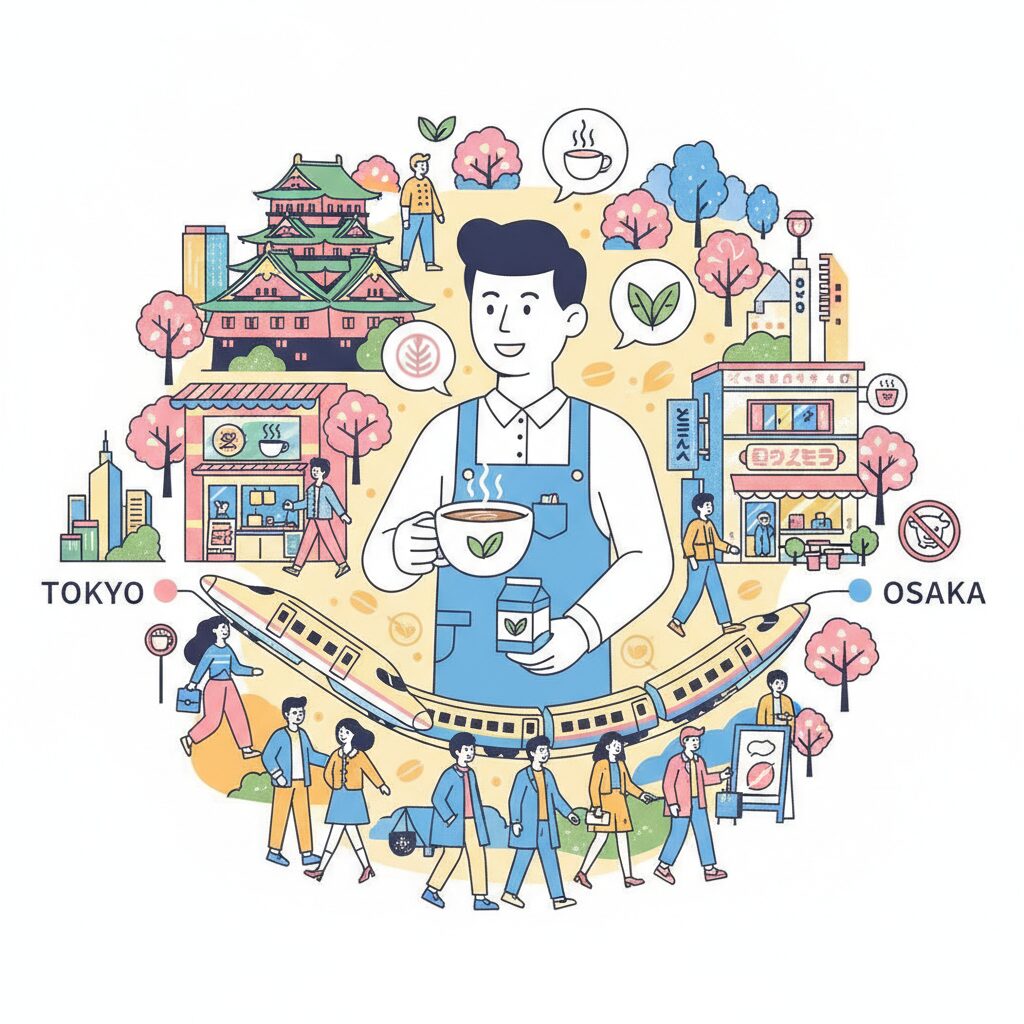
Living in Osaka means adapting to a very distinct social atmosphere. Foreigners often hear the cliché that “Osaka people are friendly.” While this is generally accurate, it lacks subtlety. Osaka people are not merely friendly; they are boldly honest, highly pragmatic, and completely devoid of pretense.
In Tokyo, if you request a complicated dietary substitution from a barista that cannot be fulfilled, they will probably bow, apologize profusely, and use very polite customer service language to express their regret. The interaction is smooth but can feel quite cold and distant. In Osaka, the response is completely different. If you ask a neighborhood kissaten master for oat milk, he might just laugh aloud, wave his hand, and tell you in thick Kansai dialect that he has no idea what that is. He might offer you black coffee instead or suggest you visit the fancy new place down the street if you want “that hipster stuff.”
This is where many foreigners misunderstand Osaka. They misinterpret this bluntness as rudeness. It is not rude. It is an invitation to connect. The master is treating you like a human being, not just a customer. He is breaking the strict conventions of Japanese customer service to be sincere with you. When you live here, you come to appreciate this honesty. You realize that dietary restrictions are not seen as a moral crusade or a status symbol in Osaka; they are simply regarded as practical requests. If a shop can accommodate them, they will gladly do so. If they cannot, they will tell you directly. Embracing this straightforwardness makes daily life incredibly refreshing.
How to Order Plant-Based Milk in Japanese (Useful Phrases)
Navigating the ordering process smoothly is all about syncing with the rhythm of the city. You don’t need perfect Japanese, but showing that you’re making an effort goes a long way in Osaka. Locals appreciate it when foreigners try, and they are very forgiving of mistakes.
When you approach the counter, begin by stating your coffee order. For instance, if you want a latte, say “Rate o hitotsu onegaishimasu” (One latte, please).
Right after that, request the milk substitution. The most helpful phrase to learn is “Tonyu ni henko shite kudasai” (Please change it to soy milk). The word “henko” means change or substitute.
If you want oat milk, simply replace the word. Say “Ootsu miruku ni henko shite kudasai” (Please change it to oat milk).
If you want to check whether they have plant-based options before ordering, you can ask, “Tonyu ya ootsu miruku wa arimasu ka?” (Do you have soy milk or oat milk?).
The Golden Rule of Reading the Room
Even more important than vocabulary is understanding the context of where you’re ordering. This is the golden rule of living in Japan. You have to “read the air,” a concept known as “kuuki o yomu.”
If you’re in a brightly lit, modern café in Kitahama with an espresso machine that looks like a sports car, feel free to ask for any modification you want. The staff expect it. But if you enter a tiny, smoke-filled kissaten in a residential neighborhood where the menu is handwritten in faded marker on cardboard, you must adjust your expectations. Don’t ask for oat milk. Don’t ask for a vegan menu. You’re entering their sanctuary. In such moments, simply order a black coffee or tea and sit back to absorb the atmosphere. Let the city wash over you just as it is.
Living in Osaka is about finding balance. It’s about enjoying the deep, rich history of the old neighborhoods while embracing the vibrant, progressive energy of new cafés. It’s about understanding that a lack of oat milk in a traditional shop isn’t a failure of service, but a preservation of culture. And when you finally discover that perfect cup of plant-based coffee, whether sitting by the river in Kitahama or tucked away on a backstreet in Horie, it tastes all the sweeter because you know exactly how it fits into the beautiful, chaotic rhythm of this incredible city.