When you first pack your bags for Japan, your mind is likely filled with quiet imagery. You picture serene temples wrapped in morning mist, the hushed whispers of commuters on flawlessly punctual trains, and the stoic, polite nods exchanged between strangers on immaculate streets. You expect a society governed by the strict, unspoken rules of harmony, a place where standing out is heavily discouraged and silence is not just golden, but practically mandatory. This is the Japan that movies sell you. This is the Japan that guidebooks prepare you for.
And then, you step off the bullet train at Shin-Osaka Station.
Within five minutes, the illusion of a perpetually silent, reserved Japan begins to fracture. You hear a burst of loud, unrestrained laughter echoing from a group of women standing by a kiosk. You see two businessmen playfully shoving each other while waiting for a taxi, their voices booming over the traffic. You walk into a local convenience store and the cashier greets you not with a hushed, robotic bow, but with a wide, beaming smile and a melodic, rising intonation that sounds less like a formal greeting and more like the start of a friendly conversation.
Welcome to Osaka. You have just entered a different country altogether.
As an Australian mother who has spent years navigating the beautifully chaotic streets of this city, I can tell you that living in Osaka requires a complete recalibration of your cultural expectations. When I first arrived, armed with a newborn, a toddler, and a highly rehearsed arsenal of polite Japanese phrases, I was completely overwhelmed. I was prepared to be quiet. I was prepared to blend in. But Osaka does not want you to blend in. Osaka wants you to participate.
In this city, the highest compliment you can receive is not that you are smart, beautiful, or wealthy. The highest compliment is being called ‘omoroi’.
‘Omoroi’ is the Kansai dialect version of the standard Japanese word ‘omoshiroi’, which translates to interesting, amusing, or funny. But in Osaka, ‘omoroi’ is so much more than a simple adjective. It is a philosophy. It is a social currency. It is the very foundation upon which relationships are built, business is conducted, and daily life is navigated. If someone calls you ‘omoroi’, it means you bring value to the interaction. It means you have successfully connected with them on a human level. It means you belong.
For foreign residents, understanding this concept is the ultimate key to unlocking a truly fulfilling life in Japan’s most vibrant city. This is not about learning how to be a stand-up comedian. It is about understanding how the people around you think, speak, and act. It is about decoding the everyday banter at the supermarket, the playful teasing at the school gates, and the lively debates in the boardroom. It is about realizing that in Osaka, humor is not just a way to pass the time; it is the essential glue that holds the community together.
Why Osaka is the Undisputed Comedy Capital of Japan
To grasp daily life in Osaka, you first need to recognize the city’s undisputed reputation as Japan’s comedy capital. This is not merely a self-declared title or a clever marketing ploy crafted by a tourism board; it is a deeply rooted cultural truth. Just as Los Angeles is synonymous with the film industry and Milan is inseparable from fashion, Osaka is intrinsically connected to the art of making people laugh.
Living here, you quickly realize that comedy is literally in the city’s lifeblood. It seeps into every part of society. Turn on the television at any time of day, and you’ll see comedians born in Osaka dominating the national airwaves. They host morning talk shows, lead evening variety programs, and star in primetime dramas. The major talent agencies producing Japan’s top comedic performers are based here, transforming the city into a vast, thriving incubator for comedic talent.
Yet the true magic of Osaka’s comedy scene isn’t confined to television. It happens on the streets.
For a foreign resident, this cultural environment fundamentally changes how you engage with your neighbors. In many other areas of Japan, social interactions are strictly governed by protocol. There is a proper way to speak to a store clerk, a correct way to greet a neighbor, and an appropriate way to conduct a business meeting. Straying from these expectations often results in confusion or mild discomfort.
Osaka, however, flourishes on spontaneity.
People here deliberately seek moments of amusement in everyday life. A visit to the ward office to update your address—a process that is notoriously tedious and bureaucratic elsewhere in the country—can easily become a lighthearted conversation about the local weather, your home country, and whether you’ve tried the takoyaki stand down the street. The clerk isn’t just processing your paperwork; they are gauging your personality, searching for a connection, and looking for a moment of ‘omoroi’ (funny).
This constant pursuit of laughter fosters an environment uniquely welcoming to outsiders. As a foreigner, you will inevitably make mistakes. You will fumble the language, misinterpret cultural cues, and occasionally appear completely lost. In some cities, these errors might cause embarrassment or awkward silence. In Osaka, your mistakes become prime comedic material. They serve as invitations to connect. When you stumble, an Osaka local won’t politely look away; they will laugh, point it out, help you up, and turn the entire experience into a shared joke. This dynamic is incredibly freeing. It removes the paralyzing fear of ‘getting it wrong’ that many expats in Japan face, replacing it with the reassuring realization that as long as you can laugh at yourself, you’ll be just fine here.
The Merchant Roots: How Business Shaped Osaka’s Quick Wit
To truly understand why people in Osaka communicate the way they do, we need to take a brief, practical look back in time. The modern Osaka mentality cannot be separated from its historical identity as Japan’s merchant capital.
During the Edo period, Tokyo (then called Edo) was the political center, dominated by the rigid and highly formalized samurai culture, while Osaka served as the economic powerhouse driven by merchants. This historical split is crucial to grasping the deep cultural differences that remain today.
Samurai culture was grounded in hierarchy, stoicism, and preserving dignity. Its communication focused on establishing rank and maintaining order, where silence was valued as a virtue. A samurai didn’t need to convince you with words; his sword spoke for him.
Merchants, by contrast, had an entirely different set of priorities. Their survival depended on building relationships, negotiating deals, and moving goods. You can’t sell a bolt of silk or a sack of rice by remaining silent in front of a customer. You have to engage them, make them feel comfortable, and quickly break the ice.
In the competitive marketplaces of historical Osaka, smooth talking and sharp wit were essential business skills. Humor was used deliberately to lower defenses, foster trust, and create camaraderie. A merchant who could make a customer laugh was a merchant who would close a sale.
This merchant spirit remains very much alive in modern Osaka. It influences interactions in boardrooms, shops, and neighborhood meetings. When an Osaka businessperson enters a negotiation, they don’t immediately dive into a dry presentation of data. They start by reading the room, making a self-deprecating joke, commenting on the stifling summer heat, or teasing a colleague playfully. They are continuing the centuries-old tradition of breaking the ice.
For foreigners living or working in Osaka, understanding this merchant mindset can be eye-opening. It explains why the local butcher throws in an extra croquette for your kids with a dramatic wink and a joke about helping them grow taller. It explains why a seemingly intense bargaining session at Kuromon Ichiba market always ends in hearty laughter and a firm handshake. It’s never about aggression; it’s a dance of connection. The humor is the handshake before the actual handshake.
If you move to Osaka and try to operate with a stoic, ultra-formal, strictly business approach, you’ll find it incredibly hard to get things done. You’ll come across as cold, distant, and unapproachable. But the moment you lower your guard, flash a smile, and toss in a small joke, doors will open wide for you.
Tokyo vs. Osaka: A Tale of Two Cultural Vibes
If you are thinking about relocating to Japan, you are almost certainly deciding between the Greater Tokyo Area and the Kansai region (centered around Osaka). The differences between these two areas are so pronounced that Japanese people often joke they might as well be separate countries.
For an expat, understanding the contrasts between Tokyo and Osaka is crucial for setting your expectations and finding a cultural environment that matches your personality.
Tokyo represents a masterpiece of order. It is a city where thirty million people coexist in close quarters with remarkable peace. This peace stems from a cultural concept called ‘tatemae,’ roughly meaning the public facade or the polite behavior one adopts to preserve social harmony. In Tokyo, harmony is maintained by not intruding on others. You respect people’s physical and emotional space, lower your voice on trains, and avoid small talk with strangers to prevent burdening them with unwanted interaction. This approach is deeply respectful, highly efficient, and for some foreigners, profoundly isolating.
Osaka, on the other hand, achieves social harmony through the exact opposite approach: by engaging with one another rather than ignoring each other.
Here in Osaka, the concept of ‘honne’—one’s true feelings and desires—is much more visible. People are direct, vocal, and genuinely curious. If you stand on a train platform in Tokyo wearing a strikingly colorful shirt, people might notice but will politely avert their eyes and say nothing. In contrast, on the Midosuji subway line in Osaka, an older woman (the famous Osaka ‘obachan’) might tap you on the shoulder, ask where you bought it, comment that it is too loud, and then offer you a piece of hard candy from her purse.
This fundamental difference in atmosphere shapes daily life. In Tokyo, a foreigner can easily live for years inside a comfortable bubble of anonymity. In Osaka, anonymity is nearly impossible; the city expects you to engage.
This can be surprising for introverted expats who envisioned Japan as a place of quiet reserve. I remember vividly taking my toddler to a local park during our first week here. In other cities, mothers might exchange polite bows and keep to themselves. In Osaka, within ten minutes, three different mothers had asked where I was from, told me my son was underdressed for the autumn chill, and dramatically shared their own childbirth stories. I felt exhausted, but also immediately woven into the neighborhood’s fabric.
Tokyo is a city where you learn to observe. Osaka is a city where you learn to engage. If you prioritize privacy and quiet efficiency above all else, Tokyo is your haven. But if you want to experience the messy, warm, and loud heartbeat of a community every day, Osaka is your home.
The Core of Japanese Comedy: Understanding “Boke” and “Tsukkomi”
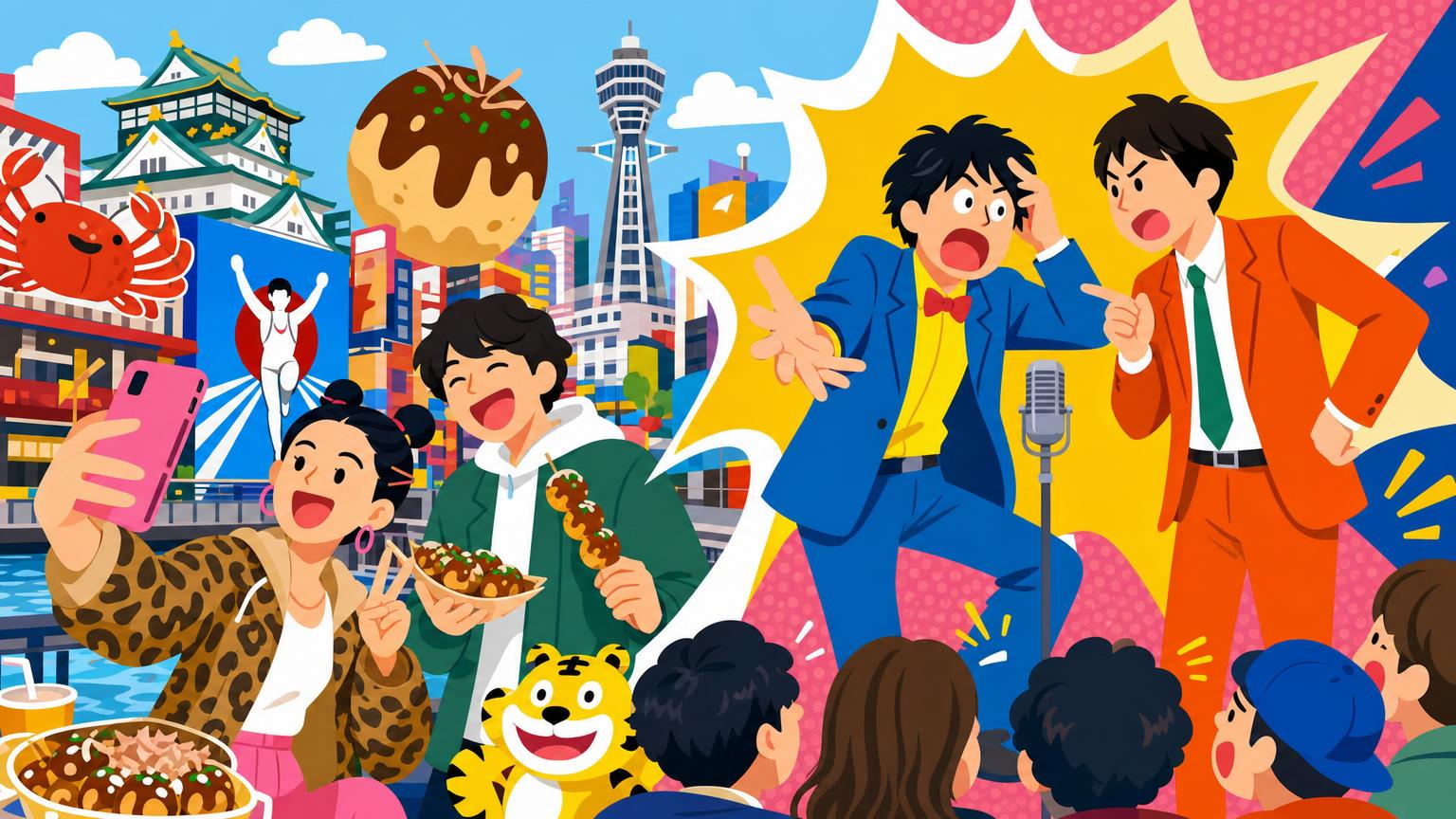
To truly become part of Osaka society, you need to grasp the fundamental mechanics of its conversational style. Living here for any length of time means encountering the concepts of ‘boke’ and ‘tsukkomi’.
These terms come from Manzai, a traditional Japanese stand-up comedy style featuring two performers exchanging rapid-fire jokes. Manzai is at the heart of Osaka entertainment, but its influence goes well beyond the stage. The boke and tsukkomi interaction serves as the framework for how people in Osaka speak with friends, spouses, colleagues, and even complete strangers.
The ‘boke’ is the comic figure. Its literal meaning leans toward senile, forgetful, or airheaded. In conversation, adopting the boke role means intentionally saying something absurd, blatantly wrong, exaggerated, or silly. It functions as the setup.
The ‘tsukkomi’ is the straight man. Literally, it means to thrust or butt in. The tsukkomi’s job is to quickly correct the boke, highlight the absurdity of their statement, and bring the conversation back to reality. This correction often comes with a light, theatrical tap on the boke’s shoulder, arm, or head, marking the end of the joke.
This dynamic isn’t limited to comedians. It’s a natural part of daily conversation.
Picture a husband and wife walking through a supermarket. The husband picks up an enormous, ridiculously expensive watermelon and says, ‘I think I’m going to eat this entire thing in the car on the way home.’ He’s playing the boke. The wife doesn’t politely ignore him or calmly explain why that’s a bad idea. Instead, she lightly taps his arm and shouts, ‘Like hell you will! You’d explode before we hit the highway!’ She’s playing the tsukkomi.
They aren’t arguing. They’re performing a small affectionate routine. They’re connecting.
For a foreign resident, understanding this dynamic is a superpower. Why? Because as a foreigner adapting to a new culture, you’re bound to make mistakes. You’ll mispronounce words. You’ll get on the wrong bus. You’ll wear your slippers in the tatami room.
Simply by being an expat, you constantly provide natural ‘boke’ material.
If you understand the culture, you can embrace this. When you make a small mistake and a local Osaka resident calls you out with a laugh and a playful jab, they aren’t insulting you. They’re playing the tsukkomi to your accidental boke. They’re treating you like one of their own.
When I first joined the local PTA, my Japanese was functional but awkward. I once accidentally used very casual slang when addressing the school principal during a meeting. The room went silent for a moment. In Tokyo, this might have led to prolonged, painful awkwardness. But at my Osaka school, the vice principal instantly stepped in, lightly waved his hand toward me in classic tsukkomi fashion, and loudly declared, ‘She thinks you’re her drinking buddy!’ The whole room burst into laughter. The tension disappeared. I had accidentally played the boke, he played the tsukkomi, and I was officially welcomed into the group.
Everyday Comedy: How Locals Turn Life into a Sitcom
Living in Osaka, life often feels like being an extra in a huge, unscripted sitcom. The locals have a unique talent for turning the ordinary details of everyday life into theatrical events. Yet, this daily comedy is far from random; it follows a set of unspoken rules and social contracts that, once grasped, make navigating the city an absolute delight.
The Unwritten Rule of the “Ochi” (Punchline)
One of the toughest cultural adjustments for expats from Western countries is adapting to Osaka’s storytelling style. In many English-speaking cultures, stories are often shared simply to recount an experience. We might spend ten minutes describing a frustrating grocery store trip, ending with a sigh and a casual, ‘Anyway, that was my day.’
Don’t try that in Osaka.
If you tell a rambling story to an Osaka local without a clear point, they will fix you with an intense stare, lean in, and ask the dreaded, ‘De, ochi wa?’ (And, where is the punchline?)
In Osaka, a story is a performance, and every performance requires an ‘ochi.’ The ochi is the drop, the punchline, the twist, or the funny conclusion that rewards the listener for their time. It needn’t be a comedic masterpiece; it just has to offer a satisfying, humorous payoff.
This expectation transforms your communication style. It pushes you to trim your thoughts, find humor in your frustrations, and focus on entertaining your audience rather than merely venting. When my bike got a flat tire in the heavy rain, my first impulse was to complain about bad luck. But knowing my Osaka friends, I reshaped the story. I highlighted how I tried to look cool and dramatic walking the broken bike in the rain, only to accidentally step in a huge puddle and lose my shoe. The lost shoe became the ochi.
Learning to shape your everyday anecdotes with an ochi is the quickest way to earn the ‘omoroi’ (interesting/funny) label. It shows you respect your audience’s time and are willing to find humor in your own setbacks.
Playful Teasing (Ijiri) and Affection
Another key part of everyday Osaka comedy is ‘ijiri,’ which means playful teasing, roasting, or messing with someone.
For many expats, especially from cultures where teasing can easily become bullying, ijiri can be tough to navigate initially. It demands a thick skin and a keen sense of context. But in Osaka, ijiri is the ultimate language of affection and inclusion.
If a group of Osaka locals treats you with formal politeness and avoids personal comments, it means they respect you but haven’t yet accepted you as a close friend. You’re being kept at a polite distance.
However, when the owner of your local izakaya makes fun of your usual drink, or your coworkers relentlessly tease you about your messy desk, it’s cause for celebration. You’ve crossed an invisible boundary. They are using ijiri to show comfort, see you as an equal, and trust you won’t take offense.
It’s a rough, unpolished kind of warmth, but deeply sincere. For expats, the challenge is not to get defensive. Smile, laugh it off, and once your Japanese is confident enough, return the good-natured teasing.
The Famous Osaka “Finger Gun” Test
If one gesture perfectly captures the playful, participatory spirit of Osaka street culture, it’s the famous finger gun test.
Here’s how it goes: You form a gun with your hand, point it at a random person on the street (often an older man or a group of young students), and enthusiastically shout, ‘Bang!’
In Tokyo, this would lead to being ignored, avoided, or even reported to the police. The other person might think you’re seriously unwell.
But in Osaka, an unwritten social contract kicks in immediately. The person must clutch their chest, contort their face in agony, and dramatically pretend to die. Some collapse to the pavement; others stagger into a wall. After the theatrical death, they jump up, laugh, and walk off as if nothing happened.
This is no myth; it happens constantly. Japanese TV shows often send crews to Osaka specifically to capture locals’ reactions to the finger gun. It showcases the city’s collective willingness to play along. It’s a shared understanding that life is too short to take yourself too seriously, and if a stranger invites you into a brief moment of absurdity, you accept.
While I don’t advise expats to go around pointing finger guns at everyone, watching or joining in on this ritual gives you a deep insight into the city’s spirit. Osaka is a place that always says, ‘Yes, and…’ to life.
Speak Like a Local: Essential Osaka Humor Phrases
To truly immerse yourself in the daily rhythm of Osaka, understanding the local dialect, known as Kansai-ben, is essential. Kansai-ben is softer, warmer, and arguably far more expressive than standard Japanese. It is the language of business, comedy, and everyday street life.
While fully mastering the dialect can take years, there are two key phrases that are indispensable for grasping and engaging with Osaka’s humor.
Nandeyanen! (The Ultimate Comeback)
If Osaka had an official slogan, it would be ‘Nandeyanen!’
This single word serves as the ultimate tsukkomi tool. It roughly means ‘Why?!’, ‘No way!’, or ‘You’ve got to be kidding me!’ It’s the vocal equivalent of a straight man’s corrective smack.
‘Nandeyanen’ is used to highlight the absurd. If a friend tells you they bought a plain white t-shirt for five hundred dollars, your reaction is ‘Nandeyanen!’ If a coworker claims they plan to run a marathon tomorrow despite never having jogged in their life, you respond with a ‘Nandeyanen!’
But the real power of ‘nandeyanen’ lies in its delivery. It is never whispered. It’s a sharp, percussive exclamation, often paired with a physical gesture—a backhanded swipe through the air, aimed at the person who made the ridiculous remark.
Knowing when and how to deliver a perfectly timed ‘nandeyanen’ is a rite of passage for foreign residents. It shows you are actively listening, understand the absurdity, and are ready to play your part in the conversational comedy.
Shirankedo (The Perfect Escape Clause)
If ‘nandeyanen’ is Osaka humor’s sword, ‘shirankedo’ is its shield.
‘Shirankedo’ literally means ‘…but I don’t know.’ It is a powerful, uniquely Kansai phrase that locals tack onto the end of sentences, opinions, or lengthy stories.
Picture a local telling you a detailed, convincing story about how drinking green tea at exactly 3:00 PM cures seasonal allergies. They sound like an expert, presenting facts confidently—and just as they finish, they casually shrug and say, ‘Shirankedo.’ (But I don’t really know.)
It’s the ultimate escape hatch. Adding ‘shirankedo’ to a statement instantly removes all responsibility for its accuracy, turning a factual claim into a casual, offhand observation.
For expats, this word is a lifeline. When speaking a second language, sharing opinions can feel risky. What if you’re wrong? What if you offend someone? In Osaka, you simply state your opinion or story, then tack on ‘shirankedo.’ It softens your statement, reduces tension, and signals, ‘Take this lightly—we’re just chatting.’
It embodies Osaka’s laid-back character. Life isn’t a peer-reviewed journal; it’s a conversation at a bar. Shirankedo.
Where to Experience Authentic Osaka Comedy
While comedy fills the streets, there are certain spots where the culture concentrates and erupts. As a resident, knowing where to go to experience this energy in its purest form helps you grasp the essence of your new city’s identity.
Theaters and Comedy Clubs
For a structured, historical insight into the city’s comedic heart, look to the Namba Grand Kagetsu (commonly called NGK). Situated in the lively center of the Namba district, this theater is the epicenter of Japanese comedy. Owned by the prominent Yoshimoto Kogyo talent agency, it features daily performances of Manzai (stand-up) and Yoshimoto Shinkigeki (slapstick theatrical comedy).
Although NGK appears frequently in tourist guides, dismissing it as merely a tourist attraction is a mistake. It is a crucial cultural institution. Audiences are filled with locals of all ages, from young couples on dates to groups of grandmothers who have been attending for decades. The comedic style showcased—loud, physical, self-deprecating, and highly interactive—is exactly the same you will encounter when chatting with your local butcher. Watching a show at NGK is like attending a masterclass in the psychology of your neighbors. Even if you don’t catch every rapid-fire Kansai-ben phrase, the timing, rhythm, and physical exchanges of boke and tsukkomi are universally clear.
Izakayas in Tenma and Shinsekai
If NGK is the formal theater of Osaka humor, the narrow alleys of Tenma and Shinsekai serve as the gritty, impromptu underground clubs.
These areas are known for their dense clusters of cheap, lively izakayas (Japanese pubs), many of which are tachinomi (standing bars). These bars are small, cramped, and inherently cozy. You inevitably find yourself shoulder to shoulder with the person beside you.
In a Tokyo standing bar, patrons often keep polite distance, scrolling through their phones or speaking quietly with their companions. In Tenma or Shinsekai, the entire bar frequently engages in one large, lively conversation. The bartender acts as the conductor, throwing jokes to regulars, teasing newcomers, and keeping the mood high.
For a foreigner, stepping into one of these authentic local spots can feel intimidating. You will undoubtedly stand out. But if you enter with a smile, try a bit of Kansai-ben, and show you’re open to being gently teased, you’ll be warmly welcomed.
Once, I ducked into a tiny standing bar in Tenma to escape a sudden downpour. The bartender glanced at my soaking hair, slammed a beer on the counter, and announced to the room, “We’ve got a drowned rat from overseas! Someone get her a towel before she ruins my floor!” The whole bar laughed, a regular handed me a dry cloth, and for the next two hours, I was drawn into a spirited debate about the local baseball team. No one asked for my credentials. No one cared about my background. I was willing to play along, and that made me ‘omoroi’ enough to stay.
Respecting the Culture: Laughing With, Not At
As you navigate the lively, teasing, joke-filled environment of Osaka, it is crucial to understand the boundaries. Though the city is much more relaxed than other parts of Japan, it is still Japan. There is an underlying current of respect that must always be upheld.
The fundamental rule for any foreign resident trying to blend into Osaka’s humor culture is straightforward: You must always laugh with people, never at them.
Osaka humor is inherently warm. It springs from a desire to connect and create shared moments of joy. It is seldom cynical, mean-spirited, or intended to truly hurt someone. When an Osaka local teases you, they’re gauging if your ego is small enough to fit through the door. They want to see that you’re a regular person who doesn’t take yourself too seriously.
When you join in the banter, you must reflect this warmth. Self-deprecation is always your safest and most effective approach. Making fun of your poor Japanese pronunciation, your struggle with the humid summer heat, or your confusion over the complicated train system will always earn you points. It shows humility.
However, trying to start aggressive teasing (ijiri) toward a local before you’ve built a deep, trusting relationship will most likely backfire. It will be seen not as ‘omoroi,’ but as arrogant and disrespectful. The cultural license to tease is earned gradually, through shared meals, drinks, and experiences.
Living in Osaka is an extraordinary experience. It’s a city that sheds the sterile, overly polite facade of corporate Japan and replaces it with loud, messy, vibrant human connection. It’s a city where a well-timed joke can get you a discount on vegetables, where strangers on the subway might offer life advice, and where being called ‘interesting’ is the highest compliment you can receive.
If you approach this city with an open heart, a willingness to appear a bit foolish, and a readiness to laugh at yourself, Osaka will embrace you. You will stop worrying about the strict rules of Japanese society and start focusing on the punchline. And in the end, that’s exactly what makes daily life here so undeniably, unapologetically omoroi.