
The first time a vegan foreign resident in Osaka is invited to a nomikai, the question is usually simple: What am I supposed to eat?
The harder question is cultural: What am I supposed to do?
An after-work drinking party in Osaka is not only dinner. It can be a welcome, a team-building exercise, a chance to complain about work, a quiet test of social timing, or simply the easiest way for colleagues to become less formal with one another. The food matters, but the rhythm matters just as much. You arrive together, order quickly, pass dishes around, refill someone else’s glass, laugh at a story you only partly understand, and decide whether you are leaving after the first restaurant or following the group to a second stop.
For vegans, the difficulty is not only that Japanese pub food often contains fish broth, bonito flakes, eggs, or meat. It is also that nomikai culture is built around shared ordering. You may not control the menu. You may not know who is paying. You may not want to interrupt the senior colleague who has just ordered a large platter for the table. You may be worried that explaining your diet will make everyone feel responsible for you.
The good news is that living vegan in Osaka does not require avoiding Osaka culture. It requires learning how the culture works. Osaka people often value ease, humor, directness, and the pleasure of eating together. If you explain your needs before the food arrives, show that you are ready to participate, and understand which dishes are safe, most situations become much less dramatic.
This guide focuses on everyday life in Osaka rather than sightseeing. It explains what an izakaya is, how nomikai invitations work, why Osaka can feel different from Tokyo, what people may expect from you at the table, and how to handle a regular pub when there is no vegan restaurant nearby. Restaurant information changes, so confirm opening hours, menu details, and booking rules directly before going, especially for small owner-operated places. The information below reflects the Osaka dining landscape as of September 12, 2026. Current listings show a small but growing group of fully vegan evening options, including Aju in Nakazakicho, while places such as OKO offer vegan options within a broader okonomiyaki-bar setting.
Experiencing Osaka’s Izakaya Culture as a Vegan
What an izakaya really is
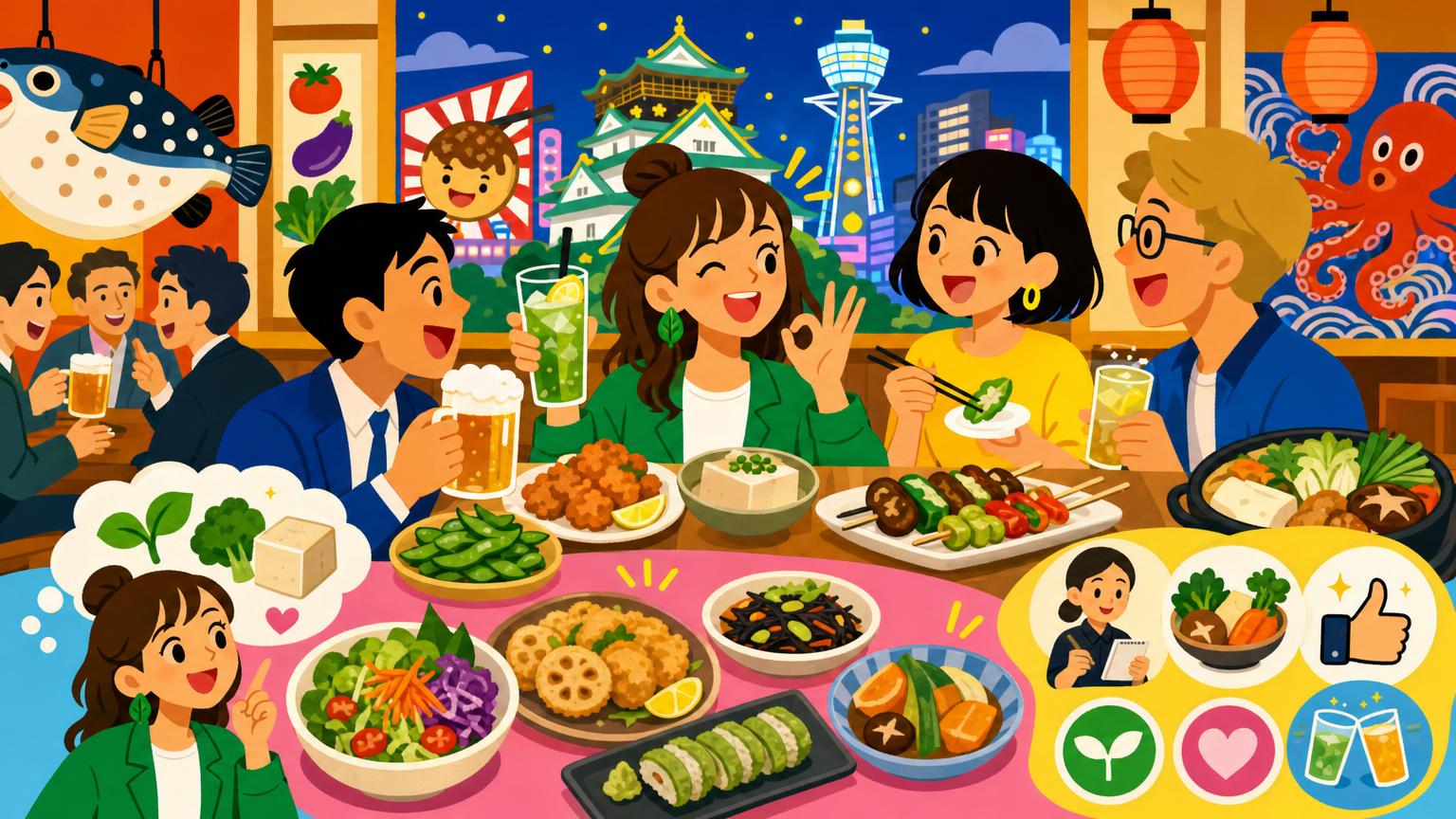
An izakaya is often described as a Japanese pub, but that description is too limited. An izakaya is a spot where people drink alcohol and order several small dishes over time. It might be a bright restaurant near a station, a dim counter with six seats, a noisy chain location, a family-run venue with handwritten menus, or a standing bar where patrons eat quickly before catching the last train.
The meal rarely revolves around one main plate per person. Instead, the table gradually fills up. Someone orders edamame. Another person wants fried food. A senior colleague selects sashimi or grilled fish. Someone else orders a hot plate to share. You might eat a little, wait, then eat again when the next dish arrives. The food serves a social purpose in a practical way: it gives people something to do with their hands while conversation unfolds.
For a vegan, this shared style can feel challenging. In a Western restaurant, you might order one clearly labeled entrée. At an izakaya, a dish that appears to be vegetables may have been cooked in fish stock. A plate of fried tofu might come with bonito flakes. Pickles may contain fish-based seasoning. Even if the ingredients seem harmless, the cooking method may not be.
This is why the safest approach is not to examine every dish closely after it arrives. Instead, inform the organizer or server before the first order is placed. The earlier you explain your dietary needs, the easier it is for everyone to plan.
Why nomikai matters in everyday Osaka life
Nomikai refers to a drinking gathering. It can be a work party, a club meeting, a reunion, a welcome party, a farewell party, or an informal evening with neighbors. The term doesn’t always imply heavy drinking. Younger workers might drink lightly, opt for non-alcoholic drinks, or leave early. The key point is that the gathering is structured around shared time outside of work.
In Japan, coworkers often spend many hours together without discussing personal matters directly. A nomikai creates a more relaxed space. People talk about food, television, local neighborhoods, family, dating, money, or workplace frustrations. The conversation might grow more personal, but the relationships don’t necessarily become intimate in a Western sense. You can enjoy the evening and still maintain clear boundaries afterward.
Osaka’s version often feels more verbally lively than the stereotype of a quiet Tokyo office gathering. This doesn’t mean every Osaka person is loud or constantly joking. It means the city has a strong culture of quick reactions, teasing, conversational interruptions, and informal remarks. A colleague might comment that your Japanese is surprisingly good, complain candidly about the restaurant, or joke about your dietary restrictions. The tone may sound sharper than intended.
Foreign residents sometimes misinterpret this directness. They hear blunt comments and assume hostility. Sometimes comments are hostile, of course. But often they are invitations to respond. In Osaka, a small amount of playful pushback can make the conversation feel more balanced. A quiet, serious reply may close the exchange, while a lighthearted answer can open it.
You don’t need to perform comedy. A simple phrase like vegan nanode, taberareru mono o oshiete kudasai, meaning I am vegan, so please tell me what I can eat, is enough to start. If someone jokes that you can’t eat anything, you can smile and say, Daijobu, Osaka wa tabemono no machi desu kara, meaning It’s okay, Osaka is a city of food.
The difference between an invitation and an obligation
A Japanese coworker might invite you using language that sounds indirect: Moshi yokattara nomikai ni kimasen ka, or If you are free, would you like to come to the drinking party? In practice, you may be genuinely welcome, but the invitation may not carry the same emotional weight as a close friend asking you to dinner.
Sometimes the invitation is socially important even if nobody says so directly. A new employee may be expected to attend the welcome party. A foreign worker might be invited because colleagues want to include them but might also be unsure if the food suits them. If you decline every gathering due to dietary concerns, people may eventually stop inviting you. If you attend once and explain how to accommodate you, future invitations generally become easier.
You are free to ask practical questions before accepting:
- Is it a restaurant or a standing bar?
- Is the menu fixed, or can we order separately?
- Will there be a course meal?
- What time will it finish?
- Is the restaurant near a station?
- Can the organizer tell the restaurant that I am vegan?
These questions are not rude. They show you want to participate thoughtfully.
The first toast and the timing of food
The phrase kanpai means cheers, and the first toast usually happens before serious eating begins. At many work gatherings, people wait until everyone has received a drink. You don’t need to order alcohol. Beer, oolong tea, soda, and non-alcoholic drinks are all common choices.
If you are handed a glass of beer for the toast, you can quietly ask for a non-alcoholic drink instead. Do not feel pressured to drink alcohol simply because the event is called a nomikai. Alcohol tolerance varies, and many people in Japan refrain from drinking heavily for health, religious, medical, or personal reasons.
The most important timing rule is this: try to explain your food needs before the kanpai if possible. After the toast, the table becomes busy. People reach for menus, call the server, and begin sharing dishes. A brief explanation at the start helps avoid lengthy corrections later.
Osaka, Tokyo, and the Social Meaning of Food
Why Osaka can feel more informal than Tokyo
Osaka and Tokyo are both large, complex cities. It is not accurate to assume that everyone in either city behaves in the same way. However, the social atmosphere can feel quite different.
Tokyo often encourages maintaining polite distance. People tend to be courteous, restrained, and careful not to cause inconvenience. While Osaka also values politeness, everyday conversations may shift toward informality more quickly. The divide between customer and staff, senior and junior, or stranger and acquaintance often softens sooner, especially in small eateries and local bars.
This difference can be confusing for foreigners. In Tokyo, a coworker might respond to your dietary restriction with a formal apology and quietly arrange a separate meal. In Osaka, the same coworker might say, Nani mo taberarenai yan, or “You cannot eat anything, can you?” Although this may sound negative, the person is usually trying to help you find something suitable.
The best response is not to ignore the comment or become defensive right away. Instead, clarify your situation with confidence:
- Niku to sakana wa tabemasen. Yasai, tofu, kinoko wa daijobu desu.
- I do not eat meat or fish. Vegetables, tofu, and mushrooms are fine.
Then add a lighthearted line if the mood permits:
- Demo, nomikai wa tanoshimitai desu.
- But I still want to enjoy the drinking party.
This communicates the key message: you are setting a boundary without rejecting the group.
Osaka people may test your comfort level
In Osaka, teasing can be a way to check social comfort. Someone might ask if you eat fake meat, miss cheese, or find your diet expensive. They may even offer you a dish containing fish despite your explanation. This usually comes from ignorance rather than ill intent.
A helpful approach is to assume the first instance is a mistake, but become firmer if it continues. You can say:
- Sumimasen, kore wa dashi ga haitteimasu ka?
- Excuse me, does this contain dashi?
Or:
- Katsuobushi wa taberaremasen.
- I cannot eat bonito flakes.
If the pressure persists, steer the conversation back to participation: say you will order something safe and that you’d love to try the drinks. It’s not necessary to debate veganism at the table.
Food is often a faster bridge than language
Many foreign residents worry that limited Japanese will make nomikai culture hard to join. In practice, food often makes communication easier. Pointing to ingredients, sharing photos of the menu, and learning a few phrases usually works better than trying to explain every ethical or nutritional reason for veganism.
If you want to share your reasons, wait until the group is relaxed. During the first ten minutes, focus on practical details. Later, someone may ask why you became vegan, which can lead to a genuine conversation—especially if you answer without making others feel judged.
You can say:
- Watashi wa doubutsu to kankyou no koto o kangaete, vegan ni narimashita.
- I became vegan because I think about animals and the environment.
Then return the question:
- Osaka de wa, minna wa niku o tabemasu ka?
- In Osaka, does everyone eat meat?
The answer is usually more varied than you expect. Some eat meat daily, some rarely, some follow Buddhist or other religious practices, and some are curious about plant-based food but don’t know how to order it.
The Dashi Problem: Why Vegetables Are Not Automatically Vegan
What dashi means
Dashi is a Japanese soup stock used to add flavor. The most common type found in everyday restaurants is made with kombu seaweed and katsuobushi, or dried bonito flakes. Other varieties of dashi may include dried sardines, mackerel, shellfish, chicken, or pork.
Dashi is used in miso soup, noodle soup, sauces, simmered vegetables, okonomiyaki batter, takoyaki batter, fried food seasoning, dipping sauces, and hot-pot broth. A dish might contain no visible animal products yet still be unsuitable for a strict vegan diet.
This is the most important fact to understand before attending a Japanese drinking party. The word yasai, meaning vegetables, does not guarantee the dish is vegan. A vegetable dish might be cooked in fish stock. A tofu dish might be topped with bonito flakes. A rice ball might contain fish-based seasoning. A salad dressing might include egg or dairy.
Katsuobushi is not a garnish you can always remove
Katsuobushi appears as thin, dancing flakes placed on top of okonomiyaki, tofu, takoyaki, or cold noodles. Some people assume they can simply brush the flakes off. However, that is not always enough. The dish may already contain dashi, and the flakes may have touched the sauce or hot surface.
Ask for both no dashi and no katsuobushi:
- Dashi nashi de onegaishimasu.
- Please make it without dashi.
- Katsuobushi nashi de onegaishimasu.
- Please make it without bonito flakes.
For a clearer explanation, say:
- Niku, sakana, ebi, ika, tamago, nyuuseihin, hachimitsu wa taberaremasen.
- I cannot eat meat, fish, shrimp, squid, eggs, dairy products, or honey.
The word nyuuseihin means dairy products. It’s helpful because staff may understand milk or cheese but not immediately grasp the English term vegan.
Vegetarian and vegan are not interchangeable
In Japan, the word bejitarian may be used loosely. Some restaurants use it to describe menus without meat but containing fish stock. Others include eggs, dairy, or seafood. You should always ask what the restaurant means.
Say:
- Kono menu wa kanzen ni vegan desu ka?
- Is this menu completely vegan?
Or:
- Sakana no dashi mo dame desu.
- Fish stock is also not okay for me.
If you are vegan due to allergies, state this clearly. If cross-contact is a concern, mention it before ordering. A restaurant that can provide ingredients but cannot guarantee a separate cooking surface might not be safe for you.
How to Handle a Regular, Non-Vegan Izakaya
Start with the organizer
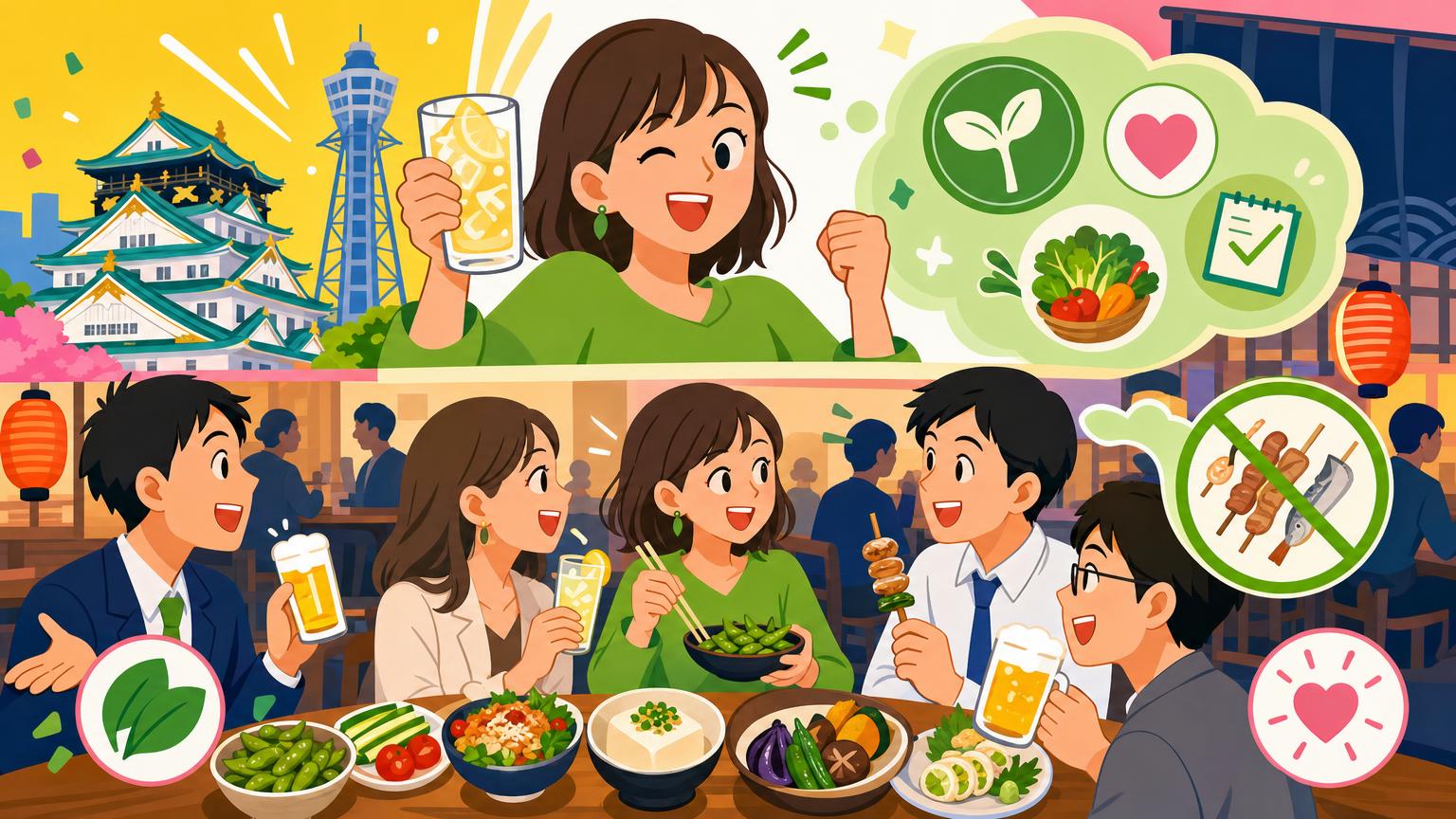
When a colleague invites you to a nomikai, don’t wait until you’re seated to bring up veganism. Send a brief message beforehand. It doesn’t have to be perfect Japanese.
You can write:
Sumimasen, watashi wa vegan desu. Niku, sakana, ebi, tamago, miruku, bataa, hachimitsu wa taberaremasen. Sakana no dashi ya katsuobushi mo dame desu. Restaurant ni kakunin shite moraemasu ka?
This translates to: I am vegan. I cannot eat meat, fish, shrimp, eggs, milk, butter, or honey. Fish dashi and bonito flakes are also not allowed. Could you please check with the restaurant?
A Japanese colleague might not know how to respond, and that’s okay. You can ask them to forward the message to the restaurant or show the restaurant staff the ingredients in Japanese. You don’t have to carry the full responsibility by yourself.
Order one safe dish early
If the restaurant can’t guarantee many vegan options, order a safe dish early before the table fills up with food. This helps prevent you from going hungry and eases the pressure on others.
Potential options include:
- Edamame, if no fish seasoning is used
- Plain rice
- Fresh fruit, when available
- Plain salted cabbage or cucumber, after confirming the dressing
- Pickled vegetables, after checking the seasoning
- Cold tofu, if served plain and without bonito flakes
- Grilled mushrooms or vegetables, if cooked without butter, meat, or fish sauce
- Fries, after verifying the oil and seasoning
- Plain salad with oil and salt, if the dressing is safe
Remember, these dishes are possibilities, not guaranteed safe choices. Always ask before eating.
Share the ordering role
In a traditional izakaya, one person often takes on the role of ordering for the group. If this person understands your dietary restrictions, the evening will be much smoother. You can say:
- Watashi wa vegan nanode, taberareru osusume o onegaishimasu.
- I am vegan, so please recommend something I can eat.
If the server suggests a suitable dish, consider ordering it for the whole table or ask for a small portion. This shows you’re joining the group meal rather than making a separate event.
Alternatively, you can offer to order your own dish. Say:
- Watashi no bun wa jibun de chuumon shimasu.
- I will order my portion myself.
This works well when the group is having a fixed course meal.
Be careful with course menus
Nomikai often use nomihoudai (all-you-can-drink) combined with course meals, where dishes come in a fixed order with little room for changes.
If the event is course-based, ask if the restaurant can substitute animal-based dishes. Some restaurants can prepare vegan options if notified several days ahead. Others cannot alter the course since dishes are prepared in bulk.
Useful phrases include:
- Course no ryouri wa vegan ni henkou dekimasu ka?
- Can the course meal be changed to vegan?
- Vegan no ryouri ga muzukashikattara, watashi dake betsu ni chuumon shite mo ii desu ka?
- If vegan course food is difficult, may I order separately?
Don’t take it personally if a restaurant can’t change the course. Smaller kitchens might lack the ingredients, staff, or space to prepare special meals on short notice.
Bring a backup without making it dramatic
Living in Osaka means learning to prepare for imperfect situations. Carry a small snack in your bag on nights when the menu is uncertain. A protein bar, rice crackers, nuts, or a convenience-store onigiri with a clearly checked filling can keep hunger from turning into frustration.
You don’t need to announce that you’ve brought food. You can eat it before or after the gathering if necessary. The goal is to stay comfortable enough to enjoy the conversation.
This is one practical difference between a short visit and daily life in Osaka. Visitors might treat one challenging meal as a crisis, while residents develop a backup plan and keep the evening going.
Naturally Vegan-Looking Izakaya Dishes to Investigate
Edamame
Edamame is one of the simplest dishes to order, typically steamed or boiled soybeans served with salt. However, confirm whether the restaurant adds any flavored seasoning or butter. Plain salted edamame is usually the safest shared appetizer.
Say:
- Edamame wa shio dake de onegaishimasu.
- Edamame with salt only, please.
Hiyayakko
Hiyayakko is chilled tofu. Common toppings include green onion, ginger, soy sauce, and bonito flakes. Request no katsuobushi and verify the soy sauce doesn’t contain fish-based additives.
Say:
- Hiyayakko, katsuobushi nashi de onegaishimasu.
- Cold tofu without bonito flakes, please.
Tsukemono
Tsukemono refers to Japanese pickles. Pickles made from cucumber, daikon, cabbage, and eggplant may be vegan, but seasonings vary. Some include fish sauce, bonito dashi, or tiny dried fish.
Ask:
- Tsukemono ni sakana ya dashi wa haitteimasu ka?
- Does the pickle contain fish or dashi?
Grilled vegetables and mushrooms
A plate of grilled shiitake, shishito peppers, corn, asparagus, or eggplant may appear safe. Risks come from butter, meat-based seasoning, fish sauce, or a glaze containing animal ingredients. Request salt only when possible.
- Yasai wa shio yaki de onegaishimasu.
- Please grill the vegetables with salt only.
Rice and plain noodles
Rice is usually easy to find, but rice balls and flavored rice might contain fish, meat, or egg. Plain steamed rice is the safest option. Noodles are trickier since the noodles themselves may be vegan, but the broth or dipping sauce often have fish dashi.
If the restaurant can offer a safe sauce, ask for noodles without soup. Don’t assume shoyu ramen or udon is vegan just because the broth looks clear.
Fried food
Fried potatoes, lotus root, eggplant, and mushrooms may be appropriate, but inquire about shared oil if cross-contact is a concern. Japanese fried dishes may be seasoned with chicken powder, fish powder, or mayonnaise after cooking.
The term agemono means fried food but doesn’t indicate what is in the batter or oil. Ask about the specific item.
Fully Vegan and Vegan-Friendly Evening Places in Osaka
This article focuses on social life rather than ranking restaurants. However, knowing a few dependable evening spots can make it easier to accept invitations and introduce coworkers to shareable food.
Aju in Nakazakicho: a small, slow-paced, local-style option
Aju is a tiny Japanese restaurant in Nakazakicho reported to be fully vegan since late 2025. Current descriptions highlight a small owner-run space serving dishes like soy-based yakitori-style skewers, okonomiyaki, curry, and other comfort foods. Recent reports emphasize the limited seating, with only a few tables and a maximum capacity of around four guests at a time.
Aju helps one understand Osaka because it doesn’t operate like a large international restaurant. The pace may be slower. The owner may be juggling several roles simultaneously. The space is small. Dining here feels more like eating in someone’s carefully managed neighborhood kitchen than joining a commercial dining machine.
That atmosphere calls for patience. Avoid arriving with a large work group expecting fast service. Aju suits one or two friends or introducing a curious coworker to vegan Japanese food in a quiet setting. The intimate scale also highlights an important aspect of Osaka life: the city has many independent businesses where the personality of a single owner shapes the entire experience.
OKO: okonomiyaki-bar vibe with vegan options
OKO in the Nagahoribashi area is an evening-focused okonomiyaki bar offering a casual, social atmosphere. Current information lists vegan options, multilingual menus, alcohol, counter seating, sofa seating, and evening hours starting around 6 p.m., though exact details should be confirmed before visiting.
OKO is not a completely vegan restaurant. That distinction is important. When booking or ordering, confirm which dishes are vegan and whether the vegan batter, sauce, mayonnaise, toppings, and cooking surface are separated from the standard options.
Places like OKO are valued for their social aspect. Okonomiyaki is cooked on a hotplate and eaten casually, naturally encouraging conversation. This isn’t about silently enjoying a carefully plated course; you watch the food cook, comment on texture, choose toppings, and share the experience. For vegan foreign residents, OKO provides a relaxed way to invite non-vegan colleagues into your food world without taking them to a health-focused restaurant.
Paprika Shokudo Vegan: a dependable plant-based dinner spot
Paprika Shokudo Vegan is a fully plant-based restaurant in Shinmachi, near Yotsubashi and Shinsaibashi. The current menu includes soy-meat karaage, mushroom-and-tofu fried oysters, tempeh dishes, vegan burgers, pizza, cocktails, beer, sake, and other evening drinks. Recent listings show dinner service in the early evening, though hours and closing days may change.
Paprika fits well with workplace life because its menu offers familiar pub-style textures. A colleague wary of vegan food might feel more comfortable ordering soy-meat karaage or a burger rather than dishes described solely by unfamiliar ingredients.
It also provides a welcoming setting for mixed groups. You can dine without repeatedly checking if each dish contains dashi, while non-vegan friends can focus on flavor instead of feeling like they’re attending a dietary lecture. The restaurant presents vegan cuisine as abundant and social, not just a plate of side dishes.
Because the restaurant uses online ordering and menus may change, bring your phone to check the current dinner schedule. Some sources list different closing times, so avoid relying on outdated travel articles or map entries.
Shinsekai and veganized Osaka comfort food
The Shinsekai area is well known for casual drinking, kushikatsu, inexpensive eateries, and a retro working-class vibe. A smaller Paprika Shokudo location has been reported there, featuring plant-based versions of kushikatsu and takoyaki-style dishes. Current local guides describe this spot as an evening vegan option, but hours and menus should be verified directly since small Osaka restaurants often change their schedules quickly.
The cultural point is more significant than the exact address. Vegan residents often want to engage with Osaka’s flavor language: fried food, skewers, hotplates, sauces, and casual drinking. Dedicated vegan venues that imitate or reinterpret these dishes let you participate in the local food culture rather than eating separate cuisine each time.
Vegan ramen and late-evening options
Some Osaka restaurants change their service style over the course of the day. A venue might serve ramen during the daytime and switch to an izakaya-style menu in the evening. These details can confuse new residents: a place may be open, but the dishes you want might not be available at that time.
Current listings note that Playpen Friends offers an evening menu different from its daytime ramen service, beginning an izakaya-style menu later in the day. Confirm the schedule before visiting, especially if planning a work gathering.
How to Join a Nomikai Without Becoming the Center of Attention
Tell one person, not the entire table
There’s no need to give a speech about veganism. Simply inform the organizer, the person who made the reservation, or the server. One informed individual can quietly assist you with your order.
If several colleagues ask questions, respond briefly and warmly. The more at ease you seem, the less nervous they will be about making a mistake.
Order a drink that looks ordinary
While a vegan meal might prompt questions, a drink usually does not. Common choices include beer, sake, shochu with soda, highballs, plum-flavored drinks, tea, and soft drinks. If your veganism is strict, check the alcohol ingredients carefully, especially for flavored drinks, cream-based cocktails, or items that might use animal-derived processing agents.
At a work gathering, opting for a standard drink can make participation feel easy. You don’t need to pick the most unusual option on the menu to express your identity.
Match the pace, not the alcohol level
If everyone is drinking quickly, you can keep up with the social rhythm without matching their drink count. Hold your glass during toasts, join in conversations, offer to refill someone’s water, and laugh when the group laughs. Order another non-alcoholic drink as needed.
Someone who drinks tea but stays engaged is often viewed more positively than someone who drinks too much and becomes difficult. In Japan, maintaining group harmony usually matters more than proving your ability to consume alcohol.
Understand the seating pattern
At a nomikai, seating may reflect workplace hierarchy. The most senior person often sits farthest from the entrance, while the newest or youngest sits near the door. Don’t worry if you don’t understand the seating arrangement—just follow others and wait to be guided.
As a foreign employee, your colleagues likely won’t expect you to know all the seating rules. Asking, “Where should I sit?” with a smile is better than choosing a seat that makes someone uncomfortable.
Do not assume separate plates mean separate responsibility
Some Japanese restaurants serve individual small plates even during social gatherings, while others place everything in the center. If your food arrives separately, you can still participate by offering shared dishes to others and commenting on what looks good.
Try phrases like:
- Kore wa vegan desu. Tabete mite kudasai.
- This is vegan. Please try it.
Sharing vegan food can change the mood at the table, turning your diet from a limitation into an invitation.
Neighborhoods and Their Different Drinking Personalities
Umeda and Kita
Umeda serves as Osaka’s northern hub for business and transportation. After-work drinking here often feels efficient and office-focused, particularly near major stations, underground dining areas, and business districts. Groups might gather straight after work, enjoy a set course meal, and then head home by train.
Nakazakicho, located near Umeda but noticeably cozier, features smaller independent shops and narrow residential streets. A small restaurant like Aju fits well within this local scale. This contrast is helpful for foreign residents: you can transition from a large commercial area to a neighborhood where the owner may recognize regular customers and service might depend on one person.
If your workplace is in Umeda, try to learn the nearby smaller streets rather than relying solely on chain restaurants. While independent izakayas may be less predictable for vegan options, they’re often more willing to accommodate if you explain your needs clearly.
Dotonbori, Namba, and Minami
Minami is Osaka’s southern commercial heart, encompassing Namba, Dotonbori, Shinsaibashi, and Amerikamura. The area is bustling, brightly lit, and accustomed to visitors, but residents also work, shop, commute, and socialize there. The social atmosphere can be more openly casual than in many northern business districts.
For vegans, Minami offers a convenient cluster of plant-based options, especially around Shinsaibashi and nearby central neighborhoods. This makes it easier to organize mixed gatherings where someone requires strict vegan meals while others prefer familiar Osaka dishes.
Don’t assume that Minami’s lively streets represent all of Osaka. The city isn’t constantly on display. Just two streets away from the main commercial areas, the atmosphere can become quiet, residential, and unpretentious.
Shinsekai and Tennoji
Shinsekai is known for its strong casual drinking vibe. The area is linked with standing bars, kushikatsu, affordable meals, and an older style of Osaka entertainment. Some restaurants are welcoming and flexible, while others aren’t equipped to handle special dietary requests.
For vegans, Shinsekai can feel emotionally challenging. You may be surrounded by the sights and smells of fried skewers but unable to eat from many traditional stalls. Having a dedicated plant-based option makes the district more approachable, but don’t assume that a vegetable skewer at a typical kushikatsu spot is vegan—the batter, sauce, and shared oil all need to be checked.
Tenma and Kyobashi
Tenma and Kyobashi are known for their dense restaurant streets and lively after-work scene. These neighborhoods often feel more local than major tourist spots. People might stand outside waiting for a seat, move between small venues, or meet friends for a quick drink before heading home.
They aren’t the easiest areas for spontaneous vegan dining. The upside is that you can closely observe everyday Osaka social life. The challenge is that the most authentic small bars may lack English menus, dietary labels, or the kitchen capacity to accommodate special requests.
For strict vegans, it’s best to arrive with a plan. For more flexible vegans who can eat at a vetted restaurant first and then join friends for drinks, these neighborhoods can be quite enjoyable.
What Foreign Residents Commonly Misunderstand
Osaka friendliness does not mean unlimited service
People might smile, joke, and speak casually, but that doesn’t imply every restaurant can accommodate all requests. A friendly staff member may still refuse because the kitchen is busy, the menu is fixed, or ingredients are not available.
Do not take refusal as a personal rejection. Thank the staff, order a safe drink, and change plans if needed.
Direct speech is not necessarily aggression
Osaka speech tends to be energetic and straightforward. A colleague may ask personal questions sooner than you expect. They might comment on your accent, clothing, height, food, or relationship status. This can feel intrusive, especially if you come from a culture that values polite distance.
You can set boundaries without appearing cold. For example, say:
- Chotto himitsu desu.
- That is a little private.
Or respond lightly and ask a question in return. You are not obligated to share everything just because the conversation is casual.
Being invited doesn’t mean you must stay until the end
A nomikai may continue through multiple venues, but you can leave after the first round. Inform the group before you go:
- Kyou wa koko de kaerimasu. Arigatou gozaimashita.
- I will go home from here today. Thank you very much.
If it’s an official work event, say goodbye to the organizer or a senior colleague. Avoid leaving without a word unless the situation is uncomfortable or unsafe.
Second and third rounds are optional
The first restaurant is usually the main event. A second location is called nijikai, and the third sanjikai. Food options at later stops may be more limited, and vegan choices harder to find. It’s reasonable to attend the first round and leave before the menu becomes restrictive.
If you want to continue, ask where the group is heading and whether suitable drinks or snacks are available. You are free to join selectively.
A Practical Language Kit for Vegan Nomikai Life
Explaining veganism
- Watashi wa vegan desu. I follow a vegan diet.
- Niku to sakana wa tabemasen. I avoid eating meat and fish.
- Tamago to miruku mo tabemasen. I also refrain from eating eggs and milk.
- Hachimitsu mo dame desu. Honey is also off-limits.
- Sakana no dashi wa taberaremasen. I cannot consume fish-based broth.
- Katsuobushi wa dame desu. Bonito flakes are not allowed.
Asking what is safe
- Kore wa vegan desu ka? Is this suitable for vegans?
- Nani ga taberaremasu ka? What foods are safe for me to eat?
- Dashi wa haitteimasu ka? Does this contain dashi?
- Niku ya sakana wa haitteimasu ka? Are meat or fish included?
- Choumi料 ni sakana wa tsukatteimasu ka? Is fish used in the seasoning?
Requesting simple preparation
- Shio dake de onegaishimasu. Please prepare it with salt only.
- Yaku dake de onegaishimasu. Just grill it, please.
- Sauce nashi de onegaishimasu. Please serve without sauce.
- Mayonnaise nashi de onegaishimasu. No mayonnaise, please.
- Katsuobushi nashi de onegaishimasu. Without bonito flakes, please.
Handling uncertainty
- Kakunin shite moraemasu ka? Could you please verify?
- Muzukashikattara, daijoubu desu. If it’s too difficult, that’s fine.
- Taberareru mono dake de onegaishimasu. Please give me only what I can safely eat.
This last phrase is particularly helpful as it eases the situation for everyone involved.
Frequently Asked Questions
Is it hard to find vegan food at an Osaka nomikai?
It can be challenging at a traditional izakaya, but the difficulty mainly arises from hidden ingredients and shared ordering rather than a complete lack of vegan options. Osaka boasts a growing number of dedicated vegan kitchens and vegan-friendly evening restaurants, while regular izakayas may still have safe dishes if you inquire about dashi, bonito flakes, sauces, eggs, and cooking methods.
The best strategy is to plan ahead before accepting the invitation. Ask where the group will go, inform the organizer that you are vegan, and bring a backup snack. Current listings include Aju, Paprika Shokudo Vegan, OKO, and other plant-based evening venues, though hours and menus may change.
Do I need to make a reservation in advance?
For typical work parties, the organizer usually makes the reservation. If you pick a vegan restaurant yourself, it’s best to reserve ahead, especially for small owner-operated places. Aju has limited seating, and Paprika’s dinner service can get busy. OKO might be better suited for casual groups, but confirm its vegan offerings when you book.
Should I bring my own food?
Bring a small backup snack when the menu is uncertain, but don’t assume you can eat outside food inside the restaurant. Consume it before or after the gathering, or discreetly if the situation allows. Your aim is to stay comfortable, not to place the restaurant in a position of managing a second meal.
What if the restaurant cannot provide anything vegan?
Order a safe drink, explain you will eat later, and stay part of the social group if you’re comfortable doing so. You can also ask if plain rice, fruit, or simply prepared vegetables are possible. If nothing is safe, politely leaving is reasonable. Dietary restrictions are not a reason to jeopardize your health.
Is Osaka more difficult for vegans than Tokyo?
It depends on the kind of vegan experience you want. Tokyo has a larger population and a wider range of specialized restaurants, but Osaka has a strong culture of casual shared food and a growing plant-based scene often centered on local comfort dishes. Osaka may require more attention to dashi in traditional restaurants, but its independent restaurants can feel approachable once you know how to communicate.
The main difference is not the absence of vegan food in Osaka. It’s that typical Japanese food often contains ingredients invisible to visitors. Once you understand dashi, katsuobushi, fixed courses, and shared ordering, daily life becomes easier.
Can I decline alcohol at a nomikai?
Yes. You can join the toast with tea, soda, or a non-alcoholic drink. Match the social mood rather than the alcohol itself. If someone pressures you, say:
- Osake wa nomimasen ga, nomikai wa tanoshindeimasu.
- I do not drink alcohol, but I am enjoying the drinking party.
What is the most important rule for living vegan in Osaka?
Explain early, ask specific questions, and stay socially open. Don’t rely on a dish’s appearance. Don’t wait until everyone is hungry. Don’t assume a restaurant serving vegetables understands vegan preparation.
At the same time, don’t let dietary caution turn every gathering into a negotiation. Give people a clear way to include you. Tell one person. Learn a few phrases. Order a safe dish. Join the toast. Laugh when you can. Leave when you need to.
That’s how you survive and thrive at Osaka’s after-work drinking parties. You don’t have to eat everything the group eats. You don’t have to drink alcohol. You don’t have to pretend that fish stock is acceptable. But you can still share the table, understand the jokes, learn how colleagues interact, and become part of ordinary Osaka life without compromising your values.