
A foreign resident in Osaka often notices the same thing during the first few weeks. A shopkeeper makes a joke while handing over your change. A neighbor comments on your umbrella, your lunch, or the weather without much ceremony. A colleague who barely knows you may tease you before they have even learned your full name. Then, when you compare the experience with Tokyo or Kyoto, the difference can feel surprisingly strong.
Is Osaka less polite? Are people in Tokyo cold? Do people in Kyoto really hide their feelings behind indirect language? The honest answer is more complicated, and more useful, than any city stereotype. Osaka’s everyday communication is often direct, humorous, and fast-moving. It can feel warm almost immediately, but it can also feel intrusive or blunt if you are used to more personal distance. Tokyo usually places more weight on controlled politeness and reading the situation. Kyoto often values restraint, implication, and careful attention to social position, although real people in all three cities are more varied than the clichés suggest.
For someone living in Osaka, the important question is not whether one style is better. The important question is how to understand what is happening beneath the words. A comment that sounds critical may be an invitation to relax. A joke may be a test of whether you can join the group. A quiet response may not mean agreement. A very polite response may not mean enthusiasm. Daily life becomes easier when you learn to listen for timing, tone, facial expression, and the relationship behind the sentence.
This article looks at Osaka as a place to live, not simply as a destination to visit. It focuses on ordinary conversations in workplaces, apartment buildings, neighborhood shops, clinics, schools, restaurants, and family settings. It also explains why Osaka is often described as more open than Tokyo or Kyoto, why foreigners sometimes misunderstand Osaka people, and how humor works as a form of social connection.
What Makes Osaka’s Communication Style So Distinctive?
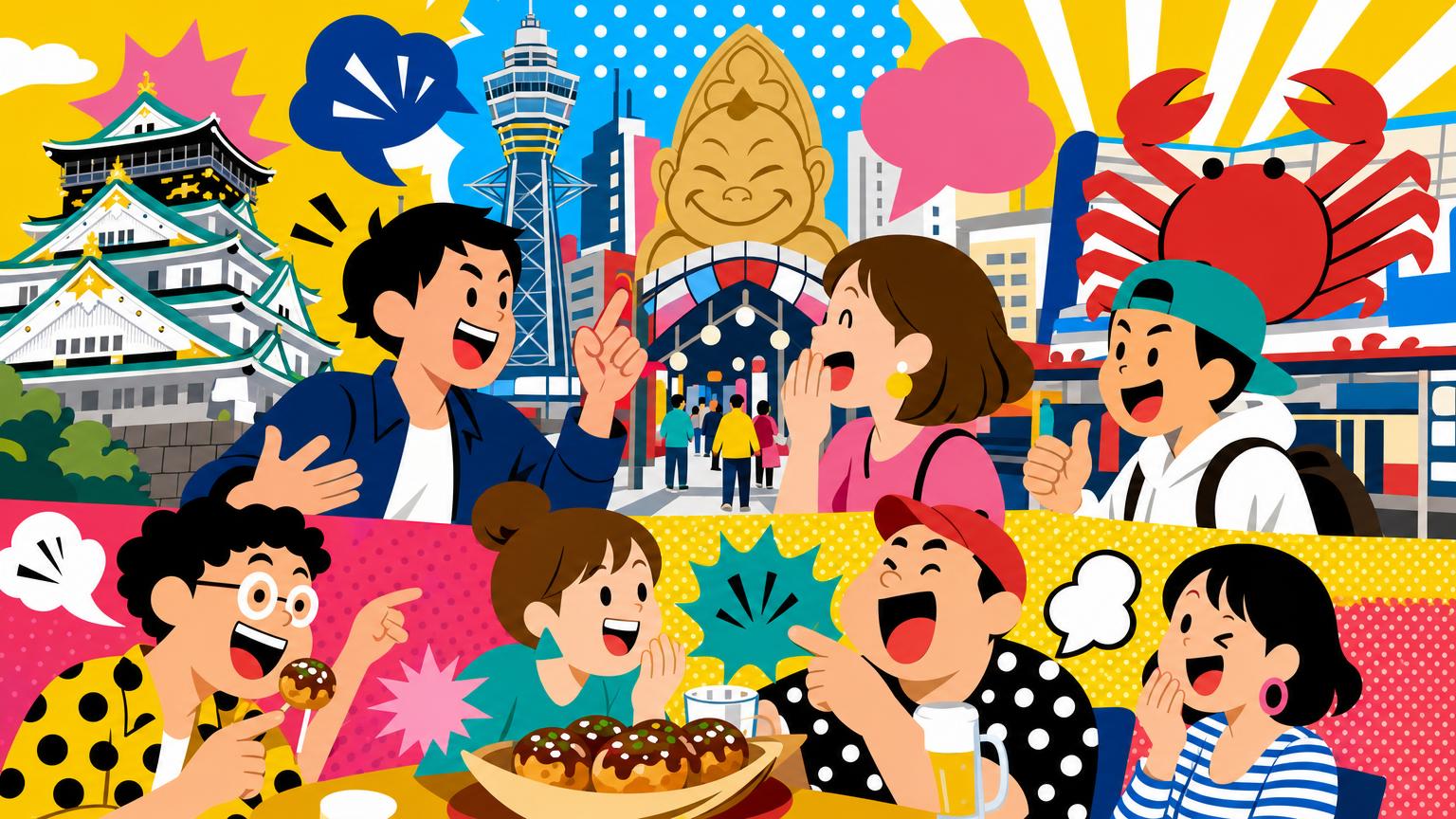
Osaka communication is not simply “friendly Japanese.” That phrase is too broad to provide much insight. A more accurate description is that Osaka often quickly narrows the social distance between people. Conversations may become personal, playful, or emotionally expressive even before a formal relationship is fully established.
A neighbor might ask if you are eating well. A taxi driver could share an opinion about your neighborhood. A small restaurant owner might complain about the weather, vegetable prices, or a competing shop while preparing your meal. A colleague may use a nickname, joke about their own mistake, or ask a question that would seem unusually personal in other contexts.
This does not imply that everyone in Osaka is outgoing. Many people are quiet, private, shy, or very formal. Osaka is a large metropolitan area with residents from diverse backgrounds. The difference is that the local communication style often permits people to show personality in everyday interactions. A conversation doesn’t have to remain perfectly neutral; it can meander, tease, exaggerate, complain, and return to practical matters without anyone feeling the relationship is harmed.
Directness Over Formality: The Role of Honne
The Japanese term honne refers to a person’s true feelings, opinions, or intentions. It is often discussed alongside tatemae, which signifies the public stance or socially appropriate expression used in formal settings. These concepts exist throughout Japan, not just in Osaka. However, many people find that honne surfaces more quickly in Osaka’s everyday conversations.
In highly formal settings, a person might say, “That could be a little difficult,” when they actually mean no. In a more direct Osaka conversation, the same person may say, “No, that’s not going to work,” and then immediately explain why. Such directness can seem harsh to foreigners familiar with Japanese politeness, which usually softens disagreement. Yet, this straightforward response can be more useful—you know where you stand and what practical issues need resolving.
In the workplace, this directness may appear in meetings. A Tokyo-style meeting might feature many polite phrases before someone clearly objects to a proposal. In an Osaka office, a person might interrupt with, “Wait, that number is too high,” or, “Who is going to do all of that?” The tone tends to be energetic rather than hostile. After voicing an objection, the same person may help revise the proposal.
The key is distinguishing direct content from emotional intent. Osaka residents may express disagreement strongly while maintaining respect for the relationship. A raised voice doesn’t automatically signal anger. A complaint doesn’t necessarily mean refusal. Sometimes a complaint is the start of cooperation.
Why Directness Is Sometimes Misunderstood as Rude
Foreign residents often come to Japan expecting politeness to be quiet, restrained, and indirect. Osaka can challenge that expectation. Someone may ask your age, marital status, rent, salary, or reasons for moving to Japan. A vendor may tease you about your Japanese pronunciation. An older neighbor might comment on your clothes or wonder why you’re not wearing a warmer jacket.
By international standards, such questions may feel intrusive. However, they are often intended as casual conversation rather than control. In Osaka, asking personal questions can reduce formality. The speaker may see teasing as a way to show comfort. Still, you cannot assume every question is harmless. Tone, context, and social dynamics remain important.
A useful approach is to respond lightly without sharing information you want to keep private. You could say, “That’s a secret,” or, “I’m still learning how to answer that in Japanese.” If the person laughs and changes the subject, the question was likely conversational. If they persist, you can respond more firmly: “I’d rather not talk about that.” Directness doesn’t mean you must accept every intrusion.
Osaka warmth often takes a practical form. It might include checking if you’ve eaten, asking if you found your way home, offering leftovers, or warning about a bad deal. It may not sound like gentle reassurance. Instead, it could be, “Don’t buy that one. It’s expensive,” or, “You’re going to catch a cold dressed like that.” The care is hidden behind the complaint.
Humor Is a Shortcut to Familiarity
Humor allows Osaka residents to build closeness without lengthy explanations of their feelings. A joke can communicate, “You’re welcome here,” “No need to be so nervous,” or, “We can speak casually now.” It also helps reduce embarrassment after a mistake.
For example, if you use the wrong word at a neighborhood bakery, a highly formal interaction might involve simply correcting you and moving on. In Osaka, the staff might repeat your mistake dramatically, smile, and add a playful comment. If the exchange feels good-natured, laughing along can turn an awkward moment into a small bond.
The risk is that humor doesn’t always translate smoothly. Sarcasm, exaggeration, and teasing may sound aggressive when you’re still learning the language. It’s perfectly fine to pause before laughing. Observe whether others are smiling, if the speaker softens their voice, and whether the joke includes themselves. Self-mockery often signals an invitation to share amusement rather than an attack.
Osaka vs. Tokyo: Different Ideas of Social Ease
The Osaka–Tokyo contrast is one of the most frequently asked questions by people moving within Japan. It is also one of the easiest comparisons to oversimplify. Tokyo is not devoid of emotion, and Osaka is not merely one large comedy club. Both cities feature formal workplaces, warm neighborhoods, impersonal services, lively friendships, and quiet individuals.
Nonetheless, the cities often shape different expectations about how strangers should behave.
Osaka and Tokyo: Honne, Tatemae, and the Public Self
Communication in Tokyo often values careful control. On a crowded train, people typically maintain a broad zone of privacy. In an office, people may wait for the right moment to speak. A stranger might apologize for a minor inconvenience even when no apology is necessary. The language of respect can endure for a long time.
This does not necessarily imply that Tokyo residents are less sincere. Rather, public interactions tend to emphasize reducing friction. People may avoid imposing their personal mood on others, viewing restraint as a form of consideration.
Communication in Osaka may allow more visible personality in public. People can show annoyance, delight, worry, or amusement without fully concealing their emotions. Conversations often include more interruptions, volume shifts, dramatic gestures, and rapid reactions, creating a sense of speed and familiarity.
For foreign residents, the practical difference may appear when asking for help. In Tokyo, you might receive a precise, polite answer followed by a calm goodbye. In Osaka, you may get the same answer along with a warning, a personal story, and a joke about poorly designed station layouts. Neither interaction is inherently more caring; Osaka simply makes the social layer more transparent.
In business, a Tokyo colleague may prefer addressing disagreements privately or through careful wording. An Osaka colleague might raise issues openly, especially when aiming to improve a plan. However, this varies greatly depending on age, company culture, industry, and rank. Traditional Osaka companies can be highly hierarchical and formal, while Tokyo startups might be relaxed and direct.
When Osaka Directness Helps Foreign Residents
Osaka can be easier for foreigners who struggle with ambiguity. If a landlord describes an apartment as “a little difficult,” you might still need to find out whether the issue lies with your visa status, guarantor, income, or building rules. In Osaka, someone might clarify the real obstacle more plainly: “The owner does not want a foreign tenant,” or “The paperwork is missing this document.” This honesty can be uncomfortable, but it provides something specific to address.
The same holds true for neighborhood relations. If your garbage separation is incorrect, a neighbor might tell you immediately. They may sound irritated, but you get a chance to fix the issue before it escalates to a formal complaint. If you make noise late at night, someone might knock on your door instead of silently resenting you. Though the conversation may be awkward, direct resolution is often possible.
Of course, some people use “directness” to excuse bad manners. Osaka’s reputation for frankness does not make every rude remark acceptable. If someone insults your nationality, threatens you, or repeatedly violates your boundaries, you are not obliged to interpret it as local warmth. Cultural understanding should help you assess situations more accurately, not compel you to tolerate disrespect.
Osaka and Kyoto: Open Expression Versus Indirect Meaning
The comparison between Osaka and Kyoto is especially delicate because it is steeped in longstanding regional stereotypes. Osaka is often perceived as loud and outgoing, while Kyoto is viewed as elegant but hard to read. A well-known stereotype suggests that Kyoto residents might say polite things while conveying a completely different message. Although this stereotype is not a reliable way to judge individuals, it does highlight a genuine difference in communication ideals.
Kyoto’s Preference for Restraint and Implication
Kyoto has traditionally been linked to refined social conduct, intricate etiquette, and sensitivity to context. In certain situations, people may expect you to grasp the intended meaning without everything being explicitly stated. For example, a polite hint to conclude a visit might come through remarks about the time, the weather, or an upcoming appointment, rather than a direct request to leave.
This style relies on shared cultural understanding. It can be elegant when everyone recognizes the signal, but confusing if someone lacks that background. A foreign resident might interpret a gentle hint as casual small talk and unintentionally stay too long, ask for too much, or overlook a subtle refusal.
In contrast, Osaka tends to be more accommodating of explicit clarification. If something is unclear, you might say, “Do you mean that I should do this?” and get a straightforward response. While some people in Kyoto will also answer directly, the expectation to read the atmosphere is generally stronger in formal or traditional settings.
The “Ikezu” Stereotype and Why It Requires Caution
The term ikezu is sometimes used in discussions about Kyoto to describe a sly, difficult, or indirectly unkind demeanor. Foreigners should be cautious with this label. It is a stereotype from popular Japanese culture, and applying it to all Kyoto residents is unfair. Kyoto is home to many generous, humorous, and straightforward individuals. Likewise, Osaka has its share of reserved, calculating, or hard-to-read people.
The important takeaway is not that Kyoto residents are secretly unkind. Rather, different communities may value directness differently. In Osaka, displeasure might be openly expressed; in Kyoto, it could manifest through changes in politeness, shorter responses, or carefully phrased suggestions. In both places, it’s necessary to listen beyond the words themselves.
Navigating Between Cities Without Misunderstanding People
A foreigner moving from Kyoto to Osaka might perceive Osaka residents as unusually informal, with people speaking casually before relationships are firmly established. Conversely, someone from Osaka relocating to Kyoto might interpret Kyoto’s interactions as distant or evasive. In truth, each city has its own assumptions about how quickly strangers can become socially at ease.
Do not respond to Osaka’s informality by immediately becoming casual with everyone. Politeness remains important, particularly with elders, managers, landlords, teachers, and service workers. Instead, let others set the level of familiarity. If they joke, respond with a smile and a small joke of your own. If they maintain formality, do the same. The warmth of Osaka is not an excuse to ignore all social boundaries.
The Comedy Connection: Why Conversation Can Feel Like a Performance

Osaka’s reputation for humor is linked to owarai, the broad Japanese term for comedy and comedic entertainment. While Osaka is closely associated with professional comedy, its influence extends beyond just the presence of comedians on television. Comedy provides a framework for how ordinary people handle awkwardness, disagreement, and group dynamics.
Boke and Tsukkomi in Everyday Conversation
Two fundamental comedy roles are boke and tsukkomi. The boke is the person who says or does something foolish, exaggerated, confused, or unexpectedly strange. The tsukkomi is the one who reacts by pointing out the error, correcting the exaggeration, or steering the conversation back to reality.
In everyday situations, these roles are not always performed formally. For example, a friend may say something clearly impossible, and another friend might respond with, “Nande-ya-nen?” meaning something like, “What are you talking about?” This response is not necessarily anger; it can be a playful correction that signals mutual understanding of the joke.
This rhythm can be observed in families, offices, restaurants, and television conversations. One person creates an opening; another reacts. The humor often arises from timing rather than a perfectly crafted punchline. A pause, an exaggerated facial expression, or a sudden shift in tone can be enough.
Foreign residents sometimes feel uneasy when a colleague corrects them publicly. In Osaka, such a correction may be a tsukkomi, intended to keep the conversation lively. However, it’s important to consider the power dynamics involved. A senior colleague mocking a junior employee in public isn’t automatically harmless comedy. The same words spoken between close friends might feel very different coming from a manager.
The Importance of a Good Reaction
In Osaka humor, the reaction is often as valued as the original joke. The person who says something funny may look at you, waiting to see your response. You don’t need to deliver a clever comeback. A smile, a surprised look, or a simple “Really?” can keep the interaction flowing.
If you understand the joke, you might respond with a slight exaggeration: “That sounds dangerous,” or “So this is Osaka training?” If you don’t understand, it’s fine to say so lightly: “I think I missed the joke.” Many people will then explain or repeat it more slowly. Pretending to understand can cause confusion, especially if the humor relies on wordplay or dialect.
Giving a good reaction doesn’t mean laughing at everything. Sometimes the most natural response is a calm look followed by, “Are you serious?” That itself can become part of the rhythm. The aim is participation, not performance.
Why Complaining Can Be Social Bonding
Osaka conversations often include complaints about trains, weather, prices, work, food portions, television, or other people’s behavior. To outsiders, frequent complaining may sound negative. In reality, complaining can be a low-risk way to connect. Two strangers might bond over how humid the summer is or how confusing a station feels.
Complaints create common ground. You don’t need to reveal anything deeply personal; you just need to agree that the rain is heavy, the queue is slow, or the lunch portion is too small. From there, the conversation might become more personal.
This can be especially helpful for foreign residents. Starting with a safe shared observation may encourage people to open up. “The summer is intense this year” might lead to advice about air conditioners, local swimming pools, electricity costs, and neighborhood events. Communication in Osaka often shifts from practical complaint to personal connection more quickly than a carefully planned introduction.
How Humor Works in Daily Life for Foreign Residents
The most noticeable difference often lies not in what people say, but in how quickly the tone of a conversation can shift. A clerk might begin with polite language, then crack a joke, before returning to politeness. A colleague may bow solemnly while making a ridiculous comment. An older neighbor might complain about your recycling and then hand you a bag of mandarins.
These shifts can be challenging to interpret because many foreigners expect a single, consistent emotional tone. If someone is polite, they must be distant. If they joke, they must be close. In Osaka, this isn’t always the case. Politeness and familiarity can coexist within the same conversation.
At Work
In an Osaka workplace, humor can help lessen hierarchy without eliminating it entirely. A manager may poke fun at their own forgetfulness. A team might share jokes before a tough meeting. A colleague might use a playful phrase to soften a correction.
You shouldn’t assume that all jokes indicate equality. Japanese workplaces often maintain clear distinctions based on seniority, job title, age, and employment status. Be especially careful with jokes regarding appearance, relationships, nationality, gender, disability, or language skills. When uncertain, keep your humor modest until you better understand the team.
The safest humor tends to be self-directed and situational. You can joke about getting lost in a large office, struggling with a complex form, or needing another coffee after a long meeting. Avoid jokes that could embarrass others.
In Apartment Buildings and Neighborhoods
Living in Osaka involves frequent small encounters. You may see the same cleaner, delivery worker, convenience store employee, or neighbor multiple times a week. A brief greeting may develop into a familiar exchange. Eventually, the person might ask about your work, family, or Japanese studies.
A simple greeting is enough at first. Saying “Ohayou gozaimasu” in the morning and “Konbanwa” in the evening establishes recognition. If a neighbor begins speaking in a more casual tone, you can respond warmly while maintaining respectful language. Over time, the relationship may include small favors, building maintenance tips, or invitations to local events.
Don’t assume every neighborhood question means you must become close friends. Osaka communities can be socially active but also value convenience and routine. A neighbor may chat enthusiastically in the hallway while still preferring privacy at home.
In Shops, Cafes, and Izakayas
In a small Osaka shop, the relationship between customer and staff may feel less formal than in a large department store. The owner might comment on your order, inquire about where you live, or suggest something different. If the shop is busy, keep your replies brief and avoid pushing the conversation. If the owner continues to talk, match their pace.
In an izakaya, conversation often moves quickly as people eat, drink, and listen to several exchanges at once. You might hear jokes not directed at you or be drawn into a conversation simply because you are sitting nearby. A smile and a brief response are appropriate. You don’t need to understand every word to be part of the interaction.
The atmosphere can be noisy, but noise doesn’t always indicate conflict. People may speak loudly due to a small room, music playing, or an energetic conversation. Observe body language before assuming an argument is taking place.
Osaka-ben: Small Phrases That Change the Mood
You don’t need to be fluent in Osaka dialect to live comfortably in Osaka. Standard Japanese is perfectly fine, and many locals tend to switch to standard language when speaking with foreigners. However, learning a few Osaka-ben expressions can demonstrate that you are attuned to the local flavor of the city.
Ookini
Ookini is a traditional Osaka expression meaning “thank you.” It is especially associated with older speech, local businesses, and the broader Kansai region. It doesn’t replace the more widely understood arigatou gozaimasu in every context.
A foreign resident might say it after receiving a small favor from a shopkeeper or neighbor: “Ookini.” Say it naturally and lightly. If it feels too theatrical for you, stick with standard Japanese. People usually appreciate an honest attempt more than an exaggerated dialect.
Maido
Maido is a shortened phrase related to “every time” or “as always,” and in Osaka it often serves as an informal greeting in commercial settings. Shop owners or regular customers may use it when welcoming someone familiar. You’re likely to hear maido in local shops, especially when there’s an established relationship.
As a newcomer, it’s best to listen first. After you become a regular at a neighborhood store, you can try saying “Maido” with a smile. It works best when the interaction already feels warm. Saying it loudly to every stranger can come across as imitating TV comedy.
Nande-ya-nen
Nande-ya-nen literally means “Why is that?” but functions more like “What are you talking about?” or “Come on, that makes no sense.” It’s a classic tsukkomi phrase whose meaning depends entirely on tone.
Use it only in clearly playful situations with people who know you. For example, if a friend says, “I woke up at three in the afternoon because I’m preparing for tomorrow,” you might respond jokingly with nande-ya-nen. Avoid using it with landlords, managers, elderly strangers, or anyone giving serious instructions. A phrase that sounds funny in a comedy sketch can come off as rude when aimed at the wrong person.
Honma
Honma means “really” or “truly.” You might hear it in reactions like honma? when someone is surprised. It’s useful because it expresses interest without a lengthy sentence.
If a colleague mentions the office will close early, you might say, “Honma?” with a surprised smile. In formal workplaces, standard hontou desu ka? remains safer. The dialect form works best when the other person is already speaking casually.
Akan
Akan means “no good,” “not allowed,” or “that will not work.” It’s common in Kansai speech and may be heard as a practical warning. For example, a neighbor might say that leaving garbage out early is akan. A friend might say your plan is akan because it’s too expensive.
Since it can sound firm, pay attention to the tone. It might be a serious warning or a playful objection. If you use it, keep it for casual situations: “That plan is akan,” said with a smile, can be humorous among friends.
How to Respond When Osaka Humor Feels Too Personal
Cultural openness does not eliminate the need for boundaries. Foreign residents often feel pressured to laugh when someone comments on their accent, body, relationships, or nationality. It is perfectly acceptable to dislike the joke. You are also allowed to respond clearly without causing a dramatic confrontation.
A gentle boundary might be: “I know you are joking, but I am sensitive about that.” In Japanese, you could say, “Joudan da to wakatteimasu ga, sore wa chotto…” meaning, “I understand it is a joke, but that is a bit difficult for me.” The incomplete phrase expresses discomfort while allowing the other person the opportunity to apologize.
A firmer response is appropriate if the behavior persists: “That topic is private,” or, “Please do not joke about that.” You don’t need to smile when saying this. People in Osaka often respect clear signals, especially when conveyed calmly.
If your Japanese is limited, speaking in English is still acceptable. You can also prepare one or two short phrases in advance. The goal is not to sound perfectly local, but to make your boundary clear and understandable.
What Foreigners Commonly Misunderstand About Osaka People
“Loud” Does Not Always Mean Angry
Conversations in Osaka can be louder and more animated than a foreigner might expect. People may talk over each other without intending to interrupt or dominate. Someone might laugh heartily, bang the table, or respond dramatically to a minor story. These actions can simply reflect enthusiasm.
Observe the overall pattern. Are people smiling? Are they continuing to share food? Do they return to a normal conversation afterward? If so, the intensity is likely social energy rather than anger.
“Friendly” Does Not Always Mean Personally Available
Someone who jokes with you may still have no interest in meeting outside the current environment. Osaka friendliness is often immediate and situational. A person might treat you like an old friend for ten minutes and then go back to their private life.
Do not feel rejected if a lively conversation does not turn into a lasting friendship. The moment may have been sincere, even if brief.
Direct Advice Is Not Always a Command
When someone says, “You should move to this neighborhood,” “You should eat more,” or “You should change that job,” they may be expressing conversational energy rather than giving direct orders. You can acknowledge the advice without feeling obligated to follow it.
Consider replying, “I will think about it,” or, “That’s one possibility.” If the advice involves safety, finances, housing, or legal issues, verify the information independently. Warmth does not necessarily equal expertise.
Silence Does Not Always Mean Disapproval
Even in Osaka, people become quiet when tired, busy, uncertain, or struggling to communicate across a language barrier. Someone may stop joking because they are focusing, not because you have offended them.
Foreign residents sometimes overinterpret a single quiet exchange. Pay attention to patterns over time. A brief or short reply usually means little, but repeated avoidance, canceled plans, or a shift in formality may indicate something more significant.
Is Osaka a Good Place to Live If You Prefer Quietness?
Yes, but you should recognize that quietness in Osaka does not equate to social distance. It is possible to live a private life in Osaka. Large residential areas, modern apartment complexes, commuter neighborhoods, and ordinary shopping streets provide plenty of anonymity. No one expects every resident to be highly social.
At the same time, you may experience more spontaneous interactions than you would in a more reserved setting. Someone might strike up a conversation in an elevator. A shopkeeper may remember your usual order. An older neighbor might ask if you have a partner. A coworker could invite you to eat after work and then tease you for declining.
If you prefer quietness, maintain polite consistency. Greet people, respond briefly, and clearly communicate your schedule. You don’t need to match everyone’s energy. Over time, people usually come to understand your style. In Osaka, a person who is quiet but dependable is often better understood than someone who is very talkative one day and absent the next.
The city can be comfortable for foreigners who appreciate practical honesty, humor, and everyday human contact. It can be exhausting for those who require strict privacy boundaries and dislike spontaneous conversation. Neither response is wrong. The key is whether you can establish routines that provide both connection and time for recovery.
How to Build Trust in Osaka Without Performing a New Personality
The simplest method is consistent participation. Learn the names of the people you meet regularly. Return greetings. Show up as promised. Follow neighborhood rules. If you make a mistake, admit it straightforwardly rather than offering a complicated excuse.
Humor is helpful, but reliability is even more important. Osaka residents may enjoy a humorous conversation, yet daily trust is established through practical actions: sorting garbage properly, paying bills on time, keeping noise levels reasonable, responding to messages, and offering help when it’s genuinely needed.
If you don’t understand an indirect hint, ask a clear question. If a joke makes you uncomfortable, express your boundary. When someone gives practical advice, consider it without assuming it’s absolute truth. When someone sounds blunt, listen carefully to determine if they’re trying to solve a problem or just hurt you.
You can also develop your own local rhythm. Maybe you become the foreign resident who knows which bakery sells out quickly, which recycling day is confusing, or which phrase makes your elderly neighbor smile. Belonging doesn’t mean becoming a caricature of an Osaka person; it means finding a natural place within the city’s existing patterns.
Experiencing the Real Warmth of Osaka’s Everyday Life
Osaka’s warmth is not always gentle. It can come as a warning, a complaint, a correction, a joke, or an unsolicited opinion about your lunch. It might sound like someone telling you your plan is ridiculous before helping you carry it out. It might show up in a small restaurant where staff remember your preferences, the apartment hallway where a neighbor checks on your well-being, or the office where a colleague turns your mistake into a joke so you don’t feel alone.
This is why Osaka can feel both inviting and demanding. The city often encourages you to be socially present before you feel fully prepared. It rewards those who respond, not necessarily with perfect Japanese or flawless humor, but with attention and sincerity.
Compared to Tokyo, Osaka may reveal more of the person behind the public persona. Compared to Kyoto, it may communicate more directly. However, these are tendencies, not rules. Individual personality, age, class, profession, family background, and neighborhood all play a significant role.
The best way to understand Osaka’s people is to stop asking if they are polite or rude, warm or cold, direct or indirect. Instead, ask what the conversation aims to achieve. Is it building familiarity? Easing tension? Offering a warning? Testing if you can join the group? Protecting someone’s dignity through humor? Showing care without explicitly saying “I care”?
Once you start asking these questions, Osaka becomes easier to understand. A joke might be an invitation. A blunt comment could be practical help. A complaint might become shared ground. And a conversation that initially seemed too loud, too personal, or too fast may reveal the city’s most important social habit: people often connect by encountering each other openly, with all the awkwardness, humor, and genuine reactions that everyday life brings.