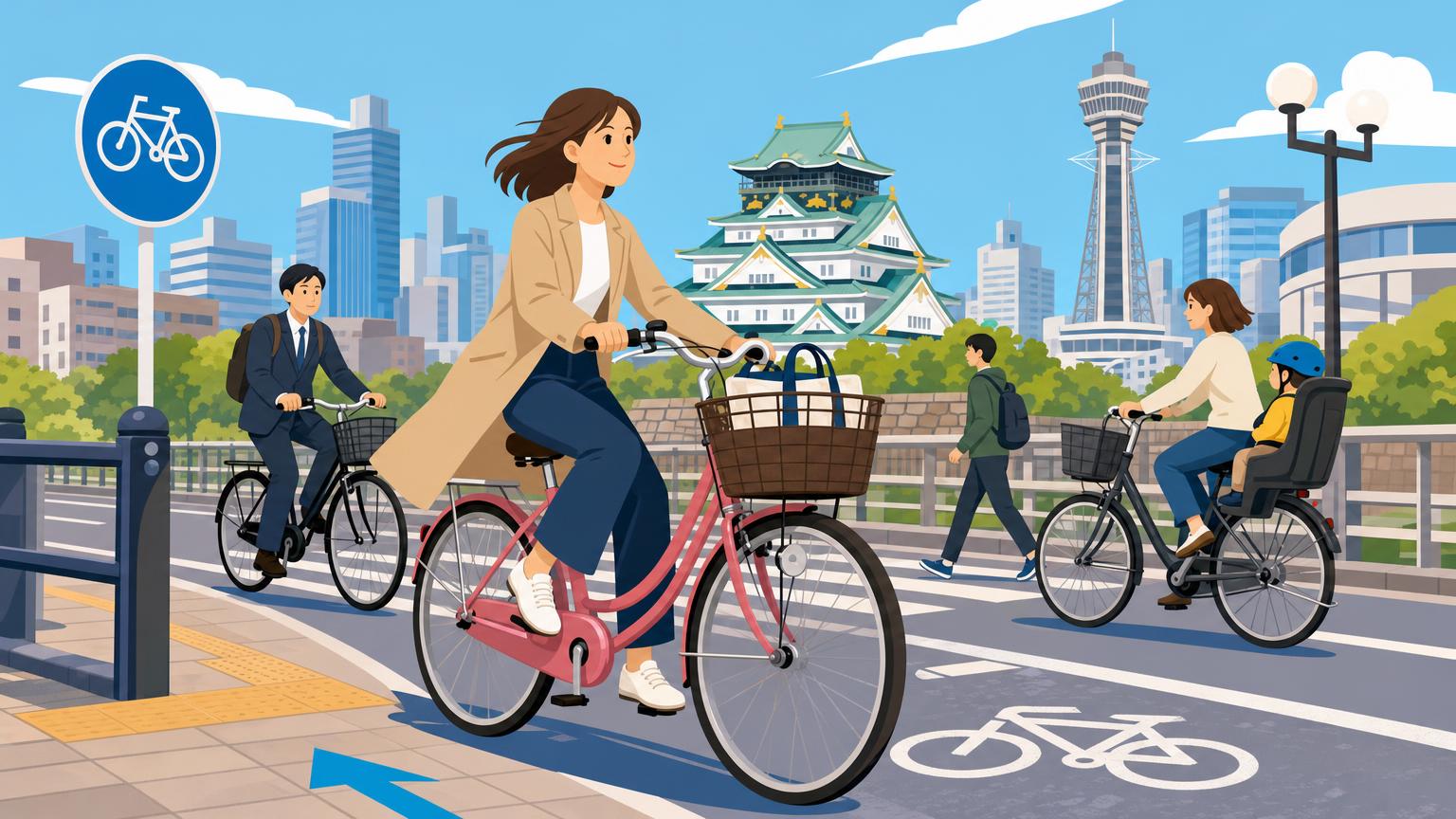
You may have already noticed the scene. A parent in a padded jacket rides one-handed through a narrow shopping street. A child sits in the front seat, another child sits behind, and a basket carries groceries, school bags, or a folded umbrella. At a station, dozens of bicycles are arranged in neat rows while a few others are tied to railings, signposts, or guardrails. At a red light, some riders stop carefully. Others slow down, look around, and continue as if the signal were only a suggestion.
If you are learning daily life in Osaka, this can be confusing. Is a bicycle treated like a vehicle or like a walking aid? Why do people ride on sidewalks when the rules say to use the road? Why does a resident sometimes stop in the middle of a cycle lane to speak with a neighbor? Why can a bicycle that appears harmlessly parked outside a station suddenly disappear?
The answer is that Osaka cycling is a mixture of formal law, practical habit, neighborhood memory, and a strong instinct to keep daily life moving. The word mamachari usually refers to the practical Japanese family bicycle: a sturdy city bicycle with a front basket, chain guard, kickstand, upright handlebars, and often one or two child seats. It is not a sports machine. It is a household tool, closer to a washing machine or shopping trolley than to a recreational bicycle.
For foreigners living in Osaka, understanding the mamachari means understanding more than how to turn left. It means learning how people share narrow streets, how residents judge whether a situation is “safe enough,” how direct communication works when paths become crowded, and why bicycle parking is treated as a serious public issue. Osaka is not simply a city where people happen to ride bicycles. In many neighborhoods, the bicycle is part of the local infrastructure of family life.
The map below is included only as a practical orientation to the central Osaka area discussed in this article. It is not a sightseeing route. It helps show how closely residential streets, shopping arcades, railway stations, schools, and commercial districts are woven together.
What “mamachari” really means in Osaka daily life
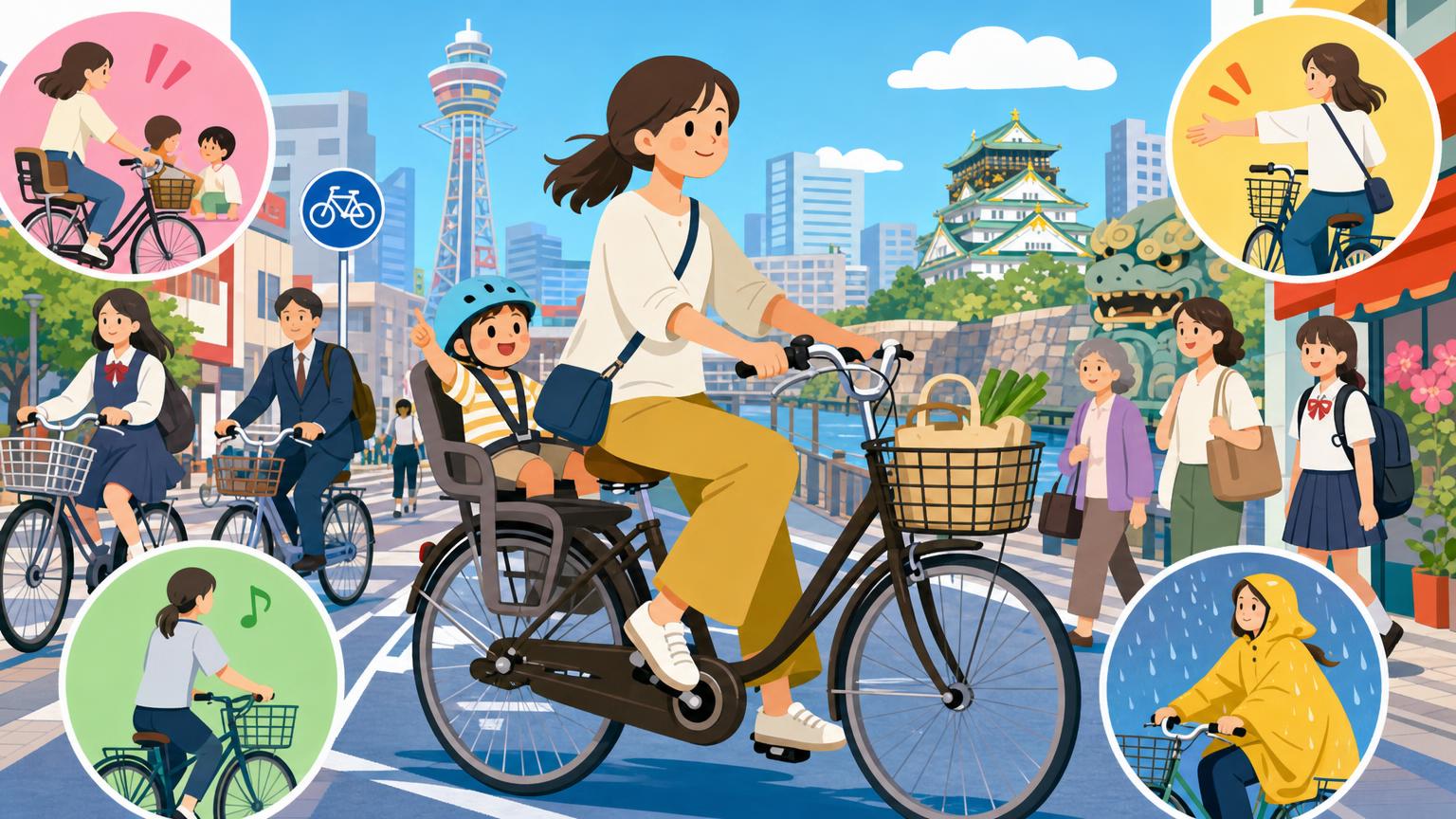
A mamachari is often translated as “mama’s bicycle,” but the name can be misleading to foreigners. It does not mean that only mothers ride them. Students, office workers, older residents, shop employees, grandparents, and delivery workers all use similar bicycles. The design is popular because it is stable, inexpensive to maintain, easy to mount, and practical for carrying things.
The typical rider is not trying to exercise. They are going somewhere specific.
They may be taking a child to kindergarten, stopping at a supermarket, visiting a clinic, collecting a parcel, traveling from a station to work, or carrying a bag of rice home. The bicycle is part of a chain of everyday tasks. A short bicycle trip may replace a bus ride, a car journey, and several minutes of walking.
This helps explain a feature of Osaka cycling that can surprise newcomers: many riders are not thinking like cyclists. They are thinking like residents who happen to be riding bicycles.
A sports cyclist may focus on lane position, speed, road surface, and distance. A mamachari rider is often thinking about the next errand, the child behind them, the traffic light near the supermarket, whether rain is starting, or whether there is room to stop outside the convenience store. Their attention is practical and local. They know the route because they use it every day, but they may not describe it in formal traffic terms.
This does not excuse unsafe behavior. It helps explain why the street can sometimes feel less orderly than a foreign resident expects. The system is not built solely around perfect lane discipline. It is built around thousands of people negotiating small movements in close quarters.
The bicycle as a household extension
In Osaka, a mamachari can serve as a mobile hallway, shopping basket, school-run vehicle, and informal neighborhood connection. The front basket may hold vegetables, a work bag, or a child’s rain cover. A rear rack may carry a delivery box or a heavy shopping bag. A parent may stop beside a pedestrian crossing to adjust a child’s helmet, exchange a quick greeting, or check a message before moving on.
This is why residents may appear to make sudden stops. Their bicycle is not simply transportation from A to B. It is part of the household routine unfolding outdoors.
Foreign residents sometimes interpret these movements as inconsiderate or careless. At times, they are careless. But often the rider is following a familiar neighborhood rhythm that locals understand without discussing it. A bicycle slows near a corner because children may come out of a side street. A rider moves toward the curb because a shop customer may step into the road. Someone rings a bell near a narrow entrance because they are giving a warning, not expressing anger.
The key is to distinguish between intention and result. A rider may not intend to challenge you, block you, or claim priority. They may simply be making a quick household adjustment in a space shared by everyone.
Why Osaka can feel different from Tokyo on a bicycle
The contrast between Osaka and Tokyo is easy to exaggerate, but the street-level difference is noticeable enough. Tokyo often feels more vertical, more centered around railways, and more compressed around major stations. Osaka also has dense central districts, but many neighborhoods are flatter, more mixed, and more connected by short local bicycle trips.
In Osaka, you might move from an apartment street to a shopping arcade, then to a school zone, and then to a small factory district, all within a few minutes. The city can feel less divided into clearly defined residential and commercial areas. A narrow road may accommodate pedestrians, bicycles, parked vehicles, delivery trucks, children, and customers entering shops.
This creates a different kind of urban awareness.
A Tokyo resident may plan around train exits and station transfers. An Osaka resident may plan around which side street avoids a busy intersection, where covered bicycle parking is available, which supermarket has space beside the entrance, or when a school route becomes crowded. These are not absolute distinctions, but they influence everyday behavior.
The Osaka preference for practical negotiation
Osaka communication is often described as direct, but directness does not always mean aggression. On a bicycle, it may take the form of a brief verbal warning, a hand gesture, a quick glance, or a simple phrase such as “すみません” or “ちょっと通ります.” The usual goal is to resolve the immediate problem without creating a formal confrontation.
A resident may speak sharply when you stop in the wrong place, but that same person may move around you two seconds later and continue shopping. In many Osaka interactions, the key question is not whether the tone sounds warm, but whether the problem has been resolved.
This may feel different from the more controlled politeness that foreigners often associate with Tokyo. People in Osaka may use humor, a louder voice, or a more visibly expressive reaction. That does not necessarily indicate hostility. At the same time, the idea that “people in Osaka are friendly” should not be treated as a free pass to ignore boundaries. A friendly city still has rules, and residents may be particularly impatient when someone creates avoidable trouble in a crowded passage.
What foreigners often misunderstand
Foreign residents sometimes make one of two mistakes.
The first is assuming that everyone on a bicycle follows the formal rulebook perfectly. They do not. The second is assuming that because local riders bend a rule, the rule is unimportant. It does matter, especially when an accident occurs, when police are present, or when a bicycle obstructs public space.
The local pattern is often this: residents know the official rule, understand the physical limitations of their neighborhood, and make informal judgments about risk. Those judgments may be reasonable, questionable, or plainly wrong. As a foreign resident, the safest approach is not to copy every local habit. Learn the law first, then understand the local rhythm so that you can move predictably within it.
The legal foundation: a bicycle is a vehicle
Under Japanese traffic law, a bicycle is classified as a “light vehicle,” not a pedestrian. Osaka Prefectural Police explains that bicycles are vehicles and that the basic rule is to ride on the left side of the roadway. The police also state that sidewalks are an exception rather than the normal place for cycling.
This is the foundation for everything else.
You should generally ride on the road, keep to the left, obey traffic signals, stop at stop signs, use a light at night, and avoid riding while holding or looking at a smartphone. Drinking and cycling are prohibited. Osaka Prefectural Police also recommend helmet use regardless of age, while Osaka’s bicycle insurance rules make liability insurance an important part of responsible ownership.
As of April 1, 2026, Japan’s bicycle traffic-offense system also includes a “blue ticket” procedure for people aged sixteen and older. Osaka police list examples such as using a smartphone while riding, ignoring a red light, failing to stop, riding on the wrong side, riding without lights, riding with an umbrella, and riding with earphones in situations covered by enforcement. The listed penalty amounts vary depending on the violation.
The practical message is simple: do not treat a bicycle as a casual object outside the scope of traffic law. If you ride in Osaka every day, you are a road user with responsibilities.
Roadside behavior that matters most
You do not need to memorize every article of the Road Traffic Act to ride safely. However, you do need to develop a few basic habits.
- Ride on the left side of the road when road and traffic conditions allow.
- Come to a complete stop at a stop sign, even when the intersection appears empty.
- Follow the appropriate signal. A bicycle riding on the road normally follows the vehicle signal; special pedestrian-and-bicycle signals may apply where indicated.
- Use a front light after dark. Reflective material and a rear light are also sensible.
- Keep both hands free for steering and braking.
- Do not hold an umbrella while riding. Wear rain gear or stop somewhere safe.
- Do not ride after drinking, even if you feel physically capable.
- Slow down before blind corners, driveways, school entrances, and shop doorways.
- Give pedestrians priority whenever you are in a shared space.
These habits are particularly important in Osaka because the built environment leaves little room for sudden movement. A narrow street may have no painted bicycle lane. A parked car may push you toward the center. A delivery vehicle may reverse out of a small shop. A child may run from a house entrance. In many situations, predictability is more valuable than speed.
Sidewalk cycling: why it happens and how to do it properly
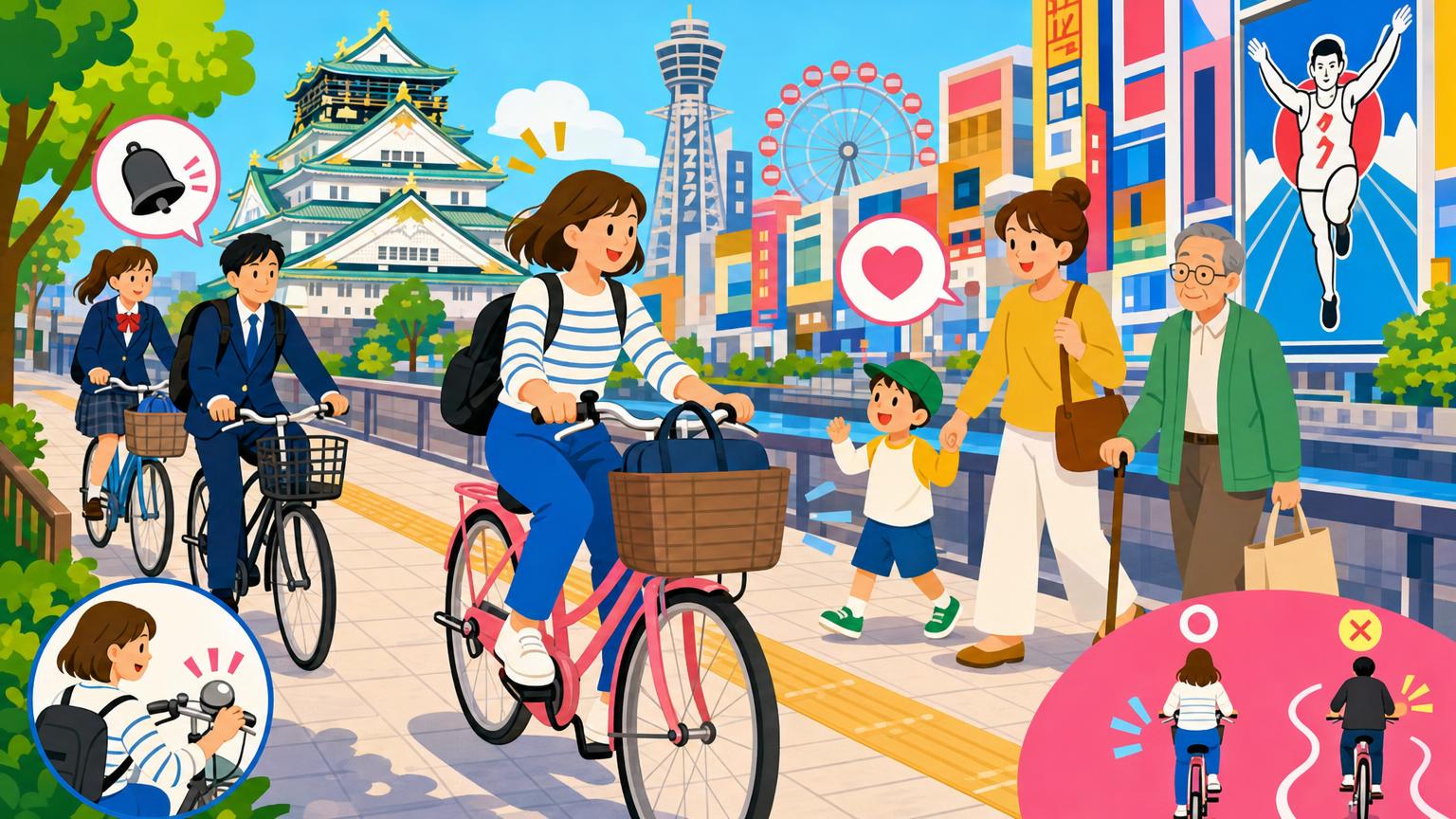
Many foreigners notice that residents ride bicycles on sidewalks even though bicycles are generally expected to use the road. The formal rule is not that “bicycles may always use sidewalks.” A bicycle may use a sidewalk in situations such as when a bicycle-allowed sign is present, when the rider is a young child, an older person, or a person with a disability, or when road conditions make traveling safely on the roadway difficult. Osaka police explain that when a bicycle is on a sidewalk, the rider must travel slowly along the roadway side, yield to pedestrians, and stop if pedestrians would be obstructed.
The reality at street level is more complicated because many Osaka sidewalks are shared spaces. They may be marked for bicycles, used by schoolchildren, lined with shop signs, or interrupted by bus stops and entrances. Some residents ride there because the road feels dangerous. Others do so because everyone in the neighborhood rides that way. Neither reason changes the requirement to yield to pedestrians.
The correct sidewalk mindset
If you need to use a sidewalk, think of yourself as a guest.
Do not expect pedestrians to move aside for you. Do not repeatedly ring the bell to make a path. Slow to walking speed near people, pass only when there is sufficient room, and stop whenever the space becomes uncertain. A bell should be used as a warning when necessary, not as a demand for priority.
If a sidewalk becomes crowded, get off your bicycle and walk. This is not an embarrassing failure. It is often the most socially intelligent choice.
When another bicycle approaches on a narrow sidewalk, reduce your speed early. Leave room for the other rider as well as for pedestrians. If someone is walking with a child, carrying shopping bags, or using a cane, give them extra space. Osaka residents may not announce these decisions aloud, but they notice whether someone understands that the pavement is shared.
Why locals sometimes ride differently from you
A long-term resident may ride on a sidewalk for thirty seconds to avoid a dangerous section of road, then return to the road at the next opening. They may know that a particular intersection has poor visibility or that cars regularly stop in the bicycle path. A foreign resident who copies only the sidewalk portion without understanding the local road situation may create a new hazard.
Observe the entire movement, not just the isolated action. Where did the rider come from? Was the road blocked? Was the sidewalk marked? Did they slow down? Did they yield? Local knowledge can explain a choice, but it does not turn reckless riding into good etiquette.
The daily commuting rhythm on a mamachari
The busiest moments for bicycles in Osaka are usually not the dramatic ones. They are ordinary transitions.
Around the time schools open, parents and children converge near smaller roads. During the commuter rush, bicycles appear along station approaches. In the late afternoon, shopping trips overlap with school pick-up. In the evening, office workers, students, and residents returning from supermarkets share the same narrow spaces.
The skill is not riding quickly. It is anticipating the next two or three movements.
Look for someone who is about to step away from a shop. Notice a parked car with its hazard lights on. Expect a taxi door to open near a station. Watch for a pedestrian looking at a phone. Assume that a child on a bicycle may turn without signaling. Keep enough distance to stop without shouting.
Commuting near stations
Station areas are where Osaka’s bicycle culture is most visible and most regulated. People want to park as close to the entrance as possible, but the space around stations must remain open for pedestrians, buses, emergency access, and businesses. Osaka City designates bicycle parking prohibition areas around railway stations. Within these areas, bicycles left on roads or station plazas may be removed immediately, even if they have been left only briefly. The city also states that bicycles locked to railings or other structures may be removed and that the lock may be cut during the removal process.
This is one of the most important differences between “I will only be five minutes” and local expectations for public space. Five minutes can still obstruct a path. A bicycle leaning against a guardrail may force a stroller into the road. A row of bicycles outside a shop may narrow the entrance for older customers. What seems temporary to the owner can become a daily obstruction for everyone else.
Use a designated bicycle parking area, commonly called a churinjo. Some are free, some require payment, and some use a machine that issues a numbered ticket or locks the front wheel. Read the signs before leaving your bicycle. If you are unsure, ask station staff, a nearby shop worker, or the parking attendant.
The small gesture that prevents conflict
When approaching a crowded station entrance, slow down before reaching the crowd. Do not ring your bell continuously. If you need to pass, say “sumimasen” in a calm voice and wait for a clear opening. If no opening appears, dismount.
Osaka’s preference for practical communication works best when your behavior is equally practical. A loud apology after nearly hitting someone is less useful than slowing down three seconds earlier.
Bicycle parking is part of neighborhood etiquette
Foreign residents often learn about bicycle parking only after receiving a warning sticker or finding that their bicycle has been removed. By that point, the local lesson has become both expensive and frustrating.
The basic rule is never to assume that a sidewalk, station wall, guardrail, or shop frontage is an acceptable place to park. Look for an official bicycle parking area. A supermarket may offer customer-only parking. An apartment building may have a residents-only bicycle room. A station may have separate parking areas with different time limits or payment systems.
What to check before leaving your bicycle
- Is there a bicycle parking sign or a marked rack?
- Is payment required after a free period?
- Must the bicycle be placed in a specific rack number?
- Is the facility open all night?
- Is your bicycle registered with the building, workplace, school, or landlord?
- Do you need to keep a ticket or receipt?
- Are there different rules for electric bicycles or bicycles with child seats?
Do not leave a bicycle across a tactile paving strip. Tactile paving helps people with visual impairments navigate the city, so blocking it is more than a minor inconvenience. Do not park in front of a fire exit, shop entrance, curb cut, bus stop, or narrow alley. Do not attach your bicycle to a public sign or fence simply because a lock fits.
Osaka City explains that bicycles removed from prohibited areas are taken to designated bicycle storage facilities, where owners must follow the return procedure. The city recommends having the bicycle registration number ready when making inquiries.
The local mindset is not that parking enforcement is an attack on bicycle users. Rather, it is that the street belongs to many users at once. If everyone claims a small piece of public space for a private bicycle, the result is not convenience. It is a blocked city.
Riding with children: the real mamachari responsibility
The mamachari becomes a different type of vehicle when carrying a child. The bicycle is heavier, slower to accelerate, and less stable when stopping. A parent may need to balance a child seat, a backpack, groceries, a rain cover, and even a second child.
Osaka’s bicycle safety guidance provides specific precautions for carrying young children. For example, when carrying two preschool children, the bicycle should be stabilized on flat ground with the stand engaged and the handlebar lock in use. The older child should be placed in the rear seat and the younger child in the front seat, with the child seats and belts used correctly. Adults should never leave children sitting on the bicycle unattended.
In daily life, the most important point is to treat loading and unloading as a separate activity. Do not try to mount while a child is still adjusting their helmet. Do not unlock the handlebar until you are seated and ready. Do not leave a child in the seat while you run into a shop “for just a moment.” A bicycle can tip over even when it appears stable.
How other road users read a parent with children
Most people give a family bicycle extra space, but they may not know which way the parent intends to turn. If you are riding behind a mamachari, do not pass too closely. Give the rider enough time to stop. If the bicycle is moving slowly near a school or kindergarten, assume there is a reason.
If you are the parent, make your movements clear. Signal your turn with your arm when possible, check behind you, and slow down before crossing a driveway. A child may shift their weight unexpectedly. The familiar Osaka habit of moving quickly through a gap is not appropriate when the bicycle is carrying children.
How to communicate without creating a street argument
Cycling etiquette is also a form of communication etiquette. Osaka residents may be expressive, but most everyday conflicts are avoided through small signals.
A brief “sumimasen” is helpful when passing slowly or asking someone to make room. “Abunai” means dangerous and may be shouted when someone is about to step into a bicycle’s path. A bell can alert someone who has not seen you, but it should not replace slowing down. Eye contact can help at crossings, although you should never assume it means the other person will stop.
When someone blocks your path
Do not immediately take a blocked path as a sign of disrespect. The person may be reading a notice, waiting for a child, carrying a delivery, or simply unaware that you are approaching.
Try giving a calm verbal warning. If the route remains blocked, stop. Do not squeeze through a gap that is too narrow. Do not brush past a pedestrian and apologize only after making contact. The Osaka style of “just get it done” is useful for ordinary inconveniences, but it should not become an excuse to pressure vulnerable people.
When someone speaks sharply to you
You may occasionally hear a complaint about your riding. The tone can sound stronger than the same words might in another city. Take a breath and listen for the practical point. Are you on the wrong side? Are you blocking a doorway? Did you pass too close? Did you ride quickly on a crowded sidewalk?
You do not need to win the conversation. Move safely, apologize if appropriate, and continue. In Osaka, many small confrontations are brief because both people prefer to get back to their day. A defensive explanation in English may make the moment longer and more uncomfortable than necessary.
At the same time, you are not required to tolerate harassment. If someone is threatening you or behaving dangerously, move toward a staffed public place and seek help. Practical communication is not the same as accepting abuse.
Rain, winter, and the uncomfortable truth about daily cycling
Osaka’s climate makes bicycle commuting possible for much of the year, but it is not always comfortable. Rain changes everything: roads become slippery, visibility decreases, umbrellas obstruct movement, and rain covers can limit a rider’s ability to see or steer.
Never hold an umbrella while riding. Use a proper rain jacket and trousers, a bicycle-specific rain cover, or stop in a safe covered area. A plastic convenience-store poncho may be safer than an umbrella, but it can flap into the wheels if worn carelessly. Keep your lights on whenever visibility is poor, not just after sunset.
Winter is usually manageable, with wind and cold posing more of a concern than deep snow. On a February morning, a mamachari can feel much colder than the same journey on foot because the moving air cuts through gloves and sleeves. Wear layers, cover your ears, and use gloves that still allow you to operate the brakes. Avoid bulky clothing that may catch on the handlebars or child seat.
Wet leaves, metal covers, painted road markings, and bridge surfaces can become slippery. Approach them slowly and keep the bicycle upright. Do not turn sharply while crossing a slick surface. If the weather becomes unpleasant enough that your hands lose feeling or your vision is impaired, stop and take the train or walk.
The local mindset is practical here as well. Residents may continue cycling through poor weather because work, school, and errands still have to be managed. That does not mean every condition is safe; it means the city’s routines are built around adapting to inconvenience.
The unspoken rule: be predictable, not perfect
Osaka’s streets are not perfectly uniform. You will see residents who stop completely at every signal and others who roll through empty intersections. You will see careful helmet users alongside people carrying open umbrellas. You will find bicycles on roads, sidewalks, shopping streets, and narrow alleys.
Trying to copy the most confident rider is a mistake. A better standard is predictability.
A predictable rider is easier for pedestrians, drivers, and other cyclists to understand. They keep left, slow down before intersections, and avoid sudden weaving. They do not stop in the middle of a narrow path without warning. They use lights, indicate turns, and leave space around children and older people.
This is where daily life in Osaka resembles daily life in other Japanese cities, but the density of small, mixed-use streets makes the lesson especially visible. You are constantly negotiating with people who are not sharing the road for the same reason. A delivery driver wants access. A parent wants to reach kindergarten. A shop worker wants to move boxes. An older person wants to cross slowly. A student wants to get home. A foreign resident wants to understand the system.
Everyone is moving through the same limited space.
Common mistakes foreign residents should avoid
Treating a bicycle like a pedestrian vehicle
Walking on the left does not mean you can ride on either side of the road. A bicycle is a vehicle, and riding the wrong way is dangerous because drivers and other cyclists do not expect you to approach from that direction.
Assuming an empty road makes a red light optional
A quiet intersection is still an intersection. Stop, check, and wait for the proper signal. This is especially important on roads with hidden side traffic, where a car or bicycle may appear suddenly.
Riding quickly on a crowded sidewalk
Even if other people do it, riding at speed creates risks. On a sidewalk, pedestrians have priority. Slow down enough to stop immediately, and dismount when the path becomes too crowded.
Ringing the bell as a demand
A bell is not a horn that gives you ownership of the path. Use it sparingly, and make slowing down your first response.
Parking outside a station “for a few minutes”
This is one of the costliest misunderstandings. In Osaka’s bicycle prohibition areas, even short-term parking can result in removal. Use a churinjo and keep the ticket or receipt.
Cycling after drinking
Do not ride home after drinking at a restaurant, bar, party, or company gathering. Arrange a taxi, walk while pushing the bicycle if appropriate, or leave the bicycle in a permitted location and return later. Alcohol affects your balance and judgment even when you feel calm.
Believing local informality means no enforcement
Osaka may feel relaxed in conversation, but traffic enforcement and bicycle removal are real. Since April 1, 2026, the blue-ticket system has made the consequences of certain bicycle violations more direct for riders aged sixteen and older.
A practical routine for new residents
When you buy or receive a bicycle in Osaka, begin with the unglamorous details. They help prevent the biggest problems.
- Confirm that the bicycle has valid theft-prevention registration.
- Check whether your rental apartment requires bicycle registration or a parking sticker.
- Obtain liability insurance as required under Osaka’s bicycle safety framework.
- Test both brakes, the light, the bell, the tires, and the kickstand.
- Find the location of the nearest legal bicycle parking area.
- Walk your usual route once before cycling it, especially if it passes through a school zone or busy station.
- Identify dangerous crossings, narrow sidewalks, and roads where cars are illegally parked.
- Save the bicycle registration number and take a photograph of the bicycle.
- Carry a small lock, even if the bicycle has a built-in wheel lock.
- Keep a rain jacket and gloves somewhere easy to reach.
Use the first week for observation. Notice when the street becomes crowded. Notice which side of the station has bicycle parking. Notice whether a shopping street allows cycling during certain hours or expects people to walk. Notice how residents slow down near schools and clinics.
You are not trying to become invisible. You are learning how the neighborhood breathes.
What Osaka people may think of a foreign cyclist
Most residents do not expect a foreigner to know every Japanese traffic custom. However, they do notice whether the person is making an effort to be safe and considerate.
A foreign resident who rides slowly, parks legally, waits at signals, and dismounts on crowded sidewalks will usually earn quiet acceptance. By contrast, a foreign resident who rides against traffic, blocks an entrance, rings aggressively, or argues that “everyone else does it” makes a stronger impression than their nationality or Japanese ability.
This is an important aspect of living in Osaka. Social trust is often built through repeated small actions rather than formal introductions. The neighbor who sees you park correctly every day may never speak to you, but they understand that you are not creating extra work. The shop worker who watches you slow down near the entrance learns that you are aware of the space. The parent at the school crossing notices whether you pass carefully.
You become part of the neighborhood through your habits before you become part of it through conversation.
The deeper lesson of the mamachari
The mamachari reveals a side of Osaka that is easy to overlook if you see the city only through its trains, restaurants, and large commercial buildings. It presents a city organized around short distances, repeated errands, family logistics, and informal coordination.
It also reveals the limits of the city’s friendliness. People may be willing to help you find a route, explain a parking rule, or make room on a narrow street. However, they still expect you to notice how your actions affect others. A warm social atmosphere does not eliminate the need for discipline. In fact, the more closely people share space, the more important everyday discipline becomes.
Osaka’s cycling culture is therefore neither entirely relaxed nor completely strict. It is practical, crowded, adaptive, and sometimes inconsistent. The formal rules tell you what is legal, while local observation tells you what is expected. Good judgment tells you when to slow down, when to speak, and when to get off your bicycle.
If you remember only one principle, remember this: ride as though the person around you has somewhere important to go, because they probably do.
That is the street-level mindset behind mamachari life in Osaka. You are not simply traveling through the city; you are joining a daily negotiation among homes, schools, shops, stations, cars, pedestrians, and bicycles. Ride predictably. Park legally. Give people room. Speak briefly and calmly. Once those habits become natural, Osaka begins to feel less confusing—not because the streets become simpler, but because you begin to understand the people moving through them.