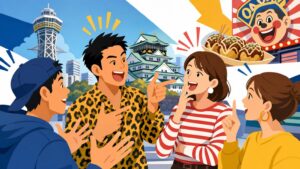
Osaka is loud. Osaka is bright. Osaka is a city that vibrates with a relentless, percussive energy that hits you the moment you step off the Shinkansen onto the concrete platforms of Shin-Osaka Station. If you have spent any time in Tokyo, you will immediately feel the shift in the atmosphere. Tokyo is a city of whispers, a city of quiet precision, a city where the unspoken rule is to avoid disturbing the peace of the collective. Tokyo operates on a frequency of polite distance. Osaka, however, operates on a frequency of immediate, undeniable proximity. In Tokyo, you hide in the silence. In Osaka, you swim in the noise. You feel it in the way people walk. You feel it in the way people stand on the right side of the escalator instead of the left. Most importantly, you feel it in the way people talk. The language here is not just a tool for conveying information. It is a tool for closing the gap between human beings. As a historical researcher who spends my days tracing the threads of Japan’s past into the fabric of its modern identity, I have come to realize that to understand Osaka, you must understand its rhythm. You must understand the historical and psychological underpinnings of a city built by merchants, not samurai. And at the absolute center of this cultural rhythm is a conversational art form known as Tsukkomi. For a foreign resident trying to navigate daily life in this chaotic, wonderful metropolis, mastering or at least understanding Tsukkomi is the key to unlocking the true warmth of the city. It is the difference between living in Osaka as an outsider and living in Osaka as a neighbor. This exploration is not a superficial guide to tourist attractions. This is a deep, unflinching look at the socio-linguistic mechanics of everyday life in the Kansai region. We will dissect the psychology, the history, and the practical application of Osaka’s unique sense of humor. We will look at how friendly jabs, witty retorts, and exaggerated reactions serve as the ultimate social glue in a city that values human connection above all else. Welcome to the real Osaka.
What is “Tsukkomi”? The Heart of Japanese Comedy in Osaka
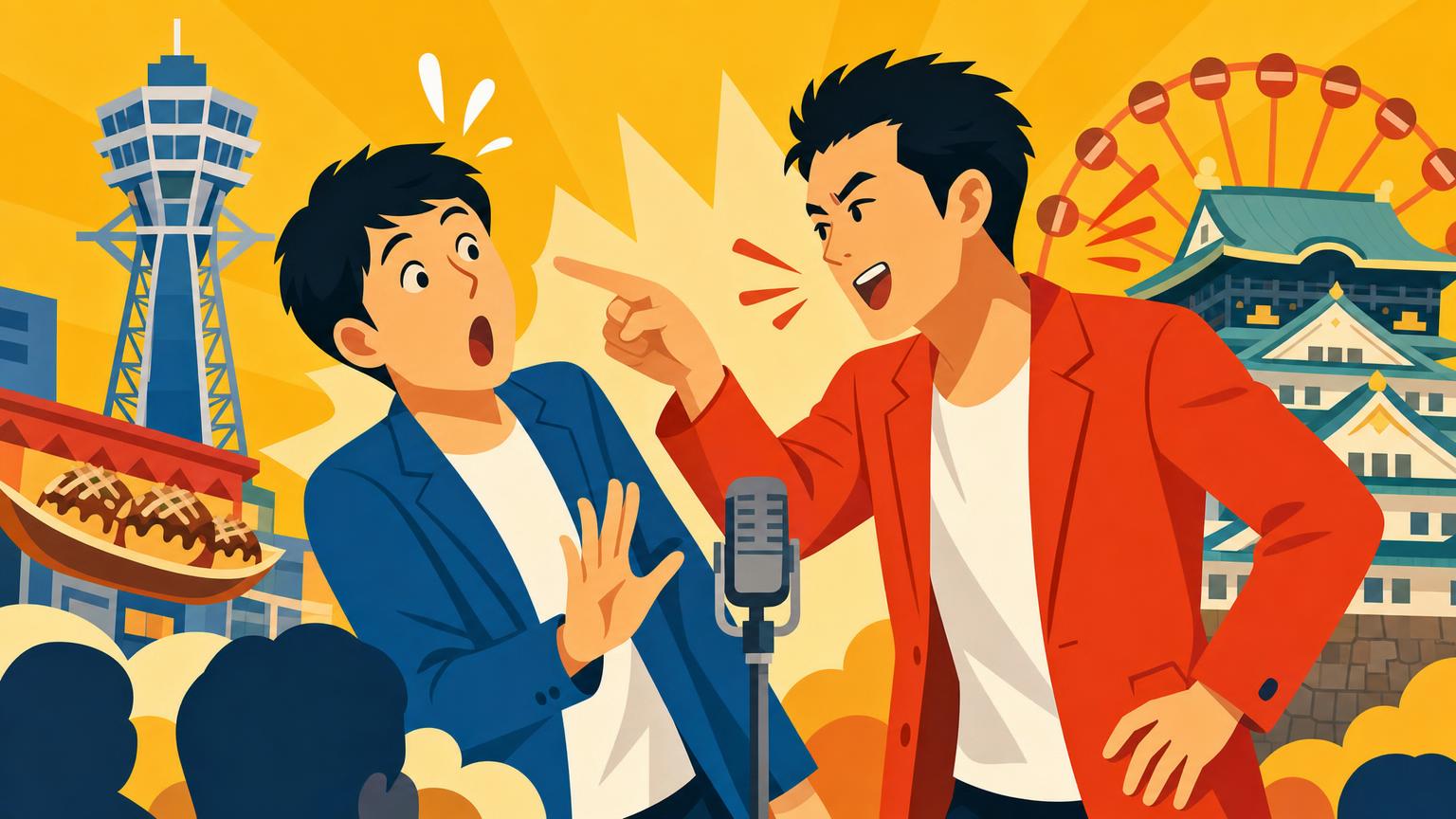
To the untrained ear, a conversation between two locals in Osaka may sound like an argument. Voices rise. Hands gesture wildly. Sharp, sudden interjections interrupt the flow of sentences. Someone might literally slap the back of another person’s hand. For an expat newly arrived from North America or Europe, this physical and verbal intensity can be startling. You might think you have just witnessed a friendship falling apart. In reality, you have witnessed the exact opposite. You have witnessed a moment of profound intimacy. You have witnessed Tsukkomi in action. Tsukkomi is not merely a comedic device reserved for television studios. It is a fundamental mechanism of social interaction in the Kansai region. It is the art of the reaction. It is the swift, sharp, and ultimately affectionate correction of absurdity. To understand Tsukkomi, you must realize that in Osaka, conversation is a team sport. It is a collaborative performance where both participants are responsible for keeping the energy alive, maintaining the rhythm, and ensuring that neither person takes themselves too seriously. In standard Japanese culture, particularly in the Kanto region around Tokyo, harmony is maintained through agreement. You nod. You say “sou desu ne,” which means “that is right.” You validate the other person by mirroring their reality. In Osaka, harmony is maintained through playful friction. You validate the other person by engaging with their absurdity. You show you are paying attention by playfully dismantling their illogical statements. This is the heart of the culture. It says, “I am comfortable enough with you to call you out when you are being foolish, and I trust you know I’m doing it with love.”
The Dynamics of Boke and Tsukkomi Explained
The origins of this conversational style go back centuries, evolving from a traditional form of Japanese stand-up comedy known as Manzai. Manzai began in the Heian period as a New Year’s blessing performed by two entertainers. Over time, it transformed into a fast-paced comedic dialogue that became the signature entertainment of the Kansai region. The structure of Manzai depends entirely on the interaction between two distinct roles. The first is the Boke. The Boke is the funny one, the foolish one, the person who misinterprets situations, leaps to illogical conclusions, or acts with a childlike misunderstanding of reality. The Boke lives in a dream world. The second role is the Tsukkomi. The Tsukkomi is the straight man, the voice of reason, the anchor to reality. The word Tsukkomi literally derives from the verb “tsukkomu,” meaning to thrust, plunge, or dive into. The Tsukkomi’s job is to thrust reality back into the conversation. When the Boke says something ridiculous, the Tsukkomi does not ignore it. Instead, the Tsukkomi points it out, highlights it, and verbally knocks it down for the audience to see.
Imagine a scenario in a modern Osaka supermarket. A husband and wife are shopping. The husband picks up a huge, incredibly expensive melon costing thousands of yen. He glances at his wife and says, completely deadpan, “We should get this for dessert tonight. I found a spare coin in the sofa.” He is playing the Boke, introducing absurdity into the mundane act of grocery shopping. If this were Tokyo, the wife might quietly put the melon back and gently remind him of their budget, aiming for smooth, conflict-free resolution. But this is Osaka. The wife, acting as the Tsukkomi, raises her voice slightly, adopts an exaggerated look of disbelief, and swiftly responds, “Are you a millionaire from the Edo period? Put that down before we go bankrupt!” She might even lightly swat his shoulder. She has completed the circuit. She has validated his joke by reacting with the appropriate level of comedic outrage. For foreign residents, understanding this dynamic is essential because Osakans often test you by playing the Boke. They might say something mildly ridiculous to see if you have the cultural awareness to play the Tsukkomi. If you take their absurd statements literally and respond with polite confusion, the rhythm falters. The conversation deflates. But if you recognize the Boke and step up to playfully point out the absurdity, you instantly bridge the cultural divide. You show that you understand their world.
Why Osaka People Are Known for Their Unique Sense of Humor
To grasp why this particular style of humor developed in Osaka rather than Tokyo, we must look deeply into the city’s historical DNA. Japan’s history is largely defined by the contrast between its two greatest urban centers. Edo, which later became Tokyo, was the seat of the Shogun. It was a city built by samurai, for samurai. Samurai culture was characterized by strict hierarchy, rigid codes of honor, stoicism, and a profound fear of losing face. In a society where one misplaced word could trigger a fatal duel or forced ritual suicide, you learn to choose your words carefully. You learn to avoid standing out. You prioritize formal politeness and emotional restraint above all else. This legacy still resonates in the quiet, orderly streets of modern Tokyo.
Osaka, by contrast, was Naniwa. It was the nation’s kitchen. It was a city built by merchants, traders, and commoners. Very few samurai lived in Osaka. The city’s economy revolved around rice, goods, and money. In a merchant society, stoicism gets you nowhere. If you sit quietly and refuse to engage, you don’t make a sale or build connections. Merchants had to be charismatic. They needed to approach strangers from different provinces, quickly break the ice, build trust, and strike deals. How do you break down a stranger’s defenses instantly? You make them laugh. Humor became a vital tool for survival and success in Osaka. Moreover, whereas a samurai dictates his reality from the top down, a merchant must negotiate reality on an equal footing. Tsukkomi inherently levels the playing field. When a shop owner plays the Boke and lets the customer take the Tsukkomi role, the shop owner is intentionally lowering his status to make the customer feel powerful, relaxed, and ultimately, more willing to spend. This merchant mindset shaped every layer of Osaka society. It created a culture that is decidedly pragmatic, highly communicative, and fiercely egalitarian. Osakans don’t care about your formal title or samurai heritage. They care about whether you are a good person to share a drink with, whether you can carry a conversation, and whether you have the warmth to engage in the lively, beautiful dance of daily banter. This is why Osaka people are renowned for their humor. It’s not just that they enjoy comedy—it’s that humor forms the very foundation of their social world.
Essential Osaka Tsukkomi Phrases and Kansai Dialect for Travelers
Living in Osaka as a foreigner means immersing yourself in a completely different linguistic environment. You may have spent years studying standard Japanese from textbooks in your home country and perhaps mastered the polite “Keigo” forms needed for corporate life in Tokyo. However, the moment you step into a local Izakaya in Osaka, you’ll realize that textbook Japanese only takes you so far. Kansai-ben, the Kansai dialect, is more than just an accent; it features a unique vocabulary, different pitch accent, and an entirely distinct emotional rhythm. While standard Japanese often strives for neutrality, Kansai-ben aims for character. It’s a language designed for storytelling, theatrical complaining, and most importantly, delivering the Tsukkomi. For a foreign resident, picking up a few key Kansai-ben phrases is the quickest way to show locals that you’re not merely a tourist passing through, but someone genuinely trying to become part of the community. You don’t need perfect fluency in Kansai-ben—in fact, that might come off as unnatural. However, skillfully using essential Tsukkomi phrases can significantly change how you are perceived, transforming you from an outsider into an active participant.
“Nandeyanen!” (Why the heck?!) – The Ultimate Tsukkomi
If there’s one phrase that captures the spirit of Osaka, it’s “Nandeyanen.” This is the quintessential Tsukkomi phrase—a versatile tool in Kansai conversation. Literally, it translates to something like “Why the heck is that?” or “What the hell are you talking about?” Yet a literal translation doesn’t fully convey its true function. Nandeyanen is the verbal brake that stops a runaway train of absurdity. When someone says something ridiculous, contradictory, or plainly false, you respond with a Nandeyanen.
Let’s dissect this phrase. It’s not just about the words but their rhythm and delivery. The word has four syllables: Nan-de-ya-nen. The pitch accent is key. It starts low on “Nan,” rises slightly on “de,” reaches a peak on “ya,” then sharply drops on “nen.” The “nen” anchors the phrase and must be delivered with a crisp, percussive snap. You cannot whisper it or say it with hesitant politeness—it demands full commitment. Historically, “Nandeyanen” developed from older Kansai grammar where “ya” replaces the standard Japanese “da” (meaning “is”), and “nen,” an emphatic particle unique to the region, adds emotional weight and undeniable truth.
Picture yourself as an expat in a quiet Osaka neighborhood. You take your bike to the local repair shop because of a flat tire. The owner, an elderly man with a towel around his head, examines the tire and deadpans, “Well, the repair will take about three years. You can pick it up in 2029.” If you freeze, look worried, and say, “Three years? Really?” you miss the mark—you’ve broken the rhythm. The owner will sigh inwardly, realize you don’t get the culture, and switch into dull, standard customer service mode. But if you smile, wave your hand dismissively as if swatting a fly, and loudly declare, “Nandeyanen! I need it for work tomorrow!” you instantly become his friend. His eyes will light up; he’ll laugh, tell you it will actually take ten minutes, and probably offer a discount or a free coffee while you wait. By using Nandeyanen, you acknowledge his Boke; you step into the Tsukkomi role. You play the game and build a connection. This is the magic of the phrase—turning mundane transactions into moments of shared joy.
“Shiran Kedo” (I don’t know, though) – The Classic Osakan Disclaimer
While Nandeyanen is the sharp sword of the Tsukkomi, “Shiran Kedo” acts as a soft, reassuring shield. This phrase has recently gained popularity even outside Kansai, but its essence remains deeply rooted in Osaka. Literally, it means “I don’t know, though” or “But I don’t really know.” It’s often added at the end of a sentence, typically following a long, passionate, detailed explanation or confident advice.
To grasp “Shiran Kedo,” you must understand Osaka’s eagerness to help paired with a strong aversion to taking unnecessary responsibility for matters beyond their control. Osakans love to talk and offer advice. If you look lost at an Osaka train station, a local will likely approach, grab your map, and enthusiastically explain which train to take, which platform it departs from, and where to stand to get the best seat. They speak with the authority of an experienced conductor. Then, right at the end of this well-delivered monologue, they shrug slightly, avert their gaze, and say, “Shiran Kedo.”
For foreigners, this can be puzzling. You might wonder, “Wait, did you just make that up? Do you really know where the train is?” But you shouldn’t interpret “Shiran Kedo” literally. The person knows precisely where the train is. Instead, it’s a psychological safety net. By adding it, they remove the heavy formal responsibility of a guarantee. They’re saying, “I’m giving you this information with goodwill and confidence, but we’re all human, the world is unpredictable, and if the train is late or I made a small mistake, please don’t hold it against me.” It keeps the mood casual and friendly, preventing the conversation from becoming too serious or binding.
For a foreign resident, mastering “Shiran Kedo” is a lesson in assimilation. Imagine you’re at an Izakaya with your Japanese coworkers, and they ask for a recommendation for a good Italian restaurant back home. You describe a tiny hidden bistro in Rome—pastas, wine, atmosphere—and speak for three minutes straight. If you stop there, you risk sounding pompous. But if you finish, take a sip of your beer, and casually add, “Shiran Kedo,” the entire table erupts in laughter. You’ve perfectly caught the city’s rhythm, showing passion without taking yourself too seriously. You’ve skillfully navigated Osaka’s social balance.
“Aho Chauka” (Are you crazy?) – Friendly Banter vs. Insult
Navigating insults in a foreign language is always tricky. Words that seem identical in a dictionary can carry very different emotional weights depending on the region. The most important distinction for a foreign resident in Japan to learn is between “Baka” and “Aho.” This difference reveals a deep cultural divide between Tokyo and Osaka.
In Tokyo and Kanto, “Baka” is used casually among friends to mean “silly” or “foolish”—light and acceptable. However, “Aho” in Tokyo is a harsh insult, implying severe mental deficiency; it’s cold, clinical, and deeply offensive.
In Osaka and Kansai, the reverse is true. Here, “Baka” is a severe insult—a character attack that ends conversations and burns bridges. But “Aho”? Aho is an expression of warmth and affection. It’s the heart of Kansai’s endearment. When an Osakan calls you “Aho,” they are welcoming you into their circle, acknowledging your human flaws, and loving you for them. “Aho Chauka” literally means “Are you an idiot?” or “Are you crazy?” but in the Tsukkomi context, it translates to, “You’re being delightfully ridiculous, and I love you for it.”
Understanding “Aho Chauka” demands a look back at the region’s merchant history. Merchants accepted that people make mistakes—that human frailty is natural. When a comedian does something foolish on stage, the Tsukkomi slaps them and yells, “Aho Chauka!” The audience laughs because they see their own imperfections reflected.
For a foreigner in Osaka, getting called “Aho” by a local is a milestone. It means the polite, formal facade reserved for strangers has dropped. Imagine trying to assemble a piece of furniture you bought locally, but putting the legs on backward. Your Osakan neighbor comes over, sees your mistake, laughs heartily, and says, “Aho Chauka! You put it upside down!” A newcomer might feel insulted, but a local knows this is a warm embrace. The neighbor isn’t judging your intelligence; they’re teasing to build camaraderie. Learning to smile, nod, and playfully accept the label “Aho” is a crucial step in adapting to the city’s psychological landscape. It requires shedding the rigid pride often found in foreigners and allowing yourself to be the cherished fool.
Osaka Greetings vs. Standard Japanese: Speaking Like a Local
Daily life revolves around greetings. The way a city says hello and goodbye sets the baseline emotional tone of its streets. In standard Japanese, you learn phrases like “Konnichiwa” for good afternoon, “Irasshaimase” for welcome to a store, and “Arigatou gozaimasu” for thank you. These expressions are polite, functional, and universally understood. But in Osaka, relying solely on these standard phrases is like exploring a vibrant, technicolor city while wearing tinted sunglasses—you miss the subtle hues of the local culture. Osaka has its own unique set of greetings, deeply connected to its mercantile history, which carry a distinct rhythm and warmth that standard Japanese cannot duplicate. Understanding these greetings is not just about learning vocabulary; it’s about grasping the mindset of a community that sees every interaction as a potential long-term relationship.
Maido (Hello / Thanks for your business)
Step into any traditional shop, small restaurant, or local Izakaya in Osaka, and the first word you’ll hear is not “Irasshaimase.” It’s “Maido!” often called out with a booming, cheerful tone from behind the counter. Maido is the quintessential greeting of Osaka. It embodies the entire philosophy of this merchant city.
To understand Maido, we must consider its historical background. The word is an abbreviation of phrases like “Maido arigatou gozaimasu” or “Maido osewa ni natte orimasu,” which roughly mean “Thank you for your continuous patronage every time.” During the Edo period, Osaka was threaded with canals, and merchants traveled by boat or foot, visiting the same clients repeatedly over time. They didn’t need a simple “hello.” They needed a word that acknowledged the ongoing, cyclical nature of their relationship—a word that said, “We are in this together, time and again.” That’s how Maido began.
Today, Maido serves as a versatile, multi-functional greeting. It means hello. It means welcome. It means thank you for coming. It means I recognize you. For a foreign resident, hearing a shopkeeper switch from a polite, formal standard greeting to an enthusiastic “Maido!” as you walk in signals that you’ve crossed from being a faceless customer to a familiar regular. It’s a badge of honor.
But the true power of Maido lies in how you respond. If you reply with a stiff, formal standard Japanese greeting, you maintain distance. However, if you casually nod, smile, and reply with your own “Maido!” you instantly sync with the neighborhood’s rhythm. You’re speaking their language. You’re acknowledging the merchant spirit. Imagine visiting the same yakitori stand near your home every Friday night. The master behind the grill spots you amid the smoke and calls out, “Oh! Maido!” If you raise your hand slightly and say, “Maido, master. Beer please,” you have effectively cemented a bond that will ensure you receive the best chicken cuts and the warmest conversations for as long as you live in the area. Maido is not just a word; it’s an acoustic handshake.
Ookini (Thank you)
If Maido is the robust, energetic beat of Osaka’s daytime commerce, “Ookini” is the warm, lingering melody of its gratitude. Textbooks teach that thank you is “Arigatou.” Arigatou is lovely. It is polite. But in the heart of Kansai, Ookini holds the highest regard.
Historically, Ookini derives from the phrase “Ohoki ni arigatou,” where “ohoki ni” is an older adverbial form meaning “greatly” or “very much.” Over centuries of merchant banter, the “arigatou” was dropped, leaving just the modifier. When an Osakan says Ookini, they are literally expressing “Greatly.”
The charm of Ookini is in its phonetic softness. Arigatou includes hard consonants and a structured form. Ookini flows gently. It begins with a long, drawn-out “Oh,” dips on the “ki,” and softly resolves on the “ni.” It sounds like a sigh of relief, like a warm blanket. When you buy a bag of oranges from an elderly woman at the Kuromon market, and she hands you your change with a heartfelt “Ookini, careful on your way home,” you experience a deep human connection that transcends language.
For expats, using Ookini is a subtle craft. Because it is so deeply tied to Kansai’s traditional culture, a foreigner using it may sound like they’re performing a caricature if overdone. The secret is subtlety and context. You don’t shout Ookini at a clerk in a sterile, corporate convenience store in Umeda’s business district—they’ll likely be puzzled. But you do use Ookini when paying your bill at a tiny, family-run Okonomiyaki restaurant that’s been operating out of a garage for forty years. Used in the right setting, the response is almost always warmly positive. It shows cultural research and respect that locals truly appreciate. It says, “I’m not just living in Japan. I’m living in Osaka. I see the difference, and I honor it.”
Where to Experience Authentic Tsukkomi and Comedy in Osaka
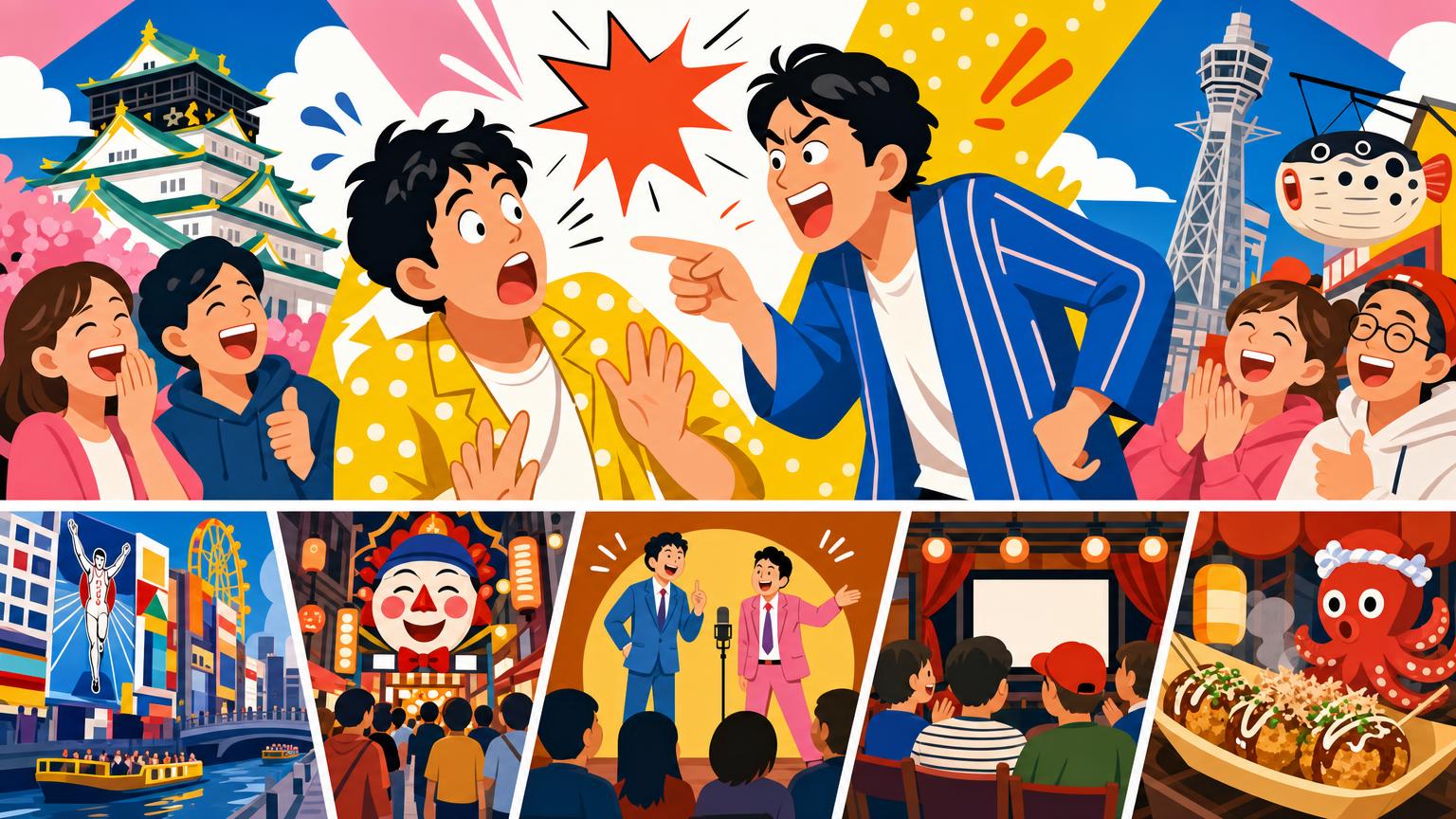
Grasping the theory of Tsukkomi is one thing; experiencing its chaotic, electric reality is quite another. Osaka is a city that openly displays its emotions, with its humor intricately embedded in the very layout of its streets. You cannot truly understand the culture by sitting quietly in an apartment and reading a book. Instead, you must step into the noise. You must immerse yourself in the rapid-fire exchanges of the locals. For a foreign resident eager to deepen their grasp of this distinctive social dynamic, certain places exist where the art of Tsukkomi is not only practiced but mastered. These venues serve as the laboratories of Osaka’s human connection.
Namba Grand Kagetsu: The Mecca of Manzai Comedy
To witness the pure, unfiltered, professional essence of Boke and Tsukkomi, a pilgrimage to the Namba Grand Kagetsu, affectionately known as NGK, is essential. Situated in the lively entertainment district of Namba, this theater is the flagship venue for Yoshimoto Kogyo, the enormous entertainment conglomerate that virtually monopolizes Japanese comedy. Yoshimoto Kogyo is to Japanese comedy what Hollywood is to American cinema. NGK is its vibrant core.
Even if your Japanese isn’t fluent enough to catch every lightning-fast pun or obscure cultural nuance, attending a show at NGK is a crucial educational experience for any expat living in Kansai. The reason is simple: comedy is physical, and rhythm surpasses vocabulary. Sitting in that theater, surrounded by hundreds of locals of all ages—from schoolchildren to elderly grandmothers—you begin to sense the collective heartbeat of the city. You watch the performers on stage. You see the Boke deliver an absurd remark. You feel tension build in the room. Then comes the sharp, percussive slap of the Tsukkomi, paired with a resounding “Nandeyanen!” The tension breaks, and the audience bursts into laughter.
You are witnessing a cultural ritual. You learn the city’s timing. You understand how loud is too loud, and how physical is too physical. You see that the physical slap of the Tsukkomi isn’t an act of violence but a precisely choreographed comedic punctuation. Even more importantly, you observe how engaged the audience is. They are not passive; they lean forward, anticipating the punchline. Understanding NGK helps you grasp why your coworkers banter as they do in the office breakroom: because they have grown up absorbing this exact rhythm on stage and television every day of their lives. It forms their cultural baseline.
Izakayas in Shinsekai and Dotonbori: Real-Life Banter
While NGK sets the professional stage, the true, raw, amateur practice of Tsukkomi unfolds in Osaka’s Izakayas. There are no better places to witness this than Shinsekai and the narrow alleys of Dotonbori. With its retro, post-war atmosphere, glowing neon blowfish lanterns, and the towering steel Tsutenkaku, Shinsekai feels disconnected from the sleek modernity of 21st-century Japan. It is raw, gritty, and unapologetically working-class.
The architecture of Izakayas here encourages interaction. Unlike the private, partitioned booths typical in Tokyo restaurants, traditional Osaka drinking spots often have a single, continuous wooden counter or “tachinomi” (standing bars) without chairs. Patrons stand shoulder-to-shoulder with businessmen, construction workers, and local artists. Physical closeness fosters verbal closeness. Isolation is impossible.
In these settings, Tsukkomi is the currency. A man three seats away might order a drink with a terrible pun, and the bartender will immediately fire back a sharp Tsukkomi, rolling his eyes and mocking the customer’s lack of originality. The whole counter laughs. It is a shared ecosystem of banter. For a foreign resident, standing at one of these counters is the ultimate cultural test. If you stand silently staring at your phone, you’ll be left alone—but you’ll miss the magic. If you engage—laugh at the bartender’s joke or play the Boke by asking a slightly silly menu question—you’ll be promptly drawn into the group’s orbit. Locals will eagerly play the Tsukkomi to your Boke. They’ll tease your chopstick skills, ask outrageous questions about your home country, and if you courageously reply with a well-timed “Shiran Kedo” or a laughing “Aho Chauka,” you won’t have to pay for your drinks all night. Here you learn that Tsukkomi is not just comedy; it’s a profound expression of inclusive hospitality.
Interacting with Friendly Vendors at Local Shopping Arcades
The most practical, everyday use of Osaka humor happens in the “Shotengai,” the covered shopping arcades threading through every neighborhood. Streets like Tenjinbashisuji—the longest shopping street in Japan—or the famous Kuromon Ichiba serve as lively arteries of commerce. Unlike the sterile, silent exchanges of modern supermarkets, shopping here is negotiation, conversation, and performance.
Vendors in these arcades are masters of the merchant mindset. They want your money, yes, but they aim to earn it through charm. If you pause to examine a pair of socks, the vendor might claim these exact socks were worn by the Emperor of Japan. It’s an obvious lie—a massive Boke. A tourist might nod politely and walk away confused, but a local knows it’s an invitation to play along. You pick up the socks, meet the vendor’s eye, and deliver a Tsukkomi: “The Emperor? Then why are they only 300 yen?! You must be crazy!”
The vendor laughs, admits defeat, and perhaps knocks 50 yen off the price. This interaction encapsulates daily life in Osaka. It’s a life lived out loud. By engaging in playful banter with the butcher, grocer, and bicycle mechanic, a foreign resident builds a network of local allies. No longer just an anonymous face in a crowd of millions, you become the foreigner with good timing—the neighbor who understands the joke. Bit by bit, you are woven into the fabric of the neighborhood, stitch by conversational stitch.
The Do’s and Don’ts of Using Tsukkomi as a Foreigner
Adopting the cultural habits of a new country is a delicate balancing act. On one side, you want to assimilate, connect, and show respect for the local way of life. On the other side, there is a fine line between cultural appreciation and cultural caricature. Trying to master the art of Tsukkomi as a foreign resident is highly rewarding, but it carries psychological risks. When done well, it opens doors to deep friendships; when done poorly, it can make people uncomfortable, confused, or even offended. To successfully navigate this landscape, you need to understand not only the words but also the subtle, unspoken psychological boundaries of Japanese society. You must learn the nuanced art of reading the air.
Reading the Room: When to React and When to Observe
In Japanese culture, there is a concept called “Kuuki wo yomu,” which literally means “reading the air.” It involves gauging the emotional atmosphere of a room and adapting your behavior to maintain harmony. In Tokyo, reading the air often means recognizing when to remain quiet. In Osaka, it usually means knowing when you are expected to be loud, when to interject, and when to deliver a Tsukkomi. However, just because Osaka is livelier doesn’t mean that social hierarchies and situational appropriateness vanish; they are simply different.
The most crucial rule for a foreigner attempting Tsukkomi is to understand the hierarchy within the relationship. Tsukkomi requires either an equal status or a scenario where the higher-status person intentionally takes on the Boke role. You do not deliver a sharp “Nandeyanen” to your company president during a formal board meeting, even in Osaka—that would be career suicide. The Boke and Tsukkomi dynamic is reserved for peers, casual settings like drinking parties (Nomikai), or interactions with local vendors, where a playful crossing of boundaries is socially acceptable.
Moreover, you must be keenly aware of your own position as an outsider. When a local acts as the Boke, they are inviting your reaction, which is safe. But if you try to forcibly initiate comedy by delivering an aggressive Tsukkomi to someone who wasn’t actually joking, you will disrupt the harmony of the room. For example, if a coworker is sincerely discussing a difficult problem at home and you respond with a loud joke, you have failed to read the air. The golden rule is to start as an observer. Watch how your local friends interact, notice who plays Boke and who plays Tsukkomi, and feel the rhythm of their timing. Only once you are fully comfortable with the group’s emotional temperature should you step in and deliver your own responses. Let them lead you into the exchange.
Respecting the Culture of Kansai-ben
Language is deeply intertwined with identity. For the people of Osaka, Kansai-ben is more than a dialect; it is a powerful source of regional pride and a symbol of historical resistance against Tokyo’s cultural dominance. When a foreigner makes an effort to learn and use standard Japanese, it is appreciated. When a foreigner genuinely strives to understand and respectfully use Kansai-ben, it is celebrated. But the key word here is “respectfully.”
The greatest danger for a foreign resident is treating Kansai-ben and the Tsukkomi culture like a caricature. Because Osaka humor is heavily featured in television and pop culture, some expats fall into the trap of imitating the exaggerated, theatrical voices of comedians in daily life. If you enter an office and loudly shout “Maido!” or “Nandeyanen!” in a fake, booming comedian’s voice, you are not engaging with the culture—you are mocking it. You reduce a rich, historical linguistic tradition to a joke.
Locals can immediately sense the difference between someone using the dialect to sincerely connect and someone using it as a party trick. To honor the culture of Kansai-ben, use it sincerely. Speak naturally without forcing the accent if it doesn’t feel right. Allow the vocabulary to gradually enter your daily speech naturally. When you use a phrase like “Shiran Kedo,” let it come from a genuine desire to soften your statement, not simply to sound cool.
Living in Osaka is a privilege. The city embraces you with a rare combination of ferocity and warmth. But it asks for your active participation. It demands that you let down your guard, laugh at your own mistakes, and learn to navigate the lively, beautiful rhythm of human connection. Tsukkomi is the key to this world. It teaches you that true harmony is not the absence of friction but the playful, affectionate navigation of it. So, the next time a shopkeeper in Shinsekai tells you an absurd lie or a friend makes a silly leap in conversation, don’t just nod politely. Take a breath, smile, and snap reality back into the room. Deliver the Tsukkomi. Beneath the sharpness of your words, you will find the warmest welcome the city has to offer.