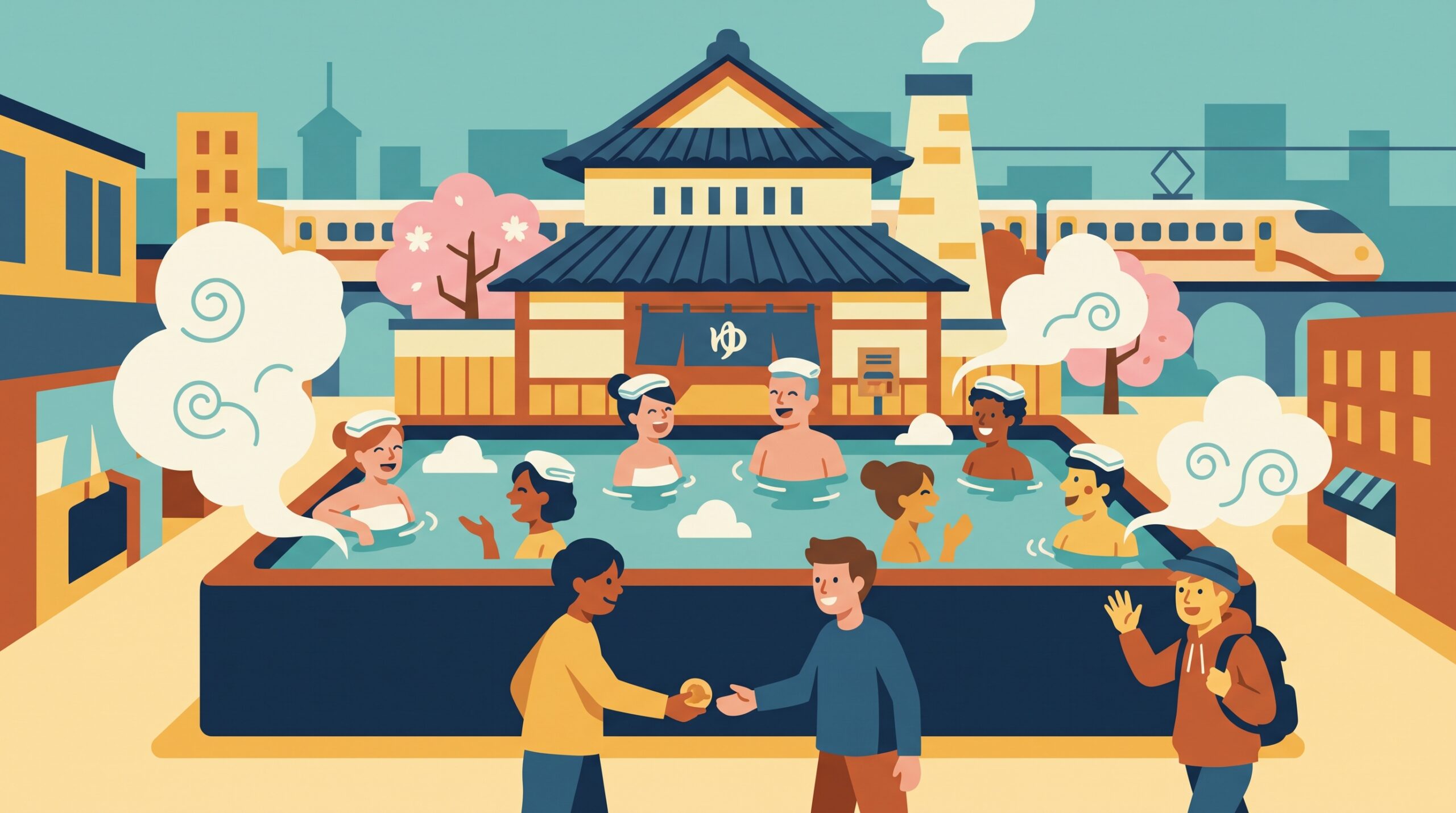
The streets of Osaka are loud, a chaotic symphony of bicycle bells, vendor shouts, and the endless rumble of the elevated trains. But beneath this frantic urban rhythm lies a different kind of heartbeat, a quieter, more intimate pulse that has sustained the working class of this merchant city for centuries. This is the sento, the neighborhood public bathhouse. For a foreigner navigating the complexities of expatriate life in Japan, the sento represents far more than a place to scrub away the grime of a humid Kansai summer. It is the ultimate equalizer. It is a classroom where the unwritten rules of local society are laid bare, quite literally, and where the barriers of language, status, and origin dissolve into the hot, mineral-rich waters. If you truly want to understand how Osaka thinks, how it feels, and how it differentiates itself from the stoic, reserved capital of Tokyo to the east, you must strip down, grab a small towel, and step through the sliding glass doors of a local bathhouse.
Living in Osaka is a profoundly sensory experience, one that demands participation rather than mere observation. When you move to this city, you quickly realize that the polished, polite veneer often associated with Japanese culture is significantly thinner here. Osaka people are pragmatic, fiercely local, and deeply invested in human connection. They do not care where you come from or what your job title is; they care about whether you can share a laugh, respect the communal space, and understand the unspoken rhythms of the neighborhood. Nowhere is this civic philosophy more evident than in the sento. The public bath is the living room of the community, a place where generations collide, where neighborhood gossip is traded over wooden buckets, and where the true, unfiltered spirit of Osaka breathes easiest. Understanding this culture is not about learning a list of rules; it is about absorbing a mindset. It is about learning to appreciate the beauty of shared vulnerability.
Yet, for many newcomers, the prospect of communal bathing is terrifying. The anxiety of doing something wrong, of offending the regulars, of breaking some invisible taboo, often keeps foreign residents locked in their cramped apartment shower stalls. This apprehension is natural, but it is also a barrier to experiencing the profound warmth of local life. This guide is designed to dismantle that barrier. We are going to explore the vast, steamy landscape of Osaka’s bathing culture, contrasting the intimate, community-focused traditional bathhouses with the sprawling, entertainment-driven super sentos. We will dissect the historical roots that make Kansai bathhouses structurally and socially unique, break down the precise etiquette required to navigate these spaces with confidence, and address the nuanced realities of integrating into a deeply traditional space as an outsider. From the retro tiles of local haunts to the expansive natural hot springs in Osaka, we will trace the waterlines that connect the city’s past to its vibrant present.
Discovering Osaka’s Bathhouse Culture
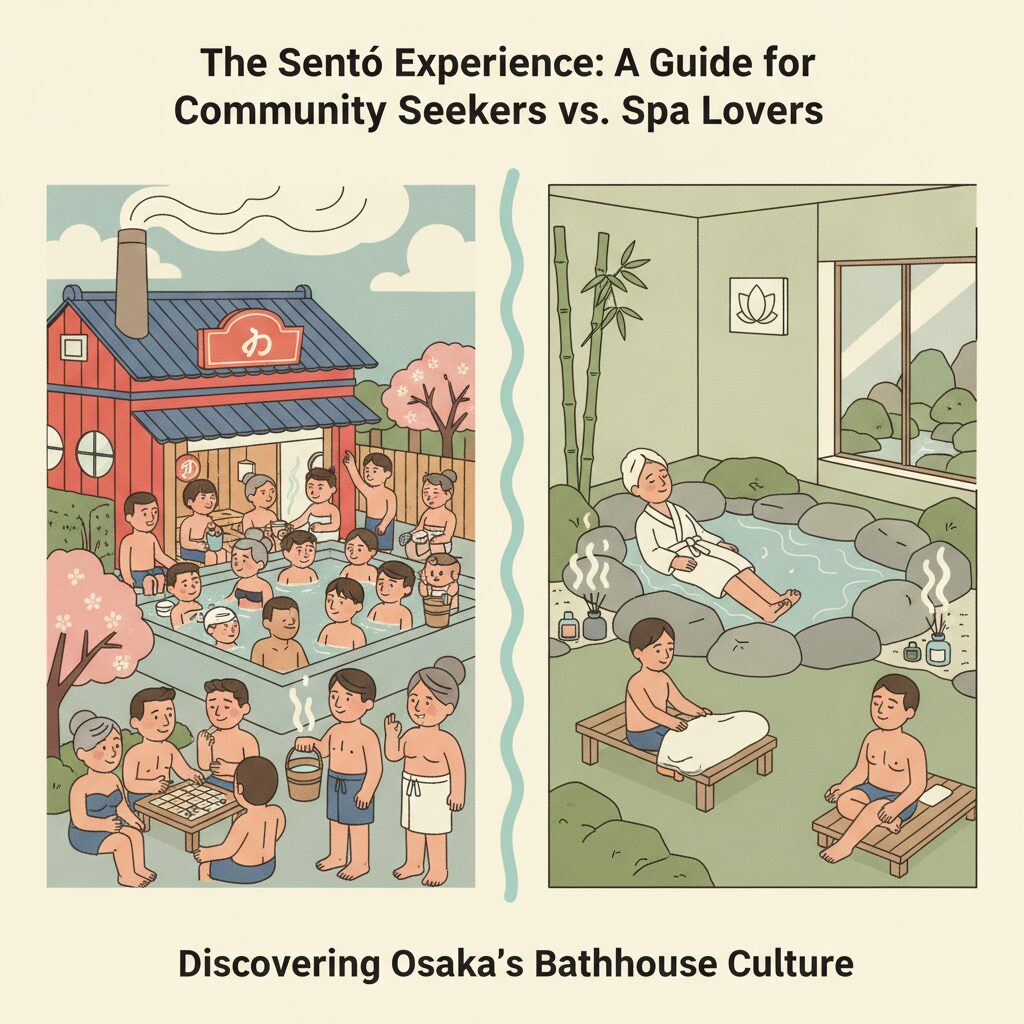
To truly appreciate the modern sento, one must understand the environment from which it emerged. Osaka has long been a city of commerce—a sprawling metropolis shaped by merchants, artisans, and laborers. Unlike Tokyo, designed as a political capital centered around the samurai class and the strict hierarchies of the shogunate, Osaka was a city of the people. Wealth was determined by trade, and practicality consistently outweighed pretension. This historical backdrop fundamentally influenced the city’s social dynamics, nurturing a culture that values direct communication, shared resources, and a robust egalitarian spirit. The bathhouse arose out of necessity during a time when private plumbing was a luxury reserved for the elite, but it quickly became an essential social institution that reflected the merchant city’s philosophy of communal living.
Sento vs. Super Sento vs. Onsen: What is the Difference?
Before immersing ourselves, it’s important to clarify the terminology, as the lines between sento, super sento, and onsen often become blurred in translation, confusing many foreign residents. A traditional sento is a neighborhood public bathhouse whose primary purpose is practical: to offer a place for people to wash their bodies. Sentos use heated tap water, though some may source water from local wells, and their prices are strictly regulated by the prefectural government to keep them affordable for everyone, regardless of income. They are small, tucked into residential blocks, and typically run by a single family. The atmosphere is intimate, sometimes even intimidating, as the patrons are almost exclusively local regulars who have been bathing there for decades.
Legally defined in Japan, an onsen is a facility that uses water drawn from a natural geothermally heated spring that meets specific temperature and mineral content standards. While onsens are generally linked to rural ryokans and mountainous resort towns, natural hot springs do exist in Osaka, often pumped up from deep beneath the city’s concrete. An onsen is identified by the source of its water rather than the type of facility. Therefore, a traditional sento could technically be classified as an onsen if it uses natural spring water, though such cases are rare in the city center.
The super sento, however, is a relatively recent creation born from Japan’s economic bubble and the growing desire for accessible urban leisure. A super sento is a large entertainment complex built around bathing. These facilities offer a wide variety of bath types, saunas, massage rooms, restaurants, and relaxation lounges. They are designed not only for washing but for spending an entire day in pure relaxation. These are privately operated, meaning their prices are not regulated by the government, often making them substantially more expensive than traditional sentos. While many super sentos incorporate natural spring water or pump it from deep underground—transforming them into large-scale urban onsens—their defining feature is their size and emphasis on leisure rather than basic hygiene.
The Historical Evolution of Kansai Bathhouses
The architectural design of a sento in the Kansai region, which includes Osaka, Kyoto, and Kobe, tells a story of historical divergence from the Kanto area around Tokyo. Having bathed in Tokyo before visiting a sento in Osaka, one would immediately notice structural differences that reflect contrasting cultural philosophies. Tokyo’s traditional sento features a massive, towering Mount Fuji mural on the back wall, with bathtubs arranged along the rear and side walls. The changing rooms are separated from the bathing area by a small courtyard or sliding doors, and the attendant sits in a high booth called a bandai, overseeing both men’s and women’s changing rooms. This design was influenced by the frequent fires and earthquakes that devastated Edo, necessitating resilient, standardized architecture focused on ventilation and clear sightlines for the attendant.
By contrast, Osaka avoided many of Edo’s devastating fires, allowing its bathhouse architecture to evolve differently. The Kansai sento typically places the main bathtub in the center of the room, creating an island of hot water around which bathers gather. This central placement encourages conversation; bathers sit on the edge of the tub, facing inward or outward, interacting in ways that the wall-facing tubs of Tokyo do not encourage. Additionally, Kansai sentos rarely showcase the iconic Mount Fuji mural, instead favoring intricate tile work, mosaic scenes depicting local landscapes, or European-inspired statues and fountains. The attendant’s booth in Osaka is often located in a front lobby area, outside the changing rooms, offering more privacy for bathers and reflecting a more modern customer service approach. These subtle architectural differences highlight Osaka’s mindset: a preference for interactive, communal spaces rather than rigid, standardized layouts.
Why Osaka Sentos Differ Geographically from Tokyo
Osaka’s geographical and economic realities also influenced its bath culture’s development. Built on water and crossed by rivers and canals that once served as arteries for its booming mercantile trade, the city’s early bathhouses were often located near docks and canals, catering to thousands of boatmen, stevedores, and laborers working the waterways. The water in Osaka, drawn from the Yodo River basin, was historically softer than the mineral-rich waters of the Kanto plain, affecting residents’ choice of soaps and bathing styles. The pragmatic Osaka merchant viewed the bathhouse not as a place for silent, solitary reflection, as romanticized in other parts of Japan, but as a bustling center for networking, deal-making, and lively social interaction. Even today, conversation levels in Osaka sentos are notably higher than in Tokyo; people do not just bathe—they engage.
Basic Sento Etiquette: A Guide for Foreign Visitors
The biggest obstacle for a foreigner wanting to experience an Osaka bathhouse is not the language but the complex network of unwritten rules and etiquette that govern the space. The Japanese bathing ritual is highly structured, involving a sequence of actions aimed at maintaining the purity of the communal water and ensuring the comfort of all patrons. Ignorance of these rules is not acceptable, and breaking them, even unintentionally, can cause real distress to local regulars. However, these rules make perfect sense once you understand their purpose: since the water in the tubs is shared, you must be completely clean before entering it. The bath is meant for soaking, not washing.
Step-by-Step Bathing Rules for Complete Beginners
The ritual begins even before entering the bathing area. Upon entering the sento, you remove your shoes and place them in a small wooden locker. Then, you pay the entrance fee to the attendant. In a traditional sento, this might be an elderly man or woman seated in a booth; in a super sento, it will likely be a ticket vending machine. Next, proceed to the changing room, which is strictly separated by gender. Here, you must take off all your clothing. Swimsuits, underwear, or any other garments are strictly forbidden in the bathing area. You may bring only two items into the bath: a small hand towel and your toiletries.
Once inside the tiled bathing room, do not head straight to the tubs. First, find an empty washing station. These stations come equipped with a low plastic stool, a plastic bucket, and faucets for hot and cold water. Sit on the stool—standing while washing is avoided to prevent splashing water and soap suds on others. Use your bucket to rinse yourself thoroughly. Then, lather your body with soap and wash completely. This is the most important step; you must scrub away all sweat, dirt, and grime before approaching the communal tubs. After washing, rinse yourself thoroughly to remove every trace of soap. Clean your stool and bucket, leaving the station tidy for the next person.
Now you may approach the baths. Enter the water slowly, as it is often much hotter than foreigners expect, sometimes exceeding forty-two degrees Celsius. While soaking, observe the golden rule of the sento: your small hand towel must never touch the communal water. Considered dirty because it is used for washing, dipping it in the pure bath water is a serious taboo. Most people fold the towel and place it on their heads or rest it on the dry edge of the tub. Soak quietly and enjoy the heat. If you need to cool off, step out and sit on the edge. When finished bathing and ready to return to the changing room, wring out your small towel and use it to dry off excess water from your body. Avoid dripping water on the changing room floor, as it creates a slipping hazard and is regarded as very inconsiderate.
What to Bring: Towels and Amenities
One common concern among foreign residents is what to bring. The requirements vary greatly between a traditional sento and a modern super sento. If visiting a local, retro sento, assume they provide nothing beyond hot water. You must bring your own soap, shampoo, conditioner, and towels. Most regulars carry a small plastic basket with their preferred toiletries. If you forget something, the front desk usually sells miniature, single-use packets of soap and shampoo for a small fee, and you can rent or buy a small towel. You’ll need two towels: a small, thin hand towel for use in the bathing area during washing and for modesty, and a larger bath towel stored in your locker to dry off after bathing.
Super sentos, on the other hand, operate differently. Because they cater to visitors seeking a day of leisure, they almost always provide high-quality shampoo, conditioner, and body wash at every washing station. They also offer towel rental sets, typically for a small extra charge. In super sento changing rooms, you will find an array of complimentary amenities, including hair dryers, cotton swabs, skin lotions, and sometimes even toothbrushes. When visiting a super sento, you can theoretically arrive empty-handed and find everything you need. However, when exploring traditional neighborhood baths in Osaka, bringing your own small kit shows respect for local culture and preparedness to follow its customs.
Navigating the Unspoken Social Contracts
Beyond the physical steps of washing and soaking, an intricate social dance takes place inside an Osaka sento. Unlike Tokyo, where public baths tend to be quiet and solitary, Osaka bathhouses are social spaces. You’ll hear laughter, animated debates about the Hanshin Tigers baseball team, and neighbors catching up on each other’s families. However, this doesn’t mean you should start loud conversations with strangers immediately. As a foreigner, you are a guest in their living room. The best approach is to observe quietly and acknowledge politely. A simple nod or quiet greeting when making eye contact is enough. If a local strikes up a conversation with you—which is quite likely given Osaka’s famously friendly and curious nature—respond warmly. They often genuinely want to know where you’re from and why you chose to visit their local bath.
Another unspoken rule concerns managing personal space. Sentos can get crowded, especially during early evening hours. If all washing stations are occupied, wait patiently. Don’t hover over someone washing. When in the tubs, make room for others to enter. Avoid stretching out and occupying a small bath alone. Also, staring is considered very rude. Although it’s natural to be curious about your surroundings, especially in a culturally novel setting, you must consciously avoid staring at other patrons. Everyone is naked, but the fundamental understanding is that this shared nudity is non-sexual and utterly mundane. Treat the space with the casual indifference of a local, and you will seamlessly blend into the flow of the room.
Best Traditional Sento in Osaka
For foreigners seeking authentic community connections and an unfiltered view of the daily lives of the local working class, the traditional sento is an absolute must. These are not tourist attractions; they are functional, living monuments of history. They are where the true spirit of Osaka endures, etched into the fading tiles and worn wooden lockers. Visiting these baths requires a willingness to step beyond your comfort zone, embrace the absence of English signage, and engage in a ritual that has remained largely unchanged for decades.
Healthy Onsen Tateba: A Retro Masterpiece
Situated in the deep south of Osaka, in the working-class district of Naniwa Ward, Healthy Onsen Tateba stands out as a quintessential example of the classic Osaka neighborhood bath. Operating since the mid-twentieth century, this sento offers an immersive retro aesthetic experience. Upon passing through the noren curtains, you are instantly transported to the Showa era. The changing rooms boast high ceilings, polished wooden floors, and vintage massage chairs that look museum-worthy but still function flawlessly. The real highlight, however, is the bathing area. Tateba is renowned for its intricate hand-painted tile murals that adorn the walls, showcasing vibrant landscapes and historical scenes. The water is distinctly hot, reflecting the older generation’s preference for a scorching soak to ease muscle tension. Various baths are available, including an electric bath that runs a mild current through the water—a uniquely Japanese experience that is both surprising and oddly soothing. Deeply embedded in the local community, Tateba may draw curious glances from other patrons when a foreigner visits, but they exude that unmistakable warmth of Osaka. Bring your own soap, respect the sauna’s silence, and you will be welcomed into one of the city’s hidden historical treasures.
Chidori-yu: The Beating Heart of the Local Block
Nestled within the dense residential maze of Fukushima Ward, Chidori-yu serves as a testament to the endurance of the traditional bathhouse amid modern urban development. Unlike Tateba’s grand tile murals, Chidori-yu embraces a simpler, more utilitarian design, focusing solely on the quality of the water and the comfort of its patrons. This small facility is often filled with locals by early evening. The air is thick with steam, accompanied by the sounds of splashing water and the distinct Kansai dialect echoing through the space. Chidori-yu’s exceptional nature lies in its steadfast dedication to the core sento experience. Its centrally arranged tubs—classic to the Kansai region—encourage social interaction. It’s common to see elderly men chatting about the day’s news while soaking shoulder to shoulder. For foreign residents, Chidori-yu provides an unparalleled chance to witness the social fabric of an Osaka neighborhood. There is no pretense here: bring your own amenities, follow washing etiquette carefully, and embrace the heat. This place demands respect but rewards visitors with a deep sense of belonging to the city.
Showa-yu: Preserving History in Awaji
Found in the northern area of Osaka, in Higashiyodogawa Ward, Showa-yu stands as a proud guardian of history. Its name pays tribute to the era it so faithfully preserves. The exterior features a traditional temple-style roof, once typical of Japanese bathhouses, designed to convey dignity and importance to the bathing ritual. Inside, Showa-yu is impeccably clean—an immense point of pride for the family that runs it. They have carefully preserved retro fixtures, from analogue scales to woven bamboo baskets for clothes. The bathing area boasts exceptionally deep tubs, perfect for fully submerged soaks that wash away the stresses of urban life. Showa-yu is notably welcoming, often hosting community events and working to introduce sento culture to younger generations and foreigners alike. The water is soft and gentle on the skin, while the atmosphere is noticeably more relaxed compared to the intense, fast-paced baths nearer the city center. For foreigners anxious about their first traditional sento experience, it offers a pristine, historically rich setting with a gentle learning curve.
Suehiro-yu: The Authentic Local Vibe
Hidden down a narrow alley in the bustling commercial district, Suehiro-yu is a sento for the truly adventurous—one that makes no concessions to modern trends or foreign tourism. It is gritty, authentic, and utterly charming in its steadfast refusal to change. The patrons here are the city’s lifeblood: shop owners, tradesmen, and laborers relaxing after a long day. The facilities are basic, the water blisteringly hot, and the space intimate. Yet, this cramped atmosphere fosters the strong camaraderie that defines the space. Mastering the complex washing etiquette here will earn you the silent nod of respect from the regulars. In places like Suehiro-yu, you understand that a sento is not just a place to cleanse the body but a vital psychological decompression chamber for Osaka’s residents—a place where the intense pressures of Japanese corporate and commercial life temporarily lift.
Best Super Sento and Natural Hot Springs in Osaka
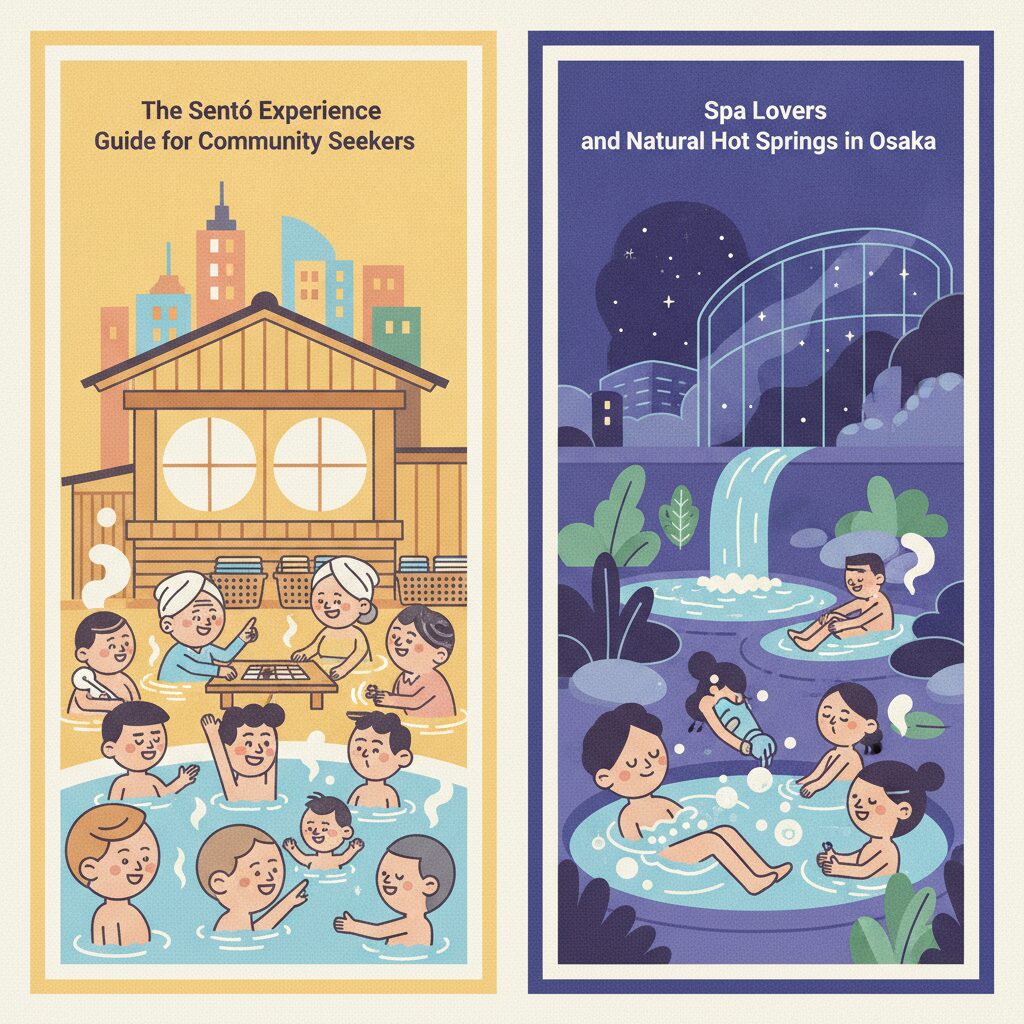
While the traditional sento provides an immersive experience into local community life, sometimes you just want to indulge in pure, unabashed luxury. For spa enthusiasts, foreigners seeking relaxation rather than cultural immersion, the super sento is a revelation. These expansive complexes blend the ancient custom of communal bathing with modern entertainment, offering a comprehensive range of saunas, bedrock baths, massage treatments, and dining options. Many of these establishments also qualify as an Osaka Onsen for foreigners, sourcing mineral-rich water from deep beneath the city streets, proving that you don’t have to travel to the mountains to enjoy authentic Japanese hot springs.
Rinku no Yu (Perfect Before or After Kansai Airport)
For international travelers and expatriates, Rinku no Yu Osaka offers the ultimate logistical convenience. Situated just one train stop from Kansai International Airport, within the Rinku Town complex, this facility is ideally suited as either your first encounter with Japanese bathing culture or your final moment of relaxation before a long flight. Unlike cramped neighborhood baths, Rinku no Yu is spacious, featuring large open-air outdoor baths (rotenburo) overlooking the bay. You can soak in natural hot spring water while watching airplanes descend toward the airport’s artificial island. The facility caters to modern tastes, providing plush towels, upscale amenities, and expansive relaxation lounges furnished with recliners and personal televisions. They offer rock salt saunas, highly favored for detoxification, and a variety of dining options serving classic Japanese comfort food. Due to its location, Rinku no Yu is well accustomed to foreign visitors, making it a stress-free environment for those unfamiliar with bathing etiquette. Signage is clear, the staff are accommodating, and the focus is entirely on physical and mental rejuvenation.
SpaWorld: Massive Bathing Entertainment in Shinsekai
If the traditional sento is a quiet neighborhood bar, SpaWorld is a vast, multi-story Las Vegas-style casino dedicated to bathing. Located in the historically rich and delightfully chaotic Shinsekai district, under the shadow of Tsutenkaku Tower, SpaWorld is a spectacle that must be experienced to be believed. It’s one of the largest bathhouse complexes globally, divided into two huge zones: the European Zone and the Asian Zone, which alternate monthly between men and women. The European Zone offers baths inspired by ancient Rome, a Greek herb bath, and a Finnish sauna house. The Asian Zone includes a Japanese outdoor stream bath, a Persian bath, and a Balinese resort pool. It’s unapologetically flashy, wonderfully extravagant, and extremely fun. SpaWorld isn’t a place for quiet reflection; it’s designed for families, groups of friends, and tourists to spend an entire day exploring endless varieties of heated water. They feature extensive dining courts, a massive indoor swimming pool with water slides, and a comprehensive gym. While it lacks the intimate charm of local bathhouses, SpaWorld provides a uniquely Osaka interpretation of the super sento: loud, colorful, oversized, and focused on maximizing entertainment value.
Nobeha no Yu: A Modern Oasis in Tsuruhashi
Tsuruhashi, Osaka’s Korea Town, is known for its winding alleys, the intense aroma of barbecued meat, and bustling markets. Within this sensory-rich environment lies Nobeha no Yu, a super sento that serves as a masterclass in modern Japanese relaxation. Nobeha no Yu is designed with a sophisticated and refined aesthetic, using dark woods, dim lighting, and minimalist architecture to create a deeply calming atmosphere. It sharply contrasts with the neon city lights outside. The facility is especially famous for its extensive “ganbanyoku” or bedrock bathing area. Visitors wear a special uniform and lie on heated stone slabs, believed to emit far-infrared rays that induce a deep, detoxifying sweat without the stifling heat of a traditional sauna. Nobeha no Yu also boasts excellent outdoor baths where you can soak in hot spring water while enjoying the cool night breeze. It’s popular among young professionals and couples seeking a high-end spa experience within the city center. It perfectly balances traditional bathing customs with contemporary wellness trends, making it a must-visit for serious spa enthusiasts.
Naniwa no Yu: Rooftop Serenity
Located in the northern part of the city near the bustling Umeda district, Naniwa no Yu offers a unique architectural feature: it sits on the rooftop of a large building. This elevated setting provides a surprising escape from the city’s dense urban environment. The highlight of Naniwa no Yu is its outdoor bathing area, beautifully landscaped with natural rocks and plants to create a tranquil garden atmosphere suspended above the city streets. They draw natural hot spring water from deep underground, ensuring an authentic onsen experience. The water here is renowned for its skin-softening qualities. Naniwa no Yu is easily accessible, impeccably clean, and offers a broad variety of indoor baths, including jet baths and cold plunges. It bridges the gap between a neighborhood bathhouse and a super sento, providing the conveniences and amenities of the latter while maintaining a slightly more local, community-focused feel than larger entertainment complexes like SpaWorld. It’s the perfect spot to watch the sunset over the Osaka skyline while soaking in steaming, mineral-rich water.
Navigating the Ink: Tattoo-Friendly Sento in Osaka
For many foreign residents and tourists, the biggest source of anxiety about Japanese bathhouses is the issue of tattoos. In Japan, tattoos have a long and complex history, closely linked to the yakuza, the nation’s organized crime syndicates. For decades, nearly all public bathing facilities, swimming pools, and gyms in Japan have enforced a strict ban on anyone with a tattoo, regardless of its size, style, or the bearer’s nationality. This blanket prohibition often surprises foreigners, who see tattoos as a form of personal art or cultural expression. However, understanding the nuances of this rule and how it is applied in Osaka is essential for anyone wishing to experience the city’s bath culture. Although the situation is evolving, careful navigation remains necessary.
The Historical Stigma and Modern Reality
The tattoo ban in public baths wasn’t originally intended to target foreigners with tribal bands or floral designs; it was a practical measure to keep organized crime out of communal spaces. Historically, elaborate full-body irezumi (traditional Japanese tattoos) were meant to intimidate, so bathhouse owners banned them to help ordinary citizens feel safe. Because Japanese rules tend to be applied uniformly to avoid confrontation or subjective judgments, the ban was extended universally to all tattoos. However, with Japan welcoming more foreign residents and tourists, and younger Japanese increasingly adopting Western-style fashion tattoos, this rigid stance is slowly softening. True to its pragmatic and commercially minded character, Osaka tends to be more flexible than Tokyo in this respect, but rules still vary widely depending on the facility you visit.
Why Traditional Sentos Welcome Tattoos
The most important information for tattooed foreigners in Osaka is this: traditional neighborhood sentos are almost always tattoo-friendly. Since traditional sentos are considered essential public hygiene facilities, heavily regulated and subsidized by the government to ensure all citizens have access to bathing, they generally cannot legally refuse entry to someone with tattoos. If a facility charges the standard prefectural sento fee (currently about 520 yen in Osaka), you will almost always be allowed in regardless of how extensive your tattoos are. At places like Healthy Onsen Tateba or Chidori-yu, for example, you might see local older men with traditional Japanese back tattoos bathing alongside you. The neighborhood sento acts as a great equalizer, where tattoos are simply not a barrier in these vital community hubs. This is why a search for tattoo-friendly sento Osaka will almost always lead to these retro, local bathhouses.
Finding the Right Tattoo-friendly sento Osaka
The difficulty arises when trying to visit a super sento or a private onsen resort. Classified as private leisure facilities, these places reserve the right to refuse service to anyone and almost always enforce strict no-tattoo policies. Venues like SpaWorld or Nobeha no Yu display clear signage at the entrance, and if you are found inside with a tattoo, you will be asked to leave immediately without a refund. However, some exceptions exist. A few modern facilities are starting to recognize the economic potential of the foreign market and are offering compromises. An increasing number of super sentos allow small tattoos if they can be fully covered by a flesh-colored adhesive bandage, often sold at the front desk. If your tattoo is larger than such a bandage, you won’t be permitted entry at these super sentos. Thus, tattooed foreigners must decide whether to embrace the authentic, hyper-local experience of traditional neighborhood sentos, where tattoos are always welcome, or to carefully research modern facilities that explicitly mention a tolerant policy. Attempting to hide a large tattoo and sneak into a strict facility is not only disrespectful to local customs but will also result in an embarrassing eviction.
The Sociology of the Osaka Bathhouse
To view the sento simply as a place to cleanse the body fundamentally misses its significance in Japanese society. The bathhouse serves as an essential sociological space, enabling a unique form of communication that is nearly impossible elsewhere. In a culture that often values stoicism, politeness, and maintaining a public facade (tatemae), the sento offers a vital outlet. It is a setting where the physical act of undressing parallels the psychological shedding of social barriers.
Naked Communication and the Concept of Hadaka no Tsukiai
The Japanese have a distinct term for this phenomenon: “hadaka no tsukiai,” which literally means “naked relationship” or “naked association.” The idea is that when people remove their clothes, jewelry, expensive suits, or worn work uniforms, they also remove their social status. In the bathwater, a corporate CEO and a local carpenter are seen as equals. This equality encourages a level of honesty and openness rarely found in everyday Japanese life. In Osaka, where the culture tends toward informality and directness, hadaka no tsukiai is even more pronounced. The sento is where neighborhood disputes are resolved, local political opinions are openly expressed, and generations interact. An elderly man might scold a young boy for splashing, acting as a surrogate grandfather. For foreigners, taking part in hadaka no tsukiai represents the ultimate form of integration. Sitting naked on a small plastic stool and exchanging a nod with the person washing next to you becomes a ritual of trust. It demonstrates your willingness to be vulnerable, to follow community norms, and to participate as a resident rather than a tourist.
Generational Shifts in Bathhouse Attendance
The social dynamics of the sento are currently experiencing significant change. The heyday of the neighborhood bathhouse was the mid-twentieth century, an era when most homes lacked private baths. Today, nearly every apartment in Osaka, no matter how small, includes a shower and a deep soaking tub. As a result, the traditional sento’s primary clientele has aged considerably. Visit any local bath in the afternoon, and you will find a sea of silver hair. For these older patrons, the sento is more than a place to bathe—it is a crucial connection to the outside world. It helps prevent isolation and ensures someone notices if they skip their daily soak. Meanwhile, a counter-movement is underway. Young people, burdened by intense corporate pressures and seeking a digital detox, are rediscovering the sento. The retro atmosphere appeals to their nostalgia, and the physical warmth offers essential comfort. Moreover, the rise of “sauna culture” (saunner) among young Japanese men and women has breathed new life into struggling bathhouses. For an observer, witnessing this generational interaction—the tattooed elder locals sharing the cold plunge pool with stressed young office workers—provides deep insight into the changing nature of Japanese community.
The Sentō as a Pillar of Neighborhood Resilience
In Osaka, the neighborhood sento also plays a vital role during crises. Japan is prone to natural disasters, especially earthquakes and typhoons. When infrastructure fails, power outages occur, and municipal water lines break, local sentos often become emergency centers. Many traditional baths draw water from deep, independent wells and use wood-fired or gas boilers, enabling them to function independently of the vulnerable city grid. After the devastating Hanshin Earthquake in 1995 and during major typhoons, sentos across Kansai opened their doors, offering free baths and clean water to displaced residents. The sento holds implicit trust within the community and is regarded as a dependable anchor when modern systems collapse. For foreign residents, patronizing a local bathhouse contributes to this resilience. Your entrance fee helps keep the boilers running, ensuring this indispensable community resource remains sustainable for the future.
Frequently Asked Questions about Osaka Sento
The prospect of entering a Japanese bathhouse can cause immense anxiety for those unfamiliar with the experience. The rules appear complicated, the heat seems overwhelming, and the fear of making a cultural mistake can be paralyzing. To help you move from a nervous newcomer to a confident regular, we will address the most common logistical and cultural questions foreign residents face when navigating the bathhouses of Osaka.
Can I bring my own soap and shampoo?
Yes, absolutely. In fact, if you are visiting a traditional neighborhood sento, bringing your own is expected. Most sentos do not provide complimentary toiletries in the washing area. Regular visitors carry small plastic baskets stocked with their preferred brands of body wash, shampoo, facial cleansers, and razors. If you forget your basket, don’t worry. Every sento has a small retail section at the front desk where you can purchase travel-sized packets of soap and shampoo for fifty to a hundred yen. Towels are also available for rent. Conversely, if you are visiting a super sento like SpaWorld or Rinku no Yu, high-quality amenities are provided in bulk dispensers at each washing station, so bringing your own is unnecessary, though certainly allowed.
How hot is the water usually?
This is often the most physically surprising aspect for foreigners. The water in a traditional Japanese sento is hot—very hot. While Western baths generally stay around thirty-seven to thirty-nine degrees Celsius, a typical Osaka sento maintains temperatures between forty-one and forty-three degrees Celsius (105 to 109 degrees Fahrenheit). Some older baths, catering to elderly regulars who prefer intense heat, can be even hotter. This temperature is intended to quickly relax muscles and induce sweating, rather than for long, leisurely soaks. When you first enter, move slowly. Avoid plunging in suddenly. Sit on the edge and pour water over your shoulders (kakeyu) to acclimate your body. Enter the tub gradually, minimizing movement—still water feels slightly cooler than moving water. If you feel dizzy or notice your heart racing, leave the tub immediately and sit on the edge or take a cold shower. Never push beyond your physical limits in a sento.
What is the proper way to use the sauna?
Many sentos in Osaka have saunas, often with a small additional fee (usually a few hundred yen), which is indicated by a special colored towel or wristband. Sauna etiquette is strict. First, you must have thoroughly washed your body before entering. Second, you must dry off completely before stepping into the wooden sauna room; bringing dripping water into the dry heat damages the wood and creates unpleasant humidity. Third, always sit on your towel, never letting your bare skin touch the wooden benches, out of respect for hygiene and future users. Finally, after exiting the sauna, you must rinse off sweat—usually with a bucket of cold water or a quick shower—before entering the cold plunge pool (mizuburo). Entering the cold pool while still sweaty is considered a serious breach of etiquette.
Do I need to speak Japanese to enter?
You don’t need to be fluent in Japanese to navigate a sento successfully, but knowing a few basic phrases and having a polite attitude will help greatly. The front desk transaction is usually straightforward: hand over the money, and they let you in. In super sentos, this process is often automated via ticket machines, many of which offer English language options. In traditional sentos, the most important communication is non-verbal: following the rules, washing thoroughly, and maintaining quiet respect for the space. If you need to buy a towel, simply say “Taoru, onegaishimasu” (A towel, please). If you accidentally bump into someone, a quick “Sumimasen” (Excuse me) is essential. The locals in Osaka are very understanding of language barriers as long as they see sincere effort to respect their customs and community space.
Are there specific days when sentos are closed?
Yes, almost all traditional sentos have a designated rest day, called a “teikyubi.” Since these are family-run businesses operating on slim margins, they cannot stay open every day. The closed day varies greatly; some close on Mondays, others on Thursdays. It is vital to check the specific sento’s schedule before you visit, usually by looking on Google Maps or the Osaka Sento Association website. Super sentos, supported by corporate funding and larger staff, are typically open 365 days a year, closing only a few days annually for required maintenance.
Integrating the Bathhouse into Your Osaka Life
The ultimate aim of this guide is not merely to help you get through one visit to the bathhouse, but to inspire you to make it an essential part of your life in Osaka. The sento is addictive. Once you push past the initial apprehension, the physical and mental benefits become unmistakable. The deep, penetrating heat eases the persistent aches from city walking, the forced digital disconnection offers a rare moment of mental calm, and the subtle, repetitive interactions with the neighborhood ground you in the city’s reality.
Making the Sento a Weekly Habit
To truly appreciate the power of the sento, you need to go regularly. Choose a day of the week—perhaps Sunday evening to wash away the stress of the past week, or Wednesday night to break up the work routine—and make it your dedicated bath night. Once you start showing up at the same time each week, something special happens. The staff at the bandai will recognize you. The elderly regulars will cease staring and start nodding. You’ll shift from being a novelty to a fixture. You’ll begin to notice the subtle rhythms of the place: the precise moment the water’s hottest, the corner where the cold draft bites most, the bucket that’s perfectly balanced. You’ll learn how to fold your towel just right on your head and how to slip into the boiling water without flinching. This routine embodies living in Japan. It’s the mastery of small, repetitive actions that bring order and comfort to a chaotic world.
Connecting with Your Neighbors
As you become a regular, the sento will reveal the neighborhood to you in ways that a visit to the local supermarket never could. Osaka residents are naturally talkative, and the shared vulnerability of bathing together breaks down the last walls of reserve. You might find yourself drawn into a chat about the rising price of daikon radishes or asked to explain the political situation in your home country while completely naked. Embrace these moments. They are among the rarest and most genuine interactions you can have as a foreigner in Japan. Don’t be afraid to look foolish, stumble over your Japanese, or admit you don’t understand. It’s the effort that counts. Through these brief, steamy conversations, you’ll map the human geography of your block, turning a vast, impersonal city into a community of familiar faces.
The Future of the Osaka Sento
The truth is that traditional sentos are vanishing. Each year, dozens of bathhouses across Japan shut their doors for good, victims of aging owners, rising fuel costs, and changing demographics. When a sento closes, a piece of the neighborhood’s soul disappears with it. The sprawling super sentos and the luxurious natural hot springs around Osaka will certainly endure, buoyed by tourism and the modern leisure industry. But the quiet, retro bathhouses—with their fading tiles and blistering hot water—are fragile. By choosing to support these local spots, you’re doing more than just cleaning your body. You’re voting with your yen to protect a vital cultural institution. You’re helping keep the boilers running, ensuring the warm, beating heart of Osaka remains accessible for the next generation of residents, both local and foreign. So grab your towel, step out into the humid Osaka night, and slide open the heavy glass doors. The water is waiting.