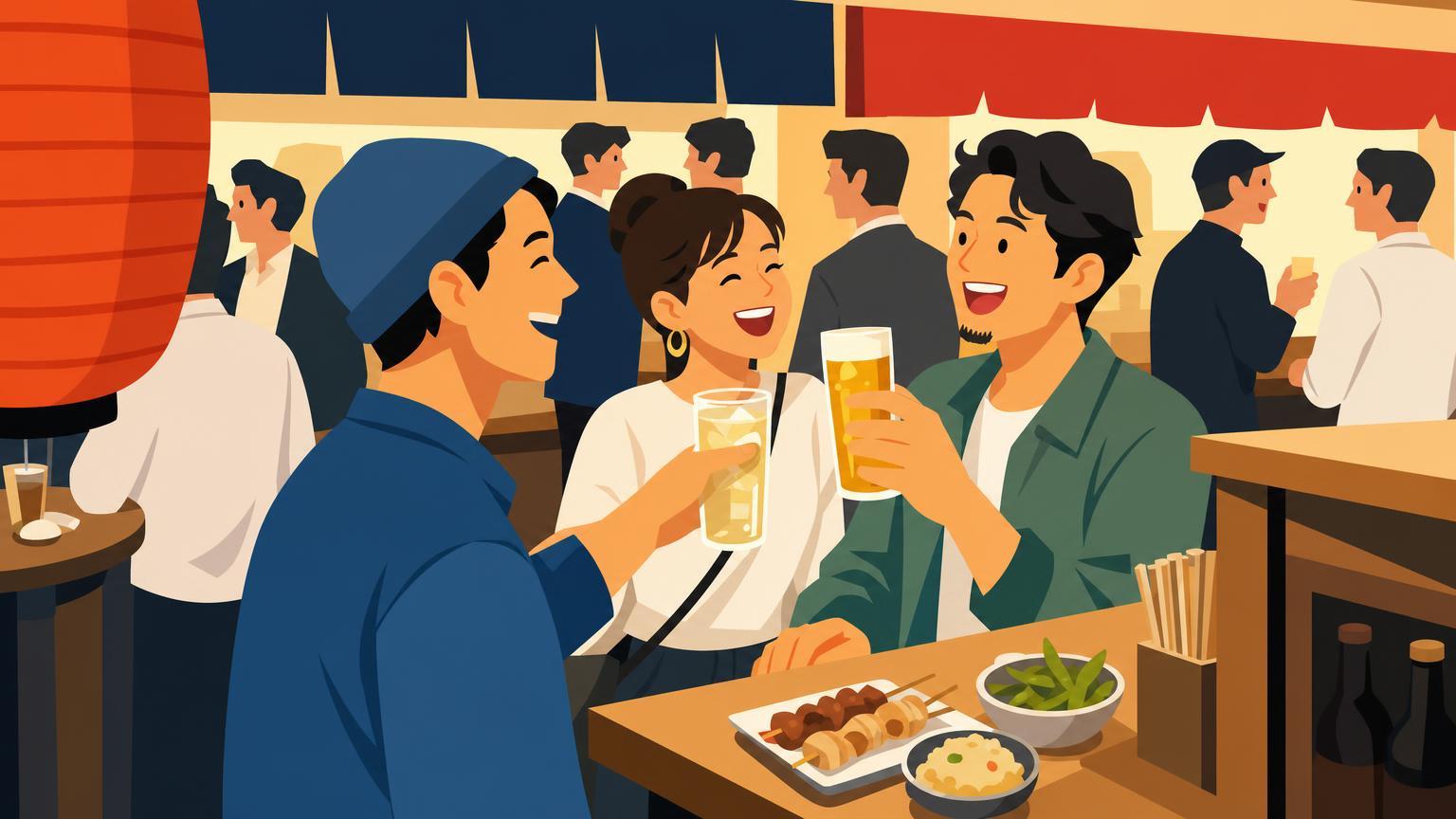
If you live in Osaka, or are trying to understand what daily life in Osaka is really like, you will eventually notice a strange-looking scene outside a small bar: office workers standing shoulder to shoulder, eating from tiny plates, talking across strangers, and leaving after less than an hour. There may be no chairs, no polished entrance, and no obvious English menu. This is Osaka tachinomi, the city’s standing-bar culture. It is not simply a cheap way to drink. It is a small daily system built around speed, affordability, shared space, direct conversation, and the Osaka habit of making ordinary pleasures feel worth discussing.
For many foreign residents, the first question is practical: “How am I supposed to enter a bar where nobody sits down and I cannot read the menu?” The deeper question is cultural: “What does this place say about Osaka people?” The answer is more interesting than the usual description that Osaka is “friendly.” A tachinomi shows how friendliness often works here. It is not always warm introductions or long conversations. It can be the staff shouting a quick joke, a customer shifting half a step to make room, or someone pointing at a dish and saying, “That one is good.”
A standing bar also explains an important difference between Osaka and Tokyo. Tokyo often organizes social life through reservations, polished neighborhoods, strong distinctions between insiders and outsiders, and carefully managed personal space. Osaka has those places too, but its everyday drinking culture is more comfortable with improvisation. You can arrive alone, order one small drink, eat one plate, exchange a few words, and leave without turning the evening into an event. You do not need to perform sophistication. You only need to understand the rhythm.
What Is a Tachinomi? Osaka’s Standing-Bar Culture
The word tachinomi combines tatsu, meaning “to stand,” and nomu, meaning “to drink.” A tachinomiya is a bar or small eating-and-drinking establishment where customers typically stand at a counter, around narrow tables, or outside under a covered entrance. Some establishments provide a few stools, while others offer a small number of seats for older patrons. However, the basic concept is that you do not settle in for a long, leisurely dinner.
The physical design is important. A standing bar usually has lower rent, less furniture, faster customer turnover, and a menu focused on small portions. These savings are passed on to the customer. In many parts of Osaka, a beer may cost roughly JPY 350–500, a highball JPY 300–450, and a small dish JPY 200–600, although popular seafood or seasonal items might be priced higher. Current local guides describe tachinomi as one of Osaka’s most affordable nightlife options, with many drinks and small plates priced below what foreign residents might expect at a full-service restaurant.
For someone living in Osaka, the key point is not just the low price. Tachinomi functions as social infrastructure. It provides a spot to stop between work and home, allowing a person to eat without cooking, drink without planning, and be near others without arranging a formal meeting. In a city where many commute alone, that brief pause can be significant.
The Difference Between a Tachinomi and an Izakaya
The distinction is not always clear-cut. Many izakaya have standing counters, and some tachinomi serve enough food to operate like casual restaurants. Yet, there are notable differences.
A traditional izakaya generally expects you to sit, order multiple dishes, and stay for a longer meal. A tachinomi encourages short visits, repeated small orders, and flexible movement. You might start with a beer, add grilled pork or sashimi, then leave after twenty minutes. Another customer may arrive alone, have one glass of sake, and be gone before you finish your second dish.
This is why tachinomi feels less like “going out for dinner” and more like stopping at a neighborhood crossroads. You’re not necessarily there to make friends; you’re sharing a temporary pocket of public life.
Why Osaka Developed Such a Strong Standing-Bar Image
Osaka has long been known as a commercial city where food, price, and practical enjoyment are valued. Historically, workers, traders, shop owners, and commuters needed places to eat and drink without spending much time or money. Standing bars fit that urban logic perfectly.
The culture also reflects a distinct Osaka preference for value. A customer might praise a restaurant by saying 安い、うまい—cheap and delicious—or by highlighting the amount of food served for the price. This is not merely bargain hunting; it’s a way to assess whether a business understands everyday life. While a restaurant charging high prices for small portions may be respected for its skill, a place that offers quality at a reasonable price earns a different kind of affection.
This doesn’t mean everyone in Osaka is loud, humorous, or eager to chat with strangers. That stereotype can be misleading. Many Osaka residents are quiet, private, tired after work, or simply focused on their meals. The standing-bar environment does not demand intimacy; it offers the possibility of brief contact without requiring it.
What Foreign Residents Often Misunderstand
The most common misconception is that a tachinomi is simply a casual version of a Western pub. This is not entirely accurate. You don’t automatically order one large drink and occupy a table for three hours. Nor should you expect staff to explain every dish, split every bill, or switch to English just because the area is popular with international residents.
Another misconception is that being “local” requires fluent Japanese. It doesn’t. Basic words, gestures, patience, and a willingness to accept uncertainty will serve you better than flawless pronunciation delivered confidently. The atmosphere tends to be forgiving when your behavior shows respect.
A third misconception is that the cheapest spot is always the best choice for a first visit. Very small bars can be inviting but might only have six standing spots and a handwritten menu that changes daily. If it’s crowded, staff may not have time to guide you. A slightly larger venue with a visible counter, food photos, or a display case may be easier as you get accustomed to the system.
A fourth misunderstanding involves conversation. If a customer speaks to you, it doesn’t mean you have to form a long international friendship. Osaka conversations can be brief, playful, and situational. Someone might ask where you’re from, comment on your Japanese, recommend a dish, and then return to their companions. That interaction still counts and isn’t a failed conversation simply because it ended quickly.
Essential Rules and Etiquette for Foreign Residents
Tachinomi etiquette is rarely displayed on signs and is typically learned by observing those around you. The rules aim not to exclude foreigners but to keep a small space flowing smoothly.
Entering Without Causing Confusion
Pause for a moment outside before entering. Take in the room, counter, payment area, and menu board. If there’s a line, wait your turn. Avoid standing in a narrow doorway while you decide.
Upon entering, a simple “Konbanwa” or “Onegaishimasu” suffices. During the day, “Konnichiwa” is appropriate. No lengthy speech is needed. A quiet greeting shows respect for the staff’s workspace, not a self-service venue.
If the room is crowded, use eye contact to ask before squeezing in. In a true standing bar, patrons often make space, but staff need to know if you’re staying for one drink or arriving with a group. One person can fit at the counter; four might not.
Understanding the Payment System: Cash-on-Delivery Versus a Tab
Payment methods vary. Don’t assume every tachinomi functions identically.
Cash-on-delivery
In a cash-on-delivery system, you pay as each drink or dish arrives. You might put coins or bills on a small tray, hand money directly to staff, or pay at a central counter. This method is common in compact, affordable bars to prevent confusion when customers come and go quickly.
Bring JPY 1,000 notes and coins if possible. Although JPY 10,000 notes are legal tender, handing one over during a busy rush can slow the counter. Some smaller or older establishments may not accept credit cards, electronic money, or QR payments. The official Tachinomi Shomin store list notes multiple Osaka branches, while local listings specify cash-only service at some locations. Check each branch individually rather than assuming uniformity across a chain.
Tab system
Some bars run a tab. Staff may give you a small numbered card, jot down orders next to your name, or simply remember your spot. Payment is made upon leaving. If unsure, ask “O-kaikei wa itsu?” (“When do I pay?”) or simply point to your wallet and say, “Saki ni harau?” (“Pay first?”).
The safest approach is to observe a local customer’s first order. If they place money on the counter, follow suit. If they pay at the register before leaving, do likewise.
Sharing Space and Observing Local Manners
Space is the core of tachinomi etiquette; you may have as little as forty centimeters of personal room. This is not rudeness but a necessity for sharing limited counter space.
Keep bags close to your legs or use provided hooks. Avoid spreading a jacket over an empty section if others are waiting. Keep your phone off the center of the counter. Don’t take photos of others without permission, especially in small spaces where everyone may be captured.
If someone steps away briefly, don’t assume their spot is open—they might be ordering, smoking outside, or chatting. If you need to leave temporarily, inform the staff or the person next to you.
Avoid blocking the serving area. Staff move quickly with hot plates, beer glasses, and heavy trays. If someone says “Sumimasen,” they might just need you to shift slightly. Move first and apologize afterward.
How Long to Stay?
No set time limit exists, but tachinomi encourages turnover. One or two drinks with a few dishes is typical. If the bar is nearly empty, staying longer is fine. However, if there’s a line outside, finish your drink, pay, and make room promptly.
This highlights a key difference from a living room—the goal is not to claim a spot but to engage in a flowing social rhythm.
Smoking, Noise, and Personal Boundaries
Smoking policies vary widely. Some older bars allow smoking, some have designated areas, and others are smoke-free. Don’t assume an open door means no smoking.
While the atmosphere may be lively, loud English conversation can carry more than expected in a small bar. Speak at a normal volume, then lower it if the room quiets. Osaka humor can be boisterous but is not an excuse to turn a neighborhood bar into a performance space.
Physical contact isn’t inherently friendly. A shoulder tap might occur in crowded areas, but hugging strangers, touching staff, or leaning over others is inappropriate. Warmth is usually expressed through words, recommendations, and helpful gestures rather than constant physical closeness.
Decoding the Osaka Tachinomi Menu
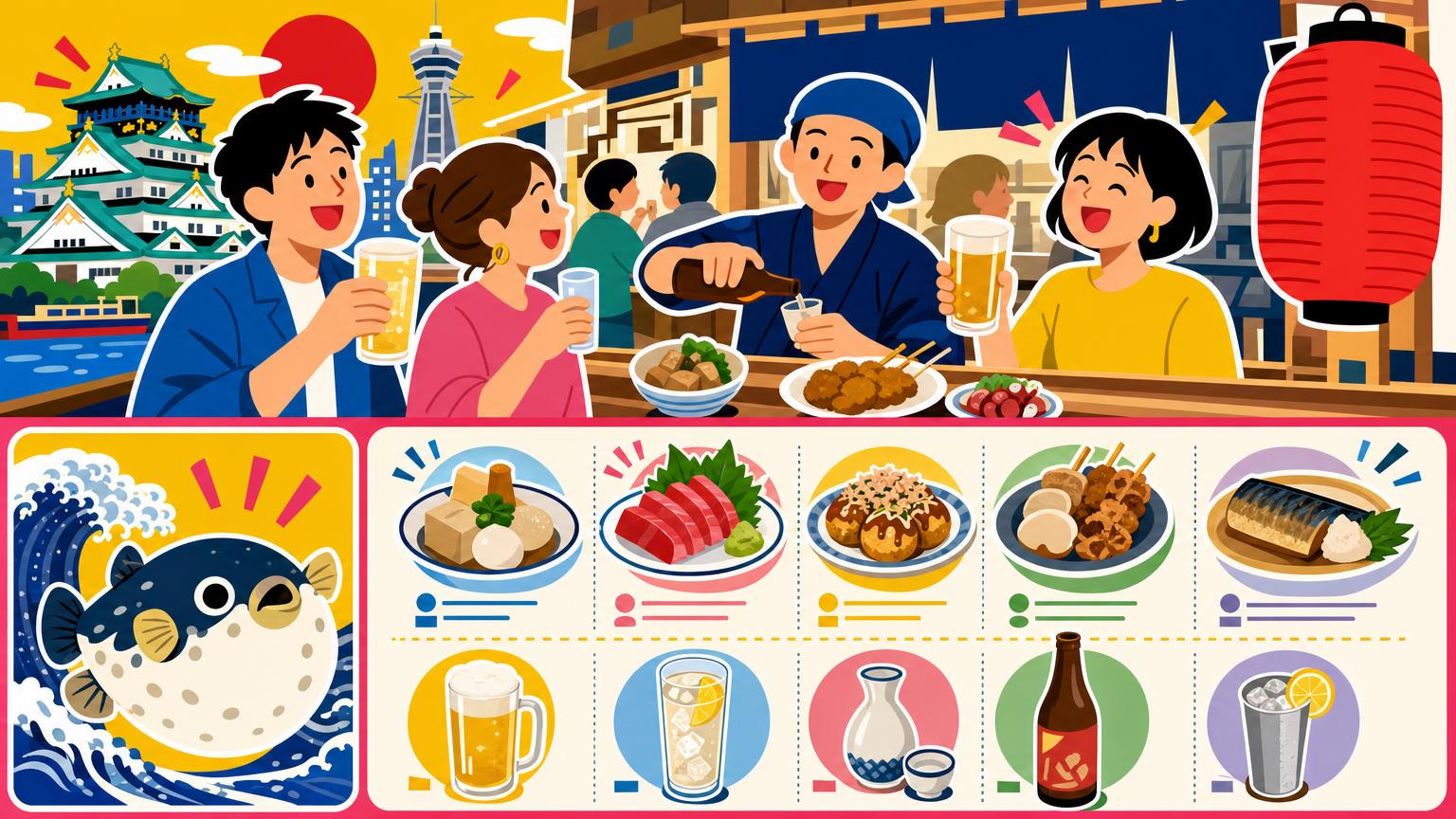
Menus often cause the most pressure for foreign residents. A small board might display Japanese names, abbreviations, seafood terms, and handwritten prices. You don’t need to understand everything at once. Start by recognizing a few reliable words and learn to identify common dishes.
Prices differ by neighborhood, shop, ingredient, and time of day. The ranges below are practical estimates for casual Osaka tachinomi, not guarantees. A seafood specialty or seasonal dish can be much more expensive than a typical small plate.
Popular Drinks to Order
Nama beer — draft beer
Nama means draft beer. You might hear nama biiru or just nama. A small glass may cost about JPY 300–500, while a larger mug may be JPY 500–700. If the bar serves major Japanese brands, staff might ask you to choose between Asahi, Kirin, Sapporo, or Suntory.
Useful phrase: “Nama hitotsu, onegaishimasu.” This means, “One draft beer, please.”
Bin beer — bottled beer
Bin biiru is bottled beer, usually served with a small glass. A medium bottle generally costs around JPY 500–700. Bottled beer is handy when you want to drink slowly or avoid a crowded draft-beer pour.
Highball
A hai-booru typically combines whisky with soda and ice. A basic highball may cost JPY 300–500. You might see lemon highball, yuzu highball, or seasonal variations. Don’t assume every highball uses the same whisky or sweetness level.
Chuhai and sour drinks
A chuhai or saa is a shochu-based mixed drink, often flavored with lemon, grapefruit, plum, or other fruits. The classic lemon sour is one of the easiest choices in a standing bar. Expect to pay roughly JPY 300–500.
Shochu
Shochu is a distilled spirit made from ingredients like barley, sweet potato, rice, or buckwheat. It may be served with water, hot water, soda, tea, or on the rocks. Mugi means barley shochu, imo means sweet potato shochu. If the menu says wari, it indicates the spirit is mixed with something.
Nihonshu
Nihonshu refers to what many foreigners call sake. It may be served atsukan (hot), jo-on (room temperature), or chilled. Prices range from around JPY 400 for a basic glass to JPY 1,000 or more for premium selections.
Umeshu
Umeshu is plum liqueur. It’s sweet, easy to drink, and often served on the rocks or with soda. While not formally a “beginner drink,” it’s a practical choice if beer or whisky isn’t your preference.
Non-alcoholic drinks
Look for oolong tea, cola, ginger ale, orange juice, or non-alcohol beer. You can ask, “Nomimono wa non-arukooru arimasu ka?”—“Do you have non-alcoholic drinks?” Some small bars offer only tea or soft drinks, so don’t expect a full mocktail menu.
Must-Try Local Food Items
Doteyaki — miso-braised beef tendon
Doteyaki is beef tendon simmered slowly in sweet miso, often with konnyaku. The texture is soft and gelatinous, with a rich savory-sweet flavor. A small serving may cost about JPY 300–600.
It’s a strong Osaka choice, reflecting the city’s love for inexpensive, slow-cooked, and satisfying food. The dish pairs especially well with beer or highball when you want something warm.
Kushikatsu — deep-fried skewers
Kushikatsu refers to ingredients fried on skewers. Common options include pork, onion, lotus root, shrimp, quail egg, and asparagus. Prices typically range from JPY 100–250 per skewer in casual shops, with specialty items costing more.
Older kushikatsu restaurants may have shared sauce containers. The famous “no double dipping” rule applies when sauce is shared. Many modern shops offer individual dishes or squeeze bottles—check before dipping. If unsure, wait for another customer or ask, “Nidome dame?”
Sashimi — sliced raw fish
Sashimi is raw fish served without rice. In a standing bar, portions may be small and affordable, often around JPY 400–900 for a basic plate. Common terms include maguro (tuna), sake (salmon), tai (sea bream), hamachi (yellowtail), and ika (squid).
Seafood is one reason a standing bar can feel more like a serious place to eat rather than just a cheap drinking spot. Tachinomi Shomin promotes low-priced fish dishes across its branches, and the Tenma seafood bar Tachinomi Dokoro Uo Sho is known as a cash-only stand-up place with an average spending range of JPY 2,000–2,999.
Tofu and hiyayakko — chilled tofu
Hiyayakko is cold tofu topped with green onion, ginger, bonito flakes, or soy sauce. It usually costs around JPY 200–400. It arrives quickly and is good when you want a light dish instead of fried food.
Nasu dengaku — miso-glazed eggplant
Nasu dengaku is eggplant grilled or fried and coated with a sweet miso glaze. It typically costs around JPY 300–500. The dish is soft, rich, and usually more filling than it appears.
Agedashi tofu — fried tofu in dashi
Agedashi doofu is lightly fried tofu served in warm dashi broth. Expect to pay around JPY 300–600. It’s a great choice if you prefer something gentle and savory.
Oden
Oden is a simmered assortment of items like daikon radish, egg, tofu, konnyaku, fish cakes, and beef tendon. Each piece is usually priced separately, often between JPY 100–300. You can point to what you want or say the ingredient’s name.
Useful words include daikon (radish), tamago (egg), atsuage (thick fried tofu), and konnyaku (firm gray or white jelly-like ingredient).
Tamagoyaki and dashimaki tamago
Tamagoyaki is a rolled omelet. Dashimaki tamago includes dashi stock and is softer and more delicate. It costs about JPY 300–600. In Osaka, dashi is an essential part of everyday flavor. The city’s food culture values savory depth rather than intense spice, and local guides highlight dashi as central to Osaka cooking.
Potato salad and small prepared dishes
Potato salad, marinated vegetables, simmered pork, pickles, and namul may be displayed in small glass cases or handwritten lists. These are often called otsumami, meaning snacks to accompany drinks. Prices range from JPY 150–500.
Don’t consider small dishes merely decorative side orders. In a tachinomi, they form the structure of the meal. One drink, one salty dish, one fresh dish, and one warm dish can be enough.
How to Order When You Cannot Read the Menu
You have several strategies available, and none require pretending to understand everything.
Use the display case
Many standing bars display prepared dishes in a refrigerated case. Pointing is acceptable. Say “Kore onegaishimasu,” meaning “This one, please.” If the staff asks a question you don’t understand, smile, show your phone translation, or say “Osusume wa?”—“What do you recommend?”
Choose by price and category
Look for familiar characters. Nama means draft beer. Nihonshu refers to sake. Sashimi may be written as 刺身. Oden might appear as おでん. Kushi or 串 indicates skewers. Niku means meat. Sakana means fish. Yasai means vegetables.
When prices are listed beside each item, ordering is usually straightforward. If prices aren’t shown, ask before ordering: “Ikura desu ka?”—“How much is it?”
Order one item at a time
Avoid pointing to ten dishes all at once. Order one drink and one food item, then observe how the shop handles the next order. This reduces the chance of misunderstandings and allows the staff to assist you better.
Use your phone carefully
A translation app can be helpful, especially for ingredients and allergies. Don’t place your phone directly in front of a busy staff member and expect an immediate translation session. Type a short phrase, show it briefly, and keep the interaction efficient.
For allergies, use clear Japanese terms if possible. If you have a severe allergy, a small tachinomi with no English-speaking staff may not be the safest place to try. Choose a restaurant that can confirm ingredients carefully.
Best Neighborhoods for a Standing-Bar Crawl in Osaka
A bar crawl might seem like a tourist activity, but for residents, it can serve as a practical way to grasp the city’s internal geography. Tenma, Kyobashi, and Namba each offer distinct social atmospheres, reflecting various facets of life in Osaka.
Tenma: The Vibrant Local Maze
Located north of central Osaka, near Tenma Station and the extensive Tenjinbashisuji shopping street, Tenma is easily accessible from Osaka Station and Umeda. The streets around the station narrow, grow noisier, and take on a mixed residential-commercial character. According to JNTO, Tenma is a place where visitors can dine and drink alongside locals, while local Osaka guides highlight its side streets as some of the city’s densest tachinomi zones.
The vibe is lively yet informal, with office workers, independent shop owners, young service staff, older regulars, couples, and foreign residents intertwining within a few blocks. The neighborhood feels like a living and working community rather than a nightlife district designed solely for entertainment.
Tenma is ideal for standing-bar hopping because the bars are close together and offer a variety of styles. One might specialize in seafood, another in kushikatsu, a third in sake, and another in affordable prepared dishes. If one bar feels too crowded, simply walk a few minutes to find another.
For locals, Tenma exemplifies Osaka’s habit of blending categories. A shopping arcade, a small shrine, a family-run restaurant, a standing bar, and a contemporary wine shop can all coexist along the same path. The neighborhood blurs the lines between “old Osaka” and “new Osaka,” as they overlap.
Kyobashi: The Retro Core of Tachinomi
Kyobashi, situated east of central Osaka and served by JR, Keihan, and Osaka Metro lines, offers easy access from various parts of the city. Yet the area surrounding the station shifts quickly once you leave the main commercial routes. Osaka Metro highlights Kyobashi’s connectivity with JR and Keihan, helping explain the district’s strong after-work drinking culture.
Kyobashi’s ambiance is more compact, gritty, and workday-focused than the polished areas of Umeda. Narrow streets, train noise, intimate counters, and older buildings create a sense that the district has catered to commuters for decades. Local sources note clusters of tachinomi bars near the station, especially to the south and east of the main streets.
Kyobashi is recommended for those wanting to see how Osaka locals separate work from home without fuss. People might finish their shift, stand and eat a quick meal, have a couple of drinks, and catch their train. Here, the bar serves as part of the weekday routine rather than a destination.
The area can feel less immediately welcoming to foreigners, as some bars lack English menus and have limited space. This isn’t necessarily unfriendly; instead, it often reflects businesses built around regulars who are already familiar with the system. Start at a larger, well-reviewed spot, arrive early, and keep your first visit brief.
Namba and Ura-Namba: Convenient and Trendy
Namba is the most accessible area for many foreign residents, thanks to multiple railway and subway lines converging here. While the main shopping and entertainment streets can be crowded, the backstreets east of central Namba—known as Ura-Namba—offer a different pace. Official Osaka tourism materials describe Ura-Namba as the area behind Namba, packed with restaurants and bars that have grown popular as a social hub.
The atmosphere is more diverse than Tenma or Kyobashi. You’ll find established Osaka businesses, innovative food concepts, small sake bars, standing counters, and venues accustomed to international customers. English menus are more common here, especially in spots expecting visitors, though not guaranteed.
Ura-Namba is ideal for a first standing-bar experience due to its easy access and wide range of options. If a traditional tachinomi feels intimidating, there are modern bars with photos or bilingual descriptions. If the area seems too commercial, simply explore one or two streets away from the main flow.
It’s important to note that “accessible” does not equal “authentic” or “inauthentic.” Local residents also frequent Namba. The key is which part of Namba you visit and how you behave while there. A foreign resident who regularly visits the same casual spot may become part of the neighborhood faster than a visitor who spends one evening photographing every dish.
Fuse and Other Areas Worth Exploring
Fuse, located in Higashiosaka, boasts a strong working-class drinking culture with many small establishments. Although it lies outside Osaka City proper, it’s valuable for residents interested in seeing how standing bars operate beyond the central nightlife zones. Local accounts of Fuse emphasize compact bars, inexpensive food, and a mixed crowd of workers, older regulars, and midday drinkers.
Fukushima, Nakazakicho, Nishinaka-jima, Juso, and Shinsekai also feature standing bars, each with a distinct social character. Fukushima is increasingly food-focused and trendy. Nakazakicho blends older buildings with independent shops. Juso offers a more direct, entertainment-driven vibe. Shinsekai maintains a strong retro identity but should not be dismissed as merely a theme-park version of “old Osaka.”
Approachable Tachinomi Bars for Foreign Residents
A bar’s opening hours, payment methods, smoking policies, and menu languages may vary. Consider the examples below as initial references rather than permanent assurances. Be sure to verify the shop’s current details on the day you visit, especially during holidays or after any management changes.
Tachinomi Shomin: Affordable Local Favorite
Tachinomi Shomin is a helpful name for foreign residents, as it has several Osaka branches, including those in Kyobashi and Tenma. Its official store information lists the Kyobashi branch at Higashinoda-cho and the Tenma branch along Tenjinbashisuji, noting daytime opening hours at both locations.
The term shomin broadly means ordinary people or the general public. The concept is straightforward: affordable food, quick service, and a simple, unpretentious atmosphere. You can expect sashimi, tuna, makizushi, prepared dishes, and drinks priced for regular customers rather than special occasions.
Do not assume English menus are available. A translation app, pointing, and knowledge of a few food terms will be helpful. Payment is generally safest with cash; some branches specify cash-only service. The patrons might include older regulars, workers, solo drinkers, and customers stopping by for an early drink. Arriving early will give you more space and less pressure.
The cultural lesson of Shomin is its unpretentious nature. No one feels the need to demonstrate knowledge of wine, cocktails, or dining etiquette. You order, eat, pay, and then make room for the next person.
Tachinomi Dokoro Uo Sho Tenma: Seafood and a Compact Counter
Tachinomi Dokoro Uo Sho Tenma, located near Tenma Station, specializes in seafood. Current English listings describe it as a stand-up bar focused on seafood, with typical spending between JPY 2,000–2,999, no reservations, and no acceptance of credit cards or electronic payments.
This spot is ideal for those wanting to practice ordering fish instead of just fried snacks. Expect a primarily Japanese environment and do not count on an English menu. Pointing at the display or asking for today’s recommendation is more realistic than expecting detailed explanations of every cut.
The clientele is likely to be both food- and drink-focused, which affects the atmosphere. Customers may speak more quietly while eating, and staff may carefully time each dish. Bring cash, order modestly, and avoid arriving in large groups expecting a table.
Useful phrases include “Kyou no osusume wa nan desu ka?” meaning “What is today’s recommendation?” and “Sashimi moriawase hitotsu,” which means “One assorted sashimi plate.”
Shintamon Sakakura: A More International Interpretation
Shintamon Sakakura in Ura-Tenma offers a different take on tachinomi. The bar is described as a Malaysian standing bar run by an international couple, featuring Malaysian dishes alongside Japanese foods such as sashimi and small dishes designed to accompany alcohol.
This place is useful for foreign residents as it demonstrates that tachinomi is not stuck in the past. The standing-bar style can embrace new cuisines, multilingual conversation, and international ownership without losing its core form. You can still order small plates, stand near other customers, and leave without a formal reservation.
There may be better English support than at traditional Japanese-only bars, but do not rely on this. The crowd might include local regulars, international residents, and people interested in the food itself. Confirm payment methods and opening hours before visiting.
This shop is especially valuable if you want to see how Osaka absorbs outside influences through everyday businesses. Serving a Malaysian dish alongside sashimi is not contradictory here; it is part of the city’s ongoing adaptation.
Izakaya Toyo: Famous, Crowded, and Not the Easiest First Stop
Izakaya Toyo in Kyobashi is often mentioned internationally for its seafood and distinctive open-air style. It has no chairs, no traditional indoor dining room, and, according to current guides, no English menu.
While interesting, its popularity does not necessarily make it beginner-friendly. The crowd, limited operating days, and fast pace might be difficult if you are still learning how tachinomi works. If you go, bring cash, expect to stand outside or in a cramped space, and avoid treating the staff like performers for your camera.
For residents, the more important takeaway is not whether this specific bar is “worth it,” but how fame influences the relationship between a local business and external attention. A shop can remain locally meaningful while also gaining international recognition. Your role is to behave like a customer, not an audience.
A General Rule for Choosing Your First Bar
Seek out a place with a visible menu, enough space to stand without blocking the entrance, and pricing that’s easy to understand. Larger shops, chains with multiple branches, or bars with food photographs may be more helpful for your first visit than the smallest legendary counters.
Once you grasp the rhythm, you can explore places with handwritten menus, limited hours, and no translations. Local knowledge develops gradually. There’s no need to start at the deepest end of the pool.
Can You Enjoy Standing Bars Sober?
Yes. The notion that tachinomi is solely for heavy drinkers overlooks the food and social aspects of the experience. You can order oolong tea, soda, ginger ale, non-alcoholic beer, or simply a small soft drink if the establishment offers one. You can also eat slowly and concentrate on the dishes.
Sober tachinomi is easiest when you are straightforward. Say, “Kyou wa nomimasen,” which means “I am not drinking today,” and order food along with a non-alcoholic beverage. Staff may not require any further explanation. If you are meeting friends who are drinking, the standing format allows you to stay briefly without committing to a full evening.
Choose food that is easy to share: sashimi, tofu, omelet, oden, grilled vegetables, pickles, or potato salad. Avoid ordering only water unless you have a good reason, as small bars rely on drink sales. A soft drink or tea is usually the more considerate choice.
Sober visits can also highlight the social dynamics more clearly. You notice who arrives alone, who greets the owner, which dishes are served quickly, and how customers make space for each other. Alcohol can soften perception, but it can also obscure it. You don’t need to drink heavily to appreciate the culture.
How Tachinomi Explains Osaka People
A standing bar provides a more accurate picture of Osaka than the stereotype of a loud, generous comedian. You observe people valuing efficiency, protecting their personal time, and staying open to small moments of connection.
Osaka Directness Is Often Practical
Osaka speech may sound blunt to foreign residents. A staff member might correct your order right away. A customer could say your Japanese is “strange” or that you picked an unusual dish. The tone might come across as sharper than what you’re used to in Tokyo.
Don’t automatically interpret directness as hostility. In many everyday situations, straightforward speech saves time and builds a shared understanding. If staff say the bar is full, they might not be making a personal judgment. If someone warns you that a dish is too spicy, they may be trying to help you avoid a bad choice.
At the same time, don’t romanticize every blunt interaction as charming Osaka honesty. People can be rude in Osaka, just as anywhere else. Cultural explanations should not be used to excuse poor behavior.
Humor Is a Relationship Test, Not a Requirement
Osaka is strongly associated with comedy, and strangers may joke more readily than in other Japanese cities. But you don’t have to be humorous to fit in. A smile, a brief response, or a simple “sou desu ne” might be enough.
If someone teases you, pay attention to the context. Are they joking with other customers as well? Is the staff using a playful tone with everyone? Are they trying to include you, or making you uncomfortable? You can laugh lightly without agreeing to everything.
Foreign residents sometimes mistakenly become louder because they think that’s the local style. Usually, the best approach is to stay relaxed and observant. Osaka’s energy isn’t about speaking louder.
Value Matters More Than Status in Many Everyday Settings
A good tachinomi meal can be satisfying precisely because it doesn’t require a high income or special occasion. Students, office workers, business owners, older residents, and foreign residents may all share the same narrow counter. Their social status outside the bar becomes less visible for a while.
This doesn’t mean Osaka is entirely classless. It isn’t. But the standing-bar format reduces the need for status display within the shared space. You don’t need a designer outfit, a reservation, or a detailed explanation of your order.
That’s one reason tachinomi can be helpful for someone deciding if Osaka is a good place to live. The city offers many levels of dining, but everyday enjoyment isn’t always reserved for people with large budgets.
Osaka Versus Tokyo: What the Difference Feels Like in a Bar
Comparisons between Osaka and Tokyo are often exaggerated. Tokyo is known for its many casual standing bars, while Osaka has elegant restaurants, quiet neighborhoods, and formal social customs. The contrast is not simply a matter of “friendly Osaka” versus “cold Tokyo.”
The difference frequently lies in the mix of price, informality, neighborhood scale, and style of conversation. In Osaka, an inexpensive bar can be a vital part of city life rather than just a cheaper option. A small restaurant may hold strong opinions about food, have loyal regular customers, and a distinct personality, all while remaining casual and affordable.
Tokyo’s size can make neighborhood identity feel more fragmented. Although Osaka’s central districts are also large, many social routes are concentrated around stations, shopping streets, and clusters of small businesses. You might frequently encounter the same staff, customers, and shop owners because the city’s everyday spaces overlap.
For foreign residents, this can make Osaka easier to access but also more difficult to fake. People may notice if you come back, remember a dish, or always treat the bar like a photo spot. Regularity matters. The local feeling often begins when you stop seeking new experiences and start repeating ordinary ones.
A Practical First-Night Plan for Residents
Select one neighborhood instead of attempting to explore the entire city. Tenma is convenient from Umeda, Kyobashi works well for eastern Osaka and the Keihan corridor, and Ura-Namba is accessible from many central areas.
Visit between late afternoon and early evening, when the first after-work customers start arriving but the smallest bars may still be relatively empty. Bring cash, a charged phone, and a small amount of Japanese vocabulary. Eat something light beforehand if you aren’t sure how quickly the food will be served.
Start with one drink and order one familiar dish. Pay attention to the payment process. Keep your bag close by. If the atmosphere feels uncomfortable, pay and leave politely. There is no need to stay just because the bar is popular.
On a second visit, either return to the same bar or try a nearby one. Regulars aren’t made in one memorable night; they are built through repetition: the same greeting, the same counter, the same staff, and the gradual building of recognition.
Useful Japanese Phrases for Tachinomi
“Konbanwa.” — Good evening.
“Kore onegaishimasu.” — I’ll have this one, please.
“Osusume wa?” — What do you suggest?
“Kyou no osusume wa nan desu ka?” — What do you recommend today?
“Ikura desu ka?” — How much does it cost?
“Nama hitotsu.” — One draft beer, please.
“Lemon sour hitotsu.” — One lemon sour, please.
“Sashimi moriawase hitotsu.” — One assorted sashimi, please.
“Yasui mono wa arimasu ka?” — Do you have any inexpensive items?
“Non-arukooru arimasu ka?” — Do you have non-alcoholic beverages?
“O-kaikei onegaishimasu.” — Could I have the bill, please?
“Gochisousama deshita.” — Thank you for the delicious meal.
You don’t need perfect grammar. A clear noun, a number, and “onegaishimasu” often work. Speak slowly. Don’t raise your voice just because the other person doesn’t understand.
Living With the Tachinomi Mindset
Tachinomi culture is not about ticking off dishes or competing to drink the most. Instead, it’s a way to observe how Osaka arranges everyday pleasures. The city creates space for small meals, brief conversations, practical generosity, and a kind of social interaction that doesn’t require a formal invitation.
If you are considering living in Osaka, this is significant. A city is not truly understood only by its landmarks or major festivals. It is understood through the places where people stop on an ordinary Tuesday. In a standing bar, you can see how people behave when they are tired, hungry, and not trying to impress anyone.
You might see an office worker eating doteyaki alone. You might overhear two older customers debating baseball before sharing a recommendation. You might notice a staff member recalling a regular’s usual drink without any ceremony. You might stand next to someone who speaks no English and still share the simple rhythm of ordering, eating, paying, and making space.
That is the local lesson. Osaka doesn’t always welcome you with grand gestures. Often, it offers you a narrow spot at the counter and waits to see if you understand how to use it.
Drink slowly. Order modestly. Pay attention. Make room. Return if you enjoyed it. That is close to drinking like a local.