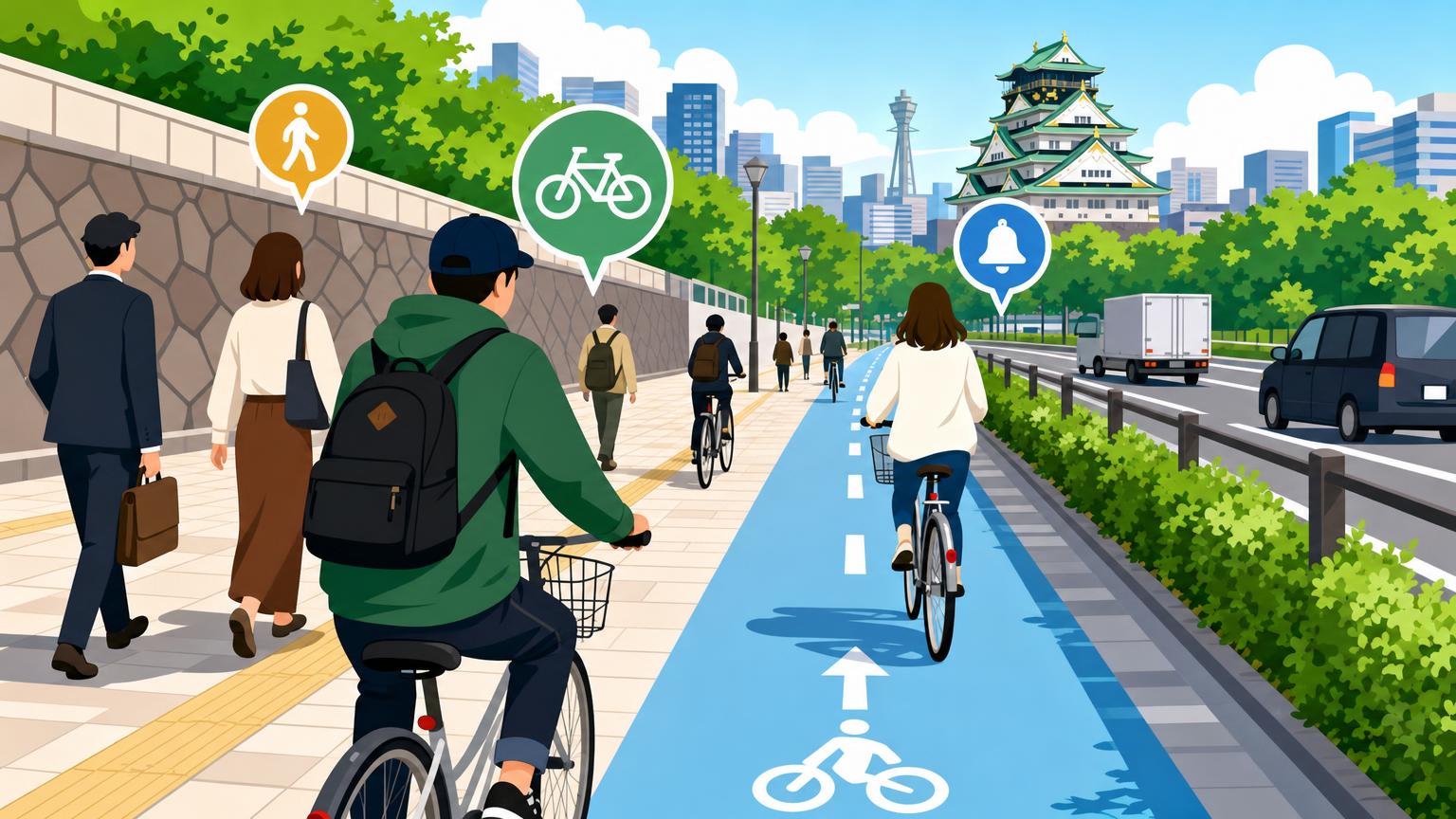
If you live in Osaka for more than a few weeks, you will probably notice something that is difficult to explain to visitors: the bicycle is everywhere, yet cycling does not always look like a formal transport system.
A student glides past a narrow shopping street. A parent balances a child seat, a shopping bag, and an umbrella. An office worker leaves a bicycle beside a station for “just five minutes.” Someone rides slowly along a sidewalk while pedestrians make room without saying anything. Another cyclist comes from the opposite direction, and both people adjust their lines almost instinctively.
To a foreign resident, this can feel chaotic. It may even look as though Osaka has an enormous sidewalk superhighway with no lanes, no signals, and no clear rules. In reality, there are formal laws, local habits, and a large collection of unspoken agreements operating at the same time.
Understanding those layers will tell you a great deal about daily life in Osaka. Cycling here is not only about transportation. It reveals how people share narrow spaces, how much direct confrontation they avoid, when convenience is accepted, and why “being considerate” often means adjusting quietly instead of explaining yourself.
This is not a guide to sightseeing by bicycle. It is a guide to the social logic of cycling in Osaka: what residents expect, what foreigners often misunderstand, how Osaka differs from Tokyo, and how to move through the city without becoming the person everyone silently complains about.
Why Bicycles Matter So Much in Everyday Osaka
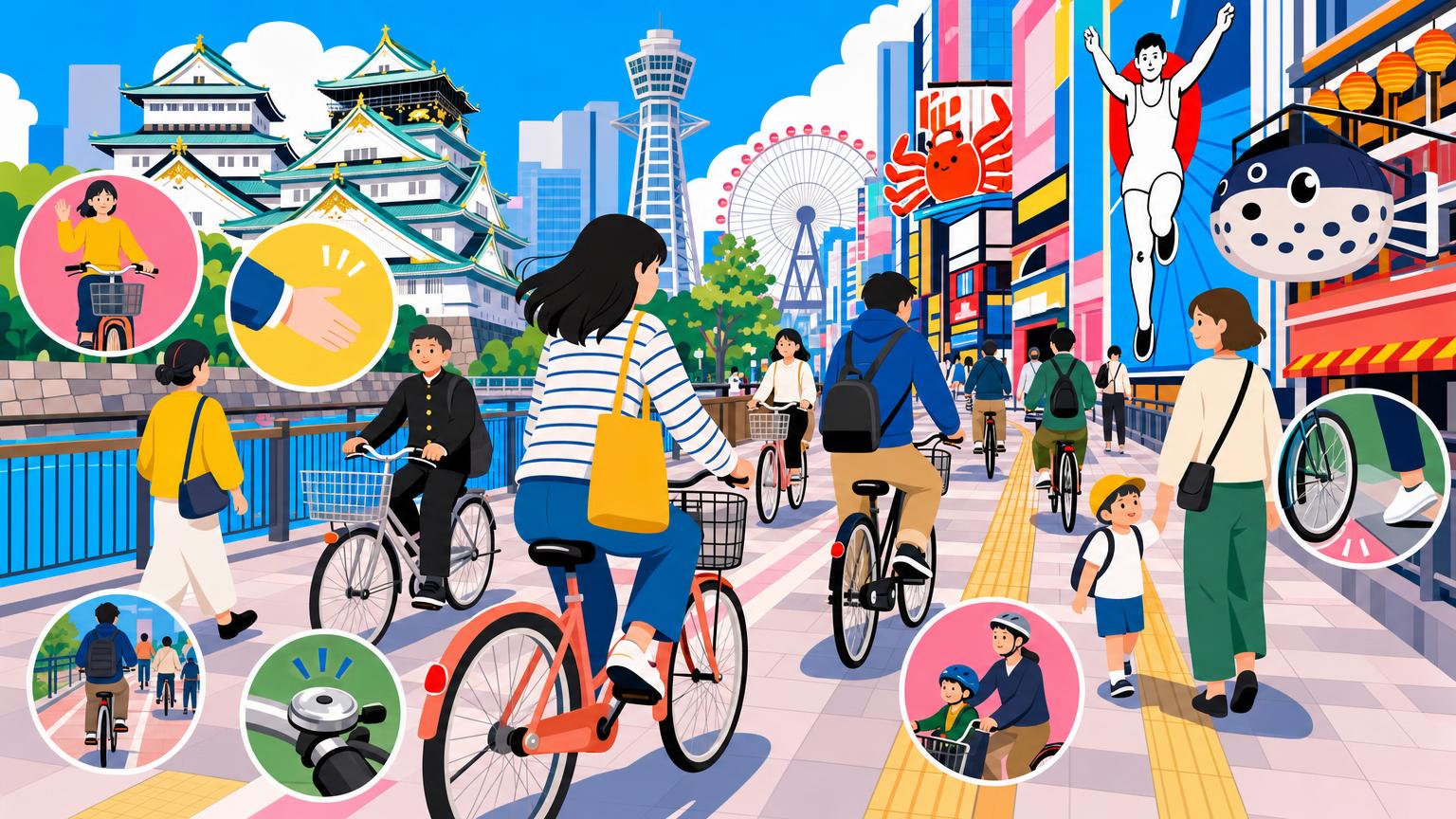
Osaka is a large city, yet many daily trips are surprisingly short. Your apartment might be a fifteen-minute walk from the nearest supermarket, a ten-minute ride from the station, and a twenty-minute ride from your workplace. While trains are excellent for crossing the city, they don’t always address the short distances at either end of a journey.
That’s where the bicycle becomes an essential part of everyday life.
People use bicycles to go to the supermarket, take children to nursery school, visit a local clinic, stop by a public office, carry laundry to a coin-operated laundromat, or travel between nearby stations. The bicycle is not primarily a leisure item; for many residents, it functions as an extra pair of legs.
This explains why cycling in Osaka often appears less athletic and more domestic compared to cycling cultures in many Western cities. The typical bicycle isn’t a sleek road bike. It’s the practical city bicycle known in Japanese as a mamachari, often equipped with a basket, rear carrier, child seat, heavy frame, and a kickstand that can be quickly operated outside a shop.
The mamachari reflects the city’s priorities. It is stable rather than fast, carries groceries rather than prestige, and can be left for a few minutes while someone buys tofu, vegetables, or a packed lunch. It’s designed for the numerous small errands that make up urban life.
For foreigners living in Osaka, this is one of the first cultural adjustments. You might expect bicycles to belong mainly to commuters or enthusiasts, but instead, you see children, elderly residents, parents, students, restaurant workers, and office employees using them as naturally as people elsewhere use cars.
The city also enhances the utility of bicycles because Osaka has many areas where streets are close together but not especially comfortable for cars. In older neighborhoods, roads may be narrow, irregular, or lined with small businesses. Cars feel too large. Walking is possible but slow. A bicycle matches the scale of the neighborhood.
This is especially apparent around local shotengai, residential lanes, school zones, and streets behind major stations. Main roads may have traffic lights and marked lanes, but the everyday city often lies one turn away, where a bicycle can slip through the gaps between larger forms of transport.
Osaka’s Cycling Culture Is Practical, Not Performative
In Tokyo, cycling can sometimes feel linked to commuting efficiency, fashion, fitness, or the search for a quieter route through a densely crowded city. Osaka has these patterns too, but ordinary cycling often feels more improvised and more closely tied to household life.
This difference should not be overstated. Osaka is not a completely different world from Tokyo, and both cities include many kinds of people. Still, the atmosphere can feel distinct.
Tokyo often gives foreigners the impression that public behavior is governed by a highly polished system. People queue carefully, avoid taking up space, and rely on formal signals. Osaka also has strong rules, but daily interactions can feel more flexible. People make small adjustments on the spot. They squeeze past one another, pause in places that are technically inconvenient, and use a brief glance, a hand gesture, or a quiet “sumimasen” instead of a formal exchange.
On a bicycle, this creates a style that may seem casual from the outside. The rider is constantly assessing the space: the pedestrian who may suddenly turn, the delivery worker carrying boxes, the child near a parked bike, the elderly person who cannot hear a bell, and the car that may cut across a narrow side road.
The skill is not only knowing where you are legally allowed to ride, but also recognizing when your presence is putting pressure on someone else.
The First Rule: A Bicycle Is a Vehicle, Even When Everyone Treats It Like a Household Object
The most important mental adjustment is straightforward: in Japan, a bicycle is legally classified as a vehicle. The fundamental rule is that bicycles should use the road and travel on the left side. Riding on the sidewalk is an exception rather than the norm, and pedestrians always have priority whenever bicycles are allowed on sidewalks. The National Police Agency states that cyclists should slow down enough to stop immediately and must stop if they risk obstructing pedestrians.
Many residents do not adhere perfectly to this rule on every trip. You might see bicycles on sidewalks, crossing pedestrian areas, or riders briefly moving against the usual flow. However, this visible behavior does not mean the legal rule no longer applies.
It means there is a gap in Osaka between the formal road system and the practical realities of local streets.
Some roads are narrow. Some are busy with buses and turning vehicles. Some sidewalks are wide and marked for bicycle use. Some riders are carrying children or heavy shopping. Some people have used the same route for twenty years and feel they know its risks.
As a foreign resident, do not imitate every behavior you observe. Learn to distinguish between what people commonly do and what you are actually allowed to do.
Riding on the Left Is More Than a Traffic Rule
When riding on the road, keep to the left. This may be obvious to people from countries where driving is on the left, but many foreigners from right-driving countries need time to make it second nature. The challenge increases at intersections, in narrow lanes, and when a car is partly parked on the road.
Do not drift toward the center simply because the road appears empty. Do not turn right across multiple lanes as if you were driving a car. At larger intersections, cyclists typically make a two-step right turn, moving to the far side of the intersection and waiting for the correct signal rather than cutting diagonally across traffic.
You also need to be aware of the Japanese habit of looking in several directions at once. A side street might seem quiet, but a scooter, bicycle, or delivery vehicle can appear suddenly. Cars may turn left across a cyclist’s path. Pedestrians may step into the street without making eye contact.
The safest cyclist in Osaka is not the fastest but the one who anticipates movement from seemingly still places.
The Sidewalk Is Not a Bicycle Lane Unless Clearly Marked
Foreigners often misunderstand Osaka sidewalks because many bicycles use them. Some sidewalks have signs or markings permitting bicycle traffic. Others are simply wide enough that residents use them informally. The legal distinction matters, but so does the social one.
If you are allowed to ride on a sidewalk, stay close to the road side, reduce your speed, and give priority to pedestrians. If someone is walking slowly, do not rush past at speed. If the space is crowded, dismount. Even if legally allowed, a bicycle is still the larger and more potentially dangerous object.
Do not assume ringing your bell grants you automatic right of way. In Japan, the bell serves as a warning in situations where a collision is likely, not as a general command for pedestrians to move aside. Osaka police guidance also cautions against obstructing pedestrians, riding while using a mobile phone, riding under the influence, riding double, riding without lights, and other dangerous behaviors.
The unwritten rule is clearer: if you are behind a pedestrian, you are responsible for managing the inconvenience of passing.
That may mean slowing down. It may mean waiting. It may mean softly saying “sumimasen” and passing only when there is enough room. It may mean getting off the bicycle and walking for a short distance.
Why People Rarely Complain Directly
Osaka is often described as a direct or outspoken city, especially compared to Tokyo. There is some truth to this, but it does not mean residents constantly confront strangers over minor behavior.
On the street, many people still avoid direct conflict. If you ride too close, block a doorway, or leave your bicycle in the wrong place, the response may be a glance, a sigh, a muttered comment, or a quiet complaint to a store employee rather than a confrontation with you.
This can confuse foreigners who might think, “No one told me it was a problem.” In Osaka, the absence of an explicit warning does not mean approval. People often expect you to notice the pressure you are causing and adjust your behavior.
A bicycle stopped across a convenience store entrance may not trigger confrontation. It still forces everyone entering or leaving to walk around it. A bicycle parked beside a station may not be removed immediately. It may still be considered an obstruction and could eventually be tagged or taken away.
The city’s communication style is often indirect at the moment of inconvenience and becomes very clear later through signs, notices, fines, or removal operations.
The Unwritten Rule of Shared Space: Make Yourself Smaller
Osaka features many shared spaces where traditional categories don’t fully apply. A sidewalk might include pedestrians, bicycles, delivery carts, restaurant signs, utility poles, and people waiting for friends. A narrow shopping street may technically permit bicycles but is socially dominated by shoppers.
In these areas, the main behavior is to make yourself smaller.
This means slowing down before a blind corner. It means keeping both hands ready to brake. It means not riding side by side with another cyclist. It means avoiding phone use while moving. It means shifting your backpack off the side that could bump into someone. It means not forcing a pedestrian into traffic just to keep your momentum.
This is more than politeness—it’s risk management in a city where the boundaries between road, sidewalk, storefront, and residential entrance often blur.
Blind Corners Require a Full Slowdown
Older Osaka neighborhoods have many corners where walls, parked cars, vending machines, or buildings block your view. Locals often slow down even when the road seems clear because they know what might suddenly appear.
Don’t treat a narrow lane as a private cycling path. Someone may open a door. A child might dart out. A vehicle could turn without seeing you. A delivery person may carry boxes across the street.
The local habit is to approach corners ready to stop. If you need to use your bell, ring it early and lightly. Don’t wait until you’re right next to a pedestrian.
Do Not Turn Every Gap Into an Invitation
A common misunderstanding by foreigners is to see a gap between people or vehicles and assume a bicycle should pass through it. Osaka residents sometimes do this too, but accepted behavior depends on speed and predictability.
Slow, clear movements may be tolerated. Sudden acceleration through a small gap is not. If others can’t predict your path, you create danger—even if there’s technically enough space.
Avoid weaving between pedestrians. Avoid passing on the left then immediately crossing to the right. Avoid moving behind someone and cutting in front of them to reach a traffic signal.
The city functions because people constantly anticipate each other. Make your movement predictable. Predictable is safe.
The Bell Is Not Your Voice
Some bicycle bells in Osaka are used too aggressively, especially by riders expecting pedestrians to instantly move aside. This may be common but is not appreciated.
A bell is useful when someone is about to step into your path or to prevent an immediate collision. It’s not a substitute for slowing down. It’s not a way to punish someone for walking slowly. It’s not an announcement of your superior importance.
When space allows, a quiet “sumimasen” is often more socially accepted than repeated bell ringing. The word doesn’t need to be dramatic; it can mean “excuse me,” “sorry,” or simply “I am passing through.”
Station Areas Are a Different Cycling Environment
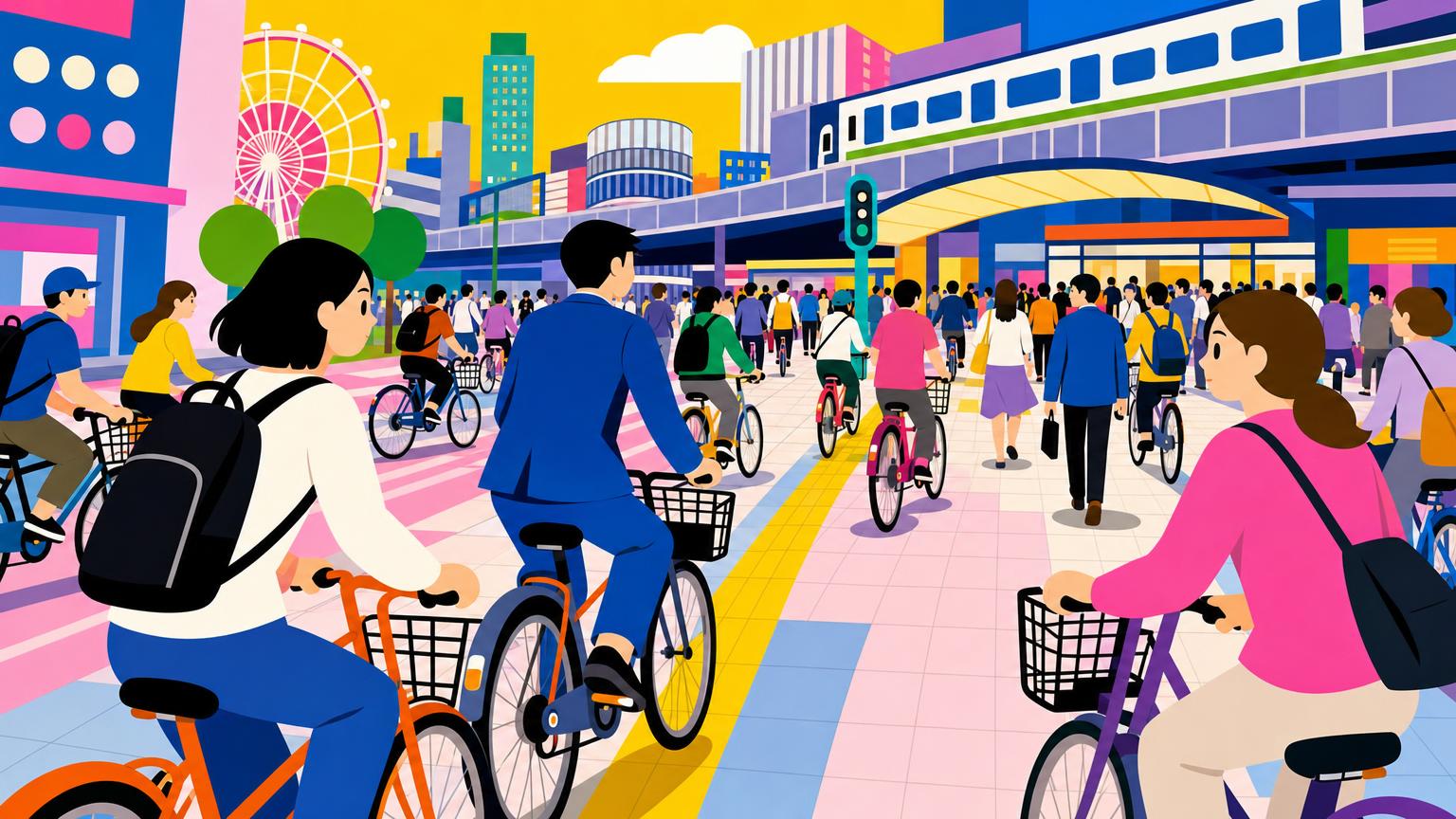
If you are new to living in Osaka, areas around stations will quickly teach you the city’s bicycle rules.
Near stations like Umeda, Namba, Tennoji, Kyobashi, and other local suburban hubs, pedestrian density fluctuates sharply throughout the day. A route that seems easy at 10:00 in the morning may become nearly impassable during the evening rush hour. People emerge from station exits, meet friends, wait for buses, carry shopping bags, and cross streets while checking train information on their phones.
The right approach is not to assert priority simply because you are moving straight ahead. In crowded station areas, dismounting is often the most practical option.
Avoid Station Entrances and Narrow Gateways
Do not stop directly outside a station entrance, even if you are waiting for someone. This also applies to the top or bottom of stairs, elevator entrances, convenience store doorways, and the narrow spaces beside ticket machines.
These spots are pressure points. People are already changing speed and direction there. A parked bicycle can create more difficulty than its owner might realize.
If you need to wait, move to a designated bicycle parking area, a wider public space, or a place where people don’t have to maneuver around you.
Read the Flow Rather Than the Sign Alone
Signs are important, but station areas also have an observable flow. If pedestrians are moving in a broad stream, don’t cut across it on your bicycle. If a shopfront is crowded, walk your bike. If the sidewalk narrows near a construction site, slow down before reaching the bottleneck.
Osaka’s streets often convey their rules through movement. Watch where local cyclists dismount, notice where pedestrians become tense, and observe where bicycles are lined up neatly rather than scattered.
These patterns are key local information.
Bicycle Parking Is a Major Part of Daily Life
One major difference between cycling in Osaka and cycling in many foreign cities is the emphasis placed on designated bicycle parking, known as churinjo.
A bicycle can be left almost anywhere with ease. However, that does not mean it is acceptable to leave it just anywhere. Osaka has specific parking areas near stations, shopping streets, public facilities, and apartment buildings. Some of these areas are staffed, others operate with a ticket or automated system, and some allow a brief free period before charging a fee.
Parking outside a designated spot may result in a warning tag, removal, or a complicated retrieval process. Procedures vary by municipality and location, so it’s best to check the signage where you live rather than relying on advice from other residents.
Why Osaka Takes Parking Seriously
To a foreigner, a bicycle parked next to a guardrail may appear harmless. However, when multiplied by several hundred bicycles, the problem becomes evident. Pedestrians lose walking space, wheelchairs and strollers find it difficult to pass, emergency access is restricted, shop entrances get blocked, and sightlines at intersections worsen.
Osaka’s bicycle parking challenges are linked to the city’s density and the fact that bicycles are used for nearly every small trip. The more convenient bicycles become, the more problematic careless parking turns out to be.
The unspoken rule is straightforward: if you wouldn’t leave a car in that spot, don’t assume a bicycle can be left there automatically.
Apartment Parking Is Not the Same as Street Parking
If you rent an apartment, ask where bicycles should be stored. Many buildings feature a shared bicycle space, sometimes with assigned spots or registration stickers. Some charge a small monthly fee, while others limit the number of bicycles per household.
Avoid leaving your bicycle in the entrance hall, next to the garbage collection area, or in a neighbor’s seemingly unused space. Japanese apartment buildings often follow shared management rules that may not be explained in English.
A bicycle invisible to you might be very noticeable to the building manager.
The Five-Minute Exception Is Not a System
You may see residents quickly parking outside a shop, especially in neighborhoods where they know the owner or expect to be inside for under five minutes. This is one of the more flexible aspects of Osaka street life.
Don’t mistake this exception for permission. Locals may be taking a calculated risk based on habit, timing, and familiarity with the area. As a foreigner, you won’t know which spots are monitored, which shops tolerate brief stops, or which streets are prone to frequent removals.
When unsure, use the churinjo.
What Osaka People Expect From a Cyclist
Osaka residents generally do not expect every cyclist to ride like a professional road racer, but they do expect basic awareness.
They expect you to notice children, slow down near elderly people, stop at red lights even if other cyclists don’t, use lights at night, avoid using your phone while riding, and maintain a reasonable distance from pedestrians.
The National Police Agency’s bicycle guidelines highlight core safety rules such as traveling on the left side, giving pedestrians priority on sidewalks, stopping at signals and stop signs, using lights at night, and refraining from cycling under the influence of alcohol. Using a smartphone while cycling is also prohibited, and Osaka police materials caution against it.
These rules remain important even if enforcement seems inconsistent.
The Red Light Test
To understand how foreigners are viewed as cyclists, observe what happens at red lights.
Some cyclists stop, some roll through slowly, and others cross when no cars are visible. The fact that others break the rule does not make it safe or acceptable for you.
Foreign residents who confidently run red lights may be seen as reckless, especially when riding large rental bikes or moving quickly near children. Osaka tolerates minor everyday infractions but has little patience for behavior that creates sudden danger.
Stop at signals. Stop at stop signs. Always look both ways, even if you believe you have the right of way.
Night Riding Requires Extra Caution
Many bicycles travel after dark in Osaka, and some riders do so without strong lighting. That doesn’t mean you should follow their example.
Use a working front light and a rear reflector or light. Wear visible clothing when possible. Be particularly cautious near parked cars, where a driver might open a door or pull into traffic without noticing you.
In residential areas, people may not expect a fast bicycle to appear silently. Lights are not only for seeing the road but also for making your presence clear.
Alcohol and Bicycles Are a Dangerous Mix
The belief that cycling is harmless after drinking is both dangerous and illegal. Cycling under the influence is prohibited, and the National Police Agency warns that alcohol impairs the recognition, judgment, and motor skills needed for safe riding.
This is important in Osaka, where drinking and cycling often happen during the same evening. You might ride to a restaurant, have drinks with coworkers, and feel able to cycle home. Don’t do it. Leave your bike, use public transportation, take a taxi, or arrange another safe option.
Leaving a bicycle overnight may be inconvenient, but a collision can permanently change your life—and someone else’s.
Smartphone Use Is a Social Problem, Not Just a Legal Problem
Foreigners often recognize that using a phone while driving is dangerous, but they tend to underestimate the risk when cycling at low speeds. In Osaka, riders frequently check maps, send messages, or listen to voice directions while navigating crowded streets.
Even a brief moment of screen attention can cause you to miss a pedestrian, a red light, an opening car door, or a bicycle approaching from the opposite direction. The police classify smartphone use while riding as a prohibited dangerous behavior.
There is also a social impact. A cyclist looking at their phone appears unpredictable, making it difficult for others to anticipate whether they will turn, stop, drift, or continue straight.
If you need directions, pull over completely, put both feet down, and check the map away from traffic flow. If there is no safe place to stop, continue slowly until you find a wider area.
This is one of the simplest ways to show that you understand how Osaka works: don’t make strangers compensate for your private task.
Families Reveal the City’s Real Cycling Priorities
Children are among the clearest reasons why Osaka’s cycling culture cannot be understood solely through traffic laws.
You will often see parents carrying children in front or rear seats, sometimes equipped with rain covers, helmets, bags, and groceries. School and nursery routes can become crowded with bicycles in the morning and afternoon. Parents are not necessarily trying to ride quickly; they are aiming to complete several tasks in one trip.
This is why Osaka’s bicycle culture is closely linked to childcare, work schedules, and the cost of moving around the city. A bicycle enables one adult to take a child to nursery school, continue to a station, and return later with shopping. It serves as a tool that makes urban life possible.
At the same time, family cycling is not inherently safe. A child seat changes the balance and braking distance. A rain cover reduces visibility. A heavy load makes sudden turns more challenging. Parents know their routes well, but even familiar streets can become dangerous when crowded.
As a cyclist without children, give family bicycles extra space. Avoid passing aggressively. Do not squeeze between a parent and the curb. Remember that a child may move unpredictably even when the adult seems steady.
As a parent, do not assume that local familiarity makes every shortcut safe. Opt for routes with fewer blind corners and less traffic, even if the distance is slightly longer.
Osaka Versus Tokyo: What Feels Different on a Bicycle?
People often search for “Osaka versus Tokyo” to find a straightforward personality difference. Cycling provides a more practical comparison than stereotypes do.
Tokyo tends to feel more vertically organized. Major stations, office districts, rail lines, and commercial areas generate strong flows of people. Cycling can feel like navigating large systems, where you consider station restrictions, crowded sidewalks, traffic density, and the need to avoid inconveniencing others.
Osaka, on the other hand, can feel more horizontally intimate. Many neighborhoods include homes, small factories, clinics, supermarkets, schools, bars, and restaurants all within a short ride. The city’s daily life unfolds through local streets rather than focusing solely around major landmarks.
This can make Osaka seem more relaxed, but it can also make the rules less clear. You might move from a broad street to a narrow alley, from a commercial area to a residential entrance, and from an open sidewalk to a busy market space in less than a minute.
Tokyo often teaches you to follow the visible system. Osaka teaches you to interpret the immediate situation.
This is not to say that people in Osaka ignore rules. Rather, local behavior depends heavily on context. The same bicycle action may be acceptable on a quiet residential road but inconsiderate near a crowded station.
“Friendly” Does Not Mean “Anything Goes”
Another common misconception is that Osaka’s reputation for warmth or humor means people will overlook careless behavior.
They may forgive language mistakes. They might help you understand confusing signs. They could joke about your oversized rental bicycle. They may give directions with more enthusiasm than expected.
However, this does not mean they want you to block sidewalks, disregard traffic signals, or park across entrances.
Osaka friendliness is often practical. It shows when people help you solve problems, explain local customs, or ease tense interactions. It is not a blanket excuse for irresponsible behavior.
In fact, because people share space so closely, considerate behavior is usually noticed quickly. A foreign resident who slows down, parks properly, and apologizes naturally can earn trust without many words. Someone who repeatedly causes small disruptions may be judged harshly, even if no one confronts them directly.
The Language of Cycling: Small Words, Useful Timing
You don’t need advanced Japanese to cycle respectfully in Osaka, but knowing a few expressions can be helpful.
“Sumimasen” is useful when passing carefully, asking someone to move slightly, or acknowledging a minor inconvenience. “Daijoubu desu ka?” means “Are you okay?” and is appropriate after a near collision or fall. “Abunai” means “dangerous” or “watch out,” but should be used for actual danger rather than as a general complaint.
A nod can suffice when another cyclist yields. A raised hand can signal thanks. Making eye contact before passing through a narrow space helps prevent confusion.
Do not rely on language as a substitute for proper movement. Saying “sumimasen” doesn’t justify passing too closely. Often, the most sincere apology is shown through slower speed and a wider gap.
The Osaka Preference for Quick Repair
In everyday Osaka life, small misunderstandings are usually resolved quickly rather than with lengthy explanations. Someone may say “sorry,” adjust their bicycle, and continue. You might receive a brief comment instead of a formal complaint.
Follow that approach when the issue is minor. Apologize clearly, correct your actions, and avoid turning the situation into a debate about who was technically correct.
If you bump into someone, stop and ask if they are okay. Exchange contact details if there is injury or damage. Don’t dismiss it lightly just because the collision seems minor.
The city may be casual about many things, but physical harm is not one of them.
Common Foreign Resident Mistakes
The most common mistakes are generally not severe. They involve small misunderstandings repeated daily.
A new resident might ride on the sidewalk because it feels safer, without slowing down for pedestrians. They might park outside the supermarket, assuming a stop of only two minutes is acceptable. They might use a phone mounted on the handlebars, thinking it differs from looking at the screen directly. They might ride after drinking since they are not driving a car. They might ring the bell repeatedly because pedestrians do not move quickly enough.
Each action reveals a different assumption about public space.
The local expectation is that bicycle riders should minimize the inconvenience they cause to others. If your cycling forces pedestrians to stop, move, or guess your next action, it is likely too aggressive for the environment.
Mistake: Imitating the Fastest Local Rider
There is always someone who rides fast, crosses late, parks carelessly, or moves confidently through crowded sidewalks. Do not assume that person represents the norm.
They might be late for work. They might know the streets very well. They might accept risks you do not want. They could simply be inconsiderate.
Instead, follow the cautious local rider: the one who slows before corners, stops at signals, dismounts near stations, and parks properly.
Mistake: Assuming Silence Equals Consent
People may not tell you when your bicycle is in the way. They might step around it and keep going. They might not correct you for riding too close. They might not explain why a neighbor has moved your bicycle away from the garbage collection point.
Silence usually means the issue isn’t worth the effort, not that your behavior is welcomed.
Observe the patterns around you. If everyone parks in a certain area, do the same. If local cyclists dismount at a particular entrance, dismount there too. If pedestrians look tense when you approach, slow down before they have to react.
Mistake: Treating Every Street as Equally Safe
Osaka’s streets change rapidly. A road can be quiet in the morning but crowded at lunchtime. A school route may be calm during the day and full of children in the afternoon. A restaurant district might be easy to cycle through before dinner but nearly impossible afterward.
Learn your neighborhood’s time patterns. Ask your building manager or neighbors which roads are challenging during school dismissal, market hours, or evening peaks.
Living in Osaka means understanding not just where places are, but when they change character.
A Practical Daily Cycling Routine for Osaka Residents
Before leaving home, check both the weather and your bicycle. Rain alters the entire social rhythm of the street. Umbrellas reduce visibility, wet brakes respond differently, and pedestrians may move unpredictably while avoiding puddles.
If you ride a bicycle regularly, keep your lights charged or replace batteries before they fail. Inspect the brakes, tires, chain, and kickstand. If the bicycle feels unstable, don’t wait for a problem to occur on a crowded road.
When you leave your apartment, ensure your bicycle is parked in the building’s designated area. At the station, use a churinjo instead of leaving it beside a sign or railing. On the road, choose routes with fewer complex intersections, even if it takes a few extra minutes.
During the ride, keep your phone away. Slow down before corners. Use the road when appropriate, and treat any permitted sidewalk as pedestrian territory. At your destination, park so that people using a wheelchair, stroller, or cane can pass easily.
This routine may seem overly cautious, but after a few weeks, it becomes second nature.
How to Become Comfortable Without Becoming Careless
The goal is not to cycle out of fear but to build local awareness.
Begin with routes you know well. Learn where the road narrows, where cars make sudden turns, where pedestrians cross between shops, and where bicycles are commonly parked. Ride at a moderate pace until you become familiar with the route.
Observe before you imitate. Osaka residents vary in confidence and their approach to risk. Watch how cautious cyclists position themselves at intersections, when they dismount, and how they navigate around pedestrians.
Use public transportation when weather or traffic conditions make cycling impractical. Cycling is convenient but not a test of endurance. You don’t need to prove you can ride through heavy rain, summer heat, or a crowded entertainment district.
If a particular bicycle route makes you tense every day, choose a different path or switch your mode of transport. Daily life should not rely on constant close calls.
When You Should Walk Instead
Walk your bicycle when the space is crowded, visibility is poor, you are carrying something awkward, or you’re unsure if cycling is allowed. Walking a short distance is not a failure; it’s often the most socially thoughtful decision.
Dismount near busy station entrances, crowded shotengai, narrow temple paths, school gates, and areas where pedestrians frequently change direction.
Osaka favors those who can adapt quickly. A cyclist who knows when to become a pedestrian is far easier for the city to accommodate.
Is Osaka a Good Place to Live If You Cycle Every Day?
For many foreign residents, yes—but not because every road is comfortable or every cyclist strictly follows the rules.
Osaka is ideal for everyday cycling because many essential destinations are close together, the city features extensive local streets, and bicycles naturally suit the scale of routine errands. Often, you can make daily life more flexible without owning a car or relying solely on train schedules.
However, there are real drawbacks. Traffic can be stressful, sidewalks may be crowded, and finding bicycle parking requires attention. Summer heat and humidity can make even short rides tiring, while rain can complicate a simple commute. Apartment buildings might have strict storage policies, and cycling at night demands more caution than many newcomers anticipate.
Your experience will vary greatly depending on where you live. Someone in a quiet residential area will likely enjoy cycling more than a person whose route crosses a major station every morning. A workplace with secure bicycle parking differs significantly from one where you have to search for a spot to leave your bike.
Before choosing an apartment, consider the actual route between home, station, supermarket, and workplace. Don’t judge solely by distance—check the number of major intersections, the width of roads, availability of bicycle parking, and traffic behavior at your usual travel times.
A ten-minute ride along peaceful streets can be much easier than a five-minute ride through a busy commercial area.
The Deeper Lesson of Osaka Cycling
Cycling in Osaka offers a broader lesson about living here: the city is structured through a blend of rules and mutual adjustment.
The rules are important. Ride on the left. Yield to pedestrians. Use lights. Stop at signals and stop signs. Do not ride under the influence. Avoid using a smartphone while moving. Park only in designated areas. These are not optional details; they form the legal basis for safe cycling.
However, the rules alone do not explain why some cycling behaviors feel acceptable while others seem immediately rude. To understand this, you need to grasp Osaka’s everyday mindset.
People share narrow spaces by reading each other’s cues. They often avoid direct confrontation but remain aware of inconveniences. They might accept practical compromises but expect these compromises to be managed carefully. They appreciate speed when it benefits everyone and dislike it when it causes uncertainty.
The best cyclist in Osaka is not merely the one who memorizes every traffic rule but the one who senses the street’s atmosphere.
When the sidewalk is empty, ride cautiously if allowed. When it is crowded, walk. When the road is safe, keep left. When it is dangerous, choose a different route. When someone is slower, do not make them feel pressured. When you make a mistake, apologize and correct it.
This is the unwritten rule behind the sidewalk superhighway: move through the city in a way that leaves space for others to feel comfortable.
Once you grasp this, Osaka’s bicycles stop seeming chaotic. Instead, they reveal themselves as what they truly are—a daily language of timing, compromise, and shared space.